CD
~~
t
~
0'11
/,'J..ltl
V
SCiENee
&
TECHN010GV
February, 1971
Vol.
20, No.
2
Studying Electronic Circuits
---The New York Times and
Computers and Automation
announce a practical guide to
the most elusive components in
computers and data processing ...
PEOPLE
Who they are ...
What they do ...
Where they do it ...
Until now, it has been well-nigh
im-possible to keep track of the
thou-sands of highly skilled professionals
engaged in the world's fastest
grow-ing profession.
The painstaking task required to
in-ventory the qualifications and
back-grounds of the 15,000 most
neces-sary professionals in every branch of
the computer field has now been
ac-complished. The oldest magazine in
the field, Computers and
Automa-tion, and the information retrieval
services of The New York Times
have pooled their resources to
pro-duce the Fifth Edition of
WHO'S WHO IN
COMPUTERS AND
DATA PROCESSING
This is the most extensive register of
computer professionals ever
pub-lished - the first of its kind in seven
years.
Itis arranged for your
con-venience in three volumes:
1. Systems Analysts and
Program-mers
2. Data Processing Managers and
Directors
3. Other Computer Professionals
(from professors of computer
sci-ence to attorneys versed in the
computer field)
PLUS both
homp ~nll hm,;no",... ....1~
;:.
';:~ ;~i. ~.
:-:-~. l;:~;
g
1.:
It~ ~
D
': 1;' I,:' L':
d U
jiR '{ 1
~l7 1
(
\ I
r
I
I
I
I
I
I
I
I
I
I
I
I
I
I
.65
re-publication Price.
tion form below will bring
'olume set at the reduced
D . . . an immediate
sav-[rom the regular price of
is no risk involved.
10-xamination.
10 IN COMPUTERS
~
PROCESSING
tmund
C.Berkeley
n durable hard-cover
$75 the set
ation Price $60
'---',
sing,
UTERS AND DATA lrly $75). You will bill
s if not fully satisfied.
IF COMPANY ORDER)
Each of the more than 15,000
spe-cialists is covered by a separate
cap-sule biography detailing: Birth Date
I
I
t
I
I
insive geographical list-;hared services, courses... Education . .. Year Entered
Com-puter Field . .. Title . .. Honors . ..
I
I
npus computer centers, 'plications of computerMemberships . .. Special Skills (from
I
lOre! Order now at $20BRANDON'S BACK
in PUBLIC TRAINING
with fin expflnded series fJf systems trflining ...
Problem Analysis for
Information Systems
New York, March 29-April4
Washington, May 24-28
Practical Systems
Design
New York, March 15-19
Washington, May 3-7
Chicago, June 14-18
Basic Business
Systems Analysis
Washington, March 22-26
Chicago, April 19-23
New York, May 17-21
find the new wfJrkshfJps in develfJping methfJds ffJr mfJre
effective perffJrmflnce ...
Systems
Standards
Washington, April 12-13
Chicago, May 10-11
New York, June 7-8
Project Control
Standards
Washington, April 14-15
Chicago, May 12-13
New York, June 9-10
Programming
Standards
Washington, April 26-27
Chicago, May 24-25
New York, June 21-22
Computer Operations
Standards
Washington, April 28-29
Chicago, May 26-27
New York, June 23-24
FfJr further inffJrmfltifJn fJr registrfltifJn, coIl fJr write
BRANDON SYSTEMS INSTITUTE
1700 Broadway New York, N. V. 10019 Tel.: (212) 757-2100
1611 North Kent Street Arlington. Va. 22209 Tel.: (703) 525-2620 640 North LaSalle Street
Chicago. III. 60610 Tel.: (312) 751-0100
Vol.
20,
No.2
February,
1971
Editor
AHistant Editors
Software Editor AdtJcrtising
Director Art Directors
Contributing Editors
AdtJisory Committee
Fulfillment Manager
Edilorial Offices
Adrel'tising Contact
Edmund C. Berkeley Linda Ladd Lovett Neil D. Macdonald Stewart B. Nelson
Bernard Lane Ray W. Hass Daniel T. Langdale
John Bennett Moses M. Berlin Andrew D. Booth John W. Carr III Ned Chapin
Alston S. Householder Leslie Mezei
Ted Schoeters Richard E. Sprague
James J. Cryan Alston S. Householder Bernard Quint
William J. McMillan
Berkeley Enterprises, Inc. 815 Washington St., Newtonville, Mass. 02160 617-332-5453
THE PUBLISHER Berkeley Enterprises, Inc. 815 Washington St., Newtonville, Mass. 02160 617-332-5453
Computers and Automation is published monthly (except two issues in November) at 815 Wash ing· ton St., Newtonville, Mass. 02160, by Berkeley Enterprises, Inc. Printed in U.S.A.
Subscription rates: United States, 11 monthly issues and two issues in November (one of which is a directory issue) - $18.50 for 1 year, $36.00 for 2 yeArS; 12 monthly issues (without directory issue in November) '- $9.50 for 1 year; $18.00 for 2 years. Canada,' add 50¢ a year for po~tage;
foreign, add $3.50 a year for postage. Address all U.S. subscription mail to: Berkeley Enterprises, Inc., 815 Washington St., Newtonville, Mass. 02160. Second Class Postage paid at Boston, Mass. Pos1master: Please send all forms 3579 to Berkeley Enterprises, Inc., 815 Washington St., Newtonvi lie, Mass. 02160. © Copyright 1971, by Berkeley En-terprises, Inc.
Change of address: If your address changes, please send us both your new address and your old address (as it appears on the magazine address imprint and allow three weeks for the change to be made.
4
computers
and automation
The magazine of the design, applications, and implications
of information processing systems.
Computer Programming and Software
13 ACORN (Automatic COder Report Narrative): [A]
23
AN AUTOMATED NATURAL-LANGUAGE QUESTION-ANSWERING SYSTEM For Surgical Reports
by Paul A. Shapiro and David F. Stermole
A highly successful pilot model of a system (at a cancer research institute in Buffalo, N. Y.) for: (1) storing post-operative surgical reports written by doctors in ordinary English; and (2) allowing researchers to question this great catalog of stored data, using ordinary English.
VERIFICATION OF SOFTWARE PROGRAMS [A] by LTC Fletcher J. Buckley, U.S. Army Computer Systems Command
How a Formal Qualification Test (FaT) of a software program can be used to verify that each of the individual requirements in the specification has been met - and why this general method is more reliable and more useful than other approaches.
19 SOURCE LANGUAGE DEBUGGING [A]
by Richard C. Taylor, Senior Project Analyst, United Aircraft Research Laboratories
An example of source language debugging (in FORTRAN on a Univac 1108 computer) which demonstrates a technique that could be used with other higher level languages on other computers.
Computers and Competition
7 GOVERNMENT REQUIREMENTS FOR THE COMPUTER INDUSTRY
[F]
8
by Congressman Jack Brooks
The government is working towards a system of procurement based on all-out competition on cost versus quality.
liTHE DVORAK SIMPLIFIED TYPING KEYBOARD" - [F] COMMENT
by Kevin R. Jones and the Editor
An increased typing speed of 30% to 50% appears probable with the Dvorak keyboards; "Computers and Automation" hopes to sponsor speed contests in keyboard typing to promote competition in keyboard design.
Computer Applications
25 THE COMPUTER REVOLUTION - AND THE RAILROADS [AJ by Alan S. Boyd, Pres., Illinois Central Railroad
How the use of computers to simpiify transportation data could eliminate some of the more-than-trillion existing rates, and could result in enormous savings for shippers, carriers, and the public.
28 COMPUTERS IN COMMUNITY SERVICE: [A]
44
CAN THE CULTURAL GAP BE BRIDGED? Part One by James F. Muench, Computer Consultant
An "instruction manual" for the computer worker-technician-salesman who seeks to move his product - his terminal, his software, his computer utilization advice - into the wide-open market of community service.
CONSUMER INFORMATION SYSTEM COMPUTERIZED, [G] RALPH NADER STYLE
by T.D.C. Kuch, National Cancer Institute, Supervisory Computer Specialist
The launching of a group of volunteer computer professionals, to assist the Public Interest Research Group of Ralph Nader, in studying and appraising a computerized consumer information system.
Computers and Society
31 THE SOCIAL CONTROL OF SCIENCE [A]
by Dr. Lee A. DuBridge, Science Advisor to the President
What kinds of controls do individuals, universities, commercial companies, consumers, and federal, state and local governments really have over what scientists will investigate and how scientific knowledge will be used?
63 MARTIN LUTHER KING, JR., [F)
MEMORIAL PRIZE CONTEST - THIRD YEAR
A $300 prize for the best article on the application of information sciences and engineering to the problems of improvement in human society.
36 THE CASE OF CLARK SQUIRE: COMPUTER PROGRAMMER, [A] BLACK PANTHER, PRISONER - INTERIM REPORT
by George Capsis, Kenneth M. King, Monroe Newborn, Computer People for Peace, Michael B. Griswold, E. C. Witt, and the Editor Action and recommendation by the Council to the Association for Computing Machinery; reports by its Ad Hoc Committee regarding Clark Squire, computer programmer; other reports; and comments and questions raised.
Computers and Philosophy
6 NOT UNDERSTANDING A COMPUTER [E)
9
by Edmund C. Berkeley, Editor, Computers and Automation
There is a great future in working out better models (such as maps, pictures, patterns, frameworks, etc.) for human understanding so that people can understand computers, and much more besides.
WHAT IS A PROFESSIONAL? [F)
by Data Management and Bruce Madsen
A challenge to a definition of "professional" because the definition left out "the important words responsibility and social value".
Computers, Science, and Assassinations
48 THE REPORT OF THE NATIONAL COMMITTEE TO INVESTIGATE ASSASSINATIONS
by Bernard Fensterwald, James Lesar, and Robert Smith
[A]
What the National Committee in Washington, D.C. is doing about computerizing files of evidence, initiating lawsuits to obtain information, etc.; and comments on two new books by District Attorney Jim Garrison and Robert Blair Kaiser.
Computers and Puzzles
35 NUMBLES
by Neil Macdonald
10 PROBLEM CORNER
by Walter Penney, COP
The Golden Trumpet
42 THE GOLDEN TRUMPETS OF YAP YAP
by Mike Gold
[C)
[C)
[G)
An adventure of the famous explorer Dr. Emery Hornsagle on the little known island of Yap Yap.
43 FEAR [G)
43
by Anonymous and the Editor
Fear within a staid organization of being found reading something radical such as assassination articles in "Computers and Auto-mation" .
POLITICAL BLURP SHEET [G)
by William E. Thibodeau and the Editor
Articles devoted to politics instead of computers.
44 IS THERE NO HORROR POINT? [E)
by Edmund C. Berkeley
An editorial about not printing a computer applications article on the spreading of poison gas, reprinted from "Computers and Automation," February, 1958.
COMPUTERS and AUTOMATION for February, 1971
Front Cover Picture
Michael H. Boyd of Omaha, Nebraska, first year student at Rochester Institute of Tech-nology, Rochester, N.Y., uses a terminal linked to an IBM 1500 instruction system to study electronic circuit analysis. Mr. Boyd is using a "light pen" to indicate his answer to a problem. The course is one of several sponsored by the National Tech-nical Institute for the Deaf to help deaf students prepare for college-level technical studies. For more information, see page 55.
Departments
51 Across the Editor's Desk
51 Applications
52
Education News 53 Research Frontier 63 Advertising Index 47 Calendar of ComingEvents
10 Classified Advertisement 61 Monthly Computer
Census 59 New Contracts 60 New Installations 56 New Products and
Services 7 Readers' Foru m
Key
[A] - Article
[C] - Monthly Column
[E] - Editorial
[F] - Readers' Forum
[G] - The Golden Trumpet
[R] - Reference Information
EDITORIAL
Not Understanding A Computer
One afternoon recently I tried for about four hours to explain what is inside a computer and how a computer works, to a very intelligent attorney. The purpose of our session was to try to organize a massive file of evidence into a computerized data base:
• What kind of information or data might go in? • How should the coding brief be designed?
• What instructions should be given to the coding clerks?
• What sorts of problems would we want the computer system to deal with?
• What kinds of answers would we like the system to give us?
• What was feasible? What was trivial? What was im-possible?
At the end of the afternoon I had the unhappy feeling~
that almost no progress had occurred, that due to some strange difference between his mind and my mind, he still had no systematic picture or concept or model of a computer in his mind from which he could correctly conclude what was reasonable and what was not reasonable for the desired computer system to produce. He did not understand a computer; it almost seemed to me as if he would not be able to; and I was very much surprised.
In order to grapple with this surprising experience, I started to wonder to what extent a person who drives a car understands a car. I inquired of my wife, who drives a car much better than I do. Did she know why a car goes? Did she know what the flywheel does? Did she know what the transmission is? Did she know why if one rear wheel is spinning, she can get no traction out of the other? I was utterly astonished by what seemed to me a surprising lack of understanding. She displays an excellent capacity to use and drive a car, together with what seems to me a primitive and even mistaken understanding of a car and how it works, and therefore what it is reasonable to expect a car to do.
"Understanding" according to several dictionaries has a number of synonyms such as "comprehending, grasping", etc. These words say nothing to an investigator, for they define one unknown in terms of another. But in one
6
dictionary I did find a good definition, "the capacity to distinguish truth from falsehood, and to adapt means to ends". This is a definition one can operate with.
Basically, to understand something is, I believe, to have in your mind a model (or concept or pattern or picture or map) such that:
• You can derive conclusions from the model; • The conclusions can be applied in the real world; • When they are so applied, they enable you to
dis-tinguish between truth and falsehood, they enable you to adapt means to ends, they enable you to make decisions that work reasonably well - or even very well -, and they keep you out of many kinds of trouble and mistakes.
For example, when does an assistant understand an instruction? I may ask a high-school student who works in the afternoon in my office to "go along Walnut St. to my house and bring back the 1966 World Almanac from my library". When he starts, he finds Walnut St. blocked by police on account of an accident; so he comes back and says, "I can't go right now - Walnut St. is blocked". So I then chide him gently and tell him to go another way, using Lowell Ave., a longer way, of course, but avoiding the blockage. He says to me, "But you told me to go along Walnut St." And thus he reminds me of the first version of a computer program which often does just what you say without understanding what you mean.
There is an immense future in working out better models for "understanding" things: maps, pictures, patterns, which people can take into their minds, and by means of which they can make better decisions and gain more under-standing, including understanding of cars, instructions, and computers.
READERS' FORUM
GOVERNMENT REQUIREMENTS
FOR THE COMPUTER INDUSTRY
Congressman Jack Brooks U.S. House of Representatives Washington, D.C. 20515
In any discussion of the effects of government require-ments on the computer industry, we should distinguish between the sovereign powers of the United States, as contrasted to the proprietary interests of the government as the largest user of data processing in the world.
Sovereign actions in fields such as antitrust, the granting of patents and trademarks, the regulation of communica-tions by the Federal Communicacommunica-tions Commission, and the establishment of foreign trade policy, will continue to have a fundamental impact on the growing computer industry, which some experts have predicted will be the largest industry in America by 1985.
As computers extend the fundamental intellectual capac-ity of the individual, computer technology must be applied to the solution of that broad spectrum of social and economic problems that confront the nation. Progressive, forward-looking, and enlightened sovereign policies must, therefore, be evolved and maintained to encourage the effective and efficient use of computers and to maintain the overwhelming technological advantage the United States has in this area.
But, in practical terms, on a day-by-day basis, it is the federal government as the largest computer user, that will continue to have the most significant impact on the computer industry.
Procurement
Computer management, and particularly computer pro-curement, is an area of primary impact. For a number of
Based on remarks made at the Fall Joint Computer Conference, Houston, Texas, November 19, 1970.
COMPUTERS and AUTOMATION for February, 1971
years, the computer market, insofar as the cost is con-cerned, has been artificially influenced by the predom-inance of IBM and the antitrust consent decree that came about in the late 1950's. In the absence of this decree, IBM could, if the corporation had chosen to do so, imperil the existence of its smaller competitors through drastic price reduction. To a very great extent, the nation's computer industry operates under a price umbrella, making it impos-sible for the government or for private users generally to obtain truly competitive prices on computer equipment. Somehow (and I am not certain of the solution) we must discard this umbrella and bring true price competition to the market place.
The government is working toward a system of procure-ment based upon all-out competition on cost versus quality. Our goal is to develop performance specifications for computers and peripheral equipment, allowing the govern-ment to satisfy its computer needs by procuregovern-ment of computer capacity rather than equipment of some specific manufacturer.
The impact of this policy on the computer industry will be that those vendors desiring to compete for government business will ultimately have to compete directly with IBM on a "no holds barred" cost competition basis.
Software
Compatibility
This leads to the area of computer compatibility. As the largest computer user, the benefits to the government of reasonable standards are more obvious and perhaps more pronounced than they are to the average smaller user. In 1962, the Government Activities Subcommittee, which I serve as Chairman, supported a federal standards effort with primary reliance upon a voluntary industry-wide approach to these problems. As a policy, I still believe in a voluntary standards effort, with the government as an active partici-pant reflecting the level of importance these standards can have on government computer operations.
During the past eight years, the government has partici-pated in the nation's standards effort. And, we have developed federal standards in some instances when appro-priate.
Standards
The effort, however, has not moved along at a satis-factory rate. And, while continued federal participation on a voluntary basis is essential for an optimum result, the industry must recognize that it is not the sole alternative. If compIlcating and frustrating factors continue to retard progress in standards essential to the government's interests, then I believe the industry can logically expect the federal government to exercise sovereign powers in this area, despite the obvious disadvantages inherent in this approach. Federal procurement policies regarding standardization, therefore, can and will continue to have a significant effect on the industry and on the degree to which computers can be efficiently and effectively applied throughout the econ-omy.
The Need for IJser Orientation
In these areas that I have discussed, it is, of course, of fundamental importance that the federal government devel-op and maintain goals and policies that, on a long-range basis, accrue to the benefit of the nation as a whole. Foremost in these goals and policies should be the effort to make computers user-oriented. After 25 years, the user of a computer is limited to the trained technician. The time has come for the computer industry to respond to the needs of the consumer. Through development of more sophisticated software and hardware, the industry should make it possi-ble for people in government, business, and industry who need computers to use them without months of training.
This goal is entirely reasonable, despite the monumental problems in achieving it. The problems will be a meaningful challenge to the industry. The achievement of this goal will broaden computer utilization and put computers at the forefront of American industry. As the world's largest user of computers, this will be the purpose and the goal of the federal government.
Research and Development
In the area of research and development, the federal government will continue to spend countless billions an-nually in the development of sophisticated defense and space systems. The impact of the development and the procurement of these systems on the industry is to allow for a continuing advancement in the state of the art of
8
general benefit to all segments of the nation's economy. Federal funds invested in advanced military command and control systems, for example, can be translated into im-proved computer systems directly beneficial to all segments of the nation's business and industry. The industry must take full advantage of this research and development and see that the advances in the state of the arts that are brought into being for purposes of defense and space are translated into the general good of the entire economy.
If we are to exploit data processing techniques to the fullest in the government so as to have a lasting and beneficial impact on the computer industry and the nation as a whole, it is essential that all segments of the govern-ment fully appreciate and understand the importance of computers to the country.
Throughout the spectrum of federal activities in the Executive Branch, we must have sophisticated and capable policy makers who can rely upon the full support of the computer industry in the course of their efforts in deter-mining federal policy. Should we, at any time, lose our overwhelming technological advantage over the rest of the world so as to become a second-rate computer power, we will at the same time, become a second-rate power in the
world. o
"THE DVORAK SIMPLIFIED
TYPING KEYBOARD" - COMMENT
I. I ntroductory Note:
(
In the December 1970 issue of "Computers and Auto-mation" on page 8 is a discussion of the Dvorak Simplified Typing Keyboard, by Bob McCauley and the Editor. The sequence of letters on the three rows of the Dvorak keyboard is:
P
Y
F
G
C R
L
A 0 E U I
D H T N S
Q
JK X
B M W V Zwhereas the sequence of letters on the ordinary "standard" keyboard is:
Q
W E R T Y U I 0P
A S D F G H J K L
Z X C V B N
M
The questions were raised: (1) How difficult is it for an adult who has learned the standard keyboard, to learn the Dvorak keyboard? (2) What kinds of adults relearn easily and what kinds cannot? (3) After such a person has "re-learned" the Dvorak keyboard, can he or she confidently expect a substantial gain in typing speed? (4) Is it not possible to provide an electrical overlay so that the Dvorak keyboard would be impulsed but the impulses would be rerouted electrically to the mechanical keys, so that exactly the same mechanical keyboard structure could be used?
II. From Dr. Kevin R. Jones
Director, Computing Center University of Delaware Newark, Del.
The Dvorak keyboard was developed by a man of the same name during World War II. At that time questions 1,2 and 3 were, in effect, answered:
1. Between test and control groups of beginning typists, those using the Dvorak progressed faster and reached higher final rates. The difference was so great that it could be called qualitative, not merely a few percentage points.
2. An experienced typist who was willing to take the trouble found little difficulty in learning the new keyboard. The experiments, as I remember, did not reveal anyone who could not learn the Dvorak keyboard.
don't recall the time required for retraining but my impression is that it took around a month to get back to the same speed on the new keyboard. From there on, speed was all upward.
3. Everyone who "relearned" the new keyboard came out with an improved speed.
In general this would be 30 to 50% greater speed for someone who just went back to work after a short retraining period. There may have been some "Hawthorne effect" here, but by no means enough to account for the great difference.
The last question (no. 4) wasn't asked in those days. What
was
asked was how this would affect the marketing aspects of the typewriter business.Of course, the whole point is that for the Dvorak keyboard to be used with any real effect, it must supersede the present keyboard, not for some specific application, but everywhere. You couldn't effectively use one keyboard for typing and another for time-sharing. You couldn't have a secretary who used a different keyboard unless she could supply her own typewriter (some do). And, except for experimental purposes, no one is going to retrain himself to use a piece of equipment which is not generally available.
From much experience on keypunches, teletypes, and typewriters, I have become a fairly good typist. I would be happy to retrain myself to the Dvorak keyboard, but only if I can expect it to be available on all three.
It could be done. Every piece of equipment (even standard typewriters) can be converted. It would take a while, and there would be a cost, but the benefits to be gained within a reasonable time would be worth it, to say nothing of the tremendous favor it would do for future generations.
But the shame is that the typewriter companies had the chance to do it in 1945 when it would have been relatively easy and, instead, they consciously decided against it. Right after the war when much of our equipment was due for replacement and when there was much less equipment than now, they could have made the change, to the benefit of all of us now.
I never did understand why the manufacturers made the wrong decision. I would have thought that they would have sold many more new typewriters, to say nothing of change kits for old ones. In any case, the manufacturers made the wrong decision and then carried it out with a vengeance.
An example of what I think of as a "conspiracy", is that the decision killed typing contests. Before the war there were regular speed contests including "World Champion-ships" and all. After the war suddenly there were no more. It wasn't for lack of interest. No, the fact was that everyone knew that the winner would be using a Dvorak keyboard. In order to forestall this, the companies quit sponsoring the speed contests.
I knew the man who would have won any contest. I clocked him in bursts of a minute at 195 words per minute.
He could go at nearly 160 for an hour. At that time the record was around 150 (on electrics - manuals were slower).
Good luck to anyone who wants to promote the Dvorak keyboard. He will be right. I doubt that he will be successful.
III. From the Editor
It is evident that:
1. The Dvorak keyboard could be very beneficial to great numbers of persons;
2. Any electrical standard typing keyboard could be easily equipped with a supplementary alternate electrical Dvorak keyboard, so that either could be used at any time on any electrically aperated keybaard with no mechanical changes, just a plug-out plug-in change;
3. A typing speed gain of 30
to.
50% for almost everybady is a huge gain in productivity;4. Mare and mare persans who. deal with camputers through keybaards at camputer terminals can abtain a 30
to.
50% greater speed from a keybaard af better design (than the standard keybaard) from the paintaf view af human engineering.
Accordingly, "Camputers and Autamatian" hapes to spansor ane or mare keybaard typing speed cantests - at which the Dvarak ar ather nanstandard keybaards may demanstrate their advantages in abjective co.mpetitian. The way
to.
begin a change isto.
begin it.For organizations laaking for new and valuable products, here is an apportunity.
Any persans interested are invited
to.
writeto.
the editar.WHAT IS A IIPROFESSIONALII?
I. Reprinted from "QA Sharing - The EDP Managers' Problem Corner", page 58, Data Management for Oct. 1970.
Dear Q/A: Seminars, editorials and articles urge us to become "professionals." I have a degree and I thought that made me a professional, but I'm not so sure after I read some of the editorial comments. What in your opinion separates a professional from a non-professional?
Q/A says: The saying that you may have seven years of experience or one year of experience seven times sums up the difference between the professional and the non-professional. This may seem like an over-simplification, but it implies that the true professional has a good base of knowledge and then continues to perfect and add to that base of knowledge. He learns and uses the knowledge he acquires, to progress to more complex and responsible tasks.
In our opinion, the true professional gives a little more of himself, but not to the extent that he ceases to be true to himself as an individual. He performs each task meticulously, organizes his work, and is infused with a high degree of integrity.
The true professional has an interest in acquiring more knowl-edge and applying it to the task he is doing. He is continually preparing himself for the next "rung on the ladder."
The non-professional, on the other hand, "takes" from his present employer, then hops to another job, and repeats the same year of experience.
II. From Bruce Madsen 10332 E. Lake Rd., RD-1 North East, Pa. 16428
(Letter sent to Data Management, with a copy to e&A, in response to the above.)
I must disagree with an answer given in your October 1970 "QA Sharing" column. The question was, "What ... separates a profes-sional from a non-profesprofes-sional?" The answer was, essentially, that a professional works hard, tries to learn his job well, and tries to advance in his job, while a non-professional learns from more than one employer and (by inference) does not advance in his job.
There are many problems with the given answer. The distinguish-ing characteristics are not mutually exclusive. More important, the "professional" described is an ambitious worker, nothing more. A better description comes from Computers and Automation:
. . . the professional ... includes not only competence in handling information using computers and other means, but also a broad responsibility, in a professional and engineering sense, for:
The reliability and social significance of pertinent input data;
the social value of the output results.
In the same way, a bridge engineer takes a professional responsibility for the reliability and significance of the data he uses, and the safety and efficiency of the bridge he builds for human beings to risk their lives on.
The important words are responsibility and social value. The responsibility is to society, not to one employer. The strong
implication is a code of ethics. 0
THE LATENESS OF THE
111970 COMPUTER DIRECTORY
AND BUYERS' GUIDE ISSUE
I I I. From L. E. Hetland, Marketing Manager SISCO - Western Operations477 Division St. Campbell, Calif. 95008
I will be the first to admit that your EDP periodical is superior to all the others. But this year I've been more and more disappointed with the delay of your Directory issue.
The first "story" was publication in June, as in previous years. Then other months were given as the date of publication, and here it is December, and I still have nothing. What is going on? I've had many needs for reference to the Directory, and each time I get more irritated when I am reminded that it is not here.
Because of the delay, I can't help but think how outdated some of the information will be before I ever see it. I want to continue my subscription to C&A, but only if and when your fulfillment of our agreement is completed.
II. From the Editor
By the time this February issue of Computers and Automation is
printed, all copies of the 1970 Directory issue should have been mailed to our subscribers. On Dec. 30, 1970, the entire issue was in the hands of the printer and was scheduled for completion of printing on January 18.
As we explained in the "Preface and Editorial" to the Directory issue, we encountered unforeseen and unbelievable delays in our efforts to have a substantial portion of the Directory issue typeset by computer. We will not allow that to happen again. We are indeed· sorry for the lateness of the 1970 Directory issue - and greatly appreciate the patience our subscribers have shown in accepting this delay.
We believe that the 1970 Computer Directory and Buyers Guide issue of Computers and Automation is better and more useful than
any of the 15 previous editions. We know that it is 220 pages long as compared with 200 pages last year, and contains some new kinds of reference information not previously published. We hope it will prove to be really valuable to all of our subscribers who receive the directory issue (*D on your mailing label). 0
10
PROBLEM CORNER
Walter Penney, CDP Problem Editor
Computers and Automation
PROBLEM 712: A NEW GEMATRIA?
"I think it would have been much better if they had made up some completely new symbols for those six hexadecimal digits instead of using the poor overworked letters," Al said to no one in particular.
"Oh, I don't know," said Bob who happened to hear this. "Once you get used to them it's not so bad."
"Seems like it's becoming the new gematria. People are trying to read meanings into numbers expressed by letters in hex."
"Is that what you're doing?" asked Bob, seeing Al working on a sheet covered with the letters A, B, C, D, E and F.
"No, I'm trying to reconstruct a problem Charlie worked out. It consisted only of letters and looked like one of those enciphered arithmetic problems. It involved two two-digit numbers, or rather two-letter numbers multiplied together to produce a four-letter number. I remember all six letters were used."
"Wouldn't eight letters be necessary even if you didn't show the partial products? And wouldn't this mean that two letters would have to be repeated?"
"No. Actually one of the digits occurred three times and the others only once."
What were the numbers?
Solution to Problem 711: Chrystal or Crystal
According to the flow chart, A would be computed as
1
+
2
2
+
2
7f2 _
1
4,,(2 - 1
97T2 -1
which
=
csc 1. Therefore, E=
sin I, or approximately .84147. The reference was to Chrystal's Textbook of Algebra, p. 361, where the formula (in effect) is derived.Readers are invited to submit problems (and their solutions) for publication in this column to: Problem Editor, Computers and Automation, 815 Washington St., Newtonville, Mass. 02160.
CLASSIFIED ADVERTISEMENTS
360 LEASES - LONG OR SHORT TERM
WE ALSO BUY AND SELL
360's 7074's 1401's
-Complete Systems or Components
SUMMIT COMPUTER CORPORATION
785 Springfield Avenue
Summit, New Jersey 07901
(201) 273-6900
ACORN (AUTOMATIC CODER RE,PORT NAR,RA TIVE):
AN AUTOMATED NA TURAL·LANGUAGE
QUESTION.ANSWERING SYSTEM FOR SUIRGICAL REPORTS
Paul A. Shapiro and David F. Stermole
Department of Biostatistics Roswell Park Memorial Inst.
666 Elm St.
"ACORN, we believe, demonstrates the feasibility of a linguistically-based,
automated, retrieval system, which allows a user to communicate with the
system in his own natural language. "
Buffalo, N. Y. 14203
A problem of growing concern in all fields of research today is that of handling an enormous and continually expanding volume of information.
At Roswell Park Memorial Institute (a cancer research institute in Buffalo, New York), for example, productive avenues of investigation are often blocked not because of a lack of raw data, but because the data is totally unstruc-tured and unmanageable in form.
For this reason, a project was initiated in 1964 by Dr. Irwin D. J. Bross, Director of the Biostatistics Department at the Institute, to investigate the feasibility of automating both the storage of post-operative surgical reports written in ordinary English and the retrieval of informa tion from them. The primary goal was to determine whether modern theories of linguistic analysis could aid in constructing a computer system which would allow surgeons to dictate their reports in a free, unrestricted style and still allow researchers to question this great catalog of stored data, also using natural English. In other words, the goal is to set up a system in such a way that no unnatural restrictions whatsoever are placed upon the human beings using the system.
The initial linguistics research on the project was done by Miss Barbara Anderson, now at the University of New Brunswick. She concluded that for our purposes, the linguistic theories of Dr. Zellig Harris of the University of Pennsylvania were the most useful. Although Dr. Harris' work was used as a basis, many modifications had to be made by the authors of this paper, because of peculiarities of the surgeon's jargon and limitations imposed by the computer system being used.
The programming on the project was done by the au thors during the summers from 1965 through 1970 with the aid of National Science Foundation summer students! and the assistance of Dr. Roger Priore, Director of Com-puter Research at the Institute.
1 Lawrence Perletz (1965); George Olshevsky, Francine
Hom-burger, Peter McHugh (1966); Daniel Hansburg (1967); David Myerson, Greta Heintz, Benjamin Yalow (1968); Helen Means (1969); Thomas Giancarlo (1970).
This investigation was supported by Public Health Service Research Grant No. CA-11531 from the National Cancer Institute.
Outline of the System
In this paper, we present a brief outline of the system called ACORN (Automatic Coder Of Report Narrative) now running at the State University of New York at Buffalo (SUNYAB) Computing Center. We include examples of the analysis and storage of actual post-operative reports and of the retrieval of answers to actual specific questions. Readers interested in more detailed descriptions of the system are directed to the references to previous publications listed at the end of this article.
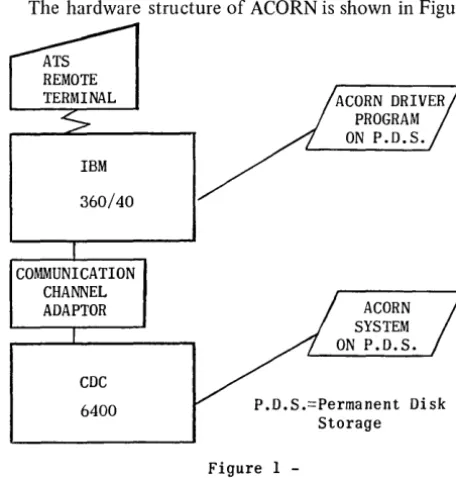
The hardware structure of ACORN is shown in Figure 1.
IBM
360/40
COMMUNICATION CHANNEL ADAPTOR
CDC 6400
ACORN DRIVER PROGRAM ON P.D.S.
ACORN SYSTEM ON P.D.S.
P.D.S.=Permanent Disk Storage
Figure 1
-Hardware configuration for ACORN System
The structured catalog of stored informatIOn is created in the following manner: First, the surgeon describes the sequence of events which occurred during the operation just completed into an ordinary recording device, speaking as he ordinarily would and with no external restrictions imposed on him at all. Next, a stenographer transcribes this natural-language document on to a magnetic disk file via the IBM 2741 communications terminal and the A.T.S. (Administrative Terminal System). A.T.S. is a software system on the IBM 360/40 for storing documents via a
[image:11.618.326.554.408.647.2]typewriter terminal; it provides sophisticated editing capa-bilities for the user. Documents can be saved, deleted, and corrected with a minimum of effort.
The driver program for the entire ACORN system is stored on an A.T.S. permanent file, and the surgical report just entered becomes the data for the ACORN programs. The system is activated from the terminal by submitting the job (consisting of the driver program and the surgical report as its data) to the Control Data Corp. CDC 6400 computer via SUNY AB's TJE (Terminal Job Entry) system. TJE is a software system which permits submission of an A.T.S. permanent file as a job to be run on the CDC 6400 by means of a communications adaptor between the IBM 360/40 and the CDC 6400. This eliminates the need for card input and permits output to be listed back at the user's terminal. This system also allows for ACORN to be activated from any A.T.S. terminal authorized to make use of it.
When the job reaches the top of the 6400 input queue, the ACORN system programs (in binary code) are extracted from the 6400 permanent disk storage unit and ACORN is loaded and executed in 15 fragments known as "overlays". This fragmentation means that the independent modules of ACORN do not reside in core simultaneously but rather successively, enabling the entire process to be carried out within a maximum program size of 55k octal.memory locations. By minimizing the program size in this way, the priority of the job in the CDC 6400's multiuser environ-ment remains high, and tum-around time is excellent. In fact, an average sentence or question requires about 1 second of central processor time. Turn-around time at the terminal for retrieval of information is approximately 3 minutes on the average.
Once execution begins, the first step consists of a "dictionary lookup" (see the first block in Figure 2). In this operation each word in the sentence is looked up in an alphabetic dictionary by a search, in order to determine the part-of-speech and the "seme-number" of each word. The seme-number is a number denoting the meaning of the word; synonyms and related words are given similar seme-numbers.
-1
DICTIONARY SYNTACTIC LOOKUP ANALYSISTRANSFORMATIONSf--_ _ _ ~
Figure 2
-Diagram of ACORN System for Storing Document Information
Sample Sentence·
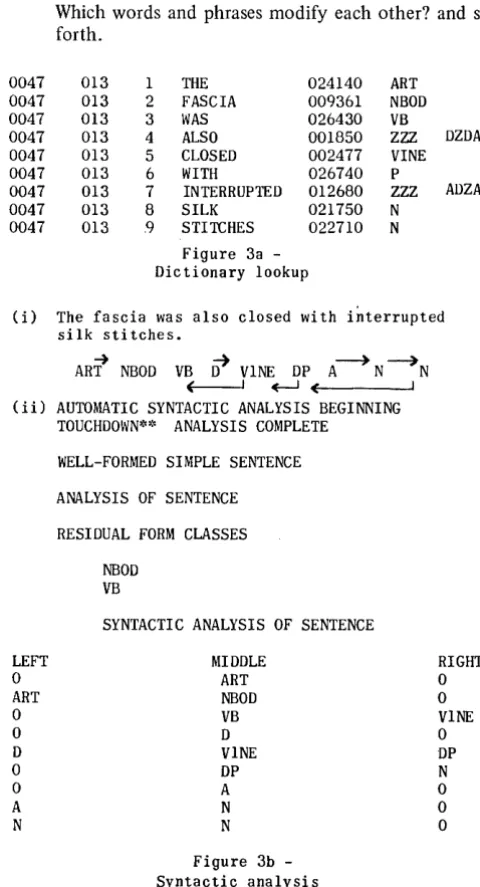
As an example, we will first consider the sample sen-tence "The fascia was also closed with interrupted silk stitches". Figure 3a is a print-out of the dictionary lookup process for this sentence. From left to right on each line,
we see: Report number, sentence number, word number within sentence, word, seme-number, and part-of-speech.
Syntactic Analysis
The next step of the process consists of a syntactic analysis of the sentence using our modified version of Harris's cycling cancellation automaton (References 2 and 3), in order to determine the syntactic relationships be-tween:
0047 0047 0047 0047 0047 0047 0047 0047 0047
What is the subject? What is the main verb?
Which words and phrases modify each other? and so forth.
013 1 013 2 013 3 013 4 013 5 013 6 013 7 013 8 013 .9
THE 024140 FASCIA
WAS ALSO CLOSED WITH INTERRUPTED SILK STITCHES Figure 3a -Dictionary lookup
009361 026430 001850 002477 026740 012680 021750 022710
ART NBOD VB
ZZZ DZDA VINE P
ZZZ AUZA N
N
(i) The fascia was also closed with interrupted silk sti tches.
ARt NBOD VB
?
VINE DPA~N~N
( - - - - J ~ ( I
(ii) AUTOMATIC SYNTACTIC ANALYSIS BEGINNING TOUCHDOWN** ANALYSIS COMPLETE
LEFT 0 ART 0 0
0
0 0 A N
WELL-FORMED SIMPLE SENTENCE
ANALYSIS OF SENTENCE
RESIDUAL FORM CLASSES
NBOD VB
SYNTACTIC ANALYSIS OF SENTENCE
MIDDLE ART NBOD VB
0
VINE DP A N N
Figure 3b -Syntactic analysis
RIGHT 0 0 VINE 0 DP N 0 0 0
This analysis will be used in the next phase of ACORN, in which the actu~l extraction of the information contained in a sentence occurs. A detailed description of the syntactic analysis component can be found in References 4 and 5.
Figure 3b is the output from the syntactic analysis programs for our sample sentence. After completion of analysis, the sentence was judged to be a well-formed simple sentence whose subject is "fascia" (part-of-speech: "NBOD" or "NOUN of BODY") and whose main verb is "was" (part-of-speech: "VB" or "VERB of BEING"). Part (ii) of figure 3b is a vertical representation of the manner in which the words in the sentence connect to each other. It is
[image:12.615.313.553.176.620.2] [image:12.615.56.293.504.670.2]a short-hand notation for the interconnection schematically shown in Part (i).
The analysis therefore conveys the following vital in-formation:
(1) "the" is an article modifying "fascia". (2) "also" is an adverb modifying "closed".
(3) "interrupted" is an adjective modifying "stitches". (4) "silk" is a noun modifying "stitches".
(5) "stitches" is the object of the preposition "with".
(6) The entire prepositional phrase is an adverbial modifier of the verb "closed".
(7) The past participle "closed" connects to the main verb "was".
Semantic Analysis
Now, the final major stage of analysis occurs - the use of the linguistic transformation programs to decompose the sentence into its "kernels" or basic units of meaningful information. Although a given piece of information can be expressed in many ways in natural language, each para-phrase should of course produce the same kernels. A kernel regularly has three parts, F, X, and Y, which will now be explained. For example,"the tumor was removed" and "removal of the tumor" and "the surgeon excised the tumor" are all decomposed by appropriate transformations into the very same kernel:
OP(TUMOR) = REMOVED.
This kernel denotes that the surgeon performed an opera-tive act (OP) on the tumor (TUMOR) - namely, it was removed (REMOVED).
Notice that the format for kernels is the mathematical function notation F(X)
=
Y. This says that a function F of the entity X has a value Y. Y need not be (and often will not be) a single value.0047
0047
0047
0047
0047
EXISTS (FASCIA 7 09361013
DSCRP (STITCHES
7 22710013 912680013
DSCRP (STITCHES
7 22710013 921750013
OP (FASCIA
4 09361013 202477013
MEANS (CLOSED
10 02477013 522710013 Figure 3c -Kernels of information
) =
) =
) =
) =
Let us return now to the sample sentence: 0
INTERRUPTED 7
SILK 8
CLOSED 5
STITCHES 9
The fascia was also closed with interrupted silk stitches. For this sample sentence, the kernels were ex-tracted by the transformations shown in Figure 3c. The first kernel in figure 3c signifies that the body-noun "fascia" was mentioned in this report; so, if a question was later posed asking which reports dealt with "fascia", one of the answers would be "report #47". The next two kernels are triggered by the syntactic information of (3) and (4) above, and signify that the "stitches" can be described as being "interrupted" and "silk". The fourth kernel is gener-ated from the subject and main verb of the sentence and (7) above, and denotes that the surgeon performed the
oper-Table 1
THE NATURE OF FUNCTIONS F
(1) (2)
Value of
Function F Meaning of Function
EXISTS To denote the existence of an object
SIZE
DSCRP
DEGREE
ACT2
ACT3
OP
MEANS
MANNER
WHEN
WHERE
POSSES
QUANT
or condition
To specify physical size
To specify any description of an object or condition
To specify the degree of a description or condition
To denote any action by the patient (person 2) during the operation
To denote any activity by a body organ or tissue (entity 3)
To denote any operation by the surgeon (person 1)
To specify the means by which any action was accomplished
To specify the manner in which an action occurred
To specify the time when an action or event occurred
To specify the location of an object or condition
To specify the possessor of an object or condition
To specify the quantity of objects of a particular type which are present
ative act of closure upon the fascia. Finally, the fifth kernel is generated by (5) and (6) above and specifies the means of closure.
Semantic Functions
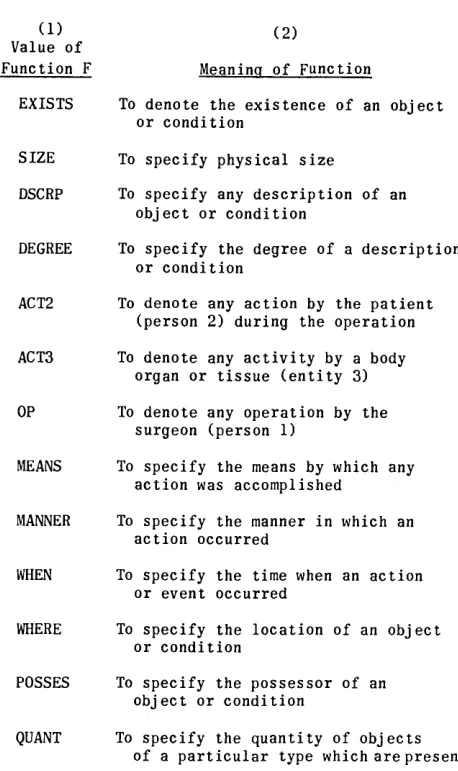
It is worth stopping for a moment and stating the functions being used in this system of information retrieval. At present, we are using a set of approximately 20 different functions in working with the surgical texts at Roswell Park Memorial Institute. In general, however, the nature of the set of functions and kernels will depend upon the particular universe of discourse being analyzed.
In our surgical texts, the most common of the functions that arise are shown in Table 1.
Examples of each of these functions, with sample sen-tences of text from which they might be generated, are shown in Table 2. It should be noted that the kernel of information that Roswell uses evolved quite naturally from the punch-card format of standard data-manipulation pro-cedures.
[image:13.613.326.555.75.461.2](1)
Exam-ple No.
l
Table 2
EXAMPLES OF KERNELS F(X)
=
Y(2)
Sample Sentence
of Text
An 8 x 10 cm. mass was discovered
(3)
Expression in Kernels
EXISTS(MASS)
SIZE(MASS)
=
8 X 10 CM. 2 The mass was slightly DSCRP(MASS)3
4
6
irregular = IRREGULAR
The patient toler-ated the proce-dure .well
There were four lesions present
The tumor extended into the colon
The tissue was ap-proximated with sutures
DEGREE(IRREGULAR)
= SLIGHTLY
ACT2(PATIENT)
=
TOLER-ATED PROCEDUREMANNER(TOLERATED)
=
WELLEXISTS(LESIONS)
QUANT(LESIONS)
=
FOURACT3(TUMOR)
= EXTENDED INTO COLON
OP(TISSUE)
=
APPROXIMATEDMEANS(APPROXIMATED)
= SUTURES
7 Dressing was applied WHEN(APPLIED)
=
AFTER after approximation APPROXIMATION8 Lesions were present WHERE(LESIONS) in the stomach = IN STOMACH
9 The patient's con- POSSES(CONDITION) dition was good
=
PATIENT'Sthe "tumor" card might be equivalent to WHERE-(TUMOR)
=
STOMACH.However, there is one very significant advantage of the kernel format of storage over the traditional format of punch cards. Suppose a situation arises like the following:
Prior to operation 3243, no tumors had ever been discovered in the liver, but in operation 3243 a tumor was found in this location.
Here a novel situation has arisen; chances are that no code number for "liver" exists for column 10; and a code-clerk would be stymied. ACORN, however, is not stymied; it simply generates "where" functions automatically from certain syntactic patterns in the text, and so it would respond with a kernel WHERE(TUMOR) = LIVER, with LIVER as the Y-value instead of STOMACH. ACORN should do this of course for any possible English paraphrase such as "A tumor was found in the liver". It is for this reason that much of the future work on ACORN will be devoted to improving the syntactic analysis and transforma-tion components so as to handle a wider range of para-phrase constructions.
Once the kernels of information have been extracted from a large group of reports, they are stored on a permanent random-access disk file. The method of storage of the "F(X)
=
Y" kernels is to sort them first numerically by the seme-number of X. Then, each group of kernels with the same X value are sorted according to F value. Finally,0046 005 1 THE 024140 ART 0046 005 2 MARGINS 007984 NPAR 0046 005 3 OF 016350 POF 0046 005 4 THE 024140 ART 0046 005 5 DEFECT 001213 N 0046 005 6 WERE 026434 VB
0046 005 7 APPROXIMATED 002470 VINE 0046 005 8 WITH 026740 P 0046 005 9 SILK 021750 N 0046 005 10 AND 001980 C 0046 005 11 THE 024140 ART 0046 005 12 PATIENT 017450 N 0046 005 13 WAS 026430 VB
0046 005 14 RETURNED 020330 ZZZ VOINE 0046 005 15 TO 024690 ZZZ TOZP 0046 005 16 HIS 017452 NSPP 0046 005 17 DIVISION 021330 N
0046 005 18 IN 012542 ZZZ DZPIN 0046 005 19 SATISFACTORY 001445 A
0046 005 20 CONDITION 005430 N
Figure 4a -Dictionary lookup
AUTOMATIC SYNTACTIC ANALYSIS BEGINNING
TOUCHDOWN*~' ANALYSIS COMPLETE
A CONJUNCTION BRANCH IS BEING ATTEMPTED WELL-FORMED COMPOUND SENTENCE
ANALYSIS OF SENTENCE
RESIDUAL FORM CLASSES
NPAR VB C N VB
SYNTACTIC ANALYSIS OF SENTENCE
LEFT MIDDLE RIGHT
0 ART 0
ART NPAR POF
0 POF N
0 ART 0
ART N 0
0 VB VINE
0 VINE DP
0 DP N
0 N 0
0 C 0
0 ART 0
ART N 0
0 VB VINE
0 VINE DP DP
0 DP N
0 NSPP 0
NSPP N P
0 P N
0 A 0
A N 0
Figure 4b -Syntactic analysis
each of these groups is sorted numerically by the seme-number of Y. The result is a structured catalog of kernels of information.
Another Sample Sentence
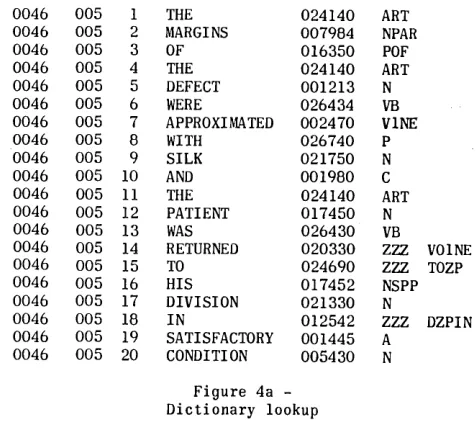
The complete analysis of a more complex sentence is reproduced in Figure 4a. The steps in the process are identical to those above.
[image:14.613.311.549.46.259.2] [image:14.613.304.556.47.662.2] [image:14.613.54.284.74.465.2]For this second sample sentence, the kernels (see Figure 4c) convey the following information:
(1) "Margins", "detect", "silk", and the "patient" were mentioned in this report.
(2) The "division" involved was that of the patient (a male).
(3) The patient's "condition" was described as "satis-factory".
(4) A descriptive restriction ("DREST" function) on any mention of the "defect" in any of the kernels is that only the "margins" of the "de-fect" are involved.
(5) The next kernel says that location of the "divi-sion" is the "condition" and is a "garbage ker-nel" of pseudo-information generated by the syntactic ambiguity of the phrase "in satisfactory condition" which could modify either "division" or "returned". Experience has shown that storage of these garbage kernels (of which there are very few, running under 5%) is harmless since they are rarely retrieved.
EXISTS (MARGINS
0046 7 07984005 2 0 0
EXISTS (DEFECT
0046 7 01213005 5 0 0
EXISTS (SILK
0046 7 21750005 9 0 0
EXISTS (PATIENT
0046 7 1745000512 0 0
POSSES (DIVISION
) =
HIS0046 13 21330005171745200516 0 0
DSCRP (CONDITION
) =
SATISFACTORY 0046 7 05430005200144500519 0 0DREST (DEFECT
) =
MARGINS0046 20 01213005 507984005 2 0 0
WHERE (DIVISION ) ~ IN CONDITION 0046 12 213300051712542005180543000520 0
OP (DEFECT
) =
APPROXIMATED 0046 4 01213005 502470005 7 0 0MEANS (APPROXIMATED
) =
SILK0046 10 02470005 721750005 9 0 0
OP (PATIENT
) =
RETURNED0046 4 17450005122033000514 0 0
WHERE (RETURNED ) = TO DIVISION 0046 12 203300051424690005152133000517 0
MANNER (RETURNED )
=
IN CONDITION 0046 9 203300051412542005180543000520 0Figure 4c -Kernels of Information
(6) The operative act of "approximation" was per-formed on the "defect".
(7) The means of "approximation" was "silk". (8) The "patient" was "returned" by a member of
the surgical staff.
(9) The place he was returned to was the "division". (10) The manner he was returned was in a
"condi-tion" previously described as "satisfactory".
COMPUTERS and AUTOMATION for February, 1971
3 101 3 101 3 101 3 101 3 101 3 101 3 101 3 101 3 101
10001 THROUGH 024352 10002 WHAT 026550 10003 KIND 025351 10004 OF 016350 10005 INCISION 012002 10006 WAS 026430 10007 THE 024140 10008 ABDOMEN 001150 10009 ENTERED 016471
Figure Sa
-Dictionary lookup of question
DECLARATIVE FORM OF QUESTION 10007 THE
10008 ABDOMEN 10006 WAS 10009 ENTERED 10001 THROUGH
o
ADJ10005 INCISION
Figure 5b
-024140 001150 026430 016471 024352 032767 012002
Conversion of interrogative to declarative
Synonyms
P NPRO N POF
N
VB ART N VINE
ART
N VB
VINE
P A
N
It is worth mentioning at this point that the problem of synonymy is handled in a very simple fashion by ACORN. Words which are synonymous with one another have seme-numbers which differ only in their final digit. For example, in the first sample sentence above "closed" is listed with seme-number 02477 and in the second sentence "approximated" is listed with seme-number 02470; later, when a question is asked, the retrieval programs are de-signed to ignore this final digit when searching through the kernel catalog of stored information.
Questions
Once a kernel catalog has been permanently created by the process discussed above, it becomes a relatively simple matter to interrogate it. A user wishing to ask a question submits it as a job" for the CDC 6400' from the same typewriter terminal previously described. He uses the same driver program that is used to submit surgical documents, but specifies that the input is in the interrogative mode.
ACORN then analyzes the question in a manner almost completely analogous to the analysis of a document. First, its dictionary-lookup program produces the same output as
it would for a sentence in a post-operative report. As an example, Figure 5a shows the dictionary-lookup output for the question "Through what kind of incision 'Yas the abdomen entered?"
At this point, a special program used in the analysis of questions but not documents is loaded into core. Its function is simply to convert the question into a declarative form amenable to analysis by the remaining ACORN analysis programs already described. Frequently this special program must generate a "dummy" word to represent the unknown element in the question. For example, the phrase "what kind of" in the sample question generates the dummy adjective word "adj" appearing in Figure 5b.
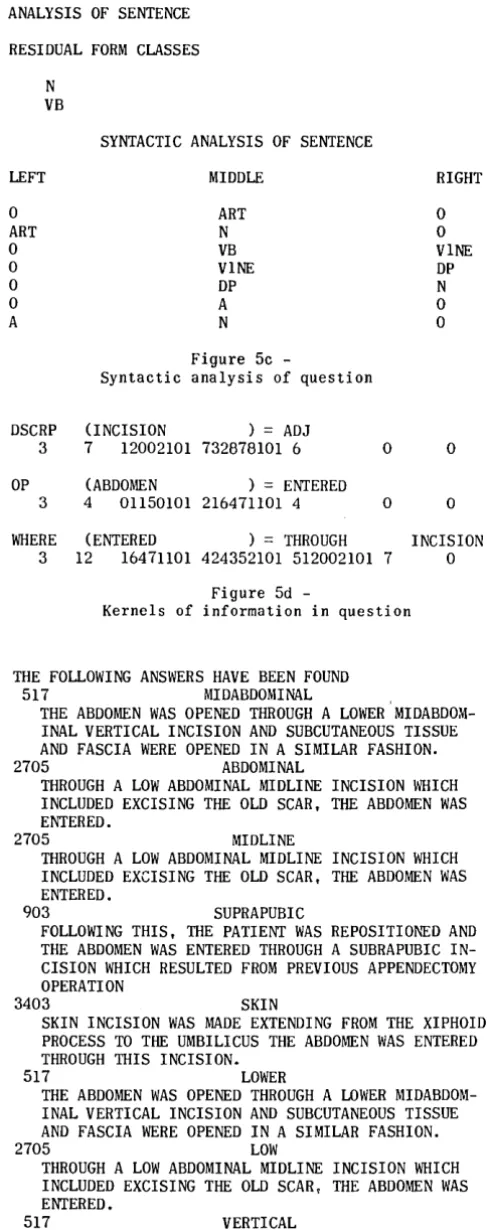
From this point through the generation of the' kernels, analysis proceeds just as it would for a sentence from a post-operative report. Figures 5c and 5d show the' syntactic analysis and kernel extraction respectively for the sample question.
[image:15.615.318.558.42.251.2] [image:15.615.58.292.290.660.2]