warwick.ac.uk/lib-publications
Original citation:
Shreejith, Shanker, Mathew, Libin K., Vinod, A. P. and Fahmy, Suhaib A. (2018) Efficient
spectrum sensing for aeronautical LDACS using low-power correlators. IEEE Transactions on
Very Large Scale Integration (VLSI) Systems, 26 (6). doi:
10.1109/TVLSI.2018.2806624
Permanent WRAP URL:
http://wrap.warwick.ac.uk/99474
Copyright and reuse:
The Warwick Research Archive Portal (WRAP) makes this work by researchers of the
University of Warwick available open access under the following conditions. Copyright ©
and all moral rights to the version of the paper presented here belong to the individual
author(s) and/or other copyright owners. To the extent reasonable and practicable the
material made available in WRAP has been checked for eligibility before being made
available.
Copies of full items can be used for personal research or study, educational, or not-for-profit
purposes without prior permission or charge. Provided that the authors, title and full
bibliographic details are credited, a hyperlink and/or URL is given for the original metadata
page and the content is not changed in any way.
Publisher’s statement:
“© 2018 IEEE. Personal use of this material is permitted. Permission from IEEE must be
obtained for all other uses, in any current or future media, including reprinting /republishing
this material for advertising or promotional purposes, creating new collective works, for
resale or redistribution to servers or lists, or reuse of any copyrighted component of this
work in other works.”
A note on versions:
The version presented here may differ from the published version or, version of record, if
you wish to cite this item you are advised to consult the publisher’s version. Please see the
‘permanent WRAP URL’ above for details on accessing the published version and note that
access may require a subscription.
Efficient Spectrum Sensing for Aeronautical
LDACS Using Low-Power Correlators
Shanker ShreejithMember, IEEE, Libin K. Mathew Student Member, IEEE, A. P. Vinod Senior Member, IEEE and Suhaib A. Fahmy Senior Member, IEEE
Abstract—Air traffic has seen tremendous growth over the last decade pushing the need for enhanced air traffic management schemes. L-band Digital Aeronautical Communication System (LDACS) is gaining traction as a scheme of choice, and aims to exploit the capabilities of modern digital communication techniques and computing architectures. Cognitive radio based approaches have also been proposed for LDACS to improve spectrum efficiency and communication capacity; however, these require intelligent compute capability in aircrafts that enforce limited space and power budgets. This paper proposes the use of multiplierless correlation to enable spectrum sensing in LDACS air-to-ground links, and its integration into the on-board LDACS system. The proposed architecture offers improved performance over traditional energy detection even at low signal to noise ratio (SNR) with lower energy consumption than a multiplier-based correlator, while also assisting in receiver synchronisation. We evaluate the proposed architecture on a Xilinx Zynq FPGA and show that our approach results in 28.3% reduction in energy consumption over the multiplier-based approach. Our results also show that the proposed architecture offers 100% accuracy in detection even at -12 dB SNR without requiring additional circuitry for noise estimation, which are an integral part of energy detection based approaches.
I. INTRODUCTION
The sustained growth of air traffic over the past decade is pushing the limits of global air traffic management (ATM) systems, and it is expected that current systems will reach peak capacity by 2020. To address this challenge, the International Civil Aviation Organisation (ICAO) has recommended the Fu-ture Communications InfrastrucFu-ture that will integrate optimal datalink protocols for enhancing air-to-air, air-to-ground, and satellite-based links. For air-to-ground links, L-band Digital Aeronautical Communications System (LDACS) is gaining traction as the preferred system for final deployment [1], [2]. LDACS is proposed as an inlay approach with legacy L-band systems like Distance Measuring Equipment, and hence has stringent requirements on transmission and reception [2]. LDACS uses modern digital modulation schemes like Orthog-onal Frequency Division Multiplexing (OFDM) for improved performance and spectral efficiency over the traditional analog techniques employed by current systems.
S. Shreejith, S. A. Fahmy are with the School of Engineering, University of Warwick, United Kingdom.
L. K. Mathew is with the School of Computer Science and Engineering, Nanyang Technological University, Singapore.
A. P. Vinod is with the Indian Institute of Technology (IIT), Palakkad, India.
e-mail: {s.shanker, s.fahmy}@warwick.ac.uk, [email protected], [email protected]
The introduction of digital processing blocks can also enable intelligent and on-demand spectrum allocation in LDACS, further enhancing its appeal in aeronautical systems [3]. Use of cognitive radio (CR) based dynamic spectrum access has been proposed for LDACS, which would enable opportunistic and on-demand access to the L-band channel(s) while meeting the reliability and safety requirements imposed by the stan-dard [4]–[6]. This allows an aircraft to identify vacant spectral bands in the air-to-ground spectrum and choose a suitable channel to initiate an LDACS air-to-ground transmission. However, introducing dynamic spectrum access for LDACS presents unique challenges over terrestrial CR systems; aircraft in the range of the system are in constant motion resulting in an evolving network structure, while the channel conditions between communicating entities can change very rapidly, requiring more effective sensing compared to terrestrial CR systems. Furthermore, while ground-based systems can em-ploy powerful computational systems to support the processing demands, implementations for aircraft must be compact and power efficient to satisfy weight, space, and power budgets.
In this paper, we present an approach for spectrum sensing using low power correlators that also serve as the receiver synchroniser for the OFDM baseband. The multiplierless correlator architecture presented for IEEE 802.16d in [7] is enhanced to cater to the longer preamble structure of LDACS air-to-ground transmissions. Further, we enhance the computational precision to improving performance in very low signal-to-noise ratio (SNR) conditions, which are likely in the LDACS scenario due to diverse channel conditions, limited transmission power, and the mobile nature of the aircraft. We show that the proposed approach outperforms traditional energy detection (ED) as well as feature detection (FD) based spectrum sensing schemes even when the ED technique in-corporates highly accurate noise prediction. The multiplierless approach also results in improved power consumption, making it an ideal choice for on-board implementation. The proposed correlator is implemented on a Xilinx Zynq FPGA to evaluate the performance in hardware.
and FD techniques for LDACS under multiple signal quality conditions. Finally, we conclude the paper in Section VI.
II. RELATEDWORKS
A. Spectrum Sensing
CR based communication systems aim to make use of vacant areas of allocated spectrum by providing mechanisms to dynamically access these spectrum holes. By allowing devices to opportunistically time-share slices of spectrum, CR improves available communication bandwidth and spectral efficiency. A key requirement of a CR system is the ability to efficiently detect spectral holes. The literature describes several techniques to detect spectrum holes with varying efficiency (in terms of probability of detection and false alarm) and computational complexity. These include simple techniques like energy detection (ED) [8], as well as computationally intensive methods like matched filter detection [9], cyclosta-tionary feature detection [10], and eigenvalue detection [11], among others. ED has generally been the most popular and widely deployed scheme due to its incoherent nature and low computational complexity. However, the accuracy of ED based spectrum sensing is significantly affected by the accuracy of noise variance estimation. ED based techniques are also unable to distinguish between licensed and malicious users, while also suffering from a lower SNR threshold for accurate detection [12]. In [5], the authors enhance traditional ED using an energy-difference based detection algorithm within the context of LDACS communication, however it is still vulnerable to errors in noise estimation.
Eigenvalue detection [11] is also an incoherent detection technique in which the maximum to minimum ratio of eigen-values of the covariance matrix of the received signal is com-pared with a threshold to determine the presence/absence of communication in the current channel. Eigenvalue detection, however, requires computation of a covariance matrix and eigenvalue decomposition of the received signal, which are computationally complex tasks. Furthermore, the threshold selection for eigenvalue detection is a challenging problem, limiting the application of this approach in low power systems. Coherent detection techniques such as cyclostationary fea-ture detection [10] and matched filter detection, have the ability to differentiate noise (or unlicensed user transmissions) from licensed user communication. Cyclostationary feature detection exploits the cyclostationary properties of received signals to detect the presence/absence of communication in a given channel. However, decomposition of the cyclosta-tionary features is also computationally intensive, and the technique requires relatively long observation times for high detection accuracy. Matched-filters also rely on knowledge of the transmitted signal properties such as frame structure, pilot symbol structure, and sampling frequency to provide optimal detection. As with cyclostationary feature detection, matched filter sensing is also computationally intensive as the received signals must be demodulated prior to applying the matched filtering process.
B. Multiplierless Correlators in OFDM Systems
OFDM is a widely used modulation technique in high throughput wireless systems that offers resilience to multi-path fading and methods to allocate communication spectrum in a flexible manner. This makes OFDM a key scheme in CR systems by supporting techniques like spectrum pooling, which allows temporary access of licensed (idle) spectrum to unlicensed users, thus natively enabling dynamic spectrum access [13]. A key challenge in efficient OFDM systems is receiver synchronisation, since minor errors can lead to inter-carrier or inter-symbol interference [14].
Various approaches have been proposed in the literature to achieve accurate synchronisation. They either rely on auto-correlation based techniques [15]–[17], which offers a low complexity implementation and performance that severely de-grades at low signal power (low SNR), or on cross-correlation based techniques [18], which offer better performance at low SNR rates with very high implementation complexity or a combination of the two as cascaded stages [19], [20] that offers the best of both worlds. Though efficient implementations of cross-correlators were proposed [21], these are still over 5⇥ more complex than efficient implementation of classic auto-correlators. Multiplierless correlators address this challenge by replacing the multiplication operation with shift-add blocks and representing the known preamble as a sum of powers-of-2 [7], [22]. It has been shown that they can maintain the same synchronization accuracy as multiplier-based correlators, while consuming significantly fewer resources [7].
In this work, we improve the multiplierless correlator approach described in [7] and employ these correlators to perform spectrum sensing in the LDACS air-to-ground band. The correlator is enhanced to cater for the very low SNR conditions that may be encountered in aeronautical systems and also to support the larger preamble of LDACS com-munication. The proposed correlator can also synchronise the OFDM receiver in the LDACS ground-to-air link, thus reducing overall resource consumption. The structure mimics a matched filter detector using a-prioi knowledge of the LDACS air-to-ground and ground-to-air frame structures for receiver synchronisation and spectrum sensing in time domain.
C. FPGAs as Radio Platforms
evaluate the performance in actual hardware in addition to software simulations.
III. LDACS AIR-TO-GROUND COMMUNICATION
LDACS is a cellular communication system involving a network of Ground Stations (GS) and Airborne Stations (AS). As mentioned, LDACS uses OFDM as the modulation scheme with FFT length 64 and a total bandwidth of 0.5 MHz for each channel. It uses 50 sub-carriers for transmission with a spacing of 9.8 KHz. These are further separated into two banks of 25 subcarriers each, which are used for ground-to-air and air-to-ground communication. LDACS defines these links as the Forward Link (FL) and Reverse Link (RL) respectively. In this work, we explore the case for opportunistic spectrum access by aircraft in the RL segment. This allows aircraft to sense spectrum usage in the RL band, determine the optimal segment, and request permission to use this spectrum from the ground station. The ground station has a global view of spectrum usage and can allow a requested channel to be used if there are no potential conflicts. Dynamic spectrum access in this manner enables more efficient use of the limited RL spectrum, especially in congested airspaces.
The RL transmission in LDACS is based on OFDM-TDMA bursts that adapt to the demands of multiple users. The transmitter design mimics a typical OFDM transmitter design, with support for adaptive coding and modulation schemes to cater to environments with strong interference, support high-priority messages, and maintain reception quality. The Inverse Fast Fourier Transform (IFFT) operation distributes the modulated data into different sub-carriers.
The receiver block also resembles a typical OFDM receiver with enhancements to eliminate interference with adjacent distance measuring equipment (DME) channels (blanking non-linearity block). The synchronization logic determines the starting point of a multi-frame, the Fast Fourier Transform (FFT) block demodulates the signal followed by equalization, demodulation and decoding to extract the received informa-tion.
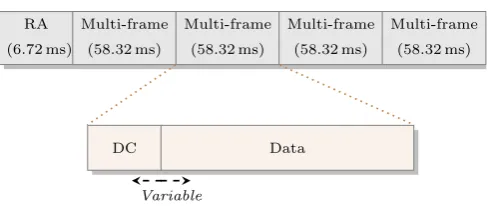
A hierarchical arrangement of the communication in the RL is shown in Fig. 1. Communication is organised into a cyclic structure of super frames, each having a duration of 240 ms. Each super frame has one random access slot, used by the aircraft to request cell entry, and 4 frames. Each multi-frame is composed of a variable-sized Dedicated Control (DC) segment and a data segment. Our aim is to enable dynamic access in the multi-frame segment, which would otherwise be manually allocated to different aircraft by the respective ground station.
The detailed frame structure of an RL DC segment with 4 tiles is shown in Fig. 2. The format follows a tiled structure, each tile corresponding to 720 µs, organised as 6 rows (time domain) and 25 columns (frequency domain). In time-domain, each row also has a cyclic prefix (CP) that marks the start of each row (not shown in Fig. 2). The first tile is called the synchronization tile that contains a fixed structure of AGC preamble, two synchronization symbols, and two pilot symbols, followed by a repetition of the AGC preamble, which
RA
(6.72 ms)
Multi-frame
(58.32 ms)
Multi-frame
(58.32 ms)
Multi-frame
(58.32 ms)
Multi-frame
(58.32 ms) RL Frame
DC Data
[image:4.595.304.549.103.206.2]Variable
Fig. 1: Framing structure of LDACS RL communication.
aids in synchronising the LDACS receive chain at the ground station. Since the synchronization tile must be present in each RL segment, detecting its presence or absence at fixed time intervals can confirm whether the segment is currently in use or not. The remaining tiles are filled with information transmitted to the ground segment, with pilot symbols inserted at regular intervals.
The FL frame also uses a similar structure for the synchro-nization tile, but only uses the synchrosynchro-nization symbols instead of a full tile. While receiving a frame from the ground station, the aircraft must detect the synchronization symbol to detect the start of frame, and to adapt the sample timing window to reduce inter-symbol interference at the aircraft receiver. Since transmission and reception occurs at distinct time intervals, the same synchronizer block within the aircraft receiver can be used to sense the presence of communication in the RL DC segment (when the aircraft wants to transmit), and to perform accurate reception (when the aircraft receives information from the ground station).
The time duration of each OFDM symbol in LDACS is 120 µs; this, when combined with the FFT length of 64, results in 375 samples (time domain) of synchronisation information in a multi-frame (excluding the repetitive AGC preamble, and including the 11 sample CP for each row). The synchronisation elements are known (or can be calculated) a priori, allowing the use of cross-correlation for synchronisation and spectrum sensing. The complex cross-correlator structure could be built efficiently in hardware which can perform the computation at line rate to ensure on-the-fly detection. For our experimental setup, we use the minimum allowed RL DC size of two tiles (including the synchronisation tile) followed by eight data tiles as the multi-frame data, with a total frame size of 4950 samples in the time domain (including the CP for each row).
IV. MULTIPLIERLESSCORRELATOR FORSPECTRUM
SENSING INLDACS A. Architecture of Multiplierless Correlator
Null symbol Pilot symbol
PAPR symbol Data symbol
AGC symbol Sync symbol Sync tile for sensing
t i m
[image:5.595.316.535.83.237.2]e
Fig. 2: Organisation of RL DC Segment, reproduced from [2].
z-1
I/Qin
Cout
shift_add
RL/FL +
Sync0
Sync1
Sync299
Sync375
+ + +
Sync75
RL/FL RL/FL RL/FL
register
Fig. 3: Architecture of the multiplierless correlator.
of fine-grained elements (registers/LUTs) and at the same time, increasing the overall performance of the system (clock speeds). For resource constrained implementation, the same DSP block could be reused over two computations to reduce the utilisation by half; however, this would result in an increase of latency by 4⇥ at each node, while still consuming higher power. Multi-pumping could also be used to time-multiplex the DSP blocks [28], but this would require a higher clock rate, consuming more power. Multiplierless correlation reduces this complexity by replacing the multiplier(s) with a series of shift-adds, requiring fewer computational resources, at a cost of reduced accuracy.
The high-level architecture of the multiplierless correlator is shown in Fig. 3, which extends the correlator used in [7] for the IEEE 802.16d standard. The structure mimics a transpose-direct form filter where the multiplication operation at each tap is replaced by a multiplexer, that selects one among its many inputs based on the synchronisation symbol value at that tap (Sync[n]). Like in [7], our architecture uses a single shared shift-add block to optimise resource consumption; however, our design supports higher quantization levels to improve performance under very low SNR conditions. This shared shift-add block receives the I and Q components from the RF front-end and computes all possible multiples of the input sample corresponding to the 375 synchronisation samples. While the design in [7] uses a 64 sample preamble structure, the long synchronisation tile in LDACS creates a long critical path through the multiplexers. To mitigate this, we introduce a pipeline stage at the output of the tap multiplexers to increase the operating frequency of the design. Finally, to re-use the
-12 -14 -16 -18 -20
0 25 50 75
Signal to Noise Ratio (dB)
F
ai
lu
re
rat
e
(%)
[image:5.595.47.293.95.221.2]4-bit 6-bit 7-bit 8-bit 16-bit
Fig. 4: Variation of detection accuracy with quantisation levels of mulitplierless correlator for LDACS-1 frame.
RF Rxr & A-to-D
LDACS+DME
Channelizer LDACS frame
Proposed correlator Sync.
Sync detect FFT
LDACS tiles Equalisation, Demod.
& Decoding Data
From RF
D-to-A & RF Txr
Spectal mask LDACS shaped
CP insertion
IFFT Signal
mapping Encoding
Data
Cognitive logic
Frame detect Spectrum Sensing
[image:5.595.49.290.258.372.2]To RF
Fig. 5: Integrating the multiplierless correlator into the LDACS processing chain.
correlator for synchronisation of the FL frames (unique to our application), which rely on the synchronisation symbols alone instead of a full tile, the input multiplexers of taps 1–75 have an additional select line, which can bypass theshift-add inputs for ‘0’. In this case, the output of tap 225 is used for synchronisation purposes.
To optimise the quantisation level for the design, we simu-lated the multiplierless correlator in MATLAB using different quantisation levels and observed that there is no appreciable gain beyond 6-bit quantisation (2-5), as shown in Fig. 4. Hence
during implementation, the quantised values of the synchroni-sation tile (Sync[n]) were hard-coded with 6-bit quantization and I and Q sample wordlength of 16 bits. This allows the tools to optimize most of the multiplexers (except 1–75) into fixed logic during the implementation process, reducing the resource consumption further. The multiplexers corresponding to taps 1–75 were optimized to 2-to-1 multiplexers, also lowering resource consumption. Though this results in an inflexible design, the contents of the synchronisation tile are fixed in LDACS, allowing them to be computed off-line and loaded into the system at design time.
[image:5.595.308.542.283.423.2]inte-Zynq PL
ZyCAP
Rx Bu↵er
Tx Bu↵er
Tx Baseband Rx Baseband Mless-corr
DMAs
RF
Inter
fac
e
Zynq PS ARM
Obs Act
Switch DDR Memory
Flash Memory
Channelizer Channel Filter
Sense/Sync Config
[image:6.595.53.291.90.316.2]Reconfig.
Fig. 6: Integrating multiplierless correlator into the radio platform on Zynq.
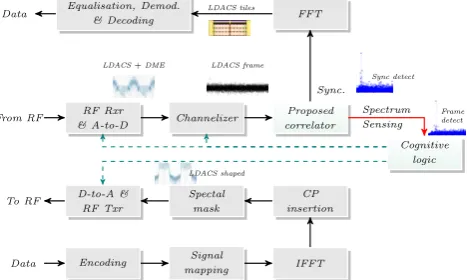
grated into the datapath. In the receive direction, the digitised signals are passed through a programmable channeliser that can extract and isolate the LDACS channels from the adjacent DME pulses. The binary data from the selected channel is fed to the correlator (part of receiver synchroniser), which attempts to estimate the symbol timing offset by detecting the start of a ground-to-air frame (signal cross correlation approach). The remainder of the receive channel baseband mimics a typical OFDM receiver – the FFT module transforms the received frame to the frequency domain, which is then equalised, demodulated and decoded to obtain the actual transmitted information. The LDACS standard also suggests the use of time- and frequency-domain interference mitigation techniques and adaptive equalisation to ensure robust and reliable reception.
When the station needs to transmit information, the spec-trum sensing chain is activated and the cognitive logic config-ures the channeliser to scan the LDACS RL bandwidth. In this configuration, the correlator tries to detect the presence of a synchronisation tile in the data received from the channeliser output, and the information is relayed to the cognitive logic. Once a suitable channel is detected, the transmit chain is activated and the cognitive logic configures the RF modules to use the selected channel for transmission. The baseband modules map the information using QPSK modulation, applies the IFFT, and inserts the cyclic prefix to form the LDACS frame. The spectral masking filter transforms the signal to maintain the stringent LDACS specification, before feeding it to the Digital to Analog conversion and RF modules.
C. Integration into LDACS Radio Platform
The simplified diagram in Fig. 6 shows the architecture of our radio platform for LDACS [6] on a Xilinx Zynq device. The Zynq architecture integrates a dual core ARM processor
and a programmable fabric on the same chip, enabling tight coupling between software and hardware processing blocks. The baseband functionality (LDACS channelizers and filters) and interfaces to the antenna are implemented in the pro-grammable logic (PL) region of the Zynq with dedicated interfaces to interact with the cognitive software tasks run-ning on the ARM core. Dedicated direct memory access (DMA) controllers offer high speed data movement between the baseband modules and software (or external interfaces). The platform offers high speed dynamic adaptability through parametric reconfiguration (for tuning parameters) and high-speed partial reconfiguration, which can be initiated through simple software APIs. An Analog Devices AD-FMCOMMS4-EBZ board (based on the AD9364) connects to the antenna interface to complete the RF front-end (see [6] for more details on our LDACS radio platform).
The LDACS standard allows transmission of air-to-ground information over 23 channels and places stringent require-ments on the pulse shape of the transmitted signal. This results in the use of complex filters for channelization during recep-tion and pulse shaping during transmission. We implement this non-concurrent functionality using partial reconfiguration to reduce the area overheads and power consumption; the channelization module is loaded on the fly during spectrum sensing, while the channel filter module is loaded during actual transmission. The PR approach optimises resource utilisation, leaving behind enough resources to implement other complex baseband modules, like the correlator in this case.
As shown in Fig. 6, the correlator module (marked as Mless-corr) interfaces with the output of the partially reconfigurable region (PRR) that holds either the channelizer or the channel filter (depending on the operating mode). We have replaced the filter-bank based spectrum sensing scheme in [6] with an optimal channelizer for LDACS and the channel filter with the work proposed in [29] to reduce multiplication complexity. During a sensing operation, the channelizer output is also read by the correlator module which then determines if there is an LDACS air-to-ground frame transmitted in the chan-nel. Four such channels are available simultaneously through the channelizer, and are sequentially fed into the correlator module under software control. The result of sensing is read by the cognitive software to determine the best channel for transmission. During a normal receive operation, the software configures a register bit in the correlator module allowing it to be reused as a receiver synchroniser for the OFDM de-modulator stage. The parametric configuration changes as well as the mode switch through reconfiguration are all performed using simple function calls from the cognitive software, such
asset_basesband(spectrum_sense). Our framework
handles all the low-level steps need to manage the change in parameters or physical reconfiguration operation in response to these function calls.
V. RESULTS
A. Implementation Results
correlator on a Zynq XC7Z045 device as a standalone module.
Sub-module FFs LUTs Slices DSPs
shift add 242 180 67 0
[image:7.595.322.528.121.220.2]tap mux 0 5,961 1,766 0 add–delay chain 23,726 23,754 5,957 0 Total Utilisation (%) 24,000 29,895 7,806 0 % Utilisation 5.5 13.7 14.2 0 Frequency 195 MHz
TABLE II: Resource comparison of proposed correlator on the Zynq XC7Z045 and the multiplier-based correlator on the Zynq XC7Z100 device.
Design FFs LUTs Slices DSPs % Util. FMax
Multiplierless 24,000 29,895 7,806 0 13.67 (LUTs) 195 Multiplier-based 11,968 6,112 1,528 1,500 74.25 (DSP) 406
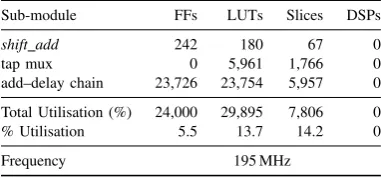
correlator in isolation on a Xilinx Zynq XC7Z045 FPGA. The detailed resource consumption of the sub-modules of the mul-tiplierless correlator is shown in Table I. The design achieves an operating frequency of 190 MHz on the moderate-grade fabric of the XC7Z045, and the complete design consumes only 14% of the resources on the Zynq design allowing the rest of the baseband modules to be integrated on the same device.
For comparison, we also implemented an optimised multiplier-based correlator design (in isolation, transpose di-rect form), which could only fit on the larger XC7Z100 device (same architecture, but offers more resources) due to the large number of DSP blocks required. The optimised structure maps the delay elements using the internal pipeline registers within the DSP block to maximize performance with minimal fine-grained resource usage. The results of the different imple-mentations are shown in Table II. The multiplier-based design consumes nearly 2% of LUTs and Flip-flops (FFs) and 76% of the DSP blocks available on the larger XC7Z100 device. The lower resource utilisation of the multiplierless approach enables a more compact implementation (and a smaller device with less static power consumption), making our architecture better suited for on-board systems, while also leaving sufficient resources available for the rest of the baseband functions. The pipelined structure ensures that both designs offer similar com-pute throughput (one output per clock cycle) and latency (376 cycles); however, the higher operating frequency achievable using multiplier-based correlators make them suited for use in LDACS ground stations for managing/monitoring spectrum allocation across all aircraft.
We also evaluate the power consumption of the design using the XPower Analyser tool from Xilinx. A post place-and-route simulation dump was used to generate the activity rates with actual LDACS frame data as the input to the correlator in each clock cycle. The simulation was performed at the design clock frequency of 125 MHz. The tool computed
after integrating the proposed correlator.
Sub-module FFs LUTs BRAMs(36/18) DSPs Channel Filter 1,336 1,397 0/0 23 Channelizer 1,581 2,161 4/0 46 Mless-corr 24,000 29,895 0 0 RF I/F 22,781 21,970 6/4 77 Reconfig 697 767 1/1 0 Total Utilisation 49,913 55,594 11/5 123 % Utilisation 11.4 25.4 2.57 13.67
the total power consumption of the multiplierless correlator as 1,160 mW, with 1,038 mW contributed by the correlator operation (dynamic power) on the XC7Z045 device. The power analysis of the multiplier-based correlator at the same operating frequency resulted in an estimated consumption of 3,166 mW of dynamic power (contributed by the correlator in operation). The proposed design thus achieves a 3⇥advantage in dynamic power consumption. The larger device requirement for the multiplier-based design also contributes to a much higher total power, further highlighting the advantage of the proposed approach.
Finally, we evaluate the resource overheads of the design when integrated into our radio platform on the XC7Z045 de-vice. The results of the implementation are shown in Table III. It can be observed that the proposed correlator is logic inten-sive and contributes nearly 65% of the total LUT consumption of the system (without considering the baseband modules that are not integrated here). However, our correlator doubles up as the receiver synchroniser in the LDACS OFDM baseband, a key functionality that is required to ensure accurate decoding of the received information (over the critical LDACS ground-to-air link). A standalone multiplierless cross-correlator to assist with receiver synchronisation would otherwise consume 9215 registers and 9574 LUTs more, and our proposed corre-lator effectively reducing the resource consumption by 16%. The overall design consumes less than 26% of resources on the device, leaving considerable general (LUTs, FFs) and specialised (DSP Blocks, BRAMs) resources for implementing baseband modules and other compute intensive processing for on-board LDACS systems.
B. Spectrum Sensing Effectiveness
[image:7.595.74.265.122.211.2] [image:7.595.49.289.274.314.2](a) Actual LDACS RL frame with no noise.
[image:8.595.48.280.89.280.2](b) Received LDACS RL frame at -10 dB SNR.
Fig. 7: Frequency plots of generated LDACS RL frames under different SNR conditions.
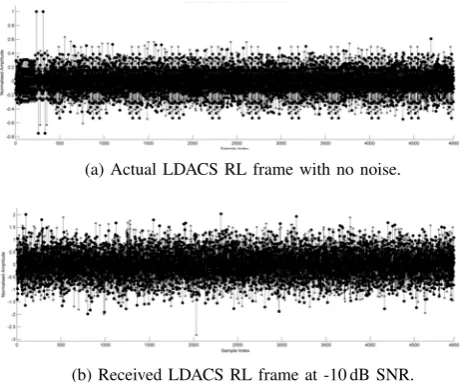
the case when the frames are received at SNR conditions of -10 dB. It can be observed that the noise significantly affects the frequency response signature and noise power level of the transmitted LDACS frame, limiting the scope of simple energy detection-based techniques. An effective spectrum sensing scheme should be able to accurately determine the presence of LDACS transmission under such diverse conditions.
For our evaluation, these received frames are used as inputs to the hardware implementation (as preloaded RAM contents), simulation model of the proposed multiplier-less correlator (MATLAB simulation), and the multiplier-based model (in hardware). The inputs are quantized to 16-bit signed-magnitude fixed-precision format for hardware implementa-tion while the MATLAB simulaimplementa-tion model is tested with MATLAB’s native accuracy (double precision floating point). The output of the proposed correlator (hardware evaluation) corresponding to received LDACS frames at different noise conditions (SN R = 0dB, SN R = 10dB) is plotted in Fig. 8. The presence of frame is determined by detection of a significant peak (more than 1.33⇥ all others in the current frame) at sample index 375, corresponding to the LDACS RL preamble. Though the plots vary significantly due to the difference in input noise levels, the proposed correlator achieves significant peaks at index 375 most of the time, resulting in positive frame detection.
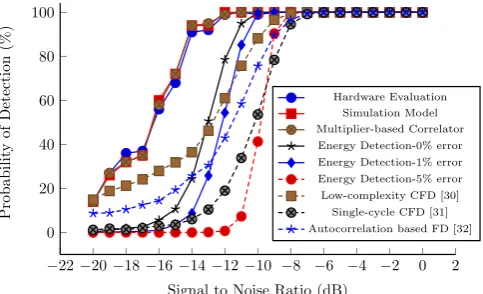
We also evaluate the detection accuracy of the proposed correlator under different noise conditions with SNRs ranging from 0dB to 20dB in hardware, by loading the test frames into BlockRAMs on the FPGA. The performance is averaged over 1000 LDACS frames (4950 samples each) for each SNR condition, with each frame having a different noise signature at the same SNR. We also compare against the performance of a simulation model of the proposed correlator in MATLAB and a multiplier-based correlator in hardware (at 16-bit precision), to compare against the proposed correlator with the same input frames. The results are plotted in Fig. 9. The hardware model achieves almost identical accuracy to the multiplier-based
equivalent (same truncation mechanism) and the simulation model in MATLAB (minor deviations due to rounding), with 100% positive frame detection in conditions up to 12dB.
We also compare the approach against the traditional ED based technique (in MATLAB) under different noise variance estimation conditions. The performance of ED based detection is largely determined by the noise variance estimation, which is complex to compute and is often assumed to be a known parameter while evaluating the algorithm. For our evaluation, we consider three cases of noise variance estimation: with no error (ideal condition), with 1% error and with 5% error (practical condition); the error detection techniques that can achieve these conditions are beyond the scope of this paper. We have used a 4950 sample observation window and 1% probability of false alarm as the parameters for determining the decision threshold in ED. With perfect noise estimation, it can be observed that the percentage detection of ED reduces rapidly beyond an SNR of 11dB, while the proposed ap-proach can achieve close to 90% positive detection even at an SNR of 15dB. As the quality of noise estimation deteriorates to 1% and 5% error, the performance of ED deteriorates significantly compared to the proposed approach. The results show that the proposed correlator based technique offers better detection accuracy over the ED technique without incurring the computational complexities associated with highly accurate noise estimation.
Finally, we also compare the proposed technique against cyclostationary feature detection (CFD) and autocorrelation based schemes from the literature. A low-complexity cyclo-stationary technique was proposed for sensing spectrum in a femtocell design for LTE networks [30], while the work in [31] explores a cooperative cyclostationary technique for spectrum sensing in low SNR conditions in generic OFDM systems (which we have adapted to a single-cycle CFD scheme for LDACS). The autocorrelation technique described in [32] relies on the detection of autocorrelation coefficient for spec-trum sensing in generic OFDM systems. For our experiments, we adapt these algorithms to the properties of LDACS RL-DC frame and simulate the performance in MATLAB, under different noise conditions with SNRs ranging from 0dB to 20dB. The results, shown in Fig. 9, clearly shows that the proposed technique offers higher detection accuracy, even while running at lower computational precision. It should be noted that the detection accuracy of techniques which rely on periodic properties of the signal will improve further as the detection window is increased, which requires detection across multiple timeslots in the LDACS RL-DC segment.
VI. CONCLUSION
Fig. 8: Correlator output at SNR of0dB and 10dB.
22 20 18 16 14 12 10 8 6 4 2 0 2
0 20 40 60 80 100
Signal to Noise Ratio (dB)
P
rob
ab
il
it
y
of
D
et
ect
ion
(%)
Hardware Evaluation Simulation Model Multiplier-based Correlator Energy Detection-0% error Energy Detection-1% error Energy Detection-5% error Low-complexity CFD [30] Single-cycle CFD [31] Autocorrelation based FD [32]
Fig. 9: Comparison of detection accuracy of RL DC frames using different detection techniques.
in LDACS, the associated operations are computationally intensive, requiring efficient techniques to implement them on on-board systems that operate under tight constraints.
In this paper, we proposed the use of multiplierless corre-lation for spectrum sensing in the LDACS digital front-end, with the added benefit of the same hardware being used for timing synchronization in the LDACS OFDM receiver. We show that the proposed architecture offers 3⇥ energy reduc-tion over multiplier-based correlators and better detecreduc-tion of LDACS RL frames in air-to-ground channels even at low SNR values, compared to traditional ED systems and other feature detection techniques. Moreover, the observation window for spectrum sensing can be as small as the minimal RL frame structure, enabling faster turn-around from sensing to start of transmission. Our results show that the proposed correlator based spectrum sensing offers 100% detection accuracy even 12dB SNR without requiring noise estimation, reducing the computational complexity in on-board implementation.
REFERENCES
[1] W. Sch¨utz and M. Schmidt, “Action Plan 17 - Future Communication Study: Final Conclusions and Recommendations Report,” EUROCON-TROL/FAA Memorandum of Cooperation, Tech. Rep., 2007.
[2] M. Sajatovic, B. Haindl, U. Epple, and T. Gr¨aupl, “Updated LDACS1 System Specification,” SESAR Joint Undertaking Report EWA04-1-T2-D1, Tech. Rep., 2011.
[3] C. Zhang, Y. Zhang, J. Xiao, and J. Yu, “Aeronautical Central Cognitive Broadband Air-to-Ground Communications,”IEEE Journal on Selected Areas in Communications, vol. 33, no. 5, pp. 946–957, 2015. [4] P. Jacob, A. S. Madhukumar, and A. P. Vinod, “Efficient aviation
spectrum management through dynamic frequency allocation,” in Pro-ceedings of the Integrated Communication, Navigation and Surveillance Conference (ICNS), 2015, pp. L3:1–L3:9.
[5] L. K. Mathew and A. P. Vinod, “An Energy-difference Detection based Spectrum Sensing Technique for Improving the Spectral Efficiency of LDACS1 in Aeronautical Communications,” inProceedings of the IEEE Digital Avionics Systems Conference, 2016, pp. 1–5.
[6] S. Shreejith, A. Ambede, A. P. Vinod, and S. A. Fahmy, “A Power and Time Efficient Radio Architecture for LDACS1 Air-to-Ground Communication,” inProceedings of the IEEE Digital Avionics Systems Conference, 2016, pp. 1–6.
[7] T. H. Pham, S. A. Fahmy, and I. V. McLoughlin, “Low-Power Cor-relation for IEEE 802.16 OFDM Synchronization on FPGA,” IEEE Transactions on Very Large Scale Integration (VLSI) Systems, vol. 21, no. 8, pp. 1549–1553, 2013.
[8] H. Urkowitz, “Energy detection of unknown deterministic signals,”
Proceedings of the IEEE, vol. 55, no. 4, pp. 523–531, 1967. [9] J. G. Proakis, “Digital communications fourth edition, 2001,” 1998. [10] T. Yucek and H. Arslan, “A survey of spectrum sensing algorithms for
cognitive radio applications,”IEEE communications surveys & tutorials, vol. 11, no. 1, pp. 116–130, 2009.
[11] Y. Zeng and Y.-C. Liang, “Eigenvalue-based spectrum sensing algo-rithms for cognitive radio,” IEEE transactions on communications, vol. 57, no. 6, pp. 1784–1793, 2009.
[12] A. Mariani, A. Giorgetti, and M. Chiani, “Snr wall for energy detection with noise power estimation,” in2011 IEEE international conference on communications (ICC). IEEE, 2011, pp. 1–6.
[13] A. Recio and P. Athanas, “Physical layer for spectrum-aware recon-figurable ofdm on an fpga,” inDigital System Design: Architectures, Methods and Tools (DSD), 2010 13th Euromicro Conference on. IEEE, 2010, pp. 321–327.
[14] L. Hanzo and T. Keller, “OFDM and MC-CDMA: A Primer,” 2006. [15] T. M. Schmidl and D. C. Cox, “Robust frequency and timing
synchro-nization for OFDM,”IEEE Transactions on Communications, vol. 45, no. 12, pp. 1613–1621, 1997.
[16] L. Schwoerer, “VLSI suitable synchronization algorithms and architec-ture for IEEE 802.11 a physical layer,” inInternational Symposium on Circuits and Systems (ISCAS), vol. 5. IEEE, 2002, pp. V–V. [17] A. Langowski, “Fast and accurate OFDM time and frequency
syn-chronisation,” inInternational Symposium on Wireless Communication Systems. IEEE, 2007, pp. 86–90.
[18] C. Nanda Kishore and V. Umapathi Reddy, “A frame synchronization and frequency offset estimation algorithm for OFDM system and its analysis,”EURASIP Journal on Wireless Communications and Network-ing, vol. 2006, pp. 1–16, 2006.
[image:9.595.51.293.282.429.2]synchroniza-tion for IEEE 802.16d systems,”IEEE Transactions on Very Large Scale Integration (VLSI) Systems, vol. 16, no. 12, pp. 1620–1630, 2008. [20] T. H. Pham, I. V. McLoughlin, and S. A. Fahmy, “Robust and efficient
OFDM synchronization for FPGA-based radios,”Circuits, Systems, and Signal Processing, vol. 33, no. 8, pp. 2475–2493, 2014.
[21] A. Fort, J.-W. Weijers, V. Derudder, W. Eberle, and A. Bourdoux, “A performance and complexity comparison of auto-correlation and cross-correlation for OFDM burst synchronization,” in IEEE International Conference on Acoustics, Speech, and Signal Processing (ICASSP), vol. 2. IEEE, 2003, pp. II–341.
[22] K.-W. Yip, Y.-C. Wu, and T.-S. Ng, “Design of multiplierless correlators for timing synchronization in IEEE 802.11 a wireless LANs,” IEEE Transactions on Consumer Electronics, vol. 49, no. 1, pp. 107–114, 2003.
[23] G. Eichinger, K. Chowdhury, and M. Leeser, “Crush: Cognitive radio universal software hardware,” inProceedings of the International Con-ference on Field Programmable Logic and Applications (FPL), 2012, pp. 26–32.
[24] K. Le, P. Maddala, C. Gutterman, K. Soska, A. Dutta, D. Saha, P. Wolniansky, D. Grunwald, and I. Seskar, “Cognitive radio kit frame-work: experimental platform for dynamic spectrum research,” ACM SIGMOBILE Mobile Computing and Communications Review, vol. 17, no. 1, pp. 30–39, Jan 2013.
[25] K. Amiri, Y. Sun, P. Murphy, C. Hunter, J. R. Cavallaro, and A. Sab-harwal, “WARP, a unified wireless network testbed for education and research,” in Proceedings of the IEEE International Conference on Microelectronic Systems Education, 2007, pp. 53–54.
[26] J. Lotze, S. A. Fahmy, J. Noguera, B. Ozgul, L. E. Doyle, and R. Esser, “Development framework for implementing FPGA-based cognitive net-work nodes,” inProceedings of the IEEE Global Telecommunications Conference (GLOBECOM), 2009, pp. 1–7.
[27] S. Shreejith, B. Banarjee, K. Vipin, and S. A. Fahmy, “Dynamic Cognitive Radios on the Xilinx Zynq Hybrid FPGA,” inProceedings of the International Conference on Cognitive Radio Oriented Wireless Networks (CROWNCOM), 2015, pp. 427–437.
[28] B. Ronak and S. A. Fahmy, “Multi-pumping flexible DSP blocks for resource reduction on Xilinx FPGAs,”IEEE Transactions on Computer Aided Design of Integrated Circuits and Systems, vol. 36, 2017. [29] A. Ambede, A. P. Vinod, and A. S. Madhukumar, “Design of a low
complexity channel filter satisfying LDACS1 spectral mask specifica-tions for air-to-ground communication,” inProceedings of the Integrated Communications Navigation and Surveillance (ICNS) Conference, April 2016, pp. 7E3:1–7.
[30] R. F. A. Tani and D. Marabissi, “A Low-Complexity Cyclostationary Spectrum Sensing for Interference Avoidance in Femtocell LTE-A-Based Networks,”IEEE Transactions on Vehicular Technology, vol. 65, no. 4, pp. 2747–2753, 2016.
[31] T. L.-N. M. Derakhshani and M. Nasiri-Kenari, “Efficient Cooperative Cyclostationary Spectrum Sensing in Cognitive Radios at Low SNR Regimes,” IEEE Transactions on Wireless Communications, vol. 10, no. 11, pp. 3754–3764, 2011.
[32] V. K. S. Chaudhari and H. V. Poor, “Autocorrelation-Based Decentral-ized Sequential Detection of OFDM Signals in Cognitive Radios,”IEEE Transactions on Signal Processing, vol. 57, no. 7, pp. 2690–2700, 2009.
Shanker Shreejith (S’13, M’16) received the B. Tech. degree in electronics and communication en-gineering from University of Kerala, India and the Ph.D. degree in computer science and engineering from Nanyang Technological University (NTU), Sin-gapore, in 2006 and 2016, respectively.
From 2006 to 2008, he worked as an FPGA design and development engineer. From 2008 to 2011, he worked as a scientist at Digital Systems Group, Vikram Sarbhai Space Centre, Trivandrum, under the Indian Space Research Organisation (ISRO). From 2015 to 2016, he was a Research Fellow at the School of Computer Science and Engineering, NTU, Singapore. Since 2017, he is a Teaching Fellow at the School of Engineering, University of Warwick, UK. His research interests include reconfigurable computing, distributed embedded systems, and computer networks.
Libin K. Mathew(S’16) received the B. Tech. de-gree in Electronics and Communication engineering from Kannur University, India and the M. Tech. de-gree in Electronics and Communication Engineering from National Institute of Technology, Kurukshetra, India, in 2010 and 2015, respectively. Since 2015, he is a Ph.D. candidate at the School of Computer Science and Engineering, Nanyang Technological University, Singapore. His research interests include wireless communications, cognitive radio and signal processing.
A. P. Vinod(M’01, SM’07) received his B. Tech. degree in Instrumentation and Control Engineering from University of Calicut, India in 1993 and the Master of Engineering (By Research) and Ph.D. degrees from School of Computer Engineering, Nanyang Technological University (NTU), Singa-pore, in 2000 and 2004 respectively. He has spent the first 5 years of his career in industry as an automa-tion engineer at Kirloskar, Bangalore, Tata Honey-well, Pune and Shell Singapore. From September 2000 to September 2002, he was a Lecturer in Singapore Polytechnic, Singapore. He joined NTU as a Lecturer in the School of Computer Engineering in September 2002; became an Assistant Professor in December 2004, and tenured Associate Professor from September 2010 to August 2017. He will join Indian Institute of Technology (IIT), Palakkad, India, as a Professor in Electrical Engineering in September 2017.
Dr. Vinods research interests include digital signal processing, low power, reconfigurable circuits & systems for wireless communications and Brain-Computer Interface (BCI) systems. He has published over 230 papers in refereed international journals and conferences. He is a Senior Member of IEEE, Associate Editor of IEEE Transactions on Human-Machine Sys-tems, Associate Editor of Circuits, SysSys-tems, and Signal Processing Journal (Springer), and Technical Committee Co-Chair of Brain-Machine Interface Systems of IEEE Systems, Man & Cybernetics Society. He is also the recipient of Nanyang Award for Excellence in Teaching in 2010, University’s highest teaching recognition award.
Suhaib A Fahmy (M’01, SM’13) received the M.Eng. degree in information systems engineering and the Ph.D. degree in electrical and electronic engineering from Imperial College London, UK, in 2003 and 2007, respectively.
From 2007 to 2009, he was a Research Fellow with the University of Dublin, Trinity College, and a Visiting Research Engineer with Xilinx Research Labs, Dublin. From 2009 to 2015, he was an As-sistant Professor with the School of Computer En-gineering, Nanyang Technological University, Sin-gapore. Since 2015, he has been an Associate Professor at the School of Engineering, University of Warwick, UK. His research interests include recon-figurable computing, high-level system design, and computational acceleration of complex algorithms.