
© 2019, IRJET | Impact Factor value: 7.211 | ISO 9001:2008 Certified Journal | Page 3322
ANALYSIS OF RICE HUSK ASH AS A SECOND STRINGER OF CEMENT IN
CONCRETE STRUCTURE
Anuj
1, Akash batra
2, Pappu Sharma
3, Sohan lal
41
Student, Dept. Of Civil engineering, Indus Institute of Engg. and Tech., Kinana, Haryana, India
2Assistant Professor, Dept. Of Civil engineering, Indus Institute of Engg. and Tech., Kinana, Haryana, India
3
Assistant Professor, Dept. Of Civil engineering, Indus Institute of Engg. and Tech., Kinana, Haryana, India
4Assistant Professor, Dept. Of Civil engineering, Indus Institute of Engg. and Tech., Kinana, Haryana, India
---***---Abstract -
Due to rapid growth in population, sometechnologies are made for usage of waste and to reduce cost in industrial processing by using rice husk ash as a good material to partial replace cement. Rice husk act as adsorbent for removing heavy metals from wastewater. In mostly countries of the world biomass used for bioethanol production because it is a renewable and environment friendly fuel. In present study we use RHA at 7, 14, 21 and 28 % by replacing it with cement. My work included to find various properties like compressive strength, flexural strength, consistency, initial & final setting time etc.andto find outs how different contents of Rice Husk Ash added to concrete may influence its physical and
mechanical properties. Sample Cubes were tested with
different percentage of RHA replacing in massthe cement.Due to the pozzolanic reactivity, rice husk ash (RHA) used as supplementary cementing material in mortar and concrete and has demonstrated significant influence in improving the mechanical and durability properties of mortar and concrete. It has economical and technical advantages to use in concrete.
Key Words: Rice husk ash, Compressive Strength, Concrete, Flexural Strength
1.INTRODUCTION
The population increase more generated source and waste, one of source is need shelter used to cement, 1 ton generated cement approximately 0.6 ton CO2 gas emission produced ,which causes to global warming 7% Total produced CO2 gas emission in atmosphere, reduces CO2 gas emission is cement replacing some waste or ash, used waste in concrete. Waste as well as controlled to pollution. One of the major causes of CO2 emission in the world is caused by construction. This is due to the fact that the construction industry uses untreated materials which are considered as major elements in generating noise, dust and considerable amount of waste. Furthermore, the production and use of concrete has an enormous environmental effect this is because Cement is an energy consumer and CO2 fabricated material.
1.1 Rice Husk Ash
Rice milling generates a by-product known as husk. This surrounds the paddy grain. During milling of paddy about 78% of weight is received as rice, broken rice and bran. Rest 22% of the weight of paddy is received as husk. This husk is used as fuel in the rice mills to generate steam for the boiling process. This husk contains about 75% organic volatile matter and the remaining 25% of the weight of this husk is converted into ash during the firing process, known as Rice Husk Ash (RHA).
1.2 Objectives
1) To determine the effect of rice husk ash on the compressive and flexural strength of concrete. 2) To study the effect of rice husk ash in concrete
when mix design.
3) To study the effect of rice husk ash on workability of concrete.
4) To study the some physical property like initial setting time, final setting time, consistency etc.
2. LITERATURE REVIEW
Salas et al. 1986 The low strengths achieved, even with negligible proportions of husk, of 22.96% and 32.4% should be noted. One possibility put forward for achieving greater strengths with the same proportion of husk is to only substitute sand, instead of sand and gravel.
© 2019, IRJET | Impact Factor value: 7.211 | ISO 9001:2008 Certified Journal | Page 3323
3. EXPERIMENTAL PROGRAMME
The experimental program are carried out with an objectives to study the effects of using rice husk partial replacement of cement, and also to study the effects of using rice husk cement on the performance of concrete. To achieve these objectives, two major experiments were designed. The experiment was done to determine the effects of replacing part of Ordinary Portland cement with rice husk ash with different percentage on various properties of cement such as water requirement or normal consistency, setting time, soundness, compressive strength and flexural strength.
3.1 Material Used
Concrete is a variable material. It is not practical to expect that the characteristics of a concrete mix can be identically replicated on a consistent basis. One of the main reasons for the variability in the concrete is because of the variability in the materials used to make the concrete. The basic constituents of ordinary Portland cement concrete are:
1) Cement 2) Rice Husk Ash 3) Water
4) Fine aggregate 5) Coarse aggregate
3.2 Tests on Materials
Tests on Portland pozzolona cement with rice husk ash as an additive in various percentages are:
1) Consistency test 2) Soundness test 3) Setting time test 4) Specific gravity test 5) Particle Size Distribution 6) Slump test
7) Compressive strength test 8) Flexural Strength Test
Five Samples of 0, 7, 14, 21 and 28% of rice husk ash is used as partial replacement of cement is prepared as shown below
3.3 Consistency Test
The basic aim is to find out the water content required to produce a cement paste of standard consistency as specified by the IS: 4031 (Part 4) – 1988. The principle is that standard consistency of cement is that consistency at which the Vicat plunger penetrates to a point 5-7mm from the bottom of Vicat mould.
Apparatus:- Vicat Apparatus Conforming to IS: 5513-1976, Balance of capacity 1Kg and sensitivity to 1gram, Gauging trowel conforming to IS: 10086-1982.
Fig -1: Vicat Apparatus
3.4 Workability of Concrete Specimens
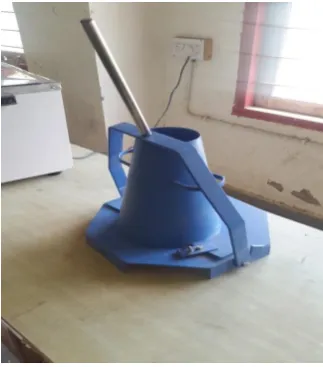
Workability is the property of freshly mixed concrete that determines the ease with which it can be properly mixed, placed, consolidated and finished without segregation. Workability depends on water content, aggregate, cement content and age and can be modified by adding chemical admixtures. The workability of fresh concrete was measured by means of the conventional slump test as per IS: 1199-1989. Before the fresh concrete was cast into moulds, the slump value of the fresh concrete was measured using slump cone.
Fig -2: Slump Test Apparatus
3.5 Compression Test
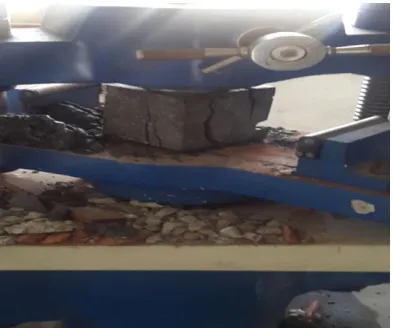
The compressive strength test is the most common test which is conducted on the hardened concrete, partly because it is easy to perform and partly because of desirable characteristic properties is qualitatively related to compressive strength. For compressive strength testing 150mm X 150mm X 150mm cubes are casted from the reference mix and kept in a curing pound up to 28-days. The specimens are tested after 7-days, 14-days and 28-days, using a calibrated compressive strength testing machine of 2000KN capacity as per IS: 516-1959.
[image:2.595.325.539.99.259.2] [image:2.595.352.514.418.602.2]© 2019, IRJET | Impact Factor value: 7.211 | ISO 9001:2008 Certified Journal | Page 3324 Where,
P= load at failure of cube, A= cross-section area of cube
Fig -3: Compressive Strength Test Machine
4. ANALYSIS OF RESULTS AND DISCUSSION
An Experimental study on the behavior of rice husk ash based concrete has been conducted for various loading conditions. The results of the present investigation are compared with the other investigation. A good agreement between the compression, workability test and flexural strength has been obtained. The results of the present investigation are discussed under the following heads
4.1 Consistency Test
Normal consistency tests, for the blended cements, are conducted, by Vicat apparatus, to observe the changes in water requirement of pastes due to the presence of rice husk ash . Test result on cement paste replaced with rice husk ash is show in table given below. In present study no. of sample casted are big in number so it is decided to nomenclature each sample with particular code.
Table -1 Consistency of Rice Husk Blended Cement Pastes S. No. Code Consistency (%)
1 MIX 1 30
2 MIX 2 32.5
3 MIX 3 35
4 MIX 4 35.5
5 MIX 5 32
From the above table we find there is variation on cement paste up to 21% of addition of rice husk ash and after more addition there is no change in consistency. The above change
in consistency at initial stage is due the particle size of rice husk ash. The particle size of rice husk ash is less as compare to cement so it fill maximum voids of the paste, which help in increase in consistency of the paste.
26
28
30
32
34
36
MIX1
Figure -4:MIX2
Consistency GraphMIX3
MIX4
MIX5
4.2 Workability Test [image:3.595.64.261.143.307.2]The test result of workability show that there is some increment in workability of concrete after addition of rice husk ash. There is some decrease in workability till 21 % addition of rice husk ash after more addition of this waste increase in concrete workability.
Table -2 Workability Test Result
Mix Designation Slump Value (mm)
MIX 1 85
MIX 2 75
MIX 3 70
MIX 4 60
MIX 5 65
0
20
40
60
80
100
MIX 1 MIX 2 MIX 3 MIX 4 MIX 5
Worka
bi
li
ty
Rice Husk %
[image:3.595.311.567.149.315.2] [image:3.595.314.551.443.733.2]© 2019, IRJET | Impact Factor value: 7.211 | ISO 9001:2008 Certified Journal | Page 3325
4.3 Compressive Strength
[image:4.595.32.298.263.609.2]The unconfined characteristic compressive strength is generally the foremost specification for concrete. It is also usually the most important property of the concrete. Whether it is the primary consideration of a concrete mix or not the compressive strength is always specified and tested, to a high standard of quality control. Not only is the compressive strength an important test it is also generally considered the most easily obtained test for hardened concrete on site, thus most preferable.
Table -3: Detail of compressive strength of mixes ] Rice husk ash content Mix
designation N/mm² 7 day N/mm² 14 day N/mm² 28 day
0 MIX 1 26 33.5 39.8
7% MIX 2 28 34.8 40.7
14% MIX 3 29.8 35.8 44.3
21% MIX 4 28.1 36.7 45.5
28% MIX 5 27.5 34.2 42.2
0
10
20
30
40
50
MIX 1 MIX 2 MIX 3 MIX 4 MIX 5
CO
M
P
RESSIV
E
STRENG
TH
DESIGNATION
7 days
14 days
28 days
Figure -6: Comparison of Compressive Strength for various mix
5. CONCLUSIONS
Present investigation was undertaken to study the effect of rice husk ash on strength characteristic strength of concrete. To achieve the objectives of the present study, the cement were replaced 7%, 14%, 21% and 28% respectively. The compressive strength and the flexural strength test were determined for the mixes at the curing age of 7 days, 14 days and 28 days. The results obtained for the above mixes were
compared to investigate the effects of partial replacement of cement by rice husk ash on the above strength parameters of concrete. The conclusion drawn from this study is presented in this chapter
5.1 CONCLUSIONS
Based on the results obtained in the present investigation, the following conclusion can be drawn. The results obtained in the present study indicates that it is feasible to replace the cement by rice husk ash for improving the strength characteristics of concrete, thus the rice husk ash can be used as an alternative material for the production of concrete to address the waste disposal problems and to minimize the cost of construction with usages of rice husk
1) The Experimental work shows that properties of concrete M35 gets improved due to incorporation of rice husk ash.
2) M35 concrete produced from cement replacement upto 21% rice husk ash leads to increase in compressive strength of concrete at the end of 7, 14 & 28 days respectively. Beyond 21% there is a decrease in compressive strength of concrete. 3) M35 concrete produced from cement replacement
upto 21% rice husk ash leads to increase in flexural strength of concrete at the end of 7, 14 & 28 days respectively. Beyond 21% there is a decrease in flexural strength of concrete.
4) It can be concluded that the workability of fresh concrete is 85 mm and the workability of concrete is decrease as the percentage of rice husk ash upto 21% after more addition there is increament in workability of concrete
REFERENCES
T.S.Ramesh Babu and D.Neeraja “Rice Husk Ash as Supplementary Material in Concrete –A Review” International Journal of ChemTech Research, CODEN (USA): IJCRGG, ISSN:0974-4290, ISSN (Online):2455-9555, Vol.9, No.05 pp 332-337. Koteswara Rao. D, Pranav, Anusha. M
“Stabilization of Expansive Soil With Rice Husk Ash, Lime and Gypsum – An Experimental Study” International Journal of Engineering Science and Technology (IJEST) ISSN : 0975-5462 Vol. 3 No. 11 November 2011.
Obilade, I.O. “Experimental Study On Rice Husk As Fine Aggregates In Concrete” The International Journal Of Engineering And Science (IJES), Volume 3, Issue 8, Pages 09-14, 2014. ISSN (e): 2319 – 1813 ISSN (p): 2319 – 1805.
© 2019, IRJET | Impact Factor value: 7.211 | ISO 9001:2008 Certified Journal | Page 3326 M.R. Karim, M.F.M. Zain, M. Jamil, F.C. Lai and
M.N. Islam “Strength of Mortar and Concrete as Influenced by Rice Husk Ash: A Review” World Applied Sciences Journal 19 (10): 1501-1513, 2012, ISSN 1818-4952, IDOSI Publications, 2012. S. D. Nagrale, Dr. Hemant Hajare, Pankaj R. Modak
“Utilization Of Rice Husk Ash” International Journal of Engineering Research and Applications (IJERA), ISSN: 2248-9622, Vol. 2, Issue 4, July-August 2012, pp.001-005.
![Table -3: Detail of compressive strength of mixes ]](https://thumb-us.123doks.com/thumbv2/123dok_us/9383473.441526/4.595.32.298.263.609/table-compressive-strength-mixes.webp)
