© 2019, IRJET | Impact Factor value: 7.211 | ISO 9001:2008 Certified Journal | Page 3909
Modification of I.C. Engine to run with water as supplement fuel to
increase its efficiency using HHO Kit
Aditya Palkar
1, Bhushan Sonawane
2, Gourav Singh
3, Kaveen Bindra
4, Prof. Arun Kumar Battu
5 1,2,3.4,5 Department of Mechanical Engineering, D.Y. Patil college of Engineering, Pune, India
---***---Abstract -
Comfort coupled with safety and simplicity is what man strives for. Our research has been to bring about both. The culmination of our project has resulted in a new “WATER IS USED AS A SECONDARY FUEL TO INCREASE EFFICIENCY.”The paper presents a basic as well as very professional treatment of the subject in a very comprehensive way, based on learning effort and understanding capability of today as per their levels. The device is simple and comfortable. Basic calculation, drawing and designing is included in the project.
The salient features of our machine can be listed as the mechanism used is very simple, easy for operation; no skill is required to operate the machine.
Key Words: SI engine, electrolysis of water, hydrogen cell.
1.INTRODUCTION
The hydrocarbon gasses are used in IC engines to produce work but they produce emission also, which are harmful to environment and mankind. To minimize these harmful effects in some proportion we can use water in addition to hydrocarbon gasses.
The chemical composition of water is H2O. By using
water, the conversion of CO from emission to CO2 can
be achieved and facilitate the complete burning with more heat by help of Hydrogen from water. In engine
due to insufficient oxygen some amounthydrocarbon
gases remain unburnt. For complete combustion of unburnt fuel oxygen from water can be used. The
separation of Hydrogen and oxygen from the water is done by electrolysis process. By using this setup, efficiency can be increased and lower the emissions can be decreased. Hydrogen fuel enhancement is the process of using a mixture of hydrogen and conventional hydrocarbon fuel in an internal combustion engine, typically a car or a truck or even in two wheeler, is an attempt to improve fuel economy, power output and reduction of toxic gas in emissions.
2.LITERATURE SURVEY
The following literature is based on the research papers published in various national and international journals, books and review articles :
T.Tsujimura,Y.Suzuki; “The utilization of hydrogen in hydrogen/diesel dual fuel engine” ;Elsevier (2017); International journal of hydrogen energy (2017) ;1-9
This paper explains study on DDF (diesel dual fuel ) where hydrogen is secondary fuel. Also this paper gives explanation about hydrogen DDF working and evaluation of performance of DDF engine. [1]
A. F. Ambrose a,A.Quasem Al-Amin , R.Rasiaha,R.
Saidur c, N.Amind; “Prospects for introducing
© 2019, IRJET | Impact Factor value: 7.211 | ISO 9001:2008 Certified Journal | Page 3910
This paper gives introduction of hydrogen fuel cell vehicles (FCVs). The main message of this article is that hydrogen FCV in Malaysia can be expected and is possible when there is a thorough understanding of energy security issues, where energy policy integration for economic development and environmental objectives are achieved at the same time. [2]
J. K.Unni, P.Govindappa,L. M. Das;Development of hydrogen fuelled transport engineand field tests on vehicles;Elsevier(2016); International journal of hydrogen energy (2016) ;1-11
This paper gives overview about modifications in the three wheelers in such a way that they can run on dual fuel which are gasoline and hydrogen. Also it gives various changes in the performance characteristics and the emissions. [3]
M.M. EL-Kassaby, Y.A. Eldrainy, M.E. Khidr, K.I. Khidr; “Effect of hydroxy (HHO) gas addition on gasoline engine performance and emissions”; Alexandria Engineering Journal;Elsevier (2015); 1-9
This paper’s result showed that the HHO gas maximum productivity of the cell was 18 L/h when using 2 neutrals plates with 1 mm distance and 6 g/L of KOH. The results also showed 10% increment in the gasoline engine thermal efficiency, 34% reduction in fuel consumption, 18% reduction in CO, 14% reduction in HC and 15% reduction in NOx. [4]
3. HHO KIT
HHO stands for two parts of Hydrogen and one part of Oxygen. When two hydrogen atoms are bound to one oxygen atom. The electrolysis process is done on the
water and final product of this process is combined Oxy-hydrogen.
There are many names for this gas such as brown gas, green gas, Hydroxyl, Di-hydroxyl and water gas. The wonderful thing about this gas is, this gas is the by product which is water. By a simple method called electrolysis; a method first recorded in 1800 by William Nicholson and Johann Ritter. Electrolysis involves the passage of an electric current through electrodes. As we know, batteries have positive and negative terminals.
Water, by itself, is not a good conductor of electricity so an electrolyte is commonly added to the water to allow current to pass through the water, to break it down into HHO. There are many types of electrolytes and each have pro’s and con’s and most manufactured HHO generators are usually designed for a particular electrolyte.
4.WORKING
© 2019, IRJET | Impact Factor value: 7.211 | ISO 9001:2008 Certified Journal | Page 3911
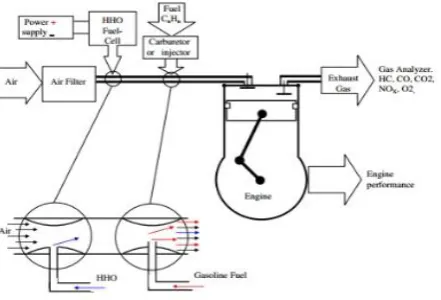
engine’s combustion chamber, and mix with the fuel. The introduction of the hydrogen into the combustion chamber creates a more efficient, complete combustion; thereby increasing fuel efficiency while at the same time reduces emissions and increasing power and performance. On average every vehicle on the road is around 66% efficient. Adding HHO to your air intake system increases this to right at 100% efficiency.
[image:3.595.37.258.564.714.2]HHO cell reduces vehicles fuel consumption over all by creating a more efficient combustion cycle. In other words you use all of your fuel. A more efficient consumption cycle allows you to use less fuel at the same throttle setting. But, the efficiency increase allows a lower throttle setting for a given horsepower production and therefore reduces consumption for traveling a given distance. It also, by burning hotter, consumes other material in the cycle such as excess lubricants and carbon residue thereby resulting in cleaner engine combustion chambers as well. When HHO is not in use the extra unused fuel going through the engine is known as blow by. This is the engine gunk which forms on your pistons. This blow by which does not get used goes out your exhaust as hydro carbons.
Fig No.1 Working of S.I with HHO Kit
5.DISTILLED WATER
Rainwater, spring water and tap water all contain impurities. A typical analysis will show minerals, suspended solids and other contaminates contained in these varieties. These impurities will precipitate out of the water when subjected to electrolysis. These appear in the form of brown, black and green scum in water or any discoloration of the water itself. These impurities have a solid mass which in turn will clog up the electrodes of your HHO generator and further impede the operation of the HHO cell overall. Of further concern is the fact that these solid accompany known gases which mix with the HHO gas and create unknown chemical reactions which are toxic to the environment, Therefore only distilled water should be used in the production of HHO gas in the HHO kit.
6.ACRYLIC TUBE
The hydrogen generator is made from length of 4 inch diameter acrylic pipe and two caps, several metal plates, the couple of metal straps and some other various parts. Assembly is fairly straight forward and this hydrogen generator can be built by anybody. The acrylic tube is used because of its transparency as we can see the level of water and gas bubble in it. Another nice thing is compact design.
7.CATALYST FOR ELECTROLYSIS
© 2019, IRJET | Impact Factor value: 7.211 | ISO 9001:2008 Certified Journal | Page 3912 8.PLATINUM ELECTRODE
1. Platinum is ductile, meaning it can be drawn into wire while maintaining toughness and flexibility and without becoming brittle.
2. Platinum is malleable, meaning it can be reshaped and easily worked with without breaking.
3. Platinum is lustrous (shiny), silvery-white metal and is highly resistant to corrosion and oxidation in moist air and does not tarnish or rust.
9.PULSE WIDTH MODULATION CIRCUIT
The HHO experimenter will be busy observing and maintaining the average flow of the HHO electrolyte. And, it is nice to be able to control the output of your hydrogen generator - from your dashboard.
During winter months, we need more electrolyte in the water because cold water does not conduct electricity as well. In summer months, we need less electrolyte in the water because hot water conducts electricity much better than cold water. During periods of mixed hot and cold, you are screwed; unless you have a PWM. The PWM allows you to use more electrolyte, but still control the output of the HHO generator.
10.TESTING AND RESULTS
The electrolysis unit is installed in a two wheeler and a road test is conducted.
Engine Specifications
Sr No. Parameters Specifications
1 Engine CD Deluxe , Air
Cooled
2 Cubic capacity 97.2cc
3 Stroke 4 Stroke
4 Brake power 7.44HP@8000RPM
5 Speed 1500RPM
6 No. of
Cylinders
Single
7 Mileage 78 Kmpl
8 Transmission 4 speed constant
mesh
Results
Without hydrogen gas Trial
No.
Amount of Gasoline Consumption
Distance Covered
Average distance covered(km)
1 2
1. 50 3.7 3.6 3.65
2. 100 7.7 7.9 7.8
3. 150 12.3 12.1 12.0
4. 200 16 15.7 15.85
With hydrogen gas Trial
No.
Amount of Gasoline Consumption
Distance Covered
Average distance covered(km)
1 2
1. 50 4.1 4.0 4.05
2. 100 9.3 9.5 9.40
3. 150 13.0 13.1 13.05
© 2019, IRJET | Impact Factor value: 7.211 | ISO 9001:2008 Certified Journal | Page 3913 Graph: Performance Test
11. CONCLUSIONS
Electrolysis process is used for production of hydrogen gas. This hydrogen gas is supplied to the intake of engine. This increases the rate of combustion and also reduces the harmful emissions to the environment.
REFERENCES
[1]T.Tsujimura,Y.Suzuki,The utilization of hydrogen in hydrogen/diesel dualfuel engine ;Elsevier (2017); International journal of hydrogen energy (2017) ;1-9 [2]A. F. Ambrose a,A.Quasem Al-Amin , R.Rasiaha,R. Saidur c, N.Amind; “Prospects for introducing hydrogen fuel cell vehicles in Malaysia”;Elsevier(2016); international journal of hydrogen energy;1-10
[3]J. K.Unni, P.Govindappa,L. M. Das;Development of hydrogen fuelled transport engineand field tests on vehicles;Elsevier(2016); International journal of hydrogen energy (2016) ;1-11