© 2019, IRJET | Impact Factor value: 7.211 | ISO 9001:2008 Certified Journal
| Page 4911
SELF COMPACTING CONCRETE WITH REPLACEMENT OF FLYASH
AGGREGATE AS FINE AGGREGATE AND LECA AS COARSE AGGREGATE
Mr. V.M. Gnanasundar
1, Mr. R. Rahul
2, Mr. M. Kishore Srinivas
2, Mr. S.B. Kartiheyan
2,
Mr. B. Varathan
21
Assistant Professor, Civil Engineering, Bannari Amman Institute of Technology - Sathy,
2
Final Year Student, Dept. of Civil Engineering, BIT - Sathy, Erode, Tamilnadu – 638041.
---***---Abstract -
Self-compacting concrete (SCC), which streams
under its very own weight and doesn't require any outer vibration for compaction, has altered the solid arrangement. Such concrete ought to have a generally low yield an incentive to guarantee high flow ability, a moderate thickness to opposes isolation and draining and should look after its homogeneity amid transportation, setting and relieving to guarantee sufficient basic execution and long haul solidness. Self-compacting concrete (SCC) can be characterized as a crisp solid which has prevalent flow ability under looked after solidness (for example no isolation) in this way permitting self-compaction that is, material combination without the expansion of vitality. Self-compacting concrete is a liquid blend reasonable for putting in structures with Congested support without vibration and it helps in accomplishing a higher nature of surface completions. The general extents of key segments are considered by volume rather than by mass. self-compacting concrete (SCC) blend plan with 29% of the coarse total class F fly slag, mixes of both and controlled SCC blend with 0.36 water/cementitious ratio(by weight) and388 litre/m3 of bond glue volume. Pulverized rock stones of size 16mm and12.5mm are utilized with a mixing 60:40 by rate weight of the all-out coarse total. Self-compacting concrete the similarity is influenced by the attributes of materials and the blend extents; it winds up important to advance a methodology for blend plan of SCC. The properties of various constituent materials utilized in this examination and its standard tests methodology for acknowledgement qualities of self-compacting cement, for example, droop stream, V-channel and L-Box are exhibited.
Key Words: Self Compacting Concrete, Flyash, Properties.
1. INTRODUCTION
Self-compacting concrete (SCC), which streams under its own weight and does not require any outside vibration for compaction, has altered the solid arrangement. Such concrete ought to have a generally low yield an incentive to guarantee high stream capacity, a moderate consistency to oppose isolation and dying, and should keep up its homogeneity amid transportation, putting and restoring to guarantee satisfactory auxiliary execution and long haul toughness which incorporate
i. Lessening the volume proportion of total to cementitious material 1-2,
ii. Expanding the glue volume and water-bond proportion (w/c),
iii. Cautiously controlling the greatest coarse total molecule size and all-out volume; For SCC, it is commonly important to utilize super plasticizer so as to acquire high portability. Including a huge volume of powdered material or thickness changing admixture can dispense with segregation. Okamura and Ozawa have proposed a blend proportioning framework for SCC. In this framework, the coarse total and fine total substance are fixed and self-similarity is to be accomplished by altering the water/powder proportion and super plasticizer measurements. The coarse total substance in cement is commonly fixed at 50 per cent of the absolute strong volume, the fine total substance is fixed at 40 per cent of the mortar volume and the water/folio proportion is thought to be 0.4 - 0.5 by weight contingent upon the properties of the powder and the super plasticizer dose. The required water/cover proportion is dictated by directing various preliminaries.
To meet the solid execution prerequisites the accompanying three kinds of self-compacting cement are accessible. a) Powder type of self-compacting concrete
b) Viscosity agent type self-compacting concrete c) Combination type self-compacting concrete
1.1 ADVANTAGES
The SCC as the name proposes does not expect vibration to accomplish full compaction. These offer points of interest over customary cement.
Can be put at a quicker rate with no mechanical vibration and less screeding, bringing about reserve funds in situation cost.
Ease of filling limited segments and difficult-to-achieve regions.
Improved union around fortification and bond with support.
© 2019, IRJET | Impact Factor value: 7.211 | ISO 9001:2008 Certified Journal
| Page 4912
Improved consistency of setting up cement by disposing of variable administrator – related exertion of solidification.
Shorter development periods and coming about cost investment funds.
Quicker solid truck pivot times empowering the maker to support venture all the more proficiently.
1.2 FRESH SCC PROPERTIES
The three primary properties of SCC in the plastic state are
Filling capacity (astounding deformability) Passing (capacity to pass support without blocking) High protection from isolation.
1.3 ADVANTAGES OF LECA
Light in weight (380 to 710 Kg/m3) Sound protection
Water absorption(40% of volume in the immersed state amid 48Hrs)
Fire opposition
Lightening up to 30% of the dead burden Appropriate conduct in seismic tremor Low moduli of the flexibility of LECA concrete
1.4 OBJECTIVES OF THE PRESENT INVESTIGATION
Investigate the crisp properties of SCC like stream capacity, passing capacity, and isolation obstruction.
Investigate the solidified properties of SCC like compressive quality, split elasticity, adaptable quality, youthful's modulus.
Investigate the inward relieving impact of SCC utilizing light weight total like Light Expanded Clay Aggregate (LECA) and fly powder total. To decide the ideal level of LECA and Fly slag total
required for Self Compacting Concrete.
2.
EXPERIMENTAL
INVESTIGATIONS
AND
DISCUSSIONS
2.1 CEMENT
[image:2.595.314.553.112.319.2]The utilization of 53 grade OPC is favoured as it was seen from the past records of concretes accessible in the market. Properties of concrete appear Table among the synthetic constituents of Cement the most vital are C3A, C3S and C2S.
Table -1: Properties of Cement
S. No Test for
Cement Relevent Is Code Result
1. Standard Consistency Test
IS 4031(Part
IV):1988 33% 2. Fineness Test IS:4031(Part
III):1988 1% 3. Specific
gravity IS:4031(Part II):1988 gm/cc 3.15 4. Initial setting
time IS:4031(Part V):1988 70 min 5. Final setting
time IS:4031(Part VI):1988 min 300 6. Compressive
strength at 28 days
IS 12269-1987 56 N/mm2
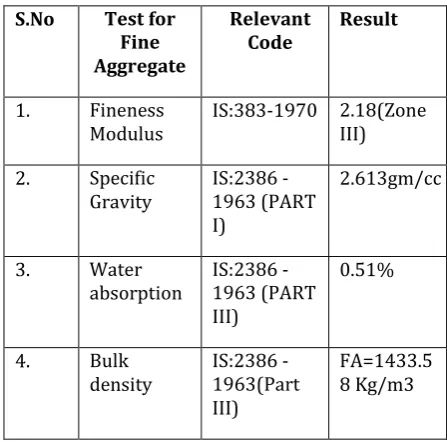
2.2 FINE AGGREGATE
The fine aggregate in SCC plays a major role in the workability and stability of the mix. Sands with fineness moduli of between 2.4 to 2.6 have been used in producing SCC.
Table -2: Properties of Fine Aggregate
S.No Test for Fine Aggregate
Relevant
Code Result
1. Fineness
Modulus IS:383-1970 2.18(Zone III) 2. Specific
Gravity IS:2386 -1963 (PART I)
2.613gm/cc
3. Water
absorption IS:2386 -1963 (PART III)
0.51%
4. Bulk
density IS:2386 -1963(Part III)
[image:2.595.321.545.435.656.2]© 2019, IRJET | Impact Factor value: 7.211 | ISO 9001:2008 Certified Journal
| Page 4913
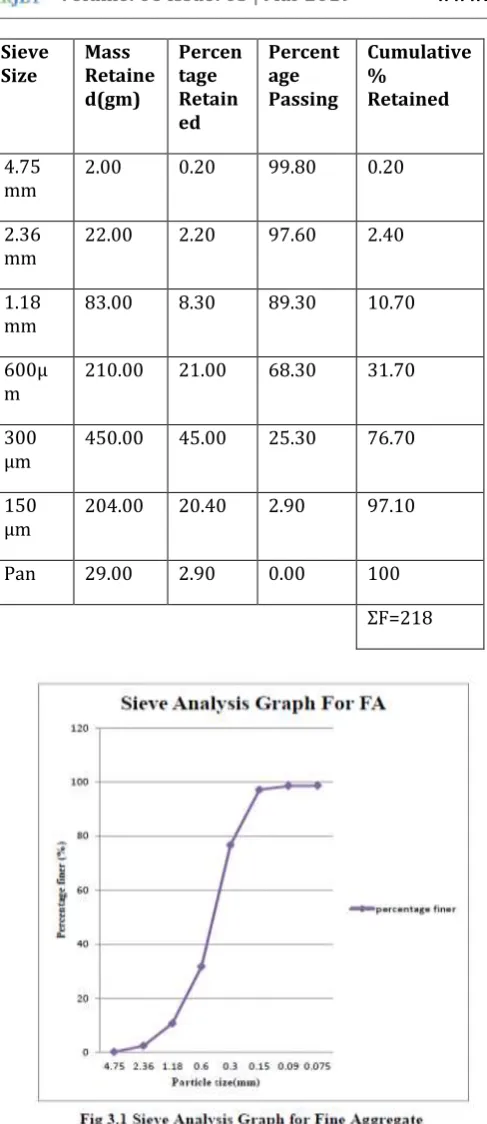
Sieve
Size Mass Retaine d(gm)
Percen tage Retain ed
Percent age Passing
Cumulative %
Retained
4.75
mm 2.00 0.20 99.80 0.20 2.36
mm 22.00 2.20 97.60 2.40 1.18
mm 83.00 8.30 89.30 10.70 600μ
m 210.00 21.00 68.30 31.70 300
μm 450.00 45.00 25.30 76.70 150
μm 204.00 20.40 2.90 97.10 Pan 29.00 2.90 0.00 100
ΣF=218
Chart -1: Sieve Analysis Graph For FA
2.3 COARSE AGGREGATE
[image:3.595.38.541.48.653.2]The influence of coarse aggregate on self-compatibility of fresh concrete,
Table -3: Properties of Coarse Aggregate
S.No Test For Coarse Aggregate
Relevant
Code Result
1. Water
Absorption IS:2386-1963 (Part III)
0.20%
2. Specific
Gravity IS:2386 -1963 (PART I)
2.73
3. Sieve
analysis IS:383-1970 FM-3.93 4. Bulk
density IS:2386 -1963 (Part III)
CA=1471. 31 Kg/m3
5. Packing
Factor Mixture Proportion Procedure for SCC, Indian Concrete Journal, June 2009, pp35-41
CA= 1.171
2.4FLY ASH (MINERAL ADMIXTURES)
Fly ash is the by-product of the combination of pulverized coal in electric power generation plants. When the pulverized coal is ignited in the combustion chamber, the carbon and volatile materials are burned off.
CLASSES OF FLY ASH
Two classes of fly ash are defined by ASTM C618, Class F fly ash
Class C fly ash
Table -4
S.No Test For Fly Ash Result
[image:3.595.42.286.74.637.2]© 2019, IRJET | Impact Factor value: 7.211 | ISO 9001:2008 Certified Journal
| Page 4914
2.5 FLY ASH LIGHTWEIGHT AGGREGATE
Natural aggregates are commonly used in concrete which can be depleting the natural resources and scarcity of aggregates become high. Hence necessitates using alternative aggregate. This led to the widespread research on using Artificial aggregate as an alternative aggregate.
2.6 WATER
Mixing water quality is required in accordance with the quality standards of drinking water, the use for PH > 4 clean water.
2.7 SUPER PLASTICIZER
Generally, in order to increase the workability, the water content is to be increased provided a corresponding quantity of cement is also added to keep the water-cement ratio constant so that the strength remains the same.
Table -5: Properties of super plasticizer
2.8 LIGHT WEIGHT EXPANDED CLAY AGGREGATE
LECA consist of small, lightweight, bloated particles of burnt clay. The thousands of small, air-filled cavities give LECA its strength and thermal insulation properties.
The base material is plastic clay which is pretreated and then heated and expanded in a rotary kiln. Finally, the product is burned at about 900 °C to 1250 °C to form the finished LECA product
Table -6: Properties
Properties Character
Colour Light to dark brown
Shape Accordion-shaped round
Bulk density 380-710Kg/m3
2.9 VISCOSITY MODIFYING AGENT (VMA)
SCC should have reasonable workability and viscosity. The fluidity of the mix increase as there is no internal friction between the particles and the concrete flows freely.
3. WORKABILITY TEST METHODS
SLUMP FLOW &T50 TEST L-Box
V-Funnel J-Ring U-Box
4. SCC MIX DESIGN
4.1EFNARC-GUIDELINES
In designing the mix it is most useful to consider the relative proportions of the key components by volume rather than by mass.
Water / Powder ratio by volume of 0.80 to 1.10 Total powder content – 160 to 240 litres (400 – 600
kg) per cubic meter.
Coarse aggregate content normally 28 to 35 per cent by volume of the mix.
Water-cement ratio is selected based on requirements in EN 206. Typically water content does not exceed 200 litter/m3
The sand content balance the volume of the other constituents
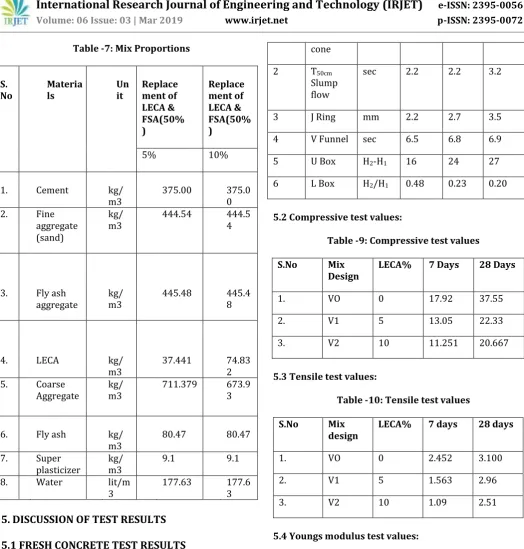
4.2 MIX PROPORTION
The brief description of mix design is given Annexure 1. Mix proportions are described below.
Cement content = 375 kg/m3 Fly ash = 80.47 kg/m3
Fine aggregate = 890.96 kg/m3 Coarse aggregate = 748.82 kg/m3 Water content = 177.63 kg/m3 Super plasticizer = 9.1 kg/m3 Properties of super
plasticizer Character
Physical state Light brown liquid Viscosity medium
© 2019, IRJET | Impact Factor value: 7.211 | ISO 9001:2008 Certified Journal
| Page 4915
Table -7: Mix Proportions
S.
No Materials Unit Replacement of LECA & FSA(50% )
Replace ment of LECA & FSA(50% )
5% 10%
1. Cement kg/
m3 375.00 375.00 2. Fine
aggregate (sand)
kg/
m3 444.54 444.54
3. Fly ash
aggregate kg/m3 445.48 445.48
4. LECA kg/
m3 37.441 74.832 5. Coarse
Aggregate kg/m3 711.379 673.93
6. Fly ash kg/
m3 80.47 80.47 7. Super
plasticizer kg/m3 9.1 9.1 8. Water lit/m
3 177.63 177.63
5. DISCUSSION OF TEST RESULTS
5.1 FRESH CONCRETE TEST RESULTS
Since the limitations of workability for SCC as per (European Federation for National Association for producer and applicators specialist building concrete) EFNARC.
Table -8:
FRESH CONCRETE TEST RESULTS
S.No Method Unit SCC
CONV LECA (5%) LECA (10%)
1 Slump Flow by Abram’s
mm 705 700 690
cone 2 T50cm
Slump flow
sec 2.2 2.2 3.2
3 J Ring mm 2.2 2.7 3.5 4 V Funnel sec 6.5 6.8 6.9 5 U Box H2-H1 16 24 27
6 L Box H2/H1 0.48 0.23 0.20
5.2 Compressive test values:
Table -9: Compressive test values
S.No Mix
Design LECA% 7 Days 28 Days
1. VO 0 17.92 37.55 2. V1 5 13.05 22.33 3. V2 10 11.251 20.667
5.3 Tensile test values:
Table -10: Tensile test values
S.No Mix
design LECA% 7 days 28 days
1. VO 0 2.452 3.100 2. V1 5 1.563 2.96 3. V2 10 1.09 2.51
5.4 Youngs modulus test values:
Table -11: Youngs modulus test values
S.N
o Mix design LECA% 7 days 28 days
1. VO 0 1.25 x
105 1.34 x 10⁵ 2. V1 5 0.267 x
105 0.4x 10⁵ 3. V2 10 0.25x
© 2019, IRJET | Impact Factor value: 7.211 | ISO 9001:2008 Certified Journal
| Page 4916
Table -12: Cost Comparison
S.No Materials Replacement of LECA & FSA (50%)
SCC 5% 10%
1. Cement 2572.5 2572.5 2572.5
2. Fine
aggregate 706.71 706.71 706.71
3. Fly ash
aggregate 330.82 330.82 330.82 4. LECA - 1123.23 2244.96
5. Coarse
aggregate 432.84 406.10 385.10
6. Fly ash 444.093 44.093 44.093
7. Super
Plasticizer 2275 2275 2275 8. Total cost 6361.963 7258.85 8559.183
6. CONCLUSIONS:
Based on investigations in this project, the following conclusions can be made,
For 5% and 10% replacement of fine aggregate by fly ash aggregate and coarse aggregate by LECA, 5% gives the optimum results in hardened concrete tests.
The incorporation of light weight aggregate can reduce the water content which could yield a more durable concrete.
From the experimental investigation, pre-wetted light weighted expanded clay aggregate replacement percentage increases it satisfies the fresh concrete properties of SCC and significantly decreases the compressive strength, splitting tensile strength, flexural strength and the modulus of elasticity of concrete.
7. REFRENCES:
1) Assie, S., Escadeillas, G. and Waller, V. 2007. Estimates of self-compacting concrete ‘potential’ durability.
2) Construction and Building Materials, 21 (10): 1909-1917.
3) ASTM C 143-03. 2003. Standard test method for slump of hydraulic cement concrete, Annual Book of ASTM Standards, 1-8.
4) ASTM C 494. 1992. Standard specifications for chemical admixtures for concrete, Annual Book of ASTM Standards.
5) Baoguo, Ma and Huixian, Wang. 2011. Effect of viscosity modifying admixture on the workability of self-compacting concrete, Advanced Material Research, 306-307: 946- 950.
6) BIS: 12269. 1987. Specification for ordinary Portland cement, New Delhi -Reaffirmed 1999. 7) Bosiljkov, V.B. 2003. SCC mixes with poorly graded
aggregate and high volume of limestone filler. Cem. Concr. Res., 33 (9):1279-1286.
8) EFNARC. 2005. European guidelines for selfcompacting concrete, specification, production and use. May.
9) Felekoglu, B., Tosun, K., Baradan, B., Altun, A. and Uyulgan, B. 2006. The effect of fly ash and limestone fillers on the viscosity and compressive strength of self-compacting repair mortars. Constr.Build.Mater., 36 (9):1719-1726.
10)Jino, John, Maya, T.M. and Meenambal, T. 2012. Mathematical modeling for durability characteristics of fly ash concrete. International Journal of Engineering Science and Technology (IJEST).
11) Nabil, M. and Al-Akhras. 2005. Investigation of the effect of metakaolin (MK) replacement of cement on the durability of concrete to sulfate attack. 12)Nagataki, S. and Fujiwara, H. 1995. SelfCompacting
property of highly-flowable concrete, Second Conference on Advances in Concrete Technology, ACI SP-154, V.M. Malhotra, American Concrete Institute, June, 301-304.
13)Okamura, H. and Ouchi, M. 1999. Selfcompacting concrete-development, present use and future. First International RILEM Symposium on Self-compacting Concrete. Rilem Publications SARL, 3-14.
14)Poppe, A.M. and Schutter, G.D. 2005. Cement hydration in the presence of high filler contents. Cem. Concr. Res., 35 (12): 2290-2299.
15)Unal, O., Topcu, I.B. and Uygunoglu, T. Use of marble dust in self-compacting concrete. In: Proceedings of V Symposium MERSEM0 2006 on Marble and Natural Stone. Afyon, Turkey, 413-420.