Original citation:
The Pelvic floor Society, National Institute for Health Research: Chronic Constipation
Treatment Pathway (Including: Grossi, U., Knowles, C. H., Mason, James, Lacy-Colson, J. and
Brown, S. R.). (2017) Surgery for constipation : systematic review and practice
recommendations : Results II: Hitching procedures for the rectum (rectal suspension).
Colorectal Disease, 19 (S3). pp. 37-48.
Permanent WRAP URL:
http://wrap.warwick.ac.uk/92940
Copyright and reuse:
The Warwick Research Archive Portal (WRAP) makes this work of researchers of the
University of Warwick available open access under the following conditions.
This article is made available under the Creative Commons Attribution 4.0 International
license (CC BY 4.0) and may be reused according to the conditions of the license. For more
details see: http://creativecommons.org/licenses/by/4.0/
A note on versions:
The version presented in WRAP is the published version, or, version of record, and may be
cited as it appears here.
Surgery for constipation: systematic review and practice
recommendations
Results II: Hitching procedures for the rectum (rectal suspension)
U. Grossi*, C. H. Knowles*, J. Mason†, J. Lacy-Colson‡ and S. R. Brown§on behalf of the NIHR
CapaCiTY working group¶and Pelvic floor Society**
*National Bowel Research Centre, Blizard Institute, Queen Mary University London, London, UK,†University of Warwick, Coventry, UK,‡Royal Shrewsbury Hospital, Shrewsbury, UK,§Sheffield Teaching Hospitals, Sheffield, UK,¶National Institute for Health Research: Chronic Constipation Treatment Pathway, London, UK, and **Affiliate section of the Association of Coloproctology of Great Britain and Ireland, London, UK
Abstract
AimTo assess the outcomes of rectal suspension proce-dures (forms of rectopexy) in adults with chronic con-stipation.
MethodStandardised methods and reporting of
bene-fits and harms were used for all CapaCiTY reviews that closely adhered to PRISMA 2016 guidance. Main con-clusions were presented as summary evidence statements with a summative Oxford Centre for Evidence-Based Medicine (2009) level.
ResultsEighteen articles were identified, providing data on outcomes in 1238 patients. All studies reported only on laparoscopic approaches. Length of procedures ran-ged between 1.5 to 3.5 h, and length of stay between 4 to 5 days. Data on harms were inconsistently reported and heterogeneous, making estimates of harm tentative and imprecise. Morbidity rates ranged between 5–15%, with mesh complications accounting for 0.5% of patients overall. No mortality was reported after any procedures in a total of 1044 patients. Although
inconsistently reported, good or satisfactory outcome occurred in 83% (74–91%) of patients; 86% (20–97%) of patients reported improvements in constipation after laparoscopic ventral mesh rectopexy (LVMR). About 2– 7% of patients developed anatomical recurrence. Patient selection was inconsistently documented. As most com-mon indication, high grade rectal intussusception was corrected in 80–100% of cases after robotic or LVMR. Healing of prolapse-associated solitary rectal ulcer syn-drome occurred in around 80% of patients after LVMR.
ConclusionEvidence supporting rectal suspension pro-cedures is currently derived from poor quality studies. Methodologically robust trials are needed to inform future clinical decision making.
Keywords Rectopexy, chronic constipation,
laparo-scopic ventral mesh rectopexy (LVMR), robotic ventral mesh rectopexy (RVMR), laparoscopic resection recto-pexy (LRR), open rectorecto-pexy (OR)
Introduction
Background and procedural variations
Constipation, in a proportion of patients and in the broad sense of the term, is related to an inability to evacuate the rectum. This obstructed defaecation or rectal evacuation disorder is characterized by excessive straining, the feeling of incomplete evacuation, post-defaecatory seepage and often mucous discharge and pelvic pain [1]. In some of these patients there is clinical and proctographic evidence of a rectocoele and/or intussusception. These anatomical
variants are considered to cause obstructed defaecation by a process of loss of force vector (ballooning of the rectum into a rectocoele or invagination of the rectum into an intussusception rather than evacuation of stool on strain-ing) or mucosal obstruction (in the case of an intussus-ception) [1]. It follows that clinical resolution of symptoms could be achieved by restoration of normal anatomy by surgery. Resuspension of the rectum aims to hitch the prolapsing or redundant rectal wall thus straightening the intussusception and/or effacing the rec-tocoele. This concept while anatomically rational remains clinically controversial for a number of reasons. First, such anatomical variants are common and are often found in healthy individuals with no symptoms of obstructed defaecation [2]. Secondly, resuspension operations when employed to patients with full thickness rectal prolapse,
Correspondence to: Mr Steven Brown, Consultant Colorectal and General Surgeon, Department of Surgery, Northern General Hospital, Herries Road, Sheffield S5 7AU, UK.
may themselves cause increasing constipatory symptoms [3]. Such procedures include posterior rectopexy [4]. The potential for worsening constipation is thought to relate to fibrosis caused by insertion of foreign material or mobilization of the lateral ligaments of the rectum. These ligaments contain nerves to the rectal wall and the resul-tant denervation may be the cause. In the process of developing alternative resuspending procedures, surgeons have attempted to limit the effect of the foreign material by using sutures only [5], added a resection of the sig-moid colon to the rectopexy [6–8] or more recently, lim-iting the dissection of the rectum to the ventral surface by supporting the rectum with mesh [9–23]. In addition, laparoscopy has become the favoured approach procedu-rally, not only allowing a more rapid recovery but also easing access to, and visibility in the pelvis.
Scope
The purpose of the overall CapaCiTY review process is to assess the efficacy and harms of surgical procedures for chronic constipation in adults. Thus, the aim of this review is to assess the outcomes of rectal suspension pro-cedures in adults presenting with chronic constipation symptoms. In effect, this is however limited to patients with obstructed defaecation and internal prolapse (intus-susception). Procedures considered beyond the scope of systematic review included rectal excisional procedures, e.g. STARR [9], rectal reinforcement procedures, e.g. transanal/transperineal repair of rectocele [10], and
uncommon variant of suspension procedures, e.g. laparo-scopic promonto-fixation [11]. Studies where outcomes could not be segregated by eligible procedure were also excluded due to a mixed patient population with internal and external rectal prolapse [12–19], mixed indications including numerous pelvic floor abnormalities [20] or limited postoperative outcomes [21].
Previous reviews
Seven systematic [3, 22–27] and 4 narrative [28–31] reviews have focused on the outcome of rectal suspen-sion. Of the systematic reviews, 3 [3,23,26] focused on full thickness external rectal prolapse, 2 included both full-thickness prolapse and constipation participants, and 2 [22,25] analysed outcomes of robotic surgery.
Summary of search results and study quality
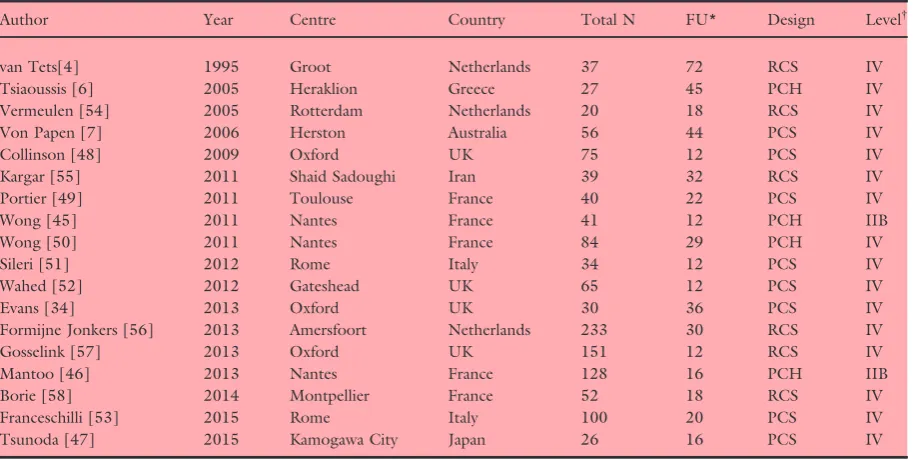
[image:3.595.108.506.462.690.2]The search yielded a total of 47 manuscripts for full text review (Fig. 1). From these, 18 articles published between 1995 and 2015 contributed to the systematic review, providing data on outcomes in a total of 1238 patients (range 20–233 patients per study) based on 18 defined patient cohorts (Table 1). Specific exclusions after full-text review (and after exclusion of non-English language publications) included 4 studies where the pop-ulation sample was confirmed to be less than 20 patients [5,36–38], 4 studies of out-of-scope procedures [9– 11,39], 2 studies where data were considered a duplicate
[34,40], and 10 studies where outcomes could not be segregated by eligible procedure; [12–21] other exclusion criteria were: constipation not representing an indication (n=2) [32,41], follow-up less than 12 months (n=5) [8,33,35,42,43], and lack of primary patient data (one international survey on 391 surgeons) [44].
The general quality of studies was poor due to inade-quate description of methods. The 18 included studies were all observational with no randomised controlled trials. These comprised two good quality prospective cohort studies [45,46] (level IIB), and 16 (level IV) studies comprising two poor quality case-control studies [34,47], eight prospective case series [6,7,48–53], and six retrospective case series [4,54–58]. Mean patient fol-low-up ranged from 12 to 72 months (median 25 months). Fifteen studies derived from European centres, with one each from Australia, Iran and Japan.
Perioperative data
Perioperative data were reported by all 18 studies (Table 2). Reporting of procedure duration was incon-sistent but median procedural duration for laparoscopic ventral mesh rectopexy (LVMR) was 159 (range 75– 198) min; for robotic ventral mesh rectopexy (RVMR), 205 (range 191–218) min; for laparoscopic resection rectopexy (LRR), 123 min (one study) [45,46]. Although robotic procedures appeared to take longer, substantial non-reporting of other procedures
precluded a clear finding. The two papers on RVMR were from the same centre. It is interesting to note a decrease in duration of operation, which may indicate a learning curve. Conversion to laparotomy was rare (me-dian 2%, range 0–8%) (Table 2), with the most com-mon reason being adhesions. The median length of stay (LOS) was similar for procedures: LVMR, median 3.3 (range 1.0–7.1) days; RVMR, median 4.3 (range 4.0–4.6) days (data from one centre via two reports) [45,46]; LRR, 4 days (data from one study) [7]. LOS possibly reflected local policy rather than clinical need, since day case procedures have been shown to be feasi-ble [59,60]. The reason to keep patients in hospital for up to 1 week was not documented. Only one paper commented on LOS after open rectopexy (OR) (8.5 days) [54].
Summary evidence statements: perioperative data
1 Procedures are reported to take from 1.5 to 3.5 h, with consequent typical LOS of 4–5 days (level IV). 2 There was no clear variation between procedures in
perioperative measures, although non-reporting by studies may have concealed differences (level IV).
Harms
[image:4.595.60.518.90.320.2]There was a considerable heterogeneity in surgical morbidity reported as well as in overall procedural Table 1All studies included in systematic review.
Author Year Centre Country Total N FU* Design Level†
van Tets[4] 1995 Groot Netherlands 37 72 RCS IV
Tsiaoussis [6] 2005 Heraklion Greece 27 45 PCH IV
Vermeulen [54] 2005 Rotterdam Netherlands 20 18 RCS IV
Von Papen [7] 2006 Herston Australia 56 44 PCS IV
Collinson [48] 2009 Oxford UK 75 12 PCS IV
Kargar [55] 2011 Shaid Sadoughi Iran 39 32 RCS IV
Portier [49] 2011 Toulouse France 40 22 PCS IV
Wong [45] 2011 Nantes France 41 12 PCH IIB
Wong [50] 2011 Nantes France 84 29 PCH IV
Sileri [51] 2012 Rome Italy 34 12 PCS IV
Wahed [52] 2012 Gateshead UK 65 12 PCS IV
Evans [34] 2013 Oxford UK 30 36 PCS IV
Formijne Jonkers [56] 2013 Amersfoort Netherlands 233 30 RCS IV
Gosselink [57] 2013 Oxford UK 151 12 RCS IV
Mantoo [46] 2013 Nantes France 128 16 PCH IIB
Borie [58] 2014 Montpellier France 52 18 RCS IV
Franceschilli [53] 2015 Rome Italy 100 20 PCS IV
Tsunoda [47] 2015 Kamogawa City Japan 26 16 PCS IV
PCH, prospective cohort study; RCS, retrospective case series; PCS, prospective case series study. *Mean follow up in months.
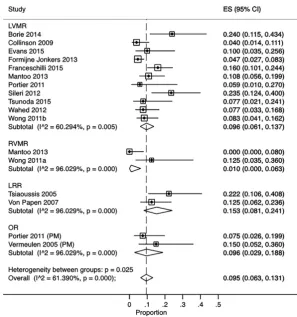
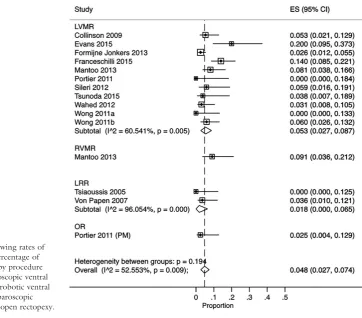
complication rates (Fig. 2), with individual study rates varying from 0.0% to 23.5% (Table 2). Such hetero-geneity may reflect different inclusion, thresholds or conventions for recording complications. Complica-tions typically occurred in about 5–15% of patients. Pooled findings suggest that LRR might be associated with higher morbidity (total complications 15% for LRR vs 10% LVMR) although the findings were not statistically significant (Z-test, P=0.30), and absolute patient numbers were small for LRR. The majority of complications were minor and included urinary tract infections (the most common reported), wound infec-tions, haematoma formation, persistent pain and uri-nary retention. There were some more serious complications including port-site hernia, small bowel obstruction (usually after conversion but also related to mesh or suture adhesions), osteomyelitis and blad-der injury (often when associated to bladblad-der prolapse surgery). Specific mesh complication rates were rare, with only five occurrences after 939 procedures (0.53%). Overall, procedures were safe: conversion to laparotomy was rare (median 2%, range 0–8%) (Table 2), with the most common reason being adhe-sions; stoma was only reported in one study; no peri-operative deaths were reported. Two open rectopexy
procedures (posterior mesh) were described, but data concerning post-operative complications were limited. There was no mortality recorded after any resuspension procedures.
Summary evidence statements: harms
1 Data on harms were inconsistently reported and heterogeneous, making estimates of harm tentative and imprecise (level IV).
2 Complications typically occurred in about 5–15% of procedures (level IV).
3 Mesh complications were reported in a minority of studies and occurred in about 0.5% (range 0–3.9%) of patients overall (level IV).
4 No mortality was recorded after any resuspension procedure, in a total of 1044 patients reporting this outcome (level IV).
Efficacy
Measurement of clinical outcomes was inconsistent and included the variable use of validated and un-validated scoring instruments for symptoms, such as Patient Assessment of Constipation Quality of Life (PAC-Figure 2 Forest plot showing rates of
[image:6.595.214.512.72.390.2]QOL) and Patient Assessment of Constipation-Symp-toms (PAC-SYM) scores (one study only) [57], Cleve-land Clinic Constipation score [34,47,48,50,51,53,56], obstructed defecation syndrome (ODS) score [46,50,56,58], Knowles-Eccersley-Scott score (KESS) [48], Cleveland Clinic Incontinence score [46,49,56], Faecal Incontinence Severity Index (FISI) [47,48,51– 53,56–58] and St Marks Incontinence score [48]. Glo-bal ‘success’ or ‘satisfaction’ ratings (GSR) were obtained via a variety of methods in 7 studies (where ‘satisfied’ or ‘very satisfied’, ‘good’, ‘very good’, and ‘excellent’ were interpreted as a positive outcome or overall improvement). Further studies also reported individual symptoms. No study reported acquiring data objectively using personnel not involved in the surgical care of the patient or data collection blinded to inter-vention status. Average reported studies follow-up was 31 months (range 12–72 months).
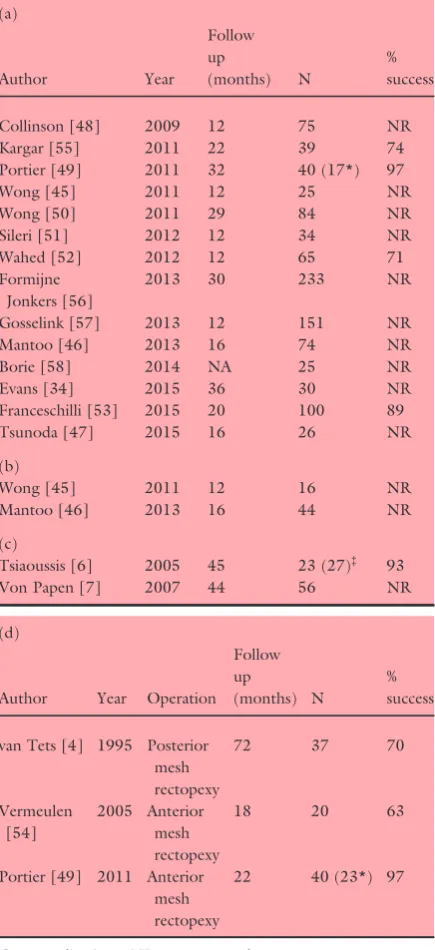
Accepting these methodological limitations, several reports assert that most patients undergoing rectal sus-pension procedures were satisfied. Meta-analysis of stud-ies reporting a summary measure found considerable heterogeneity, which may reflect variation in measure-ments, patients or procedures. Overall improvement (a good or satisfactory outcome) was reported in 83% (95%CI: 74–91%, I2=77%) of cases, based on 328
patients (Table 3; Fig. 3). Similar levels of improvement were recorded for LVMR and OR; only one small study reported improvement after LRR, and data were not available for RVMR.
The initial aim of ‘suspension’ procedures is to treat symptoms. Functional assessment of constipation is therefore the most important outcome. However, many patients also suffer from incontinence, typically post-defaecatory seepage. The various scoring instru-ments and functional outcomes employed are reported in Table 4. Generally, measures are too sparsely reported to be informative. For LVMR, Cleveland Clinic Constipation score improved from a median of 14 (range 7–18) to a median of 5 (range 4–7) in 6 studies providing pre- and post-operative data. Improvement in constipation was highly heteroge-neous and only reported in a minority of studies, varying from 20% to 97%. By pooling data for LVMR, the reported improvement in constipation was 86% (95%CI: 20–97%).
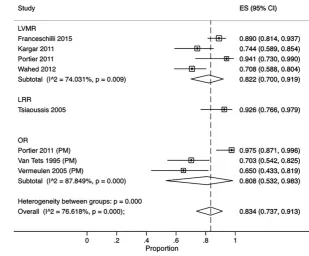
While the clinical outcome has primacy, the most immediate visible consequence of surgery is to correct anatomy. Therefore, an assessment of anatomical recur-rence is also important (although necessarily represent-ing only a surrogate outcome). Anatomical recurrence rates varied between 0 to 21% (Fig. 4), but typically occurred in 2–7% of patients in most studies. Functional
[image:7.595.318.536.126.602.2]outcome data on robotic surgery and LRR were rarely available, but again anatomical correction was very likely achieved with both procedures. No conclusions about functional or anatomical outcomes could be made for the other rectopexy procedures.
Table 3 Overall improvement based on global satisfaction rat-ings (GSR). (a) Laparoscopic ventral mesh rectopexy (LVMR). (b) Robotic ventral mesh rectopexy (RVMR). (c) Laparoscopic resection rectopexy (LRR). d) Open rectopexy (OR).
(a)
Author Year
Follow up
(months) N
% success
Collinson [48] 2009 12 75 NR
Kargar [55] 2011 22 39 74
Portier [49] 2011 32 40 (17*) 97
Wong [45] 2011 12 25 NR
Wong [50] 2011 29 84 NR
Sileri [51] 2012 12 34 NR
Wahed [52] 2012 12 65 71
Formijne Jonkers [56]
2013 30 233 NR
Gosselink [57] 2013 12 151 NR
Mantoo [46] 2013 16 74 NR
Borie [58] 2014 NA 25 NR
Evans [34] 2015 36 30 NR
Franceschilli [53] 2015 20 100 89
Tsunoda [47] 2015 16 26 NR
(b)
Wong [45] 2011 12 16 NR
Mantoo [46] 2013 16 44 NR
(c)
Tsiaoussis [6] 2005 45 23 (27)‡ 93
Von Papen [7] 2007 44 56 NR
(d)
Author Year Operation Follow up
(months) N
% success
van Tets [4] 1995 Posterior mesh rectopexy
72 37 70
Vermeulen [54]
2005 Anterior mesh rectopexy
18 20 63
Portier [49] 2011 Anterior mesh rectopexy
22 40 (23*) 97
Cx, complications; NR, not reported. *17 were laparoscopic, 23 open.
Summary evidence statements: efficacy
1 Data on efficacy were inconsistently reported and findings heterogeneous, making estimates tentative and imprecise (level IV).
2 Although inconsistent, patient GSR suggest that a good or satisfactory outcome typically occurs in 83% (74–91%) of patients (level IV).
3 Similar levels of satisfaction were recorded for all pro-cedures where data were available (LVMR, OR, LRR) (Level IV).
4 Patient-reported improvements in constipation occurred in 86% (95%CI: 20–97%) of patients after LVMR (Level IV).
5 Limited evidence found consistently improved Cleve-land Clinic Constipation scores for patients undergo-ing LVMR (level IV).
6 Anatomical recurrence typically occurred in about 2– 7% of patients (level IV).
Patient selection
Patient selection is perceived by many experts as extre-mely important when choosing the surgical approach. Whilst these procedures may be efficient at correcting normal anatomy (median 95%, range 79–100%), many underlying functional and organic pathologies may jeopardize the success of surgery in the attempt of ‘cur-ing’ the patient [61]. Fifteen of 18 papers highlight the fact that all patients had undergone a period of conser-vative management. Other than this common feature,
selection was inconsistent. Even the diagnosis of abnor-mal anatomy varied throughout the literature. Studies described interventions for patients with: ungraded intussusception [7,54]; ‘rectoanal’ intussusception [6,47]; ‘high grade’ intussusception [57]; ‘grade 3 or 40 intussusception [48,49,51,53,56]; ‘anterior or circum-ferential’ intussusception [4]; rectocoele +/- intussus-ception [52,54,58] or +/- cystocoele [13]; complex rectocoele of above 2–3 cm [50]; multi-compartment pelvic floor disorders [46]; solitary rectal ulcer syn-drome (SRUS) [34,55]. Thus, it was difficult to draw any conclusions as to which group could benefit from intervention. When summarising the data, the most common theme regarding patient selection is a high grade intussusception (i.e. rectoanal or Oxford grade ≥3). Table 5 lists the papers where this inclusion crite-rion has been adopted and one of the primary indica-tions along with a summary of the outcome measures reported (if given in more than one paper). The conclu-sions from this sub-analysis resemble those described in the whole review.
[image:8.595.203.513.73.329.2]SRUS deserves specific mention as two papers included patients specifically diagnosed with this condi-tion [34,55]. Patients report passage of mucus and bloody liquid on defaecation, with an ulcer seen within the rectum. Treatment is conservative, initially using biofeedback and behavioral intervention. A proportion of patients present an element of internal intussuscep-tion, which may reflect the ulcerated area as the apex of the intussusception, repetitively traumatised with strain-ing. The surgical correction of a prolapse (when Figure 3 Forest plot showing rates of
T able 4 Fu nctional and cl inical outcomes by proce dure. (a) Laparoscopi c ventral m es h rectopexy (LVMR). (b) Ro botic vent ral mesh rec topexy (RVM R). (c) Lapa roscopic resect ion rec topexy (L RR). (d) Ope n rectopexy (OR) . (a ) A uthor Year N CCS pre CCS post ODS pre ODS post FISI pre F ISI post Co nstipation im proved % Anat omica l recu rrence % Co llinso n [48] 2009 75 1 2 5 N R N R 2 8 8 86 5 K argar [55] 2011 39 NR NR NR NR NR NR NR NR Po rtier [49] 2011 40 NR NR NR NR NR NR Wor se 2.5 Wong [45] 2011 25 NR NR NR NR NR NR NR 0 Wong [50] 2011 84 7 5 NR* NR* NR NR Im proved 6.3 Siler i [51] 2012 34 1 6 7 N R N R 9 3 N R 5.9 Wa hed [52] 2012 65 NR* NR* NR NR NR* NR* 97 3.7 F ormijn e Jonk ers [56] 2013 233 NR 8 .1 NR* NR* NR* NR* 81 2.6 Gos selink [57] 2013 151 NR NR NR NR NR* NR* NR NR Ma ntoo [46] 2013 74 NR NR NR † NR † NR NR NR 8 Bo rie [58] 2014 25 NR NR 16 7.6 24 2 2 0 N R Eva ns [34] 2015 30 1 7 6 N R N R 1 9 N R N R 2 1 F ranceschilli [53] 2015 100 1 8.4 5 .5 N R N R NR* NR* 89 14 T sunoda [47] 2015 26 1 1 4 N R N R 3 0 6 NR 3.8 (b) Wong [45] 2011 16 NR NR NR NR NR NR NR NR Ma ntoo [46] 2013 44 NR NR NR NR NR NR NR † 8 (c ) T siaoussis [6] 2005 23 (27) ‡ NR NR NR NR NR NR NR 0 V o n Pape n [7] 2007 56 NR NR NR NR NR NR 53 3.6
(d) Author
detected) may be reasonable in the hope of resolving the ulcer. Data on a total of 75 patients with SRUS who have undergone LVMR are available from the two papers. Healing of the ulcer occurred in 78% of patients after surgery.
Summary evidence statements: patient selection
[image:10.595.147.510.72.390.2]1 Although patient selection is perceived as vital in pre-dicting outcome, it was inconsistently documented (level IV).
Figure 4 Forest plot showing rates of anatomical recurrence (percentage of patients) after rectopexy by procedure type. KEY: LVMR, laparoscopic ventral mesh rectopexy; RVMR, robotic ventral mesh rectopexy; LRR, laparoscopic resection rectopexy; OR, open rectopexy.
Table 5Summary of papers where participants had a high grade internal intussusception (rectoanal, Oxford grade≥3).
Author Year Op N FU % success
CCS pre
CCS post
FISI pre
FISI post
Constipation improved
Anatomical recurrence
Tsiaoussis [6] 2005 † 27 45 93 NR NR NR NR NR 0
Collinson [48] 2009 LVMR 75 12 NR 12 5 28 8 86 5
Portier [49] 2011 * 40 22 97 NR NR NR NR Worse 2.5
Wong [45] 2011 ‡ 41 12 NR NR NR NR NR NR 6.3
Sileri [51] 2012 LVMR 34 12 NR 16 7 9 3 NR 5.9
Formijne Jonkers [56]
2013 LVMR 233 30 NR 8.1 NR NR NR NR 2.6
Gosselink [57] 2013 LVMR 151 12 NR NR NR NR NR NR NR
Borie [58] 2014 LVMR 52 1–18 NR NR NR 24 2 20 NR
Evans [34] 2015 LVMR 30 36 NR 17 6 19 NR NR 21
Franceschilli [53] 2015 LVMR 100 20 89 18.4 5.5 NR NR 89 14
Tsunoda [47] 2015 LVMR 26 16 NR 11 4 30 6 NR 3.8
*Lap and Open Ant mesh rectopexy.
†Lap resection rectopexy.
[image:10.595.60.515.424.599.2]2 One common indication appears to be high grade rectal intussusception (level IV).
3 For high grade intussusception, LVMR, RVMR and resection rectopexy typically correct anatomy in about 80–100% of cases (level IV).
4 If SRUS is associated with prolapse, a LVMR typi-cally results in healing of the ulcer in around 80% of patients (level IV).
Discussion
A systematic review of evidence for the perioperative and long terms benefits and harms of rectal suspension procedures identified no high quality studies. The evi-dence base is characterised by observational studies of variable and often uncertain methodological quality. Definitions are poor, e.g. grading of complications was inconsistent. Future studies should provide robust and comparative evidence for clinicians to support patient decision making, in terms both of the incremental bene-fits and harms of suspension procedures. A Clavien-Dindo (or equivalent) classification is essential. Greater understanding is required of the mediating effects of prognostic factors particularly preoperative definition of both functional and radiological parameters that impact upon treatment success. Relevant to future research would be to define a minimum set of outcomes for reporting future studies. Finally, and most obviously, the evidence base requires urgent augmentation with some high quality studies focused on having at least one well powered randomized controlled trial to inform future clinical decision making.
Acknowledgments
We would like to acknowledge the following people in relation to the NIHR CapaCiTY working group: Mr Steven Brown, Sheffield Teaching Hospitals NHS Foundation Trust; Mr Kenneth Campbell, The Univer-sity of Dundee, NHS Education for Scotland; Mr Mark Chapman, Heart of England NHS Trust; Mr Andrew Clarke, Poole Hospital NHS Foundation Trust; Mr Neil Cruickshank, Sandwell and West Birmingham Hospitals NHS Trust; Mr Anthony Dixon, University of Bristol, Bristol, UK; Dr Christopher Emmett, County Durham and Darlington NHS Foundation Trust; Mr Ugo Grossi, Queen Mary University of London; Dr Richard Hooper, PCTU, Queen Mary University of London; Miss Emma Horrocks, University Hospital Southamp-ton NHS Foundation Trust; Professor Charles Knowles, Queen Mary University of London; Mr Jon Lacy-Col-son, Shrewsbury and Telford Hospital NHS Trust; Mr Ian Lindsey, Oxford University Hospitals NHS Trust;
Professor James Mason, University of Warwick, Coven-try; Mr Mark Mercer-Jones, Gateshead Health NHS Foundation Trust; Mr Andrew Miller, University Hospitals of Leicester NHS Trust; Mr David Pares, Hospital Germans Trias i Pujol, Barcelona, Spain; Miss Sophie Pilkington, University Hospital Southampton NHS Foundation Trust; Mr Neil Smart, Royal Devon & Exeter NHS Foundation Trust; Ms Natasha Stevens, PCTU, Queen Mary University of London; Professor Douglas Tincello, University Hospitals of Leicester NHS Trust; Miss Karen Telford, South Manchester NHS Foundation Trust; Mr Paul Vollebregt, Queen Mary University of London; Mr Andrew Williams, Guy’s and Thomas’ NHS Foundation Trust; Professor Yan Yiannakou, County Durham and Darlington NHS Foundation Trust.
Conflict of interest
The authors declare no conflict of interest.
Funding
This project was funded by the National Institute for Health Research (NIHR) Programme Grant for Applied Research (RP-PG-0612-20001). The views and opin-ions expressed in this report are those of the authors and are not those of the PGfAR Programme, NIHR, the UK National Health Service, or the UK Depart-ment of Health.
References
1 D’Hoore A, Penninckx F. Obstructed defecation.Colorectal Dis2003;5:280–7.
2 Shorvon PJ, McHugh S, Diamant NE, Somers S, Steven-son GW. Defecography in normal volunteers: results and implications.Gut1989;30:1737–49.
3 Tou S, Brown SR, Nelson RL. Surgery for complete (full-thickness) rectal prolapse in adults.Cochrane Database Syst Rev, 2015;11:CD001758.
4 Vantets WF, Kuijpers JHC. Internal rectal intussusception -fact or fancy.Dis Colon Rectum1995;38:1080–3. 5 Graf Wet al.Functional results after abdominal suture
rec-topexy for rectal prolapse or intussusception. Eur J Surg 1996;162:905–11.
6 Tsiaoussis J et al. Rectoanal intussusception: presentation of the disorder and late results of resection rectopexy.Dis Colon Rectum2005;48:838–44.
7 von Papen Met al.Functional results of laparoscopic resec-tion rectopexy for symptomatic rectal intussuscepresec-tion. Dis Colon Rectum2007;50:50–5.
9 Biviano Iet al.Comparative outcome of stapled trans-anal rectal resection and macrogol in the treatment of defeca-tion disorders.World J Gastroenterol2011;17:4199–205. 10 Hirst GR et al. The role of rectocele repair in targeted
patients with obstructed defaecation. Colorectal Dis 2005; 7:159–63.
11 Sabbagh R et al. Long-term anatomical and functional results of laparoscopic promontofixation for pelvic organ prolapse.BJU Int2010;106:861–6.
12 Sitzler PJet al.Long-term clinical outcome of surgery for solitary rectal ulcer syndrome.Br J Surg1998;85:1246– 50.
13 Bruch HP et al. Laparoscopic surgery for rectal prolapse and outlet obstruction. Dis Colon Rectum 1999; 42: 1189–94.
14 Schultz Iet al. Whole gut transit is prolonged after Rip-stein rectopexy.Eur J Surg1999;165:242–7.
15 Badrek-Amoudi AH et al. Laparoscopic ventral mesh rec-topexy in the management of solitary rectal ulcer syndrome: a cause for optimism?Colorectal Dis2013;15:575–81. 16 Laubert Tet al.Obstructive defecation syndrome: 19 years
of experience with laparoscopic resection rectopexy. Tech Coloproctol2013;17:307–14.
17 Mackenzie H, Dixon AR. Proficiency gain curve and pre-dictors of outcome for laparoscopic ventral mesh rectopexy. Surgery2014;156:158–67.
18 Owais AE et al. Laparoscopic ventral mesh rectopexy in male patients with internal or external rectal prolapse. Colorectal Dis2014;16:995–1000.
19 Gravie JF, Maigne C. “Wrap technique”: a new operative procedure using a self-adhesive prosthesis for laparoscopic ventral rectopexy.Tech Coloproctol2015;19:361–3. 20 Gultekin FAet al.Safety of laparoscopic ventral rectopexy
in the elderly: results from a nationwide database. Dis Colon Rectum2015;58:339–43.
21 Abet Eet al.Sexual function and laparoscopic ventral rec-topexy for complex rectocoele. Colorectal Dis 2012; 14: e721–6.
22 Ramage L et al.Is robotic ventral mesh rectopexy better than laparoscopy in the treatment of rectal prolapse and obstructed defecation? A meta-analysis Tech Coloproctol 2015;19:381–9.
23 Faucheron JL et al. Anterior rectopexy for full-thickness rectal prolapse: technical and functional results. World J Gastroenterol2015;21:5049–55.
24 Gouvas N et al. Ventral colporectopexy for overt rectal prolapse and obstructed defaecation syndrome: a systematic review.Colorectal Dis2015;17:O34–46.
25 Rondelli Fet al.Robot-assisted or conventional laparoscoic rectopexy for rectal prolapse? Systematic review and meta-analysis.Int J Surg2014;12(Suppl 2):S153–9.
26 Cadeddu Fet al. Focus on abdominal rectopexy for full-thickness rectal prolapse: meta-analysis of literature. Tech Coloproctol2012;16:37–53.
27 Samaranayake CBet al. Systematic review on ventral rec-topexy for rectal prolapse and intussusception. Colorectal Dis2010;12:504–12.
28 Shastri-Hurst N, McArthur DR. Laparoscopic rectopexy for rectal prolapse: will it be the gold standard?Indian J Surg2014;76:461–6.
29 Cullen J, Rosselli JM, Gurland BH. Ventral rectopexy for rectal prolapse and obstructed defecation.Clin Colon Rec-tal Surg2012;25:34–6.
30 Harmston C, Jones O. The evolution of laparoscopic sur-gery for rectal prolapse.Int J Surg2011;9:370–3. 31 Senagore AJ. Management of rectal prolapse: the role of
laparoscopic approaches. Semin Laparosc Surg 2003; 10: 197–202.
32 Lahr SJ et al., Operative management of severe constipa-tion.Am Surg1999;65:1117–21: discussion 1122-3. 33 Silvis Ret al.Abdominal rectovaginopexy - Modified
tech-nique to treat constipation.Dis Colon Rectum1999; 42: 82–8.
34 Evans C et al. Laparoscopic ventral rectopexy is effective for solitary rectal ulcer syndrome when associated with rec-tal prolapse.Colorectal Dis2014;16:O112–6.
35 Schultz Iet al.Continence is improved after the Ripstein rectopexy - Different mechanisms in rectal prolapse and rectal intussusception?Dis Colon Rectum 1996; 39:300– 6.
36 Orrom WJ et al. Rectopexy is an ineffective treatment for obstructed defecation. Dis Colon Rectum 1991; 34: 41–6.
37 Tweedie DJ, Varma JS. Long-term outcome of laparo-scopic mesh rectopexy for solitary rectal ulcer syndrome. Colorectal Dis2005;7:151–5.
38 van den Esschert JWet al. Laparoscopic ventral rectopexy for obstructed defecation syndrome.Surg Endosc2008;22: 2728–32.
39 Portier G et al. Malone antegrade colonic irrigation: ileal neoappendicostomy is the preferred procedure in adults. Int J Colorectal Dis2006;21:458–60.
40 Johnson E et al. Resection rectopexy for internal rectal intussusception reduces constipation and incomplete evacu-ation of stool.Eur J Surg Suppl2003;588:51–6. 41 Maggiori L et al. Laparoscopic ventral rectopexy: a
prospective long-term evaluation of functional results and quality of life.Tech Coloproctol2013;17:431–6.
42 Schultz Iet al.Long-term results and functional outcome after Ripstein rectopexy.Dis Colon Rectum2000;43:35– 43.
43 Wong MTC et al. Robotic versus laparoscopic rectopexy for complex rectocele: a prospective comparison of short-term outcomes.Dis Colon Rectum2011;54:342–6. 44 Formijne Jonkers HA et al.Evaluation and surgical
treat-ment of rectal prolapse: an international survey.Colorectal Dis2013;15:115–9.
45 Wong MTet al.Minimally invasive ventral mesh rectopexy for complex rectocoele: impact on anorectal and sexual function.Colorectal Dis2011;13:e320–6.
47 Tsunoda A et al. Laparoscopic ventral rectopexy for rec-toanal intussusception: postoperative evaluation with proc-tography.Dis Colon Rectum2015;58:449–56.
48 Collinson Ret al.Laparoscopic ventral rectopexy for inter-nal rectal prolapse: short-term functiointer-nal results.Colorectal Dis2010;12:97–104.
49 Portier Get al.The effect of abdominal ventral rectopexy on faecal incontinence and constipation in patients with internal intra-anal rectal intussusception. Colorectal Dis 2011;13:914–7.
50 Wong M et al.Safety and efficacy of laparoscopic ventral mesh rectopexy for complex rectocele.Colorectal Dis2011; 13:1019–23.
51 Sileri P et al. Laparoscopic ventral rectopexy for internal rectal prolapse using biological mesh: postoperative and short-term functional results.J Gastrointest Surg2012;16: 622–8.
52 Wahed Set al. Short-term results for laparoscopic ventral rectopexy using biological mesh for pelvic organ prolapse. Colorectal Dis2012;14:1242–7.
53 Franceschilli Let al. Laparoscopic ventral rectopexy using biologic mesh for the treatment of obstructed defaecation syndrome and/or faecal incontinence in patients with inter-nal rectal prolapse: a critical appraisal of the first 100 cases. Tech Coloproctol2015;19:209–19.
54 Vermeulen Jet al.Anterolateral rectopexy for correction of rectoceles leads to good anatomical but poor functional results.Tech Coloproctol2005;9:35–41; discussion 41. 55 Kargar S et al. Laparoscopic rectopexy in solitary rectal
ulcer.Acta Med Iran2011;49:810–3.
56 Formijne Jonkers HAet al.Laparoscopic ventral rectopexy for rectal prolapse and symptomatic rectocele: an analysis of 245 consecutive patients.Colorectal Dis2013;15:695–9. 57 Gosselink MPet al.Impact of slow transit constipation on
the outcome of laparoscopic ventral rectopexy for obstructed defaecation associated with high grade internal rectal prolapse.Colorectal Dis2013;15:e749–56. 58 Borie Fet al.Laparoscopic ventral rectopexy for the
treat-ment of outlet obstruction associated with recto-anal intus-susception and rectocele: a valid alternative to STARR procedure in patients with anal sphincter weakness. Clin Res Hepatol Gastroenterol2014;38:528–34.
59 Powar MP, Ogilvie JW Jr, Stevenson AR. Day-case laparo-scopic ventral rectopexy: an achievable reality. Colorectal Dis2013;15:700–6.
60 George Ret al.Re: day-case laparoscopic ventral rectopexy. Colorectal Dis2013;15:1450–1.