© 2019, IRJET | Impact Factor value: 7.211 | ISO 9001:2008 Certified Journal | Page 1818
IMAGE AND SIGNAL FILTERING USING FIR FILTER MADE USING
APPROXIMATE HYBRID HIGH RADIX ENCODING FOR
ENERGY-EFFICIENT INEXACT MULTIPLIERS USING 4:2 COMPRESSORS
G. Sri Vidhya
1, S. Esther Ranjani
2, R.S. Haripriya
3, G. Ashweetha
4, Devareddy Priyanka
51
Assistant Professor, Dept. of ECE, Panimalar Engineering College, Poonamalle, Tamilnadu, India
2,3,4,5UG Students, Dept. Of ECE, Panimalar Engineering College, Poonamalle, Tamilnadu, India
---***---Abstract - Hybrid high base encoding for generating the partial products in signed multiplications that encodes the foremost important bits with the correct radix-4 Approximate computing forms a design alternative that exploits the intrinsic error resilience of assorted applications and produces energy-efficient circuits with little accuracy loss. During this paper, we propose associate approximate coding and also the least significant bits with an approximate higher base radix-2k encoding. Theapproximations are performed by rounding the high base values to their nearest power of 2. The projected technique is organized to attain the specified energy–accuracy tradeoffs. Compared with the correct radix-4 multiplier, the projected multipliers accomplish area savings.
Finite Impulse Response filters are the foremost necessary element in signal processing and communication. Area optimization and speed are the key needs of Finite Impulse Response filters. Finite Impulse Response filter involves multiplications, additions and shifting operations. As the multiplier is the slowest element in the system, it will affect the performance of the FIR filter. In this paper, Finite Impulse Response filter based on modified Booth multiplier is designed and compared with typical filter, during which former reduces both area and delay.
1. INTRODUCTION
Approximate computing has emerged as a possible solution for the design of energy-efficient digital systems. In this paper, the design of inexact multipliers by applying approximations on the partial product generation is done. We propose a novel approximate hybrid high radix encoding with 4:2 compressor techniques[1].In the projected technique, the most significant Bits (MSBs) of the multiplicand are encoded using the radix-4 encoding.
The Least Significant Bits (LSBs) of the multiplicand are encoded using a radix-2k (with k ≥ 4), whereas the ‘k’ is Least
significant a result. It composes a promising design paradigm targeting energy-efficient systems by extraordinarily decreasing the power consumption of inherently error resilient applications. Approximate computing exploits the innate error tolerance of the assorted applications and deliberately relaxes the correctness of some computations, so as to decrease their power consumption and/or accelerate their execution. Approximations on the partial product generation[1] and approximations on their accumulation are synergistic, and may be applied unitedly so as to attain higher power reduction. In this paper, targeting the design of inexact multipliers by applying approximations on the partial product generation, we propose a novel approximate hybrid high radix encoding. In the planned technique, the most significant bits (MSBs) of the multiplicand are encoded using the radix-4 encoding, whereas the k least significant bits (LSBs) are encoded using a radix-2k (with k ≥ 4). To
simplify the increased complexity induced by the proposed hybrid encoding, the circuit for generating the partial products is approximated by altering accordingly its truth table. Hence, the number of the partial Products decreases considerably and simpler tree architectures are used for their accumulation, reducing the multiplier’s energy consumption, area, and critical path delay.
1.1Hybrid high radix encoding
We propose and enable the application of hybrid high base encodings for the generation of energy-efficient approximate multipliers, exceeding the increased hardware complexity of very high radix encodings. The projected technique will be applied to any multiplier architecture and is reconfigurable, enabling the user to pick out the optimum per application energy–error tradeoff.
1.2Analytical error analysis
An analytical error analysis is conducted, showing that the output error of the proposed technique is finite and certain[2]. Such a rigorous error analysis leads to precise and a priori error estimation for any input distribution, without the need of
© 2019, IRJET | Impact Factor value: 7.211 | ISO 9001:2008 Certified Journal | Page 1819
partial products in signed multiplications that encodes the most significant bits with the accurate radix-4 encoding and least significant bits with an approximate higher radix -2^k encoding. The approximations are performed by rounding high radix value to their nearest power of two. In the proposed technique the multiplicand B is encoded using the approximate high radix encoding, generating B bar, and the approximate multiplication A.B bar is performed. In addition we replace the normal adder circuit into 4:2 Compressor techniques because of area reduction, in the existing once the area will be large because of normal adder circuit occupy larger area in the operation.1.4 FIR FILTER
Finite Impulse Response (FIR)[6] filters are widely used in Digital Signal Processing (DSP) applications due to their stability and linear-phase property. In today scenario, low power consumption and less area are the most important parameter for the fabrication of DSP systems and high performance systems.
Nowadays, many finite impulse response (FIR) filter designs aimed at either low area or high speed or reduced power consumption are developed [7]. With the increase in area, hardware cost of these FIR filters are increasing.
This leads to design a low area FIR filter with the advantage of moderate speed performance. The implementation of an FIR filter needs three basic building blocks. They are Multiplication [9], Addition and Signal delay.
Multipliers consume the foremost amount of space in a FIR filter design. As the multiplier is the slowest element in the system, it will affect the performance of the FIR filter [8].
Here, Conventional multipliers are replaced by a modified Booth multiplier. Modified booth multiplier performs the computations using lesser number of adders and repetitious steps. As a result of that they cover lesser area as compared to the standard multiplier.
This is a very vital criterion because in the fabrication of chips and high performance system requires components that are as small as possible. Modified Booth is twice as fast as conventional multiplier. It produces only half the number of partial products (PPs) when compared with an ordinary binary multiplication. Modified Booth encoding (MBE) [9] scheme is known as the most effective Booth encoding and decoding scheme.
II.LITERATURE SURVEY:
Approximate computing has received vital attention as a promising strategy to decrease power consumption of inherently
error tolerant applications.
In this paper, we tend to target hardware-level approximation by introducing the partial product perforation technique for designing approximate multiplication circuits. Approximate computing is an attractive design methodology to realize low power, high performance (low delay) and reduced circuit complexity by relaxing the requirement of accuracy. In this paper, approximate Booth multipliers are designed based on approximate radix-4 modified Booth encoding (MBE) algorithms and a regular partial product array that employs an approximate Wallace tree.
© 2019, IRJET | Impact Factor value: 7.211 | ISO 9001:2008 Certified Journal | Page 1820
III. MODULE EXPLANATION:3.1 APPROXIMATE HYBRID HIGH RADIX MULTIPLIERS
The high radix encodings require complex encoding and partial product generation circuits negating thus the benefits of the partial products reduction [4]. The circuit complexity is presented encoding and the performed approximations for simplifying
its proposed hybrid high radix. In the proposed technique, the multiplicand B is encoded using the approximate high radix
encoding, generating ˜B, and the approximate multiplication A・ ˜B is performed [5]. Finally, its adaptation on inexact 16-bit multipliers is described, and a qualitative analysis is conducted, targeting to estimate the potential area gains.
In the proposed hybrid high radix encoding, B is divided in two groups: the MSB part of n-k bits and the LSB part of k bits. The MSB part is encoded using the radix-4 (modified Booth) encoding while the LSB part is encoded with the high radix-2k
encoding. The hybrid high radix encoding is characterized by increased logic complexity, due to the high radix values of y0R2k that are not power of two, and thus, an approximate version is proposed. However, so as to retain high accuracy, the radix-4 encoding of the MSB is performed accurately.
[image:3.595.131.523.339.787.2]In particular, in the approximate encoding, all the values that are not power of two and the k − 4 smallest powers of two as well, are rounded to the nearest of the 4 largest powers of two or 0, so that the sum of all the values of the approximate Digit is y0^R2k is 0. We choose to keep only the four smallest power of two, so that the radix-2k encoding circuit requires only about area in comparison with the accurate radix-4 encoder.
[image:3.595.213.382.638.748.2]Fig 1: accurate radix-4 encoding
Fig 2: accurate radix -64 encoding
© 2019, IRJET | Impact Factor value: 7.211 | ISO 9001:2008 Certified Journal | Page 1821
Fig 4: accurate radix-1024 encodingThe effectiveness of the approximate hybrid high radix encoding technique is explored with its application to 16-bit signed numbers, for k = 6, 8, 10, namely the LSBs are encoded using the radix-64, radix-256, and radix-1024 encoding, respectively. We are implementing the radix-1024 in 16-bit multiplier circuit.
Example 1: radix-1024 encoding the 16-bit multiplicand B grouped as
Similarly, the no powers of two are rounded to •±64, •±128, •±256, or ±512, and the smallest powers of two (•±1, ±2, ±4, ±8,±16,±32) are rounded to 0 or ±64. The encoder’s inputs are the bits b9, b8, . . . , b0 the approximate radix-1024 digit is y0^R1024∈ {0,±64,±128,±256,±512}, and the output signals that define y0^R1024 are sign, ×64, ×128, ×256, ×512
3.1.1 Partial Product Generation
In this planned hybrid encoding, the n − k MSBs of multiplicand B are encoded with the accurate radix-4 encoding, whereas the k LSBs are encoded with associate degree approximate radix-2kencoding. The implementation of the partial product accumulation is chosen by the designer. Overall, the multiplication circuit consists of stages of operand hybrid radix encoding, partial product generation, partial product accumulation, and final addition. The projected approximate multipliers are RAD2k named, showing the chosen approximate high base encoding, e.g., RAD64, RAD256, and RAD1024.The advantage of the approximate hybrid high base multipliers is their simple logic, resulting in fast operation and low power performance. The partial product generator deliver low space, and the reduction of the number of the partial products.
2.1.2 Hardware requirements
Field-Programmable Gate Array (FPGA)
A field-programmable gate array (FPGA) is an integrated circuit designed to be organized by the customer or designer after manufacturing—hence "field-programmable". The FPGA configuration is usually specified using a hardware description language (HDL), almost like that used for an application-specific integrated circuit (ASIC) (circuit diagrams were previously accustomed specify the configuration, as they were for ASICs, however this can be increasingly rare).
FPGAs will be accustomed implement any logical operate that an ASIC might perform. The ability to update the functionality after shipping, partial re-configuration of the portion of the design and the low non-recurring engineering costs relative to an ASIC design (not withstanding the generally higher unit cost), offer advantages for many applications.
3.1.3 SOFTWARE REQUIREMENTS:
Verification Tool ModelSim 6.4c Synthesis Tool
© 2019, IRJET | Impact Factor value: 7.211 | ISO 9001:2008 Certified Journal | Page 1822
IV Experimental analysis [image:5.595.198.394.138.279.2]SIMULATION RESULTS
[image:5.595.35.561.307.453.2]Fig 5: Block diagram of inexact multiplier using compressor
Fig 6: Output waveform of inexact multipliers using Compressor
Fig 7: Design summary of inexact multiplier using Compressor
Fig 6 & 7 shows the simulation output of proposed hybrid high radix encoding for inexact multipliers using 4:2 Compressor technique.
[image:5.595.35.559.486.567.2] [image:5.595.201.397.632.753.2]© 2019, IRJET | Impact Factor value: 7.211 | ISO 9001:2008 Certified Journal | Page 1823
Fig 9: Output waveform of inexact multiplier using adderFig 10: Design summary of inexact multiplier using adder
Fig 9 & 10 shows the existing hybrid high radix encoding for inexact multipliers.
[image:6.595.235.360.418.661.2]© 2019, IRJET | Impact Factor value: 7.211 | ISO 9001:2008 Certified Journal | Page 1824
Fig 12: Modified Booth Multiplier Based FIR Filter [image:7.595.132.462.108.284.2]Fig 13:Architecture of the modified Booth multiplier
[image:7.595.35.561.542.744.2]© 2019, IRJET | Impact Factor value: 7.211 | ISO 9001:2008 Certified Journal | Page 1825
Fig 15: Block diagram of FIRFig 16: SCHEMATIC VIEW
[image:8.595.42.560.513.739.2]© 2019, IRJET | Impact Factor value: 7.211 | ISO 9001:2008 Certified Journal | Page 1826
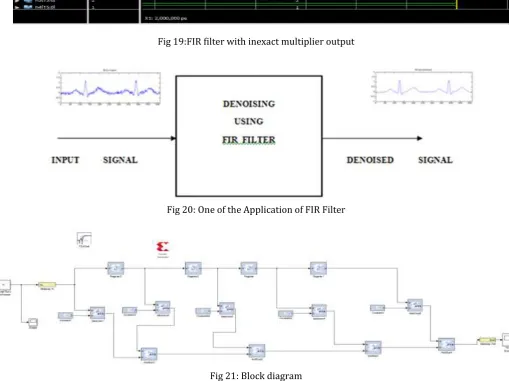
Fig 18: Design summaryFig 19:FIR filter with inexact multiplier output
Fig 20: One of the Application of FIR Filter
© 2019, IRJET | Impact Factor value: 7.211 | ISO 9001:2008 Certified Journal | Page 1827
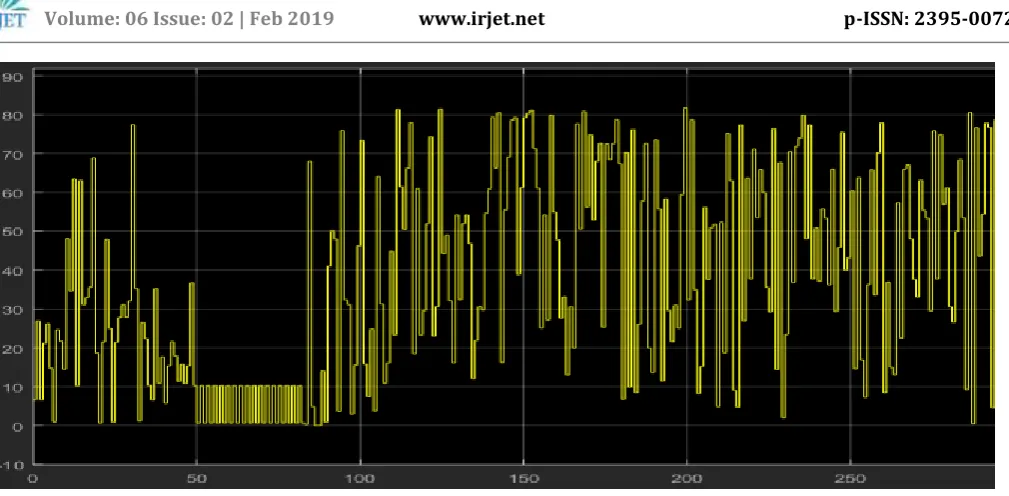
[image:10.595.50.555.62.310.2] [image:10.595.36.562.337.481.2]Fig 22: EEG signal input with noise
Fig 23: signal EEG output with noise removed
[image:10.595.58.541.501.726.2]© 2019, IRJET | Impact Factor value: 7.211 | ISO 9001:2008 Certified Journal | Page 1828
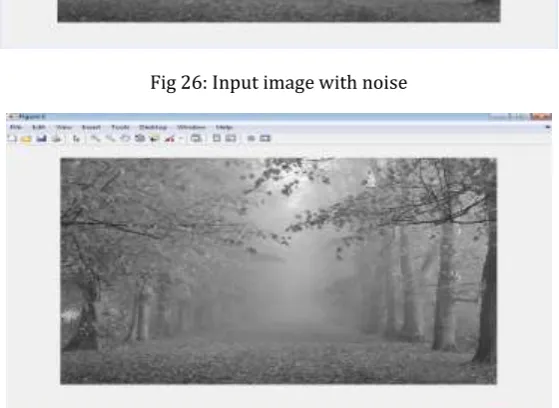
Fig 25: Image output without noiseFig 26: Input image with noise
[image:11.595.158.438.524.728.2]© 2019, IRJET | Impact Factor value: 7.211 | ISO 9001:2008 Certified Journal | Page 1829
REFERENCES1) "Design-Efficient Approximate Multiplication Circuits Through Partial Product Perforation”, G. Zervakis, K. Tsoumanis, S. Xydis, D. Soudris, and K. Pekmestzi
2) Design of Approximate Radix-4 Booth Multipliers for Error Tolerant Computing”, W. Liu, L. Qian, C. Wang, H. Jiang, J. Han, and F. Lombardi
3) ”Design of Low-Error Fixed-Width Modified Booth Multiplier”, K.-J. Cho, K.-C. Lee, J.-G. Chung, and K. K. Parhi
4) High-Accuracy Fixed-Width Modified Booth Multipliers for Lossy Applications”, J. P. Wang, S. R. Kuang, and S. C. Liang
5) Approximate Radix-8 Booth Multipliers for Low-Power and High-Performance Operation”,H. Jiang, J. Han, F. Qiao, and
F. Lombardi
6) Performance Analysis of FIR filter using Booth Multiplier D. Jaya Kumar, Dr.E. Logashanmugam.. 7) Modified Booth Multiplier Based Low-Cost FIR Filter Design Shelja Jose, Shereena Mytheen. 8) Low power designing of FIR filters -- Sarita Chouhan1, Yogesh Kumar.