RESEARCH ARTICLE
DETECTION OF FOREST FIRE IN WIRELESS SENSOR NETWORK USING
EVIDENCE COMBINATION
Mohamed Sathick, M., Balasubramanian, A
1
Department of Computer Science, Sadakathullah Appa College, Tirunelveli, India
2
Department of Computer Science, Manonmanium
ARTICLE INFO ABSTRACT
In this paper, we propose an intelligent and robust system for forest fire detection using wireless sensor network. The intelligent system consists of three different neural network classifiers to overcome the problem of training and testing under conditio
aim of using three classifiers in the intelligent system is that classification in this forest fire context is extremely important as the cost of misclassification using a single classifier is very high. Hence, a combination of thei
which provides a representation of epistemic plausibility overcomes weaknesses exhibited by anyone classifier to a particular data set and helps to detect the forest fire accurately. The com
provides a higher accuracy in detecting and forecasting forest fire more promptly. The experimental results show the combination approach yield better accuracy in predicting the forest fire.
INTRODUCTION
Forests play a crucial role for sustaining the human environment and Forest fires are among the largest dangers for forest preservation It is widely reported that a total of 77,500 wildfires burned 6,790,000 acres in USA during the year 2004. Hence, it is necessary to detect and predict forest fire more promptly and accurately in order to minimize the loss of Forests Wild animals and Peoples in the Forest fire. It is a well known fact that the satellite based monitoring is a popular method to detect
Forest fire now (Li et al., 2000).
*Corresponding author: [email protected]
But, the of satellites
satellite based forest fire detection. More over, the difficulty of using Satellites based method is that it can not forecast forest fires before the fire is s uncontrollable. The architecture of Wireless sensor Network is shown below for forest fire detection as Wireless sensor networks have been attracting many research efforts during the past few years and have been used in a variety of applications such habitat
Wireless Sensor networks are usually composed of a few sinks and a large quantity of inexpensive, small and efficient sensor nodes which are densely
ISSN:
0975-833X
International Journal of Current Research
Vol.2, Issue, 1, pp. 073-077, January
Key words:
Belief;
Dempster-Shafer theory; Evidence combination; Forest Data mining; Neural Networks; Uncertainty.
Article History:
Received 11th September, 2010
Received in revised form
15th October, 2010
Accepted 25th December, 2010
Published online 6th January, 2011
ARTICLE
DETECTION OF FOREST FIRE IN WIRELESS SENSOR NETWORK USING
EVIDENCE COMBINATION
Mohamed Sathick, M., Balasubramanian, A
2and Syed Mohamed, M
3Computer Science, Sadakathullah Appa College, Tirunelveli, India
anonmanium Sundaranar, University, Tirunelveli, India
In this paper, we propose an intelligent and robust system for forest fire detection using wireless sensor network. The intelligent system consists of three different neural network classifiers to overcome the problem of training and testing under conditions of insufficient and noisy data. The aim of using three classifiers in the intelligent system is that classification in this forest fire context is extremely important as the cost of misclassification using a single classifier is very high. Hence, a ination of their beliefs by Dempster– Shafer evidence combination which provides a representation of epistemic plausibility overcomes weaknesses exhibited by anyone classifier to a particular data set and helps to detect the forest fire accurately. The combination approach provides a higher accuracy in detecting and forecasting forest fire more promptly. The experimental results show the combination approach yield better accuracy in predicting the forest fire.
But, the very long scan period and low resolution of satellites restrict the use and effectiveness of the satellite based forest fire detection. More over, the difficulty of using Satellites based method is that it can not forecast forest fires before the fire is spread uncontrollable. The architecture of Wireless sensor Network is shown below for forest fire detection as Wireless sensor networks have been attracting many research efforts during the past few years and have been used in a variety of applications such as habitat monitoring, forest fire detection etc., The Wireless Sensor networks are usually composed of a few sinks and a large quantity of inexpensive, small and efficient sensor nodes which are densely
ternational Journal of Current Research 077, January, 2011
INTERNATIONAL JOURNAL OF CURRENT RESEARCH
deployed in a forest. Sensor nodes collect
measured data (e.g. Temperature, Relative
humidity) and send to their respective cluster nodes
that collaboratively process the data by
[image:2.504.53.229.157.238.2]constructing the neural network. This paper aims to study and apply a formal evidence combination technique for mining forest data for detection and forecasting the forest fire.
Fig. 1. Architecture of a Wireless Sensor Network
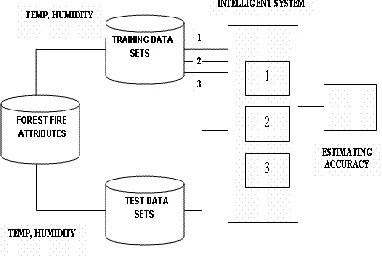
The measured data viewed as input data consisting of feature vectors is input to the intelligent system which comprises of three different neural Network based classifiers. The classifiers used in this paper are Kohonen Learning network, Back propagation network and Radial Basis function network. The architecture of the intelligent system is shown below.
Fig. 2. Architecture of the Intelligent System
The forest fire attributes such as Temperature, Humidity measured periodically by the sensor nodes are sent to the intelligent systems. The intelligent system which comprises of three different classifiers described above as 1, 2 and 3 process the data Each of the neural network classifiers provide beliefs for each class such as
Sustentation and Cataclysm.These pieces of evidence are then combined to reach a final decision using Dempster’s belief combination formula (Liu Rujie and Yuan Baozong, 2000). In this paper, experiments are accomplished on forest data such as Temperature and Relative Humidity. The approach proposed above has two primary advantages. One advantage is that Robustness across multiple datasets with multiple classifiers and the second one is management of uncertainty in the presence of unequal error costs. In this paper, we considered temperature and humidity. Very high temperature and low humidity were the key factors for forest fire. Wind speed, vegetation type were not considered. The remainder of this paper is organized as follows. Section II describes a brief introduction to the theory of belief functions and evidence. We then describe the three neural network based classifiers and uncertainty under section III. Section IV describes the proposed work. Section V describes performance analysis of this intelligent system.
Description about dempster-shafer theory
We herewith present a brief introduction about Dempster - Shafer Theory (DST) or the theory of probable or evidential reasoning. In a finite space, the DST can be interpreted as a generalization of the Bayesian theory of subjective probability to handle uncertain information effectively. In traditional probability theory, it was found that evidence is associated with one possible event. But in the case of DST, evidence can be associated with multiple possible events. e.g., sets of events As a result of this added feature, evidence in DST can be meaningful at a higher level of abstraction without having to resort to assumptions about the events with in the evidential set. One of the most important features of DST is that the model is designed to cope with varying levels of precision regarding the information and there are no further assumptions needed to represent the information. We hereby explain the term Belief which is nothing, but a measure of trust or confidence that a
particular event will occur (Ji et al., 1995). Let us
[image:2.504.44.235.387.516.2]degree of support to belief is known as a belief function as given in equation (1). Basic belief m (X) , that represents belief mass of some evidence for event X provided by the source of information under consideration has the following properties as disclosed below.
∑ m ( X ) = 1 Where X Є Ώ ……… ...(1)
m (Φ) =0 ……. (2)
Where, Φ is empty, Ώ represents the total event space and m (X) is the mass of the event X. The belief function for an event A is given by the formula,
Bel (A) = ∑ m(X) ………. (2)
Where, X Є A, A Є Ώ and Bel (A) is the belief of event A.
It is necessary to disclose that the theory of evidence deals with the evaluation of beliefs from a number of evidences and their combination[8].For example, Consider three sources of evidence M ,N
and P. Let the event space be Ώ = {A, B} The
measure which is assigned by uncertain component of probability constitute exhaustive events. The formula for the belief of evidence M is disclosed below.
Bel M ( A) + Bel M ( B) + Bel M (Uncertainty) = 1
………..(3)
Similarly, for N and P sources of evidence, the formula is,
Bel N (A) + Bel N (B) + Bel N (Uncertainty) = 1
……….(4)
Bel P (A) + Bel P (B) + Bel P (Uncertainty) = 1
……….. (5)
Using the above formulae, a decision can be made based on the combination of these beliefs. In our approach, we are using the classifier output to form evidence and a decision such as Sustentation and Cataclysm forms an event. Thus, a possible
event space is,Ώ = {Sustentation, Cataclysm}. The
class Sustentation refers to the preservation of forest and the class Cataclysm refers to destroying the same. We are disclosing below a brief illustrations about the operations of three classifiers
Kohonen Learning network Back propagation net work and Radial Basis function network.
Neural network classifiers
Neural networks are composed of simple elements operating in parallel. We can train a neural network to perform a particular function by adjusting the values of the connections (weights) between elements. Commonly neural networks are adjusted, or trained, so that a particular input leads to a specific target output. Here, the network is adjusted, based on a comparison of the output and the target, until the network output matches the target value. Typically many such input/target pairs
are essentially needed to train the network. The
procedure which is used to perform the learning process is called a learning algorithm. The training phase is nothing, but the network is provided with enough examples called training sets. Each training set consists of a list of input values and the corresponding output. Training data sets are used by the network to learn the mapping from the input data to the output. The method of learning is quite different for each network as disclosed below.
Kohonen Learning Network Classifiers
It is well known fact that Self-organizing in networks is one of the most significant topics in the neural network field. The Said networks can learn to detect regularities and correlations in their input and adapt their future responses to that input accordingly. It is known that the neurons of competitive networks can learn to recognize groups of similar input vectors, in such a way that neurons physically near to each other in the neuron layer respond to similar input vectors. This network allows one to project multi dimensional points to somewhat two dimensional network Kohonen
Learning Networks are usually based on
Radial Basis Function Network Classifiers
Aradial basis function (RBF) network is a popular
alternative to the multilayer perceptrons (MLP). The construction of a radial-basis function (RBF) network involves three layers with entirely different roles. The first layer is composed of input nodes
whose member is equal to the dimension m. The
second layer is a hidden layer, composed of nonlinear units with a radial-basis activation function, and the third, output layer performs the network response to an input signal and conventionally consists of linear neurons.
Back Propagation Network Classifiers
In the Back Propagation Network, two distinct passes of computations are accomplished. The first pass is referred to as the forward pass and the second is referred as the backward pass. The network during forward pass generates some form of output and this output is compared to the target output, which leads to calculate the Mean Squared Error signal. The error value is then propagated backwards during the backward pass. A small change is made to the weights in each layer, which reduces the error signals. The above said process is repeated until the overall error value reaches threshold value and stabilizes.
Uncertainty
The Dempster-Shafer Theory can handle
uncertainty effectively. Here, we use the class
differentiation quality as the uncertainty
measure[9].The motivation behind this idea is that the closer the values of beliefs for Z classes to each other, the more uncertain the classifier is about its decision. as the beliefs start spreading apart, it precisely leads to uncertainty starts decreasing. Let uncertainty be denoted as H (U)[9].If there are z classifications ,the distance between the belief values and the value 1/Z are evaluated. If all classes have the same distance then the ambiguity involved in the classification is the highest and the ambiguity involved in the classification is the least, if one class shows maximum possible distance.
Proposed work
In this paper, we perform pair–wise combination of classifiers. We first combine beliefs of back
propagation Network classifier and Kohonen Network. In the next step, we combine the output of the first step with the evidence from the Radial Basis Function Network classifier. Let us assume that the Back Propagation Network classifier provides beliefs Bel_BPN (A) and Bel_BPN(B), where Bel_BPN is the belief provided by the Back Propagation Network .A and B are the two classes
positive and negative under consideration.
Similarly, Kohonen Network classifier provides beliefs Bel_KN (A) and Bel_KN (B), where Bel_KN is the belief provided by the Kohonen Network. Uncertainties of the above two classifiers are U_BPN and U_KN respectively. The product of Sustentation belief of one classifier and uncertainty of another classifier and vice versa are added to the Belief masses of the two classifiers. Similarly, the combined Belief from the first step and the Radial Basis Function Network classifier beliefs are combined.
Performance analysis
Table 1. Classification of forest weather data
BPN KN
0 1 2 0 1 2
0 214 5 5 0 201 12 11
1 4 168 5 1 10 15 10
RBF BPN+KN+RBF
0 1 2 0 1 2
0 210 6 8 0 222 0 2
1 4 164 9 1 0 174 3
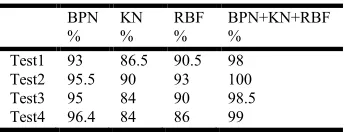
According to the results taken the accuracy calculation of four test cases are as follows.
Table 2. Accuracy of all Classifiers
BPN %
KN %
RBF %
BPN+KN+RBF %
Test1 93 86.5 90.5 98
Test2 95.5 90 93 100
Test3 95 84 90 98.5
Test4 96.4 84 86 99
Overall accuracy of BPN classifier is 95% KN classifier is 86%, RBF classifier is 94% and the combination of BPN+KN+RBF classifier is 98%.The combination accuracy is high compared to individual classifier. This type of combination may override the difficulties of false diagnosing and is found to be accurate. The overall accuracy of all classifiers is shown below.
Fig. 1. Experimental results of overall Accuracy
Conclusion
We have designed a method for classifying the forest fire data by combining multiple classifiers. We have designed the combination of evidences from three different classifiers using the Dempter– Shafer Theory. The combination approach shall definitely yield better classification accuracy. The combination approach is robust and reliable. The
future work includes that this combination approach may be compared with other rules such as yager’s modified Dempster’s rule and Inagaki’s unified combination rule for better accuracy. Also, other classifiers are used for handling large data sets and better performance.
REFERENCES
Akyildiz, I.F., Su, W., Sankarasubramaniam, Y. and Cayirci, E. 2002. “Wireless sensor networks: a survey,” Computer Networks, vol. 38(4): 393- 422.
Li, Z., Nadon, S. and Cihlar, J. 2000. “Satellite detection of Canadian boreal forest fires:
development and Zpplication of the
algorithm,” International Journal of Remote
Sensing, 21(16): 3057-3069.
Shafer, G. 1976. A Mathematical Theory Of Evidence” Princeton University Press 1976. Ji, M.Q., Marefat, M.M. and Lever, P. J. 1995. “An
Evidential approach for recognizing shape features” Proceeding of IEEE AIA.
Liu Rujie and Yuan Baozong, 2000. D.S based Multi channel Information Fusion Method using classifiers Uncertainty measurement “ Proceedings of ICSP, 1297 – 1300.
Zaiane, O.R., Antonie, M.L. and Coman, A. 1997.
Mammography Classification By An
Association Rule based classifier “ Proceeding of AMIA Annual Fall Symposium.
Lotfi A. Zadeh,1985. “Syllogistic Reasoning as a basis for Combination of Evidence in Expert systems” IJCAI: 417-419.
Li pan Hong Zheng S.Nahavandi, 2003. “ The application of rough set and kohonen network to feature selection for object extraction”2003 International Conference on machine Learning and Cybermetrics.
[image:5.504.38.242.375.500.2]