© 2019, IRJET | Impact Factor value: 7.211 | ISO 9001:2008 Certified Journal
| Page 2612
A Performance Study of Response of (G+20) Regular and Braced RC
Building Under the Effect of Soil Structure Interaction (SSI)
Prof. Dr.B.R.Patagundi
1, Ms. Ujwala M. Ghorpade
21
HOD of Civil Engineering Department S.G.Balekundri Institute of Technology, Karnataka, India..
2PG Student, M.Tech, Dept of Civil Engineering, S.G.Balekundri Institute of Technology, Karnataka, India
---***---Abstract -In the construction of high rise structure the SOIL
STRUCTURE INTERACTION (SSI) should be consider in
evaluation of stiffness and strength of structure.Usually in the seismic design of ordinary bldg, soil structure interaction is neglected. But the lateral loads (Seismic & wind forces) work as an main role in the construction of high rise structures. The structure is analyzed for its structural behavior assuming base condition as fixed base. it is observed that effect of soil structure interaction is changes as the flexibility of soil varies. i.e., for fixed as well as for various flexible base conditions, i.e., for hard, medium and soft soil. In this study G+20 structure is analyzed with the help of STAAD-Pro V8i software, by equivalent static method with Winkler’s approach method. considering three different soil types and compared with different arrangements of bracings system. This study reveals that SSI significantly affects the response of structure. The different parameters like Base shear, roof Displacement, Drift-ratio are considered to evaluate the output of plane frame and structures with different bracing system of models. and it is represented in the form of tables & graphs which will help us to understand the behavior of braced structure under the effect of soil structure interaction and also to suggest the better performance among the structures.
Key Words: (Equivalent Static Method, Soil Structure Interaction, Winkler’s Theory, Seismic Forces, Bracings, Staad-pro V8i)
1. INTRODUCTION
An Earthquake occurs because 0f moment of large tectonic plates and due to out come of manmade unexpected rupture. In the era 0f fast growing urbanizati0n due to paucity of land, structure are constructed on available relatively softsoil which 0therwise were deemed t0be unsuitable for constructi0n in the past.
India is gradually developing in size & integral 0f structure, where as buildings are heavy and large with the effect of SSI is not considered at the starting but from last 3 to 4 decades, the consideration of SSI effect while designing the structure is become important. The out-turn of SSI effect for low rise building can be neglected. And for heavy buildings i.e. bridges, tall structures, silos-tall chimneys, highways are considered.
1.1 SOIL STRUCTURE INTERACTION
SSI account with Interaction between structure & sub s0il. The phen0mena maybe defined as “The process in which the response of soil influences the motion of structure & motion of structure influence the response of the s0il is termed as SSI”.
When the structure is founded 0n soft or medium soil. Thus, there is an interaction between the structure behavi0r and the foundation soil response known as the soil structure interaction (SSI).the structure interacts with soil medium the behavior to the lateral load on the structure. Soil doesn’t show the similar characters with the different surrounding area, environmental & climatic conditions. Soil interaction effect is more in the heavier and softer soil medium
1.2 WINKLER’S THEORY
According to Winkler’s-approach the deformation of foundation due to applied load is restricted to loaded regi0ns 0nly. The basic difficulty with the use of Winkler’s model is to determine the stiffness elastic springs which is replaced with foundation below the soil. The care should be taken to analyses the behavior 0f subgrade stiffness numerically to use in a practical pr0blem.
The G.GAZETAS formulas are used for determination 0f spring constants which are given in above Table I..,
© 2019, IRJET | Impact Factor value: 7.211 | ISO 9001:2008 Certified Journal
| Page 2613
Fig.1.2 Winkler foundation
1.3 AIMS AND OBJECTIVES OF THE PRESENT STUDY
1.To analysis the Impact of soil structure-interaction(SSI) with different arrangements of bracing in RCC building.
2.To investigate the influence of soil structure interaction taking into consideration 3 dissimilar soil strata’s by the method of Winkler’s-Approach theory.
3.For the better performance of RCC structure to investigate the suitable arrangement of bracing system with effect of SSI..
1.4 METHODOLOGY
1. The study is carried out in the form of modeling and analysis, by using the non linear static method by the Staad-Pro V8i software.
2. By comparing the Winkler Approach and Elastic Continuum approach (FEM) method for SSI, the Winkler Approach gives accurate reaction results as well as good physical behavior of soil.
3. The above studies, along with assumed cases of RCC buildings of with various types of bracings, should be the basis for choices of promising structural systems. These structural systems were to be further studied in the project.
[image:2.595.323.535.584.755.2]4. Finally, the report ends with results of comparison between the conventional building with different types of Braced RCC building by using Winkler approach under the effect of SSI.
Table -II: Calculated Soil-Stiffness Of the Spring
Stiffness Of the
Spring Medium Soil type Soft Vertical 94583.33 40535.71 Horizontal(Lateral
Direction ) 878906.25 376674.107 Horizontal(Longitudi
nal Direction ) 878906.25 376674.107 Rocking (About
Longitudinal) 146416768.9 62750043.8 Rocking(About
Lateral) 50488541 21637946.4 Torsion 11646.753 4991.4654
2. LITERATURE REVIEW
Dhiraj Raj*, Bharathi M(2013) – According to this paper author considered G+4 RC bldg. which is located in seismic
zones of IV & V on different type of soil i.e., hard, medium and soft soil. The bldg is analyzed as per IS1893(PART-I) with fixed foundation RC bldg of diff braces having different location. This study reveals that time period of structure with braces the SSI effect increases by 100% . When compared to same type of bldg found on type-3 soil with fixed base. The increase in time period is 50% and increases in the storey drift also. When the founded on type-2 soil with the fixed base.
S.M.Barelikar et al., S.A.Halkude (2014) – This study contains of RC frame resting on raft footing. By the help of 2 different approaches of winklers (spring) model, and elastic continuum (FEM) model. The different parameters are checked on the effect of soil structure i.e., baseshear, displacement, fundamental time period etc.. were studied. It is examined that SSI constanly affects the structural performance.
N. Anand , R.M. Jenifer Priyanka, (2012) – The ten st0rey RCC frame with rigid and flexible base is analysed in Staad-Pr0 . With the help of Response spectrum meh0d for different soil starta hard, s0ft, and medium with considering zone-IV has been analyzed. Base shear, Deflection, storeydrift, column moment and axial forces are calculated f0r both Base 0ondition.
3. MODELLING AND DETAILS OF STRUCTURE
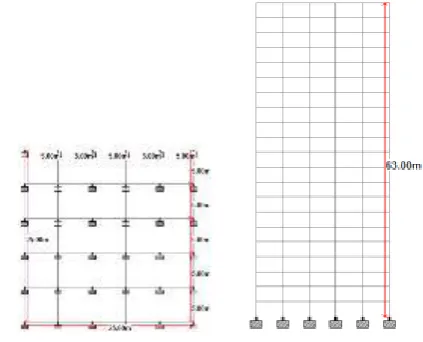
In this thesis main structure is of G+20 RCC building with different bracing arrangements are considered. Using the spring stiffness formula’ s (as per Winkler’s theory) the stiffness of soil flexibility with respective structure is found in the software [Staad Pro V8i]. Present project is considered a plan of G+20 RCC structure, having geometry for analysis. The structure is investigated for 3foundation soils: HARD , SOFT, MEDUIM with various types of bracings and there position, orientation, and foundation with and without SSI, have been considered for analysis.
The floor to floor height is 3m and 5m C/C and the area is 25 x25m is taken as the bay width on both side of the X & Y axes in the plan of structure.
© 2019, IRJET | Impact Factor value: 7.211 | ISO 9001:2008 Certified Journal
| Page 2614
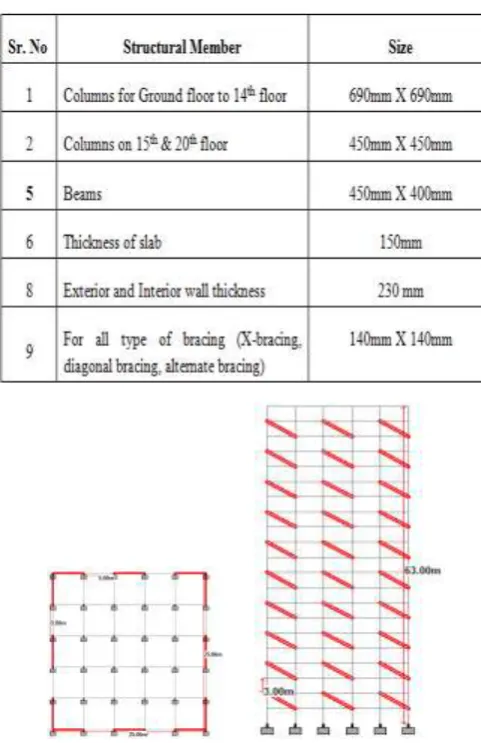
Table - III: Sizes of Structural Members
Model.2 Plan & elevation of the structure Cross bracings are diagonally @ alternate corners of
structure
Model.3 Plan & elevation of the structure Cross bracings are @ alternate periphery of
structure
Model.4 Plan & elevation of the structure X bracings are @ mid of structure
Model. 5 Plan & elevation of the structure X bracings are @ periphery of structure
4. RESULT AND DISCUSSION
From seismic behavior 0f RC structure with and without bracing-arrangement with various support condition, the results are Obtained from the software (STAAD-PRO V8i) are discussed and observed.
TABLE-IV : BASE SHEAR in (kN)
MODELS
TOTAL BASE SHEAR
HARD SOFT MEDIUM MODEL -1 3521.7163 5894.50 4795.52
MODEL -2 3526.1421 5901.9116 4801.55
MODEL -3 3530.569 5909.321 4807.583
[image:3.595.38.279.110.482.2]© 2019, IRJET | Impact Factor value: 7.211 | ISO 9001:2008 Certified Journal
| Page 2615
TABLE-V : ROOF DISPLACEMENT in (mm)
MODELS
ROOF DISPLACEMENT
HARD SOFT MEDIUM MODEL -1 152.681 219.685 288.633
MODEL -2 123.831 183.234 224.884
MODEL -3 109.350 166.109 203.961
MODEL -4 81.462 125.295 152.914 MODEL -5 100.557 155.293 189.7
TABLE-VI : STOREY DRIFT in (mm)
MODELS
STOREY DRIFT
HARD SOFT MEDIUM MODEL -1 2.727 4.03 5.535
MODEL -2 2.636 3.977 4.881
MODEL -3 3.056 4.597 5.582
MODEL -4 2.182 3.381 4.081 MODEL -5 3.376 5.052 6.14
4.1DISCUSSION
GRAPH –I: BASE SHEAR COMPARISION OF VARIOUS MODELS WITH PLANE FRAME
GRAPH –II: DISPLACEMENT COMPARISION OF VARIOUS MODELS WITH PLANE FRAME
GRAPH –II: STOREY-DRIFT COMPARISION OF VARIOUS MODELS WITH PLANE FRAME
5. CONCLUSIONS a) Base Shear
The base shear 0f the building rises due t0 SSI effect, the effect of base shear is m0re as soil strata bec0mes s0ft. the base shear is high in the structure with X- bracing 5924.14 in flexible base , and less in the structure with alternate diagonal bracing 3526.14. therefore the total increment of base -shear is 15% to 50% from hard to flexible base.
b) Roof Displacement
From upshot of analysis the displacement is decreses in structure with X- bracing@ mid is 125.295mm in medium soil, where as increased in structure with 224.884mm. so the decrement of displacement in structure ranges from 62% to 16% from hard soil to soft soil.
c) Storey Drift
© 2019, IRJET | Impact Factor value: 7.211 | ISO 9001:2008 Certified Journal
| Page 2616
According to above parameters we can prefer the building with the X –Bracing @ Mid of the structure is suitable for better performances in soft or flexible base. It can resist the seismic forces and reduces damages, so it is safe and economical.
SCOPE FOR FURTHER STUDY
1. The analysis can be further extended for unsymmetrical buildings.
2. For the different foundation types i.e raft- footing, isolated and pile foundation etc. the soil structure interaction can be investigated.
3. Similarly SSIis investigated for composite structure. 4. Elastic Continuum Method is used for various soil
models.
5. The time history method, Non linear dynamic Analysis, Response spectrum Analysis etc,, are used for further study for realistic and better assessment of structural response under seismic forces
REFERENCES
1)Dhiraj Raj, M Bharathi 2013 “Effect Of Soil Structure Interaction On Regular And Barced Building” Indian Geotechnical Conference dec 22-24, 2013.
2)S.A.Halkude, M.G.Kalayanshetti, V.A.Kadlag “Push over analysis of R.C. frames considering soil structure interaction”, International journal of current Engineering And Technology, Vol.5, NO.1, Feb 2015.
3)R. M. Jenifer Priyanka , N. Anand “Studies on Soil Structure Interaction of Multi Storeyed Buildings with Rigid and Flexible Foundation”- Volume 2, Issue 12, December 2012
4)IS-1893-2002(PART-1), IS-875(PART-1,PART-2,PART-5)
5)Earhquake Resistant Design Of Building Structure - Vinod
Hosur.
BIOGRAPHIES
PROF.DR.B.R.PATAGUNDI HOD OF CIVIL ENGINEERING DEPT.S.G.B.I.T. COLLEGE BELGAVI, KARNATAKA INDIA - 590010
MS. UJWALA M.GHORPADE M. Tech (Structural Engg ) DEPT OF CIVIL ENGINEERING S.G.B.I.T COLLEGE BELGAVI, KARNATAKA INDIA- 590010