Roadmap for Establishing Interoperability of
Heterogeneous Cellular Network Technologies -2-
Hasni Neji, Ridha Bouallegue
Innov’COM Lab, Higher School of Communications, Sup’Com, University of Carthage, Tunis, Tunisia. Email: [email protected], [email protected]
Received May 8th, 2012; revised June 7th, 2012; accepted June 16th, 2012
ABSTRACT
The global project will focus on an eventual establishment of a holistic understanding of cellular communication, and proposing an ontological approach that expresses the domain’s concepts, classes, and properties in a formal and unam-biguous way. However, this ongoing step is about making heterogeneous network technologies explicit and highlighting their commonalities and variabilities. It begins by studying three different cellular technologies, one from each genera-tion (2G, 3G and 4G). After the analysis of Lte-advanced—a fourth generagenera-tion technology—subject of the first paper [1], Universal Mobile Telecommunication System (UMTS) cellular network—a third generation technology—is the target of this current analysis. The final objective sought is to build Ontology capable of providing a common view of cellular network technologies.
Keywords: UMTS; Interoperability; Ontology; Feature Modeling; UML
1. Introduction
As a tentative to overcome the challenges stemming from the lack of interoperability between heterogeneous cellu-lar access networks, this part of study presents a high- level description and analysis of Universal Mobile Tele-communication System (UMTS) Release 1999 features. The network structure is described using a top-down ap-proach: it is logically divided into a number of sets, both from the architectural aspect and from the protocols as-pect. From the architectural point of view, the sets are called “domains” (a domain is a group of entities). From the protocols point of view, the sets are called “strata” (a stratum is a group of protocols) [2]. These principles of networks description do not correspond to any concrete realization in the network but were established mainly to organize and make the work easy.
2. UMTS Network Overview
UMTS is the successor of GSM (Global System for Mo-bile Communications). It is a third generation (3G) mo-bile communication system. UMTS has been standard-ized in several releases. The first version is -Release 99-. UMTS network can be divided into two parts. One part is responsible for the circuit switched services (CS-domain) and the other one manages the packet switched services (PS-domain). The CS-domain manages voice calls and on the other hand the PS-domain is responsible for data
connection like the connection from a mobile device to the internet. UMTS introduces a new wireless access technology, namely the wideband code division multiple access (WCDMA). The major headlines for Release 99 are:
Definition of the UMTS Universal Terrestrial Radio Access Network (UTRAN),
The Radio Network Subsystem (RNS) is added to the existing GSM network,
The Core Network (CN) is the existing GSM network with some enhancements.
3. UMTS Network Architecture
3.1. The Overall Architecture
ele-Roadmap for Establishing Interoperability of Heterogeneous Cellular Network Technologies -2- 403
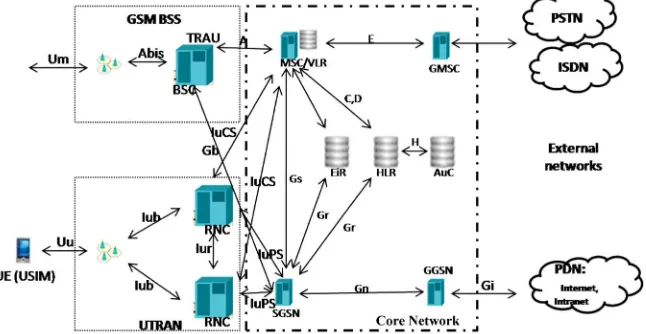
ments, like EIR, HLR, VLR and AUC are shared by both domains. The UTRAN provides the air interface access method for User Equipment. Base Station is referred as Node-B and control equipment for Node-B’s is called Radio Network Controller (RNC). Figure 1 elucidates the thorough architecture of UMTS R 99.
3.2. UMTS Functional Entities
Domains
The UMTS network architecture consists of three high level groups of physical entities called domains: the UE domain, the UTRAN domain and the CN domain [3].
The UE domain represents the equipment used by the user to access the services, it is composed of:
The Mobile Equipment (the “phone”), containing the radio transmitting/receiving device and the applica-tion (in the Terminal Equipment, TE), and
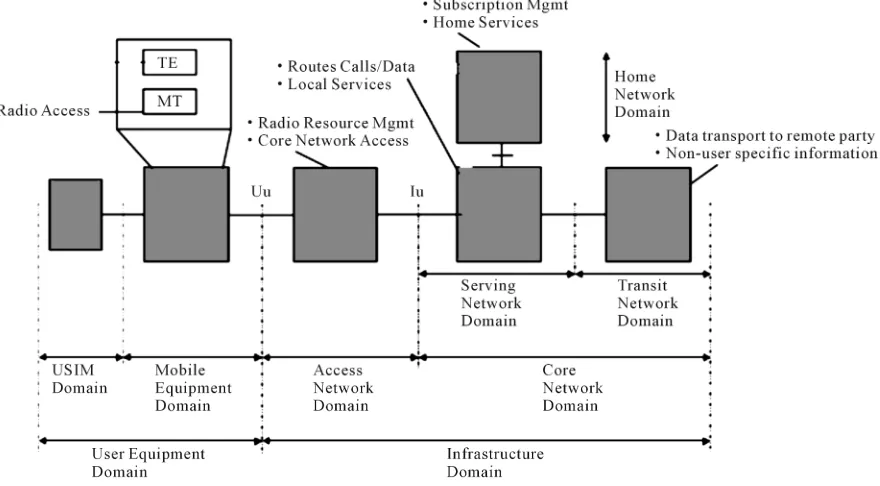
The USIM is typically embedded in an IC card. The infrastructure domain, the UTRAN domain and the CN domain, represents the physical nodes which perform the various functions required to terminate the radio interface and to support the telecommunication service requirements of the user. More detail about the three domains is given below under the form of descrip-tion and detailed Figure 2.
The Infrastructure domain, consists of the set of all the network entities, is composed of:
1) The Access Network domain, comprising all the en-tities closely related to the radio technology, and
2) The Core Network domain composed of:
The Serving Network domain, representing the core network functions local to the user’s access point and location changes when the user moves. It is composed of: the Circuit Switched (CS) domain and the Packet Switched (PS) domain.
The Transit Network (TN) domain which is the CN part between the SN and the remote party, and
Home Network (HN) domain representing the core functions conducted at a permanent location regard-less of the user’s access point. The USIM is related with a subscription to the HN.
3.3. UMTS Stratums
Stratum is the way of grouping protocols related to one aspect of the services provided by one or several domains. Different UMTS strata are illustrated by Figure 3 and detailed description is as follows:
Non-access stratum: protocol handling activities be-tween UE and Core Network.
1) Transport stratum: supporting the transport of the user data and the network control signalling from other strata through UMTS. It encompasses the Access Stra-tum, which is the part of the transport stratum located between the edge node of the serving core network do-main and the MT.
Access stratum: protocol handling activities between UE and access network. It provides services related to the transmission of data over the radio interface and the management of it.
2) Serving stratum: consists of protocols and func-tions that transmit the data/information from the source to the destination.
3) Home stratum: contains the protocols and func-tions related to the handling and storage of subscription data and possibly home network specific services;
4) Application stratum: represents the application process itself, provided to the end-user. It includes end- to-end protocols and functions which make use of ser-vices provided by the home, serving and transport strata and infrastructure to support services and/or value added services.
[image:2.595.139.462.551.718.2]The connection between domains is assured via net-work interfaces or reference points. “Netnet-work interface” refers to a physical interface whereas a “reference point”
Figure 2. UMTS domains and reference points.
Figure 3. UMTS protocol stacks.
can be physically composed of zero, one or several physical interface(s), as e.g. The Iu, which is a reference point composed of the IuCS and the IuPS interfaces.
4. UMTS Feature Modeling
UMTS feature model will allow us to explore, identify, and define the key concepts of it so that these aspects can be described in Ontology [4].
Defining a feature model for the UMTS network pro-vides means to explore, identify, and define the key ar-
chitectural aspects of this cellular network so that it would make it more explicit, comprehensible, and com-parable with other networks. These aspects can then be described more fully in Ontology. It is this Ontology that can be used to establish interoperability between cellular communication network systems.
Features are Organized in a hierarchical feature tree with classification (mandatory, optional, alternative, and/ or optional alternative features) [5].
Roadmap for Establishing Interoperability of Heterogeneous Cellular Network Technologies -2- 405
included.
Optional. An optional child feature can be optionally included in all products in which its parent feature appears.
Alternative. A set of child features is defined as al-ternative, if only one of them can be selected when its parent feature is part of the product.
Or-relation. A set of child features is said to have an or-relation with their parent when one or more of them can be included in the products in which its parent feature appears.
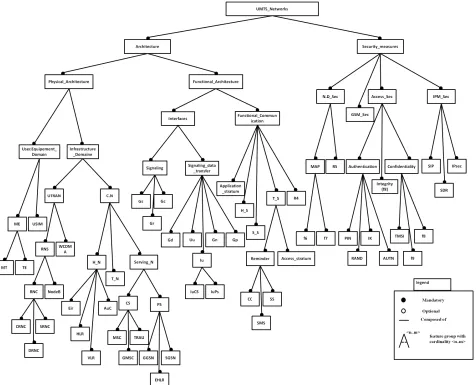
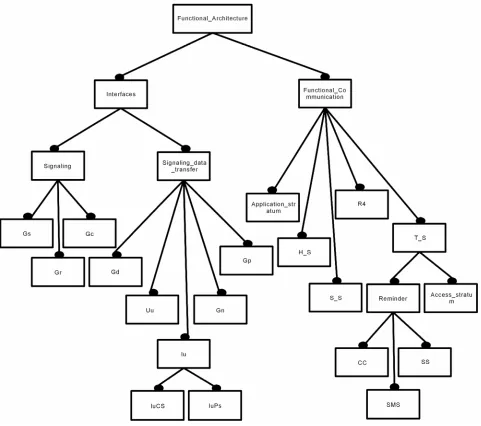
As shown in Figure 4, the feature model is defined around concepts. The objective is to model features of elements and structures of a domain, not just objects in that domain. The silhouette of the network architecture (figure) was inserted to point the relative size and com-position of the entire feature tree. For more detail on the mechanism of how to construct a feature model, the reader may consult [4-6]. Figure 5 presents an excerpt of the UMTS feature model. It presents the UMTS
func-tional architecture in a clear way via a hierarchic feature diagram.
5. Essential UMTS R 99 Network
Characteristics
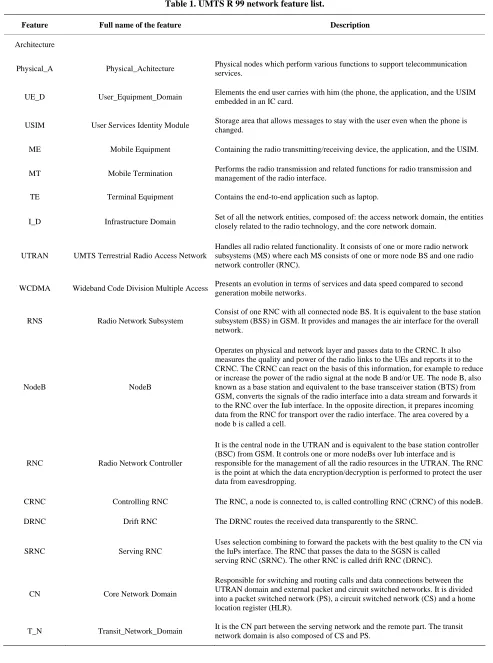
The selected essential UMTS network characteristics that will be accounted for in building interoperability Ontol-ogy for cellular network technologies are set forth in the following table.
6. UML as an Ontology Description
Language
[image:4.595.63.539.333.718.2]Drawing on the lesson learnt from the feature modeling, a method of integration of UML class diagrams will be presented [8-10], which supports interoperability. How-ever, we should not forget that our focus is to tackle the interoperability issue between different network tech-nologies. Modeling UMTS network classes using UML is one of the perquisite steps to achieve our objective.
Table 1. UMTS R 99 network feature list.
Feature Full name of the feature Description
Architecture
Physical_A Physical_Achitecture Physical nodes which perform various functions to support telecommunication
services.
UE_D User_Equipment_Domain Elements the end user carries with him (the phone, the application, and the USIM
embedded in an IC card.
USIM User Services Identity Module Storage area that allows messages to stay with the user even when the phone is
changed.
ME Mobile Equipment Containing the radio transmitting/receiving device, the application, and the USIM.
MT Mobile Termination Performs the radio transmission and related functions for radio transmission and
management of the radio interface.
TE Terminal Equipment Contains the end-to-end application such as laptop.
I_D Infrastructure Domain Set of all the network entities, composed of: the access network domain, the entitiesclosely related to the radio technology, and the core network domain.
UTRAN UMTS Terrestrial Radio Access Network
Handles all radio related functionality. It consists of one or more radio network subsystems (MS) where each MS consists of one or more node BS and one radio network controller (RNC).
WCDMA Wideband Code Division Multiple Access Presents an evolution in terms of services and data speed compared to second generation mobile networks.
RNS Radio Network Subsystem
Consist of one RNC with all connected node BS. It is equivalent to the base station subsystem (BSS) in GSM. It provides and manages the air interface for the overall network.
NodeB NodeB
Operates on physical and network layer and passes data to the CRNC. It also measures the quality and power of the radio links to the UEs and reports it to the CRNC. The CRNC can react on the basis of this information, for example to reduce or increase the power of the radio signal at the node B and/or UE. The node B, also known as a base station and equivalent to the base transceiver station (BTS) from GSM, converts the signals of the radio interface into a data stream and forwards it to the RNC over the Iub interface. In the opposite direction, it prepares incoming data from the RNC for transport over the radio interface. The area covered by a node b is called a cell.
RNC Radio Network Controller
It is the central node in the UTRAN and is equivalent to the base station controller (BSC) from GSM. It controls one or more nodeBs over Iub interface and is responsible for the management of all the radio resources in the UTRAN. The RNC is the point at which the data encryption/decryption is performed to protect the user data from eavesdropping.
CRNC Controlling RNC The RNC, a node is connected to, is called controlling RNC (CRNC) of this nodeB.
DRNC Drift RNC The DRNC routes the received data transparently to the SRNC.
SRNC Serving RNC
Uses selection combining to forward the packets with the best quality to the CN via the IuPs interface. The RNC that passes the data to the SGSN is called
serving RNC (SRNC). The other RNC is called drift RNC (DRNC).
CN Core Network Domain
Responsible for switching and routing calls and data connections between the UTRAN domain and external packet and circuit switched networks. It is divided into a packet switched network (PS), a circuit switched network (CS) and a home location register (HLR).
T_N Transit_Network_Domain It is the CN part between the serving network and the remote part. The transit
Roadmap for Establishing Interoperability of Heterogeneous Cellular Network Technologies -2- 407
Continued
H_N Home Network Domain Contains all the user specific data and responsible for management of
subscription information.
Eir Equipment identity register Logical entity storing the international mobile equipment identities (IMEIs).
HLR Home Location Register It is a database located in the user’s home system that stores all important
information relevant to the user.
VLR Visitor Location Register It is a secondary database supporting the management of mobile subscribers currently located within its VLR area.
AuC Authentication Centre
Stores data for each mobile subscriber. The AuC transmits data needed for authentication and ciphering via the HLR to the VLR, MSC and SGSN which need to authenticate a mobile station.
Serving_N Serving Network Domain Composed of the CS domain and the PS domain.
CS Circuit Switched Consists of: MSC/VLR and GMSC.
MSC Mobile Switching Centre MSC controls mobile originated and mobile terminated CS call functions.
GMSC Gateway Mobile Service Switching Centre
Its services are similar to the GGSN as the gateway towards external circuit switched networks like other public land mobile networks (PLMNs) and integrated service digital networks (ISDNs)…etc. The GMSC is responsible for collecting the location information and routing the call to the MSC through which the subscriber can obtain service at that instant.
TRAU Transcoding and Rate Adaptation Unit The function of the TRAU is to convert the ceded speech to/from standard 64 kbps
digital channels.
PS Packet Switched Consists of a serving general packet radio services (GPRS) support node (SGSN) and a gateway GPRS support node (GGSN).
GGSN Gateway GPRS Support Node Gateway towards external packet switched networks like the internet, local area
networks (LANs), wide area networks (WANs),…etc.
SGSN Serving GPRS Support Node
This entity was first developed with GPRS and its use has been carried over into UMTS network architecture. The SGSN provides a number of functions within the UMTS network architecture: mobility management, session management, interaction with other areas of the network, billing…
F_A Functional_Architecture
Interfaces
Signaling
Gs Gs-interface
The interface between the SGSN and the MSC/VLR. It uses the signaling connection control part (SCCP), it enables coordination between the MSC and the SGSN mobile that support both circuit switched services (voice) controlled by the MSC and packet data services controlled by the SGSN.
Gr Gr-interface
Interface between the SGSN and the HLR. It uses the mobile application part (MAP), it is used to provide location updates to the HLR for GPRS mobiles and to retrieve mobile information for any mobile that is located in the service area of the SGSN.
Gc Gc-interface Interface between the GGSN and the HLR. It uses MAP and it is used to determine the SGSN serving mobiles.
S_D_T Signaling_Data_Transfer
Gp Gp-interface Interface between the SGSN and the GGSN, in different PLMNs.
Gn Gn-interface Interface between the SGSN and the GGSN, in the same PLMN. It is an IP-based
Continued
Uu Uu-interface Interface between the mobile terminal and the RNS. It is the reference point
between user equipment and infrastructure domains.
Iu Iu-interface Reference point between access and serving network domains.
IuCs IuCs-interface Interface between the MSC and the RNS. It connects the RNC to the circuit
switched part of the CN.
IuPs IuPs-interface Interface between the SGSN and the RNS. It connects the RNC to the packet switched part of the CN.
F_C Functional_Communication
A_S Application_Stratum
Represents the application process itself. It includes end-to-end protocols and functions which make use of services provided by the home, serving and transport strata and infrastructure to support services and/or value added services.
H_S Home_Stratum Contains the protocols and functions related to the handling and storage of
subscription data and possibly home.
S_S Serving_Stratum Consists of protocols and functions to route and transmit data/information.
T_S Transport_Stratum
Support the transport of user data and network control signaling from other strata through UMTS. It encompasses the access stratum, which is the part of the transport stratum located between the edge node of the serving core network domain and the MT; transport of user data and network control signaling; error correction and recovery; encrypt data over the radio interface and in the infrastructure part; adaptation of data to use the supported physical format; transcoding of data to make efficient use of let’s say the radio interface.
A_S Access_Stratum
Is a part of the transport stratum located between the edge node of the serving core network domain and the MT. It provides the user with a mechanism to access the core network domain parts of infrastructure, user equipment and protocols specific to the access technique. It also provides services related to the transmission of data over the radio interface and the management of the radio interface.
CC Call Control It is a protocol that controls the establishment and release of circuit switched calls in
the CN domain.
SMS Short Message Service Controls the delivery of short text messages to and from UEs.
SS Supplementary Service Protocol that controls the activation and deactivation of various call-related and non
call-related supplementary services.
Sec_Me Security_Measures
GSM_Sec GSM_Security Security measures inherited from the global system of mobile network security.
N.D_Sec Network_Domain_Security Set of security features that enable nodes in the provider domain to securely
exchange signaling data, and protect against attacks on the wire line network.
R5 R5 For all-IP security integers in the range 0 - 127 inclusive that defines the amounts
by which intermediate variables are cyclically rotated.
MAP Mobile Application Part The MAP protocol follows a transaction-oriented communication scheme. Each transaction is executed as a dialogue between CN nodes.
Access_Sec Network Access Security Set of security features that provide users with secure access to 3G services, and
which in particular protect against attacks on the radio access link.
Authentication Authentication Typically implemented on a smart card.
Confidentiality Confidentiality Cipher algorithm agreement: the property that the MS and the SN can securely
negotiate the algorithm that they shall use subsequently.
Roadmap for Establishing Interoperability of Heterogeneous Cellular Network Technologies -2- 409
Figure 5. Excerpt of the UMTS architecture feature model.
The next step is to integrate the hierarchical UML repre-sentations of three different networks into one global network highlighting the commonalities and the vari-abilities between the three network technologies.
The UML architecture has been designed to satisfy the following:
1) Modularity: networks construct into packages by providing strong cohesion and loose coupling [7].
2) Layering: support a package structure.
3) Partitioning: organize conceptual areas within the same layer.
4) Extensibility: can be extended in various ways. 5) Reuse: UML elements are based upon a flexible li-brary that may be reused.
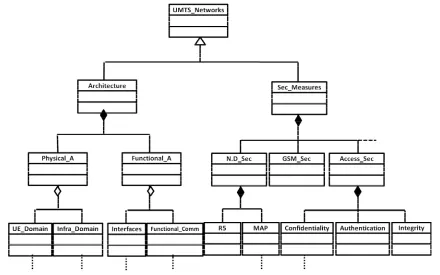
Class diagrams (Figure 6) Show the existing classes of real world system, and how they are associated with each other in a hierarchical manner. Figure 6 illustrates a
Package (the only one grouping thing available for gath-ering structural and behavioral things) of a global UMTS class diagram. It is intended to show the relative size and composition of the entire Ontology; it will be further shown in smaller diagrams (such as in Figure 7 repre-senting high level classes) easily readable and providing greater details.
As shown in Figure 7, each class is represented by a box with three parts: the first one at the top is for the name of the class, the second part is for the attributes of the class (specified by their name, type and visibility) and the third one is for the operations of the class (speci-fied by name, argument list, return type and visibility).
For the purposes of annotating our Ontologies and to keep figures light and clear, we do list neither the attrib-utes nor the operations.
Figure 6. UML Description of UMTS network features.
[image:9.595.78.518.449.724.2]Roadmap for Establishing Interoperability of Heterogeneous Cellular Network Technologies -2- 411
(Strongly-owned), meanwhile the empty one represents an Aggregation (non-strongly owned).
7. Conclusion
The lack of interoperability between cellular access net-works has long been a challenging burden, which tele-communication engineers and researchers are trying to overcome. A tentative approach to overcome this issue within heterogeneous networks begins by establishing a holistic understanding of cellular communication, and proposing an ontological framework that expresses the domain’s concepts, classes, and properties in a formal and unambiguous way. It begins by analyzing the struc-ture of three different cellular technologies, and produc-ing feature models. The UMTS cellular network feature tree is, in fact, not easily buildable, which will require from us to undertake seemingly heavy processes to iden-tify existing features that may satisfy the representational needs.
REFERENCES
[1] N. Hasni and R. Bouallegue, “Roadmap for Establishing Interoperability of Heterogeneous Cellular Network Technologies -1-,” International Journal of Computer Science and Network Security, Vol. 12, No. 4, 2012, pp. 92-103.
[2] “Overview of 3GPP Release 99 Summary of all Release
99 Features” ETSI Mobile Competence Centre Version 05/03/04
[3] 3GPP spec. TR 21-905.
[4] K. Czarnecki and U. Eisenecker, “Generative Program-ming Methods, Tools, and Applications,” Addison-Wesley, Boston, 2000.
[5] L. Geyer, “Feature Modeling Using Design Spaces,”
Proceedings of the 1st German Workshop on Product Line Software Engineering, Kaiserslautern, November 2000. [6] N. Hasni, “Towards an Interoperability Ontology for
Software Development Tools,” Master’s Thesis, Com-puter Science Department, Naval Postgraduate School, Monterey, 2003.
[7] “OMG Unified Modeling LanguageTM (OMG UML),” Superstructure Version 2.2, February 2009.
[8] P. Kogut, S. Cranefield, L. Hart, M. Dutra, K. Baclawski, M. Kokar and J. Smith, “UML for Ontology Develop-ment,” Knowledge Engineering Review, Vol. 17, No. 1, 2002, pp. 61-64.
[9] S. Cranefield and M. Purvis, “UML as an Ontology Mod-elling Language,” Proceedings of the Workshop on Intel-ligent Information Integration, 16th International Joint Conference on Artificial Intelligence, Sweden, 1999, pp. 46-53.