© 2019, IRJET | Impact Factor value: 7.34 | ISO 9001:2008 Certified Journal
| Page 1252
ACCIDENT ANALYSIS ON HIGHWAYS
Rameez Majid
1, Dr. Rakesh Gupta
2, Er. Neeraj Kumar
31
M.Tech Scholar Civil Engineering Department, SRMIET Khora Bhura, Ambala
2Professor and Director, Civil Engineering Department, SRMIET Khora Bhura, Ambala
3
Assistant Professor, Civil Engineering Department, SRMIET Khora Bhura, Ambala
---***---Abstract - Rapid growth of population coupled with
economic activities has resulted in continuous growth of motor vehicles and due to increasing population and vehicles, traffic accidents are increasing day-by-day. Traffic accidents related to deaths and injuries result in not only substantial economic losses but also serious physical and mental suffering. The increasing road accident has also created social problems due to loss of lives and human miseries. The road accidents are very much on Ambala Jagadhari Road & due to which it was very essential to evaluate " Accident analysis of Ambala Jagadhari Road " so that the remedial measures should be suggested to the accidents on Ambala Jagadhari road, according the data related to traffic volume, type of vehicles, accident data, type of accident, causes of accident vehicles involved in the accident, were collected from the last decade years and analysed.
1. INTRODUCTIONAmbala roads are proving fatal for the residents. In the past three years 59% of the accidents happened on the National Highways (NHs), reveals the data obtained from the Haryana Vision Zero (HVZ) team. The HVZ is a programme of Haryana government related to road safety. Till May 2019, Ambala district has witnessed 109 fatalities which is equal as compared to the numbers from May 2018. HVZ senior road safety associate Rashit Bajaj said, “Our team has been working on strengthening the infrastructure and increasing road safety in Ambala since three years and we have provided time-to-time reports to the National Highway Authority of India (NHAI). Earlier there were no dividers or separators on the highways which caused fatal crashes and we have continuously pressed for dividing the roads with iron grills and nets to decrease the fatality rate. The 23.1km stretch on NH-44 also famously known as GT road from Mohri to Devinagar toll plaza has recorded 19% of the total fatal accidents in the past three years.” Bajaj said, “In winter, the accidents increase due to foggy weather and since last few years we have been able to keep the number of fatalities stagnant and it has not increased. The maximum fatalities are of two-wheeler riders.” On the other side, Ambala police is continuously running awareness campaigns through its Raahgiri events and also observing ‘zero tolerance day’ against the traffic violators. Ambala DSP Sultan Singh said, “The majority of road accidents happen due to the traffic rule violations and the two-wheeler riders are requested to wear helmets while commuting on the district roads. The department is regularly organizing awareness events like Raahgiri and public should support the police by obeying traffic rules.”
When questioned about the authenticity of the data obtained from the HVZ team and efforts of the district administration for road safety, Ambala additional deputy commissioner Captain Shakti Singh said, “This data is absolutely valid and it is generated in coordination of the police department. We have been regularly holding review meetings related to road safety and the concerned officials are instructed time and again according to the inputs and requirements.” Most fatalities of two-wheelers according to the First Information Report (FIR) data registered in fatal crashes in the last three years, 35% accidents are of two-wheeler riders, 28% of pedestrians, car/jeep/taxi/van contributes 24% and cyclists 6%. There have been 759 fatal crashes in Ambala district, out of which, 59% have happened on NHs, maximum crashes happened on NH-44. 24 black spot identified in Ambala according to the Ministry of Road Transport & Highways (MoRTH), Government of India, road accidents black spot on National Highways is a road stretch of about 500m in length where atleast 5 road accidents (involving fatalities/grievous injuries) have took place during the last three calendar years.
In Ambala, a total of 24 such black spots have been identified.
© 2019, IRJET | Impact Factor value: 7.34 | ISO 9001:2008 Certified Journal
| Page 1253
with the highest number of fatalities in road accidents,followed by Sonepat, Karnal and Yamunanagar. About 50% fatal accidents took place on state highways, while 35% occurred on the national highways, mentions a previous report of the traffic police. On key factors that cause most of the accidents, Loading vehicles beyond permissible limits, driving under influence and wrong parking have also added to the reasons behind road accidents. Trucks, goods carriers and tractors have caused about 40% of the accidents in the state, it has been stated in the report. “But, we are making efforts with the help of several government departments and have succeeded in minimizing the number of accidents and deaths,” she added. Last year, the traffic and highways wing of the Haryana Police had identified 179 accidents prone areas in the state, including 41 that come under the jurisdiction of the NHAI. “We are taking measures to aware people about these spots,” she added. The police have challaned as many as 10.06 lakh vehicles in the state and earned revenue of ₹22.84 crore during these four months for blatant violations of traffic rules.
2. Road Safety
Today road traffic accidents are one of the leading causes of deaths, hospitalizations and disabilities, with severe socio economic costs in India. The increasing number of road accidents has imposed considerable social and economic burdens on the victims of accidents. The statistics maintained by the Haryana police, revealed that the state ranks number 13 in the country as far as road accidents are concerned. Around a dozen people die and another 27 to 30 sustained injuries every day on the Haryana roads. Road traffic safety refers to methods and measures for reducing the risk of a person using the road network being killed or seriously injured. The users of a road include pedestrians, cyclists, motorists, their passengers, and passengers of on-road public transport, mainly buses and trams. Best practice road safety strategies focus upon the prevention of serious injury and death crashes in spite of human fallibility. Safe road design is now about providing a road environment which ensures vehicle speeds will be within the human tolerances for serious injury and death wherever conflict points exist.
3. Causes of Accidents
The users of a road include pedestrians, cyclists, motorists, their passengers, and passengers of on-road public transport, mainly buses and trams. Best practice road safety strategies focus upon the prevention of serious injury and death crashes in spite of human fallibility. Safe road design is now about providing a road environment which ensures vehicle speeds will be within the human tolerances for serious injury and death wherever conflict points exist. The various causes of accidents may be due to three factors shown in fig. 1.2.
(i) Driver (ii) Vehicle
(iii)Environment
Fig. 1 Causes of Accidents
4. LITERATURE REVIEW
Over the years a lot of research has been carried out on the possible use of different materials for soil stabilization. The summary of few such researchers is given below:
Longo, et al., (1999) [1] analyzed blood sample for alcohol, cannabinoids, benzodiazepines from 2500 injured Australian drivers. He found drivers tested positive for alcohol only, benzodiazepine only. The combination of alcohol and cannabinoids and combination of alcohol and benzodiazepines were more culpable for the crash than drug-free group.
Holmgren, et al., (2000) [2] found fatally injured in traffic accident is a function of alcohol, pharmaceuticals and illicit drugs.
Rio, et al., (2001) [3] studied the blood samples reports of 5745 Spanish drivers killed in road accident during 1991-2000. He found psychoactive drugs among 50.1% of those driver killed in road accidents. Mainly alcohol (43.8%), illicit drugs (8.81%) and medicinal drug (4.7%). For one every three cases (32%) a BAC over 0.8g/l was recorded, cocaine (5.2%), opiates (3.2%) and cannabis (2.2%) were three illicit drugs most frequently detected. Among medicinal drugs were benzodiazepines (3.4%), antidepressant drugs (0.6%) and analgesics (0.4%).
Keall, et al., (2002) [4] investigated the effect of alcohol, driver age and influence of passengers of driver fatal injury in New Zealand. They calculated risk factor as:
Relative risk = (Risk associated with BAC) x (Risk associated with age) x (Risk associated with passenger)
© 2019, IRJET | Impact Factor value: 7.34 | ISO 9001:2008 Certified Journal
| Page 1254
roads during day light controlling weather and lightcondition.
Tornros, and Boiling., (2005) [6] conducted an experiment with 48 drivers by covering a distance of 15 Km on a rural two-lane road. They concluded that driving performance reduced by dialing hand held phone and speed decreased with hands free phone. Reaction time to warning sign at road side decreased for hand held phone user.
Constantinou, et al., (2011) [7] found that young novice driver (<25 yrs.) are in high risk related to traffic offence. The study was based on gender, sex, age and personality.
Hassan, and Aty., (2012) [8] studied 680 young driver behavior involvement in traffic crash in Florida. The result revealed that aggressive violation, in-vehicle distraction and demographic characteristics were the significant factors affecting young drivers involvement in crashes at the age of 16-17. Invehicle distraction, attitude towards speeding and demo-graphics characteristics were the significant factor effect young drivers crash risk at the age of 18-24.
Chan., (2008) [9] analyzed overloading truck reduces braking ability of truck, stability of truck, unexpected defect of road and damage of vehicle. Fatal crashes involving overloaded large truck increases by 52%.
Osueke, and Okorie., (2012) [10] had summarized tyre defect may be due to under or over inflation, overloading, ageing behavior, external impact due to pothole, debris, nail etc. Tyre up to six years from the date of manufacturer should be changed including spare tyres.
5. Annual Variation in Accidents
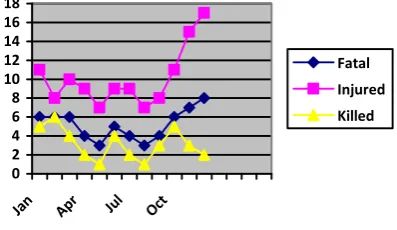
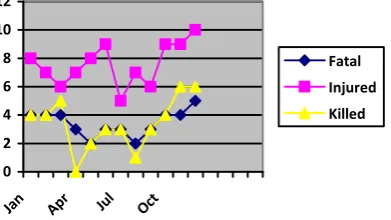
In following figures show the annual variation month wise in accidents of total stretch during year 2010-2019. It is observed that percentage accidents are decreases relatively in most of the year. In the year 2010 accident rate was high and low in the year 2019.
0 5 10 15 20 25
Jan Apr Jul Oct
[image:3.595.334.537.104.216.2]Fatal Injured Killed
Fig.2 Accidents variations during year 2010
0 2 4 6 8 10 12 14 16
Jan Apr Jul Oct
[image:3.595.336.537.276.388.2]Fatal Injured Killed
Fig. 3 Accidents variations during year 2011
0 2 4 6 8 10 12 14 16
Jan Apr Jul Oct
[image:3.595.337.536.448.563.2]Fatal Injured Killed
Fig. 4 Accidents variations during year 2012
0 2 4 6 8 10 12 14 16 18
Jan Apr Jul Oct
Fatal Injured Killed
Fig. 5 Accidents variations during year 2013
0 2 4 6 8 10
Jan Apr Jul Oct
Fatal Injured Killed
[image:3.595.63.266.571.691.2] [image:3.595.336.537.620.732.2]© 2019, IRJET | Impact Factor value: 7.34 | ISO 9001:2008 Certified Journal
| Page 1255
02 4 6 8 10 12 14
Jan Apr Jul Oct
[image:4.595.67.266.104.216.2]Fatal Injured Killed
Fig. 7 Accidents variations during year 2015
0 1 2 3 4 5 6 7 8
Jan Mar May Jul Sep Nov
[image:4.595.330.536.104.218.2]Fatal Injured Killed
Fig. 8 Accidents variations during year 2016
0 2 4 6 8 10 12
Jan Apr Jul Oct
Fatal Injured Killed
Fig. 9 Accidents variations during year 2017
0 2 4 6 8 10 12
Jan Apr Jul Oct
Fatal Injured Killed
Fig. 10 Accidents variations during year 2018
0 2 4 6 8 10 12
Jan Apr Jul Oct
[image:4.595.69.265.277.392.2]Fatal Injured Killed
Fig. 11 Accidents variations during year 2019
In view of above it is found that total accidents during the period of 2010 to 2019 1430 in which 570 fatal and 860 injuries in the month of December, November, February and January maximum accidents occurs during this period. Vehicles involved in accidents during this period was 1820 in which heavy motor vehicles 668, light motor vehicles 619, two wheeler vehicles 407 and miscellaneous 126 are involved.
6. Conclusions
Based on this study following conclusions are as under:
1. Heavy motor vehicles involved in maximum number of accidents i.e. 36.70% followed by other light motor vehicle i.e. 34.01%, two wheeler vehicles i.e. 23.36% and miscellaneous i.e. 06.93%. Further about one third deaths and two third injuries occurred in road accidents during recent past in the area.
2. On the basis of accident data analysis and field visits conducted during the study following remedial measures are taken up to reduce accidents occurrence for road safer movement:
Provision of traffic lights and road markings.
Strict enforcement of traffic regulations.
Provide speed control devices.
Periodic maintenance of road and traffic signals.
Avoiding of overloading.
7. Scope for Further Work
Further study can be done to improve road safety by developing accident prediction model based on different methodologies and then by applying remedial measures.
8. REFERENCES
[image:4.595.69.265.449.559.2] [image:4.595.65.271.619.741.2]© 2019, IRJET | Impact Factor value: 7.34 | ISO 9001:2008 Certified Journal
| Page 1256
culpability,” Accident Analysis and Prevention, Vol. 32,pp.623-632.
[2] Holmgren et al., (2000) “Alcohol and drugs in drivers fatally injured in traffic accidents in Sweden during the years 2000-2002,” Forensic Science International, Vol. 151, pp.11-17.
[3] Rio et al., (2001) “Alcohol, illicit drugs and medicinal drugs in fatally injured drivers in Spain between 1991 and 2000,” Forensic Science International, Vol. 127, pp.63-70.
[4] Keall et al., (2002) “The influence of alcohol, age and number of passengers on the night-time risk of driver fatal injury in New Zealand,” Accident Analysis and Prevention, Vol. 36, pp.49-61.
[5] Golob and Recker (2003) Journal of Transport Engineering, Vol. 4, pp.129.
[6] Tornros and Boiling (2005) “Mobile phone use-Effects of handled and hands free phones on driving performance,” Accident Analysis and Prevention, Vol. 37, pp.902-909.
[7] Constantinou et al., (2011) “Risky and aggressive driving in young adults: Personality Matters,” Accident Analysis and Prevention, Vol. 43, pp.1323-1331.
[8] Hassan and Aty (2002) “Exploring the safety implications of young drivers attitude and perceptions,”
Accident Analysis and Prevention, Vol. 43, pp.45-65.
[9] Yin Chuen Chan (2008) “Over loading problems in truck master thesis,”.