Barley (Hordeum vulgare L.) is an important cereal, which is grown in many parts of world. In 2011 the total growing area for barley was 54 million hectares with production of around 152 mil-lion tons. It is the third most important cereal in Europe after wheat and maize (FAO 2011). Efficient nitrogen fertilization is essential for economic production and protection of the environment. For this reason improvement in nitrogen use ef-ficiency (NUE) has become a desirable goal in barley research. Nitrogen use efficiency in the crop is influenced by N uptake from the soil, N assimilation in the plant and N redistribution from vegetative parts to the grain (Andersson and Holm 2011). The key targets of the NUE research are to increase the proportion of N recovered from the soil (REN) and to obtain an enhanced efficiency
of utilization of the N taken-up for yield forma-tion (NUtE). Increased N recovery and utilizaforma-tion efficiency may allow growers to maximize yield under a moderate rate of N fertilization instead of the high rate of N fertilization (Anbessa and Juskiw 2012, Bingham et al. 2012). If N is applied and not taken up by the crop or immobilized in soil organic N pools, which include both micro-bial biomass and soil organic matter, is vulnerable to losses from volatilization, denitrification and leaching (Cassman et al. 2002). Only 30–50% of applied nitrogen fertilizer is taken up by crops (Dobermann 2005), hence the improvement in NUE is important to reduce input costs and the negative impact of excessive N on the environment (Snyder 2009, Anbessa and Juskiw 2012). Fertilizer N crop recovery efficiency is driven by three main sets of
Nitrogen efficiency of spring barley in long-term experiment
Š. Shejbalová, J. Černý, F. Vašák, M. Kulhánek, J. Balík
Department of Agro-Environmental Chemistry and Plant Nutrition, Faculty
of Agrobiology, Food and Natural Resources, Czech University of Life Sciences Prague,
Prague, Czech Republic
ABSTRACT
The aim of this study was to evaluate nitrogen (N) efficiency from different organic and mineral fertilizers applied to the spring barley. Dry matter yield, N content and N uptake of spring barley from 16 years of experiments at two sites in the Czech Republic with different soil and climatic conditions were analyzed. For assessing of nitrogen ef-ficiency nitrogen utilization efef-ficiency (NUtE, kg/kg), recovery efef-ficiency of applied N (%), agronomic efef-ficiency of applied N (kg/kg) and summary N balances (ΣΔN, kg/ha) were observed. Six fertilization treatments were utilized: no fertilization (control); sewage sludge; farmyard manure (FYM); N in mineral fertilizers (N); NPK in mineral fertilizers (NPK) and N in mineral fertilizers + straw (N + ST). Yields were about 68% higher at NPK (S1 site) and 55% at N + ST (S2 site) in comparison with control. The highest NUtE was recorded at both locations after applica-tion of FYM. Higher NUtE from mineral fertilizers was obtained at low productive S1 site. At both sites a trend of decreasing ΣΔN over time was observed. At both sites a trend of decreasing negative N balance was observed. At lower productive site the decline of N balance was minimized for mineral fertilizers treatments in last experimental years. At higher productive site the differences between treatments with mineral nitrogen and control were lower and the decline of N balance continued over all 16 years of experiment duration.
Keywords: N balance; mineral fertilizers; organic fertilizers; yield; nitrogen utilization
controls: 1. crop N demand; 2. N supply and 3. N losses. Each set of controls comprises several processes and variables. Some processes can be managed in a field (e.g., delivery of nutrients, disease control), but other variables cannot be controlled (temperature, rainfall, or soil texture) (Balasubramanian et al. 2004). Nitrogen budgeting approaches are often used to evaluate system-level N use efficiency, and to understand N cycling by estimates of input, storage and export processes by mass balance (Dobermann 2005).
The objective of this paper was to investigate: treatments reaching the highest dry matter (DM) yield, N content and N uptake by spring barley grain, treatments and site supporting the highest N efficiency and their effect on summary N balance.
MATERIAL AND METHODS
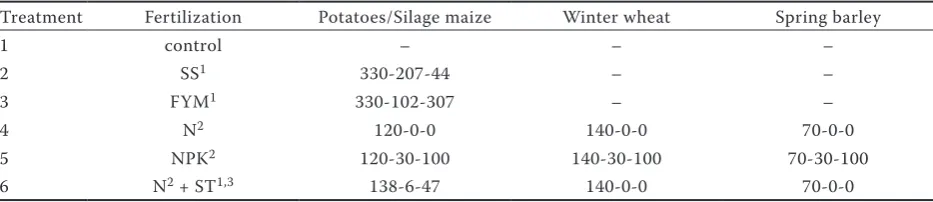
Experimental site. The experiment was es- tablished in 1996 in the Czech Republic – at two sites with different soil and climatic conditions: S1 (Humpolec, 49°33'16''N, 15°21'2''E), S2 (Červený Újezd, 50°4'22''N, 14°10'19''E). S1 site is localized 525 m a.s.l., average annual temperature is 7°C with 665 mm average annual precipitation. The soil type is Cambisol with sandy loam soil texture. S2 site is 410 m a.s.l., average annual temperature is 7.7°C with 493 mm average annual precipitation. The soil texture at S2 site is silt loam (Luvisol). A simple crop rotation included: potatoes (S1)/silage maize (S2), winter wheat and spring barley. Each year all of the crops were grown. Fertilization treatments were repeated in three blocks. The size of experi-mental plots was 60 m2 at S1 and 80 m2 at S2 site. Field experiment. Six fertilization treatments were utilized: 1. no fertilization (control); 2.
sew-age sludge (SS); 3. farmyard manure (FYM); 4. N in mineral fertilizers (in calcium ammonium ni-trate) (N); 5. NPK in mineral fertilizers (NPK) and 6. mineral N fertilizers + 5 t/ha spring barley straw (N + ST). The whole experiment was based on the same nitrogen rate 330 kg N/ha to the crop rotation (of which 70 kg N/ha to the spring bar-ley) except the non-fertilized control treatment as detailed in Table 1. By this rate of nitrogen high yields with adequate grain crude protein were achieved for malting barley (Pettersson and Eckersten 2007). Organic fertilizers (sewage sludge, farmyard manure, straw) were applied in autumn only to the potatoes (S1)/silage maize (S2) in the crop rotation. Mineral N fertilizers were applied to the spring barley before sowing. Between the years 1996–2004 cv. Akcent of spring barley was grown, between 2005–2011 cv. Calgary and then in 2012 cv. Xanadu.
Plant sampling and analysis. Plant samples were collected after the plants were harvested (at maturity). Results of the experiment were ob-tained from the years 1997–2012, which means five crop rotations. Determination of total nitrogen was carried out by the Kjeldahl method on the KjeltecAuto 1030 Analyzer (Tecator, Hoganas, Sweden) (1997–2005) and Vapodest 50s (Gerhardt Gmbh & Co. KG, Germany) (2006–2012). Statistical evaluation of the results was performed between treatments, with data over 16 years pooled together in the Statistica 9.0 program (StatSoft, Tulsa, USA) with the single-factorial ANOVA followed by the Tukey’s test at the level of significance P < 0.05.
[image:2.595.64.531.613.714.2]The following characteristics were calculated: 1. Nitrogen utilization efficiency (NUtE, kg/kg); 2. Recovery efficiency of applied N (REN, %); 3. Agronomic efficiency of applied N (AEN, kg/kg) and 4. Summary N balances (ΣΔN, kg/ha). According
Table 1. Rates of nutrients NPK (kg/ha) during crop rotation cycle
Treatment Fertilization Potatoes/Silage maize Winter wheat Spring barley
1 control – – –
2 SS1 330-207-44 – –
3 FYM1 330-102-307 – –
4 N2 120-0-0 140-0-0 70-0-0
5 NPK2 120-30-100 140-30-100 70-30-100
6 N2 + ST1,3 138-6-47 140-0-0 70-0-0
to Dobermann (2005) REN depends on the congru-ence between plant N demand and the quantity of N released from applied N. Summary N balances were calculated as differences between applied N and uptake N (grain + straw) (Liu et al. 2010) summarized in consecutive years.
1. NUtE = Y/U (Moll et al. 1982) 2. REN = (Ux – U0)/F × 100 3. AEN = (Yx – Y0)/F 4. ΣΔN
Where: x – treatments with N fertilizing; 0 – control treat- ment with no N fertilizing; Y – crop yield of grain (kg/ha); U – uptake of N by grain (kg/ha); Ut – total (grain + straw) uptake of N (kg/ha); F – amount of applied N (kg/ha)
ΔN = F – Ut
RESULTS AND DISCUSSION
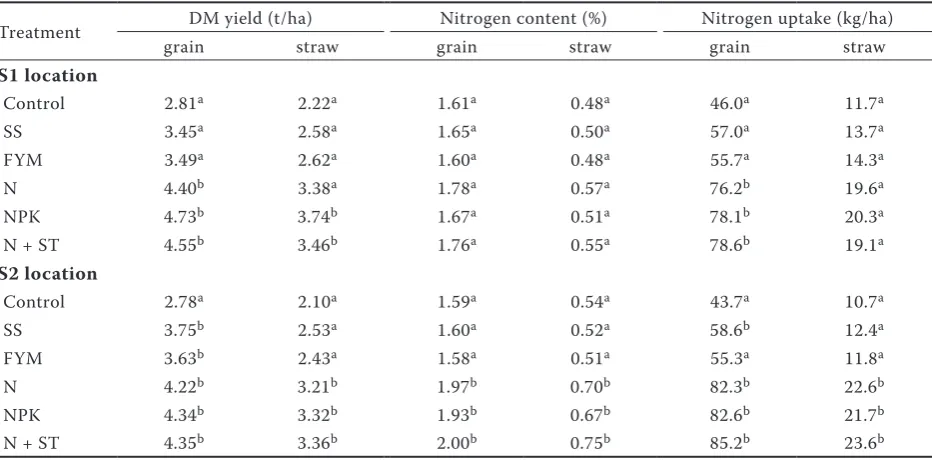
The average dry matter yield, N content in DM and N uptake by grain and straw of spring barley are shown in Table 2 (S1 and S2). DM yield of grain and straw was similar at both locations, however a slightly larger yield was achieved at S1 site. The highest increases of yield were obtained after us-ing nitrogen in mineral form. The increased yields were about 68% by NPK (S1) and 55% by N + ST (S2) higher in comparison with non-fertilized treatment. Obtaining the highest yields after us-
[image:3.595.65.532.114.344.2]ing nitrogen in mineral forms confirm Cossani et al. (2009), who achieved 4.5 t/ha of barley grain after the application of 80 kg N/ha and by Cantero-Martinéz et al. (2003), who obtained, in a 3 year experiment, an average yield of 4.3 t/ha after an annual dose of 75 kg N/ha. The effect of treatment on grain yield was highly significant at both sites: S1 (df = 5; F = 11.833; P < 0.05), S2 (df = 5; F = 9.532; P < 0.05), differences in post-hoc test are in Tables 2 and 3. DM yields of unfertilized control treatment were more balanced at S2 site, situated on Luvisol. The effect of soil type on sustainable production of crops confirms the results of many studies (Kunzová and Hejcman 2009, Černý et al. 2010, Hejcman et al. 2012). The highest increase of nitrogen content in grain was achieved at S1 by N treatment (10% higher than control) and at S2 by N + ST (26% higher than control) and by uptake of nitrogen at both sites by N + ST. Use of fertilizers with nitrogen in mineral form at S2 site led to significantly higher content of nitrogen in grain and straw compared to unfertilized treat-ment, which is in agreement with many research-ers (Pettresearch-ersson and Eckresearch-ersten 2007, Sedlář et al. 2011, Hejcman et al.2013). Previous application of organic fertilizers resulted in lower or com-parable value of nitrogen content to unfertilized treatment. Delogu et al. (1998) in the experiment with nitrogen fertilization of barley, described
Table 2. Influence of different fertilizers on dry matter (DM) yield, nitrogen content and nitrogen uptake by grain and straw of spring barley
Treatment DM yield (t/ha) Nitrogen content (%) Nitrogen uptake (kg/ha) grain straw grain straw grain straw
S1 location
Control 2.81a 2.22a 1.61a 0.48a 46.0a 11.7a
SS 3.45a 2.58a 1.65a 0.50a 57.0a 13.7a
FYM 3.49a 2.62a 1.60a 0.48a 55.7a 14.3a
N 4.40b 3.38a 1.78a 0.57a 76.2b 19.6a
NPK 4.73b 3.74b 1.67a 0.51a 78.1b 20.3a
N + ST 4.55b 3.46b 1.76a 0.55a 78.6b 19.1a
S2 location
Control 2.78a 2.10a 1.59a 0.54a 43.7a 10.7a
SS 3.75b 2.53a 1.60a 0.52a 58.6b 12.4a
FYM 3.63b 2.43a 1.58a 0.51a 55.3a 11.8a
N 4.22b 3.21b 1.97b 0.70b 82.3b 22.6b
NPK 4.34b 3.32b 1.93b 0.67b 82.6b 21.7b
that after using of 80 kg N/ha average nitrogen content in grain increased about 18% compared to unfertilized treatment.
Average values of NUtE, REN and AEN can be found in Table 3. Higher efficiency of nitrogen from mineral fertilizers was evaluated at low productive S1 site. This confirms Hejcman et al. (2012), who found a negative influence of naturally fertile soils (situated in lowlands) on the efficiency of mineral N application due to insufficient precipitation at these sites. On the contrary the efficiency of nitrogen from organic fertilizers was greater at S2 site. Angás et al. (2006) published results from the 3 year experiment on the effects of nitrogen fertilization on barley. After application of 75 kg N/ha in mineral form average NUtE was 56.6 kg/kg, which corresponds to our results. Higher values of NUtE occurred at treatments with organic fertil-ization compared to the treatments with mineral form of nitrogen. It was probably caused by lower available nitrogen in the third year of using organic fertilizers. The highest NUtE was recorded at both
[image:4.595.64.532.103.220.2]locations after application of FYM because of lower N content in grain at FYM treatment compared to treatment with mineral N fertilizers. There is also effect of increased post-anthesis nitrogen uptake from soil due the higher mineralization of organic residues from FYM at this treatment (Montemurro et al. 2006). Yield of barley is limited by the storage capacity (sink) of grains rather than the supply of assimilate for grain filling. A limited storage capacity may lead to feedback inhibition on the rate of photosynthesis post-anthesis (Bingham et al. 2007). For treatment with mineral fertilizers average values of REN ranged between 46.2% (N) and 60.3% (N + ST). Snyder (2009) and Ladha et al. (2005) determined values of REN between 30–50% as typical for N recovery in cereals and values between 50–80% as achieved in the best management in cereals. At S1 site lower values of REN were observed than in S2, it signalized a greater risk of nitrogen losses at S1, which can be due to sandy loam soil texture. The average of AEN for treatments with nitrogen in mineral form was
Table 3. Efficiency of nitrogen
Treatment NUtE (kg/kg) REN (%) AEN (kg/kg)
S1 S2 S1 S2 S1 S2
Control 63.0a 65.1a – – – –
SS 61.4a 64.2a – – – –
FYM 64.2a 66.5a – – – –
N 58.7a 51.4b 46.2b 58.2a 25.0a 22.0a
NPK 61.8a 53.1b 46.7b 56.9a 29.0a 23.3a
N + ST 59.2a 51.5b 48.7b 60.3a 26.5a 23.6a Treatments with the same letter are not significantly different (P ≤ 0.05).SS – sewage sludge; FYM – farmyard manure; ST – straw; NUtE – nitrogen utilization efficiency; REN – recovery efficiency of applied N; AEN – agro-nomic efficiency of applied N; S1 – Humpolec; S2 – Červený Újezd
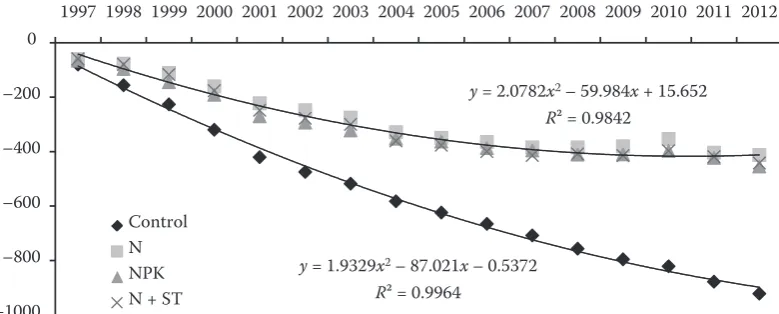
y = 1.9329x2 – 87.021x – 0.5372 R² = 0.9964
y = 2.0782x2 – 59.984x + 15.652 R² = 0.9842
–1000 –800 –600 –400 –200 0
1997 1998 1999 2000 2001 2002 2003 2004 2005 2006 2007 2008 2009 2010 2011 2012
[image:4.595.94.484.575.732.2]Control N NPK N + ST
25 kg/kg. N agronomic efficiency is according to Delogu et al. (1998) a parameter representing the ability of the plant to increase yield in response to N applied. The agronomic efficiency of N widely depends on growing conditions (Mengel et al. 2006). Higher values of AEN were at S1 site. It is consistent with higher efficiency of nitrogen from mineral fertilizers at this site. The highest value of AEN was evaluated at NPK treatment at S1 site, but the data are not statistical significant due the annual variability. Agronomic efficiency was greatly dependent on meteorological situa-tion in the growing season and therefore greatly differed between years.
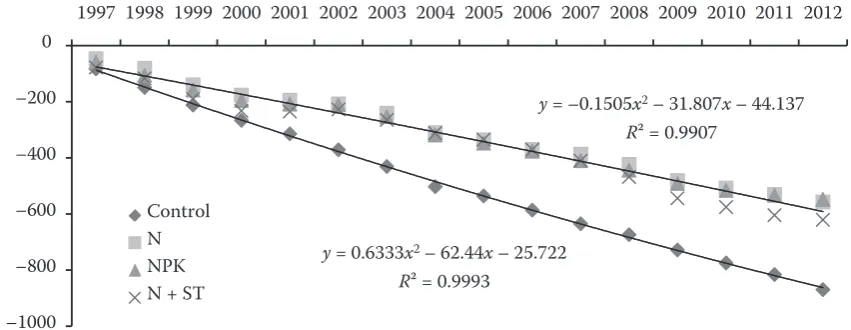
Summary N balances started at first harvested year 1997 for treatments with mineral N on –62 kg N/ha at both sites and on –81 kg N/ha at S1 and –83 kg N/ha at S2 for control treatment. For treat- ments with mineral fertilizing values of summary N balances in the last experimental year 2012 de-creased to –437 kg N/ha at S1 and –576 kg N/ha at S2, for unfertilized control treatment –922 kg N/ ha at S1 and –870 kg N/ha at S2. At both sites a trend of decreasing ΣΔN over time was observed, espe- cially for treatment without any fertilizer input. At S1 nitrogen fertilization in mineral form led from a decrease of ΣΔN to equalizing to slight in- crease in last observed years, detailed in Figures 1 and 2. At S2 site were apparent the differences between treatments with mineral nitrogen in the recent years, there were lower values for N + ST compared to other treatments with nitrogen fer-tilizers. From summary N balances and values of REN it can be assumed, that a higher risk of losses is at S1 site. Spring barley is a crop with a short growing season and weak root system, therefore
there is a greater risk of nitrogen losses into the environment.
REFERENCES
Anbessa Y., Juskiw P. (2012): Review: Strategies to increase nitro-gen use efficiency of spring barley. Canadian Journal of Plant Science, 92: 617–625.
Andersson A., Holm L. (2011): Effects of mild temperature stress on grain quality and root and straw nitrogen concentration in malting barley cultivars. Journal of Agronomy and Crop Sci-ence, 197: 466–476.
Angás P., Lampurlanés J., Cantero-Martínez C. (2006): Tillage and N fertilization: Effects on N dynamics and barley yield under semiarid Mediterranean conditions. Soil and Tillage Research, 87: 59–71. Balasubramanian V., Alves B., Aulakh M., Bekunda M., Cai Z., Drinkwater L., Mugendi D., Kessel C. van, Oenema O. (2004): Crop, environmental, and management factors affecting nitro-gen use efficiency. In: Mosier A., Syers J.K., Freney J.R. (eds.): Agriculture and the Nitrogen Cycle. Scope, USA.
Bingham I.J., Blake J., Foulkes M.J., Spink J. (2007): Is barley yield in the UK sink limited?: I. Post-anthesis radiation interception, radiation-use efficiency and source-sink balance. Field Crops Research, 101: 198–211.
Bingham I.J., Karley A.J., White P.J., Thomas W.T.B., Russell J.R. (2012): Analysis of improvements in nitrogen use efficiency associated with 75 years of spring barley breeding. European Journal of Agronomy, 42: 49–58.
Cantero-Martínez C., Angas P., Lampurlanés J. (2003): Growth, yield and water productivity of barley (Hordeum vulgare L.) af-fected by tillage and N fertilization in Mediterranean semiarid, rainfed conditions of Spain. Field Crops Research, 84: 341–357. Cassman K.G., Dobermann A., Walters D.T. (2002): Agroeco -systems, nitrogen-use efficiency, and nitrogen management. Ambio: A Journal of the Human Environment, 31: 132–140.
y = 0.6333x2 – 62.44x – 25.722 R² = 0.9993
y = –0.1505x2 – 31.807x – 44.137 R² = 0.9907
–1000 –800 –600 –400 –200 0
1997 1998 1999 2000 2001 2002 2003 2004 2005 2006 2007 2008 2009 2010 2011 2012
[image:5.595.74.500.89.254.2]Control N NPK N + ST
Černý J., Balík J., Kulhánek M., Čásová K., Nedvěd V. (2010): Mineral and organic fertilization efficiency in long-term sta-tionary experiments. Plant, Soil and Environment, 56: 28–36. Cossani C.M., Slafer G.A., Savin R. (2009): Yield and biomass in
wheat and barley under a range of conditions in a Mediter-ranean site. Field Crops Research, 112: 205–213.
Delogu G., Cattivelli L., Pecchioni N., de Falcis D., Maggiore T., Stanca A.M. (1998): Uptake and agronomic efficiency of nitrogen in winter barley and winter wheat. European Journal of Agronomy, 9: 11–20.
Dobermann A.R. (2005): Nitrogen Use Efficiency – State of the Art. University of Nebraska, Lincoln.
FAO (2011): FAOSTAT Database Agricultural Production. Avail-able at http://apps.fao.org. Food and Agricultural Organization of the United Nations
Hejcman M., Kunzová E., Šrek P. (2012): Sustainability of winter wheat production over 50 years of crop rotation and N, P and K fertilizer application on illimerized luvisol in the Czech Republic. Field Crops Research, 139: 30–38.
Hejcman M., Berková M., Kunzová E. (2013): Effect of long-term fertilizer application on yield and concentrations of elements (N, P, K, Ca, Mg, As, Cd, Cu, Cr, Fe, Mn, Ni, Pb, Zn) in grain of spring barley. Plant, Soil and Environment, 59: 329–334. Kunzová E., Hejcman M. (2009): Yield development of winter
wheat over 50 years of FYM, N, P and K fertilizer application on black earth soil in the Czech Republic. Field Crops Research,
111: 226–234.
Ladha J.K., Pathak H., Krupnik T.J., Six J., van Kessel C. (2005): Ef-ficiency of fertilizer nitrogen in cereal production: Retrospects and prospects. Advances in Agronomy, 87: 85–156.
Liu J., Liu H., Huang S., Yang X., Wang B., Li X., Ma Y. (2010): Nitrogen efficiency in long-term wheat-maize cropping sys-tems under diverse field sites in China. Field Crops Research,
118: 145–151.
Mengel K., Hütsch B., Kane Y. (2006): Nitrogen fertilizer ap-plication rates on cereal crops according to available mineral and organic soil nitrogen. European Journal of Agronomy,
24: 343–348.
Moll R.H., Kamprath E.J., Jackson W.A. (1982): Analysis and inter-pretation of factors which contribute to efficiency to nitrogen utilization. Agronomy Journal, 74: 562–564.
Montemurro F., Maiorana M., Ferri D., Convertini G. (2006): Ni-trogen indicators, uptake and utilization efficiency in a maize and barley rotation cropped at different levels and sources of N fertilization. Field Crops Research, 99: 114–124.
Pettersson C.G., Eckersten H. (2007): Prediction of grain protein in spring malting barley grown in northern Europe. European Journal of Agronomy, 27: 205–214.
Sedlář O., Balík J., Kozlovský O., Peklová L., Kubešová K. (2011): Impact of nitrogen fertilizer injection on grain yield and yield formation of spring barley (Hordeum vulgare L.). Plant, Soil and Environment, 57: 547–552.
Snyder C.S. (2009): Nitrogen use efficiency: Global challenges, trends and the future. Nutrient use efficiency. In: Proceedings of the XVIII Latin American Congress of Soil Science, 16–20th
November 2009, Costa Rica, 10–17.
Received on December 20, 2013 Accepted on April 30, 2014
Corresponding author: