The CULTAN (controlled uptake long term am-monium nutrition) system consists in injection of fertilizer with a significant ratio of nitrogen in am-monium form into the root space of plants; the place of fertilizer application in soil is called ‘depot’. Positive charge of ammonium and high concentration of fertilizer in these depots result in higher stability of fertilizer in soil (Sommer and Scherer 2009), which may improve nitrogen use efficiency (NUE; defined as grain dry matter per unit of nitrogen available from the soil, fertilizer included) (Ladha et al. 2005).
Better nitrogen use efficiency is an important presupposition for increased profit of production (Beatty et al. 2010). Ladha et al. (2005) state that increase in NUE may be also achieved by
reduc-ing nitrogen losses from the applied fertilizer either by application of slow release fertilizer or by using nitrification inhibitors. As an alternative method of NUE increasing, nitrogen fertilizer can be placed in bands, sideways, or below the seeds. Band‐placed nitrogen fertilizer leads to a reduced nitrogen immobilization by microorganisms (Ladha et al. 2005). Improving nitrogen use efficiency may also have environmental impacts through nitrate leaching by reducing the amount of fertilizer not used by the crop (Gaju et al. 2011).
Delay in nitrogen fertilization and higher stabil-ity of nitrogen fertilizer in soil at CULTAN treat-ment leads to prolonged soil nitrogen assimilation (Sommer and Scherer 2009). Increase in
post-anthe-Dynamics of the nitrogen uptake by spring barley at injection
application of nitrogen fertilizers
O. Sedlář, J. Balík, J. Černý, L. Peklová, K. Kubešová
Department of Agroenvironmental Chemistry and Plant Nutrition, Faculty
of Agrobiology, Food and Natural Resources, Czech University of Life Sciences Prague,
Prague, Czech Republic
ABSTRACT
Influence of CULTAN system (controlled uptake long term ammonium nutrition) on the nitrogen uptake by spring barley (Hordeum vulgare L.) was observed at 5-year small-plot field experiments under conditions of the Czech Republic (central Europe). Nitrogen uptake by CULTAN-fertilized plants was more even during vegetation period probably due to delayed term of fertilizer application. Nitrogen concentration in the aboveground biomass at BBCH 51 and in straw had no effect on grain yield. Post-heading nitrogen uptake as well as contribution of nitrogen trans-location to total nitrogen in grain did not differ among both nitrogen fertilization treatments. Increase in grain size of spring barley by the CULTAN system can be explained by tendency to lower number of ears per area rather than by prolonged nitrogen uptake from soil. Lower protein content in grain of CULTAN-fertilized spring barley can be caused by increase in grain retained on a 2.5 mm sieve and also decrease in total nitrogen concentration in above-ground biomass at BBCH 51. No significant effect of CULTAN treatment on nitrogen use efficiency and nitrogen uptake efficiency was recorded. Significantly higher nitrogen utilization efficiency at CULTAN treatment could be explained by lower grain protein content compared to conventional treatment.
Keywords: depot; nitrification; nitrate; leaching and losses; nitrogen assimilation
sis nitrogen uptake from soil is related to reduced rate of nitrogen remobilized from vegetative organs (Suprayogi et al. 2011), which, according to Užík and Žofajová (2012), results in delayed senescence. A delayed leaf senescence leads to prolongation of photosynthesis that increases grain yield and carbon filling into seeds (Pask et al. 2012).
The aim of this study was to investigate ability of nitrogen fertilizer injection to improve nitrogen use efficiency and to prolong nitrogen assimila-tion from soil resulting in increased grain yield, improved given qualitative parameters of grain and thus in environmental and economical benefits.
MATERIAL AND METHODS
Small-plot field experiments with spring barley (Hordeum vulgare L.) cv. Jersey were run during 2007–2011 at three sites with different soil-climatic conditions in the Czech Republic (central Europe). Conventional method of fertilization with calcium ammonium nitrate was compared with injection of urea ammonium nitrate applied at the BBCH 29–30 growth stages (the end of tillering to the beginning of stem elongation). Both treatments were evaluated at two amounts of nitrogen fertiliz-ers: 80 kg N/ha and 130 kg N/ha (Table 1).
Detailed description of methodology is given by Sedlář et al. (2011).
Samples of aboveground biomass at BBCH 51 stage (heading, ¼ of complete stage) were taken from 0.25 m2 area. Total nitrogen concentration
in aboveground biomass was determined by the Kjeldahl method using the Vapodest 50s (Gerhardt, Königswinter, Germany). To express grain protein content, nitrogen concentration in grain was mul-tiplied by the 6.25 coefficient (ČSN 46 1100-5).
Statistical analysis of data was carried out using the Statistica version 9.0 (StatSoft, Tulsa, USA). Data are presented in the results at four treatments
of nitrogen fertilization across the three sites and five years. Standard analysis of variance (ANOVA) procedures with the Fisher LSD test were used to calculate significant differences between individual treatments of nitrogen fertilization.
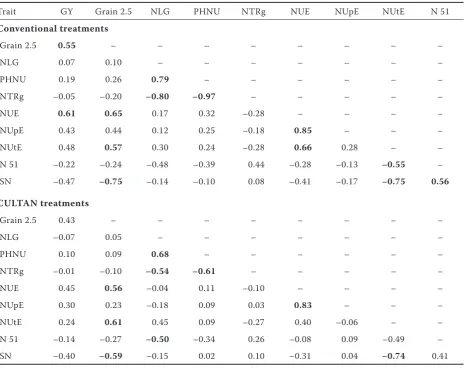
Linear regression and the resulting correlation coefficients were calculated by compiling the data obtained using the all four nitrogen fertilization treatments. Agronomical traits and traits related to nitrogen uptake by plants were analysed two by two using all possible combinations. Coefficients of correlation (r) between assessed traits are pre-sented in correlation matrix for both conventional and CULTAN treatments (Table 5).
Calculations:
Aboveground N content at maturity (AGNM):
AGNM = (GN × GY) + (SN × SY) (kg N/ha) Where: AGNM – aboveground N at maturity; GN – grain N concentration (%); GY – grain yield (t/ha); SN – straw N concentration (%) and SY – straw yield (t/ha).
Nitrogen at heading lost or gained (NLG, Bahrani et al. 2011 modified):
NLG = (%)
Where: AGNH – aboveground N at heading (BBCH 51) (kg N/ha).
Post-heading (BBCH 51) nitrogen uptake (PHNU, Pask et al. 2012 modified):
PHNU = AGNM – AGNH (kg N/ha)
Contribution of nitrogen translocation to total nitrogen in grain (NTRg, Užík and Žofajová 2012):
NTRg = (%)
Nitrogen use efficiency(NUE, Gaju et al. 2011):
[image:2.595.62.541.650.743.2]NUE = (kg grain dry matter/kg available N from soil and fertilizer) Where: SAN – soil available N before sowing (kg N/ha) and FN – N applied in fertilizer, i.e. 80 kg N/ha and 130 kg N/ha, respectively.
Table 1. Fertilizer treatment, nitrogen amounts and timing
Treatment Dosage of added N per ha (fertilizer form) Total N dosage per ha (kg) before sowing BBCH 28–29 BBCH 29–30
Conventional 80 80 kg (CAN) – – 80
CULTAN 80 – – 80 kg (UAN) 80
Conventional 130 80 kg (CAN) 50 kg (CAN) – 130
CULTAN 130 – – 130 kg (UAN) 130
CAN – calcium ammonium nitrate (27% N); UAN – urea ammonium nitrate (30% N)
AGNM – AGNH × 100 AGNH
AGNH – SN × SY × 100 GY × GN
Nitrogen uptake efficiency (NUpE, Gaju et al. 2011):
NUpE = (kg N uptake at harvest/kg available N from soil and fertilizer)
Nitrogen utilization efficiency (NUtE, Černý et al. 2012):
NUtE = (kg grain DM/kg N uptake at harvest)
RESULTS AND DISCUSSION
Significantly higher total nitrogen concentra-tion in aboveground biomass at the beginning of heading (BBCH 51) and in straw (Table 2) was observed at conventional fertilization compared to CULTAN treatment at application of 130 kg N/ha. This phenomenon could be explained by delayed term of CULTAN application, which is in accordance with the findings of Egle et al. (2008).
No significant differences in nitrogen lost or gained at heading (NLG) between conventional and CULTAN treatment were found (Table 3). Slight increase in NLG values at CULTAN-treated plants compared to conventionally treated ones could be explained according to Bahrani et al. (2011), who reported that the higher is the content of nitrogen accumulated in plant biomass before anthesis (Table 2), the higher is the probability of decrease in nitrogen content in aboveground biomass during grain filling period.
Post-heading nitrogen uptake (PHNU) as well as contribution of nitrogen translocation to total nitrogen in grain (NTRg) did not differ among both nitrogen fertilization systems. Contrary to the findings of Mickelson et al. (2003), no sig-nificant correlations between grain yield and ni-trogen concentration in aboveground biomass at the BBCH 51 growth stage and in straw in our experiments were recorded (Table 5). It can be assumed that total nitrogen concentration in grain was insufficient for significant grain yield increase. Because of no significant correlations between nitrogen concentration in aboveground biomass at the BBCH 51 growth stage as well as straw ni-trogen concentration between PHNU and NTRg values at both nitrogen fertilization systems, no significant correlations between grain yield and PHNU as well as NTRg were recorded.
Long-term plant nutrition intended by CULTAN system was not confirmed, which is in accordance with the findings of Flisch et al. (2013), who as-sume that nitrate developed through nitrification under CULTAN fertilization is continuously taken up by plants.
[image:3.595.63.533.104.155.2]To improve nitrogen use efficiency, Beatty et al. (2010) state, that it is necessary to increase both nitrogen uptake efficiency (NUpE) and nitrogen utilization efficiency (NUtE). By using the CULTAN system, significant improvement of NUtE compared to conventional treatment was achieved (Table 4), whereas no significant influence of CULTAN treatment on NUpE values was observed. Higher Table 2. Nitrogen concentration in aboveground biomass at the BBCH 51 growth stage and in straw (%)
Conventional 80 CULTAN 80 Conventional 130 CULTAN 130 N content at BBCH 51 1.86a 1.73a 2.09b 1.86a Straw N content 0.64a 0.56b 0.73c 0.60ab
Values within the row marked with the same letter are not statistically different at P < 0.05
Table 3. Nitrogen at heading lost or gained (NLG; %), post-heading nitrogen uptake from soil (PHNU; kg N/ha), contribution of nitrogen translocation to total nitrogen in grain (NTRg; %)
Conventional 80 CULTAN 80 Conventional 130 CULTAN 130
NLG 100.9ab 116.7a 71.9b 106.2ab
PHNU 50.2a 52.5a 42.9a 51.6a
NTRg 51.2a 45.1a 59.6a 49.1a
Values within the row marked with the same letter are not statistically different at P < 0.05 AGNM
SAN + FN
[image:3.595.62.533.672.741.2]NUtE values could be explained by Montemurro et al. (2006) as a result of increased post-anthesis nitrogen uptake from soil. However, regression coefficients between NUtE and PHNU were very low (Table 5). Because of lower protein content in
[image:4.595.70.533.116.184.2]grain observed by Sedlář et al. (2011) and Kozlovský et al. (2009) at CULTAN-treated spring barley and winter wheat, respectively, the significantly higher NUtE recorded at CULTAN treatment could be explained by lower grain protein content compared Table 4. Nitrogen use efficiency (NUE; kg grain dry matter/kg N available), nitrogen uptake efficiency (NUpE; kg N/kg N available) and nitrogen utilization efficiency (NUtE; kg grain dry matter/kg N uptake at harvest)
Conventional 80 CULTAN 80 Conventional 130 CULTAN 130
NUE 36.9a 36.6a 27.3b 27.9b
NUpE 0.82a 0.75a 0.48b 0.44b
NUtE 44.8a 48.8b 41.1c 47.0ab
Values within the row marked with the same letter are not statistically different at P < 0.05
Table 5. Trait correlation
Trait GY Grain 2.5 NLG PHNU NTRg NUE NUpE NUtE N 51
Conventional treatments
Grain 2.5 0.55 – – – – – – – –
NLG 0.07 0.10 – – – – – – –
PHNU 0.19 0.26 0.79 – – – – – –
NTRg –0.05 –0.20 –0.80 –0.97 – – – – –
NUE 0.61 0.65 0.17 0.32 –0.28 – – – –
NUpE 0.43 0.44 0.12 0.25 –0.18 0.85 – – –
NUtE 0.48 0.57 0.30 0.24 –0.28 0.66 0.28 – –
N 51 –0.22 –0.24 –0.48 –0.39 0.44 –0.28 –0.13 –0.55 – SN –0.47 –0.75 –0.14 –0.10 0.08 –0.41 –0.17 –0.75 0.56
CULTAN treatments
Grain 2.5 0.43 – – – – – – – –
NLG –0.07 0.05 – – – – – – –
PHNU 0.10 0.09 0.68 – – – – – –
NTRg –0.01 –0.10 –0.54 –0.61 – – – – –
NUE 0.45 0.56 –0.04 0.11 –0.10 – – – –
NUpE 0.30 0.23 –0.18 0.09 0.03 0.83 – – –
NUtE 0.24 0.61 0.45 0.09 –0.27 0.40 –0.06 – – N 51 –0.14 –0.27 –0.50 –0.34 0.26 –0.08 0.09 –0.49 – SN –0.40 –0.59 –0.15 0.02 0.10 –0.31 0.04 –0.74 0.41
[image:4.595.67.534.322.690.2]to conventional treatment which is in accordance with the findings of Albrizio et al. (2010).
Trčková et al. (2006) reported that nitrogen use efficiency was usually negatively correlated with nitrogen concentration in wheat biomass. Regression coefficients between NUE and nitro-gen concentration in aboveground biomass were in our experiments (Table 5) slightly higher at conventional treatment compared to CULTAN treatment, which could be explained by tendency to decrease in total nitrogen concentration at CULTAN-treated spring barley.
A percentage of grain retained on a 2.5 mm sieve only slightly positively correlated with post-heading nitrogen uptake from soil (Table 5). Thus, the increase in grain size of spring barley by the CULTAN method recorded by Sedlář et al. (2011) can be explained by tendency to lower number of ears per area rather than by prolonged nitrogen uptake from soil.
Sedlář et al. (2011) reported a slight tendency to higher grain yield of CULTAN-treated spring barley compared to conventionally treated plants under conditions of the Czech Republic. Unlike the conventional treatments, no significant cor-relation between grain yield and percentage of grain retained on a 2.5 mm sieve at CULTAN treatments were recorded (Table 5) which can be explained by tendency to higher percentage of grain retained on a 2.5 mm sieve at CULTAN treatments (Sedlář et al. 2011).
Lower protein content in grain of CULTAN-fertilized spring barley reported by Sedlář et al. (2011) could be caused by tendency to lower total nitrogen concentration in aboveground biomass at the BBCH 51 growth stage (Table 2), which is in agreement with the results of Příkopa et al. (2005), and higher grain retained on a 2.5 mm sieve, which complies with the findings of Qi et al. (2006). Because of no significant differences in NTRg and PHNU values among all nitrogen fer-tilization treatments, lower grain protein content at the CULTAN treatment cannot be sufficiently explained by prolonged nitrogen uptake from soil.
REFERENCES
Albrizio R., Todorovic M., Matic T., Stellacci A.M. (2010): Com-paring the interactive effects of water and nitrogen on durum wheat and barley grown in a Mediterranean environment. Field Crops Research, 115: 179–190.
Bahrani A., Abad H.H.S., Aynehband A. (2011): Nitrogen remo-bilization in wheat as influenced by nitrogen application and post-anthesis water deficit during grain filling. African Journal of Biotechnology, 10: 10585–10594.
Beatty P.H., Anbessa Y., Juskiw P., Carroll R.T., Wang J.A., Good A.G. (2010): Nitrogen use efficiencies of spring barley grown under varying nitrogen conditions in the field and growth chamber. Annals of Botany, 105: 1171–1182.
Černý J., Balík J., Kulhánek M., Vašák F., Peklová L., Sedlář O. (2012): The effect of mineral N fertiliser and sewage sludge on yield and nitrogen efficiency of silage maize. Plant, Soil and Environment, 58: 76–83.
ČSN 46 1100-5 (2005): Food Grain – Part 5: Malting Barley. Czech Office for Standards, Metrology and Testing, Prague, 8. (In Czech) Egle K., Beschow H., Merbach W. (2008): Assessing post-anthesis
nitrogen uptake, distribution and utilisation in grain protein synthesis in barley (Hordeum vulgare L.) using 15N fertiliser and 15N proteinogenic and non-proteinogenic amino acids. Annals of Applied Biology, 152: 209–221.
Flisch R., Zihlmann U., Briner P., Richner W. (2013): The CULTAN system in a screening test for Swiss arable farming. Agrarfor-schung Schweiz, 40: 40–47. (In German)
Gaju O., Allard V., Martre P., Snape J.W., Heumez E., LeGouis J., Moreau D., Bogard M., Griffiths S., Orford S., Hubbart S., Foulkes M.J. (2011): Identification of traits to improve the nitrogen-use efficiency of wheat genotypes. Field Crops Re-search, 123: 139–152.
Kozlovský O., Balík J., Černý J., Kulhánek M., Kos M., Prášilová M. (2009): Influence of nitrogen fertilizer injection (CULTAN) on yield, yield components and quality of winter wheat grain. Plant, Soil and Environment, 55: 536–543.
Ladha J.K., Pathak H., Krupnik T.J., Six J., van Kessel C. (2005): Ef-ficiency of fertilizer nitrogen in cereal production: Retrospects and prospects. Advances in Agronomy, 87: 85–156.
Mickelson S., See D., Meyer F.D., Garner J.P., Foster C.R., Blake T.K., Fischer A.M. (2003): Mapping of QTL associated with nitrogen storage and remobilization in barley (Hordeum vul-gare L.) leaves. Journal of Experimental Botany, 54: 801–812. Montemurro F., Malorana M., Ferri D., Convertini G. (2006): Ni-trogen indicators, uptake and utilization efficiency in a maize and barley rotation cropped at different levels and sources of N fertilization. Field Crops Research, 99: 114–124.
Pask A.J.D., Sylvester-Bradley R., Jamieson P.D., Foulkes M.J. (2012): Quantifying how winter wheat crops accumulate and use nitrogen reserves during growth. Field Crops Research,
126: 104–118.
Przulj N., Momcilovic V. (2001): Genetic variation for dry matter and nitrogen accumulation and translocation in two-rowed spring barley II. Nitrogen translocation. European Journal of Agronomy, 15: 255–265.
Corresponding author:
Ing. Ondřej Sedlář, Česká zemědělská univerzita v Praze, Fakulta agrobiologie, potravinových a přírodních zdrojů, Katedra agroenvironmentální chemie a výživy rostlin, Kamýcká 129, 165 21 Praha 6-Suchdol, Česká republika e-mail: [email protected]
crude protein in spring barley. Plant, Soil and Environment,
51: 144–150.
Qi J.C., Zhang G.P., Zhou M.X. (2006): Protein and hordein content in barley seeds as affected by nitrogen level and their relationship to beta-amylase activity. Journal of Cereal Sci-ence, 43: 102–107.
Sedlář O., Balík J., Kozlovský O., Peklová L., Kubešová K. (2011): Impact of nitrogen fertilizer injection on grain yield and yield formation of spring barley (Hordeum vulgare L.). Plant, Soil and Environment, 57: 547–552.
Sommer K., Scherer H.W. (2009): Source/Sink-relationships in plants as depending on ammonium as ‘CULTAN’, nitrate or urea as available nitrogen fertilizers. International Symposium on Source-sink Relationships in Plants, 835: 65–85.
Suprayogi Y., Clarke J.M., Bueckert R., Clarke F.R., Pozniak C.J. (2011): Nitrogen remobilization and post-anthesis nitrogen uptake in relation to elevated grain protein concentration in durum wheat. Canadian Journal of Plant Science, 91: 273–282. Trčková M., Stehno Z., Raimanová I. (2006): Nitrate uptake and
N allocation in Triticum aestivum L. and Triticum durum Desf. seedlings. Plant, Soil and Environment, 52: 88–96.
Užík M., Žofajová A. (2012): Progress in accumulation and translo-cation of nitrogen in winter wheat cultivars released in the years 1921–2003. Cereal Research Communications, 40: 135–146.