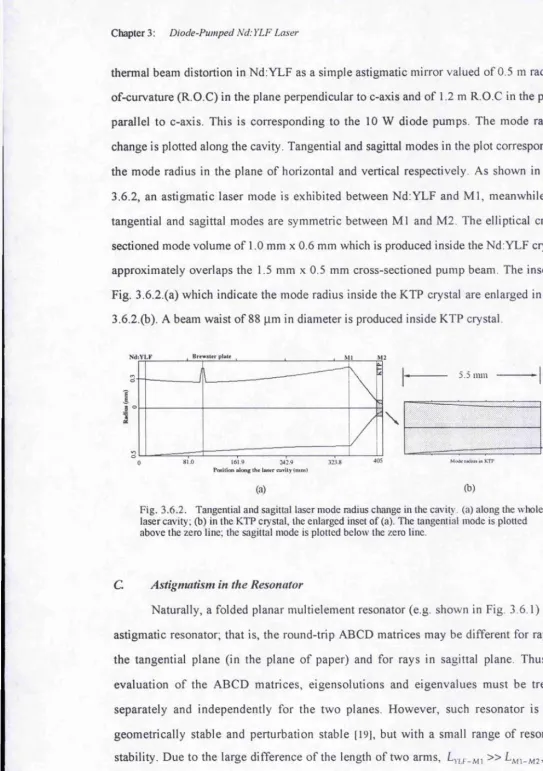
NONLINEAR FREQUENCY CONVERSION OF A
CONTINUOUS-WAVE, LASER DIODE-PUMPED ND:YLF
LASER
Jun Zhang
A Thesis Submitted for the Degree of PhD
at the
University of St Andrews
1996
Full metadata for this item is available in
St Andrews Research Repository
at:
http://research-repository.st-andrews.ac.uk/
Please use this identifier to cite or link to this item:
http://hdl.handle.net/10023/13618
a Continuous-Wave, Laser Diode-Pumped
Nd:YLF Laser
Thesis submitted for the degree of Doctor of Philosophy to the University of St. Andrews
by
Jun ZHANG, B.Sc.
The J. F. Allen Physics Research Laboratories Department of Physics and Astronomy University of St. Andrews
St. Andrews Fife KY16 9SS
Scotland, United Kingdom
ProQuest Number: 10166270
All rights reserved
INFORMATION TO ALL USERS
The quality of this reproduction is dependent upon the quality of the copy submitted.
In the unlikely event that the author did not send a com plete manuscript and there are missing pages, these will be noted. Also, if material had to be removed,
a note will indicate the deletion.
uest
ProQuest 10166270
Published by ProQuest LLO (2017). Copyright of the Dissertation is held by the Author.
All rights reserved.
This work is protected against unauthorized copying under Title 17, United States C ode Microform Edition © ProQuest LLO.
ProQuest LLO.
789 East Eisenhower Parkway P.Q. Box 1346
Declaration
I, Jun Zhang, hereby certify that this thesis has been composed by myself, that it is a record of my own work and that it has not been accepted in partial or complete fulfilment of any other degree or professional qualification.
I was admitted to the Faculty of Science of the University of St. Andrews as a candidate for the degree of Ph.D under the General Ordinance No. 12 on 1st October, 1991.
Signed Jun Zhang
September 1995
Certificate
I hereby certify that the candidate has fulfilled the conditions of the Resolution and Regulations appropriate to the Degree of Ph.D.
M. H. Dunn
Signatuie of Supervisor September 1995
Copyright
I would like to thank my supervisor, Professor Malcolm Dunn, for giving me the opportimity, encouragement, support, and patient help throughout the course of this work.
I am indebted to Dr. Bruce Sinclair for his helpful suggestions and infectious enthusiasm for physics, Dr. Angus Henderson for his expertise in CW OPO works, Cameron Rae for the advice in development of all-solid-state lasers. The useful discussion with Dr. Jun-hua Hong, Dr. Finally Colville, Dr. Miles Padgett during my study has been invaluable. Also, I would like to thank Dr. Majid Ebrahimzadeh, Dr. Miles Padgett, and Dr. David Burns for their proof reading of this thesis.
The assistance of the technical support staff in the mechanical workshop and electronics workshop is greatly appreciated with special thanks going to Mr. Jim Clark and Mr. Jimmy Lindsay for manufacturing optics mounts.
I am grateful to the University of St. Andrews for the postgraduate studentship and the Oversea Research Student Award.
Ill
Abstract
A continuous-wave, frequency-doubled, diode-pumped Nd:YLF laser, capable of generating 1-W of single-frequency radiation at 523.5 nm, with a linewidth of 10 kHz and frequency tunability of 9 GHz has been developed. By using the tunable green laser as pump source, 4.5 GHz continuous smooth tuning in the range of 1020 - 1070 nm has been demonstiated in a low tlireshold doubly-resonant optical parametric oscillator.
The investigation of thermal effect in the end-pump Nd: YLF laser crystal and the consideration of diode array end-pimrp geometry have led to an optimum folded-cavity design. Such an optical resonator can eliminate the astigmatism in tire laser output, which is induced by the cavity folding on a curwed mirror and the anisotropic thermal effect in Nd:YLF, resulting in a circular fundamental laser mode. In addition, a tightly focused beam waist is produced inside the cavity so that efficient intracavity SHG can be achieved. Over 30% optical conversion efficiency from diode to TEMqo 1047 nm laser-output and 10% conversion efficiency from diode to single-frequency SHG green radiation has been demonstrated. A novel intracavity biréfringent filter frequency selection technique has been applied in the standing-wave laser resonator to achieve the srngle-ffequency operation. The performances of the laser in the fundamental wave and in second harmonic generation are investigated in detail in this thesis.
The tuning behaviour and stability requirements of type-I and type-II CW doubly-resonant OPO have been compared by using the above green laser as the pump sour ce and LBO, KTP as nonlinear crystals. Through utilisation of a simple cavity length servo, type-II phase matching allows single signal-idler mode-pair operation. By means of pump frequency tuning, and cavity length servo control, the output of signal and idler frequency can be tuned continuously over the KTP crystal phase-matching range.
111
IV Ab st r a c t ...
Co n t en t s ... ... 1. In tr o d u c tio n
1.1 Background ... l
1.2 Par ametric Frequency Conversion Processes ... 2
1.3 All-Solid-State Frequency Conversion Devices ... 10
1.4 Research Overview ... 12
References ... 15
2. Dio d e-Pu m pe d So l id-Sta t e La ser s a n d Th e ir Fr eq u e n c y Do u b l in g 2.1 Introduction ... 17
2.2 Basic Concept and Historical Overview ... 18
2.3 Laser Diode Array Pumps ... 21
2.4 Present Progress of Diode-Pumped Solid-State Lasers ... 23
2.5 Comparison of Diode-Pumped Lasers with Other Devices ... 29
2.6 Design ofH igh Efficiency Diode-Pumped Lasers ... 32
2.7 Single Frequency Operation ... 37
2.8 Frequency Doubling ... 38
2.9 Rate Equations for End-Pumped Lasers ... 40
References ... 49
3. Dio d e-Pu m ped Nd:YLF Laser 3.1 Introduction ... 55
3.2 General Considerations ... 56
3.3 Nd:YLF Material for Diode Pumping ... 57
3.4 Thermal Effects in NdiYLF Crystal with Diode Pumping ... 62
3.5 Diode Laser Pump and Coupling Optics ... 67
3.6 Resonator Design ... 73
3.7 Laser Performance o f End-Pumped Configurations ... 81
3.8 Laser Output Power Characteristics ... 89
3.9 Spectral Output o f Standing-Wave Cavity ... 92
3.10 Summary ... 95
Contents
4.
1-W
Sin g l e Fr eq u e n c y Gr ee n La ser4.1 Introduction ... 97
4.2 Nonlinear- Materials ... 98
4.3 Efficiency of Intracavity Second-Harmonic Generation ... 103
4.4 Theoretical Study of Stable Single-Frequency Operation of Intr*acavity-Doubled Diode-Pumped Nd: YLF Laser ... 106
4.5 Single-Longitudinal-Mode Operation ... 117
4.6 Output Power Characteristics and Spatial Mode Quality ... 120
4.7 Spectral Characteristics and Frequency Tunability ... 128
4.8 Summary and Conclusions ... 131
References ... 133
5. Tu n a bl e
CW
Sin g le Ca v it y Opt ic a l Pa r a m etr ic Osc il l a t o r 5.1 Introduction ... 1355.2 Single-Mode-Pair Oscillation Conditions and Tuning Characteristics o f Doubly Resonant OPO ... 138
5.3 Cavity Design and Considerations ... 151
5.4 Experimental Observations in CW Pumped LBO OPO ... . 154 5.5 Experimental Observations in CW Pumped KTP OPO ... 161
5.6 Experimental Conditions for Extended Continuous Tuning ... 168
5.7 Continuous Tuning of KTP OPO ... 171
5.8 Conclusions ... 176
References ... 178
6 . G e n e r a l C o n c l u s i o n s ... 179
References ... 184
Appe n d ic e s
I Laser Diode-Pumped Intracavity Frequency-Doubled Nd:YLF Laser 185 II All-Solid-State Continuous-Wave Optical Parametric Oscillators 186
1
INTRODUCTION
1.1
Background
Nonlinear frequency conversion techniques such as harmonic generation and parametric oscillation provide a means of extending the frequency of available laser sources. Harmonic generators are widely used to provide a single harmonic from a given fundamental source. Optical parametric oscillators (OPOs) can generate two waves of lower frequency from a single-frequency pump laser, and they are capable of providing coherent radiation with potentially very large and truly continuous tuning ranges.
Unlike efficient harmonic generators, the development of continuous-wave OPOs has long been hampered by the lack of desired nonlinear materials and laser soui ces due to either the over-constrained single-mode-pair operating condition in doubly resonant optical parametric oscillators (DROs) or the substantially high pump power requirement for singly resonant optical parametric oscillators (SROs), The recent improvements in crystal quality, laser sources, and cavity designs have overcome some of the technical difficulties of stabilising and tuning CW OPOs. Continuous-wave operation with tunable single-mode-pair output has been demonstrated in both low-tlneshold DRO [1] and
high-threshold SRO [2]. These developments are enabling CW OPOs to live up to their
Chapter 1: Introduction 2
tunability, can be easily achieved in low threshold DROs. In addition, diode-pumped solid-state lasers are efficient, compact source of coherent radiation with a high degree of beam quality. They can be efficiently frequency-converted into the green or ultraviolet (UV) spectmm by harmonic generation. The combination of DPSSL and OPO can result in an all-solid-state widely tunable coherent light source.
The generation of continuous-wave, widely tunable, highly coherent optical radiation from all-solid-state OPOs is of great interest for applications of high-resolution laser spectroscopy [3] and optical frequency division [4]. These applications take advantage of unique properties of all-solid-state CW OPOs. Typically, OPO devices reproduce the frequency stability of the pump source in tlie tunable output. The narrow linewidth radiation with a continuous frequency tuning ability can provide a high-resolution optical measur ement. On the other hand, the wide timing range of many OPOs opens up prospects for laser spectroscopy in otherwise inaccessible spectral region, such as the near and mid-infrared. As for the application of optical fiequency division, since a correlated frequency chain can be set up through a series of efficient nonlinear* fr equency conversions (including SHG and OPO process), it is possible to measure, compare, and synthesise optical frequencies with precision and accuracy.
1.2 Parametric
Frequency Conversion Processes
The fundamental physics o f three-wave light interaction in nonlinear optical crystal is now largely understood. The origin o f this optical nonlinear process is the nonlinear response o f optical material to the propagating optical electric field. In this section, we briefly introduce the principle o f frequency conversion processes o f second-harmonic generation and optical paiametric oscillation.
A, Three- Wave Nonlinear Interaction
P = e.(%'"E + %"'E'+%'"'E^+... ) (1.1)
where s„ is the permittivity of free space; refer to the linear susceptibility, second-, and third-order nonlinear optical susceptibility, which describe the linear, quadratic, and cubic dependence of the polarisation on the applied field, respectively. The second-order nonlinearity P = is responsible for second-harmonic generation, sum- and difference-frequency generation, and parametric amplification and oscillation. These second-order effects are primarily parametric processes in nature. Considering the nonlinear coupling of two optical fields at frequencies £0j and Ihs presence of these two frequency components can give rise to
nonlinear polarisation (in the dominant regime) at frequencies ncOj ± mcOj, where n(oY These non-zero frequency components describe the SHG, the
sum-frequency generation, and the difference-sum-frequency generation. The above processes talce place simultaneously in the nonlinear medium with their potential paiametric gain. However, in actual nonlinear interaction, phase-matching selects the process of interest to the exclusion of other possible processes.
Chapter 1: Introduction 4
practice, the nonlinear coefficient tensor djj^. is used instead of tensor the two tensors being interrelated by the equation
(1.2)
The rfp coefficients of particular nonlinear crystal are measured most often in second-harmonic generation experiments. Applying the contracted notation
resulting components fomi a 3 x 6 matrix that operates on the column tensor to
yield P according to
P .; d l l d l l ^13 ^15 ^16 p . = 2 • d l l d l l ^23 ^24 d i5 ^26 A . d^i ^32 ^33 ^34 ^35 ^36 _
:2 y
El
2E,E, 2E.E,
(1.3)
The effective nonlinearity coefficients is a measure of the coupling between
the three fields that a wave of a given polarisation and propagation direction will experience on travelling tlirough a material in the presence of two other intense fields. Once the crystal class, the non-zero nonlinear coefficients, and the geometry are known, the value of can be calculated. It is an important parameter for evaluating the
efficiency of the nonlinear* process and choosing propagating direction.
Equations that describe three electromagnetic field interaction via nonlinear driving polarisation are derived by Yariv [6], Armstrong et al. [7], and Smith [8]. These are:
dE dz
dz
dz
+ a2E = ;rCj-E3E,
+ a3E = ;JC3-E,E2-e'''‘-^
where E- is used to abbreviate E(tü,-) and
O'.c/2;
n, -c
6)3 = 0)^ 4- Afc = /C3 - /q - k i. ( 1.5)
Above coupled-wave equations give the phase relationships, governing the direction of energy flow between any three interaction waves. Under the appropriate boundary conditions the coupled wave equation can be used to predict several characteristic features of nonlinear interaction.
B, Optical Second Harmonic Generation
In second-harmonic generation, radiation at an incident frequency is converted to radiation at twice the frequency: 0 ) 2 = 2c0p In this interaction, two of the tlnee fields
that figure in Eq. (1.4) are of the same frequency. From the coupled equations, exact solution can be found [9] for plane wave in the two cases of low and high conversion efficiency. As for low conversion efficiencies, the ratio of the power generated at the second-harmonic frequency to that incident at the fundamental fr equency is approximated by [9]
PM. = 2 . f ü f
e j
{ & k - l / 2 fA
AP(0 V 0 y = (1.6)
where I is tlie length of nonlinear ciystal, A is the area of the fundamental beam, and r ..
For a given wavelength and a given nonlinear material, the K = 2
conversion efficiency depends on the length of the crystal, the power density, and the
s r n \ m / 2 )
phase mismatch term
Chapter 1: Introduction 6
According to Eq. (1.6), a prerequisite for efficient second-harmonic generation is that Ale - k{2co) - kj{co) - kiico) = 0 or k{2cû) = kjico) + kiico). This is termed phase-matching condition which describes the momentum conservation in the process. Similarly, in other second-order processes, the phase-matching condition Ale = 0 also dictates the nonlinear conversion efficiency and even frequency tuning behaviour in the parametric process. The most common approach to satisfying the condition is to make use of the birefringence in an anisotropic medium to compensate for material dispersion. In an uniaxial crystal, the dependence of refractive index of the extraordinary wave on the angle between the propagation direction and the crystal optics (z) axis is given by
cos e . sin G
,2 ,^2 U ’U
M/g) », »,
If »f® < » “, phase matching may be obtained in a wave normal direction such that = »“; so, if the fundamental beam is launched along as an ordinary ray, the
phase-matching” can be achieved by temperature tuning the crystal for some specific wavelengths.
In practice, high-efficiency second-harmonic conversion depends on parameters of laser spectral brightness [W/cm^ sterad Â] (in terms of power density, beam divergence, and fr equency linewidth) and parameters associated with the harmonic generator (such as the value of the nonlinear coefficient, crystal length, angular and thermal deviation from the optimum operation point, absorption, and inhomogeneties in the crystal).
An analysis of optical SHG inside the laser resonator has been presented in references [10] and [11]. The steady-state condition for intracavity doubling can be
determined if we equal the round-tiip saturated gain of the laser to the sum of the linear and nonlineai* losses
where is the unsaturated gain coefficient, I * is the length of the laser medium, I is the circulating power density in the laser rod, and is the saturation power density of the
active material. All lineai’ losses occurring at fundamental frequency are lumped together into the parameter L ; the quantity ICI is the nonlinear loss. The nonlinear coupling factor K' defined by I{2co)- K''P(co) is related to K in Eq. (1.6); it is K'= K'I^K,
where k accounts for different power densities in the gain medium and nonlinear crystal
in the case of focused beams and I is the crystal length. The optimum desired nonlinear coupling is given by
= p (1.9)
Chapter 1 : Introduction 8
C. Optical Parametric Oscillation
As illustrated in Fig. 1.2.1, the optical parametric process is a nonlinear optical process in which a pump photon, when propagating in a nonlinear optical crystal, spontaneously or by stimulated emission breaks down into two lower-energy photons of frequencies (signal and idler m,) with the total photon energy conserved, i.e.
6)^ = + 0),.. The gain mechanism is based upon the stimulation emission process. That
is, the rate of emission tluough the nonlinear optical parametric process is proportional to the photon present; thus the larger the number of photons emitted, the more likely photons will be emitted leading to parametric gain. Since the optical resonator provides resonance for the signal or idler waves (or both), the parametric gain will, at some threshold pumping intensity, cause simultaneous oscillation at the signal and idler frequencies. Once above threshold, the parametric oscillator efficiently converts the pump radiation to signal and idler frequencies. Two important parametric oscillator cavity configurations are the DRO, where both the signal and idler wave are resonated, and the SRO, where only one wave is resonant. Different operation characteristics including threshold, frequency stability and tunability, and pump laser requirements are possessed by the two configurations.
0) = (O + CO p S I ^
(pump)
---Fig. 1.2.1. The optical parametric oscillator. The cavity end minors have high reflectivity at frequencies CO^ and CO^ (DRO); CO^ or CO,- (SRO).
It is clear that the frequencies of signal and idler can not be solely determined on the basis energy conservation condition. This is in fact the basic source of tunability of the OPOs. The specific pair of frequencies that will result from any given situation is dictated by the phase-matching condition, /c^ = /q + k, (or (0^»^ = co^rtg + co,.»(), that must
matching can be achieved by either type-I or type-II phase-matching geometiy. However, in an anisotropic medium, the index of refraction, and hence the magnitude of k-vector, of extraordinary wave continuously varies with the direction of propagation. For a negative uniaxial ciystal, if the birefringence is sufficiently large to compensate for the dispersion, and if the pump beam is introduced as an extraordinary wave while the signal and idler waves are ordinary waves, a particular pair of frequencies of emitted ordinary photons will satisfy the type-I phase-matching condition for each orientation of the crystal relative to the direction of propagation of the pump photon. As the crystal is rotated or crystal temperature changes, the magnitude of the k-vector or the momentum of the pump photon changes. The frequencies of the resulting pair of emitting photons will change accordingly, and they continuously satisfy the phase-matching condition. These aie the basic tuning schemes of OPO, termed “angle tuning” and “temperature tuning”
A vaiiety of theoretical and experimental studies of DRO and SRO have been cairied out [12][13][14][15]. Continuous-wave DROs have the advantage of low threshold and nanow linewidth. But it is offset by the necessity for overlapping the signal and idler cavity resonance in a single optical cavity which places server tolerance limit on the cavity length and causes the complexity of continuous frequency tuning. Single frequency, narrow-linewidth pump laser is desired as pump source in double resonance OPO. In a single-pass CW pumped DRO, the threshold of pump power required for oscillation is given by
where is the pump wavelength, and are the fractional round-trip power losses
at signal and idler wavelengths, d is the effective nonlinearity of the crystal, I is the phase-matched interaction length, k„, is a generalised Boyd-Kleinman gain reduction
Chapter 1; Introduction 10
_ J £ A
is a slowly varying function o f frequency neai* degeneracy, since 6 = {0)^- cOf) / cOp. The Boyd-Kleinman factor represents a reduction in effective parametric gain because o f
poor pump-signal-idler mode overlap. Above the operation threshold, the conversion efficiency is simply given by [9]
p + P 2 ,—
77 = - ^ = — (V N -I) (1.12)
where N is the number of times above threshold, defined by -a ^ - ( g^ is the parametric gain coefficient). This relationship give a general rule for the design of an efficient CW OPO, that is to pump at least approximately 4 times above tlireshold foi-maximum efficiency.
example, we have demonstrated the operation of a CW OPO using Lithium Triborate (LBO) ciystal pumped by 364 nm UV light with type-II noncritical phase-matching [16] and pumped by 514.5 nm green light with type-I noncritical phase-matching geometry [17]. New cavity designs such as a monolithic ring DRO [1][18] have shown dramatically better mechanical stability. Recently, Colville et al. [19] developed a dual-cavity device in which two resonant fields are split into two sepaiate cavities by a low-loss Brewster angled plate. The independent control of the two cavities makes wideband and continuous tuning of the device theoretically possible.
As discussed before, two fundamental approaches in achieving widely tunable highly coherent radiation through nonlinear frequency conversion techniques in the continuous-wave operation regime are DRO and SRO. Both approaches have been demonstrated by employing the frequency-stable single-mode solid-state lasers and then frequency-doubled output as pump sources. It is suggested that the use of diode-pumped solid-state lasers in conjunction with CW OPO devices can realise efficient, compact, and fi-equency tunable CW radiation sources in all-solid-state configurations.
Nabors et al. [\] demonstrated stable, efficient CW single-mode operation of a monolithic MgiOiLiNbOg DRO, pumped by frequency-doubled diode-pumped Nd:YAG laser. The device was tuned from 1007 to 1129 nm and exhibited a 34% conversion efficiency from 532 nm pump light to signal and idler power. A similar pump and OPO configuration was used by Gerstenberger and Wallace [2 0], where CW parametric
oscillation with the tunability over the 965 - 1185 nm spectral range and 100 mW of output power was demonstrated. Operation over most of the spectral range consisted of single signal and idler pairs with low-amplitude noise. Lee and Wong [2 1] analysed the
Chapter 1: Introduction 12
-1 0 0 kHz rms. However, such a frequency stability can be provided by a diode-pumped solid-state laser. Schiller and Byer [2 2] combined doubly resonant harmonic generator and
DRO into a single monolithic total-internal-reflection resonator (MOTIRR) and realised a quadruply resonant OPO with 0,4 mW pump threshold.
Yang et al. [2] first demonstrated a CW singly resonant OPO based on KTP. The
pump source used was a single-frequency frequency-doubled Nd:YAG laser. The minimum oscillation threshold was 1.4 W with pump light double passed. With 3.2 W of incident pmnp power, a maximum 1.07 W tunable power was generated. They [23] further demonstrated similar operation in a ring configuration with 1.9 W of sing-axial-mode output. Recently, Robertson et al. [24] used pump-enlianced technique to overcome the difficulty of the high SRO operation thieshold. They obtained single-frequency output of 500 mW with a 14 nm OPO timing range. The pump threshold was 1 W of single frequency argon pump power at 514.5 nm .
1.4 Research
Overview
demonstrated. In the course of this research, the following continuous-wave, highly coherent radiation sour ces have been developed:
1. Diode-pumped NdiYLF laser generating 2.5 W T E Mqo laser output at 1047 nm
with 30% optical-to-optical conversion efficiency (see Chapter 3).
2. Intracavity-jrequency-doubledNd: YLF green producing 1 W single
frequency T E Mqo SHG output with linewidth of less than 10 kHz and frequency tunability of 9 GHz (see Chapter 4).
3. Single-frequency green laser pumped CW doubly resonant KTP OPO providing continuous operation of tunable single-frequency mode-pair output at around degeneracy frequency range. Smooth tuning of 4.5 GHz in the 1020 -1070 nm of tlie KTP phase matcliing wavelength range have been achieved (see Chapter 5),
Detailed considerations in relation with tlie design and construction of above devices are discussed in the relevant chapters.
Chapter 1; Introduction 14
selection mechanism. These techniques employed in this frequency-doubled Nd: YLF laser to achieve the high power single-frequency SHG, demonstrate a new approach in frequency doubled solid-state laser designs. Chapters 3 & 4 will discuss and analyse these design and techniques in detail. The laser performance are further characterised in teims of laser threshold, slope efficiency, second harmonic conversion efficiency, mode quality, amplitude and frequency noise, linewidth, and frequency tunability.
The generation of single-frequency, continuous-wave tunable radiation in IR region has been demonstrated in a single cavity doubly resonant KTP OPO. Smootli frequency tuning of 4.5 GHz is achieved by tuning the green pump source. The stable single axial mode-pair operation of the device has been obtained by using the “side of fringe” locldng technique to control the length of the OPO cavity so as to maintain the doubly resonant condition. The stability requirements for type-I LBO OPO and type-II KTP OPO, both of which operate near degeneracy, have been compaied in the experiments. Evidence from both sources indicates that, for the single-mode-pair operation, type-II phase-matched geometiy is superior to type-I phase matched geometry. This is brought about by the extreme sensitivity to mode hoping for a type-I DRO in which the fr ee spectral ranges of signal and idler oscillation are nearly identical.
The rate equations of diode-end-pumped Nd: YLF laser have been developed in the section § 2.9, and theoretical analyses of laser performance are further discussed in the
References
[1] C. D. Nabors, R. C. Eckardt, W. J. Kozlovsky, and R. L. Byer, “Efficient single-axial-mode operation o f a monolithic MgOiLiNbOg optical parametric oscillator”, Opt. Lett., vol. 14, pp. 1134-1136, 1989.
[2] S. T. Yang, R. C. Eckardt, and R. L. Byer, “Continuous-wave singly resonant optical parametric oscillator pumped by a single-frequency resonant doubled Nd:YAG laser” Opt. Lett., vol. 18, pp. 971-973, 1993.
[3] E. S. Polzik, J. Carri, and H. H. Kimble, “Specti'oscopy with squeezed light”, Ph^s Rev, Lett., vol. 68, pp. 3020-3023, 1992.
[4] N. C. Wong, “Optical frequency division using an optical parametric oscillator” Opt. Lett., vol. 15, pp. 1129-1131, 1990.
[5] D. A. Kleinman, “Nonlinear dielectric polarisation in optical media”, Phys. Rev., vol. 126, pp. 1977, 1962.
[6] Amnon Yariv, "Optical Electronics”, Saunders College Publishing. 4th Ed., pp. 270. [7] J. A. Armstrong, N. Bloembergen, J. Ducing, and P. S. Perslian, “Interactions between
lightwaves in a nonlineai' dielectric” Phys. Rev., vol. 127, pp. 1918, 1962.
[8] R. G. Smith, “Effects o f momentum mismatch on parametric gain”, J. Appl. Phys., vol. 41, pp. 4421, 1970.
[9] R. L. Byer, “Parametric oscillator and nonlinear materials”, in Nonlinear Optics, P. G. Harper and B. S. Wherret, Eds., Academic Press: London. 1977.
[10] J. E. Geusic, H. J. Levinstein, S. Singh, R. G. Smith, L. G. Van Uitert, “Continuous 0.532-pm solid-state source using Ba^NaNbgB%5”, Phys. Lett., vol. 12, pp. 306, 1968.
[11] R. G. Smith, “Theory o f intracavity optical second-haimonlc generation”, IEEE J, Quant. Electron., vol. 6, pp. 215, 1970.
[12] R. L. Byer, “Optical parametric oscillator” in Treatise in Qtiantum Electronics, vol. 1, Nonlinear optics, Pts. A and B, H. Rabin and C. L. Tang Eds., New York Academic.
[13] C. L. Tang, “Spontaneous and stimulated paramefric processes”, in Treatise in Quantum Electronics, vol. 1, Nonlinear optics, Pts. A and B, H. Rabin and C. L. Tang Eds., New York Academic.
[14] R. G. Smith, “A study o f factors affecting the performance o f a continuously pumped doubly resonant optical parametric oscillator”, lEEEJ. Quant. Electron., vol. 9, pp. 530-541, 1973. [15] R. C. Eckardt, C. D. Nabors, W. J. Kozlovsley and R. L. Byer, “Optical parametric oscillator
Chapter 1: Introduction 16
[16] F. G. Colville, M. J. Padgett, A. J. Henderson, J. Zhang, and M. H. Dunn, “Continuous-wave parametric oscillator pumped in the ultraviolet”. Opt, Lett., vol. 18, pp. 1065-1067, 1993. [17] F. G. Colville, M. J. Padgett, A, J. Henderson, J. Zhang, and M. H. Dunn, “Continuous-wave
parametric oscillation in lithium ti'iborate”, Opt. Lett., vol. 18, pp. 205-207, 1993.
[18] C. D. Nabors, S. T. Yang, T. Day, and R. L. Byer, “Coherence properties o f a doubly resonant monolithic optical parametric oscillator”, J. Opt. Soc. Am. B, vol. 7, pp. 815-820, 1990.
[19] F. G. Colville, M. J. Padgett, and M. H. Dunn, “Continuous-wave, dual-cavity, doubly resonant, optical parametric oscillator”, Appl. Phys. Lett., vol. 64, pp. 1490-1492, 1994.
[20] D. C. Gerstenberger and R. W. Wallace, “Continuous-wave operation o f a doubly resonant lithium niobate optical parametric oscillator system tunable fr om 966 to 1185 nm”, J. Opt. Soc. Am. B, vol. 10, pp. 1681-1683, 1993.
[21] D. Lee and N. C, Wong, “Stabilisation and tuning o f a doubly resonant optical parametric oscillator”, J. Opt. Soc. Am. B, vol. 10, pp. 1659-1667, 1993.
[22] S. Schiller and R. L. Byer, “Quadmply resonant optical parametric oscillation in a monolithic total-intenral-reflection resonator”, J. Opt. Soc. Am. B, vol. 10, pp. 1696-1707, 1993. [23] S. T. Yang, R. C. Eckardt and R. L. Byer, “ 1.9-W ring-cavity KTP singly resonant optical
parametric oscillator”. Opt. Lett., vol. 19, pp. 475-477, 1994.
[24] G. Robertson, M. J. Padgett, and M. H. Duim, “Continuous-wave singly resonant
DIODE-PUMPED SOLID-STATE LASERS AND
THEIR FREQUENCY DOUBLING
2.1 Introduction
The advances in semiconductor diode lasers have caused a resurgence in solid-state laser technology. This is mainly because with efficient diode laser pumping, the potential of solid-state laser materials can be fully utilised for laser performance. Remarkable improvements in terms of higher slope efficiency, narrower frequency linewidth, ultrashort pulses, and higher peak powers, have been brought about by diode pumping in recent years. Based on the long lifetime and inherent stability of tlie diode laser and solid-state gain medium, the realisation of all-solid-solid-state lasers has become possible. These all solid-state devices provide stable output with high efficiency, ease of operation, long lifetime, reliability and robustness in compact forms. Combined with the techniques of nonlinear frequency conversion or direct pumping of tunable solid-state laser materials, all-solid-state lasers can be envisaged to allow complete optical spectral coverage and wavelength tunability [1][2]. These advantages of diode-pumped devices have led to the development of new lasers which ar e impossible or impractical to realise in otlier ways, and ai'e maldng a great impact on new technologies.
Chapter 2: DPSSLs and Their Frequency Doubling 18
threshold and optical slope efficiency are given for the analyses of experiments in following chapters.
2.2 Basic
Concept
and Historical
Overview
The early work on the use of semiconductor diode lasers as pump sources for solid-state laser started in the early 1960’s. Soon after the advent of diode laser, Newman [3] recognised that the spectral overlap of the GaAs diode laser emission wavelength with absorption band of Nd^+ could lead to an efficient, compact, all-solid-state laser. Keyes and Quist [4] tested the idea and demonstrated the first diode-laser-pumped Uranium-doped Cap2 laser in 1964. They noted that the use of GaAs diode lasers should be ideal
for the pumping of Nd^+ laser and that such a device should be more efficient than lamp pumping. This would induce less heating in the gain medium and reduce the thermal problems of high-power lasers. However, the low power and the cryogenic cooling requirement of early diode laser devices halted the development of all-solid-state lasers in 60’s and 70’s. Most initial works had concentrated on designing and demonstrating simple Nd^'*' doped devices, because the Nd^"^ doped material possessed strong absorption in the emission band of GaAs, GaAlAs, and GaAsP diode lasers, and they had many naiTow fluorescent transitions in the infrai'ed region.
A. Optical Pumping Process in Doped Materials
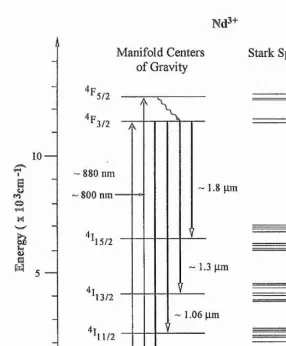
spectra of Nd^+ doped materials like Nd:YAG and Nd doped phosphate are around 800 nm. Under the illumination of diode light at this wavelength, the Nd^+ ions are excited into pump bands and then relax efficiently to the upper laser level.
10
Manifold Centers
of Gravity Stark Splittings
4p5/2
4p
' 880 nm
800 nm
-4l15/2
4l13/2
11/2
‘9/2
A
1.8 pm
1.3 pm
1.06 pm
[image:28.613.140.427.167.513.2]0.94 pm
Fig. 2.2.1. Energy level diagram o f The laser transitions are shown in heavy lines, diode pump transitions in light lines, and relaxations in wavy lines. The open box for the ground-state manifold indicates that the lasei transition to this manifold is to an energy level above the ground state.
From this upper laser level "^F3/2, there ar e two four-level transitions with high gain, the
4F3/2 - ^l\n2 and 4F3/2 -.413/2 which correspond to emissions at 1.06 }im and 1.3 pm.
Since both terminal transition levels are not thermally populated, laser action can be easily achieved with low lasing thresholds. The tluee-level transition '^F3/2 -'^19/2
Chapter 2: DPSSLs and Their Frequency Doubling 20
populated terminal level. Since the neodymium ions are excited into the pump bands that lie only slightly above the upper laser level by diode light, the non-radiation waste energy generated is much lower than that of the same-power lamp pumping, which means higher quantum efficiency for the laser transition. Together with the efficient absorption of naiTow bandwidth diode light, high optical conversion from tire diode light to the 1.06 pm high-gain line of Nd^+ can be obtained.
B, Early Work on Diode-Pumped Solid-State Laser
Ross [5] demonstrated the first NdrYAG laser side-pumped by a single GaAs diode. He noted that solid-state laser could produce high pealc power in a short pulse due to the long upper state lifetime o f the material, with a narrower spectral bandwidth and higher spatial brightness. Both laser diode and LED-pumped Nd:YAG lasers in side-pumping and end-side-pumping geometries were investigated. Side-side-pumping geometry appeared to be convenient when using a number of sources witli poor beam quality, while
the end-pump approach had the advantage o f minimising the laser threshold and the disadvantage o f limited power scaling due to the problem of coupling the output o f many diode sources into the gain medium. It was recognised that the high brightness o f diode
light could be absorbed in a small volume in the gain medium, thus leading to lower threshold and higher gains. Osteimayer et al. [6] demonstrated the GaAsi_xPx diode-arrays-pumped Nd:YAG laser operating at room temperature in continuous-wave. Illuminated by diode laser and LEDs respectively, CW operation o f NdrYAG lasers were demonsti'ated in side-pumping [7] [8] and end-pumping geometiy [9] [10].
diode was the Nd-doped silica fibre laser with 1 mW laser threshold and 1.088 [am lasing wavelength [12]. Besides the Nd-doped gain media, there were also reports on diode and
LED pumping of other ions such as YbrYAG and Tm,HO:LiYbF4. Frequency conversion
of diode-pumped lasers, driving of spiking oscillations, and the Q-switching and the mode-locking to generate higher pealc powers had also been investigated.
As Newman first recognised, the major advantage of diode pumps is the spectral overlap of the diode emission wavelength with the absorption peak of trivalent Neodymium doped materials. But only after the availability of reliable diode lasers can this advantage be practically realised. Today diode lasers are compact, efficient, robust, and potentially inexpensive, with long room-temperatuie lifetime. We review the present status of diode laser arrays as solid-state laser pump sources.
Chapter 2; DPSSLs and Their Frequency Doubling 9?
broad stripe arrays are multi-transverse mode devices and the beam quality is dependent on the drive current. Both types of diode arrays have been used in end-pumped geometries. Since the emitting region may be overall 500 \im wide by 1 pm deep, the divergence is different in the two emitting planes. Diode light coupling optics are often used.
CONTACT METALUZATION
PROTON IMPLANT
p+ -GaAs p -GaAlAs p - GaAlAs GaAlAs active layer n -GaAlAs n -GaAlAs n - GaAs Substrate
INDIVIDUAL EMITTERS
Fig. 2.3.1. Schematic diagram o f a gain-guided multisti ipe diode array
The scaling of CW arrays to higher powers is nomially achieved by using a bar structure. The commercial 5 - 20 W bar' devices which are grown on single 1-cm substrate are composed of a number of individual arrays with an aperture of ~ 1 0 0 pm and
periodical spacing of ~ 500 pm. Since the diode bar is made up of a number of independent sour*ce, the wavelength change along a bar may be 2 - 3 nm due to small material variations. The output of these devices is difficult to couple into solid-state materials particularly in end-pumping geometry. Presently, many diode array package architectures are available ranging from low array/package level to high level integration. They are capable of achieving 5 kW/cm^ peak power and 1 kW/cm^ average power for applications with low duty cycle (< 1%) and high duty cycle (20%) requirements. To achieve high pump brightness (W/cm^/sr^), var ious diode light coupling and beam shaping tecliniques have also been developed. CW fibre-coupled bar can provide as high as 1 0
Depending on the type of semiconductor material, the wavelength range from 630 to 1020 nm can be accessed. The GaAlAs devices have a spectral coverage of 780 - 860 nm. Longer wavelengths are available with InGaAs devices (900 - 1020 nm). AlGalnP diode lasers cover the red end of visible spectrum (630 - 670 nm). This broad range of pump wavelengths provides an opportunity for new applications such as pumping of Er:glass, Er:YAG, and YbiYAG lasers (long-wavelength pumps), as well as Cr:LiCaAlF6
and CriLiSrAlFg lasers (short-wavelength pumps). Wliile a given diode with a particular semiconductor composition will emit at one specific wavelength, the variation in its operating temperature allows the wavelength to be tuned by typically - 0.3 nm/®C (GaAlAs). Efficiency and long lifetime are fimdamental advantages of diode laser arrays. The commercial diode arrays have electrical to optical conversion efficiency of ai'ound 30 - 50%; and room-temperature lifetime of 3 x 10^ h for CW devices, and around 10^ pulses for pulsed diodes. Improved material quality has been combined with high aluminium cladding structures to produce Q-CW bars with excellent performance at high junction temperatures (exceeding 75 °C).
However, there are a few drawbacks of diode pumps. Firstly, typical diode laser arrays have an emission aperture of ~ 1 jxm x - 1 0 0 jam with beam divergence angles of
-40° X 10° (FWHM). It is difficult to collect and effectively utilise tliis rapidly divergent and asymmetric emission pattern, especially in the end-pumped geometry. Secondly, diode laser are susceptible to damages caused by electro-static discharge, voltage transients, or photon induce facet damage. Thirdly, these devices are still fairly expensive.
2.4 Present Progress of
Diode-Pumped Solid-State Lasers
Chapter 2: DPSSLs and Their Frequency Doubling 24
A. Diode-Pumped Nd-doped Lasers
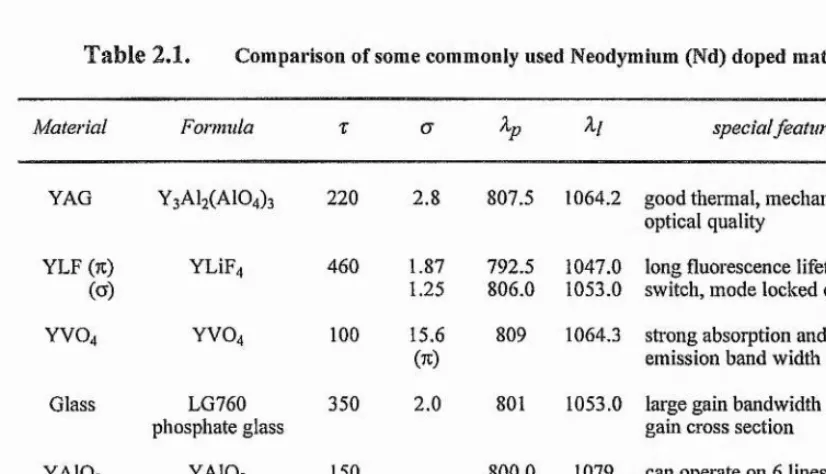
Apart from Nd:YAG, various Nd-doped gain materials have been employed in diode-pumped laser systems. They have slightly different spectroscopic properties due to the host atomic structure and the concentration level of active element, although tlie laser transitions are achieved by the same processes. Three important properties are upper state lifetime, absorption spectra and output wavelength. The different characteristics of these gain media may dictate their particular applications. Most of the recent research on diode-pumped Nd-doped lasers have concentrated on the high-gain four-level ^F3/2 - transition, although laser performance at "^F3/2 - '^Iis/2 transition
and three-level ^F3/2 - ^19/2 transition has also been reported. Table 2.1 lists some optical
[image:33.615.92.505.368.605.2]properties of commonly used Nd-doped gain materials.
Table 2.1, Comparison of some commonly used Neodymium (Nd) doped materials
Material Formula T 0 Xp Xi special features
YAG YaAbfAlO^)] 220 2 .8 807.5 1064.2 good thermal, mechanical, and optical quality
YLF {%)
(a) YLiF4 460 1.87 792.5806.0 1047.01053.0 long fluorescence lifetime for Q-switch, mode locked operation
YVO4 YVO4 100 15.6
(7C) 809 1064.3 strong absorption and wideemission band width
Glass LG760
phosphate glass 350 2.0 801 1053.0 large gain bandwidth smallergain cross section
YAIO3 YAIO3 150 800.0 1079 can operate on 6 lines around
1.06 pm
YAB Nd,Yi.,Al3(B03)4 60 2 808 1063 nonlineai' host crystal for self-frequency doubling
V. lifetime at 1 at % (ps); o',effective laser cross section (10'*^ cnF); Xp'. peak o f absorption wavelength in 800 nm region (nm); 2 /: lasing wavelength for the '‘F3/2 - '‘In/2 transition (nm)
efficiencies are exhibited due to its strong pump absorption and narrow emission spectrum. Berger et al. [14] have reported an overall efficiency of 10.8% and an output power of 415 mW from a Nd.’YAG laser end-pumped by a diode array. In fact, diode-pumped NdrYAG lasers have already become important commercial devices for the full range of laser operations from CW single-frequency to Q-switched and mode-locked. Efficient and high power NdrYAG systems have also been developed in recent years using different crystal geometiies and diode pump schemes. Improved beam quality has been achieved in these systems due to efficient heat removal and reduction of thermal effects. The research group in Lawrence Livemore National Laboratory (LLNL) has obtained 4 kW average output power [15] from a NdrYAG slab laser system. The slab dimensioned 200 x 25 x 6 mm^ is pumped by two arrays each incoiporating 150 diode
packages. Golla et al. have demonstrated 300 W CW output power from a 1100-W side-pumped NdrYAG laser [16].
NdrYLF has a few distinct advantages for diode-pumped laser performance. Efficient NdrYLF laser with polarised output at 1.047 jim and 1.053 pm has been demonstrated [17]. Thermally induced birefringence can be swamped by its natural birefringence. Since NdrYLF has longer upper level lifetime and relatively low emission cross-section, it is an attractive medium for the generation of high peak power Q-switched pulses. Baer et al.[18] have obtained as high as 70 kW peak power in a pulse of duration less than 10ns from a 10-W diode-pumped NdrYLF laser.
Ndrglass has a wide absorption spectrum and can be doped at very high concentrations. However, the main disadvantage is its low thermal conductivity which makes the Ndrglass laser susceptible to thermal effects. A pump power tlireshold of 2 niW and a slope efficiency of 42% have been obtained when pumped with a low-power diode [19]. By using a spinning glass disc as the gain medium to overcome the thermal problem, Fan [2 0] has obtained 550 mW output power from 2 W diode pumps. Basu and
Chapter 2; DPSSLs and Their Frequency Doubling 26
Other Nd-doped laser materials, e.g. Nd:BEL, NdrGSGG, Nd:LNA, NdrYVO^, Nd:YAP, have also been developed with advantages in some respects of laser performance. Scheps [2 2] has reported 635 mW output from an diode-pumped Nd:BEL
laser. It is noted that NdrBEL has greater energy storage capacity and higher active ion concentration ability than NdrYAG. NdrYV0 4 has a broad absorption band in 800 nm
region and exhibits a very high slope efficiency. Fields et al. [23] have reported an end-pumped YVO4 laser with 750 mW output power, 64% optical slope efficiency, and an
overall efficiency of 15.8 % [23]. It is suggested that NdrGSGG could be a useful laser material for high average Q-switched operation. Caffey et al.[24] have reported an optical slope efficiency of 41.5% for NdrGSGG in the rod geometry when side pumped. NdrYAP laser can be operated at both 1.34 j.im [25] and 1.083 p,m [26] with high slope efficiency. By using a Lyot filter, laser emission on six of the laser lines of the
-^1\\I2 transmission has been achieved [26]. Self-frequency-doubling operation has been demonstrated in the diode pumped NdrYAB laser. Lin et al. [27] have obtained more than 80 mW of green radiation with 1 W of diode pump power from a monolithic YAB device.
B. Diode-Pumped Rare-Earth-Doped Lasers
Trivalent rar e earth ions other than neodymium also have significant absorption in the 750 - 850 nm and aroimd 900 nm diode pump region. They provide additional wavelengths and different spectroscopic properties for laser perfomiance. Recently, there has been great interest in diode-pumped eyesafe lasers in the 1.5 jim, 2 p,m and 3 jxm wavelength regions. In particular, the liigh pump rate of diode array provides a great advantage for the quasi-three-level laser schemes, such as erbium laser at 1.5 jim and thulium or holmium laser hi die 2 jLim region.
and a pump power threshold of 108 mW in Tm,Ho:YLF laser on the same transition. Both Ho:YAG and Ho:YLF have long fluorescence lifetimes, so they are promising media for Q-switched operation. Tm:YAG at the ^F^ - transition is also a good candidate for high-energy Q-switched operation due to the same reason. Suni and Henderson [30] have reported both CW and Q-switched operation, obtaining CW output power of 530 mW for 1.37 W diode pump power. This correspond to an optical slope efficiency of 4%. They have further obtained pulse energies of 2.5 mJ at 50 Hz repetition rate from a diode-pumped TmrYAG [31].
The recent development of strained layer InGaAs diode operating between 870 nm and 1 .1 |im has opened the way for pumping erbium and ytterbium doped laser
operating at 1.5 \im, and 3 jim (for Er^+ tiansitions), and 1.03 p.m for (Yb^+ transition). Hutchinson et al. [32] have reported Yb sensitised Er:glass laser operating at 1.535 jxm in an InGaAs diode laser end-pumped geometry. The optical slope efficiency obtained was 7.1% and the pump power threshold was 0.9 mJ. Denker et al. [33] have obtained diode-pumped slope efficiency of 14% and output energies up to 18 mJ from highly concentrated Yb,Er:boro-silico-phosphate glass laser. Yb^+ has a broader absorption spectrum in diode pump region and longer fluorescence lifetime than Nd:YAG. Efficient laser performance at 1 |im has been demonstrated in diode-pumped YbrYAG laser [34].
C. Other Diode-Pumped Lasers
Chapter 2: DPSSLs and Their Frequency Doubling 28
Cr:LiCAF and CrrLiSAF have also been operated by using diode arrays as the pump source.
Stoichiometries are of interest for miniature lasers because of their high concentration of active ions. Kubodera et al [37] have reported diode-pumped operation of LNP laser at both 1.05 p,m and 1.32 pm. The optical slope efficiency of 18.2% (threshold 0.6 mW, output power 2 mW) at 1.05 pm and 6.5% (threshold 2.7 mW, output power 0.5 mW) at 1.32 pm have been obtained. Single transverse and longitudinal mode was achieved by using the 300 pm thick active crystal.
In addition to bulk lasers, progress has been made in waveguide devices. Low thi'eshold optical fibre laser operation has been demonsti'ated in a variety o f rare earth ions and glass fibre hosts. Diode-pumped Nd-doped silica fibre laser operating at 0.905, 1.06 and 1.4 pm [38], and Er-doped silica fibre laser operating at 1.553 pm [39] have also
been demonstrated. By using fluorozirconate fibres as the host medium, laser action has been achieved in thulium-doped fibre (operating at 2.3 pm [40] and 1.97 pm [41]),
erbium-doped fibre (operating at 2.7 pm) [42], and neodymium-erbium-doped fibre (operating at 1.345
pm) [43]. Only recently diode-pumped upconversion fibre lasers have been demonstrated
in erbium-doped glass fibre laser [44]. Piehler et al. [45] have obtained 11 mW o f green light from 0.03 NA, 2.0-pm core erbium-doped fluoride fibre laser pumped by a 150 mW fibre
pigtailed InGaAs diode laser operating at 971 mn. Waveguide lasers have also been
fabricated in bulk glasses and in a variety o f ci-ystals [46]. Aoki et al [47] have reported 150
mW output power from a diode-pumped Ndiglass waveguide laser. More recently, by
using ion implantation waveguide fabrication technique, ion-implanted channel waveguide laser operation has been achieved in NdiGGG [48], and Nd:YAG[49].
D. Mode-Locked Diode-Pumped Nd-doped Lasers
achieved by an intracavity acousto-optic modulator, active mode-locking of diode-pumped Nd:glass, Nd:YAG and Nd:YLF have been demonstrated [50][51][52], As short as 4 ps has been produced in Ndrglass laser [50]. NdrYAG, NdrYLF and Ndrglass have all been mode-locked by FM techniques using electro-optic phase modulators. Pulses of 12 ps, 9 ps and 9 ps, respectively have been achieved [53][54][55]. Compared with active mode-locking methods, passive coupled-cavity mode-locking has been demonstrated to be an effective teclinique for ultrashort pulse generation. Diode-pumped NdrYAG, NdrYLF and Ndrglass have been mode-locked by this process producing pulses with durations of 1.7 ps, 1.5 ps and 380 fs, respectively [56][57][58]. Recently the use of frequency doubling crystals or multiple quantum well (MQW) structures in novel coupled-cavity have also been investigated. Combining the mode-locked diode-pumped laser with Q-switched operation. Keen and Ferguson [59] have obtained a peak power of 170 kW from a 2-W diode-pumped NdrYAG laser operating at 1.3 pm. Without Q-switching, mode-locked pulses 19 ps were obtained.
2.5 Comparison of
Diode-Pumped
Lasers with Other
Devices
A. Diode-Pumped Versus Lamp-Pumped Solid-State Lasers
Chapter 2: DPSSLs and Their Frequency Doubling 30
can result in highly efficient pump absorption and utilisation of the pump energy in achieving an overall efficient laser system. Another advantage of using diode as pump source is its longer lifetime (tens of thousands of hours compared to a few hundred to a couple of thousands hours for arc lamps), which gives diode pumped lasers reliability and operational convenience. Based on these inherent advantages of diode pumps, diode pumped devices can exhibit a new regime of laser operation which is unattainable with lamp pumping. To our knowledge, the highest electrical-to-optical or “wall plug” efficiency of diode pumped solid-state lasers have reached 20% [60]. In contr ast, a good flashlamp pumped Nd:Gr:GSGG laser only has a wall-plug efficiency on the order of 5%. In our laboratory we have demonstrated a 5 W diode-pumped NdiYLF laser with 11.5% wall-plug efficiency. In the future, because the diode laser efficiency has the potential to approach 65 ~ 70 %, the overall electrical-to-optical efficiency of diode-pumped solid-state laser can be further increased.
Efficient and stable diode pumping also provides better frequency stability and narrow linewidth than that of lamp-pumping. This is due to the decreases of technical noise by reducing specific thermal loading in laser gain media. Compared with the frequency stability of lamp-pumped lasers in the region of 30-40 MHz, less than 3 kHz linewidth has been obtained in a free-rumiing diode-pumped lasers [61]. By applying frequency stabilisation tecliniques, the laser linewidth can be fmther reduced to sub-hertz levels. Efficient pump source also means much less requirements for cooling systems for either the diode laser or the solid state material. By combining their high stability with the long life time and robustness, design and fabrication of high-stability, high spatial and spectral optical quality monolithic and conventional solid-state lasers are already a reality [62] [63]. Even in the regime of high power operation, approaching 4 kW, diode array pumping has been used to obtain several hundred watts of average output power [15].
semiconductor laser industry will provide more efficient, better beam quality, and higher power diode aiTay pump sources at a lower cost and with self-contained cooling system.
Secondly, the combination o f the diode pumps and solid-state laser material provides many opportunities for new optical delivery schemes and innovative crystal geometry designs. While diode-pumped solid-state lasers offer the possibility o f greatly improved performance over lamp-pumped solid-state lasers, they also provide the basis for many innovative laser designs which are impossible with lamp pumps, such as erbium-doped
fibre amplifier and miniature lasers.
B. Diode-Pumped Lasers and Diode Lasers
The diode-pumped solid-state laser can be considered as a “mode converter” that improves the quality of diode laser output to achieve much better spatial and spectral mode and various temporal performance. Although diode lasers are one of the most efficient devices for generating coherent radiation from electrical energy, and although looking into the friture, some of the disadvantages in the beam quality and output power of the diode laser may well be overcome, the basic physical property and the quantum well structure of the diode laser prevent such devices from providing a high degree of coherent radiation and various temporal performances which are necessaiy for many applications such as coherent optical radar, interferometi'ic sensing, and holography. The spatial beam quality of current commercial high-power diode arrays is typically non-uniform with strong astigmatism. The spectral output of diode arrays is nanometers wide. The frequency is temperature- and drive current-dependent (which are considered as important factors in the spectral instabilities). Since the diode lasers are CW devices in nature, the peak power of diode lasers enlianced by pulsing is limited to about an order of magnitude of their CW output level. Another limitation to this peak powers is their low facets damage thresholds. The fundamental limit on the laser linewidth lies in the Schawlow-Townes equation, given by [64]:
Chapter 2: DPSSLs and Their Frequency Doubling 32
where Av is the linewidth in hertz, Ô is the cavity decay time, P is the output power, and hv is the output photon energy. Due to the short cavity and the low reflectivity of the facets, a small 8 is given. Compared with the 5 of a diode-pumped Nd:YAG laser
[65], this figure is on the order of 1 0^ smaller. Therefore, the fundamental linewidth limit
is 10^ greater than that of a diode-pumped Nd:YAG laser. On the contrary, the linewidth of diode-pumped lasers could be much narrower than that of botli diode lasers and lamp-pumped lasers. Other disadvantages of beam quality inherent with diode can also be overcome in diode-pumped lasers, (a) Single frequency output has been obtained from diode-pumped solid-state lasers by applying different frequency selection schemes, (b) In an end-pumped geometry the diode arrays can be spatially coupled into a TEMqo diffraction-limited state laser mode by optical fibre or a set of lens, (c) Since solid-state laser materials have longer upper solid-state lifetime, diode-pumped lasers are capable of producing high peak power in a Q-switched or mode-locked manner. For example, a 10-J,
100-Hz laser system has been developed in an all-solid-state form [6 6].
In brief, diode-pumped solid-state lasers take advantage of long life-time, efficiency and compactness of diode pumps and offer significant improvements in laser performance over lamp-pumped devices and the diode itself. They are capable of every type of laser operation: ultralow-noise continuous output; short pulse, high repetition rate by using Q-switching; ultiashort pulse by using mode-locldng; and even in the high power regime. Improved laser performance of these laser systems is expected in the future.
2.6
Design of High
Efficiency Diode-Pumped
Lasers
to obtain an overall optimum system. As a pump source, the diode output can be spectrally tuned on the absorption line of trivalent rare earth ion doped materials. The key element in optimising the efficiency of a solid-state laser is maximising the overlap of the region excited by the pumping source with the volume in the active medium occupied by the desired laser mode. Various pump geometries with diode array coupling techniques have been developed for this puipose.
A, Pump Schemes
Most pumping schemes may be categorised as either side- (transversely) pumped or end- (longitudinally) pumped, as shown schematically in Fig. 2.6.1 (a) and (b) respectively. End-pumped lasers use appropriate optics to couple and focus the diode light into the laser crystal in a small volume normally at the end of the crystal. The influence of the pump and laser mode size on laser tlneshold and output power has been investigated by various authors. It has been shown that the size of the pump distribution with respect to the size of the Gaussian laser mode is usually more important than the form of the pump distribution. Assuming that there is a continuous-wave power P incident on the laser material of a length and the pump light is substantially absorbed inside the material, the steady state population inversion AN, in the absence of the stimulated emission, is [35]
m =
(
2.
2)
where T is the fluorescence lifetime of the upper laser level, is the pump photon energy, A is the cross section of the pump beam distribution, and /„ is the pump
absorption length. The steady state gain, in this case, may be estimated to be