A Word Embedding Approach to Predicting the Compositionality of
Multiword Expressions
Bahar Salehi,♠Paul Cook♥and Timothy Baldwin♠
♠NICTA Victoria Research Laboratory Department of Computing and Information Systems
The University of Melbourne Victoria 3010, Australia
♥Faculty of Computer Science University of New Brunswick Fredericton, NB E3B 5A3, Canada
[email protected], [email protected], [email protected]
Abstract
This paper presents the first attempt to use word embeddings to predict the composition-ality of multiword expressions. We consider both single- and multi-prototype word em-beddings. Experimental results show that, in combination with a back-off method based on string similarity, word embeddings out-perform a method using count-based distribu-tional similarity. Our best results are com-petitive with, or superior to, state-of-the-art methods over three standard compositionality datasets, which include two types of multi-word expressions and two languages.
1 Introduction
Multiword expressions (MWEs) are word combina-tions that display some form of idiomaticity (Bald-win and Kim, 2009), including semantic idiomatic-ity, wherein the semantics of the MWE (e.g. ivory tower) cannot be predicted from the semantics of the component words (e.g. ivory and tower). Re-cent NLP work on semantic idiomaticity has focused on the task of “compositionality prediction”, in the form of a regression task whereby a given MWE is mapped onto a continuous-valued compositionality score, either for the MWE as a whole or for each of its component words (Reddy et al., 2011; Schulte im Walde et al., 2013; Salehi et al., 2014b).
Separately in NLP, there has been a recent surge of interest in learning distributed representations of word meaning, in the form of “word embed-dings” (Collobert and Weston, 2008; Mikolov et al.,
2013a) and composition over distributed representa-tions (Socher et al., 2012; Baroni et al., 2014).
This paper is the first attempt to bring together the work on word embedding-style distributional analy-sis with compositionality prediction of MWEs. In the context of compositionality prediction, our pri-mary research questions here are:
RQ1: Are word embeddings superior to conven-tional count-based models of distribuconven-tional similarity?
RQ2: How sensitive to parameter optimisation are different word embedding approaches? RQ3: Are multi-prototype word embeddings
empir-ically superior to single-prototype word em-beddings?
We explore these questions relative to three compo-sitionality prediction datasets spanning two MWE construction types (noun compounds and verb par-ticle constructions) and two languages (English and German), and arrive at the following conclusions: (1) consistent with recent work over other NLP tasks, word embeddings are superior to count– based models of distributional similarity (and also translation-based string similarity); (2) the results are relatively stable under parameter optimisation for a given word embedding learning approach; and (3) based on two simple approaches to composition, single word embeddings are empirically slightly su-perior to multi-prototype word embeddings overall.
2 Related Work
Recent work on distributed approaches to distri-butional semantics has demonstrated their utility in a wide range of NLP tasks, including identi-fying various morphosyntactic and semantic rela-tions (Mikolov et al., 2013a), dependency parsing (Bansal et al., 2014), sentiment analysis (Socher et al., 2013), named-entity recognition (Collobert and Weston, 2008; Passos et al., 2014), and machine translation (Zou et al., 2013; Devlin et al., 2014). Despite the wealth of research applying word em-beddings within NLP, they have not yet been consid-ered for predicting the compositionality of MWEs.
Much prior work on MWEs has been tailored to specific kinds of MWEs in particular languages (e.g. English verb–noun combinations (Fazly et al., 2009)). There has however been recent interest in approaches to MWEs that are more broadly applica-ble to a wider range of languages and MWE types (Brooke et al., 2014; Salehi et al., 2014b; Schneider et al., 2014). Word embeddings could form the basis for such an approach to predicting MWE composi-tionality.
3 Methodology
In this work, we estimate the compositionality of an MWE based on the similarity between the ex-pression and its component words in vector space. We use three different vector-space models: (1) a simple count-based model of distributional similar-ity; (2) word embeddings based onWORD2VEC; and
(3) a multi-sense skip-gram model that, unlike the previous two models, is able to learn multiple em-beddings per target word (or MWE). For all three models, we first greedily pre-tokenise the corpus to represent each MWE as a single token, similarly to Baldwin et al. (2003). In this, we apply the con-straint that no language-specific pre-processing can be applied to the training corpus, in order to make the method maximally language independent. As such, we cannot perform any form of lemmatisation, and MWE identification takes the form of simple string match for concatenated instances of the com-ponent words, naively assuming that all occurrences of that word combination are MWEs. We detail each of the distributional similarity methods below.
3.1 Count-Based Distributional Similarity
Our first method for building vectors is that of Salehi et al. (2014b): the top 50 most-frequent words in the training corpus are considered to be stopwords and discarded, and words with frequency rank 51– 1051 are considered to be the content-bearing words, which form the dimensions for our vectors, in the manner of Sch¨utze (1997). To measure the similarity of the MWE vector and the component word vectors, we considered two different approaches.
The first approach is based on Reddy et al. (2011) and Schulte im Walde et al. (2013). The similar-ity between the MWE and each of its components is measured, and the overall compositionality of the MWE is computed by combining the similarity scores for the two components as follows:
comp1(MWE) =αsim(MWE,C1) +(1−α)sim(MWE,C2)
where MWE is the vector associated with the MWE,Ciis the vector associated with theith
com-ponent word of the MWE,simis a vector similarity function, andα∈[0,1]is a weight parameter.
We also experimented with the approach from Mitchell and Lapata (2010), whereMWEis pared directly with a composed vector of the com-ponent words, based on vector addition:1
comp2(MWE) =sim(MWE,C1+C2)
For bothcomp1 andcomp2, we used cosine sim-ilarity as our simsim-ilarity measuresim.
3.2 WORD2VEC
Our second method is based on the recurrent neu-ral network language model (RNNLM) approach to learning word embeddings of Mikolov et al. (2013a) and Mikolov et al. (2013b), using the WORD2VEC
package.2 WORD2VEC uses a log-linear model
in-spired by the original RNNLM approach of Mikolov et al. (2010), in two forms: (1) a continuous bag-of-words (“CBOW”) model, whereby all words in a context window are averaged in a single projec-tion layer; and (2) a continuous skip-gram model
1We also experimented with vector multiplication, but found
it to perform poorly compared to the other approaches.
(“C-SKIP”), whereby a given word in context is
pro-jected onto a projection layer, and used to predict its immediate context (preceding and following words).
WORD2VECgenerates a vector of fixed
dimension-alitydfor each pre-tokenised word/MWE type with frequency above a certain threshold in the training corpus. We again usecomp1andcomp2to estimate compositionality from these vectors.
3.3 Multi-Sense Skip-gram Model
One potential shortcoming ofWORD2VEC is that it
generates a single word embedding for each word, irrespective of the relative polysemy of the word. Neelakantan et al. (2014) proposed a method moti-vated byWORD2VEC, which efficiently learns
mul-tiple embeddings per word/MWE. We refer to this approach as the multi-sense skip-gram (MSSG) model. We once again compose the resultant vec-tors with comp1 and comp2, but modify the for-mulation slightly to handle the variable number of vectors for each word/MWE, by searching over the cross-product of vectors in eachsimcalculation and taking the maximum in each case. We initially set the number of embeddings to 2 in our MSSG exper-iments — in keeping with the findings in Neelakan-tan et al. (2014) — but come back to examine the impact of the number of embeddings on composi-tionality prediction in Section 5.
4 Datasets
We evaluate our methods over three datasets:3 (1)
English noun compounds (“ENCs”, e.g. spelling bee and swimming pool); (2) English verb parti-cle constructions (“EVPCs”, e.g.stand upandgive away); and (3) German noun compounds (“GNCs”, e.g.ahornblatt“maple leaf” andeidechse“lizard”).
The ENC dataset consists of 90 binary English noun compounds, and is annotated on a continu-ous[0,5]scale for both overall compositionality and the component-wise compositionality of each of the modifier and head noun (Reddy et al., 2011). The state-of-the-art method for this dataset (Salehi et al., 2014b) is a supervised support vector regression
3We also considered using the dataset from the DisCo shared
task (Biemann and Giesbrecht, 2011), but ultimately excluded it because it includes different types of MWEs without indica-tion of the syntactic type of a given MWE, preventing us from carrying out construction-specific parameter tuning.
model, trained over the distributional method from Section 3.1 as applied to both English and 51 target languages (under word and MWE translation).
The EVPCdataset consists of 160 English verb particle constructions, and is manually annotated for compositionality on a binary scale for each of the head verb and particle (Bannard, 2006). In order to translate the dataset into a regression task, we cal-culate the overall compositionality as the number of annotations of entailment for the verb, divided by the total number of verb annotations for that VPC. The state-of-the-art method for this dataset (Salehi et al., 2014b) is a linear combination of: (1) the dis-tributional method from Section 3.1; (2) the same method applied to 10 target languages (under word and MWE translation, selecting the languages us-ing supervised learnus-ing); and (3) the strus-ing similarity method of Salehi and Cook (2013).
The GNC dataset consists of 246 German noun compounds, and is annotated on a continuous
[1,7] scale (von der Heide and Borgwaldt, 2009; Schulte im Walde et al., 2013). The state-of-the-art method for this dataset is a distributional similarity method applied to part-of-speech tagged and lem-matised data (Schulte im Walde et al., 2013).
5 Experiments
For all experiments, we train our models over raw text Wikipedia corpora for either English or Ger-man, depending on the language of the dataset. The raw English and German corpora were prepro-cessed using the WP2TXT toolbox4 to eliminate
XML and HTML tags and hyperlinks, and punctu-ation was removed. Finally, word-tokenispunctu-ation was performed based on simple whitespace delimitation, after which we greedily identified all string occur-rences of the MWEs in each of our datasets and com-bined them into a single token.5
The word embedding approaches are unable to generate vector representations for tokens which oc-cur with frequency below a fixed cutoff.6 In order to
4http://wp2txt.rubyforge.org/
5For English, a single model was trained over a corpus
con-taining bothENCandEVPCtokens.
6For a frequency threshold of 15, the total numbers of
Dataset Method comp1 comp1+SS comp2 comp2+SS
ENC
WORD2VEC
(d= 500,C-SKIP) .628 .761 .632 .761
(d= 500,CBOW) .696 .786 .710 .791 (d= 1000,C-SKIP) .636 .764 .648 .767 (d= 1000,CBOW) .717 .789 .736 .796
MSSG ((dd= 300= 600, w, w= 5)= 5) .640.615 .758.764 .594.624 .759.758 (d= 600, w= 10) .614 .749 .631 .756 Distributional similarity .714
String similarity .644
State-of-the-art .744
EVPC
WORD2VEC
(d= 500,C-SKIP) .289 .496 — —
(d= 500,CBOW) .293 .486 — —
(d= 1000,C-SKIP) .289 .504 — —
(d= 1000,CBOW) .289 .489 — —
MSSG ((dd= 300= 600, w, w= 5)= 5) .309.294 .498.506 —— —— (d= 600, w= 10) .273 .494 — — Distributional similarity .165
String similarity .385
State-of-the-art .417
GNC
WORD2VEC
(d= 500,C-SKIP) .393 .442 .321 .415
(d= 500,CBOW) .400 .439 .361 .423 (d= 1000,C-SKIP) .341 .411 .282 .394 (d= 1000,CBOW) .371 .414 .349 .411
MSSG ((dd= 300= 600, w, w= 5)= 5) .181.202 .335.320 .146.122 .295.303 (d= 600, w= 10) .155 .310 .101 .282 Distributional Similarity .140
String Similarity .372
[image:4.612.140.472.57.442.2]State-of-the-art .450
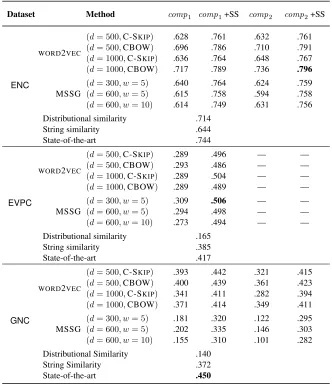
Table 1: Pearson’s correlation (r) for the different methods over the three datasets; the state-of-the-art for each dataset is described in Section 4
generate a compositionality prediction back-off for the small numbers of MWEs in this category, we as-sign a default value, which is the mean of computed compositionality scores for other instances.7
[image:4.612.143.469.62.443.2]As a baseline, we use the translation string simi-larity approach of Salehi and Cook (2013), including the cross-validation-based method for selecting the 10 best languages to use for each dataset. We further include a linear combination of the string similarity method with each of the various approaches based on word embeddings.
Table 1 shows the results for the various methods,
lack of lemmatisation.
7We also experimented with using the string similarity
ap-proach as a back-off, which resulted in marginally lower results than what is reported in Table 1.
over a range of hyper-parameter settings for each of WORD2VEC (vector dimensionality d; we also
present results for CBOW vs. C-SKIP) and MSSG
(vector dimensionality d and window size w), in-formed by the experimental results in the respective publications. Note that forEVPC, we don’t use the vector for the particle, in keeping with Salehi et al. (2014b); as such, there are no results forcomp2. For
comp1,α is set to 1.0 for EVPC, and 0.7 for both
ENCandGNC, also based on the findings of Salehi et al. (2014b).
The results indicate that the approaches using both WORD2VEC and MSSG outperform simple
parameteriza-1 2 3 4 5 6
Number of prototypes
0.1 0.2 0.3 0.4 0.5 0.6 0.7
Correlation
(
r
) ENCcomp1
ENCcomp2
EVPCcomp1
GNCcomp1
[image:5.612.84.301.88.229.2]GNCcomp2
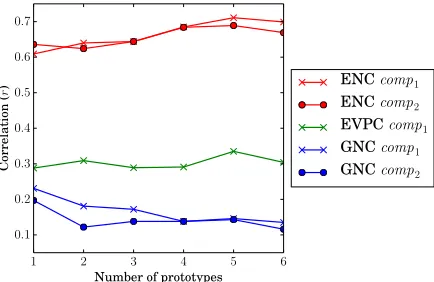
Figure 1: The effect of the number of prototypes on the results with MSSG
tions, they surpass the state-of-the-art methods for
ENC and EVPC; in the case of GNC, the best-performing method (WORD2VECwithd= 500and
C-SKIP) roughly matches the state-of-the-art. Note
that in each case, the state-of-the-art is achieved using varying levels of supervision over labelled data (ENC and EVPC) or language-specific pre-processing (GNC), whereas the word embedding methods use no labelled data. As such, the answer to RQ1 would appear to be a resounding yes.
Looking to RQ2, the models are remarkably insensitive to hyper-parameter optimisation for
EVPC, but there are slight deviations in the re-sults for ENC and GNC. Having said that, they are largely between the different word embedding approaches, and the results for a given approach under different parameter settings is relatively sta-ble. A large part of the cause of the drop in re-sults and greater parameter sensitivity over GNC
is the lower token frequencies, through a combina-tion of the Wikipedia corpus being markedly smaller and our naive tokenisation strategy having low recall over German due to the richer morphology. As such, the answer would appear to be a tentative “relatively insensitive, assuming high token frequencies”.
Finally, looking to RQ3, there was little separat-ingWORD2VECand MSSG overENC, but over the
other two datasets, WORD2VEC had a clear
advan-tage. Given the high levels of polysemy observed in high frequency English verb particle
construc-tions (Salehi et al., 2014a), this result forEVPCwas particularly surprising, and suggests that, at least under our two basic forms of composition, multi-prototype word embeddings are at best equal to, and in many cases, inferior to, single-prototype word embeddings.
According to the results, the string similar-ity approach complements all word-embedding ap-proaches. We hypothesise that this is because it is not based on any corpus, and is thus not biased by the frequency of token instances in the corpus.
In Table 1, the number of embeddings for MSSG was set to 2 prototypes, based on the default rec-ommendations of Neelakantan et al. (2014). To in-vestigate the impact of this parameter on our results, we retrained MSSG over the range[1,6]and reran our experiments for each set of embeddings over the three datasets (without string similarity, to isolate the effect of the number of embeddings), as shown in Figure 1. For both English datasets (ENCand
EVPC), setting the number of prototypes to a value higher than 2 boosts the results slightly, with 5 pro-totypes appearing to be the optimal value. For the German dataset (GNC), on the other hand, the best results are actually achieved for a single prototype. Further research is required to better understand this effect.
6 Conclusions
We presented the first approach to using word em-beddings to predict the compositionality of MWEs. We showed that this approach, in combination with information from string similarity, surpassed, or was competitive with, the current state-of-the-art on three compositionality datasets. In future work we intend to explore the contribution of information from word embeddings of a target expression and its component words under translation into many lan-guages, along the lines of Salehi et al. (2014b).
Acknowledgements
Excel-lence programme.
References
Timothy Baldwin and Su Nam Kim. 2009. Multiword expressions. In Nitin Indurkhya and Fred J. Damerau, editors, Handbook of Natural Language Processing. CRC Press, Boca Raton, USA, 2nd edition.
Timothy Baldwin, Colin Bannard, Takaaki Tanaka, and Dominic Widdows. 2003. An empirical model of multiword expression decomposability. In Proceed-ings of the ACL-2003 Workshop on Multiword Expres-sions: Analysis, Acquisition and Treatment, pages 89– 96, Sapporo, Japan.
Colin James Bannard. 2006. Acquiring Phrasal Lexicons from Corpora. Ph.D. thesis, University of Edinburgh. Mohit Bansal, Kevin Gimpel, and Karen Livescu. 2014.
Tailoring continuous word representations for depen-dency parsing. In Proceedings of the 52nd Annual Meeting of the Association for Computational Linguis-tics (Volume 2: Short Papers), pages 809–815, Balti-more, USA.
Marco Baroni, Georgiana Dinu, and Germ´an Kruszewski. 2014. Don’t count, predict! a systematic compari-son of context-counting vs. context-predicting seman-tic vectors. InProceedings of the 52nd Annual Meet-ing of the Association for Computational LMeet-inguistics (ACL 2014), pages 238–247, Baltimore, USA. Chris Biemann and Eugenie Giesbrecht. 2011.
Distri-butional semantics and compositionality 2011: Shared task description and results. In Proceedings of the workshop on distributional semantics and composi-tionality, pages 21–28, Portland, Oregon, USA. Julian Brooke, Vivian Tsang, Graeme Hirst, and Fraser
Shein. 2014. Unsupervised multiword segmentation of large corpora using prediction-driven decomposi-tion ofn-grams. InProceedings of COLING 2014, the 25th International Conference on Computational Lin-guistics: Technical Papers, pages 753–761, Dublin, Ireland.
Ronan Collobert and Jason Weston. 2008. A unified ar-chitecture for natural language processing: Deep neu-ral networks with multitask learning. In Proceed-ings of the 25th International Conference on Machine Learning (ICML 2008), pages 160–167, Helsinki, Fin-land.
Jacob Devlin, Rabih Zbib, Zhongqiang Huang, Thomas Lamar, Richard Schwartz, and John Makhoul. 2014. Fast and robust neural network joint models for statis-tical machine translation. InProceedings of the 52nd Annual Meeting of the Association for Computational Linguistics (ACL 2014), pages 1370–1380, Baltimore, USA.
Afsaneh Fazly, Paul Cook, and Suzanne Stevenson. 2009. Unsupervised type and token identification of idiomatic expressions. Computational Linguistics, 35(1):61–103.
Tomas Mikolov, Martin Karafi´at, Lukas Burget, Jan Cer-nock`y, and Sanjeev Khudanpur. 2010. Recurrent neu-ral network based language model. In Proceedings of the 11th Annual Conference of the International Speech Communication Association (INTERSPEECH 2010), pages 1045–1048, Makuhari, Japan.
Tomas Mikolov, Kai Chen, Greg Corrado, and Jeffrey Dean. 2013a. Efficient estimation of word representa-tions in vector space. InProceedings of Workshop at the International Conference on Learning Representa-tions, 2013, Scottsdale, USA.
Tomas Mikolov, Ilya Sutskever, Kai Chen, Greg S Cor-rado, and Jeff Dean. 2013b. Distributed represen-tations of words and phrases and their composition-ality. In Advances in Neural Information Processing Systems, pages 3111–3119.
Jeff Mitchell and Mirella Lapata. 2010. Composition in distributional models of semantics.Cognitive Science, 34(8):1388–1429.
Arvind Neelakantan, Jeevan Shankar, Alexandre Pas-sos, and Andrew McCallum. 2014. Efficient non-parametric estimation of multiple embeddings per word in vector space. InProceedings of the 2014 Con-ference on Empirical Methods in Natural Language Processing (EMNLP 2014), pages 1059–1069, Doha, Qatar.
Alexandre Passos, Vineet Kumar, and Andrew McCal-lum. 2014. Lexicon infused phrase embeddings for named entity resolution. InProceedings of the Eigh-teenth Conference on Computational Natural Lan-guage Learning, pages 78–86, Baltimore, USA. Siva Reddy, Diana McCarthy, and Suresh Manandhar.
2011. An empirical study on compositionality in com-pound nouns. InProceedings of IJCNLP, pages 210– 218, Chiang Mai, Thailand.
Bahar Salehi and Paul Cook. 2013. Predicting the compositionality of multiword expressions using translations in multiple languages. In Second Joint Conference on Lexical and Computational Semantics (*SEM), Volume 1: Proceedings of the Main Confer-ence and the Shared Task: Semantic Textual Similarity, pages 266–275, Atlanta, Georgia, USA, June.
Bahar Salehi, Paul Cook, and Timothy Baldwin. 2014a. Detecting non-compositional MWE components using Wiktionary. InProceedings of the 2014 Conference on Empirical Methods in Natural Language Processing (EMNLP), pages 1792–1797, Doha, Qatar, October. Bahar Salehi, Paul Cook, and Timothy Baldwin. 2014b.
transla-tions to predict multiword expression compositional-ity. In Proceedings of the 14th Conference of the European Chapter of the Association for Computa-tional Linguistics, pages 472–481, Gothenburg, Swe-den, April.
Nathan Schneider, Emily Danchik, Chris Dyer, and Noah A. Smith. 2014. Discriminative lexical seman-tic segmentation with gaps: Running the mwe gamut.
Transactions of the Association of Computational Lin-guistics, 2:193–206.
Sabine Schulte im Walde, Stefan M¨uller, and Stephen Roller. 2013. Exploring vector space models to pre-dict the compositionality of German noun-noun com-pounds. InProceedings of the Second Joint Confer-ence on Lexical and Computational Semantics, pages 255–265, Atlanta, USA.
Hinrich Sch¨utze. 1997. Ambiguity Resolution in Lan-guage Learning. CSLI Publications, Stanford, USA. Richard Socher, Brody Huval, Christopher D. Manning,
and Andrew Y. Ng. 2012. Semantic compositionality through recursive matrix-vector spaces. In Proceed-ings of the Joint Conference on Empirical Methods in Natural Language Processing and Computational Natural Language Learning 2012 (EMNLP-CoNLL 2012), pages 1201–1211, Jeju Island, Korea.
Richard Socher, Alex Perelygin, Jean Wu, Jason Chuang, Christopher D. Manning, Andrew Ng, and Christopher Potts. 2013. Recursive deep models for semantic compositionality over a sentiment treebank. In Pro-ceedings of the 2013 Conference on Empirical Meth-ods in Natural Language Processing (EMNLP 2013), pages 1631–1642, Seattle, USA.
Claudia von der Heide and Susanne Borgwaldt. 2009. Assoziationen zu Unter, Basis und Oberbegriffen. Eine explorative Studie. In Proceedings of the 9th Nord-deutsches Linguistisches Kolloquium, pages 51–74. Will Y. Zou, Richard Socher, Daniel Cer, and