Maximum Entropy Modeling in Sparse Semantic Tagging
∗Jia Cui
Center for Language and Speech Processing
Johns Hopkins University
Baltimore, MD, 21210, USA
[email protected]
David Guthrie
Department of Computer Science
University of Sheffield
Sheffield, S1 4DP, UK
[email protected]
Abstract
In this work, we are concerned with a coarse grained semantic analysis over sparse data, which labels all nouns with a set of semantic categories. To get the benefit of unlabeled data, we propose a bootstrapping framework with Maximum En-tropy modeling (MaxEnt) as the statistical learn-ing component. Durlearn-ing the iterative tagglearn-ing pro-cess, unlabeled data is used not only for better statistical estimation, but also as a medium to in-tegrate non-statistical knowledge into the model training. Two main issues are discussed in this paper. First, Association Rule principles are sug-gested to guide MaxEnt feature selections. Sec-ond, to guarantee the convergence of the boot-strapping process, three adjusting strategies are proposed to soft tag unlabeled data.
1
Introduction
Semantic analysis is an open research field in natural lan-guage processing. Two major research topics in this field are Named Entity Recognition (NER) (N. Wacholder and Choi, 1997; Cucerzan and Yarowsky, 1999) and Word Sense Dis-ambiguation (WSD) (Yarowsky, 1995; Wilks and Steven-son, 1999). NER identifies different kinds of names such as ”person”,”location” or ”date”, while WSD distinguishes the senses of ambiguous words. For example, ”bank” can be la-beled as ”financial institution” or ”edge of a river”. Our task of semantic analysis has a more general purpose, tagging all nouns with one semantic label set. Compared with NE, which only considers names, our task concerns all nouns. Unlike WSD, in which every ambiguous word has its own range of sense set, our task aims at another set of semantic labels, shared by all nouns. The motivation behind this work is that a semantic category assignment with reliable perfor-mance can contribute to a number of applications including statistical machine translation and sub-tasks of information extraction.
∗
This work was supported in part by NSF grant numbers IIS-0121285. Any opinions, fndings and conclusions or recommenda-tions expressed in this material are the authors’ and do not neces-sarily reflect those of the sponsor.
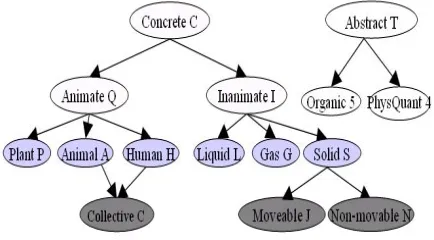
[image:1.612.323.540.306.426.2]The semantic categories adopted in this paper come from the Longman Dictionary. These categories are neither par-allel to nor independent of each other. One category may denote a concept which is a subset of that of another. Exam-ples of the category structures are illustrated in Figure 1.
Figure 1: Structure of some semantic categories used in the Langman dictionary.
Maximum Entropy (MaxEnt) principle has been success-fully applied in many classification and tagging tasks (Rat-naparkhi, 1996; K. Nigam and A.McCallum, 1999; A. Mc-Callum and Pereira, 2000). We use MaxEnt modeling as the learning component. A major issue in MaxEnt training is how to select proper features and determine the feature tar-gets (Berger et al., 1996; Jebara and Jaakkola, 2000). To discover useful features, we exploit the concept of Associ-ation Rules (AR) (R. Agrawal and Swami, 1993; Srikant and Agrawal, 1997), which is originally proposed in Data Mining research field to identify frequent itemsets in a large database.
We begin with an introduction of our bootstrapping framework and MaxEnt training. An interesting MaxEnt puzzle is presented, with its derivation showing possible di-rections of utilizing unlabeled data. Then the feature selec-tion criterion guided by AR is discussed as well as the indi-cator selection (section 3). We discuss initialization meth-ods for the unlabeled data. Strategies to guarantee conver-gence of bootstrapping process and approaches of integrat-ing non-statistical knowledge are proposed in section 4. Fi-nally, experimental results are presented along with conclu-sions and future work.
2
Bootstrapping and the MaxEnt puzzle
An instance in the corpus includes the headword, which is the noun to be labeled, and its context. To integrating the un-labeled instances in the training process, we propose a tag-ging method called soft tagtag-ging. Unlike the normal tagtag-ging, in which each instance is assigned only one label, soft tag-ging allows one instance to be assigned several labels with each of them being associated with a fractional credit. All credits assigned to one instance should sum up to 1. For example, a raw instance with the headword ”club” can be soft tagged as (movable J:0.3, not-movable N:0.3, collective U:0.4). Once all auxiliary instances have been assigned se-mantic labels, we pool them together with human-annotated data to select useful features and set up feature expectations. Then a log-linear model is trained for several iterations to maximize likelihood of the whole corpora. With the updated MaxEnt model, unlabeled data will be soft tagged again. The whole process is repeated until convergence condition is satisfied. This framework is illustrated in Figure 2.
[image:2.612.341.549.396.531.2]In building a mexent model, unlabeled data contributes differently to the feature selection and target estimation compared to the human-annotated data. While human-annotated instances never change, tags in unlabeled data keep updating according to the new MaxEnt model in each bootstrapping iteration, which might lead to a different fea-ture set.
Figure 2: The bootstrapping framework
Before presenting the MaxEnt puzzle, let’s first consider a regular MaxEnt formulation. Let l be a label and xbe an instance. Letkh(l, x)be theh-th binary feature
func-tion which is equal to 1 if(l, x)activates theh-th feature and 0 otherwise.P(l, x)is given by the model, denoting the probability of observing bothlandx. Pb(l, x)is the empir-ical frequency of(l, x)in the training data. The constraint associated with featurekh(l, x)is represented as:
X
l,x
P(l,x)kh(l,x) = X
l,x b
P(l,x)kh(l,x) (1)
In practice, we are interested in conditional models
P(l|x), which assign probability mass to a label set given supporting evidence x. And we approximateP(x) with
b
P(x). Consequently,
X
x b
P(x) X
l
P(l|x)kh(l,x) = X
l,x b
P(l,x)kh(l,x) (2)
Next, we show how the effect of unlabeled data disap-pears during the bootstrapping in a restricted situation. We make the following assumptions:
1. The feature targets are the raw frequencies in the train-ing data. No smoothtrain-ing is applied.
2. During the bootstrapping, we maintain a fixed feature set, while the feature targets might change.
3. The fractional credit assigned to labelland instancex
in thet+ 1iteration isPt(l|x).
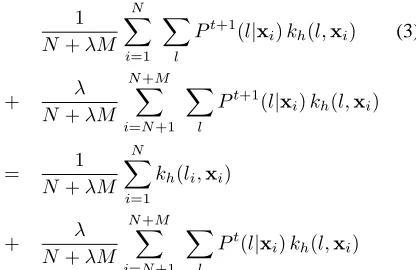
LetN be the total number of instance(1,· · ·, N) in la-beled data and M be the total number of instance(N + 1,· · ·, N+M) in unlabeled data. Letλbe the weight as-signed to unlabeled instances. The new constraint for the
h-th feature function can be rewritten as:
1
N+λM
N
X
i=1
X
l
Pt+1(l|xi)kh(l,xi) (3)
+ λ
N+λM
NX+M
i=N+1
X
l
Pt+1(l|
xi)kh(l,xi)
= 1
N+λM
N
X
i=1
kh(li,xi)
+ λ
N+λM
N+M
X
i=N+1
X
l
Pt(l|x
i)kh(l,xi)
wheret is the index of the bootstrap iterations. li is the
human-annotated label attached to theith instance. When the procedure converges,Pt(l|x
i) = Pt+1(l|xi),
the second parts on both sides will cancel each other. Fi-nally, the constraint will turn out to be:
N
X
i=1
X
l
Pt+1(l|
xi)kh(l,xi) = N
X
i=1
kh(li,xi) (4)
The above derivation shows that with the three restric-tions, the soft tagged instances make no contribution to the constraint set, which is counter-intuitive. That is why we call it a ”MaxEnt Puzzle”. Consequently, to utilize unla-beled data, we should break the three restrictions: to re-select feature set after each bootstrapping iteration, or adjust the soft tagging results given by the model.
3
Feature selection
Berger et al (1996) proposed an iterative procedure of adding news features to feature set driven by data. We present a simple and effective approach using some statis-tical heuristics for feature selection.
There are two kinds of features in MaxEnt modeling: marginal features and conditional features. Marginal fea-tures represent the priors of the semantic categories. Condi-tional features are composed of an indicator and a label. An indicator can be a single word, an array of words or a word cluster. Similarly, a label can be either a single semantic category or a set of categories.
One major motivation of combining unlabeled data with labeled data in the training process is that unlabeled data can provide a large pool of valuable feature candidates as well as more statistical information. An (indicator, label) pair may appear only once in labeled data, but it may oc-cur very frequently in soft tagged data, it might be selected as a feature during the bootstrapping. Similarly, a feature selected only from human-annotated data may become rel-atively infrequent when the soft tagged instances are added, thus being eliminated from the feature set.
3.1 Indicators
A good indicator should have an obvious preference for def-inite semantic categories. For instance, ”good”,”great” are weak indicators because they can modify almost all seman-tic categories; ”drinkable” and ”light-weighted” are usually associated with ”liquid (L)” and ”movable (J)” respectively, thus are strong indicators. The quality of an indicator can be measured by the entropy of the semantic categories it mod-ifies. The lower the entropy is, the stronger preference the indicator has.
To overcome the data sparsity problem, several tors can be clustered together to form a new single indica-tor. There are two possible ways of clustering. One is hard clustering, which divides all words into non-overlapping classes; The other is soft clustering, which permits one word to belong to different classes. Usually, words with similar semantic preferences are clustered together.
3.2 Association rules in feature selection
An indicator can be combined with different labels to form different features. But not all pairs including good indica-tors are good features. In a statistical learning algorithm, a good feature should first be statistically reliable, which is considered in most of the MaxEnt modeling implementa-tions. However, with this single requirement, it is possible that(x, l)is a feature if bothxandl are frequent, but the chance of seeing labellis tiny given the presence of indica-torx. More constraints are necessary to pinpoint indicative
features. We exploit Association Rule (AR) principles to put more restrictions in feature selecting.
Letxbe an indicator and l be a label. count(x, l) de-notes the number of instances which include indicatorxand are attached with labellin the training corpus. Nis the to-tal number of instances. We define three measurements to characterize the goodness of a given(x, l)pair from three different points. We put thresholds on each of them.
support(x, l)denotes how frequently indicatorxand la-belloccur together.
support(x, l) = count(x, l)
N (5)
conf idence(x, l)denotes how likely it is to observe label
lwhen indicatorxis at present.
conf idence(x, l) = count(x, l)
count(x) (6)
improvement(x, l)shows how much more likely to see labell when indicatorxis observed relative to the overall probability of seeingl.
improvement(x, l) =count(x, l)/count(x)
count(l)/N (7)
The concept ofimprovement can be extended to each part of the indicators. LetSbe the feature set.
improvement(x, l) =minx0∈x,(x0,l)∈S
conf idenc(x, l)
conf idenc(x0, l)
(8) For instance, assume the improvement threshold is 1. Letx=x1x2, ifconf idence(x1, l)> conf idence(x1x2, l), then(x1x2, l)will be ignored and only (x1, l) is selected as a feature; otherwise, only(x1x2, l)remains and(x1, l)
is ignored. This idea can be applied to remove embedded features, reducing the redundancy in the feature set.
The assumption behind those criteria is that most features should be positive, i.e., given feature (x,l), the existence of indicatorxalways increase the odds of seeing labell, other than decrease it.
4
Soft tagging
Initialization of unlabeled instances is important for our bootstrapping framework, because its effect will be carried on from one iteration to another. Even if the auxiliary data (unlabeled data included in training) has no effect on the constraint set under some circumstances, the soft tagged auxiliary data is still a part of the training corpus, the like-lihood of which is to be maximized in the MaxEnt training. On one hand, we wish the initialization to be as close as possible to the real value, of which we have no idea except for the knowledge from labeled data; on the other hand, we wish the tagging of the auxiliary data could be slightly dif-ferent from the model trained only on labeled data, to avoid converging to this model itself.
is one of the causes diluting the effect of the auxiliary data. Therefore, we propose to adjust the soft tagging results by non-statistical knowledge or through fixing some of the tags.
4.1 Initialization of unlabeled data
Inspired by the MaxEnt puzzle, we realize the importance of additional knowledge sources. To assign inital fractional credits to unlabeled instances, we look up a dictionary to narrow down choices. In particular,
1. If the headword of the instance has a unique semantic label choice according to the dictionary, it gets credit 1 for this label and 0 for others.
2. If the headword has been observed in labeled data and it has more than one possible labels in the dictionary, it is initialized as follows:
Letwbe the headword andlbe a label. mis the to-tal number of permitted labels forwaccording to the dictionary. LetL(w)be the set of(w, l)pairs in la-beled data andD(w)be the set of(w, l)permitted in the dictionary.
IfD(w) =L(w), then
credit(w, l) =
( count(w,l)
count(w) if(w, l)∈L(w)
0 otherwise
Otherwise, we add one and renormalize:
credit(w, l) =
( count(w,l)+1
count(w)+m if(w, l)∈D(w)
0 otherwise
3. If the headword never occurs in human-annotated data, we initialize the credits with the flat distribution.
credit(w, l) =
1
m if(w, l)∈D(w)
0 otherwise
4.2 Adjust credits according to their distributions
Considering the bootstrapping process as a tug-of-war be-tween labeled and unlabed data, with the flag denoting the model. In each bootstrapping iteration, tags of the auxil-iary data are updated in accordance with the model. Unla-beled data is moving towards the laUnla-beled data while the latter stands still. One way to prevent the auxiliary data from be-ing dragged completely to the point of the labeled data is to nail down part of the auxiliary data tags. For example, sup-pose an instance gets credits (0.8,0.15,0.05). Since the first category is much more likely than the others, we can fix the credits as (1,0,0) for ever. Another choice would be to re-move the least probable category, i.e., changing the credits to (0.84,0.16,0). An even more radical method is to remove the whole instance from the auxiliary data if it has no strong semantic preferences.
Here are the details of these adjusting strategies:
rmlow set the least probable category with credit zero and
renormalize the remaining credits. Whether to apply this action or not can depend on thresholding on the mininal credit, the ratio of the minimal credit to the maximal credit, or the entropy of the credit distribution.
kphigh assign all credit 1 to the most probable category.
Possible thresholds can be set for the maximal credit, the ratio of the maximal credit to the second maximal credit, or the entropy of the credit distribution.
rmevent remove the instance if it has a flat credit
distri-bution after several iterations. Possible thresholds can be set for the maximal credit, the ratio of the maximal credit to the minimal credit, or the entropy of the credit distribution.
The effect of those actions is permanent. That is, if a cat-egory is forbidden (set to zero) for one instance, it will be forbidden for this instance in the following iterations. Sim-ilarly, if an instance is removed, it will never be used in the training process again.
4.3 Adjust credits with non-statistical knowledge
Non-statistical knowledge is the knowlege which is not ob-tainable from statistics in a sparse data set, but rather from other resources like a dictionary or WordNet. This kind of knowledge may not be expressed in labeled data, therefore could not be used to form features. For instance, we can ob-tain easily from a dictionary that word ”long-tailed” is used to modify animals. But if ”long-tailed” is rarely observed in the training data, it will not not selected as a feature, thus being ignored by the model.
To take advantage of non-statistical knowledge, we use it to adjust soft tagging results. One possibility is pruning the illegal categories with a dictionary. By doing so, this kind of knowledge can affect the MaxEnt modeling indirectly. Similarly, the preference of a context word could also be used to adjust the credit distributions.
5
Experiments
5.1 Corpus
The corpus used in our experiments is provided by Sheffield University. The human-annotated data is divided into train-ing (SHD) and test (Blind). SHD contains 197K instances and Blind contains 13K instances.
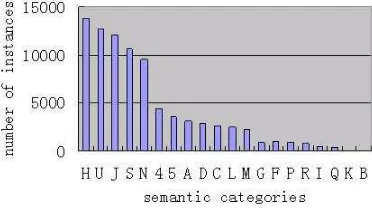
The Longman dictionary provides 36 semantic gories, among which only 21 most frequently used cate-gories with the exception of ”unknown (Z)” are used in our experiments. The distribution of the semantic categories is far from uniform. Semantic category ”abstract (T)” alone forms60%(126K) of the human-annotated instances. The histogram of the other categories is shown in Figure 3.
The inter-annotator agreement for the labeled data is95%
with exact match. Even though some semantic categories form a hierarchical structure, we always assume that human annotators chose the most specific categories. Evaluation of the classification error rate (CER) in the following experi-ments also uses exact match only.
5.2 Feature selection with Association Rule principles
Figure 3: The number of instances labeled with semantic categories other than T
Since96%of the headwords in Blind are also in SHD, headwords are the most effective indicators. Using head-words alone can get9.47%classification error rate. Other indicators investigated include adjectives, which modify headwords, and their clusters. As we mentioned before, clustering can alleviate data sparseness problem. So we group headwords and adjectives. Headword clusters are soft clusters. The ambiguous headwords can belong to several clusters as long as the corresponding categories of those clusters are permitted for these headwords in the dictionary. Adjectives are hard clustered. We discard general common adjectives according to their entropies. We keep only those with strong semantic preferences and assign them to the clusters corresponding to their best preferences.
We also include compound features such as headword-adjective, headword-adjectivecluster and other combina-tions.
Table 1 shows the experimental results with all types of indicators which are mentioned above, and compared the results with the baseline. For different types of fea-tures, we set up different thresholds. In config-1, only the
support thresholds are used. From config-2 to config-5, we raiseconf idence andimprovement thresholds grad-ually to lower the number of features. The CER results show that with proper thresholds, usingconf idence and
improvementnot only helps decreasing the feature set size by as much as26%, but also improves the performance.
The last column of the table 1 shows the p-value of sig-nificnce test between each configuration and its precedence. Clearly, config 1,2,and 3 perform similar to each other, though they are significant better than using headwords only. And config 4 and 5 are significant better than config 3.
5.3 Bootstrapping
In this group of experiments, we use Blind as the auxiliary data in the bootstrapping process. Blind data is initialized with the methods mentioned in section 4. No human labels in Blind are included in the training process. The weight for the auxiliary dataλis set to 1 in our experiments. The Longman dictionary is always used in soft tagging to elimi-nate the illegal categories.
The bootstrapping process will stop when the constraint set does not change. Since the feature set is re-selected in
configuration # of features CER(%) p-value
headwords only 12514 9.47
-config-1 49861 8.18 <1.0e−12
config-2 44141 8.18 0.53
config-3 39136 7.94 0.034
config-4 36631 7.62 <1.0e−3
[image:5.612.89.275.72.176.2]config-5 32214 7.64 0.65
Table 1: Classification Error Rates (CER) with different fea-ture sets
each iteration, the convergence of the iterative steps is diffi-cult to achieve. Fluctuations might be observed. With strate-gies proposed in 4.2, more and more auxiliary instances can be fixed with one semantic category. The whole process will stop at some point.
Figure 4 plots the CER in the first 20 iterations for dif-ferent setups. It shows adding Blind into the bootstrapping process can lower the error rate to7.37%. Without any soft tagging adjustment (normal), the training process does not stop and the CER drops at first but then climbs up later.
Using entropy as thresholds is an efficient way to en-sure the convergence for both rmlow and kphigh. Action
rmevent can also keep the results from getting much worse
during bootstrapping.
Figure 4: Error rate in each iteration for different soft tag-ging strategies
6
Conclusions
We introduce a general semantic analysis task, which labels all nouns with a unique set of semantic categories. In order to get benefitted from unlabeled data, we propose a boot-strapping framework with MaxEnt modeling as the main learning component. Unlabeled data, after soft tagging, can be combined with labeled data to provide evidence for Max-Ent feature selection and target estimation. Moreover, non-statistical knowledge can affect the modeling indirectly by adjusting the soft tagging results of the auxiliary data.
[image:5.612.326.533.363.524.2]Using AR principles not only decreases the size of the fea-ture set dramatically, but also improves the performances. But there is no good way to set the AR thresholds properly yet.
With the feature set changing in each iteration, the con-vergence of the bootstrapping is hard to guarantee. By sharpening the soft tagging results through removing the least probable label or keeping only the most probable la-bel, we can speed up convergence.
7
Future work
At present, only headwords and adjectives are used to com-pose indicators. We plan to incorporate linguistically en-riched features. Using parsing, we can locate verbs and use their relationships with headwords as new indicators. An-other type of potential indicators are the subject codes of the headwords. Subject codes represent finer grained semantic classifications. Some of the instances in human-annotated data have been marked with subject codes. There are a to-tal of 320 subject codes, such as ”architecture”,”agriculture” and ”business”. We believe that knowing the subject codes of the headwords will help to decrease the entropy of the headword senses.
We have a very large data set BNC corpus, which comes from the same source as the labeled data we use. BNC data is composed of 1.2M unambiguous instances, 1.4M seen instances (ambiguous instances with headwords being ob-served in SHD) and 0.4M unseen instances (ambiguous in-stances with headwords never being observed in SHD). In the future, we will try bootstrapping with BNC data.
Alternative indicator clustering techniques will be plored too. We have used entropy as a heuristic in the ex-periments; an alternative heuristic that can be employed is mutual information.
We have provided a framework to utilize non-statistical knowledge. In addition to using a dictionary to limit the choices of unlabeled data, we can obtain plenty of informa-tion about word sense preferences from the WordNet for soft tagging adjustment.
The bootstrapping process is closely related to Expectation-Maximization procedure, in which soft tagging can be ragarded as the E-step. In many practical EM implementations, however, updating at the E-step does not use the exact theoretical value. The modification taken in the E-step can be a linear combination of the old value and the new calculated one. Similar re-estimation strategies can be applied in our work. A theoretical description of the relationship between EM and soft tagging would potentially be able to identify convergency properties of the bootstrapping framework.
Acknowledgments
The authors would like to thank Prof. Frederick Jelinek and Dr. Louise Guthrie and all other members of the Seman-tic group in 2003 JHU Summer Research Workshop. They are also grateful to the anonymous reviewers for their very insightful comments and suggestions.
References
D. Freitag A. McCallum and F. Pereira. 2000. Maximum entropy markov models for information extraction and segmentation. In Proc. 17th International Conf. on
Ma-chine Learning, pages 591–598.
A. L. Berger, S. D. Pietra, and V. J. D. Pietra. 1996. A max-imum entropy approach to natural language processing.
Computational Linguistics, 22(1):39–71.
A. Blum and T. Mitchell. 1998. Combining labeled and unlabeled data with co-training. In COLT: Proceedings
of the Workshop on Computational Learning Theory.
A. Corduneanu and T. Jaakkola. 2002. Continuation meth-ods for mixing heterogeneous sources. In Proceedings
of the Eighteenth Annual Conference on Uncertainty in Artificial Intelligence.
S. Cucerzan and D. Yarowsky. 1999. Language indepen-dent named entity recognition combining morphological and contextual evidence. In joint SIGDAT Conference
on Empirical Methods in NLP and Very Large Corpora,
pages 90–99.
T. Jebara and T. Jaakkola. 2000. Feature selection and dual-ities in maximum entropy discrimination. In Uncertainity
In Artificial Intellegence.
J.Lafferty K. Nigam and A.McCallum. 1999. Using maxi-mum entropy for text classification. In IJCAI-99
Work-shop on Machine Learning for Information Filtering,
pages 61–67.
S. Thrun K. Nigam, A. K. McCallum and T. M. Mitchell. 2000. Text classification from labeled and unlabeled doc-uments using em. Machine Learning, 39(2-3):103–134.
Y. Ravin N. Wacholder and M. Choi. 1997. Disambiguation of proper names in text. In Proceedings of Fifth
Con-ference on Applied Natural Language Processing, pages
202–208.
T. Imielinski R. Agrawal and A. N. Swami. 1993. Mining association rules between sets of items in large databases. In Peter Buneman and Sushil Jajodia, editors,
Proceed-ings of the 1993 ACM SIGMOD International Conference on Management of Data, pages 207–216, Washington,
D.C., 26–28 .
A. Ratnaparkhi. 1996. A maximum entropy model for part of speech tagging. In Proceedings of the Conference
on Empirical Methods in Natural Language Processing,
pages 133–142.
R. Srikant and R. Agrawal. 1997. Mining generalized as-sociation rules. Future Generation Computer Systems, 13(2–3):161–180.
Y. Wilks and M. Stevenson. 1999. The grammar of sense: Using part-of-speech tags as a first step in semantic dis-ambiguation. Journal of Natural Language Engineering, 4(3).
D. Yarowsky. 1995. Unsupervised word sense disambigua-tion rivaling supervised methods. In Meeting of the