Arabic Diacritization: Stats, Rules, and Hacks
Kareem Darwish Hamdy Mubarak Ahmed Abdelali
Qatar Computing Research Institute, HBKU, Doha, Qatar
{kdarwish,hmubarak,aabdelali}@hbku.edu.qa
Abstract
In this paper, we present a new and fast state-of-the-art Arabic diacritizer that guesses the diacritics of words and then their case endings. We employ a Viterbi decoder at word-level with back-off to stem, morphological patterns, and translit-eration and sequence labeling based di-acritization of named entities. For case endings, we use Support Vector Machine (SVM) based ranking coupled with mor-phological patterns and linguistic rules to properly guess case endings. We achieve a low word level diacritization error of 3.29% and 12.77% without and with case endings respectively on a new multi-genre free of copyright test set. We are mak-ing the diacritizer available for free for re-search purposes.
1 Introduction
Modern Standard Arabic (MSA) text is typically written without diacritics (short vowels). During reading, Arabic readers need to reintroduce dia-critics to disambiguate words and to sound them correctly given their context. Diacritics play two main roles depending on their position in the word. The final vowel in a word – case ending – which typically appears on the last letter of the stem indicates its syntactic role; while diacritics on the rest of the letters indicate the lexical choice. The role of diacritics is crucial for some appli-cations such as text-to-speech (TTS) and can be beneficial in other Arabic processing steps such as part-of-speech (POS) tagging and word sense disambiguation. A single word can have multi-ple meaning given the different diacritized forms. The word “Elm”1 could be viewed as a
homo-1Buckwalter encoding is used exclusively in the paper.
graph for different lexical items. The word can be diacritized in the following ways: “Eilom” (knowledge/science), “Ealam” (flag), “Ealima” (he knew), “Eulima” (it was known), “Eal∼ama” (he taught), etc. Beginners learning Arabic get ac-customed to diacritics and gradually learn to dis-ambiguate the text without them. For final diacrit-ics, they can help disambiguate the syntactic roles of words in sentences. Consider the syntactically ambiguous sentence: “r>Y AlmElm Altlmy∗”. It most likely means: “The teacher saw the stu-dent” resulting in the diacritized version “ra>Y AalomuEal∼imu Aalt∼ilomy∗a”, because Arabic prefers placing the subject ahead of the object. However, Arabic allows subjects and objects to switch positions, and hence the meaning might be “The student saw the teacher” with diacritized form “r>Y AalomuEal∼ima Aalt∼ilomy∗u”.
In this paper we present a new state-of-the-art Arabic diacritizer. The diacritizer works in two cascaded steps: First, it guesses the diacritics for the core of words – disambiguating lexical choice; and then it guesses case endings – disambiguat-ing syntactic roles. For the first step, we em-ploy a Viterbi decoder at word-level with back-off to stem, morphological patterns, and translit-eration and sequence labeling based diacritization of named entities. For the second, we employ SVM-based ranking coupled with morphological patterns and linguistic rules to properly guess case endings.
The contributions of this work is as follows: • We introduce a back-off scheme where OOV
words are diacritized using their morphological patterns (a.k.a stem templates)
• We use transliteration mining coupled with se-quence labeling to guess diacritics on Arabic words based on how the words are transliterated in English.
• We employ SVM-based ranking to guess the ap-propriate cased endings.
• We use morphological patterns and linguistic rules to better guess case endings.
• We offer a new copyright-free multi-genre test set to measure diacritization accuracy.
• We offer a state-of-the-art Arabic diacritizer that is coded entirely in Java and can be used freely for research purposes.
2 Background
2.1 Arabic Diacritization
Significant research has addressed diacritic restoration/recovery or diacritization for Arabic and some other Semitic languages which are typi-cally written without short vowels. Diacritization is essential for a variety of applications such as TTS as well as educational tools for language learners.
In earlier attempts for automatic diacritization, Gal (2002) used a Hidden Markov Model for diacritics restoration, tested on the Quran text, and achieved 14% word error rate (WER). Vergyri and Kirchhoff (2004) used acoustic features in conjunction with morphological and contextual constrains to train a diacritizer. They evaluated their automatic diacritization system on two cor-pora, namely FBIS and LDC CallHome ECA, and reported a 9% diacritics error rate (DER) without case ending, and 28% DER with case endings. The difference between WER and DER is that the latter measures the percentage of letters with incorrect diacritics. Consequently, DER values are typically lower than WER values. Nelken and Shieber (2005) used a cascade of probabilistic finite state transducers trained on the LDCs Arabic treebank news stories (Part 2). The corpus con-sists of 501 news stories collected from Al-Hayat newspaper with a total of 144,199 words. The cascade included a word-based language model, a letter-based language model, and a morphological model. This combination of probabilistic models achieved an accuracy of 7.33% and 23.61% WER without and with case ending respectively. Zitouni et al. (2006) trained a maximum entropy model for sequence classification to restore diacritics for each character in a word. For training, they used the LDCs Arabic Tree-bank (Part 3, version 1.0) diacritized corpus, which includes complete vocalization (full diacritics including case ending) for each word. The corpus is composed of 600
documents from the An-Nahar Newspaper with a total of 340,281 words. The maxEnt system achieved 5.5% DER and 18% WER on words without case ending. Habash and Rambow (2007) presented “MADA-D” a system that combines a tagger and a lexeme language model. The system showed that the morphological tagger along with a 3-gram language model were able to achieve the best performance of 5.5% and 14.9% WER respectively for diacritized words without and with case ending. We compare to their system in our paper. Rashwan et al. (2009) introduced a two layers stochastic system to automatically diacritize Arabic text. The system combines both morphological knowledge and the word full form features. These information is exploited through a maximum marginal probability on the full form supplemented with linguistic factorization model based on morphological analysis and POS tagging. While the first is fast, the second one used as a fall back is more accurate as it exploits more inner knowledge from the word parts and the context. Later work by Rashwan et al. (2015) used deep learning to improve diacritization accuracy and they reported a WER of 3.0% without case ending and 9.9% WER for guessing case ending. We compare to their system in our paper. Recent work by Abandah et al. (2015) uses recurrent neural networks to improve diacritization, and they report results that are better than those of MADA. Bebah et al. (2014) developed a hybrid approach that utilizes the output of the open source morphological Analyzer AlKhalil Morpho System (Mohamed Ould Abdallahi Ould et al., 2011) which outputs all possible diacritization for each word analyzed out of context. These outputs were then fed to an HMM to guess the correct diacritized form. The system was trained on a large body of text consisting of 2,463,351 vowelized words divided between NEMLAR cor-pus (460,000 words), Tashkeela corcor-pus (780,000 words), and RDI corpus (1,223,351 words). The training was carried out with 90% of a corpus and the remaining 10% composed of 199,197 words was used for testing. The system achieved 9.93% WER.
using a recurrent neural network for diacritiza-tion, traditionally, works on diacritic restoration rely on linguistic features and tools. MADA (Morphological Analysis and Disambiguation for Arabic) (Habash et al., 2009) and its successor MADAMIRA (Pasha et al., 2014) are among the few available tools for diacritization. The core of MADA – MADAMIRA as well – utilizes morpho syntactic features to select a proper analysis from a list of potential analyses provided by the Buck-walter Arabic Morphological Analyzer (BAMA) (Buckwalter, 2004). Using a set of SVMs trained on the Arabic Penn Treebank, MADAMIRA selects the most probable features. The analysis MADAMIRA selects consists of the diacritized form along with other features such as its lexeme, its morphological features, and English glossary.
2.2 ATB
The availability of diacritized text for training is crucial. Much of the previous work on diacriti-zation relied on using the Arabic Penn Treebank (ATB). Though ATB is invaluable for many tasks such as POS tagging and parsing, it is sub-optimal for diacritization for the following reasons: 1. ATB is limited in terms of size with less than 570k tokens and in terms of diversity with 87,160 unique surface forms (excluding numerals). In comparison, the AFP news corpus has approxi-mately 765,890 unique tokens (Cole et al., 2001). These limitation would lead to poor coverage. 2. ATB often uses inconsistent diacritizations. For example the word “<nh” appears 27 as “<in∼ahu” and 37 as “<inhu” where the first is the correct one. Also, the diacritic sukon “o” is sometimes omitted in ATB (ex. “kwbnhAgn” is diacritized as: “kuwbinohAgin”); and default dia-critics preceding long vowels are optionally used. We thus used a large diacritized corpus that we describe in Section 3.1. When comparing with systems that were trained on the ATB, some pre-processing is required, as we show later, to make sure that we are not unfairly penalizing them. 3 Our Diacritizer
The diacritizer has two main components. The first component recovers the diacritics for the core word (i.e. word without case ending), and the ond only recovers the case ending. In this sec-tion we describe: the training and test corpora we used and how we processed them; the training of our system that diacritizes core-words and guesses
case ending; and our results compared to those of other systems that are described in the literature, and some relaxations we applied during evaluation to insure fair comparison.
3.1 Training and Test Corpora
For this work, we acquired a diacritized cor-pus from a commercial vendor containing more than 9.7 million tokens with approximately 194k unique surface forms (excluding numbers and punctuation marks). The corpus is composed mostly of modern standard Arabic (approximately 7 million words) and covers many genres includ-ing politics, economics, sports, science, etc., and the remaining 2.7 million words are mostly reli-gious text in classical Arabic. Thus the corpus is well balanced and is considerably larger than the ATB. We manually checked random samples from the corpus and we estimate diacritization errors to be less than 1%, and diacritization is thorough with no omissions of sukon or optional diacritics. We used the corpus to build several resources as we describe in Section 3.2.
For testing, we used a new test set composed of 70 WikiNews articles (majority are from 2013 and 2014) that cover a variety of themes, namely: politics, economics, health, science and technol-ogy, sports, arts, and culture. The articles are evenly distributed among the different themes (10 per theme). The articles contain 18,300 words. We compare our results to three different systems that are described in the literature, where the authors were kind enough to either diacritize our test set or provide a working system. The systems were those of Rashwan et al. (2015), Belinkov and Glass (2015), and MADAMIRA (Habash et al., 2009; Pasha et al., 2014). The first two are re-cent systems and MADAMIRA is a popular tool for processing Arabic.
3.2 Data Preparation
case ending which is attached in this case to the stem is removed, leading to “kitAb” and the full surface form “wakitAbhimo”. A few things are noteworthy here, namely that diacritized suffixes are often affected by the case-ending (ex. if the case ending in the this example was “u”, the suf-fix would have been “humo”), and the case ending may be on the attached noun suffix (ex. “p” or “At”) and not on the last letter in the stem. 3. diacritized stem with and without case end-ing, which would be ‘kitAbi” and ‘kitAb” respec-tively for our example. If the surface form had a noun suffix, then it was considered as part of the stem. For example, the word “kitAbAt” (writ-ings) is segmented as “kitAb+At”, where “At” is the noun suffix indicating feminine plural marker. In this example, the noun suffix is treated as if it is a part of the stem.
4. diacritized template of surface form. This step involves obtaining the root from which the word is derived and the stem template. Arabic words are typically derived from a set of a few thousand roots by fitting the roots into stem templates. For example, the word “kitAb” is derived by fitting the root “ktb” into the template “fiEAl”. In our exam-ple, the surface form template is “wafiEAlihimo” and “wafiEAlhimo” with and without case ending respectively. We again used the Farasa to obtain the roots and stem templates.
5. diacritized stem template with and without case ending. As shown before for the example, the stem template is “fiEAl” and “fiEAli” with and without case ending respectively.
Based on different representations, we created the following dictionaries and language models: 1. surface form dictionary, which contained sur-face forms without diacritics and seen diacritized forms without case ending. For example, the un-diacritized word “wktAbhm” has two seen dia-critized forms, namely “wakitAbhimo” and “wak-itAbhumo”. In this example, the diacritized form of the suffix actually depends on the case ending. We have a module that corrects for this when plac-ing the case endplac-ing.
2. stem dictionary, which contains the stem with-out diacritics and seen diacritized forms withwith-out case ending. From our example, the stem “ktAb” has the diacritized forms “kitAb” and “kut~Ab”. 3. surface form and stem templates without di-acritics along with the most common (based on statistics on the training corpus) diacritized
tem-plates. In our example, the template “wfEAlhm” would be mapped to “wafiEAlihimo” and the tem-palte “fEAl” to “fiEAl”.
4. a bigram surface form langauge model and a unigram stem language model. Both are without case ending.
3.3 Core word diacritization
For core-word diacritic recovery, our basic sys-tem uses a bigram word model with back-off to a stem unigram model, stem template-based di-acritization, and a sequence labeling based stem diacritization model. We experimented with a tri-gram language model instead of a bitri-gram model, and the bigger model did not yield any gain.
3.3.1 Baseline System
In our baseline system, we used the bigram lan-guage model using the word surface forms without case endings. When given a sentence to diacritize, we would build a lattice with all previously seen diacritized forms for a word by consulting the pre-viously constructed dictionary. If a word is not seen before, it is left as is without any diacritics. Then we use our bigram model and the Viterbi al-gorithm to find the most likely path in the lattice.
In the following setups, different back-offs are used when a word is not found in the dictionary.
3.3.2 Back-off to Stem
In the case of lam qamariyyah, it receives a “o” di-acritic, and the lam shamsiyyah case it is left bare.
3.3.3 Back-off based on Template
If the surface form and stem do not appear in our dictionaries, we attempt to diacritize using word and stem templates. To do so, we generate the equivalent undiacritized template for the surface form. For example, given the word “wsEAlhm” (and their coughing), we find that the underlying root is “sEl” with “wfEAlhm” and “fEAl” being the undiacritized surface form and stem templates respectively. If the surface form template is found in the previously constructed surface form plate dictionary, the most likely diacritized tem-plate is used. In this example, this would be “wafiEAlhimo”. If not, then we search the stem template dictionary and use the most likely dia-critized template (“fiEAl” for our example).
3.3.4 Automatically Diacritized Transliterated Words
One of the important sources of words for which no diacritization candidates exist in our dictionar-ies and for which we can not obtain valid tem-plates are foreign names. We devised a scheme to automatically diacritize transliterated words using transliteration mining and sequence labeling. The intuition for automatic diacritization draws from the fact that while short vowels are generally omit-ted in Arabic text, English vowels are often ex-plicit. For example, the name “klntn” is written in English as “Clinton”. The vowels on the English side imply that the proper Arabic diacritization is “kolinotun”.
The automatic diacritization process has mul-tiple steps. First, we need Arabic and En-glish transliterations, which we could obtain from Wikipedia cross-lingual links. To do so, we used the Arabic Wikipedia snapshot from September 28, 2012 that has 348,873 titles including redi-rects, which are alternative names to articles. Of these articles, 254,145 have cross-lingual links to English Wikipedia. To find which words in En-glish and Arabic titles would be transliterations, we used a transliteration miner akin to that of El-Kahky et al. (2011) that was trained using 3,452 parallel Arabic-English transliteration pairs. We aligned the word-pairs at character level using GIZA++ and the phrase extractor and scorer from the Moses machine translation package (Koehn et al., 2007). The alignment produced mappings be-tween English letter sequences and Arabic letter
sequences with associated mapping probabilities. Given a word in the Arabic title, we produced all its possible segmentations along with their asso-ciated mappings into English letters. We retained valid target sequences that produced a word in the corresponding English title. We further filtered out pairs where the transliteration probability was less than 0.1, obtaining 125k transliterated pairs.
Second, we trained a sequence labeler that would automatically assign the proper diacritic for each Arabic letter in a name given its En-glish rendition. We constructed a training set of 500 Arabic-English transliteration pairs, where the Arabic is fully diacritized. For each pair, we used our transliteration miner to automatically map each Arabic letter to one or more English let-ters. Then given these mappings, we trained a conditional random fields (CRF) model using the CRF++ implementation (Kudo, 2005) using the following features: Arabic Letter, English map-ping, is first letter in word, is last letter in word, and English is all vowels. The label was the ob-served diacritic.
Third, given all the transliterations we found from Wikipedia titles, we used the trained CRF model to automatically diacritize the Arabic words. In doing so, we were able to automati-cally diacritize more than 68k Arabic translitera-tions. We were not able to diacritize all of them because the transliteration miner was not able to fulfill the requirement that each Arabic letter was to be mapped to one or more English letters. An example diacritized name is “rAwlobinody” (Rawalpindi), which does not exist in the diacriti-zation dictionary. We took a sample of 200 words that were automatically diacritized in this fashion and the accuracy of diacritization was 79%. Per-haps in the future we can utilize more training data to further improve the accuracy.
3.3.5 Word Look-up
“wfy” (and in), “fyhm” (in them), and “wfyh” (and in it). In the second, we collected statistics on the training corpus, and any word appearing at least 10 times with a diacritized form being used more than 90% of the time, we added the word and the dom-inating diacritized form to our dictionary. Pick-ing the dominant form is mostly safe particularly in case such as words that start with prepositions. In other cases such as “gzp” (Gaza), the dominant form is “gaz∼apa”, while we know that it is pos-sible for it to be diacritized as “gaz∼apu” (with a different case ending). However, what we ob-served in our corpus is that it overwhelmingly ap-pears as part of the collocation “qTAE gzp” (Gaza Strip), and the collocations forces “gzp” to have a specific diacritized form.
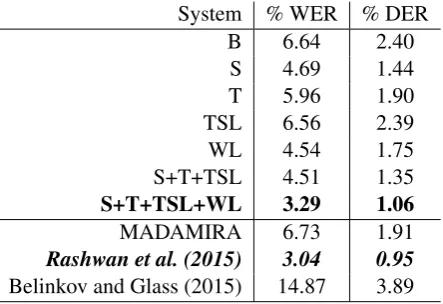
3.3.6 Results
Table 1 shows the results for the baseline sys-tem, the baseline with different back-off schemes, and the baseline with back-off and word look-up. We used the two common evaluation measures, namely error rate at word level (WER) and error rate at character/diacritic level (DER). As the re-sults show, backing-off to using stems and word or stem templates, using automatically diacritized words, and using word look-up all had a posi-tive effect on diacritizing core words. The most improvement was achieved when backing-up to stems and using word look-up. Automatically di-acritized words had a smaller effect than we ex-pected, because foreign named entities frequently use long vowels that are inserted during translit-eration instead of short vowels. For example, “John” is typically transliterated as “jwno” (with the long vowel “w”) rather than “juno”. Combin-ing the different enhancements led to even greater drops of 50% and 56% in WER and DER respec-tively. Compared to systems in the literature, our core word diacritizer is far ahead of MADAMIRA and that of (Belinkov and Glass, 2015). How-ever, we lag behind the system of Rashwan et al. (2015). When score the output of different sys-tems, we performed some relaxations to account for differences in diacritization conventions. The relaxations involved: removing default diacritics on letters followed by long vowels as in “jwno” where putting the diacritic “u” after “j” would be redundant; assuming that a letter, that is not a long vowel, with no diacritic to be followed by “o”; and removing diacritics from the determiner “Al”.
System % WER % DER
B 6.64 2.40
S 4.69 1.44
T 5.96 1.90
TSL 6.56 2.39
WL 4.54 1.75
S+T+TSL 4.51 1.35
S+T+TSL+WL 3.29 1.06
MADAMIRA 6.73 1.91
[image:6.595.309.531.63.215.2]Rashwan et al. (2015) 3.04 0.95 Belinkov and Glass (2015) 14.87 3.89 Table 1: Core word diacritization results for Base-line (B) and with back-off to Stem (S), Template based diacritization (T), and Transliteration and Sequence Labeling based diacritization (TSL), and Word look-up (WL).
3.4 Recovering Case Endings
Though the case ending of some words or word types might be fixed, such as prepositions and past tense verbs, case ending often depends on the role a word plays in the sentence. Consider the follow-ing examples: “*ahaba muHam∼adN” (Muham-mad went) and “*ahaba >lY muHam∼adK” (he went to Muhammad). The name “muHam∼ad” is assigned the case “N” (nominative) when it is a subject and “K” (genitive) when it is preceded by a preposition “>lY”. Ascertaining case endings for simple prepositional phrases may be easy, how-ever determining if a word is a subject or an ob-ject may be much hard. Though parsing can help determine the role of words in a sentence, it is typ-ically very slow and hence impractical for some real life applications such as TTS.
To determine case endings, we use a linear SVM ranking (SVMrank) model that is trained
on a variety of lexical, morphological, and syn-tactic features. The advantage of an SVMrank
model is that it is very fast, and it has been shown to be accurate for a variety of ranking problems (Joachims, 2006). For training, we use the im-plementation of Joachims (2006) with default pa-rameter values. We also employ heuristics that in-clude/exclude possible/impossible case ending to be considered by the SVMrank model. In the
fol-lowing, we describe our ranking model and how we determine which case endings to consider.
3.4.1 SVMrank Model
We use the Farasa segmenter and POS tagger (Dar-wish and Mubarak, 2016) to determine some of the morphological, lexical, and syntactic features. To help explain the features, we use here the running example “jrY Abn AljyrAn fy AlmlEb” (the neighbors’ son ran in the playground), where we will focus on assigning the case ending C of the word “AljyrAn” (the neighbors), which is segmented as “Al+jyrAn” and POS tagged as “DET+NOUNmasculine,plural” by Farasa. All
fea-ture values are computed on our training corpus. Position “0” is the current position, with “1” and “-1” being the next and previous positions. The features are as follows:
• P(C|word0) and P(C|stem0): this captures
the likelihood that case ending can appear with the current word or stem respectively (ex. P(C|AljyrAn)andP(C|jyrAn)).
• P(C|word−1), P(C|stem−1), P(C|word1),
and P(C|stem1): this captures the context
of the word (ex. P(C|Abn), P(C|Abn), P(C|fy), andP(C|fy)).
• P(C|P OSword0) and P(C|P OSstem0): some
case endings are likely for some POS tags and nearly impossible for others. For example, “DET” precludes tanween {“N”, “K”, “F”} (ex. P(C|P OSDET+NOUN) and
P(C|P OSNOUN))
• P(C|P OSword−1), P(C|P OSstem−1),
P(C|P OSword1), and P(C|P OSstem1):
this captures local contextual information that may help in detecting some syntactic constructs (ex. P(C|P OSDET+NOUN) and
P(C|P OSNOUN))
• p(C|gen/numword0), p(C|gen/numword−1),
andp(C|gen/numword1): gender and number
agreement may indicate dependency within a sentence (ex. p(C|masc pl),p(C|masc sing), andp(C|null)2).
• p(C|prefix0), p(C|P OSprefix0),
p(C|suffix0), and p(C|P OSsuffix0):
prefixes and suffixes may force or preclude certain case endings (ex. p(C|Al),p(C|DET), p(C|null),p(C|null)).
• p(C|stem template0): Some stem templates
favor particular case endings over others. For example, the template “mfAEyl” (as in “msAHyq” (powders)) does not allow tanween (ex.p(C|fElAn)).
2prepositions don’t have a gender or number
• p(C|last letterword0): the last letter in the
word may force or preclude certain case end-ings. For example, “Y” does not accept any di-acritics. For our running example, we compute p(C|n).
• p(C|P OS0, P OSword−1, diacriticword−1):
case endings are affected by the diacritic of the previous word in the case of NOUN-ADJ con-structs (ex.p(C|DET+NOUN, NOUN, u)). • p(C|word, word−1): this helps capture
collo-cations or local constructs such as short prepo-sitional phrases (ex.p(C|AbnAljyrAn)). • p(C|P OS, P OSword−1, P OSword1) and
p(C|P OS, P OSword−1, P OSword−2): this can
help detect local constructs such as NOUN-DET+NOUN which is often an idafa construct (ex. p(C|DET +NOUN, NOUN, P REP)
andp(C|DET+NOUN, NOUN, V)).
3.4.2 Filtering Heuristics
Limiting the possible case endings that the model has to rank can improve accuracy by disallowing bad choices. We applied simple heuristics to limit possible case endings to be scored by SVMRank. Some of these are based on Arabic grammar, and others are purely statistical.
• If a word or stem appears more than 1,000 times in the training corpus, then restrict possible case endings to those seen in the training corpus. Though the threshold would not preclude other cases, it is high enough to make other cases rare. • If the POS of the stem is VERB then restrict to
{a, o, u,∼a,∼u, or null}.
• If stem POS is VERB and VERB is not present tense, then restrict to{a, o,∼a, or null}. • If first suffix is “wn” or “yn” (either plural noun
suffix or plural pronoun), then restrict to{a}. • If first suffix is “An” (dual noun suffix), then
re-strict to{i}.
• If stem POS is NOUN and more than 80% of time the case ending was “o” in the training cor-pus, then restrict to{o}. This is meant to cap-ture foreign named entities, which by the con-vention in the training corpus always get a case ending of “o”.
• If suffix POS is CASE, then restrict to{F,∼F}. • If word contains non-Arabic letters, then restrict
to{null}.
• If the last letter in the stem is a long vowel “A, y, w, or Y”, then restrict to{null}.
• If last letter in the stem is not a long vowel and is not followed by a long vowel, then disallow {null}to insure a case ending is chosen. • If prefix POS has DET, then disallow tanween
{K, N, F,∼K,∼N,∼F}.
• If word or stem POS appeared in training more than 50 times, then restrict case ending to those seen for the POS during training.
• If word or stem template appeared in training, then restrict case ending to those seen for the template during training.
• If stem-template matches “fwAEl, mfAEyl, or mfAEl”, then disallow tanween.
• If a bigram appeared more than 1,000 in training with a single case ending for both words in the bigram, then restrict to the seen case endings. • If the prefix does not have a DET and the
follow-ing word does, then assume an idafa construct and disallow tanween.
• If the word matches “>n,<n, or lkn”, then re-strict case ending to{o} only if followed by a verb, and to{∼a}otherwise.
3.4.3 Results
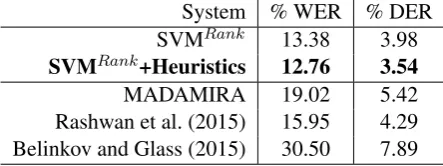
Table 2 shows the results of full diacritization including case ending with and without filtering heuristics. As can be seen, filtering heuristics led to 4.3% and 11.1% relative reduction in word and character error rates respectively. We are doing better than the other three systems. Though the system of Rashwan et al. (2015) was more accu-rate at core-word level, our system was doing a better job in case ending recovery leading to better overall diacritization.
3.5 Error Analysis
For error analysis, we inspected 500 random er-rors from the WikiNews test set. The following are those constituting more than 5% of the errors: 1. Core word diacritization errors: (21%) wrong form – ex. “Eadol” (justice) instead of “Ead∼al” (he adjusted); (8%) out of vocabulary – ex. “Eab∼ady” (Abbady – proper name).
2. Case ending errors: (12%) wrong ADJ-NOUN attachment – ex. “wzArp AlSHp AlSEwdyp”
System % WER % DER SVMRank 13.38 3.98
SVMRank+Heuristics 12.76 3.54
[image:8.595.307.529.64.147.2]MADAMIRA 19.02 5.42 Rashwan et al. (2015) 15.95 4.29 Belinkov and Glass (2015) 30.50 7.89
Table 2: Full word diacritization results of our system using SVMRank only (SVMRank)
and SVMRank after using heuristics to
include/exclude possible/impossible case endings (SVMRank+Heuristics).
(Saudi Health Ministry) where Saudi was attached to health instead of Ministry; (14%) misidentifica-tion of SUBJ or OBJ – ex. OBJ is mistaken for a SUBJ because SUBJ is omitted, or SUBJ ap-pears several words after VERB; (11%) words fol-lowing conjunctions where their dependency is not clear; (7%) appositions; (6%) substitution of tan-ween with kasra or damma with kasra and damma respectively{u↔N, i↔K}; (6%) attachments in NOUN phrases with multiple subsequent nouns; and (5%) the SUBJ of a nominal sentence switches place with the predicate.
3.6 Implementation and Speed
The diacritizer is implemented entirely in Java making it platform independent and is backwards compatible to JDK 1.5. The diacritizer is pack-aged as a single jar file that is 100 megabytes in size. It is able to diacritize a test set composed of 500k words on an Intel i7 laptop with 16 gigabytes of RAM in 3 minutes and 44 seconds (including 42 sec. loading time) with memory footprint of 2.2 gigabytes. The current implementation is sin-gle threaded, so it does not make use of the multi-ple cores. We are providing it for free for research purposes.
4 Conclusion
In this paper we present a new state-of-the-art pub-licly available Arabic diacritizer. It uses a Viterbi decoder for word-level diacritization with back-offs to stems and morphological patterns. It also uses transliteration mining in conjunction with se-quence labeling to diacritize named entities for which we have English transliterations. For case ending, it uses SVMRank coupled with filtering
References
Gheith A Abandah, Alex Graves, Balkees Al-Shagoor, Alaa Arabiyat, Fuad Jamour, and Majid Al-Taee. 2015. Automatic diacritization of arabic text us-ing recurrent neural networks.International Journal on Document Analysis and Recognition (IJDAR), 18(2):183–197.
Aqil M Azmi and Reham S Almajed. 2015. A survey of automatic arabic diacritization techniques. Natu-ral Language Engineering, 21(03):477–495. Mohamed Bebah, Chennoufi Amine, Mazroui
Azzed-dine, and Lakhouaja Abdelhak. 2014. Hybrid ap-proaches for automatic vowelization of arabic texts. arXiv preprint arXiv:1410.2646.
Yonatan Belinkov and James Glass. 2015. Arabic di-acritization with recurrent neural networks. In Pro-ceedings of the 2015 Conference on Empirical Meth-ods in Natural Language Processing, pages 2281– 2285, Lisbon, Portugal.
Tim Buckwalter. 2004. Buckwalter arabic morpho-logical analyzer version 2.0. ldc catalog number ldc2004l02, isbn 1-58563-324-0.
Andy Cole, David Graff, and Kevin Walker. 2001. Arabic newswire part 1 corpus (1-58563-190-6). Linguistic Data Consortium (LDC).
Kareem Darwish and Hamdy Mubarak. 2016. Farasa: A new fast and accurate arabic word segmenter. In Proceedings of the Tenth International Confer-ence on Language Resources and Evaluation (LREC 2016), Paris, France, may. European Language Re-sources Association (ELRA).
Ali El-Kahky, Kareem Darwish, Ahmed Saad Aldein, Mohamed Abd El-Wahab, Ahmed Hefny, and Waleed Ammar. 2011. Improved transliteration mining using graph reinforcement. InProceedings of the Conference on Empirical Methods in Natural Language Processing, pages 1384–1393.
Ya’akov Gal. 2002. An hmm approach to vowel restoration in arabic and hebrew. InProceedings of the ACL-02 workshop on Computational approaches to Semitic languages, pages 1–7. Association for Computational Linguistics.
Nizar Habash and Owen Rambow. 2007. Arabic di-acritization through full morphological tagging. In Human Language Technologies 2007: The Confer-ence of the North American Chapter of the Asso-ciation for Computational Linguistics; Companion Volume, Short Papers, pages 53–56. Association for Computational Linguistics.
Nizar Habash, Owen Rambow, and Ryan Roth. 2009. Mada+ tokan: A toolkit for arabic tokenization, dia-critization, morphological disambiguation, pos tag-ging, stemming and lemmatization. InProceedings of the 2nd International Conference on Arabic Lan-guage Resources and Tools (MEDAR), Cairo, Egypt, pages 102–109.
Thorsten Joachims. 2006. Training linear svms in lin-ear time. InACM SIGKDD-2006, pages 217–226. ACM.
Philipp Koehn, Hieu Hoang, Alexandra Birch, Chris Callison-Burch, Marcello Federico, Nicola Bertoldi, Brooke Cowan, Wade Shen, Christine Moran, Richard Zens, et al. 2007. Moses: Open source toolkit for statistical machine translation. In Pro-ceedings of the 45th annual meeting of the ACL on interactive poster and demonstration sessions, pages 177–180. Association for Computational Linguis-tics.
Taku Kudo. 2005. Crf++: Yet another crf toolkit. Soft-ware available at http://crfpp. sourceforge. net. Bebah Mohamed Ould Abdallahi Ould,
Abde-louafi Meziane, Azzeddine Mazroui, and Abdelhak Lakhouaja. 2011. Alkhalil morphosys. In7th In-ternational Computing Conference in Arabic, pages 66–73, Riyadh, Saudi Arabia.
Rani Nelken and Stuart M Shieber. 2005. Arabic di-acritization using weighted finite-state transducers. In Proceedings of the ACL Workshop on Computa-tional Approaches to Semitic Languages, pages 79– 86. Association for Computational Linguistics. Arfath Pasha, Mohamed Al-Badrashiny, Mona Diab,
Ahmed El Kholy, Ramy Eskander, Nizar Habash, Manoj Pooleery, Owen Rambow, and Ryan M Roth. 2014. Madamira: A fast, comprehensive tool for morphological analysis and disambiguation of ara-bic. InLREC-2014, Reykjavik, Iceland.
Mohsen Rashwan, Mohammad Al-Badrashiny, Mo-hamed Attia, and Sherif Abdou. 2009. A hybrid system for automatic arabic diacritization. In The 2nd International Conference on Arabic Language Resources and Tools, pages 54–60.
Mohsen Rashwan, Ahmad Al Sallab, M. Raafat, and Ahmed Rafea. 2015. Deep learning framework with confused sub-set resolution architecture for au-tomatic arabic diacritization. InIEEE Transactions on Audio, Speech, and Language Processing, pages 505–516.
Dimitra Vergyri and Katrin Kirchhoff. 2004. Au-tomatic diacritization of arabic for acoustic mod-eling in speech recognition. In Proceedings of the workshop on computational approaches to Ara-bic script-based languages, COLING’04, pages 66– 73, Geneva, Switzerland. Association for Computa-tional Linguistics.