Understanding Satirical Articles Using Common-Sense
Dan Goldwasser Purdue University
Department of Computer Science [email protected]
Xiao Zhang Purdue University
Department of Computer Science [email protected]
Abstract
Automatic satire detection is a subtle text clas-sification task, for machines and at times, even for humans. In this paper we argue that satire detection should be approached using common-sense inferences, rather than tradi-tional text classification methods. We present a highly structured latent variable model cap-turing the required inferences. The model ab-stracts over the specific entities appearing in the articles, grouping them into generalized categories, thus allowing the model to adapt to previously unseen situations.
1 Introduction
Satire is a writing technique for passing criticism using humor, irony or exaggeration. It is often used in contemporary politics to ridicule individual politicians, political parties or society as a whole. We restrict ourselves in this paper to such politi-cal satire articles, broadly defined as articles whose purpose is not to report real events, but rather to mock their subject matter. Satirical writing often builds on real facts and expectations, pushed to ab-surdity to express humorous insights about the situ-ation. As a result, the difference between real and satirical articles can be subtle and often confusing to readers. With the recent rise of social media outlets, satirical articles have become increasingly popular and have famously fooled several leading news agencies1. These misinterpretations can often
1https://newrepublic.com/article/118013/
satire-news-websites-are-cashing-gullible-outraged-readers
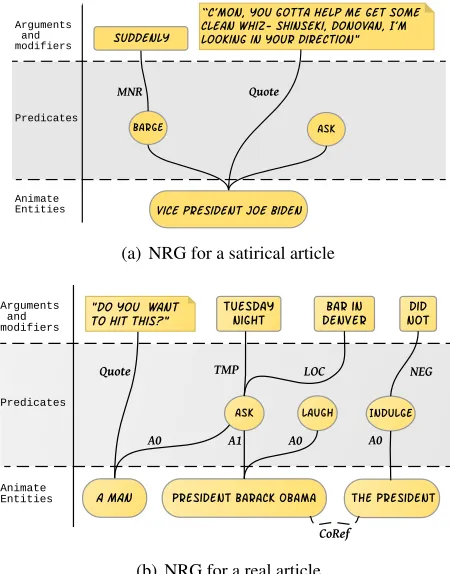
Vice President Joe Biden suddenly barged in, asking if anyone could “hook [him] up with a Dixie cup” of their urine. “C’mon, you gotta help me get some clean whiz. Shinseki, Donovan, I’m looking in your direction” said Biden.
“Do you want to hit this?” a man asked President Barack Obama in a bar in Denver Tuesday night. The president laughed but didn’t indulge. It wasn’t the only time Obama was offered weed on his night out.
Figure 1:Examples of real and satirical articles. Top:
satirical news excerpt.Bottom:real news excerpt.
be attributed to careless reading, as there is a clear line between unusual events finding their way to the news and satire, which intentionally places key po-litical figures in unlikely humorous scenarios. The two can be separated by carefully reading the arti-cles, exposing the satirical nature of the events de-scribed in such articles.
In this paper we follow this intuition. We look into the satire detection task (Burfoot and Bald-win, 2009), predicting if a given news article is real or satirical, and suggest that this prediction task should be defined over common-sense inferences, rather than looking at it as a lexical text classifica-tion task (Pang and Lee, 2008; Burfoot and Bald-win, 2009), which bases the decision on word-level features.
To further motivate this observation, consider the two excerpts in Figure 1. Both excerpts mention top-ranking politicians (the President and Vice Pres-ident) in a drug-related context, and contain infor-mal slang utterances, inappropriate for the subjects’
537
position. The difference between the two examples is apparent when analyzing the situation described in the two articles: The first example (top), de-scribes the Vice President speaking inappropriately in a work setting, clearly an unrealistic situation. In the second (bottom) the President isspoken to inap-propriately, an unlikely, yet not unrealistic, situation. From the perspective of our prediction task, it is ad-visable to base the prediction on a structured repre-sentation capturing the events and their participants, described in the text.
The absurdity of the situation described in satir-ical articles is often not unique to the specific in-dividuals appearing in the narrative. In our exam-ple, both politicians are interchangeable: placing the president in the situation described in the first ex-cerpt would not make it less absurd. It is therefore desirable to make a common-sense inference about high-ranking politicians in this scenario.
We follow these intuitions and suggest a novel
approach for the satire prediction task. Our
model, COMSENSE, makes predictions by making common-sense inferences over a simplified narra-tive representation. Similarly to prior work (Cham-bers and Jurafsky, 2008; Goyal et al., 2010; Wang and McAllester, 2015) we represent the narrative structure by capturing the main entities (and tracking their mentions throughout the text), their activities, and their utterances. The result of this process is a Narrative Representation Graph (NRG). Figure 2 de-picts examples of this representation for the excerpts in Figure 1.
Given an NRG, our model makes inferences quantifying how likely are each of the represented events and interactions to appear in a real, or satiri-cal context. Annotating the NRG for such inferences is a challenging task, as the space of possible situa-tions is extremely large. Instead, we frame the re-quired inferences as a highly-structured latent vari-able model, trained discriminatively as part of the prediction task. Without explicit supervision, the model assigns categories to the NRG vertices (for example, by grouping politicians into a single cate-gory, or by grouping inappropriate slang utterances, regardless of specific word choice). These category assignments form the infrastructure for higher-level reasoning, as they allows the model to identify the commonalities between unrelated people, their
ac-tions and their words. The model learns common-sense patterns leading to real or satirical decisions based on these categories. We express these pat-terns as parametrized rules (acting as global fea-tures in the prediction model), and base the predic-tion on their activapredic-tion values. In our example, these rules can capture the combination of (EP olitician)∧
(Qslang)→ Satire, where EP olitician and Qslang are
latent variable assignments to entity and utterance categories respectively.
Our experiments look into two variants of satire prediction: using full articles, and the more chal-lenging sub-task of predicting if a quote is real given its speaker. We use two datasets collected 6 years apart. The first collected in 2009 (Burfoot and Bald-win, 2009) and an additional dataset collected re-cently. Since satirical articles tend to focus on cur-rent events, the two datasets describe diffecur-rent peo-ple and world events. To demonstrate the robust-ness of our COMSENSE approach we use the first dataset for training, and the second as out-of-domain test data. We compare COMSENSE to several com-peting systems including a state-of-the-art Convo-lutional Neural Network (Kim, 2014). Our experi-ments show that COMSENSE outperforms all other models. Most interestingly, it does so with a larger margin when tested over the out-of-domain dataset, demonstrating that it is more resistant to overfitting compared to other models.
2 Related Work
authors also experiment with semantic validity fea-tures which pair entities mentioned in the article, thus capturing combinations unlikely to appear in a real context. This paper follows a similar intuition; however, it looks into structured representations of this information, and studies their advantages.
Our structured representation is related to several recent reading comprehension tasks (Richardson et al., 2013; Berant et al., 2014) and work on narrative representation such, as event-chains (Chambers and Jurafsky, 2009; Chambers and Jurafsky, 2008), plot-units (Goyal et al., 2010; Lehnert, 1981) and Story Intention Graphs (Elson, 2012). Unlike these works, narrative representation is not the focus of this work, but rather provides the basis for making inferences, and as result we choose a simpler (and more ro-bust) representation, most closely resembling event chains (Chambers and Jurafsky, 2008)
Making common-sense inferences is one of the core missions of AI, applicable to a wide range of tasks. Early work (Reiter, 1980; McCarthy, 1980; Hobbs et al., 1988) focused on logical inference, and manual construction of such knowledge repos-itories (Lenat, 1995; Liu and Singh, 2004). More recently, several researchers have looked into au-tomatic common-sense knowledge construction and expansion using common-sense inferences (Tandon et al., 2011; Bordes et al., 2011; Socher et al., 2013; Angeli and Manning, 2014). Several works have looked into combining NLP with common-sense (Gerber et al., 2010; Gordon et al., 2011; LoBue and Yates, 2011; Labutov and Lipson, 2012; Gordon et al., 2012). Most relevant to our work is a SemEval-2012 task (Gordon et al., 2012), looking into common-sense causality identification predic-tion.
In this work we focus on a different task, satire detection in news articles. We argue that this task is inherently a common-sense reasoning task, as iden-tifying the satirical aspects in narrative text does not require any specialized training, but instead relies heavily on common expectations of normative be-havior and deviation from it in satirical text. We design our model to capture these behavioral expec-tations using (weighted) rules, instead of relying on lexical features as is often the case in text categoriza-tion tasks. Other common-sense frameworks typi-cally build on existing knowledge bases
represent-?C?mon, you got t a hel p me get some cl ean whiz- Shinseki, Donovan, I?m l ooking in your dir ect ion"
MNR
Ar gument s and modi f i er s
Pr edi c at es
Ani mat e Ent i t i es
bar ge Suddenl y
Quote
Ask
Vice Pr esident Joe Biden
(a) NRG for a satirical article
TMP Quote
Ask
a man "Do you want t o hit t his?"
Tuesday Night
Bar in Denver
Did Not
Pr esident Bar ack Obama The Pr esident
CoRef
Ar gument s and modi f i er s
Pr edi c at es
Ani mat e Ent i t i es
LOC
Laugh
A0 A1 A0
Indul ge
A0 NEG
[image:3.612.316.541.62.349.2](b) NRG for a real article
Figure 2:Narrative Representation Graph (NRG) for two article snippets
ing world knowledge; however, specifying in ad-vance the behaviors commonly associated with peo-ple based on their background and situational con-text, to the extent it can provide good coverage for our task, requires considerable effort. Instead, we suggest to learn this information from data directly, and our model learns jointly to predict and represent the satirical elements of the article.
3 Modeling
Given a news article, our COMSENSE system
decomposing it into paths, where each path captures a partial view of the abstract NRG. Finally we asso-ciate the paths with the satire decision output. The COMSENSE model then solves a global inference problem, formulated as an Integer Linear Program (ILP) instance, looking for the most likely explana-tion of the satire predicexplana-tion output, consistent with the extracted patterns. We explain this process in detail in Section 3.2.
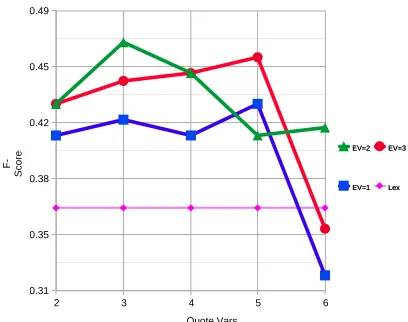
NRG Abstraction as Common-Sense The main goal of the COMSENSE approach is to move away from purely lexical models, and instead base its de-cisions on common-sense inferences. We formulate these inferences as parameterized rules, mapping el-ements of the narrative, represented using the NRG, to a classification decision. The rules’ ability to cap-ture common-sense inferences hinges on two key el-ements. First, the abstraction of NRG nodes into typed narrative elements allows the model to find commonalities across entities and their actions. This is done by associating each NRG node with a set of latent variables. Second, constructing the decision rules according to the structure of the NRG graph allows us to model the dependencies between narra-tive elements. This is done by following the paths in the abstract NRG, generating rules by combining the latent variables representing nodes on the path, and associating them with a satire decision variable. Computational Considerations When setting up the learning system, there is a clear expressiv-ity/efficiency tradeoff over these two elements. In-creasing the number of latent variables associated with each NRG node would allow the model to learn a more nuanced representation. Similarly, gener-ating rules by following longer NRG paths would allow the model to condition its satire decision on multiple entities and events jointly. The added expressivity does not come without price. Given the limited supervision afforded to the model when learning these rules, additional expressivity would result in a more difficult learning problem which could lead to overfitting. Our experiments demon-strate this tradeoff, and in Figure 4 we show the ef-fect of increasing the number of latent variables on performance. An additional concern with increas-ing the model’s expressivity is computational effi-ciency. Satire prediction is formulated as an ILP
inference process jointly assigning values to the la-tent variables and making the satire decision. Since ILP is exponential in the number of variables, in-creasing the number of latent variables would be computationally challenging. In this paper we take a straight-forward approach to ensuring computa-tional tractability by limiting the length of NRG paths considered by our model to a constant size
c=2. Assuming that we havemlatent categories as-sociated with each node, each path would generate
mcILP variables (see Section 3.3 for details), hence
the importance of limiting the length of the path. In the future we intend to study approximate inference methods that can help alleviate this computational difficultly, such as using LP-approximation (Martins et al., 2009).
3.1 Narrative Representation Graph for News Articles
The Narrative Representation Graph (NRG) is a sim-ple graph-based representation for narrative text, de-scribing the connections between entities and their actions. The key motivation behind NRG was to pro-vide the structure necessary for making inferences, and as a result we chose a simple representation that does not take into account cross-event relationships, and nuanced differences between some of the event argument types. While other representations (Mani, 2012; Goyal et al., 2010; Elson, 2012) capture more information, they are harder to construct and more prone to error. We will look into adapting these models for our purpose in future work.
Since satirical articles tend to focus on political figures, we design the NRG around animate entities that drive the events described in the text, their ac-tions (represented as predicate nodes), their contex-tualizing information (location-modifiers, temporal modifiers, negations), and their utterances. We omit-ted from the graph other non-animate entity types. In Figure 2 we show an example of this representa-tion.
utterances to their speaker based on a previously published rule based system (O’Keefe et al., 2012).
Formally, we construct a graph G = {V, E},
where V consists of three types of vertices: AN -IMATE ENTITY (e.g., people), PREDICATE (e.g., actions) and ARGUMENT (e.g., utterances, loca-tions). The edges E capture the relationships
be-tween vertices. The graph contains several different edges. COREF edges collapse the mentions of the same entity into a single entity, ARGUMENT-TYPE edges connect ANIMATE ENTITY nodes to PRED -ICATE nodes2, and PREDICATE nodes to argument nodes (modifiers). Finally we add QUOTE edges connecting ANIMATE ENTITY nodes to utterances (ARGUMENT).
3.2 Satire Prediction using the Narrative Representation Graph
Satire prediction is inherently a text classification problem. Such problems are often approached us-ing a Bag-of-Words (BoW) model which ignores the document structure when making predictions. In-stead, the NRG provides a structured representation for making the satire prediction. We begin by show-ing how the NRG can be used directly and then dis-cuss how to enhance it by mapping the graph into abstract categories.
Directly Using NRG for Satire Prediction We suggest a simple approach for extracting features di-rectly from the NRG, by decomposing it into graph paths,without mapping the graph into abstract cat-egories. This simple, word-based representation for prediction structured according to the NRG (denoted NARRLEX), generates features by using the words in the original document, corresponding to the graph decomposition. For example, consider the path con-necting “a man” to an utterance in Figure 2(b). Sim-ple features could associate the utterances words with that entity, rather than with the President. The resulting NARRLEXmodel generates Bag-of-Words features based on words corresponding to NRG path vertices, conditioned on their connected entity ver-tex.
Using Common-Sense for Satire Prediction Un-like the NARRLEX model, which relies on directly
2These edges are typed according to their semantic roles.
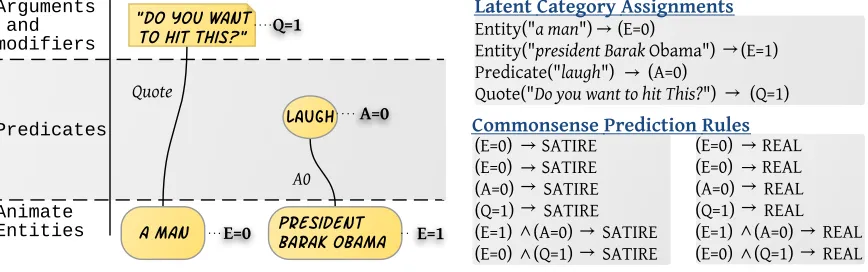
observed information, our COMSENSE model per-forms inference over higher level patterns. In this model the prediction is a global inference process, taking into account the relationships between NRG elements (and their abstraction into categories) and the final prediction. This process is described in Fig-ure 3.
First, the model associates a high level category, that can be reused even when other, previously un-seen, entities are discussed in the text. We associate a set of Boolean variables with each NRG vertex, capturing higher level abstraction over this node.
We define three types of categories correspond-ing to the three types of vertices, and denote them
E, A, Q for Entity category, Action category and
Quote category, respectively. Each category vari-able can take k different values. As a convention
we denote X = i as category assignment, where
X ∈ {E, A, Q}is the category type, andiis its as-signment. Since these category assignments are not directly observed, they are treated as latent variables in our model. This process is exemplified at the top right corner of Figure 3.
Combinations of category assignments form terns used for determining the prediction. These pat-terns can be viewed as parameterized rules. Each weighted rule associates a combination with an out-put variable (SATIRE or REAL). Examples of such rules are provided in the middle of the right corner of Figure 3. We formulate the activations of these rules as Boolean variables, whose assignments are highly interconnected. For example, the variables representing the following rules (E = 0)→ SATIRE and (E = 0)→REALare mutually exclusive, since assigning a T value to either one entails a satire (or real) prediction. To account for this interdepen-dency, we add constraints capturing the relations be-tween rules.
"do you want t o hit t his?"
Quote
A0
a man Pr esident Bar ak Obama
Laugh Ar gument s
and modi f i er s
Pr edi c at es
Ani mat e
Ent i t i es E=1
Q=1
A=0
E=0
Commonsense Pr ediction Rules Latent Categor y Assignments
Entity("a man") (E=0)
Entity("president Barak Obama") (E=1) Predicate("laugh") (A=0)
Quote("Do you want to hit This?") (Q=1)
(E=0) SATIRE (E=0) SATIRE (A=0) SATIRE (Q=1) SATIRE (E=1) (A=0) SATIRE (E=0) (Q=1) SATIRE
[image:6.612.80.514.59.195.2](E=0) REAL (E=0) REAL (A=0) REAL (Q=1) REAL (E=1) (A=0) REAL (E=0) (Q=1) REAL
Figure 3:Extracting Common-sense prediction rules.
3.3 Identifying Relevant Interactions using Constrained Optimization
We formulate the decision as a 0-1 Integer Linear Programming problem, consisting of three types of Boolean variables: category assignments indicator variables, indicator variables for common-sense pat-terns, and finally the output decision variables. Each indicator variable is also represented using a feature set, used to score its activation.
3.3.1 Category Assignment Variables
Each node in the NRG is assigned a set of com-peting variables, mapping the node to different cate-gories according to its type.
• ANIMATE ENTITY Category Variables,
de-noted hi,j,E, indicating the Entity category ifor
NRG vertexj.
• ACTIONCategory Variables, denotedhi,j,A,
in-dicating the Action categoryifor NRG vertexj. • QUOTE Category Variables, denoted hi,j,Q,
in-dicating the Quote categoryifor NRG vertexj. The number of possible categories for each vari-able type is a hyper-parameter of the model. Variable activation constraints Category as-signments to the same node are mutually exclusive (a node can only have a single category). We encode this fact by constraining the decision with a linear constraint (where X∈ {E, A, Q}):
∀jX i
hi,j,X = 1.
Category Assignment Features Each deci-sion variable decomposes into a set of features,
φ(x, hi,j,X)capturing the words associated with the j-th vertex, conditioned on X andi.
3.3.2 Common-sense Patterns Variables
We represent common-sense prediction rules us-ing an additional set of Boolean variables, connect-ing the category assignments variables with the out-put prediction. The space of possible variables is determined by decomposing the NRG into paths of size up to 2, and associating two Boolean variables with category assignment variables corresponding to the vertices on these paths. One of the variables as-sociates the sequence of category assignment vari-ables with a REAL output value, and one with a SATIREoutput value.
• Single Vertex Path Patterns Variables, denoted byhB
hi,j,X, indicating that the category assignment
captured byhi,j,X is associated with output value
B (where B∈ {SATIRE, REAL}).
• Two Vertex Path Patterns Variables, denoted by
hB
(hi,j,X1),(hk,l,X2), indicating that the pattern
cap-tured by category assignment along the NRG path of hi,j,X1 and hi,j,X2 is associated with output
value B (where B∈ {SATIRE, REAL}).
(hBhi,j,X) =⇒ (hi,j,X).
Features Similar to the category assignment variable features, each decision variable decom-poses into a set of features,φ(x, hBhi,j,X). These
fea-tures capfea-tures the words associated with each of the category assignment variables (in this example, the words associated with the j-th vertex) conditioned on the category assignments and the output predic-tion value (in this example,X, iandB). We also add a featureφ(hi,j,X, B) capturing the connection
be-tween the output value B, and category assignment. 3.3.3 Satire Prediction Variables
Finally, we add two more Boolean variables cor-responding to the output prediction: hSatire and hReal. The activation of these two variables is
mu-tually exclusive, we encode that by adding the con-straint:
hSatire+hReal = 1.
We ensure the consistency of our model adding constraints forcing agreement between the final pre-diction variables, and the common-sense patterns variables:
hBhi,j,X =⇒ hB.
Overall Optimization Function
The Boolean variables described in the previous section define a space of competing inferences. We find the optimal output value derivation by finding the optimal set of variables assignments, by solving the following objective:
max
y,h
P
i
hiwTφ(x, hi, y)
s.t. C, ∀i;hi ∈ {0,1}, (1)
where hi ∈ H is the set of all variables defined
above and C is the set of constraints defined over
the activation of these variables. w is the weight
vector, used to quantify the feature representation of eachh, obtained using a feature functionφ(·).
Note that the Boolean variable acts as a 0-1 indi-cator variable. We formalize Eq. (1) as an ILP in-stance, which we solve using the highly optimized Gurobi toolkit3.
3http://www.gurobi.com/
4 Parameter Estimation for COMSENSE
The COMSENSE approach models the decision as interactions between high-level categories of enti-ties, actions and utterances. However, the high level categories assigned to the NRG vertices are not ob-served, and as a result we view it as a weakly super-vised learning problem, where the category assign-ments correspond to latent variable assignassign-ments. We learn the parameters of these assignments by using a discriminative latent structure learning framework.
The training data is a collection
D ={(xi, yi)}n
i=1, where xi is an article, parsed
into an NRG representation, andyis a binary label,
indicating if the article is satirical or real.
Given this data we estimate the models’ parame-ters by minimizing the following objective function.
LD(w) = min w
λ
2||w||
2+ 1 n
n
X
i=1
ξi (2)
ξi is the slack variable, capturing the margin
vio-lation penalty for a given training example, and de-fined as follows:
ξi= max
y,h f(x,h, y,w) +cost(y, yi)
−max
h f(x,h, yi,w),
wheref(·)is a scoring function, similar to the one used in Eq. 1. The cost function is the margin that the true prediction must exceed over the competing label, and it is simply defined as the difference be-tween the model prediction and the gold label. This formulation is an extension of the hinge loss for la-tent structure SVM.λis the regularization parame-ter controlling the tradeoff between thel2regularizer
and the slack penalty.
We optimize this objective using the stochastic sub-gradient descent algorithm (Ratliff et al., 2007; Felzenszwalb et al., 2009). We can compute the sub-gradient as follows:
∇LD(w) =λw+ n
X
i=1
Φ(xi, yi, y∗)
Φ(xi, yi, y∗) =φ(xi,h∗, yi)−φ(xi,h∗, y∗),
whereφ(xi,h∗, y∗) is the set of features
making a prediction. φ(xi,h∗, yi) is the set of
fea-tures representing the solution obtained by solving Eq. 1 while fixing the outcome of the inference pro-cess to the correct prediction (i.e.,yi). Intuitively, it
can be considered as finding the best explanation for the correct label using the latent variablesh.
In the stochastic version of the sub gradient de-scent algorithm we approximate∇LD(w)by
com-puting the sub gradient of a single example and mak-ing a local update. This version resembles the latent-structure perceptron algorithm (Sun et al., 2009). We repeatedly iterate over the training examples and for each example, if the currentwleads to a correct
prediction (and satisfies the margin constraint), we only shrinkwaccording toλ. If the model makes an incorrect prediction, the model is updated according
Φ(xi, yi, y∗). The optimization objectiveLD(W)is
not convex, and the optimization procedure is guar-anteed to converge to a local minimum.
5 Empirical Study
We design our experimental evaluation to help clar-ify several questions. First, we want to understand how our model compares with traditional text classi-fication models. We hypothesize that these methods are more susceptible to overfitting, and design our experiments accordingly. We compare the models’ performance when using in-domain data (test and training data are from the same source), and out-of-domain data, where the test data is collected from a different source. We look into two tasks. One is the Satire detection task (Burfoot and Baldwin, 2009). We also introduce a new task, called “did I say that?” which only focuses on utterances and speakers.
The second aspect of our evaluation focuses on the common-sense inferences learned by our model. We examine how the size of the set of categories impacts the model performance. We also provide a qualitative analysis of the learned categories us-ing a heat map, capturus-ing the activation strength of learned inferences over the training data.
Prediction tasks We look into two prediction tasks: (1) Satire Detection (denoted SD), a binary classification task, in which the model has access to the complete article (2) “Did I say that?” (denoted DIST), a binary classification task, consisting only
of entities mentions (and their surrounding context in text) and direct quotes. The goal of the DIST is to predict if a given utterance is likely to be real, given its speaker. Since not all document contain di-rect quotes, we only use a subset of the documents in the SD task.
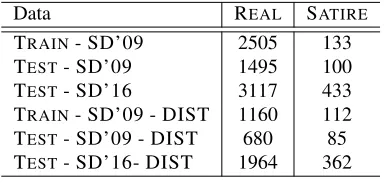
Datasets In both prediction tasks we look into two settings: (1) In-domain prediction: where the training and test data are collected from the same source, and (2) out-of-domain prediction, where the test data is collected from a different source. We use the data collected by Burfoot and Baldwin (2009) for training the model in both settings, and its test data for in-domain prediction (denotedTRAIN - SD’09, TEST - SD’09, TRAIN - SD’09 - DIST, TEST -SD’09 - DIST, respectively for training and testing in the SD and DIST tasks). In addition, we collected a second dataset of satirical and real articles (de-noted SD’16). This collection of articles contains real articles fromcnn.comand satirical articles from theonion.com, a well known satirical news website. The articles were published between 2010 to 2015, appearing in the political sections of both news web-sites. Following other work in the field, all datasets are highly skewed toward the negative class (real ar-ticles), as it better characterizes a realistic prediction scenario. The statistics of the datasets are summa-rized in Table 2.
Evaluated Systems We compare several systems, as follows:
System
ALLPOS Always predict Satire
BB’09 Results by (Burfoot and Baldwin, 2009) CONV Convolutional NN. We followed (Kim,
2014), using pre-trained 300-dimensional word vectors (Mikolov et al., 2013). LEX SVM with unigram (LEXU) or both
uni-gram and biuni-gram (LEXU+B) features
NARRLEX SVM with direct NRG-based features (see Sec 3.2)
COMSENSE Our model. We denote the full model as COMSENSEF, and COMSENSEQwhen
us-ing only the entity+quotes based patterns.
model was retrained using the entire dataset. We used SVM-light5 to train our lexical baseline
sys-tems (LEXand NARRLEX). Since the data is highly skewed towards the negative class (REAL), we ad-just the learner objective function cost factor for pos-itive examples to outweigh negative examples. The cost factor was tuned using the validation set. 5.1 Experimental Results
Since our goal is to identify satirical articles, given significantly more real articles, we report the F-measure of the positive class. The results are sum-marized in Tables 1 and 3. We can see that in all cases the COMSENSEmodel obtains the best results. We note that in both tasks, when learning in the out-of-domain settings performance drops sharply, how-ever the gap between the COMSENSE model and other models increases in these settings, showing that it is less prone to overfitting.
Interestingly, for the satire detection (SD) task, the COMSENSEQ model performs best for the
in-domain setting, and COMSENSEF gives the best
per-formance in the out-of-domain settings. We hypoth-esize that this is due to a phenomenon we call “over-fitting to document structure”. Lexical models tend to base the decision on word choices specific to the training data, and as a result when tested on out of domain data, which describes new events and enti-ties, performance drops sharply. Instead, the COM -SENSEQmodel focuses on properties of quotations
and entities appearing in the text. In the SD’09 datasets, this information helps focus the learner, as the real and satire articles are structured differ-ently (for example, satire articles frequdiffer-ently contain multiple quotes). This structure is not maintained when working with out-of-domain data, and indeed in these settings the model benefits from using addi-tional information offered by the full model. Number of Latent Categories Our COM
-SENSE model is parametrized with the number
of latent categories it considers for each entity, predicate and quote. This hyper-parameter can have a strong influence on the model performance (and running time). Increasing it adds to the model’s expressivity allowing it to learn more complex patterns, but also defines a more complex learning
5http://svmlight.joachims.org/
0.31 0.35 0.38 0.42 0.45 0.49
2 3 4 5 6
EV=2 EV=2 EV=3EV=3
EV=1 EV=1 LexLex
Quote Vars
[image:9.612.321.525.56.217.2]
F-Score
Figure 4: Different Number of Latent Categories. EV de-notes the number entity categories used, and QuoteVars dede-notes the number of quote categories used.
problem (recall our non-convex learning objective function). We focused on the DIST task when evaluating different configurations as it converged much faster than the full model. Figure 4 plots the model behavior when using different numbers of latent categories. Interestingly, the number of entity categories saturates faster than the number of quote categories. This can be attributed to the limited text describing entities.
Visualizing Latent COMSENSE Patterns Given
the assignment to latent categories, our model learns common-sense patterns for identifying satirical and real articles based on these categories. Ideally, these patterns could be extracted directly from the data, however providing the resources for this additional prediction task is not straightforward. Instead, we view the category assignment as latent variables, which raises the question -what are the categories learned by the model?
com-Task:SD INPDOMAINR(SD’09+SD’09)F OUTP DOMAINR (SD’09+SD’16)F
ALLPOS 0.063 1 0.118 0.121 1 0.214
BB’09 0.945 0.690 0.798 - -
-CONV 0.822 0.531 0.614 0.517 0.310 0.452
LEXU 0.920 0.690 0.790 0.298 0.579 0.394
LEXU+B 0.840 0.720 0.775 0.347 0.367 0.356
NARRLEX 0.690 0.590 0.630 0.271 0.425 0.330 COMSENSEQ 0.839 0.780 0.808 0.317 0.706 0.438
[image:10.612.145.467.53.166.2]COMSENSEF 0.853 0.70 0.770 0.386 0.693 0.496
Table 1:Results for the SD task
E0, Q0 E0, Q1 E0, Q2 E1, Q0 E1, Q1 E1, Q2 E0, Q0 E0, Q1 E0, Q2 E1, Q0 E1, Q1 E1, Q2 Satire Rule Rule
Real Activation Activation
Quote Topics Activation Entity Topics Activation
Satire Profanity President Real
Satire Drugs Liberal Real
Satire Polite
Conserva-Real tive
Satire Science
Annony-Real mous
Satire Legal Politics Real
Satire Politics Speaker Real
[image:10.612.101.515.67.378.2]Satire Contro- Law Enfo-Real versy rcement
Figure 5: Visualization of the categories learned by the models. Color coding capture the activation strength of manually constructed topical word groups, according to each latent category. Darker colors indicate higher values. Ei (Qi), indicates an
entity (Quote) variable assigned thei-th category.
Data REAL SATIRE
TRAIN- SD’09 2505 133
TEST- SD’09 1495 100
TEST- SD’16 3117 433
TRAIN- SD’09 - DIST 1160 112
TEST- SD’09 - DIST 680 85
TEST- SD’16- DIST 1964 362
Table 2:Datasets statistics.
binations when making predictions over the train-ing data. Darker colors correspond to larger values, which were computed as:
cell(CE, CQ, B) =
P
j hB(h
CE ,j,E),(hCQ,j,Q)
P
j,k,l hB
(hk,j,E),(hl,j,Q)
Intuitively, each cell value in Figure 5 is the number of times each category pattern appeared in REALor
SATIREoutput predictions, normalized by the over-all number of pattern activations for each output.
We assume that different patterns will be associ-ated with satirical and real articles, and indeed we can see that most entities and quotes appearing in REALarticles fall into a distinctive category pattern,
E0, Q0. Interestingly, there is some overlap between
the two predictions in the most active SATIRE cate-gory (E1, Q0). We hypothesize that this is due to the
[image:10.612.90.282.447.539.2]Task:DIST INPDOMAINR(DIST’09+DIST’09)F OUTP DOMAINR (DIST’09+DIST’16)F
ALLPOS 0.110 1 0.198 0.155 1 0.268
LEXU 0.837 0.423 0.561 0.407 0.328 0.363
[image:11.612.128.489.55.115.2]COMSENSEQ 0.712 0.553 0.622 0.404 0.561 0.469
Table 3:Results for the DIST task
For example, the entity topic PRESIDENTwas asso-ciated with words such aspresident, vice-president, Obama, Biden, Bush, Clinton. Similarly, we associ-ated with the quote topic PROFANITY a list of pro-fanity words. We associate 7 types with quote cate-gories corresponding to style and topic, namelyPRO -FANITY, DRUGS, POLITENESS, SCIENCE, LEGAL, POLITICS, CONTROVERSY, and another set of seven types with entity types, namely PRESIDENT, LIBERAL, CONSERVA -TIVE, ANONYMOUS, POLITICS, SPEAKER, LAWENFORCE -MENT.
In the bottom left part of Figure 5 (in blue), we show the activation strength of each category with respect to the set of selected quote topics. Intu-itively, we count the number of times the words as-sociated with a given topic appeared in the text span corresponding to a category assignment pair, sepa-rately for each output prediction. We normalize this value by the total number of topic word occurrences, over all category assignment pairs. Note that we only look at the text span corresponding to quote vertices in the NRG. We provide a similar analysis for entity categories in the bottom right part of Fig-ure 5 (in green). We show the activation strength of each category with respect to the set of selected entity topic words. As can be expected, we can see that profanity words are only associated with satir-ical categories, and even more interestingly, when words appear in both satirical and real predictions, they tend to fall into different categories. For ex-ample, the topic words related to DRUGS can ap-pear both in real articles discussing alcohol and drug policies. But topic words related to drugs also ap-pear in satirical articles portraying politicians using these substances. While these are only qualitative results, we believe they provide strong intuitions for future work, especially considering the fact that the activation values do not rely on direct supervision, and only reflect the common-sense patterns emerg-ing from the learned model.
6 Summary and Future Work
In this paper we presented a latent variable model for satire detection. We followed the observation that satire detection is inherently a semantic task and modeled the common-sense inferences required for it using a latent variable framework.
We designed our experiments specifically to ex-amine if our model can generalize better than un-structured lexical models by testing it on out-of-domain data. Our experiments show that in these challenging settings, the performance gap between our approach and the unstructured models increases, demonstrating the effectiveness of our approach.
In this paper we restricted ourselves to limited narrative representation. In the future we intend to study how to extend this representation to capture more nuanced information.
Learning common-sense representation for pre-diction problems has considerable potential for NLP applications. As the NLP community considers in-creasingly challenging tasks focusing on semantic and pragmatic aspects, the importance of finding such common-sense representation will increase. In this paper we demonstrated the potential of common-sense representations for one application. We hope these results will serve as a starting point for other studies in this direction.
References
Gabor Angeli and Christopher D Manning. 2014. Nat-uralli: Natural logic inference for common sense rea-soning. InProc. of the Conference on Empirical
Meth-ods for Natural Language Processing (EMNLP).
Jonathan Berant, Vivek Srikumar, Pei-Chun Chen, Abby Vander Linden, Brittany Harding, Brad Huang, Peter Clark, and Christopher D. Manning. 2014. Model-ing biological processes for readModel-ing comprehension.
InProc. of the Conference on Empirical Methods for
Natural Language Processing (EMNLP).
embed-dings of knowledge bases. In Proc. of the National Conference on Artificial Intelligence (AAAI).
Clint Burfoot and Timothy Baldwin. 2009. Automatic satire detection: Are you having a laugh? InProc. of the Annual Meeting of the Association Computational Linguistics (ACL).
Nathanael Chambers and Dan Jurafsky. 2008. Unsuper-vised learning of narrative event chains. In Proc. of the Annual Meeting of the Association Computational Linguistics (ACL).
Nathanael Chambers and Dan Jurafsky. 2009. Unsuper-vised learning of narrative schemas and their partici-pants. InProc. of the Annual Meeting of the Associa-tion ComputaAssocia-tional Linguistics (ACL).
Dmitry Davidov, Oren Tsur, and Ari Rappoport. 2010. Semi-supervised recognition of sarcastic sentences in twitter and amazon. In Proc. of the Annual Confer-ence on Computational Natural Language Learning
(CoNLL).
David K Elson. 2012. Dramabank: Annotating agency in narrative discourse. In Proc. of the International Conference on Language Resources and Evaluation (LREC).
P. F. Felzenszwalb, R. B. Girshick, D. McAllester, and D. Ramanan. 2009. Object detection with discrimina-tively trained part based models. IEEE Transactions on Pattern Analysis and Machine Intelligence, 99(1). Elena Filatova. 2012. Irony and sarcasm: Corpus
gen-eration and analysis using crowdsourcing. InProc. of the International Conference on Language Resources
and Evaluation (LREC).
Matt Gerber, Andrew S Gordon, and Kenji Sagae. 2010. Open-domain commonsense reasoning using discourse relations from a corpus of weblog stories.
In Proc. of the NAACL HLT 2010 First International
Workshop on Formalisms and Methodology for Learn-ing by ReadLearn-ing.
Roberto Gonz´alez-Ib´anez, Smaranda Muresan, and Nina Wacholder. 2011. Identifying sarcasm in twitter: a closer look. InProc. of the Annual Meeting of the
As-sociation Computational Linguistics (ACL).
Associa-tion for ComputaAssocia-tional Linguistics.
Andrew S Gordon, Cosmin Adrian Bejan, and Kenji Sagae. 2011. Commonsense causal reasoning using millions of personal stories. InProc. of the National Conference on Artificial Intelligence (AAAI).
Andrew S Gordon, Zornitsa Kozareva, and Melissa Roemmele. 2012. Semeval-2012 task 7: choice of plausible alternatives: an evaluation of commonsense causal reasoning. InProc. of the Sixth International
Workshop on Semantic Evaluation.
Amit Goyal, Ellen Riloff, and Hal Daum´e III. 2010. Au-tomatically producing plot unit representations for
nar-rative text. In Proc. of the Conference on Empirical
Methods for Natural Language Processing (EMNLP).
Jerry R Hobbs, Mark Stickel, Paul Martin, and Douglas Edwards. 1988. Interpretation as abduction. InProc. of the Annual Meeting of the Association Computa-tional Linguistics (ACL).
Jihen Karoui, Farah Benamara, V?ronique Moriceau, Nathalie Aussenac-Gilles, and Lamia Hadrich Bel-guith. 2015. Towards a contextual pragmatic model to detect irony in tweets. InProc. of the Annual Meeting of the Association Computational Linguistics (ACL). Yoon Kim. 2014. Convolutional Neural Networks for
Sentence Classification. InProc. of the Conference on Empirical Methods for Natural Language Processing
(EMNLP).
Igor Labutov and Hod Lipson. 2012. Humor as circuits in semantic networks. InProc. of the Annual Meeting of the Association Computational Linguistics (ACL). Wendy G. Lehnert. 1981. Plot units and narrative
sum-marization.Cognitive Science, 5(4):293–331. Douglas B Lenat. 1995. Cyc: A large-scale investment
in knowledge infrastructure. Communications of the ACM, 38(11):33–38.
Hugo Liu and Push Singh. 2004. Conceptnet?a practi-cal commonsense reasoning tool-kit. BT technology journal, 22(4):211–226.
Peter LoBue and Alexander Yates. 2011. Types of common-sense knowledge needed for recognizing tex-tual entailment. InProc. of the Annual Meeting of the Association Computational Linguistics (ACL). Stephanie Lukin and Marilyn Walker. 2013. Really?
well. apparently bootstrapping improves the perfor-mance of sarcasm and nastiness classifiers for online dialogue. InProc. of the Workshop on Language Anal-ysis in Social Media.
Inderjeet Mani. 2012. Computational Modeling of
Nar-rative. Synthesis Lectures on Human Language
Tech-nologies. Morgan & Claypool Publishers.
Christopher D. Manning, Mihai Surdeanu, John Bauer, Jenny Finkel, Steven J. Bethard, and David McClosky. 2014. The Stanford CoreNLP natural language pro-cessing toolkit. InProc. of the Annual Meeting of the Association Computational Linguistics (ACL). Andr´e FT Martins, Noah A Smith, and Eric P Xing.
2009. Polyhedral outer approximations with applica-tion to natural language parsing. InProc. of the
Inter-national Conference on Machine Learning (ICML).
J. McCarthy. 1980. Circumscription a form of non-monotonic reasoning.Artificial Intelligence, 13(1,2). Tomas Mikolov, Ilya Sutskever, Kai Chen, Gregory S
Tim O’Keefe, Silvia Pareti, James R Curran, Irena Ko-prinska, and Matthew Honnibal. 2012. A sequence labelling approach to quote attribution. InProc. of the Conference on Empirical Methods for Natural
Lan-guage Processing (EMNLP).
Bo Pang and Lillian Lee. 2008. Opinion mining and sentiment analysis. Foundations and trends in infor-mation retrieval, 2(1-2):1–135.
V. Punyakanok, D. Roth, and W. Yih. 2008. The impor-tance of syntactic parsing and inference in semantic role labeling.Computational Linguistics, 34(2). Nathan D. Ratliff, J. Andrew Bagnell, and Martin
Zinke-vich. 2007. (approximate) subgradient methods for structured prediction. In Proc. of the International Conference on Artificial Intelligence and Statistics
(AISTATS).
Raymond Reiter. 1980. A logic for default reasoning.
Artificial intelligence, 13(1):81–132.
Antonio Reyes, Paolo Rosso, and Tony Veale. 2013. A multidimensional approach for detecting irony in
twit-ter. Language Resources and Evaluation, 47(1):239–
268.
Matthew Richardson, Christopher J. C. Burges, and Erin Renshaw. 2013. Mctest: A challenge dataset for the open-domain machine comprehension of text. InProc. of the Conference on Empirical Methods for Natural
Language Processing (EMNLP).
Ellen Riloff, Ashequl Qadir, Prafulla Surve, Lalindra De Silva, Nathan Gilbert, and Ruihong Huang. 2013. Sarcasm as contrast between a positive sentiment and negative situation. In Proc. of the Conference on Empirical Methods for Natural Language Processing
(EMNLP).
Richard Socher, Danqi Chen, Christopher D Manning, and Andrew Ng. 2013. Reasoning with neural ten-sor networks for knowledge base completion. InThe Conference on Advances in Neural Information Pro-cessing Systems (NIPS).
Xu Sun, Takuya Matsuzaki, , Daisuke Okanohara, and Junichi Tsujii. 2009. Latent variable perceptron al-gorithm for structured classication. InProc. of the In-ternational Joint Conference on Artificial Intelligence (IJCAI).
Niket Tandon, Gerard De Melo, and Gerhard Weikum. 2011. Deriving a web-scale common sense fact database. InProc. of the National Conference on Arti-ficial Intelligence (AAAI).
Joseph Tepperman, David R Traum, and Shrikanth Narayanan. 2006. ” yeah right”: sarcasm recognition for spoken dialogue systems. InProc. of Interspeech. Byron C. Wallace, Do Kook Choe, Laura Kertz, and
Eu-gene Charniak. 2014. Humans require context to in-fer ironic intent (so computers probably do, too). In
Proc. of the Annual Meeting of the Association Com-putational Linguistics (ACL).
Byron C. Wallace, Do Kook Choe, and Eugene Charniak. 2015. Sparse, contextually informed models for irony detection: Exploiting user communities, entities and sentiment. InProc. of the Annual Meeting of the Asso-ciation Computational Linguistics (ACL).