Proceedings of the 12th International Workshop on Semantic Evaluation (SemEval-2018), pages 1017–1021
ABDN at SemEval-2018 Task 10: Recognising Discriminative Attributes
using Context Embeddings and WordNet
Rui Mao, Guanyi Chen, Ruizhe Li and Chenghua Lin Computing Science Department
University of Aberdeen Aberdeen, Scotland, UK
{r03rm16, g.chen, ruizhe.li, chenghua.lin}@abdn.ac.uk
Abstract
This paper describes the system that we sub-mitted for SemEval-2018 task 10: capturing discriminative attributes. Our system is built upon a simple idea of measuring the attribute word’s similarity with each of the two seman-tically similar words, based on an extended word embedding method and WordNet. In-stead of computing the similarities between the attribute and semantically similar words by using standard word embeddings, we pro-pose a novel method that combines word and context embeddings which can better measure similarities. Our model is simple and effective, which achieves an average F1 score of 0.62 on the test set.
1 Introduction
Capturing discriminative attributes is a novel task, which is very different from classical semantic tasks that model similarities in semantics. The task aims to recognise semantic differences be-tween words. Traditional semantic similarity eval-uation tasks were designed for evaluating the qual-ity of word representations based on the fact that words with similar semantics will be close to each other in vector space. Recent state-of-the-art dis-tributed semantic models (Ling et al., 2015; Bo-janowski et al., 2017) inspired by the success of word2vec (Mikolov et al., 2013) gave good per-formance in these similarity measure tasks. Nev-ertheless, how to capture discriminative attributes between semantically similar words is still a chal-lenge for traditional word embedding methods, be-cause these methods are designed to capture simi-lar semantics.
We have two observations for the nature of the task and the provided data: (1) only limited data is available for model training; (2) the in-puts of the model are merely isolated words them-selves, which lack context information for
apply-ing complex models. Therefore, we propose a novel framework that differentiates two semanti-cally similar words with the attribute word by us-ing their word and context embeddus-ings. We ex-perimented with both Continuous Bag of Words (CBOW) and Skip-gram, demonstrating that using the combination of word and context embeddings outperforms using word embeddings alone.
The contribution of this work can be sum-marised as follows. We examine word and con-text embeddings in CBOW and Skip-gram, show-ing that usshow-ing both word and context embeddshow-ings can better measure the co-occurrence of two words in sentences than simply using word embeddings. Hence our similarity measure can recognise the discriminative attributes of two semantically simi-lar words more accurately.
2 System Description
Our system is trained based on word and context embedding features as well as WordNet features (Fellbaum,1998). Before introducing our frame-work in detail, we first introduce the two key tech-nical parts of our framework, i.e., context embed-ding and WordNet.
2.1 Context embeddings
In contrast to simply using traditional word em-beddings which model semantic similarities based on contextual similarities, we consider using both word and context embeddings. Word and context embeddings are the vectors of target words and context words in CBOW and Skip-gram. Using them together can model the co-occurrence of at-tribute words and distinguished words in a sen-tence, which is useful in predicting whether the at-tribute word can distinguish two semantically sim-ilar words.
Take the gram model as an example. Skip-gram uses a neural network with a single hidden
layer of neurons. Given a target word, the objec-tive function is to maximize the probability of pre-dicting each context word (several words before and after the target word in a training sentence) (Rong,2014):
arg maxp(wc|wt) (1)
where wt is a target word in a training sentence, wcis a context word ofwt, appearing within the
same sentence.
During every training epoch on each context word, the weight matrices before and after the hid-den layer will be updated. A row vector in the ma-trix before the hidden layer is a traditional word embeddingvt, as the vector is updated when the
corresponding word wt is in the target word
po-sition. A column vector in the matrix after the hidden layer is defined as context embeddingvc,
as the column vector is updated when the cor-responding word wc is in the context word
po-sition. Each word has two vectors, vt and vc,
as each word can be a target word or a context word of other target words. Some popular toolkits, e.g., gensim word2vec (ˇReh˚uˇrek and Sojka,2010), abandon Skip-gram’s context embeddingsvcafter
training, as experimental research (Nalisnick et al., 2016) proves that simply usingvtorvc(IN-IN or
OUT-OUT in the original paper) for two function or type similar words to measure their similarity yields higher scores.
Actually, the conditional probability in the ob-jective function in Eq.1can be expanded as:
p(wc|wt) =
exp (vt·vc)
P
i∈|V|exp (vt·vi) (2)
where V is the vocabulary of the training set, the dot productvt·vcin numerator computes the
sim-ilarity between the target word vector and the con-text word vector. The denominator is to normalise the similarity into a probability. Thus, given a tar-get word, training the whole model involves up-dating the matrices before and after the hidden layer to maximize the probability of predicting the context word. This is similar to maximizing the similarity between the target word embeddingsvt
and context word embeddings vc. It means that
if we can reuse this trained similarity measure, to compute e.g., cosine similarity, then we will get a much better result. In other words, using both the word and context embeddings of two words that frequently appeared within each other’s contexts
will result in a better similarity measure, which may be incorporating the co-occurrence informa-tion of the two words.
CBOW can be considered as the reverse of Skip-gram. Given a context, the target is to maxi-mize the probability of predicting the target word appearing in the context. Later, we will examine both CBOW and Skip-gram’s word and context embeddings in our model.
2.2 Word definition in WordNet
We also introduce features based on word sense definitions in WordNet (Fellbaum,1998), consid-ering the differences between the definitions of two semantically similar words. The two words may be similar in semantics, but different in def-initions. An eligible discriminative attribute word may have high possibility to appear within one of the two word definitions, rather than both of them. For example,earscan distinguishcornand
broccoli, as in WordNet, ears occurs in the defi-nition of corn as“tall annual cereal grass bear-ing kernels on large ears: widely cultivated in America in many varieties; the principal cereal in Mexico and Central and South America since pre-Columbian times”, rather thanbroccoli’s defi-nition that“plant with dense clusters of tight green flower buds”. We will also capture such characters to distinguish two words.
2.3 Hypothesis and framework
Our first hypothesis is that an attribute wordwA
can distinguish two semantically similar wordsw1
andw2, if the attribute word co-occurs much more
frequently with one word than the other in the cor-pora. In vector space, the attribute word can be closer to a distinguished word than the other one. Our second hypothesis is that if wA can
distin-guish w1 and w2, wA may appear within one of
the definitions ofw1andw2in WordNet.
The framework of our model can be summa-rized as: (1) we firstly train word embeddingsvt
and context embeddingsvcon a Wikipedia dump.
(2) Given a triple (w1, w2, wA), we then
com-putewA’s cosine similarities withw1 andw2, and
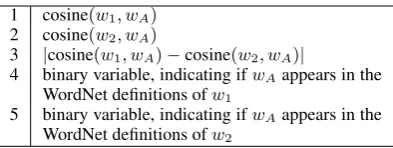
the difference in their similarities, which are used as three input features in the following classifi-cations. For example, given the context embed-dings of w1 andw2 and the word embedding of
wA, we compute Feature 1: cosine(vcw1, vwA t );
Feature 2: cosine(vw2c , vwA
t ); and Feature 3: |cosine(vw1
respec-1 cosine(w1, wA) 2 cosine(w2, wA)
3 |cosine(w1, wA)−cosine(w2, wA)|
4 binary variable, indicating ifwAappears in the WordNet definitions ofw1
[image:3.595.83.280.60.134.2]5 binary variable, indicating ifwAappears in the WordNet definitions ofw2
Table 1: Feature descriptions.
tively. (3) Next, we introduce two binary features to indicate whetherwAappears in any sense
def-initions ofw1 andw2 in WordNet (Feature 4 and
5), respectively. (4) We train a random forest clas-sifier with the above five features (see Table1) to classify if the attribute word wA can distinguish
two semantically similar wordsw1 andw2.
3 Experimental Settings
Data. The data was provided by the organizers of SemEval 2018 Task 10: Capturing Discrimi-native Attributes1. There are 17,501, 2,722 and
2,340 triples (w1,w2, wA) in training, validation
and testing sets, respectively. All the words in the triples are nouns. Note that the discriminative at-tribute wordswAin the given dataset are selected,
because they represent the visual attribute of one of two semantically similar words. For example,
red can differentiate apple and banana, because visually, apple is red, while banana is yellow. The task does not consider other discriminative fea-tures, such as sound and taste. So, using image features may take advantages in this dataset, how-ever, semantic features can also capture invisible discriminative attributes.
Word and context embedding. We first it-eratively train 300 dimensional word and context embeddings based on CBOW and Skip-gram with a Wikipedia dump2for 3 epochs respectively,
set-ting a context window of 5 words before and after the target word. Words with frequency less than 5 in the Wikipedia are ignored. The down sampling rate is10−4.
Based on CBOW and Skip-gram, we test all possible combinations of word and context em-beddings to compute cosine similarities. The first combination is context embeddings of the two se-mantically similar words w1 and w2, and word
embeddings of the attribute wordwA. In Table2
1https://competitions.codalab.org/ competitions/17326
2https://dumps.wikimedia.org/enwiki/ 20170920/
and4, this approach is represented asvw1
c vwc2vtwA.
The secondvwt1vwt2vwAc uses word embeddings of w1 andw2, and context embeddings ofwA. The
thirdvw1
c vcw2vwAc is simply context embeddings of w1,w2andwA. The fourthvtw1vwt2vwAt is simply
word embeddings ofw1,w2andwA.
4 Results
We cast the challenge task as a supervised classi-fication problem. We first examine which combi-nation of word and context embeddings and which training method (CBOW or Skip-gram) is optimal in this task. In this step, we only use Feature 1-3 (see Table1) to classify the triple (w1,w2,wA).
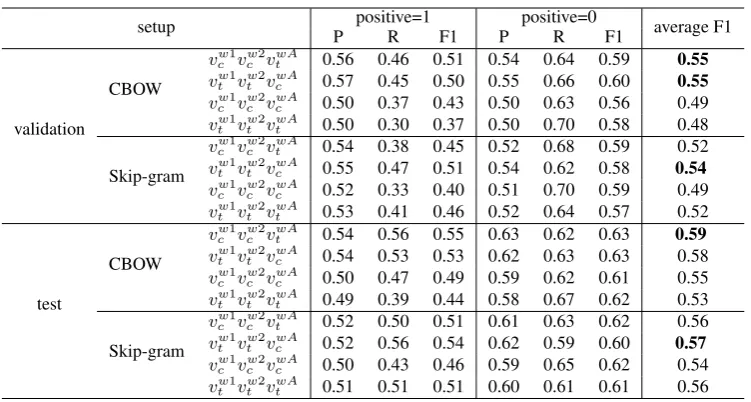
As can be seen in Table 2, both the CBOW based methods that use word and context embed-dings yield the highest average F1 of 0.55 in the validation set. Skip-gram based models generally perform worse than CBOW based models, but us-ing Skip-gram word embeddus-ings of w1 and w2
and context embeddings ofwA also outperforms
the word embedding based model in the validation set. The experiments running on the test set show similar trends that word and context embedding based models outperform word embedding based models. Such results demonstrate that using word and context embeddings together can better dis-tinguish two semantically similar words with an attribute word, than simply using standard word embeddings. The results also support our first hy-pothesis that if the attribute word frequently ap-pears in one word’s context than the other one, it can distinguish the two words.
We also examine WordNet definition features individually. As shown in Table3, simply using Feature 4-5 cannot classify the triple accurately. The F1 score of setting positive label as 1 is very low on the validation set (F1=36%). This is for the reason that an eligible discriminative attribute word cannot always associate with the definitions of one of two semantically similar words. So, sim-ply using such features cannot identify discrimina-tive words precisely.
Finally, we combine both similarity and Word-Net features together to address this challenge. There is no significant difference between CBOW based vcw1vcw2vtwA and vwt1vwc2vcwA in the
vali-dation set in terms of average F1. We select
vwc1vwc2vtwA as the winner combination of word
la-setup P positive=1R F1 P positive=0R F1 average F1
validation
CBOW
vw1
c vwc2vwAt 0.56 0.46 0.51 0.54 0.64 0.59 0.55 vw1
t vwt2vwAc 0.57 0.45 0.50 0.55 0.66 0.60 0.55 vcw1vwc2vwAc 0.50 0.37 0.43 0.50 0.63 0.56 0.49 vw1
t vwt2vwAt 0.50 0.30 0.37 0.50 0.70 0.58 0.48 Skip-gram
vw1
c vwc2vwAt 0.54 0.38 0.45 0.52 0.68 0.59 0.52 vtw1vwt2vwAc 0.55 0.47 0.51 0.54 0.62 0.58 0.54 vw1
c vwc2vwAc 0.52 0.33 0.40 0.51 0.70 0.59 0.49 vw1
t vwt2vwAt 0.53 0.41 0.46 0.52 0.64 0.57 0.52
test
CBOW
vw1
c vwc2vwAt 0.54 0.56 0.55 0.63 0.62 0.63 0.59 vtw1vwt2vwAc 0.54 0.53 0.53 0.62 0.63 0.63 0.58 vw1
c vwc2vwAc 0.50 0.47 0.49 0.59 0.62 0.61 0.55 vw1
t vwt2vwAt 0.49 0.39 0.44 0.58 0.67 0.62 0.53 Skip-gram
vcw1vwc2vwAt 0.52 0.50 0.51 0.61 0.63 0.62 0.56 vw1
t vwt2vwAc 0.52 0.56 0.54 0.62 0.59 0.60 0.57 vw1
[image:4.595.112.488.59.260.2]c vwc2vwAc 0.50 0.43 0.46 0.59 0.65 0.62 0.54 vtw1vwt2vwAt 0.51 0.51 0.51 0.60 0.61 0.61 0.56
Table 2: Experimental results by using word and context embeddings (Feature 1-3).
setup P positive=1R F1 P positive=0R F1 average F1 WordNet validationtest 0.660.66 0.240.26 0.360.37 0.530.60 0.870.89 0.710.66 0.510.54
Table 3: Experimental results by using WordNet definition features (Feature 4-5).
setup P positive=1R F1 P positive=0R F1 average F1
CBOW+WordNet validation vwc1vwc2vtwA+WN 0.57 0.53 0.55 0.56 0.59 0.57 0.56 test vw1
c vwc2vtwA+WN 0.58 0.60 0.59 0.66 0.65 0.65 0.62
Table 4: Final results by using CBOW word and context embeddings, and WordNet features (Feature 1-5).
bels (1 or 0) as the positive label. Thus, in the final submission, we use CBOW trained context embeddings ofw1 andw2, and word embeddings
ofwAto compute similarity features. We identify
whether an attribute word wA can distinguishw1
andw2 by using the above similarity features and
WordNet definition features together. Although word and context embedding based similarity tures are much more effective than WordNet fea-tures, by introducing WordNet feafea-tures, the model further improves its performance, achieving 62% F1 on the test set (Table4). WordNet definitions are also supportive features in this task.
Error analysis. We found that a significant por-tion of failures appear in those examples that the textual associations of the attribute words and the semantically similar words are not always discrim-inative. E.g., given a triple, (sons, father, young), our model failed in identifyingyoungas a discrim-inative attribute, because young has been widely used to describesons andfatherin the text (e.g.,
young sonsanda young father). In this case, our word co-occurrence based method is suboptimal.
5 Conclusion
In this paper, we extended traditional word em-bedding methods (CBOW and Skip-gram) to dis-tinguish two semantically similar words using an attribute word. In contrast with simply using tra-ditional word representations, using both context and word embeddings can better model the co-occurrence between the two similar words and their discriminative attribute word. If the at-tribute word frequently co-occurs with one of the similar words more than another one within the same sentences, then the two semantically sim-ilar words can be distinguished by the attribute word. By using CBOW word and context embed-ding based similarity features and simple WordNet based word sense definition features, our model performs an average F1 of 62% on the test set.
Acknowledgments
References
Piotr Bojanowski, Edouard Grave, Armand Joulin, and Tomas Mikolov. 2017. Enriching word vectors with subword information. Transactions of the Associa-tion for ComputaAssocia-tional Linguistics, 5:135–146.
Christiane Fellbaum. 1998. WordNet: An Electronic Lexical Database. Bradford Books.
Wang Ling, Chris Dyer, Alan Black, and Isabel Trancoso. 2015. Two/too simple adaptations of word2vec for syntax problems. In Proceedings of the 2015 Conference of the North American Chap-ter of the Association for Computational Linguis-tics: Human Language Technologies. Association for Computational Linguistics.
Tomas Mikolov, Kai Chen, Greg Corrado, and Jeffrey Dean. 2013. Efficient estimation of word represen-tations in vector space. Proceedings of International Conference on Learning Representations.
Eric Nalisnick, Bhaskar Mitra, Nick Craswell, and Rich Caruana. 2016. Improving document ranking with dual word embeddings. InProceedings of the 25th International Conference Companion on World Wide Web, pages 83–84. International World Wide Web Conferences Steering Committee.
Radim ˇReh˚uˇrek and Petr Sojka. 2010. Software Frame-work for Topic Modelling with Large Corpora. In
Proceedings of the LREC 2010 Workshop on New Challenges for NLP Frameworks, pages 45–50, Val-letta, Malta. ELRA. http://is.muni.cz/ publication/884893/en.