Proceedings of the 12th International Workshop on Semantic Evaluation (SemEval-2018), pages 958–962
THU NGN at SemEval-2018 Task 10: Capturing Discriminative
Attributes with MLP-CNN model
Chuhan Wu1, Fangzhao Wu2, Zhigang Yuan1, Sixing Wu1and Yongfeng Huang1 1Tsinghua National Laboratory for Information Science and Technology, Department of Electronic Engineering, Tsinghua University Beijing 100084, China
2Microsoft Research Asia
{wuch15,yuanzg14,wu-sx15,yfhuang}@mails.tsinghua.edu.cn [email protected]
Abstract
Existing semantic models are capable of iden-tifying the semantic similarity of words. How-ever, it’s hard for these models to discrimi-nate between a word and another similar word. Thus, the aim of SemEval-2018 Task 10 is to predict whether a word is a discrimina-tive attribute between two concepts. In this task, we apply a multilayer perceptron (MLP)-convolutional neural network (CNN) model to identify whether an attribute is discriminative. The CNNs are used to extract low-level fea-tures from the inputs. The MLP takes both the flatten CNN maps and inputs to predict the la-bels. The evaluation F-score of our system on the test set is 0.629 (ranked 15th), which in-dicates that our system still needs to be im-proved. However, the behaviours of our sys-tem in our experiments provide useful infor-mation, which can help to improve the collec-tive understanding of this novel task.
1 Introduction
Evaluating the similarity of words is an important task in semantic modeling. There have been dif-ferent approaches based on corpus statistics (Jiang and Conrath,1997;Mihalcea et al.,2006) and on-tology (Seco et al., 2004; S´anchez et al., 2012). After an effective word representation proposed by mikolov et al (2013), word similarity can be evalu-ated based on word embedding weights (Levy and Goldberg, 2014). Usually higher cosine similar-ity of word embedding vectors indicates higher se-mantic similarity.
However, existing semantic methods are not capable of discriminating similar words between each other without additional information. For ex-ample, it is easy for these models to tell “dog” and “puppy” is similar, but they can’t tell the differ-ences between each other. It limits the use of these models to mine such fine-grained semantic infor-mation from texts. Thus, the SemEval-2018 Task
10 is proposed to determine whether an attribute can help to discriminate between two words(Krebs et al.,2018). One can express semantic differences between concepts by referring to attributes associ-ated with those concepts. The differences between concepts can usually be identified by the presence or absence of specific attributes. For example, the attributes “red” and “yellow” are discriminative for concepts “apple” and “banana”, while “sweet” or “fruit” are not discriminative.
Capturing such discriminative attributes can be regarded as a binary classification task: given two words and an attribute, predict whether the at-tribute is a difference between the two words. Ex-isting methods to capture discriminative attributes are mainly based on dictionary (Parikh and Grau-man,2011). In recent years, CNN have been suc-cessfully applied to text classification task (Kim,
2014). In order to address this task, we develop a system based on MLP-CNN model. Firstly, the input words will be converted into dense vectors using the combination of different word embed-dings. Then the CNN layers are used to extract features from these vectors. Finally, a MLP classi-fier is used to predict binary labels based on both embedding and CNN features. The experimental results show that our model outperforms several baseline neural model, and the additional features can improve the model performance. Our system still has room for development according to the ex-perimental analysis. The behaviours of our system in our experiments can help to further fix and ex-tend our model.
2 MLP-CNN model with Word Feature
2.1 Network Architecture
The architecture of our MLP-CNN model is shown in Figure 1. The input of our system is a pair of words with an attribute. First, an
bedding layer is used to provide different kinds of pre-trained embedding weights (v1−dim) and the
word features (vf −dim) . We use three
differ-ent pre-trained embedding weights and concate-nate them together with the additional features of each word. Thus, the output of embedding layer is
(v1+vf)−dim.
Second, a 2-layer convolutional neural network take these vectors as input, and output the flatten feature maps. We use zeros to pad in both sides to keep the same output length. Since the length of inputs is 3, the 3 time steps of the convolutional feature maps can respectively extract the inherent relatedness of the first word with attribute, the sec-ond word with attribute and all three words. The feature map dimensions of the two CNN layers are
v2andv3respectively. In order to reduce the
diffi-culties of gradient propagation in neural networks, we use a over-layer connection between input and output of CNN. We concatenate the flatten feature maps with all word embedding and features to-gether. Finally a MLP with ReLU and sigmoid ac-tivation function is used to predict the normalized binary label. With the help of the over-layer con-nection, the MLP classifier can learn from high-level word information and raw semantic infor-mation at the same time. Since the final labels are obtained from the triples of words through the embedding, CNN and dense layers, all parameters can be tuned in model training.
2.2 Word Embedding
Since there are several out-of-vocabulary words in the dataset when using single pre-trained word embedding, we use three different embedding models to cover them. The three embedding mod-els include pre-trained word2vec embedding1
pro-vided by Mikolov et al. (Mikolov et al., 2013), the Glove embedding2 provided by Pennington
et al. (Pennington et al., 2014) and the fastText embedding3 released by bojanowski et al. (
Bo-janowski et al.,2016). These embedding weights are all 300-dim. They are concatenated together as the representation of input words.
2.3 Word Feature
In our model, we use one-hot encoded POS tags and two binary features obtained by
Word-1https://code.google.com/archive/p/word2vec/ 2http://nlp.stanford.edu/data/glove.840B.300d.zip 3 https://s3-us-west-1.amazonaws.com/fasttext-vectors/wiki.en.vec
banana long cucumber
Embedding
word embedding
(𝑣1− 𝑑𝑖𝑚) Dense layers
ReLU sigmoid
Output
(feature1) (feature2) (feature3)
Convolutional layer Convolutional layer
Flatten
3(𝑣1+ 𝑣𝑓)
-𝑑𝑖𝑚 𝑣2− 𝑑𝑖𝑚
𝑣3− 𝑑𝑖𝑚
3𝑣
3-𝑑𝑖𝑚
[image:2.595.313.521.62.383.2]Features (𝑣𝑓− 𝑑𝑖𝑚)
Figure 1: The architecture of our MLP-CNN model.
Net (Miller and Fellbaum, 1998). In the dataset, the words to be discriminated are nouns, but at-tributes are nouns, adjectives, verbs and so on. Thus, POS tags of words can help to identify the types of attributes and the relationship between them. )We use the Stanford parser tool4to get the
POS tags of words.
The WordNet feature we use is based on synsets. Among every three input words, if one word is in the synset of another word, the corre-sponding feature digit will be set to 1, or it will be set to 0. In this way, a 2-dim synset feature of each word can be obtained. We use the nltk tool(Bird et al.,2009) to generate the WordNet features. The features above are concatenated with word embed-ding as the input of MLP-CNN model.
2.4 Model Training and Ensemble
Since thetrain setis unbalanced, we randomly se-lect same numbers of positive (the attribute is criminative) and negative (the attribute is not dis-criminative) samples from thetrain setevery time. Thus, the training data we used in our experiments
consists of the sampled data from thetrain setand 80% data sampled from thedev set. The remaining 20% part indev setis used for validation.
Model ensemble strategy has been proven use-ful to neural networks (Wu et al., 2017). There-fore, we build different training samples using the method described in the above paragraph and train our model for 10 times. The final predictions on the test set are the average of the predictions of the 10 models. In this way, the performance of neural model can be further improved.
3 Experiment
3.1 Experiment Settings
The dataset we use is constructed based on the ap-proach proposed by Lazaridou et al. (2016) and the initial source of data is provided by McRae et al. (2005). The entire dataset contains 17,547 sam-ples for training, 2,722 for validation and 2,340 for testing. The training set is automatically gen-erated, while the validation and test set are manu-ally refined. The models will be evaluated by F1-measure, as is standard in a binary classification task.
In our network, the kernel sizes of CNN are set to 3. The dimensions of feature mapsv2 andv3
are set to 256, and the dimensions of dense lay-ers are 300. The dropout rate of both embedding weights and CNN is set to 0.2. The training batch size is set to 50. We use Adam as the optimizer for network training, which takes 10 epochs per time. We train our model for 10 times and average their predictions on the test set.
3.2 Performance Evaluation
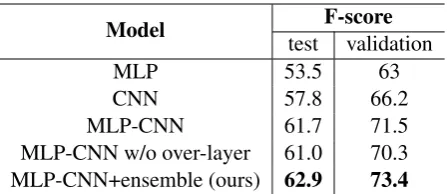
The experimental results on the test and validation set are shown in Table1. For comparison, we also present several baseline models here. Our official submission is the MLP-CNN model with ensem-ble techniques. Our F-score is 62.9 (ranked 15th) in the evaluation phase. From the evaluation re-sults, we can see that our model outperforms these baseline models. It shows that our network archi-tecture can learn more semantic information from the words and attributes. However, our system needs to be improved compared with the top sys-tem (75.0 of F-score). In addition, the testing re-sults are much lower than validation rere-sults. Some detailed information will be analysis in the next section.
Model testF-scorevalidation
MLP 53.5 63
CNN 57.8 66.2
[image:3.595.308.532.61.158.2]MLP-CNN 61.7 71.5 MLP-CNN w/o over-layer 61.0 70.3 MLP-CNN+ensemble (ours) 62.9 73.4
Table 1: Performance evaluation of our system and sev-eral baselines.
4 Discussion
4.1 Influence of Trainable Word Embedding
The influence of different word embedding weights and fine-tuning them or not is shown in Table2. Note that we don’t apply the model en-semble technique here. From the results, we can see that the combination of different word embed-ding can significantly improve the model perfor-mance. It may be because that using different word embedding can provide richer semantic in-formation. In addition, using the combinations of different word embedding can cover more words and the out-of-vocabulary words in the single em-bedding file can be reduced. Thus, the predictions of such words can be more accurate.
However, we find fine-tuning the pre-trained word embedding is not a good choice. The fine-tuned model performance is significantly worse than models using untrainable embedding. Since the training, validation and test sets have no fea-ture overlap between them, fine-tuning the embed-ding weights will lead to serious over-fitting and poor model generalization ability. We fine-tuned the embedding of our models used in the official submission, so the results are lower than the mod-els with untrainable embedding.
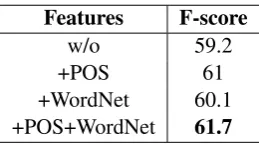
4.2 Influence of Word Features
usu-pre-trained
Embedding testF-scorevalidation w/o 44.9 63.7 word2vec+tune 50.6 65.8 Glove+tune 53.5 66.7 fastText+tune 51.5 64.4 all+tune 61.7 71.5 word2vec-tune 54.9 66
Glove-tune 57.7 69.6 fastText-tune 58.3 68.9 all-tune 65.7 75.5
Table 2: Comparisons of using different pre-trained embedding.
ally an attribute of this concept. Thus, the synset information can help the model to identify the re-lationships between words and attibutes.
Features F-score
w/o 59.2
+POS 61
+WordNet 60.1 +POS+WordNet 61.7
Table 3: Influence of word features on the test set.
4.3 Case Study
Several examples of model predictions on the test set are shown in Table 4. From the true predic-tions, we can see that our model can capture sim-ple attributes of concepts such as colors. How-ever, more complex relationships between words and attributes are difficult for our system to mine. For example, the word “mouse” can be an animal or electronic device. It’s hard to identify such se-mantic differences without incorporating external knowledge, since the information provided by the training data is limited.
True Positive False Positive
corn,tomato,yellow alcohol,liquor,strong ant,snail,black bar,shop,sell
True Negative False Negative
[image:4.595.96.265.60.214.2]father,brother,family mouse,dog,plastic father,mother,parent engine,vehicle,component
Table 4: Representative examples of the predictions on the test set.
5 Conclusion
Discriminating similar words between each other without additional information is difficult for ex-isting semantic models. Therefore, the SemEval-2018 task 10 is proposed to fill this gap. In this paper, we apply a MLP-CNN model with word feature to this task. In our model, the input and output of our CNN are highway connected. They are taken by a MLP classifier for binary classifi-cation. Based on this model, the local relation-ships between each pair of words can be mined. Our evaluation F-score is 62.9 (ranked 15th). The detailed analysis on our system shows our system can be further improved.
Acknowledgments
The authors thank the reviewers for their in-sightful comments and constructive suggestions on improving this work. This work was sup-ported in part by the National Key Research and Development Program of China under Grant 2016YFB0800402 and in part by the National Nat-ural Science Foundation of China under Grant U1705261, Grant U1536207, Grant U1536201 and U1636113.
References
Steven Bird, Ewan Klein, and Edward Loper. 2009.
Natural language processing with Python: analyz-ing text with the natural language toolkit. ” O’Reilly Media, Inc.”.
Piotr Bojanowski, Edouard Grave, Armand Joulin, and Tomas Mikolov. 2016. Enriching word vec-tors with subword information. arXiv preprint
arXiv:1607.04606.
Jay J Jiang and David W Conrath. 1997. Semantic sim-ilarity based on corpus statistics and lexical
taxon-omy. arXiv preprint cmp-lg/9709008.
Yoon Kim. 2014. Convolutional neural net-works for sentence classification. arXiv preprint arXiv:1408.5882.
Alicia Krebs, Alessandro Lenci, and Denis Paperno. 2018. Semeval-2018 task 10: Capturing discrim-inative attributes. InProceedings of the 12th inter-national workshop on semantic evaluation (SemEval 2018).
Angeliki Lazaridou, Nghia The Pham, and Marco Ba-roni. 2016. The red one!: On learning to refer to things based on their discriminative properties.
[image:4.595.116.246.324.397.2]Omer Levy and Yoav Goldberg. 2014. Neural word embedding as implicit matrix factorization. In
Ad-vances in neural information processing systems,
pages 2177–2185.
Ken McRae, George S Cree, Mark S Seidenberg, and Chris McNorgan. 2005. Semantic feature produc-tion norms for a large set of living and nonliving things. Behavior research methods, 37(4):547–559.
Rada Mihalcea, Courtney Corley, Carlo Strapparava, et al. 2006. Corpus-based and knowledge-based measures of text semantic similarity. InAAAI, vol-ume 6, pages 775–780.
Tomas Mikolov, Kai Chen, Greg Corrado, and Jef-frey Dean. 2013. Efficient estimation of word representations in vector space. arXiv preprint arXiv:1301.3781.
George Miller and Christiane Fellbaum. 1998. Word-net: An electronic lexical database.
Devi Parikh and Kristen Grauman. 2011. Interactively building a discriminative vocabulary of nameable at-tributes. In Computer Vision and Pattern
Recog-nition (CVPR), 2011 IEEE Conference on, pages
1681–1688. IEEE.
Jeffrey Pennington, Richard Socher, and Christopher Manning. 2014. Glove: Global vectors for word representation. InProceedings of the 2014 confer-ence on empirical methods in natural language
pro-cessing (EMNLP), pages 1532–1543.
David S´anchez, Montserrat Batet, David Isern, and Aida Valls. 2012. Ontology-based semantic similar-ity: A new feature-based approach. Expert Systems with Applications, 39(9):7718–7728.
Nuno Seco, Tony Veale, and Jer Hayes. 2004. An in-trinsic information content metric for semantic sim-ilarity in wordnet. InECAI, volume 16, page 1089.
Chuhan Wu, Fangzhao Wu, Yongfeng Huang, Sixing Wu, and Zhigang Yuan. 2017. Thu ngn at ijcnlp-2017 task 2: Dimensional sentiment analysis for chi-nese phrases with deep lstm. Proceedings of the