Interpersonal dynamics: a communitarian perspective
RIDLEY-DUFF, R. <http://orcid.org/0000-0002-5560-6312>
Available from Sheffield Hallam University Research Archive (SHURA) at:
http://shura.shu.ac.uk/751/
This document is the author deposited version. You are advised to consult the publisher's version if you wish to cite from it.
Published version
RIDLEY-DUFF, R. (2005). Interpersonal dynamics: a communitarian perspective. In: MCA-ENROAC Conference, Antwerp, 7th-9th April.
Copyright and re-use policy
See http://shura.shu.ac.uk/information.html
Rory Ridley-Duff, 2005 - Sheffield Hallam University
Interpersonal Dynamics: a communitarian
perspective
Rory Ridley-Duff, Sheffield Hallam University
The Changing Roles of Management Accounting as a Control System
Paper to
MCA-ENROAC Conference, April 7th - 9th – 2005, University of Antwerp, Belgium
Abstract
Conventional theories of power within organisations focus on the extent to which one party can impose their will on others through social influence. Discussion of the way that same-sex and opposite-sex attraction impacts on the workplace is rarely theorised either because it is considered uncivilised or taboo. Investigations are also hampered by resistance amongst research participants even when care is taken to establish mixed groups from different organisations. As a result, holistic theories of management control that take account of sexual behaviour remain rare.
This paper examines empirical data from an 18-month critical ethnography to present new theory on interpersonal dynamics, socialisation and identification. A grounded theory is developed that suggests social decisions are closely linked to the psychology of giving and getting attention and assistance. As relationships develop, patterns of giving and receiving create economic and social dependencies that evolve into the tacit rules of social life and affect the bonds between people.
Sharp conflicts occur when one party wants to change the relationship and the other party resists. The process of renegotiation affects the stability of directly and indirectly affected relationships and can change patterns of influence and bases of social power. Individuals’ commitment and health can be affected. Decision-making and impacts are affected by the state of other relationships, past experiences, social and economic dependency and the aspirations of both parties.
Findings are reviewed against existing theories of power to offer a radical perspective that power has two-faces, the ability to influence and the ability to resist influence. Authoritarian behaviours can be activated by perceptions of powerlessness rather than a sense of power. The implications for
! " #$ % & '
Introduction
Power within organisations is frequently discussed in terms of the extent to which one party can impose their will on others through social influence, persuasion or coercion (see French and Raven, 1958; Etzioni, 1961; Lukes, 1974; Janis, 1982; Kunda, 1992; Thompson and Findlay, 1999). Discussion of the way that same-sex and opposite-sex attraction (sexual and non-sexual) impacts on the workplace is rarely theorised because the ethical issues are provocative and controversial (but see Burrell, 1984; Hearn and Parkin, 1987; Farrell, 1994, 2005; Gummesson, 2000; Kakabadse &
Kakabadse, 2004). The process of bringing taboo subjects into the public domain for discussion is problematic:
Certain phenomena are not considered acceptable subjects of study or should not be put in writing. They might be embarrassing to those involved and even trigger the anger of
powerful people. Consequently, there is a tendency to avoid these phenomena, although they may be of decisive importance for a particular process.
(Gummerson, 2000:111)
The knock on impacts can be substantial:
Researchers are confronted with the problem of choosing between a presentation of anonymous cases in which they can be frank or case studies in which names are given but unpleasant aspects are excluded. To be able to understand and interpret a process, these taboos are of essential importance.
(ibid:115)
This paper examines empirical data from an 18-month critical ethnography (Thomas, 1993; Dey, 2002) to present new theory on interpersonal dynamics. A grounded theory (Glaser and Strauss, 1967; Locke, 2001) is developed that suggests social decisions are closely linked to the psychology of giving and getting attention and assistance and impact not only on organisational life but the interpretative frameworks of academics.
" #$ % & ' ( !
explains how social influence affects decision-making. The theory is authenticated using a second case and analysis of further data. Critical discussion and comment takes place in section 5, and implications for the literature and a summary are given in section 6.
1.
Literature Review
Hearn and Parkin (1987:13-14) contend that:
The ways we talk, walk, flirt, touch and so on, as women or as men, may all be instances of being sexual at work, and at the same time be means of displaying different sexual identities that are at least partly work-based and organisationally determined … Organisations become obvious places for the development of sexual relationships, be they unspoken glances, mild flirtations, passionate affairs, or life-long arrangements.
While feminist scholars have articulated the way that sexual attitudes have a deep-rooted impact on social control, status and career progression as well as a host of expectations with regard to
appropriate and inappropriate behaviour (see Friedan, 1963; Farrell, 1988, 1994; Townley, 1994; Eagleton, 2003) the way that gendered behaviour triggers and resolves workplace conflict, or impacts on productivity, is largely ignored in mainstream texts on organisation behaviour:
Read the ‘mountainous’ literature on industrial sociology…and you would imagine that organisations, so finely analysed, are inhabited by a breed of strange, asexual eunuch figures…[this is a product] of deeply-rooted power relations between women and men that deny major and huge aspects of reality, along gender lines.
(Hearn and Parkin, 1987:4)
Burrell (1984) regards this as symptomatic of a culture in which the notion of ‘civilisation’ contributes to a desexualisation of the workplace. Suppression of sexuality becomes a tacit
management control strategy to keep workers’ minds on productivity to the point where “work itself involves drawing on libidinal energy and diverting it into work objects rather than sexual objects” (Hearn and Parkin, 1987:12). The lack of theory regarding sexual behaviour in the literature, therefore, can itself be seen as an outcome of the civilising discourse that regards it as an inappropriate subject or hidden source of power (see Foucault, 1976; Elias, 1978).
! ) " #$ % & '
books on organisation behaviour (see Buchanan and Huczynski, 1997; Robbins, 2001) reinforces the view that theories on the impact of sexual behaviour at work are still conspicuous by their absence.
1.1
Intersubjectivity and Social Structure
Agreements are, in a social – if not a legal - sense, an attempt to achieve a level of shared understanding and values between individuals. Once made, individuals usually feel bound by
psychological contracts to keep to implicit social agreements (see Schein, 1980; Rousseau, 1995) but the inherent ambiguity in language, and the impossibility of ever fully understanding others, leaves plenty of scope for both accidental and deliberate misunderstanding (Griseri, 1998). These
misunderstandings are particularly useful to a researcher as they reveal the differences in people’s values and their link to various private and collective interests that evolve over time.
The evolution of personal relationships, therefore, has a profound impact on the development of enduring and changing social structures at work. No discussion of workplace culture can divorce itself from the way individuals meet, bond, and evolve their relationships. Nor can social life be understood without exploring how such bonds affect both individual and collective decision-making, socialisation and identification (see Kelman, 1961). These processes are important in considerations of the “culture management” literature (see Peters and Waterman, 1982; Kunda, 1992; Kotter and Heskett, 1992; Collins, 2001) and “social engineering” (see Thompson and Findlay, 1999). How do we identify with “the other” and what makes them “significant” to us?
Patriarchy and Sexism as ‘Deep Structures’
Friedan (1963) is credited by many for identifying the “problem that has no name”1. She left it to others, however, to define how patriarchy advantaged men, and disadvantaged women (see
Rowbottom, 1973). While Friedan has remained uncharacteristically sympathetic to the impact of patriarchy on both sexes (see Friedan, 1980) the argument that it is a historical “deep structure” (Putnam et al, 1993:230) has been consistently advanced as a way of understanding discrimination and harassment of women:
1
Interestingly, Friedan does not even index the word patriarchy in The Feminine Mystique, but she is credited by
" #$ % & ' ! !
The sexual division of labour and the possession of women by men predates capitalism. Patriarchal authority is based on male control over the woman’s productive capacity, and over her person.
(Rowbottom, 1973:117)
Feminist scholars have continued to articulate the way that patriarchal values pervade modern life. In making the assumption that men still control (or want to control) women, sexism and sexual harassment have become synonymous with conceptions of the way men behave towards women, but not how women behave towards men.
Hearn and Parkin (1987:4) typically adopt a gender-neutral approach to the “booming silence” on sexuality at work, but sporadically underlying assumptions resurface and orient readers towards the view that men are responsible for the intimidation and dominance of women. For example:
…interest in and outrage at the nature and scale of sexual harassment in work organisations has increased…This represents part of the broader concerns of women against male violence and objectification in its various forms…
(Hearn and Parkin, 1987:35)
Over time, however, the discourse is becoming more balanced. There is growing recognition that male points of view have not been fully integrated into feminist theory. Firstly, Segal (1990) argues that empirical studies do not support the presumption that (sexual) violence emanates from men alone. She examines the implications of Nancy Friday’s study into sexuality and violence (Friday, 1980) to reveal that women fantasise about sexual aggression far more than men 2. We should, therefore, be unsurprised that one of the most popular romance novel “formulas” feature successful men at work overcoming the resistance of women 3. Secondly, Segal challenges the idea that aggressive behaviour is linked to dominance. She argues instead that aggression is most acute when parties feel powerless rather than powerful. Both unsettle the idea that men dominate women, or are even motivated by a desire to do so.
2
Cited in Segal (1990:213). Only three men out of three thousand (just 0.1%) had “fantasies of enacting rape
from men, whereas being raped or forced were the most popular themes among women respondents”.
3
Farrell (2000:194-195). Harlequin changed its romance novel formula after discovering that 70% of its readers
had jobs outside the home. The result? A 20,000% increase in profitability over 10 years with nett revenues up
! * " #$ % & '
Claims regarding male aggression have also been challenged by both clinicians and academics (see Farrell, 1994, 2000; Goldberg, 2000; Hoff-Sommers, 1995). Hoff-Sommers argues that there is a lack of rigour in both journalistic and academic claims regarding levels of male violence, and draws attention to the way that public data4 is often a reflection of institutional interests and processes rather than actual behaviours. She particularly attacks the uncritical reporting of journalistic surveys in the mass media that fuels women’s fears. When the scope of enquiry is limited to academic studies involving both sexes, findings consistently suggest that men are less violent in their personal relationships than women5.
The most recent scholarship on intimacy6 at work also casts considerable doubt on earlier claims regarding harassment. Kakabadse & Kakabadse (2004) found very low rates of harassment, and allegations that were made were extremely rare in the formative stages of a relationship. They were far more likely to occur during relationship breakdowns and be highly contestable. In contrast to the views of McDowell (2003) that male/female relationships are characterised by inequality and
aggression, the authors report positive reactions and outcomes from close relationships7:
4
Hoff-Sommers contends that nurses are trained to spot symptoms of domestic violence in women but there is no
such training to spot symptoms in men. Farrell (2000) reports that when men need hospitalisation after domestic
violence, their most frequent explanation is that they received a ‘sports injury’.
5
Both Hoff-Sommers (1995) and Farrell (1994, 2000) discuss these issues at great length and an increasing
number of academic studies support their contention that women are marginally more violent than men in
personal relationships. For an annotated bibliography of 155 academic studies, see
http://www.csulb.edu/~mfiebert/assault.htm.
6
There is insufficient space to discuss the various meanings of intimacy here so I hope you will accept my
working definition. An intimate relationship is one that is sufficiently close for two people, of the same or
different sex, to feel comfortable discussing their own loving relationships with each other. Loving relationships
may includes those with a partner (spouse/lover), children, parents, friends, siblings and each other.
7
In their survey, nearly 40% reported that friendship resulted from intimacy while just over 10% reported
bitterness after the relationship ended (page 70). It was much more common for both parties to report positive
outcomes. In terms of organisational impact, 66% reported no personal impact (page 79), while 22% reported
" #$ % & ' + !
What also comes out of this survey is that, in the eyes of many, intimacy at work is basically not a problem, is on the increase (or at least will not go away) and many report
improvements in work performance resulting from the exhilaration of intimacy experiences. So, what is the problem that requires treatment and attention?
(Kakabadse & Kakabadse, 2004)
1.2
An Alternative Discourse on Gender
Since the 1970s, an alternative gender discourse has examined feminist claims from a different perspective. Behaviour is not driven by men’s desire to dominate women, but from “both sexes’ … instinct to protect the female” (Farrell, 1994:23). Hierarchy in social life, therefore, is articulated as a response to the desire for love, companionship and protection, and not simply a reaction to market economics (Williamson, 1975) or contractual agreements (see Berle and Means, 1932).
By drawing attention to the impact of deeply ingrained courtship processes on men’s attitude to work and money, Farrell (2005) articulates the drivers of gendered behaviour that leads both to disparities between men and women at work and social processes that create divisions between earner and carer:
…our sons are still expected to pay for…dinners, drinks, dates, dances, diamonds and driving expenses [while] our daughters are still internalising that the more desirable they are, the more boys will pay for them…All of this is to say that men’s and women’s work choices are rooted far more deeply than in mere rational work decisions. Understanding the power of these roots helps us understand where our freedom to choose may be undermined not by the other sex but by our own biology and socialization [emphasis added].
(Farrell, 2005:137)
These issues matter because the scholarly research into masculinity (see Collinson and Hearn, 2001) argues that careerism amongst men is one of the masculine behaviours that subordinates women at work (and therefore creates hierarchies in which men dominate women) rather than a strategy to win respect and find love.
! , " #$ % & '
1.3
Gender Neutral Frameworks
While there is insufficient space to do a wide-ranging review of other frameworks, it is hard to ignore the enduring and popular Transaction Analysis (TA) theories established by Berne (1964) and
popularised by the I’m OK – You’re OK books (Harris, 1970; Harris and Harris, 1986). These continue to sell not just to the wider public, but are still promoted to managers by consultants8, are responsible for a network of “transaction analysts”, and continue to be referenced in the academic literature on psychology (see Gross, 2001).
The relevance to this paper is that Berne’s theories are firmly focussed on interactions. He develops an easily understandable framework based on a theory that our childhood feelings (our “child”) and childhood experiences (our “parent”) are integrated and updated through the development of our cognitive functions (our “adult”)9. Authoritarian behaviour, it is argued, comes from our ‘parent’ while seductive and playful behaviour derives from our ‘child’. These are mediated by our
developing cognitive abilities to create rational behaviour and “knowledge” stored in our ‘adult’. As the adult matures, it is argued that s/he progressively becomes “game free” (Berne, 1964) and
eradicates the motivation for authoritarian and seductive behaviours.
Communitarian Critique
The main problem, particularly from a liberal communitarian perspective (see Etzioni, 1998; Tam,1999; Lutz, 2000), is that broader historical and current social contexts and processes are not accommodated (except through the PACs of other people, particularly parents). There are, in my view, two additional and insurmountable problems that are created by the presumptions implicit in TA theory. Firstly, relationships are treated as a ‘given’ – the theory provides no account of why enduring relationships form in the first place. Secondly, it assumes that people want to stay in the relationships they have, which is frequently not the case or not possible. While TA (and PAC) might be useful in understanding long-term durable relationships within the family or community, it is more limited in what it can bring to a discussion of workplace relationships.
8
As I was to learn personally when Leeds University invited a high-profile consultant to speak to a group of
managers.
9
" #$ % & ' - !
To understand interpersonal dynamics, symbolic interactionism offers a framework for appreciating the dynamism and variability of behaviour. Blumer (1969) sets out three things that – when taken together – differentiates symbolic interactionism from other ways of studying interpersonal
behaviour. Firstly, he contends that people behave towards others on the basis of the meanings they have for them; secondly, that meanings are developed through a process of interaction (between people, or between people and things); thirdly, that the meanings are derived from, and then used to guide future actions, through an interpretive process on the part of a human actor (see also Prus, 1996).
It is not that TA – and its more acceptable academic equivalent, Schema Theory (Rumelhart, 1975) - have little to offer (they do, and I will come back to them later in considering a new theoretical framework), it is that they encourage individualistic and incomplete views of relationship dynamics and change. They fail to adequately explain how a person’s behaviour is modified by the social influence of others, or the way that intentions and behaviours towards people and things change as their meaning for us changes (Blumer, 1969). How, for example, does a person we regard as “friendly” (i.e. a social opportunity) come to be regarded as “hostile” (a social threat)? Why does this process of change occur and what are the impacts on the social networks to which each party belongs?
2.
Methodology
The primary case study was undertaken in a company that wanted an in-depth study of its “culture management” approach to corporate governance. As they co-sponsored the research (see below), I had no influence over the selection of the primary case study company. I was able to influence the collection of additional primary data from SoftContact and the Mondragon Corporacion Cooperativa (MCC). This provided material for comparison and critique. SoftContact comprises two
organisations: a common ownership co-operative and an employee-owned sister business. The way democratic values were re-interpreted over a 13-year period, particularly in the formation of the spin-off company, is helpful to this research.
! " #$ % & '
workplace. I deliberately sought friendships with people from across the company (not always with success).
A journal was used to capture my experiences and the comments/conversations of staff members each time I was in the organisation. During the work placement many of these had to be recorded on a digital dictaphone, transferred to computer, then summarised and analysed at the end of the data collection period. To ensure that analysis took place during data collection, I captured reflections, the evolution of theoretical thinking, and comments on how relationships changed over time. In the ethnography I appear as Andy – all other characters have been constructed from multiple cases to represent discourses that arise out of different combinations of gender/status. All the dialogue is authentic, but the names, ages, job titles and personal information are fictional in order to protect identities. I summarise them below:
Andy Age: 40, white male, married with children, junior consultant, XYZ Consultants Ben Age: 35, white male, married with children, HR Officer, Custom Products
Brenda Age: 35, white female, divorced, no children, Director of Finance, Custom Products Carol Age: 29, white female, divorced, no children, Production Worker, Custom Products Diane Age: 45, white female, married with children, Support Services Manager, Custom Products Gayle Age: 28, white female, single, Company Administrator, SoftContact
Harry Age: 41, white male, married, has children, Managing Director, Custom Products
Hayley Age: 26, mixed-race female, single, no children, Temporary Female Worker, Custom Products John Age: 39, white male, separated, has children, Sales Director, Custom Products
Larissa Age: 27, mixed-race female, single, no children, Purchasing Officer, Custom Products Neil Age: 43, white male, single, no children, Technician, SoftContact
Pauline Age: 52, white female, divorced, has children, Technician, SoftContact Simon Age: 35, white male, divorced, no children, Marketing Manager, SoftContact Tim Age: 55, white male, married with children, Senior Consultant, XYZ Consultants
In the ethnography as a whole there are six organisations (5 formal, 1 informal). Data in this paper is drawn principally from two of them, Custom Products and SoftContact10. This research project was initially co-sponsored by XYZ Consultants and Custom Products. Mid-way through the project, Custom Products withdrew and the project was funded to completion by XYZ Consultants. Diagram 1 below shows the relationship between the different organisations.
10
" #$ % & ' !
Diagram 1 – Participant Organisations in the Research Project
In keeping with grounded theory, I limited theoretical reading during data collection (Glaser and Strauss 1967, Partington 2000, Goulding, 2001; Locke 2001) in order to focus on texts that were circulating amongst company managers and directors. This helped me to understand the influences on management thinking and how these informed their actions while limiting the influence of academic literature.
All methodologies have their limitations. Ethnography’s strongest claim is that it can “penetrate the various complex forms of misinformation, fronts, evasions and lies’ that are considered endemic in most social settings” (Gill and Johnson, 2002:145). But this strength leaves the researcher deep in the contestable world of social meaning, relying on their own interpretative skills to theorise about findings. Where data comes from more than one source then its authenticity is more reliable. In the sphere of behavioural and linguistic meaning, however, all claims are open to challenge. My best hope is to capture a series of authentic interpretations, rather than unchallengeable truths.
Influenced by… Directors attend...
Contacts…
Dialogue between…
Custom Products
Ltd
(1988 - )
XYZ Consultants
Ltd
Project Steering Group
SoftContact (Intl) Ltd
(2002) SoftContact (UK) Ltd
(1979 - )
MCC (1958 - )
Spins off
Visits
! " #$ % & '
3.
Developing a Theory of Relationships
In mid-2002, Harry, the MD of Custom Products called Andy, the CEO of SoftContact
(International), to ask if they could meet. Harry had read Andy’s book on “social enterprise” (see DTI, 2002) and called to ask if they could share thoughts on corporate governance. Andy had e-mailed the book to John11 who gave a copy to Harry. Harry and Andy met in May 200212 and they continued to correspond by phone and e-mail while also exploring ways to trade13. When
SoftContact stopped trading14, Harry wrote to ask Andy if he could bring a consultant from XYZ Consultants to a social evening they had arranged15.
At this meeting, Harry suggested that Andy might like to apply to XYZ Consultants and work with Tim on a project they were organising. Andy did so, and started his employment on
28th October 2002. Under Tim’s guidance, Andy began to work on a 3-year project to advise the board of Custom Products on workplace democracy, employee-ownership, and the impact of their workplace culture.
3.1
Initial Data on Male/Male Relationship Formation
From a theoretical perspective, a number of things emerge from these early interactions. Firstly, Harry’s motive for meeting Andy is to seek intellectualassistance for economic and social gain. This evolved as an informal business friendship while they explored ways to trade. Andy made
11
Harry’s co-director.
12
E-mail from Harry to Andy, 25th April 2003 in which Harry reflects back on their original meeting nearly a year
before.
13
FileRef: JN1, Para 1421. Andy reflects on his contact with Harry (and Custom Products Ltd) prior to joining
XYZ Consultants. Andy and Patrick (Executive Director of SoftContact (UK) Ltd) co-tendered for an IT project
at Custom Products Ltd in the summer of 2002.
14
Company documents show that SoftContact (International) Ltd stopped trading on 22nd August 2002 and was
voluntarily wound up by its members on 9th September 2002.
15
" #$ % & ' ( !
himself known to Harry through the marketing activities of a company he founded16. Andy, therefore, was seeking attention (for both himself and the company he wanted to promote) by offering assistance to people interested in the concept of “social enterprise”17. The assistance offered is intellectual, but the intended outcome of the assistance was social and economic advantages to “social” entrepreneurs.
Given the outcome (that Harry’s relationship helped Tim to recruit Andy) this early meeting is the culmination of a process whereby the offer of assistance by Andy prompted John to assist Harry, prompting Harry to assist Tim, who in turn offered assistance back to Andy so that Andy could assist him (Tim), John and Harry! In the process, nearly all parties saw the potential for intellectual benefits and material gain, while Andy and John also managed to establish a framework within which they provided emotional support to each other 18.
In the formative stages of relationships, therefore, giving and getting access and giving and getting information are crucial for parties to make decisions about their future relationships together. After the exchange of commitments, parties to a relationship may develop its social dimension by
providing each other with emotional support.
3.2
Initial Data on Male/Female Relationship Formation
At the outset of the project, John asks Diane (Support Services Manager) to contact Andy to arrange an induction week. Andy meets a number of staff, including Ben with whom he strikes up a
friendship at the company’s “culture classes”19. In the next block of empirical data, I draw on
16
The company, registered on 1st August 2001 by three men, started trading on January 1st 2002.
17
In an e-mail to The Economist dated 9th August 2002, Andy describes his book as “the first book specifically aimed at entrepreneurs and managers interested in the development of social enterprise. This is currently a 'hot topic' with significant government funding going into regional agencies to promote social firms and social enterprise”.
18
By late-September, they were recommending each other books. From November 2002 onwards, they
consistently enquire and follow up on personal issues in each other’s lives by e-mail. (See CP2003, Paras 32,
210, 218, 1111, 1122, 1355 (Andy shares his poetry), 1399 (John responds) etc).
19
! ) " #$ % & '
Andy’s reflections and interviews with Ben to trace the development of their relationship, and also Ben’s relationships with Brenda, Diane, Hayley, Larissa, John, Harry and Carol.
On the 25th November 2002, Diane began organising Andy’s induction and sent him a booklet about the company’s philosophy:
I received and read the "We Believe" booklet. I was moved - genuinely moved - by the piece about Reecey 20. The booklet is a powerful marketing tool - I found myself wanting to work for the company just on the strength of this booklet. When I opened the centre pages, the image was extremely powerful and well presented - it had real impact .21
Andy underwent a 3-hour interview with Diane. This also had a considerable emotional impact:
I got emotional several times during the interview; firstly, when we discussed a management training course I attended at Procter & Gamble 22 – Diane shared her own experience that was similar. I could feel my body going tight and rigid while talking about it. Secondly, I got emotional talking about my strengths and
weaknesses. I focussed on 'caring too much' and sometimes hurting people. I became a bit emotional and felt tears in my eyes. 23
Andy undertook induction training led by Diane. Together with a new starter called Larissa, he learned more about the company’s culture and product range:
Diane described a Presentation Evening - gifts were given to newcomers, and those with 5, 10 (and now) 15 years service. The two big awards, however, were for the person who had developed the most (voted for by managers), and the person who best embodied the values and culture of the company 24.…[When] she described the reaction of the person who'd received the award this year, I felt genuinely moved - to be voted this award by your fellow employees must be an experience beyond measure, I imagine.25
In addition to these ritual ceremonies, Andy found that the evening, like many other ‘socials’, involved quite a lot of bawdy humour.
Diane described the 'Bum of the Year' award in which staff voted for the most attractive butt from a series of pictures. These were the 'butts' of a number of male members of staff!!! John - to his horror (he thought his butt would not be attributed to him) - was named as 'Bum of the Year'. Diane got quite carried away talking
20
A founder member of the company who died in the mid-1990s. The booklet contains a tribute to him.
21
FileRef: JN1, Paras 154-156
22
FileRef: FC-P0, Page 88, Andy’s CV shows that he worked from 1987-89 at Procter & Gamble (HABC) Ltd,
firstly as a Business Analyst and then as Data Centre Manager.
23
FileRef: JN1, Paras 185-187.
24
This was awarded by a vote of all employees who had completed 1 year’s service.
25
" #$ % & ' ! !
about John’s butt and described her reaction when it first appeared. She said it was “as good as any male model!” 26
Both Andy and Larissa commented on the friendly atmosphere and it seemed to Andy that the
organisation had a thriving social life (both informal and formal) with sexual attitudes that were quite liberal. However, during conversation Andy found that Larissa had not found it easy to settle in at first27.
Larissa was curious about what I was doing. I said you can be “as nosey as you like” and she opened up. She said that when she first started she felt everyone was brainwashed. I thought “what a funny thing to say”. When she got her contract she questioned something in it and got a very peculiar reaction, as if she’d done something wrong. However, she enjoys the culture now, but did feel strange for quite a while. I suppose she learned to keep her mouth shut - this is my interpretation - it seems she watched what she said after she got that reaction.28
So even as Andy was enjoying the camaraderie on his first few days, he noticed that Larissa had an experience that unsettled her and made it harder for her to speak up (although she had behaved in keeping with the ethos of the company by being ‘open and honest’).
The emotional impact of the interview and opening week had an immediate effect on Andy’s and Diane’s relationship when they met again at the Christmas Party a few days later. Andy comments on her playfulness with John.
Diane was very friendly and put herself about, chatting with Harry, John, myself and Larissa. When we arrived she had her arm around John, and later she was hugging him. I learned she was married, but she seemed totally unconcerned at flinging her arms around a number of men (me included) and appeared to be having a good time. Later, she took advantage of this closeness to put an ice cube down John’s trousers. There was obvious mirth, but I did not feel that John found this funny and I felt a pang of sympathy for him. But he had to laugh…whether he felt like laughing or not. 29
3.3
Analysing Andy’s Induction Week
The first thing to note is that this is the first contact Andy has with women. The founders and senior directors of Custom Products are men, and the consultant recruiting him to XYZ Consultants is also a man. Andy himself established a company with two other men which split from a company
26
FileRef: JN1, Para 330
27
FileRef: JN3, Para 1250
28
FileRef: JN2, Para 152
29
! * " #$ % & '
established by six men30. In both the primary and secondary cases, women were recruited into the business to handle administrative and personnel functions. At Custom Products and SoftContact, women also have managerial and technical roles (see below).
While men’s activities account for virtually all the entrepreneurial behaviour observed, women dominate the ranks of management and administration. Men outnumber women on the board at Custom Products but women dominate even more so in the operational management team. The company’s staff are (in practice) managed by 9 women and 1 man 31. At SoftContact, even though the company was originally established by 6 men, women started to outnumber men during the second decade of trading, and at times outnumbered men both in terms of directorships and team leader positions. By the end of the second decade, after a change in recruitment practice, the balance shifted back towards men 32.
Analysing Gendered Behaviour
In terms of basic dynamics, much the same holds. Diane gives Andy attention in order to assist Andy’s induction. Andy responds, and gives information to assist Diane. Diane offers material assistance in the form of a booklet that provides intellectual material for Andy to read before the interview. Secondly, the booklet, the interview and the induction effect emotional changes in Andy, and it appears that they are designed to do this. All the same elements are present.
However, what leaps out of the data is the immediate presence of sexual behaviour both in the workplace and a social setting – initiated in both instances by a woman. In the workplace, Diane tells a story of sexual behaviour at the “presentation evening” (by men, it should be added, but for the amusement of the women). This includes an account of her feelings towards one of the directors’
30
FileRef: FC-S1, Document 90. Andy was given part of a PhD thesis (author unknown) about SoftContact (UK)
written in the mid-1980s, about 6 years after trading started. This information comes from page 251.
31
As at 24th November 2003. An e-mail from Andy to all 20 managers/directors shows there were 12 women and
8 men. The board had 4 men, 2 women. Managers, therefore, were split 10 women, to 4 men. Three of these
men were ‘technical’ managers and had no personal reports. One of the women had no personal reports.
32
FileRef: CS Emails, paras 580-590. The balance was 7 to 3 in December 2001. This is based on a document
" #$ % & ' + !
“butts”! In the social setting, Diane “flings her arms” around a number of men (including the external consultant, Andy), and puts ice cubes down John’s trousers.
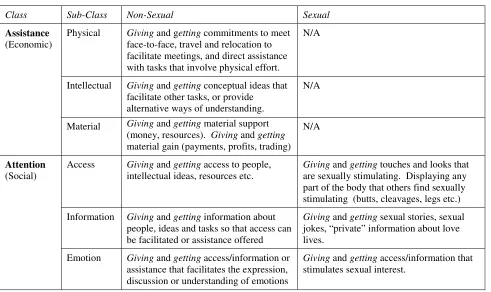
[image:18.595.67.558.210.502.2]I will classify all the behaviours in more detail after the next block of empirical data, but for now let me define a framework within which to understand what is emerging.
Table 1 – Dynamics of Relationship Formation
Class Sub-Class Non-Sexual Sexual
Assistance
(Economic)
Physical Giving and getting commitments to meet face-to-face, travel and relocation to facilitate meetings, and direct assistance with tasks that involve physical effort.
N/A
Intellectual Giving and getting conceptual ideas that facilitate other tasks, or provide alternative ways of understanding.
N/A
Material Giving and getting material support (money, resources). Giving and getting material gain (payments, profits, trading)
N/A
Attention
(Social)
Access Giving and getting access to people, intellectual ideas, resources etc.
Giving and getting touches and looks that are sexually stimulating. Displaying any part of the body that others find sexually stimulating (butts, cleavages, legs etc.)
Information Giving and getting information about people, ideas and tasks so that access can be facilitated or assistance offered
Giving and getting sexual stories, sexual jokes, “private” information about love lives.
Emotion Giving and getting access/information or assistance that facilitates the expression, discussion or understanding of emotions
Giving and getting access/information that stimulates sexual interest.
In the next set of data, I examine the role of both non-sexual and sexual attention in the bonding of teams, and develop a more detailed classification of behaviours.
3.4
Relationship Maintenance
Andy met Ben at the company’s culture classes but had not seen him at work. He later learned that Ben had decided to attend the classes during the final weeks of his convalescence – he had been sick:
Ben told me he had been off for six-months. He was very open with me and said he’d had a breakdown. He was pleased to be back - it is evidence that the company sticks by staff that have difficulties. I’m not sure what caused his illness. 33
33
! , " #$ % & '
Andy and Ben quickly struck up a workplace friendship and for the duration of the project Ben acted as a key informant for Andy. As a worker inside the “support services” team, Ben was an invaluable contact, but care should be taken in interpreting his contribution because of his closeness to the management function. He was, throughout the period, having a challenging time in his personal life and the reasons gradually become clear.
Carol joined the company while Ben had been on sick leave, but they met at the company’s “culture classes” before Ben’s official return to work. Andy also attended these as part of his critique of the company’s culture and picked up from Ben details of his first encounters with Carol:
(After Class 1) There was one young woman - probably about 30 years old - sitting opposite who looked at me quite a lot. We gave each other a big smile at one point. I don't know her name or what she does yet. 34
(After Class 2) Carol is the name of the woman who smiled quite a lot at me in the first class. Even though she sat herself down at the far end of the table (as far away as it was possible to be from me) we acknowledged each other and instinctively gave each other a wave. This strikes me as odd behaviour on both our parts because neither of us have spoken to the other yet and I still don't know what she does. Later, when I was getting a coffee and everyone was readying themselves for the continuation of Harry's talk, she very noticeably (to me) turned around to look at me and smiled - I instinctively smiled back. I'm unsure of her reason for giving me attention, but I am conscious that I find her attractive. 35
Ben was struck by Carol’s body language. He claims that she swung her whole body around directly towards him while others remained seated at the table. She was wearing jeans and lent back in her chair in such a way that Ben felt “nervous”. While he “definitely liked” the attention it also made him “uncomfortable” and he did not talk to her36. Ben claims that the dynamics between himself and Carol continued at each successive culture class and continued upon his return to work until he was convinced she was flirting with him37. He recalls that the attention was “nice” and “one of the reasons I enjoy coming into work”38.
34
FileRef: JN1, Para 758
35
FileRef: JN2, Para 1113
36
FileRef: JN1, Para 1115
37
FileRef: JN2, Para 107, 1157, 1187-1189, and especially 1229-1231 when Ben reports that “she came right over
to the desk where I work and looked directly at me while she smiled. I held her look until I felt a rush of
adrenalin go right through me. I thought she was coming onto me.”
38
" #$ % & ' - !
He also found that Carol was not completely committed to the company.
Carol was ambivalent towards work. Initially she said that she was working at Custom Products "until something better comes along". I took this to mean that she did not much care for the work. However, later, when I asked where she worked before she commented that she'd worked many places before coming here and added: "I like it here, so I’m staying." She’s still undecided what she wants to do in the long term. 39
At this time, Ben’s marriage was suffering the after effects of his wife having an affair.
Reconciliation was made more difficult by his wife’s ongoing contact with her former lover, and (as evidenced here) Ben’s own tendency to grow close to attractive women inside work40. However, during this period (March 2003), Ben talked positively about the relationships he had developed since returning to the workplace, and the effect it was having on his self-esteem:
People are bonding inside the team. I went and got a card and cakes for Hayley’s birthday and when I gave them to her she gave me a hug 41. Then I told her I had not had a good weekend. I was a bit cautious at first - I said all marriages have their problems - but then she opened up and told me about her mother having breast cancer and how this had affected her and her family over the last decade. I found myself explaining in more detail about what had happened at home.
We listened to each other - I think this isn’t anything more than friendship - but it was nice to talk a bit. I did feel the need to talk. I just feel closer and closer to people at work. This weekend I got Carol a card because I like the way she smiles at me. I was a bit nervous about that but after the weekend I’ve had, I just thought “what the hell”.
These are little things - people are letting each other into their life a bit. This opening up is not just within our team - we had a drink after the culture class. We were all chatting away and talking about Diane’s son and the great battle she has over his schooling. I think she needed to get it off her chest. She says that she does not get out for a drink often, which (laughs) means that maybe I’m bringing her out of herself, I don’t know, because she’s been out for a drink several times with me.
John was also there, and he opened up about the past. Harry and some other directors all have PE degrees (John, Harry and even Reecey). They have this common bond between them through an interest in athletics. Lots of people opening up and getting to know each other better, talking about themselves and their past. I would have talked more privately to Diane if I’d had the chance, but with other people around I thought I would wait. I could tell that she needed to let things out, so I let her, but I do want to talk to her about things before I tell her of my decision.42
39
FileRef: JN2, Para 465
40
FileRef: RV01, Para 85. Andy recorded that “Ben thinks women latch onto him because he is a good listener
(and also, in my opinion, because he is good looking). He comes across to me as a very private person who does
not go out much. The question here is who is doing the chasing!” Andy checked this directly later (JN3, para
997) and asked if he warranted a reputation as a “ladies’ man”. After a moment’s thought Ben said “I think it is
unfair, but yes, I can see why people would say that.”
41
Hayley was a temporary female worker who had joined the HR team to assist with a training evaluation.
42
! " #$ % & '
Ben’s motives for sending a card to Carol would – 10 months later - become central to a conflict between himself and his manager. At the time, Ben told Andy and later told John. Andy also discussed it – in the context of a discussion about workplace relationships - with John. Inside the card, Ben invited Carol for a drink and suggested they meet after the final culture class. In the card he gave her his mobile phone number but when she did not respond, he decided to invite Harry, John and Brenda instead. Ben reports that Carol stopped flirting for a while but later they resumed
“smiling” at each other43.
Hayley, in the week before the end of her temporary contract started to pay Ben more attention.
Darling Hayley. She kept coming up and interrupting me from time to time. I’m sure she didn’t need to, she just liked to. She was wearing a lovely black top today so I didn’t mind being interrupted by her at all. We had lunch again, and again I felt - just like yesterday - that there was a bit of sexual banter going on. I was having a coffee with Diane - we were talking about the night out for her leaving do, we ... I was asking her if she was going to get an outfit (she said “yes”, and I said that I might get one). We were talking about the fact that she was unable to stay over the night. She asked me if I would walk her back to her car - and she gave me such a look that I began to wonder what would happen if I did. 44
Ben confided in Andy that he was considering breaking off the relationship with his wife45 because he felt that the environment at Custom Products gave him the support he needed to make a
substantial change in his life. The consequent domestic arguments led to his moving into a separate bedroom for several months46 and his coming into work upset.
That morning I went into work. Both Diane and Hayley could see I was upset. Diane was very supporting and comforting. She held my hand and gave me a hug. She gave me her home number and said I could kip at their place if I needed to. I don’t think I will need to but it is lovely that she offered this because it is unpredictable how things will unfold in the coming weeks. Most of my focus was on Diane at that time. I could see that Hayley felt bad for me and wanted to talk too. When I came out of the meeting, I touched Hayley - that’s not the right way to put it - I put my hand on her shoulder and said that I would talk to her at lunch time.
At lunch I talked with Hayley and opened up about what had happened - not massively - but enough to know what had happened at home. She was very kind. She amusingly talked about my need to get back into the dating game. I said that I thought I would wait a bit before I do that. She kept telling me that I “wouldn’t be lonely” and that I would have “no trouble”. I said that I got frustrated with the games men and women play, sometimes even when they don’t know it. She looked at me knowingly and said “Oh yes, men and women know
43
JN2 Para 1518, JN3 Paras 239 (“smile still there”), 527, 608, 807.
44
FileRef: JN2, Para 1392, 1414, 1480
45
FileRef: STP1 – Document 45, see also JN2, para 169.
46
FileRef: STP1 – Document 45. Ben comments that he is not looking for relationship, but that the friendly
" #$ % & ' !
when they are playing games”. I particularly remember her eyes as she said this - they became very narrow and quite piercing. 47
Once this news circulated around the company, others offered their consolations and help. Harry, the MD, wrote to Ben personally48 and John took Ben out for a drink to give him support. As Ben was already socialising with Harry, John, Diane and Hayley on a regular basis, he decided to invite Brenda to these social evenings49. Ben had been reticent to do so due to a perception that Brenda had conflictual relationships with her subordinates50. Having picked up negative comments from Hayley and others, he also found Brenda was unpopular with women across the organisation:
When I was at lunch - the subject of Brenda working long hours was the topic of conversation. Larissa said that she went late and got in early in the morning. One night Larissa left at 8.30pm and Brenda was still there. She saw Brenda again at 7.30am the next morning and asked if she had bothered to go home. I can see this from both sides, that Brenda loves her work, enjoys her responsibility, is not married any more and does not have a man in her life. Why shouldn’t she want to work long hours to develop her career? But [someone else] said “That Brenda! Why doesn’t she get a life?” That was quite strong I thought.
Andy thought this may be sexism, particularly as staff did not criticise John for working long hours in the same way.51
From Friendship to Flirting
The formal relationships between Brenda, Diane and Ben started to change shortly after Ben informed the whole departure about his changed circumstances at home. As I outline below, there are discernable changes in virtually all the relationships Ben had with his immediate colleagues but it took him some time to realise this. He continued to grow closer to Diane through talks at the pub about work and home issues. They both had two children and Ben supported Diane through a difficult period with her daughter, while Diane gave Ben support to work out things in his marriage:
47
FileRef: JN2, paras 1360-1368
48
E-mails: Harry to Ben, 26th April, Ben to Harry, 6th May
49
E-mails, Brenda to Ben 3rd April, Ben to Brenda 3rd April.
50
FileRef: JN2, Para 1165, 1330, 1396. Andy recorded Hayley’s comment that whenever Brenda said “can I have
a word?” she felt she was being disciplined. He followed this up – indirectly – in telephone interviews and
identical sentiments (see CP2004, paras 3233-3253) were expressed. Hayley also reported feeling she was low
status and that Brenda was “all rhetoric” when it came to the company’s commitment to “equality of respect”.
51
! " #$ % & '
Diane was smashed at this point, but we talked very openly. She was arguing that because of the Data Protection Act “you can’t say anything to anyone unless they need to know” because you are in breach of the Act. We talked about the problems of divulging financial information. Under the Data Protection Act it is considered private. I asked how can we validate the fairness of a pay system if the information has to be kept private? I found there were anomalies in the pay system (that two directors were paid more than the maximum in the policy presented to staff) and that this could never be exposed if this information was kept private. It was quite a debate. 52
Ben found that his female colleagues not only showed concern about his situation, but that they took a keen interest in his immediate plans:
I’m not sure how we got onto the subject, but now my situation is known, they asked me some questions about how I felt. I said that I expected to have a period on my own - I’d been like that before - and Diane said something similar to Hayley’s comment that “I wouldn’t be lonely” (Pause…as if trying to work something out)…. in fact she said that to me at the pub the other week - but she fleshed it out a bit this time, which was that people had been asking about me, about whether I was married, about my children. Brenda was there while this was being said. 53
After Hayley’s departure from the workplace, Ben found that Brenda opened up much more and talked about commitment to her career.
What I got from talking to Brenda was how passionate she is about the whole “community” thing. She really believes in it, that we are building something worthwhile. I do too. (Curiously – as if working something out) There was something strange, however, in the way she was asking me “how do you think you are going down?” She told me that I had no sense of status, and that I did not seem to appreciate the impact I was having. From the way she looked at me, I don’t think she was talking only about my work.54
Ben continued to socialise with Diane and Brenda outside work, and occasionally took up Diane’s offer to stay the night so that he could drink. Over one late night coffee, Diane again commented on his “admirers”:
It was the small hours. We were going to go back to Brenda’s to open a bottle of whiskey but were too tired and decided to go. The whole evening unfolded how I like it...good meal, good company, lots of chat, and as the evening winds down round a table, everyone drunk, talking about how you feel, talking to each other in ways that you don’t talk in the workplace when you feel inhibited.
We had a coffee and talked on a much more personal level. Diane said again that I have some admirers. I asked if she’d tell me but she wouldn’t. She explained that this was part of the way the Data Protection Act worked, that if she told me and something happened that she could be personally liable. I said that the kids have to come first, but that I don’t want to turn down the chance of any interesting friendships. I said that if anyone asked again, that she had my permission to say that I was unhappily married.55
52
FileRef: JN2, Para 1484
53
FileRef: JN2, Para 1383
54
FileRef: JN2, Para 1476
55
" #$ % & ' ( !
Ben does not seem to be fully aware of the dynamics that are going on around him at the time, but in the conversations he later had with Andy, he did start to reflect on the meaning of people’s
behaviour. One incident concerned him quite deeply, and this caused much greater reflection:
Brenda. (Pause). The barriers have definitely come down ... I have one or two worries about an e-mail I sent. We have been open and complimentary. I said that I found her very sharp and thrive on the feedback she gives. She said that she was “so pleased” that I had come back to the company. She talked about Fred. He’d sent an e-mail which just said “Thank you”. Brenda sent one back saying “What for?” Fred just said: “Ben” so she is very happy with my work at the moment.
I can’t generalise. The place is impacting on me now I’m back. Not to put to fine a point on it, Hayley is a beautiful woman and she really took to me. As for Brenda, she’s been supportive and I find myself respecting her more. I sent an e-mail because we are building up a clutch of things that it would be good to discuss outside work, so I said that maybe it is the time to go down the pub with John. But Brenda, the next day, seemed glowing with excitement. I think she was flattered by my invitation. She came in wearing a low-cut top and I think she’s trying to flirt with me. She’s smiling much more at me. Staring at me. When I reflect about things, about the way she was very complimentary at Hayley’s leaving party, being very open, and standing close up, I just...(pause)....well, she has my respect but I don’t fancy her. I hope that...I hope....this might sound crazy but this is affecting me because I don’t know how to go into work now. It bothers me because I don’t want a complicated relationship with my director. I hope she doesn’t think I’m asking her out on a date. All this...all this attention....is changing my self-perception and also making it difficult for me at work. I think, maybe, I am more likeable and attractive than I think I am.56
A few weeks later, as things started to settle at home, Ben mentioned to Diane that he had registered himself on an Internet directory. A woman writer had contacted him and they had started
corresponding. He found Diane’s reaction quite peculiar.
It made me think back over my own behaviour. I can’t understand why she would say “look, you are not going to find love here”. I liked people but did not generally make comments to them or about them. It made me self-conscious and I felt vulnerable. Another man has been sacked for comments he’d made about women’s attractiveness and I’m now worried that I’ve made a couple of comments to Diane about finding one or two people attractive. I can’t imagine a woman would ever be taken up on this if she made comments about men. 57
Ben later discussed this man’s sacking with John and Andy and also talked about it to Brenda in his job appraisal. His concern over Diane’s comment was fuelled by feedback from Brenda. Hayley told Ben that Brenda may like him and be jealous of the way the two of them had flirted58. When Andy learned of this, and considered Diane’s behaviour when he first met her, he felt there was an inconsistency in the way people were being treated. He took up these issues in discussion with John59 and reflected on them:
56
FileRef: JN2, Para 1470, 1505-1507, see also RV01, Para 53.
57
FileRef: JN3, Para 164
58
FileRef: RV01, Paras 69-76, Ben and Hayley e-mailed each other about Ben’s appraisal.
59
! ) " #$ % & '
Ben mentioned his feelings to me about the male worker who lost his job. He also mentioned Brenda’s reaction when he discussed his flirting with Hayley during his job appraisal. He felt that it has not gone unnoticed but that they’d let it pass. He didn’t say it to Brenda … but he’s worried about his position because he probably behaved more “inappropriately” (in Brenda’s view, not his own) than a man who was sacked [for making complimentary remarks about the way women looked]….What came out is that Brenda felt flirting in the workplace is problematic. She’s saying what a manager must say, I guess, but it does not sound as if she is blameless herself. Brenda feels managers/senior people must be extremely careful, that flirting is not worth it “unless you feel someone is really special”. I went away - thought about it – and thought about John’s view that this is unfair and inconsistent. Brenda feels managers must behave differently but that does not square with the policy on fairness, consistency, gender equality etc. Why must managers (and men?) behave differently? 60
During Andy’s own induction, Diane had commented enthusiastically on the quality of John’s “butt” but was now criticising Ben for responding to her comment that he had “admirers”. Andy also gave regard to Ben’s comments that Brenda and Diane appear to have discussed his “flirty” behaviour and contrasted this with Ben’s descriptions of Brenda (and possibly Diane) trying to flirt with him. Indeed, given that Brenda’s earlier flirting impacted substantially on Ben, Brenda’s comment that a manager should only flirt if they “feel someone is really special” might be another subtle attempt to communicate her feelings to him. Andy felt that Ben’s behaviour was now being monitored quite closely and that John’s comment regarding a “dual-standard” with regard to sexual behaviour may have some substance. He also felt that Diane’s sensitivity to Ben’s interest in someone outside work might be an indication of jealousy.
In summary, the dynamics surrounding Diane, Hayley, Ben and Brenda illustrate both how a team can develop intimate friendships, but can also experience tensions when changing circumstances outside work affect relationships inside work, and vice versa. In the section below, I review these dynamics and further develop the framework to increase understanding of relationship dynamics.
4.
Analysing Interpersonal Dynamics in a Work Team
Firstly, a few critical reflections on the data. Much of it comes from Ben and Andy, which skews the perspective. While this provides good access to a male perspective, the data available for counter-perspectives is weak. Ben reports that the women looked at him a lot, but to notice this he must have been looking at them! We do not have contemporaneous data on the impact that his behaviour had on Brenda’s, Hayley’s, Carol’s and Diane’s feelings, although their actions suggest that they all wanted some kind of close relationship with him.
60
" #$ % & ' ! !
In Brenda’s, Hayley’s and Carol’s case, there are indications that their interest is partly sexual, but this is much more ambiguous in Diane’s case although her repeated comment about Ben’s
“admirers” might indicate interest. Nor do we know if any of the parties were game playing (Berne, 1964) or had a serious intent. Because we have better data on Ben’s feelings, we can be more confident that his sexual interest was in Carol and Hayley, and not Brenda and Diane, but in none of these cases does he appear to want to develop this interest beyond mild flirtation.
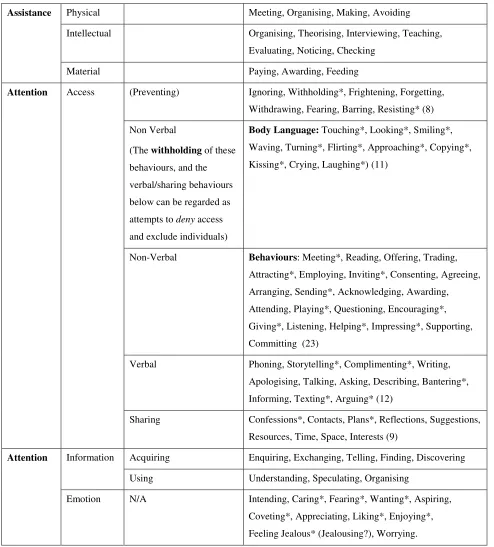
Table 2 identifies the behaviours observed during these interactions to provide a fuller picture of the way communication takes place between parties in a relationship. The framework for understanding relationship formation was developed using the Grounded Theory method of open and selective coding (see Locke, 2001). Empirical data was analysed with NVivo and a wide range of behaviours were identified. These were progressively reorganised as a result of giving presentations and
receiving feedback (to peer groups, conferences, academic associations, research participants and project supervisors). After several months, the core categories of attention and assistance emerged, and the lower levels were formalised when sub-categories were merged together.
The detailed table of behaviours below was developed using a verification process (Glaser and Strauss, 1967). This involved cutting and pasting empirical data into NVivo and analysing the behaviours observed to check they could still all be assigned to the framework61. The data was analysed until “saturated” (Glaser and Strauss, 1967; Locke, 2001) to establish the rigour of the framework and provide a comprehensive view of the ways people act during periods of relationship formation and group bonding.
61
! * " #$ % & '
Table 2 – Linking Behaviours to Relationship Dimensions
The core behaviours are characterised by a range of actions, many of which are non-verbal. Those marked with an asterisk (*) might indicate sexual interest, or be interpreted by the recipient as such.
Assistance Physical Meeting, Organising, Making, Avoiding
Intellectual Organising, Theorising, Interviewing, Teaching,
Evaluating, Noticing, Checking
Material Paying, Awarding, Feeding
Attention Access (Preventing) Ignoring, Withholding*, Frightening, Forgetting, Withdrawing, Fearing, Barring, Resisting* (8)
Non Verbal
(The withholding of these behaviours, and the
verbal/sharing behaviours
below can be regarded as
attempts to deny access
and exclude individuals)
Body Language: Touching*, Looking*, Smiling*, Waving, Turning*, Flirting*, Approaching*, Copying*,
Kissing*, Crying, Laughing*) (11)
Non-Verbal Behaviours: Meeting*, Reading, Offering, Trading, Attracting*, Employing, Inviting*, Consenting, Agreeing,
Arranging, Sending*, Acknowledging, Awarding,
Attending, Playing*, Questioning, Encouraging*,
Giving*, Listening, Helping*, Impressing*, Supporting,
Committing (23)
Verbal Phoning, Storytelling*, Complimenting*, Writing,
Apologising, Talking, Asking, Describing, Bantering*,
Informing, Texting*, Arguing* (12)
Sharing Confessions*, Contacts, Plans*, Reflections, Suggestions,
Resources, Time, Space, Interests (9)
Attention Information Acquiring Enquiring, Exchanging, Telling, Finding, Discovering
Using Understanding, Speculating, Organising
Emotion N/A Intending, Caring*, Fearing*, Wanting*, Aspiring,
Coveting*, Appreciating, Liking*, Enjoying*,
Feeling Jealous* (Jealousing?), Worrying.
In the next section, I develop a theory of social influence, and the way that seeking / avoiding
" #$ % & ' + !
party in a relationship. I will explore how these can come into conflict to induce anxiety while a person explores how to overcome contradictions.
4.1
Developing a Theory of Social Influence
The above framework is useful for identifying the behaviours taking place in an organisational context, and the role they play in relationship building. In this section, I discuss the way that they indicate the intentions of one party towards another and the impacts that these intentions have on everyday decision-making. In the above interactions we can observe the following:
1) Andy and Ben increase the attention they give each other from the outset of their relationship and maintain it through both work and personal contact.
2) Ben assists Andy with his consultancy project. Andy assists Ben with reflecting on changes in his life.
3) Carol initially increases the attention she gives to Ben and he eventually responds and increases the attention he gives to Carol. She then decreases her level of attention, and Ben responds by decreasing his attention as well.
4) John and Harry periodically increase the attention they give Ben after news of his marriage collapse. 5) Diane, Hayley and Brenda all increase the attention they give Ben after his marriage collapse, and Ben
accepts the increases from Hayley and Diane, but decreases the attention he gives Brenda and considers withdrawing further.
6) Nearly all the parties increase the emotional support they give each other over the period this data was collected (the exception being Carol who does not attain this level of closeness with any of the others in this sample).
While these behaviours can be observed, the question is why? The obvious answer – at the highest level at least – is that parties are constantly probing each other, or responding to the probing of others, and adjusting their behaviours to determine the levels of intimacy that both parties are comfortable with. The direction of change is perhaps the most relevant as this indicates the overall intention of one person towards another in the current context. Longer-term intentions, or behaviour in other contexts, are impossible to gauge.
! , " #$ % & '
that Harry and John withhold information from each other about their private lives, indicating that perhaps they are not as close as is sometimes perceived62.
Another aspect of the dynamic is that parties drift from one person to another. For example….
1) Ben increases the attention he gives Diane, Hayley and Carol as he decreases the attention he gives his wife.
2) Ben increases the attention he gives Brenda, but when Brenda gives him attention he does not want, he decreases it again and increases the attention he gives Hayley and Diane.
3) Brenda and John decrease the attention they give to people outside work to increase the attention they give to people inside (to further their careers).
4) Others comment that Brenda should decrease her attention to her career in order to “get a life” (i.e. conform to their ideals rather than her own and increase the attention she gives to others outside work).
Overall, what comes across from this data is the inseparability of personal/professional domains, and how they combine to determine commitment levels not just to the workplace, but also to
colleagues and people outside the workplace. There is not a seamless distinction between work and home, and impacts ar