DEVELOPMENT OF FAST RELEASE FORMULATION FOR
DISSOLUTION RATE ENHANCEMENT
Versha Patel, *Arun Patel, Shailendra Patel, Neeraj Kaurav and Neelesh Devedi
Shri Ram Group of Institution, faculty of Pharmacy, Jabalpur 487001 (M.P.) India.
ABSTRACT
The present work are to enhance the drug loading capacity in liquisolid
system, increase the flow property due to decrement in required
volume of nonvolatile solvent and enhance the solubility of drug in
nonvolatile solvent by using mixed solvency concept. Naproxen was
selected as model poorly water soluble drug for exploring the mixed
solvency concept to enhance the solubility and hence to enhance the
release rate of drug. The proposed formulation is aimed to enhance
solubility of naproxen by employing mixed solvency concept and to
develop the fast release capsule of naproxen by using liquisolid
technique.
KEYWORDS: Liquisolid system, Naproxen, mixed solvency concept.
INTRODUCTION
There are following approaches can be employed to enhance the aqueous solubility of poorly
soluble drugs.[2]
Alteration of pH Use of co solvents
Effect of dielectric constant Use of surface active agents Complexation
Hydrotropic solubilization
Chemical modification of the drug
Volume 6, Issue 9, 493-511. Research Article ISSN 2277– 7105
*Corresponding Author
Arun Patel
Shri Ram Group of Institution, faculty of Pharmacy, Jabalpur (M.P.) India.
Article Received on 27 June 2017,
Revised on 17 July 2017, Accepted on 07 August 2017
DOI: 10.20959/wjpr20179-9162
The above mentioned approaches have been used widely in various fields of pharmacy. However, applications of „Hydrotropic‟ and „Mixed Hydrotropic Solubilization‟ have not
been explored to appreciable extent in various fields of pharmacy.
Mixed Solvency
Mixed solvency approach has been applied for enhancement of aqueous solubility of poorly
water soluble drug .All substances whether liquids, gases or solids possess solubilizing power
and hence concentrated aqueous solution containing various dissolved substances can also
improve the solubility[1] of poorly water soluble drugs.In supercritical fluid technology
liquefied carbon dioxide acts as solvent for many insoluble substances. These points indicate
that all substances possess some solvent character.[3,4]
Application
In Pharmaceutical Analysis
In Pharmaceutical Formulation Development
Methods employed for developing Fast-release Dosage form[5]
Most conventional oral drug products, such as tablets and capsules, are formulated to release
the active drug immediately after oral administration, to obtain rapid and complete systemic
drug absorption. Such fast-release system results in relatively rapid drug absorption and fast
onset of action. There have been a number of formulation approaches explored and widely
practiced in the pharmaceutical industry to improve delivery of poorly water soluble
compounds especially in development of fast release dosage forms. These delivery
approaches are based on various techniques, such as Particle size reduction
Formation of the prodrugs/ salts Use of co-solvent
Complexation with the excipients such as cyclodextrin Solid dispersion
Liquisolid dispersion
Liquisolid Technique[6]
Liquisolid technique is the most promising method for promoting dissolution rate of poorly
water-soluble drugs. liquisolid compacts were evolved from Powdered Solutions‟ which
solvent, which was carried out on the extensive surface of an inert carrier such as silica. “Liquisolid system refers to formulations formed by conversion of liquid drugs, drug
suspensions or drug solution in non-volatile solvents into dry, nonadherent, free-flowing and
compressible powder mixtures by blending the suspension or solution with selected carriers
and coating materials”. Liquisolid system is a novel concept of drug delivery via oral route.
This technique is applied to water insoluble drugs and lipophilic drugs to sustain their
release.[7]
General method of preparation of Liquisolid[6]
A drug substance is initially dispersed in the nonvolatile solvent systems (Polysorbate 80,
PEG-200) termed as liquid vehicles with different drug: vehicle ratios. Then a mixture of
carrier or different polymers and excipients is added to the above liquid medication under
continuous mixing. Then to the above binary mixture the disintegrant like sodium starch
glycolate and other remaining additives are added and mixed for a period of 10 to 20 min.
The final mixture is compressed in the formulation of tablets (or encapsulated in hard gelatin
capsules) using the tableting machine. The final liquisolid granules are characterized for
[image:3.595.186.408.444.614.2]solubility, dissolution,flowability, compressibility and other physicochemical properties.
Fig. 1.3: Flow diagram of liquisolid system[8].
2. Advantages [6,9]
Liquisolid systems are low cost formulations than soft gelatine capsules.
Drug release can be modified using suitable formulation ingredients Drug can be molecularly
dispersed in the formulation.
Capability of industrial production is also possible.
Enhanced bioavailability can be obtained as compared to conventional tablets.
3.Applications [6]
Solubility and Dissolution Improvement Flowability and Compressibility
Designing of Controlled Release Tablets Bioavailability Enhancement
4.Evaluations [6]
Flow Behavior
Angle of Repose
Differential Scanning Calorimetry (DSC)
Powder X-Ray Diffraction
Scanning Electron Microscopy (SEM)
Dissolution Testing of Liquisolid Formulations
Material and Methods
Drug- Naproxen
Propylene glycol solvent
Microcrystalline amorphous cellulose-(Avicel PH 102 carrier
Silicon dioxide-(Aerosil 200) coating material
PVP, PEG,SB (diff. grade) solubilizer
Tween 80 Dissolution media
Preformulation studies of Naproxen
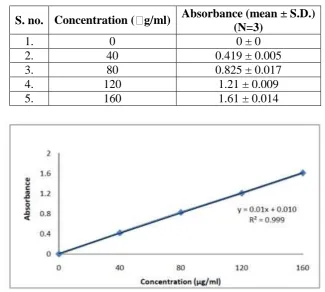
Calibration curve of Naproxen in Methenol
Accurately weighed quantity of naproxen (50 mg) was dissolved in about 35 ml of methanol
in 50 ml volumetric flask and the volume was made upto 50 ml by methanol. The
concentration of this resulting solution (stock solution) was 1000 µg/ml. Aliquots of the
above solution were taken and diluted with methanol to get naproxen concentration in the
range of 40-160 µg/ml. The resulting dilutions were analyzed at 332 nm on Shimadzu -1700
UV spectrophotometer against methanol blank. The absorbance data are shown in the table
Table 1: Calibration curve data of naproxen in methanol at 332 nm.
S. no. Concentration ( g/ml) Absorbance (mean ± S.D.)
(N=3)
1. 0 0 ± 0
2. 40 0.419 ± 0.005
3. 80 0.825 ± 0.017
4. 120 1.21 ± 0.009
5. 160 1.61 ± 0.014
Fig. 1: Calibration curve of naproxen in methanol at 332 nm.
Determination of Solubility
About 5 ml of D.M. water was taken in a vial and excess amount of drug was added. The vial
was sealed with rubber closure and aluminium seal. It was shaken for 12 hr in Orbital Flask
Shaker (Khera Instruments Pvt. Ltd., India) and allowed to equilibrate for 24 hrs in
undisturbed condition. Then the solution containing the excess undissolved drug was
centrifuged at 2200 r.p.m. for 5 minutes in ultra-centrifuge and was filtered through Whatman
grade 5 filter. Aliquot was suitably diluted with demineralised water and analyzed using UV
spectrophotometer at 330.0 nm. Same procedure was repeated for remaining solvent except
one thing in case of viscous solvent like PEG 200, 300, 400 and PG (these were not filtered
after centrifuge and clear supernatant were taken with the help of micropipette from
Table 2: Solubility of naproxen in various solvents.
S.no. Solvent Solubility of naproxen (mg/ml)
1 D. M water 0.0855
2 SGF 0.0241
3 Ethanol 41.097
4 Methanol 53.277
5 PEG 200 81.463
6 PEG 300 118.848
7 PEG 400 111.979
8 Propylene glycol 33.585
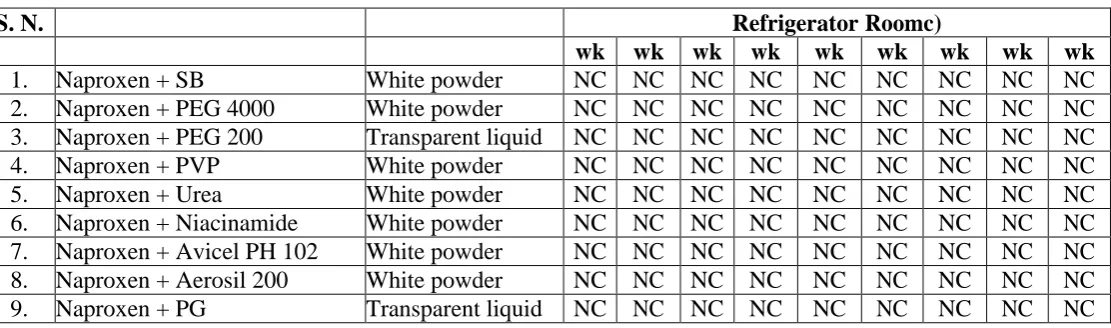
Drug excipient interaction study
This study was performed to determine any physical change in the drug when kept in contact
with solubilizers/excipients under different storage conditions for one month. Drug and
solubilizers/excipients were mixed in 1:1 ratio and divided into three parts. These parts were
sealed in vials and kept under different conditions. Two vials of each sample were kept at
room temperature, in the oven at 40ºC and in refrigerator for one month period. After every
seven days for one month, the vials were withdrawn and any change in physical appearance
and color of the contents were observed. The observations are recorded in table
Table 3: Physical interaction studies of drug with solubilizers/excipients.
S. N. Refrigerator Roomc)
wk wk wk wk wk wk wk wk wk
1. Naproxen + SB White powder NC NC NC NC NC NC NC NC NC
2. Naproxen + PEG 4000 White powder NC NC NC NC NC NC NC NC NC
3. Naproxen + PEG 200 Transparent liquid NC NC NC NC NC NC NC NC NC
4. Naproxen + PVP White powder NC NC NC NC NC NC NC NC NC
5. Naproxen + Urea White powder NC NC NC NC NC NC NC NC NC
6. Naproxen + Niacinamide White powder NC NC NC NC NC NC NC NC NC
7. Naproxen + Avicel PH 102 White powder NC NC NC NC NC NC NC NC NC
8. Naproxen + Aerosil 200 White powder NC NC NC NC NC NC NC NC NC
9. Naproxen + PG Transparent liquid NC NC NC NC NC NC NC NC NC
NC – No change, wk - Week
SB – Sodium Benzoate, PG – Propylene glycol
Development of Fast-release Formulation
1. Selection of solvent
Development of fast release formulation by liquisolid system, a non-volatile solvent is
[image:6.595.24.580.432.596.2]and not highly viscous organic solvent systems like propylene glycol, liquid polyethylene
glycols, polysorbates, glycerin etc.
Drug should be in dispersion or solution form in non-volatile solvent. If it is in solution form
then chances of fast dissolution will be more.
PEG 200 was selected as non-volatile solvent but since it was not found good solvent for
sodium benzoate &niacinamide, therefore 20% water was incorporated to enhance the
solubility of sodium benzoate &niacinamide in PEG 200.
Propylene glycol was found a good solvent for PEG 4000 & PVP (M.wt. 40,000).
PVP 40,000 was used in complete experiment.
Solubility can be increased by mixed-solvency concept and either increases the drug loading
capacity in system or decreases excipients ratio to achieve free flow of formulation and make
them as a strong solvent for naproxen
Selection of carrier material
Carrier material should be porous which has sufficient absorption properties such as
microcrystalline and amorphous cellulose, which has to contribute in liquid absorption.
Literatures revealed that microcrystalline cellulose has greater absorption capacity and hence
it is first line material for liquisolid technique.
Avicel PH 102 was selected as the carrier material after thorough literature survey.
Selection of Coating material
Coating material should be very fine and possessing highly adsorptive property such as
various types of amorphous silicon dioxide (silica). Coating material contributes in covering
the wet carrier particles and adsorbs excess liquid and gives the dry looking powder. Due to
coating material, flow property of liquisolid mass also increases.
Aerosil 200 was selected as the coating material after thorough literature survey.
Effect of various parameters on Dissolution rate of Liquisolid Dispersion
Various parameters effect the dissolution property of liquisolid system. Effect of following
Type of Non-Volatile Solvent System
Two non-volatile solvents, blend A [PEG 200: Water (8:2)] and propylene glycol were
selected to observe the effect on dissolution rate of liquisolid system.
Type of Solubilizers And Drug Loading
Effect of solubilizers on dissolution rate of liquisolid system was also studied. Different
solubilizers were taken in formulation and the effect on dissolution rate was observed.
Carrier to Coating Material Ratio
Effect of carrier to coating material ratio on dissolution rate of liquisolid system was also
studied. For this study 22:1, 18:1, 14:1 and 10:1 ratio of carrier to coating material were taken
in formulation.
Revolution Per Minute (Rpm)
50 and 100 rpm were selected to observe the effect of rpm on dissolution rate in liquisolid
system. USP apparatus –I (basket type) was selected for this purpose.
Dissolution Media
Simulated gastric fluid and simulated gastric fluid containing 0.75% v/v tween 80 were
selected to observe the effect of dissolution media on dissolution rate in liquisolid system.
Simulated gastric fluid containing 0.75% v/v tween 80 provided the sink condition.
Preparation of Liquisolid Dispersion
Preparation of Drug Solution
To prepare the drug solution, required quantity of non-volatile solvent blend A [PEG 200 :
Water (8:2)] or propylene glycol was taken in the vial. Solubilizers were added into this and
vortexing was done for 15-30 min. To dissolve solubilizers in propylene glycol, 30 min
heating was required at 50ºC after vortexing. After complete dissolution of solubilizers,
calculated amount of naproxen was added and vortexing was done for 15 min to dissolve it.
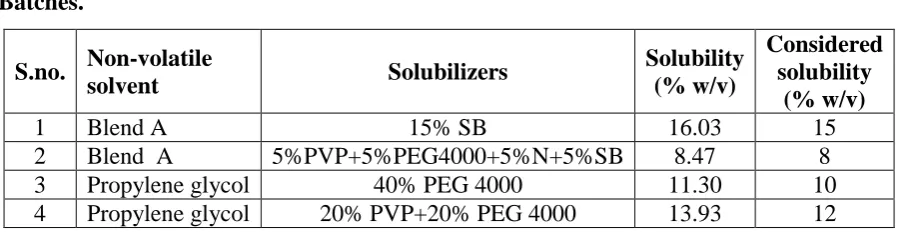
Table 4: Selected non-volatile solvent with different solubilizers for optimization of
Batches.
S.no. Non-volatile
solvent Solubilizers
Solubility (% w/v)
Considered solubility
(% w/v)
1 Blend A 15% SB 16.03 15
2 Blend A 5%PVP+5%PEG4000+5%N+5%SB 8.47 8
3 Propylene glycol 40% PEG 4000 11.30 10
4 Propylene glycol 20% PVP+20% PEG 4000 13.93 12
Preparation of Liquisolid mass
To prepare liquisolid mass, required amount of drug solution was taken in mortar and 1/3rd
portion of avicel PH102 was added into it and 10 min mixing was done using pestle. Rest two
parts of avicel were also added by geometric dilution method into it and mixed well for 10-10
min. Above powder mixture was taken out from mortar and required quantity of aerosol 200
as adsorptive material was taken in mortar. Small-2 portion of above powder mixture was
added and mixed well. The above powder blend was mixed with aerosil 200 by geometric
dilution method using pestle & mortar. After proper mixing about 30 min., the liquisolid
dispersion; so obtained, was passed through sieve no. 80.
Dissolution rate study
Dissolution tests are one of the most widely used tests in quality control of dosageforms.
Dissolution tests become especially important when dissolution is the ratelimiting step as in
the case of B.C.S. class II or B.C.S. class IV drugs.
In order to select the optimum batch of liquisolid dispersion for final formulation, dissolution
rate studies were performed. The ratio of carrier to coating material inliquisolid dispersion
with highest dissolution rate i.e. fastest dissolution was selectedfor preparing immediate
release of the final formulation.
Procedure
Required number of capsules containing liquisolid dispersion and pure drug equivalent to 50
mg of naproxen were tested in dissolution rate studies using U.S.P. XXIV (type I) dissolution
test apparatus (Model TDT6P, Electro lab Mumbai, India) with basket rotation at 50 and 100
r.p.m. Dissolution studies were conducted in two media, 900 ml of simulated gastric fluid
(pH 1.2) and simulated gastric fluid containing 0.75% tween 80 (pH 1.2). Temperature was
[image:9.595.73.525.99.215.2]filtered through Whatman grade 5 filter and analyzed for drug content spectrophotometrically
at 332 nm. Withdrawn samples were also replaced with fresh dissolution media. Calculations
for the amount of drug were done using respective regression equations.
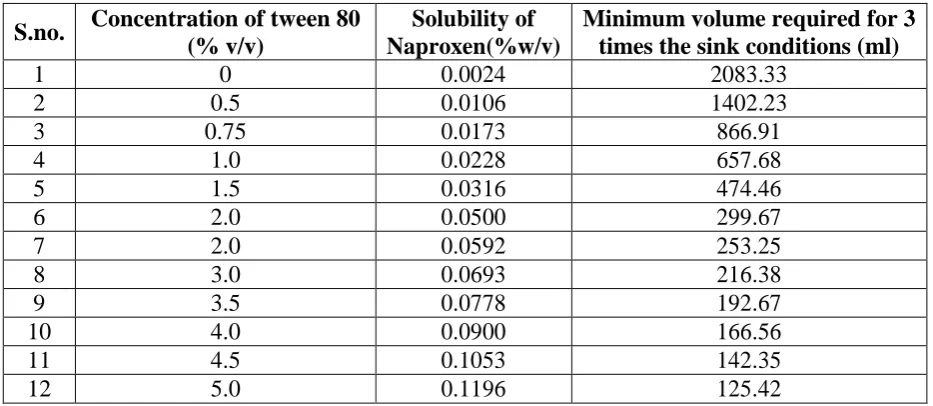
In order to obtain the sink condition for dissolution rate, solubility of naproxen was
[image:10.595.65.532.243.446.2]determined in SGF containing different concentration of tween 80. The results are shown in
table.
Table 5: Determination of tween 80 concentration in SGF for sink condition.
S.no. Concentration of tween 80
(% v/v)
Solubility of Naproxen(%w/v)
Minimum volume required for 3 times the sink conditions (ml)
1 0 0.0024 2083.33
2 0.5 0.0106 1402.23
3 0.75 0.0173 866.91
4 1.0 0.0228 657.68
5 1.5 0.0316 474.46
6 2.0 0.0500 299.67
7 2.0 0.0592 253.25
8 3.0 0.0693 216.38
9 3.5 0.0778 192.67
10 4.0 0.0900 166.56
11 4.5 0.1053 142.35
12 5.0 0.1196 125.42
Table shows solubility of naproxen at different concentrations of tween 80 in simulated
gastric fluid needed for sink condition. 0.75% v/v tween 80 was sleeted as a solubilizer to
provide the sink condition.
Optimization studies
Preparation of Different batches for optimization studies
Batches of liquisolid dispersion were prepared by the similar procedure which was described
in table shows the composition of different batches of liquisolid dispersion.
Blend A [PEG200 : Water (8:2)] as a non -volatile solvent and 15% sodium benzoate (w/v) as
a solubilizer was used for batches LSD1 to LSD4 for preparing liquisolid dispersion.
Blend A [PEG200 : Water (8:2)] as a non -volatile solvent and 5%PVP+5%PEG4000+ 5%N
+5%SB (w/v) as a solubilizers were used for batches LSD5 to LSD8 for preparing liquisolid
Table 7.1: Composition of liquisolid dispersion in different batches.
S. no.Batch
code Carrier : Coating
Quantity taken
Aerosil (mg)
Total weight
(mg) *Drug solution
(w/v) (mg)
PH102 (mg)
1 LSD1 22:1 191.5 818.4 37.2 1047.1
2 LSD2 18:1 191.5 669.6 37.2 898.3
3 LSD3 14:1 191.5 520.8 37.2 749.5
4 LSD4 10:1 191.5 372.0 37.2 600.7
5 LSD5 22:1 372.0 818.4 37.2 1227.6
6 LSD6 18:1 372.0 669.6 37.2 1078.8
7 LSD7 14:1 372.0 520.8 37.2 930.0
8 LSD8 10:1 372.0 372.0 37.2 781.2
9 LSD9 22:1 208.0 818.4 37.2 1063.6
10 LSD10 18:1 208.0 669.6 37.2 914.8
11 LSD11 14:1 208.0 520.8 37.20 766.0
12 LSD12 10:1 208.0 372.0 37.2 617.2
13 LSD13 22:1 245.0 818.4 37.2 1100.6
14 LSD14 18:1 245.0 669.6 37.2 951.8
15 LSD15 14:1 245.0 520.8 37.2 803.0
16 LSD16 10:1 245.0 372.0 37.2 654.20
*Weight of drug solution containing 25 mg of naproxen
Propylene glycol as a non-volatile solvent and 20% PVP + 20% PEG 4000 (w/v) as a
solubilizers were used for batches LSD9 to LSD12 for preparing liquisolid dispersion.
Propylene glycol as a non-volatile solvent and 40% PEG 4000 (w/v) as a solubilizer was used
for batches LSD13 to LSD16 for preparing liquisolid dispersion.
Determination of drug content in Liquisolid Dispersion
Powdered liquisolid dispersion equivalent to 25 mg of naproxen was accurately weighed and
transferred into a 50 ml volumetric flask. Approximately 25 ml of methanol was added and
flask was shaken about 10 min and kept for sonication about 15 min to dissolve the drug.
Further 20 ml of methanol was added and sonicated about 15 min again. Finally volume was
made upto the mark with methanol. After filtration through Whatman grade 5 filters. One ml
of the filtrate was diluted upto 10 ml with methanol and absorbance of the solution was
measured spectrophotometrically at 332 nm against methanol as blank. Results of the
analysis are shown in table.
To confirm drug content uniformity drug content was determined in triplicate for each batch.
Table 7.2: Drug content of naproxen in liquisolid dispersion.
S. no. Batch code Drug present in liquisolid dispersion equivalent to 25
mg of naproxen (Mean ± S.D)
1 LSD1 23.33 ± 0.38
2 LSD2 23.60 ± 0.20
3 LSD3 22.86 ± 0.35
4 LSD4 23.13 ± 0.25
5 LSD5 23.90± 0.36
6 LSD6 23.26 ± 0.15
7 LSD7 22.53 ± 0.21
8 LSD8 22.30 ± 0.20
9 LSD9 23.03 ± 0.25
10 LSD10 23.63 ± 0.21
11 LSD11 23.40 ± 0.20
12 LSD12 22.66 ± 0.25
13 LSD13 23.23 ± 0.25
14 LSD14 23.53 ± 0.25
15 LSD15 22.26 ± 0.15
16 LSD16 23.13 ± 0.25
Dissolution rate study of all batches of Liquisolid Dispersion
Dissolution studies were conducted in two media, 900 ml of simulated gastric fluid (pH 1.2)
and simulated gastric fluid containing 0.75% tween 80 (pH 1.2) and dissolution procedure of
the batches of liquisolid dispersion were carried out by the similar procedure which was
described in section 7.6 and cumulative drug release for different batches are shown in table
7.7 to 7.14 and graphically represented from fig. 7.3 to 7.18
Table 7.3: Dissolution rate studies of liquisolid dispersion in simulated gastric fluid
(SGF) pH 1.2.
S.no. Time (min.)
% Cumulative drug release at 50 r.p.m% Cumulative drug release at 100 r.p.m
PD LSD 1 LSD 2 LSD 3 LSD 4 PD LSD 1 LSD 2 LSD 3 LSD 4
1 0 0 0 0 0 0 0 0 0 0 0
2 2 1.58 4.89 4.39 3.24 2.90 2.41 3.24 2.74 1.91 4.89
3 5 3.08 7.89 6.89 5.57 6.22 3.74 10.02 7.87 7.04 7.23
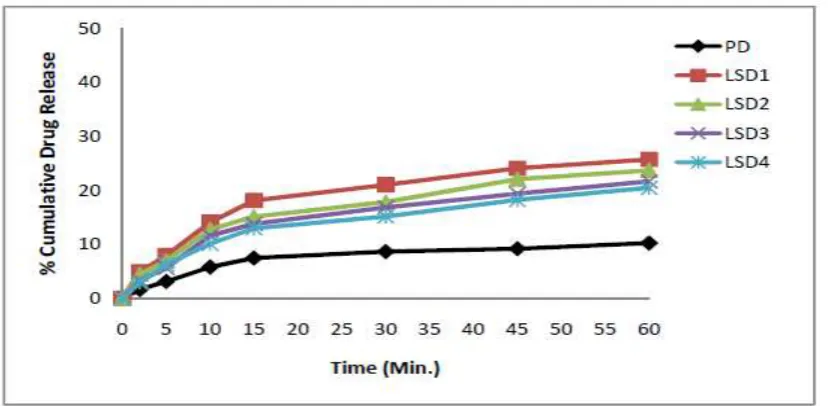
4 10 5.74 14.04 12.71 11.54 10.05 5.91 20.65 18.65 16.00 12.22 5 15 7.42 18.08 15.09 13.75 12.92 6.77 26.87 22.55 20.22 16.25 6 30 8.62 20.99 17.82 16.80 15.14 11.26 34.29 29.12 22.31 19.97 7 45 9.16 24.08 22.04 19.37 18.19 18.43 42.57 36.71 27.06 22.73 8 60 10.20 25.69 23.65 21.62 20.44 19.69 45.94 42.03 30.18 26.81
[image:12.595.66.531.533.710.2]Fig. 7.1: Dissolution rate of naproxen from liquisolid dispersion in SGF at 50 r.p.m.
Fig. 7.2: Dissolution rate of naproxen from liquisolid dispersion in SGF at 100 r.p.m.
Discussion:-In case of LSD1 to LSD 4, dissolution rate was greater as compared to pure
drug. Formulation LSD1 showed better dissolution rate at both rpm as compared to rest three
batches.
Dissolution rate was decreased as carrier to coating ratio was decreased and increasedas rpm
[image:13.595.95.504.321.483.2]Table 7.4: Dissolution rate studies of liquisolid dispersion in simulated gastric fluid
(SGF) pH 1.2.
S.no. Time(mi
n.)
% Cumulative drug release at 50 r.p.m
% Cumulative drug release at 100 r.p.m
PD LSD
5
LSD 6
LSD 7
LSD
8 PD
LSD 5
LSD 6
LSD 7
LSD 8
1 0 0 0 0 0 0 0 0 0 0 0
2 2 1.58 5.05 4.72 3.57 2.74 2.41 4.23 5.22 3.73 2.57
3 5 3.08 8.55 7.06 6.23 5.40 3.74 11.85 12.35 10.69 7.04
4 10 5.74 10.91 8.42 9.07 7.41 5.91 19.84 18.53 16.86 13.69
5 15 7.42 13.77 11.44 10.61 10.26 6.77 24.74 24.41 20.75 17.89 6 30 8.62 17.88 15.14 13.97 13.12 11.26 32.80 29.83 23.17 20.80 7 45 9.16 20.39 17.53 16.69 14.35 18.43 38.27 33.46 24.29 22.73 8 60 10.20 23.47 20.93 18.59 15.91 19.69 40.13 35.62 25.58 24.18
PD- Pure drug
[image:14.595.92.503.319.477.2]Fig. 7.1: Dissolution rate of naproxen from liquisolid dispersion in SGF at 50 r.p.m.
[image:14.595.94.502.521.694.2]Discussion: In case of LSD1 to LSD 4, dissolution rate was greater as compared to pure
drug.
Formulation LSD1 showed better dissolution rate at both rpm as compared to rest three
batches.
Dissolution rate was decreased as carrier to coating ratio was decreased and increased as rpm
was increased.
Table 7.4: Dissolution rate studies of liquisolid dispersion in simulated gastric fluid
(SGF) pH 1.2.
S.no
. Time(min.)
% Cumulative drug release at 50 r.p.m
% Cumulative drug release at 100 r.p.m
PD LSD
5
LSD 6
LSD 7
LSD
8 PD
LSD 5
LSD 6
LSD 7
LSD 8
1 0 0 0 0 0 0 0 0 0 0 0
2 2 1.58 5.05 4.72 3.57 2.74 2.41 4.23 5.22 3.73 2.57
3 5 3.08 8.55 7.06 6.23 5.40 3.74 11.85 12.35 10.69 7.04
4 10 5.74 10.91 8.42 9.07 7.41 5.91 19.84 18.53 16.86 13.69 5 15 7.42 13.77 11.44 10.61 10.26 6.77 24.74 24.41 20.75 17.89 6 30 8.62 17.88 15.14 13.97 13.12 11.26 32.80 29.83 23.17 20.80 7 45 9.16 20.39 17.53 16.69 14.35 18.43 38.27 33.46 24.29 22.73 8 60 10.20 23.47 20.93 18.59 15.91 19.69 40.13 35.62 25.58 24.18
[image:15.595.121.476.483.728.2]PD- Pure drug
Fig. 7.4: Dissolution rate of naproxen from liquisolid dispersion in SGF at 100 r.p.m.
Discussion: In case of LSD5 to LSD 8, dissolution rate was greater as compared to pure
drug. Formulation LSD5 showed better dissolution rate at both rpm as compared to rest three
batches.
Dissolution rate was decreased as carrier to coating ratio was decreased and increased as rpm
was increased.
Table 7.5: Dissolution rate studies of liquisolid dispersion in simulated gastric fluid
(SGF) pH 1.2.
S. No.
Time (min.)
% Cumulative drug release at 50 r.p.m
% Cumulative drug release at 100 r.p.m
PD LSD
9
LSD1 0
LSD1 1
LSD1
2 PD
LSD 9
LSD1 0
LSD1 1
LSD1 2
1 0 0 0 0 0 0 0 0 0 0 0
2 2 1.58 5.22 4.06 6.70 3.07 2.41 3.90 3.40 5.55 2.24
3 5 3.08 10.72 8.71 11.69 6.56 3.74 12.67 7.55 13.51 9.52 4 10 5.74 15.38 14.21 17.87 12.70 5.91 24.30 21.96 24.31 19.15 5 15 7.42 17.94 15.77 19.95 15.25 6.77 29.72 26.54 32.87 22.89 6 30 8.62 21.34 19.49 22.70 18.47 11.26 35.66 33.29 48.57 29.13 7 45 9.16 24.43 22.40 26.46 20.88 18.43 48.57 42.72 50.65 35.57 8 60 10.20 26.88 24.84 30.07 22.98 19.69 49.83 47.25 52.25 39.56
[image:16.595.72.525.408.745.2]Fig. 7.6: Dissolution rate of naproxen from liquisolid dispersion in SGF at 100 r.p.m.
Discussion: In case of LSD9 to LSD 12,dissolution rate was greater as compared to pure
drug. Formulation LSD11 showed greater dissolution rate at both rpm as compared to rest
three batches. Dissolution rate was increased in liquisolid dispersion as rpm increased.
RESULT AND DISCUSSION
The fast release formulation of naproxen was prepared by liquisolid technique using
propylene glycol and blend A [PEG 200: Water 8:2] as a non-volatile solvents and
microcrystalline cellulose (avicel PH102) as carrier material or Aerosil 200 as a coating
material. Factors, that effect the dissolution rate, studied were type of solubilizers,
non-volatile solvents, ratio of carrier to coating material, dissolution media and rpm of basket The
liquisolid dispersion of naproxen with propylene glycol containing 20% PEG 4000 & 20%
PVP 40,000 as solubilizers significantly increased the drug dissolution rate.The solubility of a
large number of poorly soluble drugs has been enhanced by mixed solvency concept.
The fast release capsule of naproxen was developed using propylene glycol with 20% PEG
4000 & 20% PVP 40,000 and 14:1 ratio of avicel to aerosil containing liquisolid dispersion.
The developed capsule of liquisolid dispersion exhibited about upto 83.64% drug release in
45 min. The optimized batch LSD11 showed the better dissolution behavior compared to pure
drug and optimized batch evaluated for the weight variation, drug content, disintegration and
drug release.
The optimized batch was evaluated using scanning electron microscopy, X-ray diffraction,
Based on the above findings, it may be concluded that fast release capsules of
naproxen can be prepared for its dissolution rate enhancement. The formulation developed in
the present studies can be further evaluated by bioavailability and scale-up studies.
REFERENCE
1. Martin, A. et al, Physical Pharmacy. 4th ed.; Lippincott Williams and Wilkins:
Philadelphia, 2004; 103-212.
2. Jain, N. K. and Patel, V. V., Hydrotropic Solubilization. The Eastern Pharmacist.1986,
29: 51-54.
3. Sinha Shilpi, Baboota Sanjula, Ali Mushir, Kumar, Anil and Ali, Javed. J Disp Sci
Technol, 2009; 30(10): 1458 -1473.
4. Moorthy Samba U, et al,. International Journal of Pharmacy and Pharmaceutical
Sciences, 2011; 3(1): 116-122.
5. Ranade, V. V. and Holinger, M. A., Drug Delivery System. II ed.; Lewis: London, 2004;
1: 3670-3672.
6. Satheeshba N.et al, Liquisolid: A Novel Technique to Enhance Bioavailability. Journal of
Pharmacy Research, 2011; 4(1): 181-185.
7. http://www.pharmacygraduates.org/apps/blog/show/2678313-liquisolid-compacts.
(accessed 12 Dec. 2010).
8. Spireas, S.2002. Liquisolid Systems and Methods of Preparing Same, US6423339B1.
9. Yadav V. B. and Yadav A. V., Liquisolid Granulation Technique for Tablet
Manufacturing: an overview. Journal of Pharmacy Research, 2009; 2(4): 670-674,
10.Ayesha S., Venkateswara R, et al, A Novel Approach to enhance Solubility of
Olmessartan Medoxomil by Liquisolid Compact Technique, International Journal of
pharmaceutical and chemical sciences, 2015; 4(2).
11.Patel Bhumi B., Shah Chainesh N., Recent Research on Liquisolid technology for
solubility enhancement-A Review, 2016.
12.Maheshwari Rajesh Kumar, Solid as solvent, Novel spectrophotometric analysis of
satranidazole tablets using phenol as solvent. The Indian Pharmacist, XII, 2014; 37-40.
13.Maheshwari RK. Solid as solvent-Novel spectrophotometric analysis of tinidazole tablets
using melted phenol as solvent. Asian Journal of Pharmaceutical Research, 2015; 5(1):
14.Kumar Averineni Ranjith, Shavi Gopal Venkatesh, Usha. Yogendra Nayak, Armugam
Karthik, Ranjan Om Prakash, Ginjupalli Kishore, Pandey Sureshwar. International
Journal of Drug Delivery, 2010; 2(1): 49-57.
15.Rao Monica et al, Dissolution Technologies, 2010; 1(1): 27-34.
16.Bobe K.R, et al, International Journal of Comprehensive Pharmacy, 2011; 1(02): (1-6).
17.Soni L K, et all, Solubilization of poorly water soluble drug using mixed solvency
approach for aqueous injection. British Journal of Pharmaceutical Research, 2014; 4(5):
549-568.
18.Patel Utsav S., Patel Khushbu C., Liquisolid Technique for Poorly Soluble Drugs, Journal
of scientific & innovative research ,vol.2,2013,Journal of scientific & innovative
research, 2013; 2: 2230-4818.
19.“The minister of health labour and welfare,” Japanese Pharmacopoeia, 2006; 15: 1242–
1243.
20.Solanki SS, et all, Review on study on mixed solvency concept in formulation of aqueous
injection of poorly water soluble drug. J pharm, 2013; 1-8.
21.Sharma D.K. and Joshi S.B., Solubility Enhancement Strategies for Poorly Water-
Soluble Drugs In Solid Dispersions: A Review, Asian Journal of Pharmaceutics April -
June, 2007; 1(1).
22.Saharan A Vikas et al “Dissolution Enhancement of drugs Part II: Effect of carriers”
International Journal of Health research, September, 2009; 207-223.
23.Babu V. Rajesh et al “Solubility and Dissolution Enhancement: An overview” Journal of
pharmacy research, 2010; 141-145.
24.Derle Deelip et al “Particle engineering technique to enhance dissolution of poorly water
soluble drugs” International journal of current pharmaceutical research, 2010; 2(1):
10-15.
25.Shaikh Hina Kousar, Et all, Mathematical models for drug release characterization : A
Review, Volume 4,, World Journal of Pharmacy and Pharmaceutical Sciences, 2015; 4:
![Fig. 1.3: Flow diagram of liquisolid system[8].](https://thumb-us.123doks.com/thumbv2/123dok_us/839469.593995/3.595.186.408.444.614/fig-flow-diagram-of-liquisolid-system.webp)