FORMULATION AND EVALUATION OF TOOTHPASTE BY USING
EGGSHELLS
Gaurav Balu Dafal* and Navin K. Khare
Department of Pharmaceutics, Dr. D.Y.Patil Institute of Pharmaceutical Science and
Research, Pimpri, Pune, Maharashatra, India, 411018.
ABSTRACT
Toothpaste is defined as a dentifrice in the form of a smooth,
semisolid, homogeneous mass containing acceptable ingredients such
as abrasives/polishing agents, surface active agents, humectants,
binding agent, and other appropriate substances for oral health
maintenance. In the present work Eggshell powder has been used as
abrasive in toothpaste. Various formulations were formulated and
evaluated and the most suitable formulation was F3 which found to
conform all statutory specifications. Eggshell based formulation is
reported useful in treatment of dental caries and tooth hypersensitivity.
Calcium plays active role in remineralization of enamel and eggshell
powder has a very high percentage of bio-available calcium. For
treatment of dental caries and tooth hypersensitivity many formulations
are commercially available but eggshell based toothpaste is seems to
be most effective and economic product. The composition of an eggshell is very similar to
that of our bones and teeth. The main objective of this work is to prepare and evaluate
eggshell powder suitable for toothpaste and to prepare toothpaste by using eggshell powder.
Toothpaste was evaluated by various evaluation parameters such as pH, Hard and Sharp
edged abrasive particles, Fineness, Foaming power, Spreadability.
KEYWORDS: Eggshell, Calcium, Abrasive, Dental caries, Hypersensitivity.
INTRODUCTION[1,2]
Toothpaste is defined as a dentifrice in the form of a smooth, semisolid, homogeneous mass
containing acceptable ingredients such as abrasives/polishing agents, surface active agents,
humectants, binding agent, and other appropriate substances for oral health maintenance. The
Volume 6, Issue 2, 534-543. Research Article ISSN 2277– 7105
*Corresponding Author
Gaurav Balu Dafal
Department of
Pharmaceutics, Dr.
D.Y.Patil Institute of
Pharmaceutical Science and
Research, Pimpri, Pune,
Maharashatra, India,
411018.
Article Received on 11 Dec. 2016,
Revised on 01 Jan. 2016, Accepted on 22 Jan. 2017
product can be opaque, transparent or combination thereof, coloured or white, packed in a
suitable container from which it can be extruded in the form of a continuous mass.
Egg shells are one of the best sources of calcium, which is absorbed by organism in
approximately 90% and it is easier for your body to digest and absorb. One whole medium
sized eggshell makes about one teaspoon of powder, which yields about 750 – 800 mgs of
elemental calcium plus other microelements, i.e. magnesium, boron, copper, iron, manganese,
molybdenum, sulphur, silicon, zinc, etc. There are 27 elements in total. The composition of
an eggshell is very similar to that of our bones and teeth. Eggshell also contains Calcium
Carbonate. Eggshell presents healthy, balanced calcium due to trace amounts of other
minerals contained in it. Eggshell is probably the best natural source of calcium. It is a much
better source of calcium than limestone or coral sources. It is recommended that people with
osteoporosis take 400-500 mg calcium per day to supplement dietary sources. Eggshells are
waste materials from hatcheries, homes and fast food industries and can be readily collected
in plenty. The composition of the egg shell is approximately 98.2, 0.9, 0.9% Calcium
carbonate, Magnesium and Phosphorous (phosphate) respectively. Shell membranes
comprises of 69.2% protein, 2.7% fat, 1.5% moisture and 27.2% ash.
[image:2.595.152.452.432.565.2]
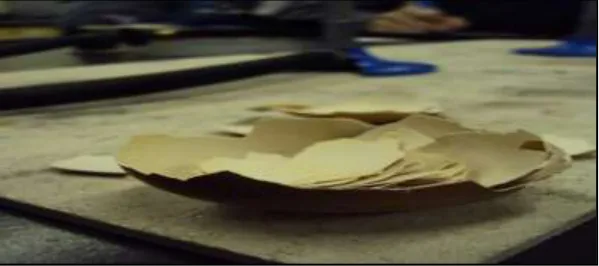
Fig. 1: Eggshells
MATERIALS AND METHODS 1) Characterisation of Eggshells
i) Organoleptic Properties: Colour and Appearance of the eggshells was determined by visual inspection, odour and taste is also determined.
- Powder the Eggshells by grinding and passing through suitable sieve.
- Storage of Eggshell powder.
A)Collection of Eggshells Eggshells were collected.
B) Cleaning of Eggshells
The eggshells were cleaned in distilled water then the eggshells were kept in a hot water bath
at 100°C for 10 minutes followed by removing the membrane.
C) Drying of Eggshells Eggshells were air dried.
D) Powdering of Eggshells
Then the eggshells were crushed using a mortar, pestle and sieved to collect the fine powder
through 150µ I.S sieve.
E) Storage of Eggshell Powder
Powdered Eggshell was stored in air tight container.
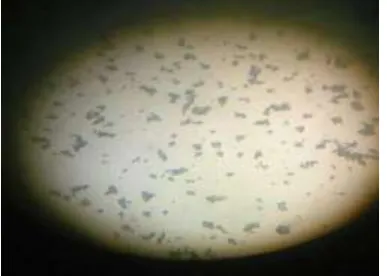
2) Morphological Analysis of powdered egg shell by Optical Microscopy
The external morphology of powdered egg shell was studied by optical microscopy. The
sample of powdered egg shell placed on transparent slide and observed under 10X.
Afterwards, the powdered egg shell sample particle size is taken and the results were
reported.
[image:3.595.58.544.601.735.2]Formulation of Toothpastes (50 gm) Table 1: Formulation data of Toothpaste
Sr.No Ingredients Category F1 F2 F3
1 Eggshell Powder Abrasive 19.75 gm 19.75 gm 19.75 gm
2 Glycerol Humectant 10 gm 10 gm 10 gm
3 Sodium Lauryl Sulphate Surface active agent 3.15 gm 3.15 gm 3.15 gm
4 Gum Tragacanth Binder 0.55 gm - -
5 Xanthan Gum Binder - 0.6 0.65
6 Sodium Saccharine Sweetener 0.05 gm 0.05 gm 0.05 gm
7 Peppermint Oil Flavouring agent 0.6 gm 0.6 gm 0.6 gm
Procedure[3]
Eggshell powder and Binder are mixed as a dry powder on ointment slab and with the help of spatula it was mixed.
Then a hot solution of Glycerol, Water and Sodium saccharine is added slowly with
mixing of the dry powder.
After that solution of peppermint oil and sodium lauryl sulfate was added to form
homogeneous paste.
Evaluation of Toothpaste[1,4,5,6] Determination of pH
Dispense 5 g of the toothpaste from the container in a 20-ml beaker and add 5 ml of freshly
boiled and cooled water (at 27°C) to make 50 percent aqueous suspension. Stir well to make
a thorough suspension. Determine the pH of the suspension within 5 min, using a pH meter.
Determination of hard and sharp edged abrasive particles
The paste was extruded about 15 to 20 cm length from collapsible tube on a butter paper.
Then the paste was tested by pressing it entire length by a finger for the presence of hard and
sharp edged abrasive particles.
Determination of Fineness
Place about 10g of the toothpaste, accurately weighed, in a 250-ml beaker. Add 100 ml of
water and allow to stand for about 30 minutes with occasional stirring until the toothpaste is
completely dispersed free of toothpaste/gel flocks trapping the agglomerates. Transfer the
beaker in an ultrasonic bath. Fill the Ultrasonic bath (2 litre capacity) to about three-fourth
height with water. Clamp the above beaker in the center of the bath keeping about 1 cm
clearance from the bottom of the bath and subject ultrasonification for 10 minutes to
completely loosen out the constituents.
Transfer this suspension quantitatively to a 150 micron IS Sieve and wash by means of a slow
stream of running tap water and finally with a fine stream from a wash bottle until all the
matter that can pass through the sieve has passed, Let the water drain out and then dry the
sieve containing the residue in an oven. If there is any residue on the sieve, carefully transfer
CALCULATION
Material retained on 150-micron IS Sieve, percent by mass.
= M1 × 100
M
Where,
Ml = massing of residue retained on the sieve, &
M = massing of the material taken for the test.
Determination of Foaming Power
Weigh about 5 g of the toothpaste accurately in a 100-ml glass beaker, add 10 ml of water,
cover the breaker with a watch glass and allow standing for 30 min. This operation is carried
out to disperse the toothpaste.
Stir the contents of beaker with a glass rod and transfer the slurry to the 250 ml graduated
cylinder, ensuring that no foam (more than 2 ml) is produced and no lump paste goes into the
cylinder. Repeat the transfer of the residue left in the breaker with further portions of 5 to 6
ml of water ensuring that all the matter in the beaker is transferred to the cylinder.
Adjust the contents in the cylinder to 50 ml by adding sufficient water and bring the contents
of the cylinder to 30oC. Stir the contents of the cylinder with a glass rod or thermometer to
ensure a uniform suspension.
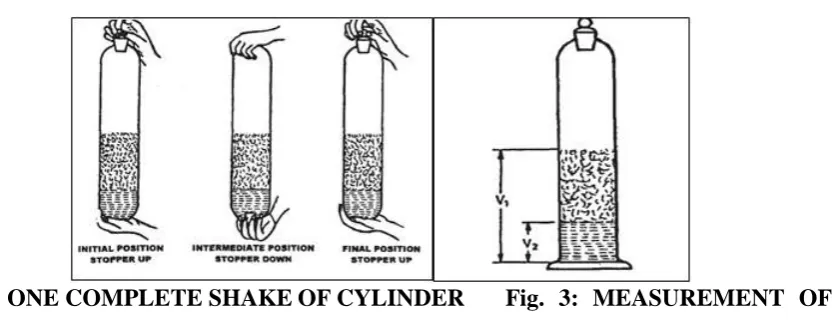
As soon as the temperature of the contents of the cylinder reaches 30°C, stop the cylinder and
give it 12 complete shakes, each shake comprising movements shown in Fig. 2 in a vertical
plane, upside down and vice versa. After the 12 shakes have been given, allow the cylinder to
stand still for 5 minutes and read the volumes of:
a) foam plus water ( V1 ml) and
Fig. 2: ONE COMPLETE SHAKE OF CYLINDER Fig. 3: MEASUREMENT OF FOAM
CALCULATION
Foaming power, ml= V1– V2
Spreadability
About 1 gm paste was weighed and kept at the center of the glass plate (10 x10 cm) and
another glass plate was placed over it carefully. 2 kg weight was placed at the center of the
plate (avoid sliding of the plate). The diameter of the paste in cms, after 30 minutes was
measured.
[image:6.595.107.525.64.228.2]RESULTS AND DISCUSSION Particle Size
Table 2: Particle Size Analysis
Size (µm) Mean size Log mean size No. of particle % frequency
0.0-15.0 7.5 0.87506126 0 0
16-30 31 1.49136169 7 7
31-45 53.5 1.72835378 35 35
46-60 76 1.88081359 21 21
61-75 98.5 1.99343623 15 15
76-90 121 2.08278537 10 10
91-105 143.5 2.1568519 7 7
106-120 166 2.22010809 4 4
Fig. 4: Microscopic Image of Eggshell Powder
Fig. 5: Particle Size Analysis Graph of Eggshell Powder
No. of particles & % frequency of optimal size i.e. 31µm-45µm (log mean size 1.72) is
higher.
Evaluation Tests for Toothpaste
Table 3: Evaluation tests for Toothpaste
Sr. No. Evaluation Test F1 F2 F3 Standard
values
1 Appearance Brown White White Observed and
write
2 pH 6.5 7.7 7.6 5.5 – 10.5
3 Hard and sharp edged
abrasive particles
Little bit present
Absent Absent Absent
4 Fineness (% by Mass) 1.7% 1.3% 1% NLT 1 %w/w
5 Foaming Power ( ml ) 57ml 56ml 51ml NLT 50
ml(min)
6 Spreadability ( cms ) 9.1cm 8.6cm 8.5cm NMT 8.5(
max )
DISCUSSION
Three formulations i.e. F1, F2, F3 were formulated by using Heated Liquid Phase Process. In
F1 formulation Gum Tragacanth was used as a binder. The pH of F1 formulation was found
log mean distribution curve
40 30 20 10 0
Particle size
0 0.5 1 1.5 2 2.5
log mean size (µm)
%
f
req
u
en
[image:7.595.206.400.72.210.2]to be 6.5 was within the standard range. There was little bit presence of hard and sharp edged
abrasive particles due to the rough nature of Gum Tragacanth. The foaming power of F1
formulation was within the standard value. The Spreadability of this formulation was more
than the standard value. Thus, F1 formulation does not comply with respect to evaluation test
no. 3 and 6.
In F2 formulation, Xanthan gum was used as a binder. The pH of F2 formulation was found
to be 7.7 was within the standard range. There was absence of hard and sharp edged abrasive
particle because the Xanthan gum is smooth in nature. The foaming power of F2 formulation
was within the standard value. The Spreadability was found to be good and the consistency of
paste was satisfactory.
In F3 formulation same binder was used i.e. Xanthan gum only the concentration was
changed for better Spreadability and consistency of paste. The pH of F3 formulation was
found to be 7.6 was within the standard range. There was absence of hard and sharp edged
abrasive particles because the Xanthan gum is smooth in nature. The foaming power of F3
formulation was within the standard value. The Spreadability was found to be within the
standard value and the consistency of the paste was also better than other formulation.
Thus, F3 formulation was found to be better than all other formulation because the evaluation
test results were within the standard values.
SUMMARY AND CONCLUSION
Toothpaste is defined as a dentifrice in the form of a smooth, semisolid, homogeneous
mass containing acceptable ingredients such as abrasives/polishing agents, surface active
agents, humectants, binding agent, and other appropriate substances for oral health
maintenance.
There are various types of toothpaste available in the market such as Anti-decay
toothpaste, Desensitizing toothpaste, Anti-calculus toothpaste, Anti-plaque toothpaste,
Whitening toothpaste, Herbal toothpaste, etc.
Typical toothpaste formulation contains Abrasives, Humectants, Surfactants, Binders,
Sweetener, Active therapeutic ingredients, Preservatives, Water, etc.
Egg shells are one of the best sources of calcium, which is absorbed by organism in
approximately 90% and it is easier for your body to digest and absorb.
One whole medium sized eggshell makes about one teaspoon of powder, which yields
about 750 – 800 mgs of elemental calcium plus other microelements, i.e. magnesium,
boron, copper, iron, manganese, molybdenum, sulphur, silicon, zinc, etc. There are 27
elements in total. The composition of an eggshell is very similar to that of our bones and
teeth.
Eggshell also contains Calcium Carbonate. Eggshell presents healthy, balanced calcium
due to trace amounts of other minerals contained in it. Eggshell is probably the best
natural source of calcium.
The eggshells were collected and cleaned. Then they were air dried and were crushed
using mortar and pestle and sieved to collect fine powder.
Then toothpaste was formulated using eggshell powder (abrasive), glycerol (humectant),
sodium lauryl sulphate (surfactant), gum tragacanth and xanthan gum (binders), sodium
saccharine (sweetener), peppermint oil (flavouring agent) and water (vehicle).
Toothpaste was evaluated by various evaluation parameters such as pH, Hard and Sharp
edged abrasive particles, Fineness, Foaming power, Spreadability and Tube Extrudability.
Thus the formulation and evaluation of toothpaste by using eggshell was done
successfully.
Various formulations were formulated and evaluated and the most suitable formulation
was F3 which found to conform all statutory specifications.
Eggshell based formulation is reported useful in treatment of dental caries and tooth
hypersensitivity.
Calcium plays active role in remineralization of enamel and eggshell powder has a very
high percentage of bio-available calcium.
For treatment of dental caries and tooth hypersensitivity many formulations are
commercially available but eggshell based toothpaste is seems to be most effective and
economic product.
Thus, this claim needs to be confirmed after clinical trials.
REFERENCES
1) Indian Standards, Toothpaste-Specification (Third Revision), Bureau of Indian Standards,
IS 6356 September 2001; 1-15.
International Journal of Poultry Science 2011; 10(11): 908-912.
3) Sanju Nanda, Arun Nanda, Roop K. Khar; Cosmetics Technology, Birla publication
pvt.ltd.; first edition 2006-2007; 438-458.
4) Geethika Priscilla.M, Amareshwar Reddy B; Antibacterial activity of Syzygium Cumini
in Herbal Toothpaste; International Journal of Inventions in Pharmaceutical Sciences;
2014 2(3): 724-729.
5) Patel Tarun K, Patel Vishnu M; Formulation and evaluation of medicated dental pastes
for treatment of Periodontitis; International Journal of Pharmaceutical Innovations;
Jan.-Feb. 2013; 3(1): 16-21.
6) S. Tejaswi, Rama Devi Bhimavarapu, Srinath Nissankar Rao; Effect of Hydrocolloids
and Casein on In-vitro drug Release from formulated double antibiotic paste;