240
International Journal of Pharmaceutical Sciences and Drug Research
2017; 9(5): 240-246
Research Article
CODEN (USA): IJPSPP
ISSN: 0975-248X
Formulation and Evaluation of Mouth Dissolving Tablets of Ondansetron
Hydrochloride Using Plantago ovata (Isapghula) Mucilage as Natural Super
Disintegrating Agent
Sunidhi Mahant
*, Shivali Singla, Sachin Goyal, Bhimi Kumari, Abhishek Soni
School of Pharmacy, Abhilashi University, Mandi, Himachal Pradesh, India
Copyright © 2017 Sunidhi Mahant et al. This is an open access article distributed under the terms of the Creative Commons Attribution-NonCommercial-ShareAlike 4.0 International License which allows others to remix, tweak, and build upon the work non-commercially, as long as the author is credited and the new creations are licensed under the identical terms.
ABSTRACT
Mouth dissolving tablet is an innovative solid unit dosage form that overcome the problem of swallowing and provide rapid disintegration & dissolution to release the drug as soon as they come in contact with saliva, hence provide quick onset action. The aim of this study was to formulate & evaluate mouth dissolving tablets of Ondansetron hydrochloride using natural super disintegrating agent. Ondansetron hydrochloride is a serotonin receptor (5-HT3) antagonist used to treat nausea and vomiting arises during chemotherapy and radiation
therapy. Mouth dissolving tablets were prepared by direct compression method using natural super disintegrating agent (Plantago ovata mucilage). Prepared tablet were evaluated for Hardness, weight variation, friability, thickness, wetting time, dispersion time, water absorption ratio, disintegration & dissolution study. According to results of optimized batches it has been concluded that Formulation batch F6 was an ideal batch which contain 12% w/v concentration of Plantago ovata mucilage showed least disintegration time that is 7 seconds & maximum drug release of (98.57%) within 15 minutes and was best among all the formulations.
Keywords:Mouth dissolving tablets, Ondansetron hydrochloride, super disintegrating agent, formulations.
DOI: 10.25004/IJPSDR.2017.090507 Int. J. Pharm. Sci. Drug Res. 2017; 9(5): 240-246
*Corresponding author: Ms. Sunidhi Mahant
Address: School of Pharmacy, Abhilashi University, Mandi, Himachal Pradesh, India Tel.: +91-7831991404
E-mail: [email protected]
Relevant conflicts of interest/financial disclosures: The authors declare that the research was conducted in the absence of any commercial or financial relationships that could be construed as a potential conflict of interest.
Received: 02 August, 2017; Revised: 23 August, 2017; Accepted: 24 August, 2017; Published: 15 September, 2017
INTRODUCTION
Oral drug delivery has been known for decades as the most preferred and widely used route of administration among all the routes that has been explored for the systemic delivery of drugs. Oral drug delivery received the gold standard in the
self-Int. J. Pharm. Sci. Drug Res. September-October, 2017, Vol 9, Issue 5 (240-246)
medication, pain avoidance and most importantly the patient compliance. The most popular solid dosage forms being tablets and capsules; Drinking water plays an important role in the swallowing of oral dosage forms. Often times people experience difficulty in swallowing (dysphasia) conventional dosage forms such as tablet when water is not available, in the case of the motion sickness (kinetosis) and sudden episodes of coughing during the common cold, allergic condition and bronchitis, during pregnancy. For these reasons, Mouth Dissolving Tablets that can rapidly dissolve or disintegrate in the oral cavity have played a great deal of attention. [1]
Difficulty in swallowing to conventional tablets and capsules is common among all age groups, especially in elderly and dysphagic patients. [2] The concept of
Mouth Dissolving Tablets emerged with an objective to improve patient’s compliance. These dosage forms rapidly disintegrate and/or dissolve to release the drug as soon as they come in contact with saliva, thus obviating the need for water during administration, an attribute that makes them highly attractive for Paediatric and geriatric patients. Mouth Dissolving Tablets are not only indicated for people who have swallowing difficulties, but also are ideal for active people. [3]
United States Food and Drug Administration (FDA) define orally disintegrating tablets as “A solid dosage form which contain a medicinal substance or active ingredient which disintegrates rapidly within few seconds when placed on a tongue. US Food and Drug Administration Center for Drug Evaluation and Research (CDER) defines, in the ‘Orange Book’, an MDT as “a solid dosage form containing medicinal substances, which disintegrates rapidly, usually within a matter of seconds, when placed upon the tongue”. European Pharmacopoeia described orally disintegrating tablets as ‘uncoated tablets intended to be placed in the mouth where they disperse rapidly before being swallowed’ and as tablets which should disintegrate within 3 minutes. [4]
Orally disintegrating tablets are also known as quick disintegrating tablets, fast disintegrating, mouth dissolving, rapid melt, rapid dissolving or orodispersible tablets. These are novel types of tablets that disintegrate/dissolve/ disperse in saliva. These are solid unit dosage forms containing medicinal substances which disintegrate or dissolve rapidly in oral cavity usually within a few seconds even without the need of water.In such cases, bioavailability of drug is significantly enhanced by avoiding first pass hepatic metabolism than those observed with conventional tablets. [5-7]
MATERIALS AND METHODS Materials
Ondansetron hydrochloride was obtained as a gift sample from Morepen Pvt. Ltd. Parwanoo H.P. Plantago
ovata seed (isapghula) was purchased from local market
of Kullu (H.P.). Micro crystalline cellulose was taken from Pharmaceutics Laboratory and was purchased from Molychem Pvt. Ltd. Sodium saccharine was obtained from pharmaceutical chemistry laboratory and it was purchased from Loba Chemie Pvt. Ltd. India. Clove oil was obtained from Pharmacognosy Laboratory which was purchased from SDFCL. Povidone was taken from Pharmaceutics Laboratory and was purchased from Molychem Pvt. Ltd.
Method
The method used for preparation of mouth dissolving tablets of ondansetron hydrochloride was direct tablet compression method. It is the simplest and least expensive tableting process. Mouth dissolving tablets made by direct compression are robust and can be easily packaged and handled. For direct compression mouth dissolving tablet processes, sugar based excipients (mannitol, sorbitol, xylitol, maltose, etc.) are routinely used for their high water solubility, sweet taste, and pleasant mouth feel. In addition to taste and mouth feel, disintegration time is a primary concern. Some Mouth dissolving tablet technologies use effervescent couples alone or in combination with other disintegrants to achieve rapid dispersion. [8-9] The use of
disintegrating agent, and especially the more modern super disintegrants, has made the advent of compression based Mouth Dissolving Tablets possible.
Formulation Development Method of Formulations
Mouth Dissolving Tablets, Ondansetron hydrochloride was prepared by direct compression method with the addition of dried Plantago ovata mucilage as a natural super disintegrating agent and binding agent, along with other excipients. These were mixed in dry and clean mortar pestle. Then the blend was passed through sieve no. #60. The prepared powder were subjected to various pre compression evaluation parameters such as angle of repose, bulk density, tapped density, carr’s index, hausner’s ratio and compressed by twelve station Tablet Punching Machine and then post compression parameters such as Hardness, weight uniformity, friability, thickness, wetting time, dispersion time, water absorption ratio, disintegration & dissolution study were evaluated. Finally at different concentrations of natural super disintegrating agent the effect of Mouth dissolving tablets mainly in terms of disintegration time and dissolution rate were concluded.
Preformulation Study[10]
Angle of repose
Int. J. Pharm. Sci. Drug Res. September-October, 2017, Vol 9, Issue 5 (240-246)
Where, θ is Angle of Repose, h is height of Cone in cms & r is Radius of cone in cms.
Bulk Density
Density is defined as mass per unit volume. Bulk density, Pb is defined as the mass of the powder
divided by the bulk volume and is expressed as g/cm3.
It depends upon particle size distribution, particle shape and the particles adhere together. Apparent bulk density (Pb) was determined by pouring the blend into
a graduated cylinder the initial weight was noted. This initial volume is called the bulk volume. The bulk density was calculated using the formula.
Where, Pb is bulk density; Vb is bulk volume & M is the
weight of the powder.
Tapped Density
The measuring cylinder containing a known mass of blend was tapped for a 100 times using density apparatus. The minimum volume (Vt) occupied in the
cylinder and the weight (M) of the blend was measured. The tapped density (Pt) was calculated using
the formula.
Where, Pt is tapped density, Vt is tapped volume, M is
weight of the powder.
Hausner’s Ratio
Hausner ratio (HR) is an indirect index of ease of powder flow. It is calculated by the following formula.
Where HR is Hausner’s Ratio; ρt is tapped density; ρb is
bulk density.
Lower Hausner’s ratio (< 1.25) indicates better flow properties than higher ones (> 1.25).
Compressibility index
The simplest way for measurement of free flow of powder is compressibility, an indication of the ease with which a material can be induced to flow is given by compressibility index (I) which is calculated as follows
Where; I is compressibility index; t is Tapped Density & b is Bulk Density.
Post Compression Tests Appearance
Twenty tablets of each formulation were taken to check any physical or surface roughness in the tablet formulation. [11]
Thickness
Tablet thickness is an important characteristic in reproducing appearance and also in counting by suing filling equipment. Some filling equipment utilizes the uniform thickness of the tablets as a counting mechanism. Ten tablets were taken and their thickness was recorded using micrometer.
Uniformity of weight
IP procedure for uniformity of weight was followed, twenty tablets were taken and their weight was determined individually and collectively on a digital weighing balance. The average weight of one tablet was determined from the collective weight. The weight variation test would be satisfactory method of determining the drug content uniformity. [11]
Hardness
Hardness of tablet is defined as the force applied across the diameter of the tablet in order to break the tablet, the resistance of the tablet to chipping, abrasion or breakage under condition of storage transformation and handling before usage depends on its hardness. Hardness of the tablet of each formulation was determined using Monsanto Hardness Tester. [12] Friability
Friability of the tablets was determined using Roche Friabilator. This device subjects the tablets to the combined effect of abrasions and shock in a plastic chamber revolving at 25 rpm and dropping the tablets at a height of 6 inch in each revolution. Pre weighed sample of tablets was placed in the friabilator and were subjected to 100 revolutions. Tablets were de dusted using a soft muslin cloth and reweighed. The friability (F %) is given by the formula.
Where, Wo is weight of the tablets before the test & W is
the weight of the tablets after test. [12] Wetting time
The wetting time of the tablets was measured using a simple procedure. Circular tissue paper of 10 cm diameter was placed in a Petri dish with a 10 cm diameter. Ten milliliters of water containing amaranth, a water-soluble dye, was added to the petri dish. A tablet was carefully placed on the surface of tissue paper. The time required for water to reach the upper surface of the tablets was noted as the wetting time (The wetting time decreased with the increase in concentration of seed and mucilage powder). [13]
In-vitro disintegration time
The process of breakdown of a tablet into smaller particles is called as disintegration. The in-vitro
disintegration time of a tablet was determined using disintegration test apparatus as per I.P. specifications. One tablet was placed in each of the 6 tubes of the basket. Add a disc to each tube and run the apparatus using pH 6.8 (simulated saliva fluid) maintained at 37 ± 2°C as the immersion liquid. The assembly should be raised and lowered between 30 cycles per minute in the pH 6.8 maintained at 37 ± 2°C. The time in seconds taken for complete disintegration of the tablet with no palpable mass remaining in the apparatus was measured and recorded. [14]
In-vitro dispersion time
Int. J. Pharm. Sci. Drug Res. September-October, 2017, Vol 9, Issue 5 (240-246)
tablet to completely disintegrate into fine particles was noted. [15]
In-vitro dissolution study
The in vitro dissolution study was carried out in the USP dissolution test apparatus type 2 (paddle). 900 ml of the dissolution medium (saline phosphate buffer pH 6.8 solution) was taken in and the temperature was maintained at 37 ± 0.5°C. The speed of the paddle was maintained at 50 rpm. Sampling was done every one min interval. For each sample 5 ml of the dissolution medium was withdrawn and the same amount of dissolution medium was replenished to maintain sink condition. The samples withdrawn were analyzed in the UV spectrophotometer at 266 nm. [14]
Drug Content
Ten tablets from each batch were weighed and finely powdered. Powder equivalent to 8 mg of Ondansetron hydrochloride was transferred to 100 ml volumetric flask and shaken with 60 ml of phosphate buffer for 10 min. The volume of resulting solution was made to 1000 ml and contents were filtered. An aliquot of 1.0 ml from this solution was diluted to 100 ml with phosphate buffer in volumetric flask and then further 1 ml from this solution were diluted up to 10 ml with phosphate buffer in a 10 ml volumetric flask. A portion of the sample was analyzed by a UV spectrophotometer at 266 nm.
RESULTS AND DISCUSSION Pre Formulations Studies
The results for characterization of blended powder are shown in Table 6. The bulk density of blend varied between 0.607-0.649g/cm3. The tapped density was
found in the range of 0.704-0.746 g/cm3. By using these
two density data, Hausner’s ratio and compressibility index was calculated. The powder blends of all formulation had Hausner’s ratio of less than 1.25 indicating good flow characteristics. Blends having value of compressibility index less than 25% were considered as free flowing ones. The values for compressibility index were found between 12.346- 14.578. The flow ability of the powder was also evidenced by the angle of repose. The angle of repose below 35° ranges indicates good flow properties of powder. The angle of repose was found to be in range 25.793°.
Post Compression Studies Appearance
All the tablets were greyish white in color, flat in shape with smooth surface without any defects.
Uniformity of thickness
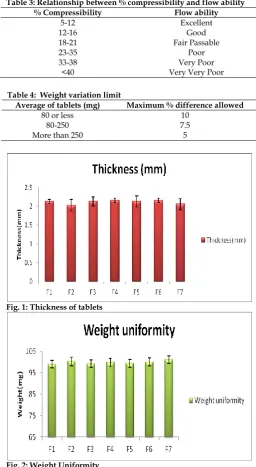
Thickness of all the formulations was found to be within the range of 2.03mm to 2.16 mm shown in Table 7 and graphical presented in Figure 1.The values were almost uniform in all the formulation.
Weight Uniformity
All the tablets passed weight variation test as the % weight variation was within the pharmacopoeial limits of ±7.5% given in Table 7. It was observed that all the
batches were uniform in weight with no significance difference. It is related to tooling of the compression machine, head pressure, machine speed and flow properties of the powder. A graphical representation is shown in Figure 2.
Table 1: Angle of Repose for Powder Flow Properties
S. No. Angle of Repose (θ) Type of Flow
1 1 < 25 Excellent
2 25 – 30 Good
3 30 – 40 Passable
4 > 40 Very Poor
Table 2: Relationship between flow characters and Hausner’s ratio
Flow Character Hausner’s Ratio
Excellent 1.00-1.11
Good 1.12-1.18
Fair 1.19-1.25
Passable 1.26-1.34
Poor 1.35-1.45
Very Poor 1.46-1.59 Very Very Poor >1.60
Table 3: Relationship between % compressibility and flow ability
% Compressibility Flow ability
5-12 Excellent
12-16 Good
18-21 Fair Passable
23-35 Poor
33-38 Very Poor <40 Very Very Poor
Table 4: Weight variation limit
Average of tablets (mg) Maximum % difference allowed
80 or less 10
80-250 7.5
More than 250 5
Fig. 1: Thickness of tablets
Int. J. Pharm. Sci. Drug Res. September-October, 2017, Vol 9, Issue 5 (240-246)
Fig. 3: Hardness of tablets Fig. 4: Friability of tablets
Table 5: Composition of Ondansetron hydrochloride mouth dissolving tablets
S. No. Ingredients F1 (mg) F2 (mg) F3 (mg) F4 (mg) F5 (mg) F6 (mg) F7 (mg)
1. Ondansetron hydrochloride 8 8 8 8 8 8 8
2. Plantago ovata 2 4 6 8 10 12 14
3. Micro crystalline cellulose 82 80 78 76 74 72 70
4. Sodium saccharine 1 1 1 1 1 1 1
5. Talc 3 3 3 3 3 3 3
6. Clove oil 2 2 2 2 2 2 2
7. Povidone 2 2 2 2 2 2 2
8. Total weight (mg) 100 100 100 100 100 100 100
Table 6: Characterization of blended powder
Formulation code Bulk density(gm/cm3) Tapped density(gm/cm3) Carr’s Index (%) Hausner’s ratio (HR) Angle of repose (0)
F1 0.632 ± 0.008 0.735 ± 0.010 13.925 ± 0.176 1.161 ± 0.002 28.063 ± 0.987
F2 0.649 ± 0.008 0.746 ± 0.011 12.988 ± 0.168 1.149 ± 0.002 28.066 ± 0.681
F3 0.625 ± 0.007 0.724 ± 0.010 13.751 ± 0.171 1.159 ± 0.002 28.363 ± 0.445
F4 0.630 ± 0.012 0.731 ± 0.016 13.868 ± 0.265 1.161 ± 0.003 29.533 ± 0.662
F5 0.607 ± 0.011 0.711 ± 0.015 14.578 ± 0.268 1.170 ± 0.003 28.666 ± 0.254
F6 0.617 ± 0.007 0.704 ± 0.009 12.346 ± 0.152 1.140 ± 0.001 25.793 ± 0.265
F7 0.632 ± 0.008 0.724 ± 0.010 12.651 ± 0.160 1.144 ± 0.002 25.943 ± 0.708 Results are in mean ± SD (n=3)
Table 7: Evaluation parameters of Formulations
Formulation Code Appearance Thickness (mm) Uniformity of Weight (mg) Hardness (kg/cm2) Friability (%)
F1 Greyish white 2.13 ± 0.057 98.90 ± 1.774 4.1 ± 0.07 0.51 ± 0.028
F2 Greyish white 2.03 ± 0.152 100.30 ± 1.976 3.9 ± 0.09 0.56 ± 0.021
F3 Greyish white 2.13 ± 0.115 99.20 ± 1.735 4.1 ± 0.08 0.42 ± 0.024
F4 Greyish white 2.16 ± 0.057 99.70 ± 1.838 4.0 ± 0.04 0.45 ± 0.022
F5 Greyish white 2.13 ± 0.152 99.35 ± 1.843 4.2 ± 0.05 0.37 ± 0.019
F6 Greyish white 2.16 ± 0.057 100.00 ± 1.716 3.9 ± 0.05 0.35 ± 0.022
F7 Greyish white 2.06 ± 0.152 101.10 ± 1.774 4.0 ± 0.03 0.39 ± 0.041 Results are in mean ± SD (n=3)
Table 8: Wetting time of Formulations
Formulation code Time (sec)
F1 15.34 ± 0.012 F2 14.45 ± 0.014 F3 13.23 ± 0.023 F4 12.84 ± 0.016 F5 11.12 ± 0.019 F6 9.09 ± 0.010 F7 10.81 ± 0.019 Results are in mean ± SD (n=3)
Table 9: Water absorption ratio of Formulations
Formulation code Percentage
F1 56 ± 0.039 F2 58 ± 0.123 F3 61 ± 0.135
F4 63 ± 0.211
F5 66 ± 0.121 F6 68 ± 0.118 F7 67 ± 0.287 Results are in mean ± SD (n=3)
Table 10: In-vitro Disintegration time
Formulation code Time (seconds)
F1 13 ± 0.53
F2 12 ± 0.58
F3 11 ± 0.57
F4 10 ± 0.56
F5 9 ± 0.56
F6 7 ± 0.55
F7 8 ± 0.59
Results are in mean ± SD (n=3)
Table 11: Dispersion time of formulations
Formulation code Time (seconds)
F1 14 ± 0.103
F2 12 ± 0.153
F3 11 ± 0.211
F4 10 ± 0.149
F5 9 ± 0.184
F6 7 ± 0.234
F7 8 ± 0.212
Int. J. Pharm. Sci. Drug Res. September-October, 2017, Vol 9, Issue 5 (240-246)
Hardness
In all the formulations, hardness test indicated good mechanical strength, as the hardness of the Mouth dissolving tablet was found in the range of 3.9 to 4.2 kg/cm2 is given in Table 7 and Figure 3. High hardness
values increase the disintegration time and reduced dissolution values.
Friability
Friability was observed less than 1% represented in Table 7 and graphically shown in Figure 4 indicated that Mouth Dissolving Tablets had a good mechanical resistance. It is designed to evaluate the ability of the tablet to withstand abrasion in packaging, handling and shipping.
Wetting time
The wetting time was rapid in all the formulations. Wetting is closely related to inner structure of tablets, this may be due to ability of swelling and also capacity of absorption of water. Among all the formulations F6 showed less wetting time. The result was shown in Table 8 and Figure 5.
Water absorption ratio: The capacity of disintegrants to
swell in presence of little amount of water were found to be in the range of 56-68% is given in Table 9 and graphically represented in Figure 6. The water absorption ratio that is the up taking of water was very fast and the ratio was found higher.
In-vitro Disintegration time: This rapid disintegration of the Mouth Dissolve in Tablets Ondansetron Hydrochloride was due to the penetration of saliva into the pores of the tablet, which lead to the swelling of super disintegrating agent (Plantago ovata) to create enough hydrodynamic pressure for quick and complete disintegration of the tablet. The disintegration time of all the formulations shown in Table 10, and graphically presented in Figure 7.
Table 12: Drug content of Mouth dissolving tablets
Formulation code Drug content (%)
F1 98.1 ± 0.43
F2 98.3 ± 0.49
F3 98.2 ± 0.72
F4 98.5 ± 0.69
F5 98.8 ± 0.67
F6 99.3 ± 0.64
F7 98.5 ± 0.58
Results are in mean ± SD (n=3)
Fig. 5: Wetting time of tablets
Fig. 6: Water absorption ratio of tablets
Fig. 7: In vitro disintegration time
Fig. 8: Dispersion time of tablets
Fig. 9: Drug content of mouth dissolving tablets
Int. J. Pharm. Sci. Drug Res. September-October, 2017, Vol 9, Issue 5 (240-246) Table 13: In vitro Drug Release
Time(min) F1 F2 F3 F4 F5 F6 F7
1 20.56 ± 0.64 21.89 ± 0.65 23.22 ± 0.89 23.68 ± 0.72 24.15 ± 0.42 26.88 ± 0.43 25.91 ± 0.23
3 35.67 ± 0.43 37.75 ± 0.71 42.87 ± 0.91 46.39 ± 0.82 47.58 ± 0.37 51.09 ± 0.54 48.20 ± 0.38
5 50.23 ± 0.37 54.65 ± 0.89 58.65 ± 0.98 62.76 ± 0.49 66.24 ± 0.73 69.71 ± 0.87 68.56 ± 0.36
10 79.47 ± 0.62 80.45 ± 0.94 82.09 ± 1.02 87.74 ± 0.31 87.66 ± 0.31 88.96 ± 0.29 87.59 ± 0.77
15 89.54 ± 0.98 90.65 ± 1.25 92.32 ± 0.32 94.32 ± 0.35 95.34 ± 0.24 98.57 ± 0.72 96.82 ± 0.35
In-vitro dispersion time: The dispersion time decreases with increase in the concentration of super disintegrating agent. The result was given in Table 11 and Figure 8.
Drug content: The drug content was found to be within
the range of 98.1 to 98.9 indicating uniform distribution of drug in the formulated tablets as per pharmacopeia specification, represented in Table 12 and Figure 9.
In vitro drug release studies: The in vitro drug release study of various formulation trials (F1-F7) were carried out represented in Table 13 and Figure 10 with different concentration of natural super disintegrating agent (2%-14%). The rate and extent of in vitro drug release was found to be in the order F1< F2< F3<F4<F5< F7< F6. From the various formulations F6 batch showed maximum drug release that is 98.57% within 15 minutes.
Mouth dissolving tablets of ondansetron hydrochloride were prepared by using natural super disintegrating agent (Plantago ovata mucilage). Different concentration of disintegrating agent was evaluated for a lot of parameters. It was concluded that batch F6 contain 12% w/v concentration of Plantago ovata mucilage showed least disintegration time that is 7 seconds and maximum drug release in 15 minutes. Also this was showed promising results in pre formulation and post formulation studies. Further preclinical studies can be done for future prospective to make the formulation marketable.
ACKNOWLEDGEMENTS
The authors would like to thank School of Pharmacy, Abhilashi University, Mandi, Himachal Pradesh, India for providing research facilities.
REFERENCES
1. Bhowmik D, Chiranjib B, Krishnakanth P, Chandira RM. Fast dissolving tablet: an overview. Journal of chemical and pharmaceutical research. 2009;1(1):163-77.
2. Panigrahi R, Behera S. A Review on Fast Dissolving Tablets. Webmed Central Quality and patient safety. 2010; 1(9): 1-16. 3. Seager H. Drug delivery products and zydis fast dissolving
dosage form. Journal Pharmacy and Phamacology. 1998; 50(4): 375-382.
4. Sharma C, Dangi V, Gupta A, Ahamad D, Ahmad A. Orally disintegrating tablets: A Review. International Journal of Pharmacy and Life sciences.2010; 1(5): 250-256.
5. Adelli GR, Balguri SP, Bhagav P, Raman V, Majumdar S. Diclofenac sodium ion exchange resin complex loaded melt cast films for sustained release ocular delivery. Drug Delivery. 2017 Jan 1;24(1):370-9.
6. Balguri SP, Adelli GR, Tatke A, Janga KY, Bhagav P, Majumdar S. Melt-Cast Noninvasive Ocular Inserts for Posterior Segment Drug Delivery. Journal of Pharmaceutical Sciences. 2017 Aug 1.
7. Jejurkar LA. Formulation and evaluation of fast disintegrating tablet of etoricoxib using natural superdisintegrants. Asian J Pharm Clin Res. 2011;4(4):85-9. 8. Singhai AK, Sharma D, Saraoji GK, Mehra N, Mudgal V.
Design and evaluation of rapid disintegrating tablet of Ondansetron hydrochloride. International journal of research in ayurveda and pharmacy. 2011; 2(1): 259-263.
9. Torne S, Sakarkar D, Pawar S, Abdul R. Fast disintegrating tablets of Ondansetron hydrochloride by direct compression technique. Int. J. PharmTech Res. 2010 Jan;2(1):433-7. 10. Sivakranth M, Althaf AS, Rajasekhar S. Formulation and
evaluation of oral fast dissolving tablets of sildenafil citrarte. International Journal of Pharmacy and Pharmaceutical Sciences. 2011;3(supplement 2):112-21.
11. Bhalerao AV, Deshkar SS, Shirolkar SV, Gharge VG, Deshpande AD. Development and evaluation of clonazepam fast disintigrating tablets using superdisintigrates and solid dispersion technique. Research Journal of Pharmacy and Technology. 2009;2(2):375-7.
12. Patil BS, Rao NG. Formulation and evaluation of fast dissolving tablets of Granisetron hydrochloride by vacuum drying technique. 2011; 1(4): 83-88.
13. Rasheed SH, Arief M, Gajavalli SR, Vani PS, Rao KS, Kumar S, Rao T, Hussain SS. Comparison of different superdisintegrants in designing of fast dissolving tablets of salbutamol sulphate. Research Journal of Pharmaceutical, Biological and Chemical Sciences. 2011 Apr;2(2):155-63. 14. RaoY DS, Doddayya H, Patil SS, Vamshidhar Reddy D.
design and evaluation of fast dissolving tablets of taste masked Ondansetron Hydrochloride. IJPRD. 2008;3(2):64-76. 15. Kavitha K, Sandeep DS, Yadawad M, Mangesh M.
Formulation and evaluation of oral fast dissolving tablets of promethazine HCL by sublimation method. International Journal of PharmTech Research. 2011;3(2):659-63.
16. Kumar E, Bhagyashree J. Mouth dissolving tablets–A comprehensive review. International Journal of Pharma Research & Review. 2013;2(7):25-41.
17. Gohel M, Patel M, Amin A, Agrawal R, Dave R, Bariya N. Formulation design and optimization of mouth dissolve tablets of nimesulide using vacuum drying technique. AAPs PharmSciTech. 2004 Sep 1;5(3):10-5.