ISI at the SIGMORPHON 2017 Shared Task on Morphological
Reinflection
Abhisek Chakrabarty and Utpal Garain
Computer Vision and Pattern Recognition Unit Indian Statistical Institute
203 B.T. Road, Kolkata-700108, India
[email protected], [email protected]
Abstract
We present a system for morphological reinflection based on the LSTM model. Given an input word and morphosyntac-tic descriptions, the problem is to classify the proper edit tree that, applied on the in-put word, produces the target form. The proposed method does not require human defined features and it is language inde-pendent also. Currently, we evaluate our system only for task1 without using any external data. From the test set results, it is found that the proposed model beats the baseline on15out of the52languages in high resource scenario. But its perfor-mance is poor when the training set size is medium or low.
1 Introduction
The morphological reinflection task is to generate the variant of a source word, given the morphosyn-tactic descriptions of the target word. This year’s shared task (Cotterell et al.,2017) is divided into two sub-tasks. Task1demands to inflect the iso-lated word forms based on labelled training data. For example, given the source form ‘communi-cate’ and the features ‘V;3;SG;PRS’, one has to predict the target form ‘communicates’. Whereas, in task2, partially filled incomplete paradigms are provided. The goal is to complete them using a re-stricted number of full paradigms. For each of the tasks, 3 separate training files are given per lan-guage, which differ in size (low/medium/high), in order to analyze systems’ generalization ability in low and high resource situations. The competition is spread over52languages. For each language, a finite set of morphological tags are provided, from which the target inflections are taken. Evaluation is done separately under each of the three different
training sets. To make the shared task competition fair, use of external resources are forbidden for the main competition track. However, for those sys-tems which make use of external monolingual cor-pora, a list of approved external corpora selected from the Wikipedia text dumps are provided.
So far, there have been several efforts on rein-flection employing statistical learning based meth-ods (Dreyer and Eisner, 2011; Durrett and DeN-ero,2013;Ahlberg et al., 2015;King, 2016) and string transduction (Nicolai et al., 2015). These methods entail feature definition which is hard to generalize for all of the world’s languages.
In this article, we introduce a long short-term memory (LSTM) network architecture to handle the morphological reinflection task. The proposed method is language independent and does not re-quire features to be defined manually. Our model is related to the encoder-decoder based approaches such as (Aharoni et al.,2016;Faruqui et al.,2016; Kann and Sch¨utze, 2016a,b), but the main dif-ference is that the proposed network is not de-signed to generate sequence of characters as out-put. Rather, we formulate the problem as to clas-sify the transformation process required to convert a source form to its target form (Chakrabarty et al., 2017). Our goal is to model such a system which receives an input word and the morphological tags and returns the proper transformation that induces the target word. The source-target transformation is accomplished using edit tree (Chrupala et al., 2008;M¨uller et al., 2015). Initially all edit trees are extracted from the labelled pairs in the train-ing data and then the distinct candidates from them are marked as the class labels. We feed the charac-ter sequence of the input word through the LSTM network to encode it and finally, the encoded rep-resentation is jointly trained with the input tags to classify the correct edit tree.
Currently, we assess our system only for task1
Figure 1: Edit tree for the source-target pair ‘sang-sing’.
on all52languages, though it can be used for task 2 also. No external data such as the Wikipedia dumps provided by the SIGMORPHON commit-tee has been exploited in the present work. The results obtained from the test sets indicate that the proposed method is resource intensive. When the training size is high, it achieves over the baseline system on 15 out of the 52 languages. But on medium and low amount training data, the perfor-mance is poor beating the baseline on5and4 lan-guages only.
2 Methodology
Edit Trees: An edit tree encodes a transforma-tion which maps a source string to a target string. Given a source-target pair, the process of find-ing the correspondfind-ing edit tree is as follows. At first, the longest common substring (LCS) be-tween them is found and then the prefix and suffix pairs of the LCS are recursively modelled in the same manner. The edit tree does not encode the LCS itself. Instead, it contains the length of the prefix and suffix in the source string for general-ization. When no LCS is found between the source and the target strings, they are kept as a substitu-tion node.
Figure1shows an example of edit trees between the source-target pair ‘sang-sing’. The LCS be-tween them is ‘ng’. In the source string, the pre-fix length of the LCS is2(for ‘sa’) and the suffix length is0. So, the root of the edit tree keeps the information (2,0). The left subtree of the root
rep-resents the edit tree between the prefix pair of the LCS in the source and the target string i.e. for ‘sa-si’ and following the same way, the right subtree remains empty.
Note that, to generalize the transformation pat-tern, the LCS is not stored in the edit tree.
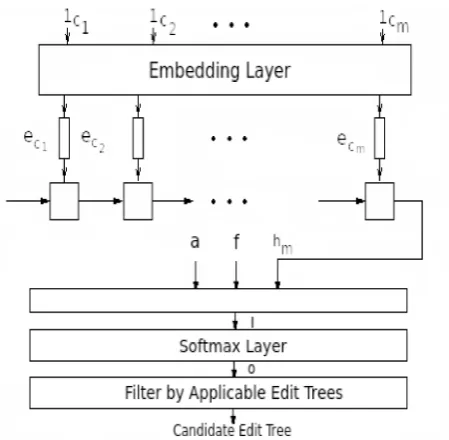
Con-Figure 2: The model architecture.
sider the two source-target pairs ‘gives-give’ and ‘takes-take’ where the transformation rule is same i.e. to omit the ending ‘s’ character. The root of the corresponding edit tree contains (0,1). If the
LCS were stored in the root, then the tree could not be generalized for all the pairs like ‘comes-come’, ‘sleeps-sleep’ etc. where the same rule works.
2.1 The System Description
The architecture of our system is presented in Fig-ure2. At first, we use the LSTM network to make a syntactic embedding of the source word, that captures the morphological regularities. A charac-ter alphabet of the concerned language is defined asC. Let the input wordw consists of the
char-acter sequencec1, . . . , cm where the word length
ismand each characterciis represented as a one
hot encoded vector1ci. The particular dimension of 1ci referring to the index of ci in the alpha-betC, is set to one and the other dimensions are
made zero. 1c1, . . . ,1cm are passed to an embed-ding layerEc ∈ Rdc×|C|, which projects them to
dcdimensional vectorsec1, . . . ,ecm, by doing the operationeci = Ec·1ci where ‘·’ denotes matrix multiplication.
[image:2.595.110.220.66.154.2]equa-tions:
ft=σ(Wfect +Ufht−1+Vfct−1+bf) it=σ(Wiect +Uiht−1+Vict−1+bi) ct=ft⊙ct−1
+it⊙tanh(Wcect +Ucht−1+bc) ot=σ(Woect+Uoht−1+Voct+bo) ht=ot⊙tanh(ct),
σdenotes the sigmoid function and⊙stands for the element-wise (Hadamard) product. LSTM uti-lizes an extra memoryctthat is controlled by three
gates - input (it), forget (ft) and output (ot).W,U,
V (weights), b (bias) are the parameters. Even-tually, we take the final state hm as the encoded
representation ofw.
In addition to the source word, we have mor-phosyntactic features in hand to predict the target form. From the training data, all distinct features are sorted out to make a feature dictionaryF. For
a training sample, the given features are mapped to
|F|dimensional feature vectorf = (f1, . . . , f|F|)
where fi = 1 if the ith feature in the dictionary
is present in the input features, otherwisefi is set
to0. Thus,fbecomes a numeric representation of the input features for the present training sample.
Another important point is that, for any arbi-trary input word, all unique edit trees in the train-ing data are not applicable due to incompatible substitutions. For example, the edit tree for the source-target pair ‘sang-sing’ (shown in Figure1) cannot be applied on the word ‘sleep’. In spite of all unique edit trees are set as the class labels, few of them are applicable for an input word to the model. To sort out this issue, we put the informa-tion over which classes the model should distribute the output probability mass while training.
Let T = {t1, . . . , tk} be the distinct edit trees
set extracted from the training data. For the input wordw, its applicable edit trees vector is defined
asa= (a1, . . . , ak)where∀j∈ {1, . . . , k},aj =
1iftj is applicable forw, otherwise0. Hence,a
holds the applicable edit tree information for w.
Finally, we combine the LSTM outputhm, feature
vectorf and applicable tree vectora together for the edit tree classification task as following,
l=sof tplus(Lhhm+Lff+Laa+b),
where ‘softplus’ is the activation functionf(x) =
ln(1 +ex)andLh,Lf,La andbare the network
parameters. Next,lis passed through the softmax layer to get the output labels forw.
To pick the maximum probable edit tree for an input word, we exploit the prior information about applicable classes. Let o = (o1, . . . , ok) be the
output of the softmax layer. The particular edit treetj ∈ T is considered as the right candidate,
where
j= argmaxj′∈{1,...,k} ∧aj′=1oj′
In this way, we choose the maximum probable class over the applicable classes only.
Language-Training Set Size Our Model’sAcc. (%) BaselineAcc. (%)
albanian-high 79.1 78.9
arabic-high 60.2 50.7
armenian-high 89.5 87.2
dutch-high 90.2 87.0
georgian-high 94.4 93.8
hebrew-high 71.1 54.0
hindi-high 99.1 93.5
hungarian-high 77.5 68.5
icelandic-high 78.2 76.3
irish-high 60.6 53.0
italian-high 91.1 76.9
khaling-high 56.0 53.7
russian-high 86.1 85.7
turkish-high 73.5 72.6
urdu-high 98.2 96.5
english-medium 91.1 90.9
french-medium 73.9 72.5
hebrew-medium 46.6 37.5
italian-medium 75.7 71.6
scottish-gaelic-medium 62.0 48.0
albanian-low 21.6 21.1
danish-low 61.9 58.4
khaling-low 6.1 3.1
[image:3.595.314.517.235.496.2]serbo-croatian-low 24.2 18.4
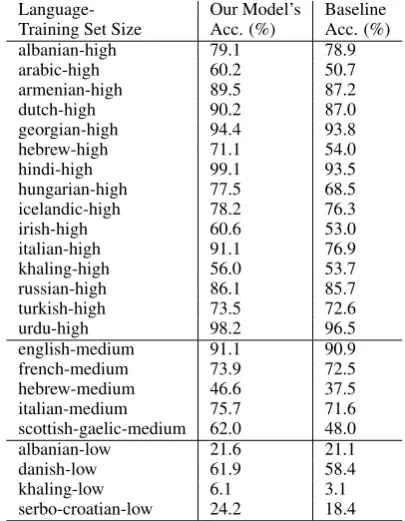
Table 1: Our model’s performance on the test datasets for those languages where it beats the baseline system.
3 Experimentation
Parameters of the Model: For all52 languages, we limit each word length to maximum25 char-acters. Null characters are padded to the smaller words at the end and for words having more than 25 characters, extra characters are omitted. We represent each character as25length sequence of one hot encoded character vectors that are passed to the embedding layer. The output dimension of the embedding layer is set as the length of the one hot encoded character vectors i.e. |C|, size of the
Language-Training Set Size Our Model’sAcc. (%) BaselineAcc. (%)
albanian-high 79.4 78.1
arabic-high 60 47.7
armenian-high 89.2 89.1
dutch-high 88 86.8
georgian-high 94.6 94
hebrew-high 72.3 55.8
hindi-high 99.1 94
hungarian-high 75.8 71.1
icelandic-high 80.6 76.1
irish-high 62.4 54.3
italian-high 91.6 79.9
khaling-high 56.2 53.8
russian-high 85.6 82
turkish-high 74.4 72.9
urdu-high 97.4 95.8
georgian-medium 90.4 90
hebrew-medium 47.3 40
italian-medium 78.2 73.8
scottish-gaelic-medium 68 52
danish-low 60.2 59.8
khaling-low 5 3.9
serbo-croatian-low 26.7 21.3
welsh-low 17 15
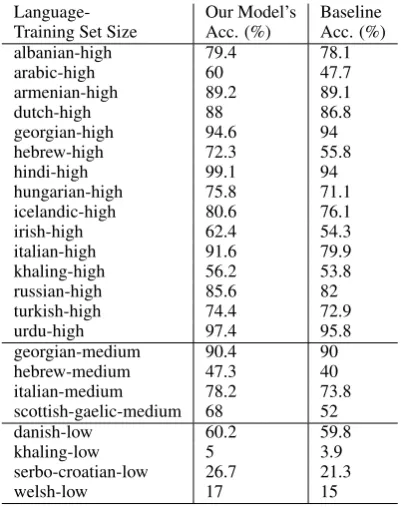
Table 2: Our model’s performance on the devel-opment datasets for those languages where it beats the baseline system.
of LSTM is set to64for all languages. We apply online learning in our model. Number of epochs and the dropout rate are set to150and0.2 respec-tively. We use ‘Adagrad’ (Duchi et al.,2011) opti-mization algorithm for training. Categorical cross-entropy function is used to measure the loss in our model.
3.1 Results
As stated in section 1, our method overperforms the baseline system on15out of the52languages in high resource configuration for the test sets. Whereas, in medium and low resource situations separately, it beats the baseline on 5 and 4 lan-guages respectively. We provide these results in Table 1. The results show that the proposed method is resource intensive.
We also provide our model’s performance on the development datasets in Table2. The results are quite similar to the results given in Table 1. When the training size is high, the proposed model beats the baseline on15 languages. For medium and low resource scenario, it achieves over the baseline on4languages only.
References
Roee Aharoni, Yoav Goldberg, and Yonatan
Be-linkov. 2016. Improving sequence to sequence
learning for morphological inflection generation: The biu-mit systems for the sigmorphon 2016 shared task for morphological reinflection. In
Proceedings of the 14th SIGMORPHON Workshop on Computational Research in Phonetics, Phonol-ogy, and Morphology. Association for Computa-tional Linguistics, Berlin, Germany, pages 41–48. http://anthology.aclweb.org/W16-2007.
Malin Ahlberg, Markus Forsberg, and Mans Hulden.
2015. Paradigm classification in supervised
learn-ing of morphology. In Proceedings of the 2015 Conference of the North American Chapter of the Association for Computational Linguistics: Human Language Technologies. Association for Computa-tional Linguistics, Denver, Colorado, pages 1024–
1029.http://www.aclweb.org/anthology/N15-1107.
Abhisek Chakrabarty, Onkar Arun Pandit, and Utpal Garain. 2017. Context sensitive lemmatization us-ing two successive bidirectional gated recurrent
net-works. InProceedings of the 55th Annual Meeting
of the Association for Computational Linguistics. Association for Computational Linguistics, Vancou-ver, Canada.
Grzegorz Chrupala, Georgiana Dinu, and
Josef van Genabith. 2008. Learning
mor-phology with morfette. In Proceedings of
the Sixth International Conference on Lan-guage Resources and Evaluation (LREC’08).
European Language Resources Association
(ELRA), Marrakech, Morocco.
http://www.lrec-conf.org/proceedings/lrec2008/pdf/594paper.pdf.
Ryan Cotterell, Christo Kirov, John Sylak-Glassman, G´eraldine Walther, Ekaterina Vylomova, Patrick Xia, Manaal Faruqui, Sandra K¨ubler, David Yarowsky, Jason Eisner, and Mans Hulden. 2017. The CoNLL-SIGMORPHON 2017 shared
task: Universal morphological reinflection in
52 languages. In Proceedings of the
CoNLL-SIGMORPHON 2017 Shared Task: Universal Mor-phological Reinflection. Association for Computa-tional Linguistics, Vancouver, Canada.
Markus Dreyer and Jason Eisner. 2011. Discovering
morphological paradigms from plain text using a dirichlet process mixture model. InProceedings of the 2011 Conference on Empirical Methods in Natu-ral Language Processing. Association for Computa-tional Linguistics, Edinburgh, Scotland, UK., pages
616–627.
http://www.aclweb.org/anthology/D11-1057.
[image:4.595.81.282.61.315.2]Greg Durrett and John DeNero. 2013. Supervised learning of complete morphological paradigms. In Proceedings of the 2013 Conference of the North American Chapter of the Association for Computational Linguistics: Human Language Technologies. Association for Computational Lin-guistics, Atlanta, Georgia, pages 1185–1195. http://www.aclweb.org/anthology/N13-1138.
Manaal Faruqui, Yulia Tsvetkov, Graham Neubig, and
Chris Dyer. 2016. Morphological inflection
gener-ation using character sequence to sequence learn-ing. In Proceedings of the 2016 Conference of the North American Chapter of the Association for Computational Linguistics: Human Language Technologies. Association for Computational Lin-guistics, San Diego, California, pages 634–643. http://www.aclweb.org/anthology/N16-1077.
Katharina Kann and Hinrich Sch¨utze. 2016a. Med:
The lmu system for the sigmorphon 2016 shared task on morphological reinflection. In Proceed-ings of the 14th SIGMORPHON Workshop on Computational Research in Phonetics, Phonol-ogy, and Morphology. Association for Computa-tional Linguistics, Berlin, Germany, pages 62–70. http://anthology.aclweb.org/W16-2010.
Katharina Kann and Hinrich Sch¨utze. 2016b.
Single-model encoder-decoder with explicit morphologi-cal representation for reinflection. In Proceed-ings of the 54th Annual Meeting of the As-sociation for Computational Linguistics (Volume 2: Short Papers). Association for Computational Linguistics, Berlin, Germany, pages 555–560. http://anthology.aclweb.org/P16-2090.
David King. 2016. Evaluating sequence alignment
for learning inflectional morphology. In Pro-ceedings of the 14th SIGMORPHON Workshop on Computational Research in Phonetics, Phonol-ogy, and Morphology. Association for Computa-tional Linguistics, Berlin, Germany, pages 49–53. http://anthology.aclweb.org/W16-2008.
Thomas M¨uller, Ryan Cotterell, Alexander Fraser, and
Hinrich Sch¨utze. 2015. Joint lemmatization and
morphological tagging with lemming. In Proceed-ings of the 2015 Conference on Empirical Methods in Natural Language Processing. Association for Computational Linguistics, Lisbon, Portugal, pages
2268–2274. http://aclweb.org/anthology/D15-1272.
Garrett Nicolai, Colin Cherry, and Grzegorz Kondrak.
2015. Inflection generation as discriminative string