A Study of Interfacial Transition Zone in Concrete
on Replacement of Fine Aggregate by Copper Slag
Reshma Malipeddi
1, Tammana Raghu Kumar
2 1Assistant Professor, Department Of Civil engineering GITAM (Deemed to be University) Visakhapatnam Andhra Pradesh
2
B.Tech, Department Of Civil engineering GITAM (Deemed to be University) Visakhapatnam Andhra Pradesh,
Abstract: As the construction activities are moving at a faster pace, with the increasing population, there needs a substitute for the materials before they gets depleted. The use of copper slag which is a industrial by product causing environmental pollution has been used as a replacement for fine aggregate in concrete. The use of copper slag has been profoundly identified to be an advantageous raw material for 0%,20%,40%,60% replacement of fine aggregate. In this paper, an attempt has been made to study the compressive strength parameters by microstructural analysis on copper slag replacement using polarising optical microscope only.
Keywords: Copper slag, microstructural analysis, polarising optical microscope, interfacial transition zone (ITZ).
I. INTRODUCTION
Copper slag is a by-product created during the copper smelting and refining process. As refineries draw metal out of copper ore, they produce a large volume of non-metallic dust, soot, and rock. Collectively, these materials make up slag, which can be used for a surprising number of applications in the building and industrial fields. This material represents a popular alternative to sand as a blasting medium in industrial cleaning. Copper slag has also gained popularity in the building industry for use as a fill material. Unlike many other fill materials, it poses relatively little threat to the environment. Copper slag is one of the material that can be considered as a waste material which could have promising future in construction industry as a partial substitute of any two either cement or aggregates. This material represents a popular alternative to sand as a blasting medium in industrial cleaning. Copper slag is been required to make the environment pollution free. It can be reused. It is used in glass, tiles cutting tools, pavements, abrasive tools.
II. LITERATUREREVIEW
1) AL.Jabri et al[1] : The researchers concluded that the workability was increase up to 31.57 for 100% replacement of copper slag as a fine aggregate. The maximum compressive strength of concrete increases up to 8.63% for 20% replacement of fine aggregate. They also revealed that 40% of the copper slag can be replaced which is greater than the target strength.
2) Brindha. D and Nagan. S[2]: Granulated copper slag from Sterilite industries as a replacement of sand in concrete mixes. Leaching studies demonstrate that granulated copper slag does not pave way for leaching of harmful elements like copper and iron present in slag. The percentage replacement of sand by granulated copper slag varied from 0% to 50%. The compressive strength was observed to increase by 35% to 40%. The split tensile strength was increased by 30% to 35%. The results showed that percentage replacement of sand by copper slag shall be up to 40%.
3) Bentz et al. 1995[3]: when the samples are prepared with high aggregate contents adjacent ITZ’s would be expected to interconnect and form a continuous path for the penetration of ions and water. Therefore, the percolation of pores in the ITZ is the great interest for studying the transport phenomena in OPC based materials.
4) Ping et al.(1991b)[4]: Available experimental studies on the effect of the interfacial transition zone (ITZ) on transport properties of cement based composite materials appear to be ambiguous. The main objective of this work was to enhance the under-standing of the relationship between ITZ and transport properties of Portland cement-based materials by using both a rapid chloride migration test and theoretical calculations. A densification factor which is related to aggregate volume content was introduced to further determine the transport properties of ITZ. thickness does not seem to follow a specific trend and appears to depend on the feature used to define the ITZ thickness.
III.MATERIALSANDMETHODS
1) Cement: Cement, commonly Portland cement, and other serve as a binder for the aggregate. The cement used in this study is of OPC 53 grade conforming to IS 12269 [7].
Table 1. properties of cement
Test Cement
Specific gravity 2.70
Fineness Modulus 2.80
Standard Consistency(%) 31
Initial Setting Time (minutes) 45
Final Setting Time (minutes) 180
2) Aggregate: Fine aggregate also called as sand. Sand is a naturally occurring granular material composed of finely divided rock and mineral particles. It is defined by size, being finer than gravel and coarser than silt. Sand can also refer to a textural class of soil or soil type. i.e. a soil containing more than 85 percent sand-sized particles by mass. The fine aggregate which has been used in the experiment is river sand and is confirming to Zone-II (as per Table 1 of IS per IS 383 [6]) The coarse aggregate is taken to be of angular shape and of nominal size of 20 mm confirmed according to the standards of (as per Table 2 of IS 383[6]).
[image:2.612.100.515.548.716.2]3) Copper Slag: An industrial by product which is used as an alternative for the fine aggregate replacement and is in the form of black granular nature and its properties are similar to the river sand. Hence the copper slag has been used and suitably identified as being harmless and hence was used in the experiment for carrying out microstructural analysis.
Table 2. Properties of fine aggregate, coarse aggregate and copper slag
Test Fine aggregate Copper Slag Coarse Aggregate
Specific gravity 2.70 3.5 2.6
Fineness Modulus 2.80 3.45 6.9
Water Absorption (%)
1.1 0.5 1.0
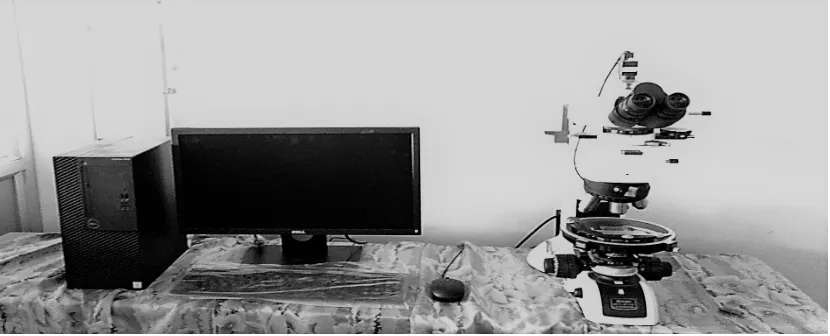
4) Optical Microscope: The optical microscope, often referred to as the light microscope, is a type of microscope that commonly uses visible light and a system of lenses to magnify images of small of lenses to magnify images of small objects. A USB Digital Microscope is used where the microscope camera attaches directly to the USB port of a computer, eyepieces are not required and the images are shown directly on the monitor. The thin sections are analysed under an optical microscope using a combination of a blue excitation filter and a yellow blocking filter. This is the fluorescent light mode in which epoxy filling air voids and cracks appears yellow, cement paste appear as shades of green, and aggregate in black. The shades of green of the cement paste depends on the capillary porosity.
5) Objective of the Study: Extensive work has been done over the copper slag to be used as a replacement material in concrete. In this experimental work copper slag has been used as a replacement material for fine aggregate. In this study, M30 grade of concrete is used and tests are performed for various replacements of fine aggregate using copper slag as 0%, 20%, 40%,60% in concrete. The optimum percentage of replacement of copper slag was studied and the microscopic analysis of the test sample was done using polarising optical microscope and then compared with that of conventional concrete along the interfacial transition zone existing between cement and the aggregates.
[image:3.612.79.547.585.710.2]6) Mix Design: Concrete mix proportioning has been done by various trial mixes and the design mix As per IS 10262 [12] standards the has been adopted for finding the proportion of M30 grade concrete which is 1:1.74:2.82:0.45 as tabulated below:
Table 3. Percentages of replacement in fine aggregate
Mix designation Cement (%) Fine aggregate Coarse aggregate Water content(%)
Sand (%) Copper Slag(%) 20mm(%) 12mm(%)
S100 100 100 0 70 30 0.45
S80CS20 100 80 20 70 30 0.45
S60CS40 100 60 40 70 30 0.45
S40CS60 100 40 60 70 ` 30 0.45
Table 4. Number of cubes for casting with M30 grade of concrete
S.No Mix designation Number of days
7days 28days
1 S100 3 3
2 S80CS20 3 3
3 S60CS40 3 3
4 S40CS60 3 3
Total 12 12
7) Preparation of the Sample for Microscopic Analysis: After casting the specimen (i.e. of fine aggregate replaced with copper slag) it is tested at the end of 28days in Universal Testing Machine and then the sample is prepared by the following steps: Extraction, cutting, Grinding, polishing.
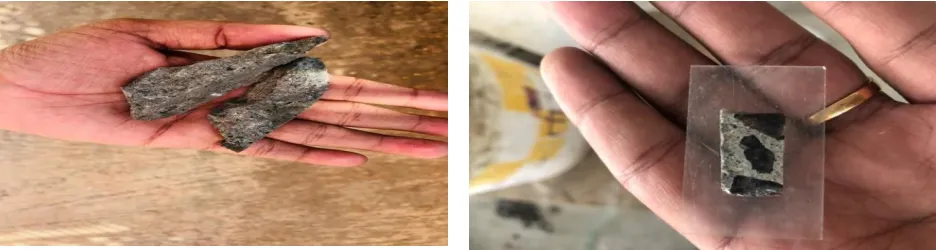
8) Sample Extraction: Extraction of the sample (thin section) from the specimen is done to observe the interfacial zone under optical microscope The identification of alkali-silica reactions and reacting aggregate particles usually requires that the thin-section be located a couple of centimetres away from the exposed surface of the concrete as general experience shows that these reactions tend to be weaker at the near surface reasons of the concrete and so the sample is extracted from core of the specimen. So, the chosen area is included in a rectangular piece of concrete, normally with the size: 35x20x10mm, which is cut from the specimen.
Fig. 2 Extraction of sample Fig.3 Sample placed on the glass plate after cutting Cement (kg/m3) Fine aggregate (kg/m3) Coarse Aggregate (kg/m3) Water (Litres)
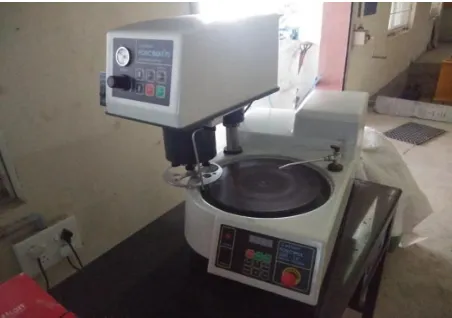
9) Cutting Process: The rectangular sample which is extracted up to a certain depth as said earlier is proceed in the GEOFORM machine by placing it on a glass plate.
Fig. 4 GEOFORM cutting machine
[image:4.612.176.448.330.469.2]10) Grinding Process: Grinding the sample must be done after processing in the cutting chamber, with the help of vacuum with the help of water which is circulated in the chamber. The glass plate should be of appropriate size so that it fits the clamping device of the grinding equipment.
Fig No.5 GEOFORM grinding machine
11) Polishing Process: Polishing the sample should be done later on using FORCIPOL and FORCIMAT polishing machine at a
constant pressure of 20 N/mm2. Since the vacuum is not available the same has to be polished manually by running it for a
certain stipulated time till the polished surface is attained with the help of Silicon Carbide powder (1000 and 320 grit). No air bubbles must be trapped beneath the glass as it would reduce the quality of the thin section.
[image:4.612.195.421.548.707.2]
12) Microscope Study: A USB Digital Microscope is used where the microscope camera is attached directly to the USB port of a computer, eyepiece are not required and the images are shown directly on the monitor. The thin sections are analysed under the microscope using a combination of a blue excitation filter and a yellow blocking filter.
Fig.7 Image analysis Under Optical Microscope
13) Compressive Strength: Compressive strength is measured on a universal testing machine and is the load bearing capacity of the specimen when uniaxially loaded. The formula for the compression for the calculation of compression strength of a specimen.
Compressive Strength =
II. RESULTS AND DISCUSSIONS
From the below graph it is observed that 20% replacement of fine aggregate has optimum strength. The decline in the compressive strength on increasing the copper slag content may be due to the in insufficient calcium content in concrete which has lapsed to maintain the calcium content required for achieving the bonding and due to increased induction of silica may have failed to establish the gain in the compressive strength of concrete. Due to the excessive free water content in the mixes with high copper slag content causes the particles of the constituents to separate leaving pores in the hardened concrete which consequently causes reduction in concrete strength.
Fig.9 Comparative analysis of compressive strength values at the end of 7days and 28days at various percentage replacements.
From the below graphs shows the density and weights of concrete cubes with fine aggregate as replacement of copper slag. The weights and densities is increased in the replacement percentage of copper slag from (0% to 60%) after 28days of curing. The density of copper slag is (4224g/cc) and for fine aggregate is (2134 g/cc). The density of the copper slag almost two times greater than the fine aggregate so that the densities are increased by replacing the fine aggregate by copper slag.
Fig.10 Comparative analysis of density of concrete specimens before curing and at the end of 7days and 28days for various replacement.
Fig.no:12 Conventional concrete depicting ITZ zone when analysed under optical microscope of 50µm.
It can be observed that, the optical microstructure in normal concrete consisted of three distinct phases and boundaries. The three phases in concrete consisted of the aggregates phase, bulk cement paste and also the interfacial transition zone (ITZ)). In addition, pores due to inefficient packing of concrete may also be observed using the optical microscope It is widely recognized that significant differences in structure exist between bulk cement paste and cement paste located in proximity to aggregate particles Paste near an aggregate surface exhibits a smaller fraction of unhydrated cement particles (out to about 40 µm) and greater porosity (especially out to about 10 µm) than cement paste in regions located farther from the aggregate.
Fig.no:13 Conventional concrete depicting ITZ zone when analysed under optical microscope of 100µm.
Fig.no 14: ITZ zone of 20% aggregate replacement of fine aggregate with copper slag under 100 µm.
Fig.no 15: ITZ zone of 40% aggregate replacement of fine aggregate with copper slag under 100 µm.
III. CONCLUSIONS
From the results and Discussions the following conclusions were made:
A. The compressive strengths of the control specimen is compared with that of the replacement of fine aggregate by copper slag
and 20% is identified as optimum percentage replacement.
B. The density of the specimen was found to increase gradually on replacement of fine aggregates by copper slag.
C. The aggregates gradation and respective interfacial transition zone (ITZ) is identified in the control specimen under polarizing
optical microscope. The C-S-H gel bonding could be identified to some extent demarcating the reaction of the unhydrated cement paste with that of the surrounding aggregate.
D. The gradation and interfacial transition zone (ITZ) with that of replacement of the fine aggregate with copper slag is also
identified under optical microscope and compared with the conventional concrete.
E. The weak links formed at the interfacial transition zone was identified on incorporation of more amount of copper slag after
optimum replacement due to the replacement of Silica content which is of higher order in the slag which is dominating the calcium content and is responsible for gradual decrease in gradation of the compressive strength thereafter.
F. The samples of 20% and 40 % replacement are compared and analysed under microscope and to some extent the reason
REFERENCES
[1] M.pavan kumar, Y.Mahesh the behavior of concrete by partial replacement of fine aggregate with copper slag and cement, vol.12, issue 3 ver.111 (may-june 2015) [2] M.V.patil, Y.D Patil ,G.R. Veshmawala, performance of copper slag as sand replacement in concrete, vol.11, no.6 (2016) pp 4349-4353
[3] Naveed A shaikh , Pradeep p Tapkire a partial replacement of fine aggregate by copper slag in concrete vol.v issue 12 2016,pageno.19809-19812 [4] Pranshu saxena,Ashish simalti scope of replacing fine aggregate with copper slag in concrete vol.111 issue 4 (july-aug 2015) pp 44-48
[5] Alnuaimi AS, (2012), Effects of copper slag as a replacement of fine aggregate of concrete vol.ix no.2 pp 90-102 [6] Akihiko Y, Takashi Y. study of utilaisation of copper slag as fine aggregate for concrete vol.23 pp 79-85
[7] AL-jabri K, Taha R, Al-Ghassani M. use of copper slag and cement by pass dust as cementitious material vol.1 ,24(2002) pp 7-12 [8] Mobasher B, Devaguptapu R, Arino AM. Effect of copper slag on hydration of blended cemtitious mixture vol.12(1996) pp-1677-1686.
[9] Microstructural analysis of interfacial transition zone (ITZ) and its impact on the compressive strength lightweight concretes P. Vargas, Oscar Restrepo- Baena, Jorge I. Tobón, 2017(Issue.No.381-389)-ELSEVEIR