Study the Effect of Curvature on Concrete Bridge
Deck
Miss. Kojagiri d. Kashid1, Mr. V. G. Khurd2, Mr. S.S. Chougule3
1
Student of P.G., M.E. Civil,-Structure Sanjay Ghodawat Institutions, Atigre,Shivaji University, Kolhapur, India
2
Assistant Professor, Civil Engg. Department, Sanjay Ghodawat Institutions, Atigre, Shivaji University, Kolhapur, India
3
Assistant Professor, Civil Engg. Department, SITCOE, Yadrav, Shivaji University, Kolhapur, India
Abstract: The paper presents the effect of curvature on horizontally curved single cell box girder concrete bridge deck for various degrees of curvature such as 15°, 30° and 45°. The end supports are provides as simply supports. For this study the models have been prepared by using finite element method in the CSi Bridge software. The response of the parameters such as shear force, bending moment, and torsion under the dead load and live load (70R Wheel IRC Loading) is studied.
Keywords: Curved box girder bridge decks, prestress concrete, finite element model in csi bridge software, structural analysis, bending moment, shear force, torsion.
I. INTRODUCTION
An analysis and design of horizontally curved bridges is very challengeable than the straight one. But sometimes it is necessary to construct curved bridges due to geographical conditions, various site conditions. In metropolitan cities curved bridges are constructed due to its smooth movement of traffic congestion and good aesthetic view. Due to the curvature effect additionally torsion in the bridge deck is developed with bending moment and shear force due to the dead load and live load. The most convenient section for the construction of curved bridges is box section because it has good mechanical performance due to its geometric efficiency and to its effectiveness in resisting torsion and warping (Granata, 2014). In this paper the effect of curvature due to dead load and live load on single cell box girder concrete bridge deck is studied for various degrees of curvature such as 15°, 30° and 45° in case of the bending moment shear force and torsion under the loading (Dead load and 70R Wheel IRC Live load). Prestressed concrete single cell box girder is used with parabolic tendon profile.
II. CURVED BRIDGES
Curved composite bridges have their unique characteristics. The curvature affects the geometry and behavior of the bridge structure. Curved bridges are subjected to coupled torsion and bending because of curvature and hence their analysis is more complex than that of straight bridges. In addition to simple vertical flexure behavior there can be significant torsional loading and twisting of the girders that cause lateral stresses to the flanges. Due to the complexity of the curved structure and its complicated 3D response different methods have been developed for the static and dynamic analysis of curved bridges. But now a day’s 3D computer analysis is recommended for the analysis of horizontally curved bridges.
III. FINITE ELEMENT METHOD
During the last two decades, the Finite Element Method (FEM) has become a popular technique in engineering for computerized complex solutions. The FEM solves the problem by using mathematical modeling in which the structure should be considered as assembly of two or three dimensional elements connected to each other at their nodal points, possessing an appropriate number of degrees of freedom. The entire structure (Box Girder) is divided into small elements and the stiffness of that structure is assembled from the membrane and the plate bending stiffness of each element (Khairmode A. S. and Kulkarni D. B., 2016).
IV. ANALYSIS
A. Material Properties
1) Material Type: Single Cell Prestressed concrete Box Girder
2) Grade of Concrete: M40
3) Weight per unit Volume: 24.99 kN/m3
5) Poisson’s ratio: 0.2
6) Area of Tendon: 2660 mm2
7)Ultimate Strength of Prestressing Tendon: 1800 N/mm2
B. Section Properties
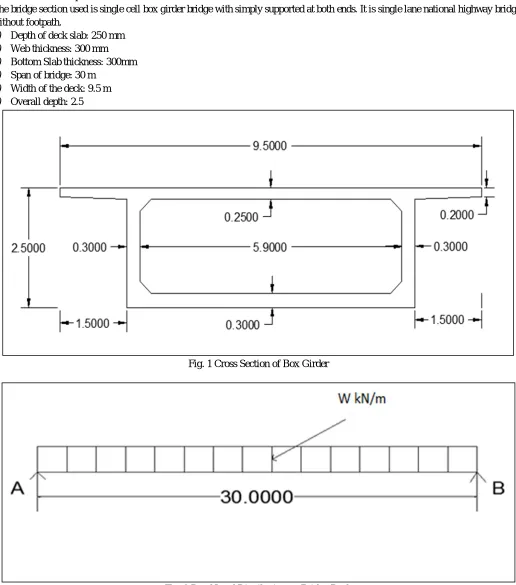
The bridge section used is single cell box girder bridge with simply supported at both ends. It is single lane national highway bridge without footpath.
1) Depth of deck slab: 250 mm
2) Web thickness: 300 mm
3) Bottom Slab thickness: 300mm
4) Span of bridge: 30 m
5) Width of the deck: 9.5 m
[image:2.612.48.564.140.725.2]6) Overall depth: 2.5
Fig. 1 Cross Section of Box Girder
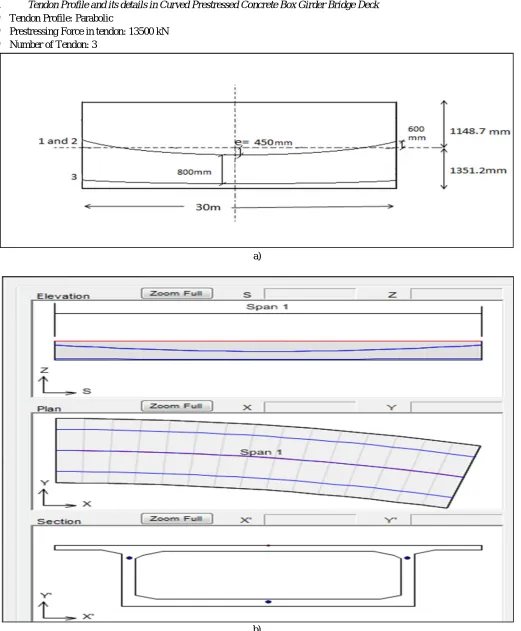
C. Tendon Profile and its details in Curved Prestressed Concrete Box Girder Bridge Deck
1) Tendon Profile: Parabolic
2) Prestressing Force in tendon: 13500 kN
3) Number of Tendon: 3
a)
[image:3.612.49.570.78.709.2]b)
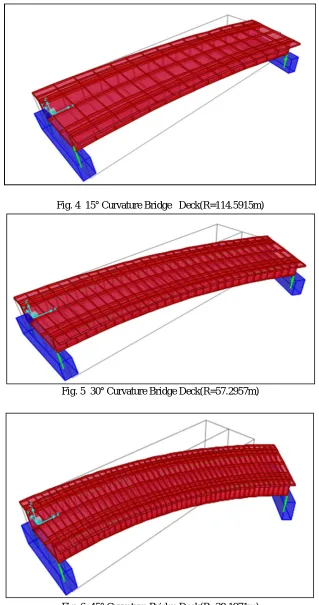
D. Curved Bridge Deck Models
The models were generated in CSi Bridge software for15°, 30° and 45° of curvature and having radius 114.5927m, 57.2957m and
38.1971m respectively.
Fig. 4 15° Curvature Bridge Deck(R=114.5915m)
[image:4.612.146.465.114.719.2]Fig. 5 30° Curvature Bridge Deck(R=57.2957m)
V. RESULT AND DISCUSSION
[image:5.612.134.477.144.363.2]The response of curved bridge deck examined for degree of curvature 15°,30° and 45° under the superimposed load and prestressing load as below.
Table 1 Response Of Curvature On Shear Force, Bending Moment With Superimposed Load And Prestressed Load
Degree of Curva-
ture
Shear Force (kN) Bending Moment (kN-m)
Superimposed Load Prestressed Load Superimposed Load Prestressed Load
15° -3039.9409 3048.113 -22962.7376 23309.16
30° -3045.7278 3034.551 -23780.421 22938.57
45° -3064.8686 3037.5625 -24926.066 22515.59
(Note: Superimposed Load= Dead Load + Live Load)
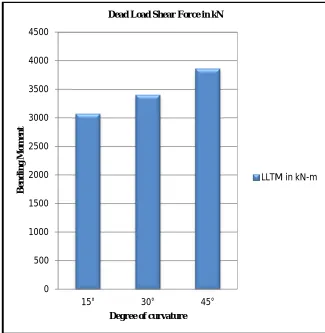
A. Effect of Curvature on Shear Force due to Dead Load
Fig. 7 Effect of curvature on Sear Force due to dead load
0 500 1000 1500 2000 2500 3000 3500 4000 4500
15° 30° 45°
B en d in g M o m en t
Degree of curvature
Dead Load Shear Force in kN
[image:5.612.141.466.388.721.2]B. Effect of Curvature on Shear Force due to Live Load
Fig. 8 Effect of curvature on Shear Force due to live load
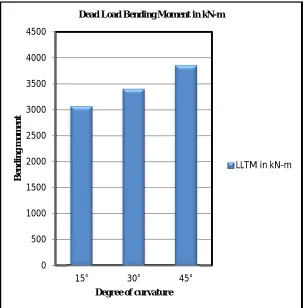
C. Effect of Curvature on Bending Moment due to Dead Load
Fig 9 Effect of curvature Bending Moment due to on dead load
0 500 1000 1500 2000 2500 3000 3500 4000 4500
15° 30° 45°
Sh e ar f o rc e
Degree of curvature Live Load Shear Force in kN
LLTM in kN-m
0 500 1000 1500 2000 2500 3000 3500 4000 4500
15° 30° 45°
B en d in g m o m en t
Degree of curvature
Dead Load Bending Moment in kN-m
[image:6.612.155.461.408.716.2]D. Effect of Curvature on Bending Moment due to Live Load
Fig 10 Effect of curvature Bending Moment due to on live load
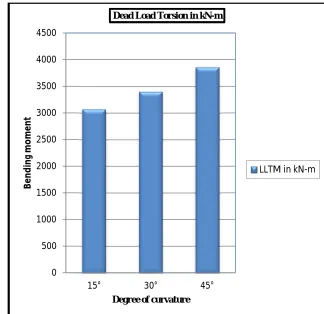
E. Effect of Curvature on Torsion due to Dead Load
Fig. 11 Effect of curvature on Torsion due to dead load
0 500 1000 1500 2000 2500 3000 3500 4000 4500
15° 30° 45°
B en d in g m o m en t
Degree of curvature
Live Load Bending Moment in kN-m
LLTM in kN-m
0 500 1000 1500 2000 2500 3000 3500 4000 4500
15° 30° 45°
B e n d in g m o m e n t
Degree of curvature Dead Load Torsion in kN-m
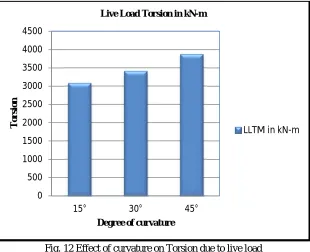
[image:7.612.139.463.402.716.2]F. Effect of Curvature on Torsion due to Live Load
Fig. 12 Effect of curvature on Torsion due to live load
VI. CONCLUSION
From the results obtained for curved bridge decks of degrees of curvature 15°,30° and 45°,
A. It is seen that values of shear force due to prestressing load are very close with the values of shear force due to superimposed load and values of bending.
B. moment due to prestressing load are also nearly close with the values of bending moment due to superimposed load but in opposite directions. It will helps to counterbalance the stresses developed along the deck and to remain the section in sable position.
C. As degree of curvature increases there is no change in shear force due to dead load but for live load shear force increases at support.
D. As degree of curvature increases Bending moments due to dead load and live load are slightly increased. It is maximum at middle span in all cases.
E.Due to curvature, torsion is created along the deck surface. Torsion value due to dead load and live load increases and it changes abruptly.
REFERENCES A. Journals
[1] Adamakos, T., Vayas, I., Petridis, S., and Iliopoulos, A. “Modeling of curved composite I-girder bridges using spatial systems of beam element.” J. Constr. Steel Research 67, pp. 467-470, 2011.
[2] Aneja, I., and Roll, F. “Experimental and Analytical Investigation of A Horizontally Curved Box-Beam Highway Bridge Model.” ACI structural journal, SP 26-16, pp.379-410.
[3] Ghali, A. “Torsion in Prestressed Curved Bridges.” ACI structural journal, SP 93-36, pp. 815-833.
[4] Granata, M. “Analysis of non-uniform torsion in curved incrementally launched bridges.” Engineering Structures 75, pp. 374-397, 2014.
[5] Khairmode, A. S., and Kulkarni D. B. “Analysis of Prestressed Concrete Multi-cell Box Girder Curved Bridge.” International Journal of Science and Research (IJSR) ISSN (Online): 2319-7064,pp. 2455-2459, 2016.
B. Books
[1] Brindra, S. P., “PRINCIPLES AND PRACTICE OF BRIDGE ENGINEERING”, Dhanpat Rai Publications (P) LTD, New elhi (1973). [2] Hambly, E. C. “Bridge Deck Behavior.”, First Edition 1991.
[3] Krishna Raju, N. “Prestressed CONCRETE.”, Fourth Edition.2011.
0 500 1000 1500 2000 2500 3000 3500 4000 4500
15° 30° 45°
T
o
rs
io
n
Degree of curvature Live Load Torsion in kN-m
C. IS Codes
[1] I.R.C. 6: 2014. The Indian road congress 2000. Standard specification and code for practice for road bridges. Section: II, “Loads and Stresses” (Fourth Revision).
[2] IRC 21-2000. “Standard Specification and Code of Practice for Bridges “, Section: III, “Cement Concrete (Plain and Reinforced Concrete) “, Third Revision. [3] IS 456-2000. “Indian Standard Plain and Reinforced Concrete-Code of Practice”, Fourth Revision.