Using a Conceptual Serious Gaming
Implementation Framework for Evaluation
Evaluation of the implementation of a serious game at Samen14
Tom, Borgerink
University of Twente
Master Thesis Business Administration
Abstract
Serious gaming is increasing in use by businesses as well increasing in number of studies. However the focus of serious gaming in literature has been put on the design phase of the game, while businesses and literature both acknowledge the importance of studying the implementation phase as well. The serious gaming sector does not have an implementation framework, while other multiple sectors do have implementation frameworks for diverse innovations. And although those frameworks could also be used for other innovation implementations, serious gaming as an innovation slightly differs from other innovations. Specific game elements and characteristics could influence the implementation of serious gaming from an innovational point of view. For future successful serious gaming implementation outcomes, a serious game implementation framework is needed that could be used to study the influence of potential barriers and facilitators of the implementation, what could be translated into meaningful outcomes that could be used in multiple contexts. The goal was to build such a framework by combining innovational constructs from the CFIR (Consolidated Framework for Implementation Research) with game elements and characteristics, and to use and test this framework by evaluating the serious game implementation effort at Samen14. While innovation implementation literature describes eight constructs (source of design, evidence strength and quality, relative advantage, adaptability, trialibility, complexity, quality of packaging and design, and costs) as potential barriers or facilitators for innovation implementation, six of those eight constructs are combined with SG theory. Using a systematic approach based on qualitative content analysis, supported by the SG implementation framework, the serious game implementation effort was studied on positive and negative influences of the constructs. The results showed two constructs were positively related to the implementation effort, four constructs were negatively related to the implementation effort, two game characteristics were negatively related to complexity, and two game characteristics were negatively related to SG quality and motivational design and one was positively related to SG quality and motivational design. Based on the results this research concludes the constructs influence the implementation of serious games due positive and negative influence of game elements: potential users involvement, perceived usefulness and effectiveness of the game, needs assessment, and game characteristics. Potential user involvement in development and experimenting is not crucial for a successful implementation. Perceived usefulness of serious gaming and the game is necessary for a successful implementation. Individual and environmental needs should be considered in the game for a successful implementation. And game characteristics (e.g. goals and game reflection of daily businesses) could influence the implementation in a positive or negative way. This research shows the importance of combining existing innovational constructs with specific game elements and characteristics and the usefulness of the serious game implementation framework.
Keywords
Introduction
Games are not just used for entertainment but are used for learning objectives as well (Conolly et al., 2012). Clark Abt describes this phenomenon as Serious Gaming, what he defined as mainframe computer or pen- and – paper based games to improve education in and outside of the classroom (e.g. De Wit, 2011; Sutti et al., 2012). Usually SG is connected to video games (Sawyer, 2002). However some definitions are defined without inclusion of video games: SG is designed for other primary purpose than entertainment (Sutti et al., 2012); “with the intention of serving learning goals, behavioral goals, organizational goals and or intervention goals set by its developers” (Spil et al., 2017, p.1). Although SG is an upcoming phenomenon in practice as well in science (Laamarti et al., 2014), focus has been mainly on the SG design phase (Azadegan et al., 2012; Spil et al., 2017). The diffusion and implementation phases in SG literature are underexposed. Although implementation of SG in some cases is found to be (in) effective, SG literature fail to translate this into meaningful outcomes that could be used across multiple contexts (Spil et al., 2017). Other sectors, like Healthcare, were successful in translating adoption/ implementation influences into implementation frameworks. Those sectors do not just evaluate summative endpoint needs but also evaluate implementation effectiveness. Existing implementation frameworks are based on barriers of multiple levels: innovation, inner and outer setting, individuals, and the process (Damschroder et al., 2009). Although SG literature does not provide much research about implementation, one study does mention barriers for SG implementation that corresponds with before mentioned dimensions by Damschroder and colleagues. Riedel et al. (2013) mentions organizational, environmental, contextual and individual, and SG specific dimensions as potential barriers of SG implementation. This underlines the importance of SG implementation research by several researchers.
SG could be defined as an innovation: “an innovation is a product or practice that is new to its developers and/ or to its potential users” (Klein and Knight, 2005, p.243); a practice or idea and object and is perceived as new by an individual or other unit of adoption (Rogers, 1995); “a new product or service, a new production process technology, a new structure or administrative system, or a new plan or program pertaining to organizational members” (Damanpour, 1991, p.556). Implementation literature provides many different innovation implementation frameworks e.g.: Interactive Systems Framework (Wandersman et al., 2008); Quality Implementation Framework (Meyers et al., 2012); Ecological Framework (Durlak and Dupre, 2008); Model for Improvement (Feldstein et al., 2008), Community- bases Prevention (Stith et al., 2006); Implementation in School- based Settings (Greenberg et al, 2005); PARIHS (Kitsen, 1998; Kitsen, 2008; Helfrich et al., 2010; Stetler et al., 2011), Implementation for Healthcare (Cook et al., 2011); Consolidated Framework for Implementation Research (Damschroder et al., 2009). These frameworks are based on different innovations in several sectors. Although implementation frameworks are developed at different
sectors, it could be used to study innovation implementations at other sectors as well (Aarons et al., 2011). Several researchers have investigated the process of innovation implementation and increased the understanding how it developed (e.g. Fixsen et al., 2005; Greenhalgh et al., 2004; Rogers, 2003; Damschroder et al., 2009). The process may be revisited when studying a new innovation implementation effort if it may bring new elements to the implementation process (Meyers et al., 2012). SG is gaining more interest in the scientific world, but the focus has been mainly on the design phase and less on diffusion and implementation (Spil et al., 2017). To get a better understanding on SG implementation one must identify the barriers and benefits of the implementation effort (Azadegan et al., 2012). For a better innovation implementation process understanding it is important to find out what factors influence innovation implementation in particular settings, to optimize implementation efforts in similar settings (Damschroder et al., 2009). Therefor research should be conducted in different settings to contribute in the explanation of why an implementation effort has been successful or a failure at specific contexts. Current research on this subject has been mainly held in the Healthcare sector, less focus has been on other industries, specifically public organizations (Choi and Chang, 2009). Based on to the definitions of innovations, SG could be defined as one. While innovation implementation frameworks from other sectors also could be used for evaluation of SG implementation. SG differentiates itself from other innovations by specific game elements and characteristics. Those game elements and characteristics could influence the implementation from an innovational point of view. These reasons are used to combine existing implementation frameworks with specific SG theory to build a SG implementation framework. Constructs of several frameworks are described and used as input for a conceptual SG implementation Framework. As mentioned before constructs could influence innovations as well SG implementations from different dimensions. It is not possible to evaluate all dimensions at once (Damschroder et al., 2009). Therefor this research has chosen to study the dimension that most likely will differ from other implementations, the innovation SG itself. The question is which and how innovational constructs could be combined with specific SG characteristics to establish an implementation framework for serious games to find out what works where and why?
study to evaluate a SG implementation effort to study what has influenced and why it has influenced the implementation effort. In 2016 a collective entity Samen14 started in cooperation with two SG developers, with the development, and implementation of a serious game for youth care process reflection and knowledge sharing between municipalities. This board game should involve fourteen municipalities, which are involved with youth care. The intention was to implement and diffuse the game by potential users involvement in the development process using the Game of Games to implement the game in all 14 municipalities. Five of the fourteen municipalities have actually started with the implementation of the game but all have failed to implement. Since all of the municipalities have failed to implement the game, all could be marked as low implementation units. Therefor the conceptual SG implementation framework is used for implementation evaluation. The first goal of the evaluation is: how to apply the conceptual SG implementation framework to identify contextual influences that explain the outcome of the implementation effort? With a second goal to describe how to use the framework, suggest refinements to the framework, and provide directions for future research. Although the implementation effort has failed the findings are nonetheless helpful for future SG implementation efforts. The SG implementation framework could be used to indicate the SG implementation context in a particular setting, to evaluate SG implementation progress, and for explanation of findings in SG implementation research or to improve SG implementation.
Overall this research is split into two aims, those aims together will provide an answer to the overarching research question, how to identify potential barriers and facilitators of serious game implementation? The first goal is to develop a conceptual framework for SG implementations. Therefor this research will answer the following research question (aim 1): which and how innovational constructs could be combined with specific SG characteristics to establish an implementation framework for serious games to find out what works where and why? This research questions was answered by the following sub- questions: what does influence an innovation implementation, what is the influence of game elements and characteristics on implementation, how to combine game elements and characteristics with implementation constructs from an innovational point of view? This framework is used to identify contextual influences that explain the implementation effort outcome at Samen14, of which results could be used to refine the conceptual SG implementation framework. The following research questions will be answered (aim 2): how and what barriers and facilitators have influenced the serious game implementation effort at Samen14? This research questions was answered by the following sub- questions: which barriers and facilitators of the serious game implementation effort could be identified by using the Conceptual Serious Game Implementation Framework, and how to use the Conceptual Serious Game Implementation Framework be used?
In the literature review existing innovation implementation theory is combined with specific game elements and characteristics that may influence a serious game implementation. The method section describes how the
conceptual serious game implementation framework is used to evaluate the implementation effort at Samen14. The results section declares the influence of the constructs by the conceptual serious game implementation framework. Based on the results a discussion and conclusion is written, while also the limitations of this research are described.
Literature Review
In this research theories (published models, theories, and frameworks) are used to describe implementation of innovations and serious games, in multiple sectors like healthcare, psychology, and business. The technique of Wolfswinkel (2013) is used to guide this literature review. A snowball effect is used to study the determinants of diffusion, dissemination, and implementation of innovations, starting with Rogers (2003) and Geenhalgh et al. (2004) for understanding innovation implementation, and later Damschroder et al. (2009) for innovation implementation construct defining. The combination Serious Games AND Implementation only provided three relevant articles (Azadegan et al., 2012; Riedel et al., 2013; Spil et al., 2017) that describes somehow the influences of SG implementation. SG literature does not provide many implementation studies; it does provide some research about SG development. Several game elements and characteristics are studied that could have influence on the development of SG. Development is part of the implementation process and therefor, game elements and characteristics are used to study the implementation from an innovational point of view. Select SG literature was sought- after through inclusion of Serious Games AND Characteristics, what could define what game elements may influence an implementation from an innovational point of view. From the literature 46 articles were screened and selected of which 17 are used for background information and 29 are used for analysis. Of those 29 articles used for analysis are 9 articles that describe specific characteristics of serious games, while the other 17 articles describe the implementation process and its influences. For the literature review in this research two types of coding processes are used: open- coding and selective- coding. Open- coding is used to describe the diffusion and innovation implementation processes what could be well defined from existing literature. It is used to identify a set of constructs that are predetermined as influential on implementation of innovations. Selective coding is used to refine the constructs identified with open- coding. Specific SG literature is used to refine found implementation constructs into new constructs that may influence the implementation of SG. The literature is presented in the literature review below, while the combined constructs are defined in the SG implementation model “figure 3”, and the codebook based on this model is provided in additional file 1.
stages “figure 1” that together combines the diffusion of innovation: 1) Awareness (dissemination: potential users make acquaintance of an innovation), 2) Persuasion (interest in innovation), 3) Evaluation/ decision (adoption: decision of potential users to try the innovation), 4) implementation (preparation of organization for innovation usage), 5) institutionalization (routine use of the innovation). Greenhalgh et al. (2004) based their model on Rogers and colleagues’ model of diffusion and differentiate six categories: 1) innovation, 2) adoption/assimilation process, 3) communication and influence (diffusion and dissemination), 4) the inner (organizational) context, including antecedents for innovation in general and readiness for particular innovations, 5) the outer (inter-organizational) context, including the impact of environmental variables, policy incentives and mandates, and inter-organizational norms and networking, 6) the implementation process. Although overlap may occur among the stages of diffusion, the implementation phase follows the adoption phase. Adoption usually starts with the identification of a need and possible solutions to this need, this is followed by the decision to adopt a solution and ending with the actual implementation of the solution (Damanpour and Schneider, 2006; Holahan et al., 2004; Sawang, 2008). Klein et al. (2001) state adoption is just the beginning of the innovation process and is successful when it is used and accepted, while such decisions are typical managers’ decisions (Klein and Sorra, 1996). Klein and Knight (2005) gave a small example of what they mean by adoption: they refer to a machine used for sporting that is bought but not in constant use. In their definition the machine is adopted but is not implemented. For a successful implementation the innovation needs thus to be in constant use. Literature shows the importance and influence of the dissemination and adoption phase on the implementation of innovations.
“Figure 1”, Model of Innovation Diffusion, Rogers (2003)
Innovation implementation has been described in several ways: as the process after the innovation is noticed, adopted and handed over to potential users (Kandiri, 2013); “events and actions that pertain to modifying the innovation, preparing the organization for its use, trial use, acceptance of the innovation by the users and continued use of the innovation until it becomes a routine feature of the
organization” (Damanpour and Schneider, 2006, p.217); a specified set of activities designed to put into practice an activity or program of known dimensions (Fixsen et al., 2005); a process within an organization to gain targeted employees appropriate and committed to use an innovation, it is the time needed for potential users to become skillful, consistent and committed to the use of an innovation (Klein and Sorra, 1996). In general it can be described as the process after adoption to make the organization ready for constant use of the innovation. The phases before implementation are highly relevant and influential on the implementation phase (Greenhalgh et al., 2004). Klein et al. (2001) state successful implementation is dependent on innovation effectiveness (benefits created by innovation) as well on implementation effectiveness (innovation implementation and use by potential users). Although the model in “figure 2” shows a direct relationship between implementation effectiveness and innovation effectiveness, successful implementation may not automatically occur in innovation effectiveness. Implementation effectiveness is influenced by the implementation climate. According to Klein and Sorra (1996) implementation climate is shaped by the experiences and observations and information and discussions by employees on organizational implementation policies and practices. These policies and practices will determine as a comprehensive and interdependent whole how strong the implementation climate will be. Better policies and practices will increase the level of support for implementation by employees (Sawang, 2008). Policies and practices are shaped by: institutional factors as financial resources and management support (Klein et al., 2001); human resources (Sawang, 2008), individual factors (Jacobs et al., 2015); collective humans’ perceptions (Holahan et al., 2004); institutional enabler, learning (Choi and Chang, 2009). Various factors from user-based point of view have an impact on innovation implementation. Although these models and that of Klein and colleagues do not show what and why factors influence implementation it does give it good overview of the process and how it is affected.
“Figure 2”, Model of Innovation Implementation Klein, Conn and Sorra (2001)
phenomena but do not provide an explanation (Damschroder et al., 2009). According to Nilsen (2015) frameworks are like checklists relevant to different aspects of implementation, which do not specifically mention the mechanisms of change. SG literature does not provide a framework that describes constructs that could influence the implementation; it does recognize dimensions like the innovation itself may have certain barriers that could influence the implementation. Individual perceptions of game elements and characteristics, organizational involvement, and community involvement will determine the accomplishment of implementation (e.g. Jabbar and Felicia, 2015; Damschroder et al., 2009; Greenhalgh et al., 2004). Aarons et al. (2011) state innovation implementation frameworks built for a specific sector could be used for other sectors as well, therefor the constructs described by Damschroder et al. (2009), which are mainly based on the theory by Rogers (2003) and Greenghalgh et al. (2004), are used as basis combined with specific game elements and characteristics. All characteristics of innovation described by Rogers (2003) are described in the framework, except for compatibility. Although this characteristic is used by Damschroder et al (2009) in the CFIR, it is not defined as a characteristic from an innovational point of view.
“Table 1”, CFIR dimension Innovation, Damschroder et al. (2009)
Use of the game will depend on potential users engagement (Jabbar and Felicia, 2015). They note enjoyment and motivation could reach engagement for potential users sustainment. According to Connolly et al. (2012) engagement is related to game elements and players’ attributes. Game elements could include game characteristics (e.g. Garris et al., 2002; Lucas and Sherry, 2004); and the type of the game (Lee et al., 2007). Although SG literature does not provide constructs that could influence the implementation, it does highlight the importance of potential user involvement in game development to access baseline knowledge and skills, and perceived game usefulness (e.g. Watson and Fang, 2012; Spil et al., 2017), what could influence the source of design, evidence strength and quality, adaptability and trialibility. While game characteristics such as challenge, rules and goals (e.g. Garris et al., 2002; Tsekleves et al., 2016), could influence complexity and the quality of packaging and design.
An overview of constructs that could influence SG implementation is provided in “figure 3”. Influences of those innovational constructs on innovation implementation and
their relation with game specific characteristics are explained in more detail per construct. “Figure 3” provides an overview of all the constructs from the SG implementation framework. Based on the CFIR the constructs are combined with game elements characteristics.
Figure 3.
Serious Games Implementation Framework
1. Source of Serious Game Design Individual perception of involvement potential users in Serious Game development. A, B, D, E, F
2. Evidence Strength and Quality the perception of stakeholders if serious games will work in the current setting using motivational game elements. A, F
3. Relative Advantage the extent to which this particular innovation is perceived better than other innovations/ methods. A, B, C
4. Adaptability degree to which the game meets the individuals’ knowledge and skills, organizational needs, and community needs. A, B, D, E, F, G
5. Trialibility degree to which potential users were allowed to participate in testing and experimenting with the game for feedback purpose. A, B, C, F, H 6. Complexity perceived difficulty of the game and
it’s implementation by specific game characteristics. Specific game characteristics: goals and rules, characters, multiplatform, transference, and challenge. A, B, C, F, G, H
7. Serious Game Quality and Motivational Design individual perceptions how design and packaging fit users and organizations, and how motivational design is conceived by specific game characteristics.
Specific game characteristics: fantasy, rules and goals, challenge, characters, playing platform, transference (game results), physical (reflection work field). A, F, G, H
8. Costs include investment, supply, and opportunity costs related to the development and
implementation of the game. A, H
“Figure 3”, SG Implementation Framework
The letters behind the constructs define by what literature the construct is based on.
Construct based on Implementation Literature e.g.: A: Damschroder et al. (2009) 1, 2, 3, 4, 5, 6, 7, 8
B: Greenhalgh et al. (2004) 1, 3, 4, 5, 6 C: Rogers (2003) 3, 5, 6
D: Fixsen et al. (2005) 1, 4 E: Stith et al. (2006) 1, 4
[image:5.612.318.570.178.557.2]Construct combined with SG Literature e.g.: F: Jabbar and Felicia (2015) 1, 2, 4, 5, 6, 7 Table 1.
Innovation Characteristics
- Innovation Source
- Evidence Strength and Quality
- Relative Advantage
- Adaptability
- Trialibility
- Complexity
- Design Quality
G: Wilson et al. (2009) 4, 6, 7 H: Tsekleves et al. (2016) 5, 6, 7, 8
Source of SG Design
This is defined as the individual perception an innovation is developed within or outside the organization (Damschroder et al., 2009; Greenhalgh et al., 2004). Participation in game development should involve all the individuals related to the game (Spil et al., 2017; Jabbar and Felicia, 2015; Garris et al., 2002). The idea is to assess the need of all of those who are involved with an innovation to consider the perspective and elements of potential users (Stith et al., 2006; Feldstein et al., 2008; Damschroder et al., 2009; Greenhalgh et al., 2004; Fixsen et al., 2005). Whether or not potential users were involved in the development it may be a barrier of facilitator on SG implementation.
Evidence strength and quality
Damschroder et al. (2009) defined this as the perception of stakeholders on quality and validity of evidence supporting required outcomes of the innovation. In other words this includes the perception of stakeholders if an innovation will work in the current setting of the organization. The perceived usefulness of SG will require the presence of motivational elements such as goals in game goals and intervention goals (Jabbar and Felicia, 2015). Motivational elements refer to how SG has influence on a players’ thoughts, actions, and reactions on gameplay and learning. A way to influence the users' perception of desired outcomes is to translate all the information required to make SG easy to understand, this is the so-called Prevention Synthesis and Translation System (Wandersman et al., 2008). How and what evidence of strength and quality of SG is provided at potential users may be barriers or facilitators for SG implementation.
Relative Advantage
Rogers (2003) defined this construct as the level to which an innovation is perceived being better than the idea it supersedes. This definition is used by multiple authors in the implementation science (e.g. Damschroder et al., 2009; Cook et al., 2009; Greenhalgh et al., 2004; Feldstein et al., 2008; Durlak and Dupre., 2008). For example, Damschroder et al. (2009) defined relative advantage as stakeholders' perception of the advantage of implementing the innovation compared to other innovations. This comparison includes the innovation with existing innovations in the organization and innovations not used in the organization. Another construct from Rogers (2003) has merged into this construct by Damschroder et al (2009); observability. Observability is described as clearly visible benefits of the innovation (Rogers, 2003). But when measuring both relative advantage and observability, both will be too tight to separate from another (Damschroder et al., 2009). Therefor Damschroder et al (2009) have placed observability under relative advantage, although both are acknowledged. Perception of stakeholders if SG supersedes other methods that share the same purpose, may be a barrier or facilitator for SG implementation.
Adaptability
Adaptability defines the degree to which an innovation could meet individual, organizational, and on community needs (Greenhalgh et al., 2004; Fixsen et al., 2005; Stith et al., 2006; Durlak and Dupre, 2008; Damschroder et al., 2009). As they share the same core Stith et al. (2006) refer to adaptability as community fit: fit between the needs of potential users and its environment. Adaptability relies on the core components (elements that cannot be missed in the innovation) versus adaptable periphery (adaptable elements, structures, and systems required to make use of the innovation in the organization) of the innovation (Greenhalgh et al., 2004; Fixsen et al., 2005; Damschroder et al., 2009). Jabbar and Felicia (2015) state involvement of potential users of SG is important for adaptation in game development process. Game development should consider baseline knowledge and skills of potential users of SG to meet individual needs (Wilson, 2009). Modification to individual and environmental needs may lead to a stronger implementation (Durlak and Dupre, 2008). SG implementation may require individual and environmental (organization and community) needs what may be barriers or facilitators for SG implementation.
Trialability
This construct defines the degree to which potential users were allowed to test and experiment with the innovation (Rogers, 2003; Greenhalgh et al., 2004). Testing and experimenting with the innovation by potential users, supports adoption of the innovation (Feldstein et al., 2008). Jabbar and Felicia (2015) argue the importance of potential users involvement in the process, while testing and experimenting with the game, potential users could provide feedback for problem solving. Testing and experimenting with the game is essential for potential users to explore the game and how this fits learning principles (Tsekleves et al., 2016). Based on this exploration, potential users could provide feedback and assess control, what is considered to be motivational (Wilson, 2009). Potential user involvement in testing and experimenting with the game may be a barrier or facilitator for SG implementation.
Complexity
could be reflected by; goals and rules (Garris et al., 2002; Wilson, 2009; Charsky et al., 2010; Jabbar and Felicia, 2015); characters (Charsky et al., 2010; Mildner, 2015); multiplatform (Owen, 2004; Tsekeleves et al, 2016); transference (Tsekleves et al, 2016), and challenge (Garris et al., 2002; Jabbar and Felicia, 2015; Wilson, 2009). The elements of challenge in games lie in its tasks and activities (Charsky et al., 2010). The characteristics of challenge describe the problems that demand the players' ability (Mildner, 2015). On the other hand, the characteristics of SG may cause complexity when implementing. All games have their story in a specific setting and with specific characters (Charsky et al., 2010), on a chosen playing platform (Owen, 2004; Tsekleves et al., 2016). Both players needed as character and the chosen platform may cause difficulties in bringing them together at the time and place needed. Transference determines the transfer of generated data using SG to the “real world”, learned processes and tasks will be executed (Wilson, 2009; Tsekleves et al., 2016). Specific game elements may influence SG implementation by making the game more difficult to play or/ and by making it harder to implement the game, what may cause barriers or facilitators for SG implementation.
SG Quality and Motivational Design
Damschroder et al. (2009) described this construct as innovational design quality and packaging. As they used the definition of Klein et al. (2001) they defined it as the perceived eminence how the innovation is interconnected, introduced and should fit the organization. In other words, it defines how individuals perceive the design as qualitative. The design of a game may determine the level of engagement (Jabbar and Felicia, 2015). Innovational characteristics may influence the individuals’ motivation and joyfulness to play the game, which will determine the degree of engagement (Garris et al., 2002; Wilson, 2009; Charsky et al., 2010; Jabbar and Felicia, 2015). According to Jabbar and Felicia (2015), a game must be playful (cause excitement) and attractive (draw players' physical attention) in order to engage potential players. Eleven elements from literature are described a game should meet for SG design. 1) Fantasy represents an imaginary world with analogies for real-world processes (Garris et al., 2002; Owen, 2004; Wilson, 2009; Charsky et al., 2010; Mildner, 2015). 2) Rules and goals are guidelines how to play SG (Garris et al., 2002; Wilson, 2009); Charsky et al., 2010; Jabbar and Felicia, 2015). 3) Sensory stimuli reflect the temporary acceptance of another reality (Garris et al., 2002; Wilson, 2009). 4) Challenge in SG is determined by perceived difficulty of players to reach SG goals (Garris et al., 2002; Jabbar and Felicia, 2015); (Wilson, 2009; Tsekleves et al., 2016). 5) Mystery involves the search for new information of unknown settings (Garris et al., 2002; Wilson, 2009). 6) Control gives the users authority playing the game (Garris et al., 2002; Wilson, 2009). 7) Characters in SG determine from what perspectives the game is played (Charsky et al., 2010; Mildner, 2015). 8) The playing platform of SG will determine in what setting the game is played (Owen, 2004; Tsekleves et al., 2016). 9) Conflict represents the problems SG is solving (Wilson, 2009). 10) Physical determines how these problems reflect the "real world" (Wilson, 2009). 11) Transference or
psychological determines the content learned with SG used in the "real world" (Wilson, 2009; Tsekleves et al., 2016). The mentioned characteristics intent to give SG structure, increase motivation, and generate fun for engagement (Mildner, 2015; Jabbar and Felicia, 2015). If the design of SG does not satisfy potential users, perceived usefulness as well as the attitude toward using is lowered (Mildner, 2015). Game elements may influence SG implementation by design quality and packaging and/ or by influencing the level of engagement what may cause barriers or facilitators for SG implementation.
Costs
This includes all the costs related to the innovation and the implementation of the innovation (Damschroder et al., 2009). Costs could include: investment, supply, and opportunity costs. According to Tsekleves et al. (2016) investment costs or production costs relate to game development, and supply costs include promotion and distribution what refer to the effort spread the game through various channels. They state due limited budgets often the focus is on learning and not necessarily on the part that motivates players. Costs of SG as well its implementation may be barriers or facilitators for SG implementation.
Method
To further develop the idea of an SG implementation framework this research has a conducted a case study to further test and develop the framework for SG implementation. This exploratory case study is combined with qualitative direct content analysis, what will give the opportunity to explore and describe the collective perspective of what SG characteristics may have influence on an implementation effort (Yin, 2003); to investigate the dynamics of SG implementation at Samen14 (Eisenhardt, 1989); while using a coding scheme derived from theory for direct content analysis (Hsieh, 2005); for building a SG implementation framework. The case study is used as an additional source on theoretical insights displayed in the conceptual framework in “figure 3”. The results of the case study are used to refine the conceptual SG implementation framework. The implementation effort however has not been successful; therefor for empirical reasons this case study should also be a sort of an evaluation for better SG implementation. “Mistakes, obviously, show us what needs improving. Without mistakes, how would we know what we had to work on?”, (McWilliams, 1994). The case study combined with direct content analysis is suited for exploring knowledge in depth leading to a new conceptual theoretical framework or theory (Hsieh, 2005). The framework build from theory might not be the same afterwards (Hartley, 2004). Existing theory helped to focus on the research question by leading to an initial coding scheme, what makes the study deductive in nature. The main strength of this approach is that it could extend and support the conceptual SG implementation framework (Hsieh, 2005).
the watch of a public opinion. Studying SG implementation in public organizations fulfills the need of more implementation research in this sector (Choi and Chang, 2009); while it also addresses the need of SG implementation research (e.g. Azadegan et al., 2012; Riedel et al., 2013; Spil et al., 2017).
Setting
This research was carried out in a network organization Regio Twente that directs a voluntarily corporation between all the fourteen municipalities: Samen14. Samen14 was created for cooperation in youth care between fourteen municipalities for better youth care in the region. Within Samen14: new youth care policies are being prepared; municipal managers vote how to use the Social Domain; and civil servants as policy staff members share experiences on performance and administrative matters. Samen14 core business’ are: contract management; client “Veilig Thuis Twente”; and monitoring and reflection (Samen14). Together the fourteen municipalities take care of approximately 13.000 children (CBS, 2016). There are no exact numbers of how many civil servants are involved with youth care, but Samen14 invites around 45 of them for a meeting every month, what is just a fraction of the total number involved (Samen14). As mentioned before reflection is one of Samen14 core businesses. Since usual consultations did not work, they came up with the idea to create a serious game for reflection. The game involves multiple civil servants from different municipalities to reflect on targets set during development. After a selection procedure two game developers from Saxion/ UTwente were contracted for leading SG development. After being officially and administratively accepted, managers of the municipalities appointed one or two civil servants per municipality to join SG development. After a first meeting five municipalities were left for the development process. Deputies from the municipalities that did join the development (N=5), contractors (N=2), and the game developers (N=2) were asked for research participation. A total of N=9 interviews were conducted.
Samen14 was regarded as appropriate for data collection since it could provide information answering the research question as it was assured civil servants and others that joined the implementation effort would tell their individual perception on the influence of SG characteristics on the implementation effort for a collective perception. The persons that were interviewed have been part of the implementation effort from different directions and are therefor suited to share their experiences from different angles that give a collective point of view on SG implementation.
Sampling
After being introduced with the subject and goal of the research through pitches and the Samen14 newspaper, civil servants that were personally involved with the implementation of SG were invited through Samen14 to participate in the research process. Through an email potential participants were extendedly informed about the purpose of the research. Those who agreed were contacted for
planning a personal interview. The persons who agreed on interview participation are a perfect reflection of those involved with the implementation. Developers, contractors, managers, and executors have joined for research participation. The individual perception combined provides a collective perception on the influence of constructs defined in the conceptual SG implementation framework. The collective perception on SG implementation could be the input for framework refinement.
Data collection
A semi- structured interview “additional file 1” was chosen for data collection. The interviews lasted approximately between 30 and 60 minutes and were audiotaped and transcribed verbatim. The interview questions were based on the conceptual SG implementation framework provided in “figure 3”. After some introducing questions, open- ended questions were asked about their perspective on what characteristics of the game had influence on the implementation effort of SG. Probes were used to identify individual perception on predetermined categories at Complexity and SG Quality and Design to define which specific SG characteristics could have had influence on the implementation effort (Hsieh, 2005). The questions and analysis is focused on innovational (SG) characteristics only. This provides a step in the direction of refining the conceptual implementation framework for SG. The focus of this study is purely on innovation since the innovation itself (SG) differentiates itself from other innovations by specific game elements and characteristics that may have influence on an implementation effort.
Data analysis and coding process
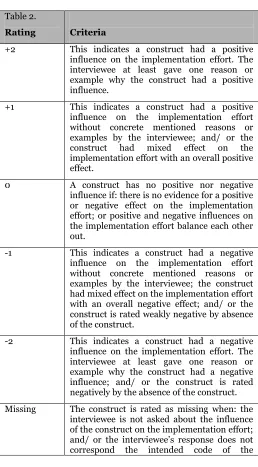
provided at the results for overall measurement of the effect on the SG implementation effort. The overall rating of the construct is assumed qualitatively correlated as SG characteristic influencing the implementation effort. Probes were used to determine what specific game characteristics could have influence on SG Complexity and SG Quality and Design for implementation. An overall rating is given to these constructs for influence on the implementation effort. Probes within the constructs are rated on the same criteria as the constructs listed in “table 2” in “additional file 3”.
Results
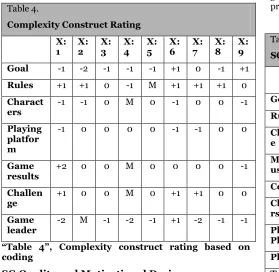
All the civil servants (N= 12) of the local governments, which have participated in SG implementation, were invited for an interview to give their individual perception of what characteristics of SG had influence on the failed implementation effort. Not all the civil servants of the local governments had interest in participation, which left 60% (N=7) of the civil servants. Besides these potential users, the game developers (N=2) both have participated, and two official contractors have participated, which gives a total of N=9 interviewees. For privacy reasons the interviewees are referred to as X:1-9. “Table 3” shows the individual perception if the construct had influence on the implementation effort in positive or negative way. The results of Complexity and SG Quality and Motivational Design in “table 3” show the usual measurement by Damschroder et al. (2009), while their relation to specific game characteristics is measured in “table 4” and “table 5”.
Of the 8 SG implementation constructs assessed, 5 constructs clearly differentiate themselves with a positive or negative influence on the implementation effort as shown in “table 3”. While complexity of SG is influenced by 2 game characteristics in a positive and negative sense, quality of packaging and motivational design is influenced by 3 game characteristics in a positive and negative way. The following section briefly describes how the mentioned constructs have influenced the SG implementation effort.
Table 3.
Serious Gaming Construct Rating
X:
1 X:2 X:3 X:4 5 X: X:6 X:7 X:8 X:9
Source of SG Design
+1 -2 +1 +2 +1 +1 +1 +1 +1
Evidence Strength and Quality
-1 -2 -2 -1 -1 -1 -2 -1 0
Relative Advantag
-1 -1 -2 +2 +1 M -1 0 +1 e
Adaptabi
lity -1 -2 -2 -1 -1 -1 -1 -1 0
Trialibili
ty +1 +1 +1 +1 +1 +1 +1 +1 +1
Complex
ity 0 0 0 0 0 0 0 0 0
SG Quality and Motivati onal Design
-1 M 0 +1 -1 +1 0 +1 +1
Costs 0 0 0 0 0 0 0 -1 0
“Table 3”, constructs ratings based on coding
Source of SG Design
Evidence of Strength and Quality
Overall the interviewees had a negative view on evidence of strength and quality of SG on the implementation effort. According to the interviewees this has resulted in low participation in game development and a failed implementation of the innovation. Some interviewees reproach lack of support and information about the evidence of strength and quality before the development process and after the development process for using the game as cause of the negative influence on the implementation effort. Almost all the interviewees (N=7) agreed no support was created for game development and game usage: “the goal and effect of the game were unknown to all the local governments”, (X:4). While supporting materials should influence the individual perception if an innovation will work in a certain setting (Damschroder et al., 2009). Potential users that were involved with SG development required information about SG effectiveness, goals and target group before development while they also mentioned potential users who were not involved with SG development also require evidence of strength and quality of SG.
Relative Advantage
The interviewees had a mixed view on the effect of relative advantage on the SG implementation effort. A part (N=2) of the interviewees that saw the game as a negative influence, had a feeling an innovation was needed for youth care process reflection and SG could contribute to this, but not in its current shape: “the overall feeling for knowledge sharing was present” (X:1); “I have a need for knowledge sharing and think SG could provide this but not in the game’s current shape”, (X:2). Another part (N=2) indicated an innovation such as SG was not considered necessary for youth care process reflection: “ it is unnecessary to share knowledge with this game, there are several other ways to do so”, (X:3). Both the shape of the game and the advantage compared to other methods are mentioned as negative influence on the implementation effort. What in reverse order, corresponds with the theory of Rogers (2003), in which the relative advantage of the game is not recognized; as a result it negatively influenced the implementation effort. A total of five interviewees mentioned they had the feeling an innovation like SG was needed for youth care process reflection. While of those interviewees three did think the game also had a relative advantage to other methods and was mentioned as a positive influence on the implementation effort. According to these interviewees the game is a creative innovation that helps the users to reflect on youth care processes in a structured way. Overall relative advantage tends to have a more negative influence on the implementation effort.
Adaptability
Adaptability had, in the overall view of the interviewees, a negative influence on the implementation effort, while it had an aspect with a positive influence. A positive influence was created due the fact potential users were involved during the development process (Greenhalgh et al., 2004; Fixsen et al.,
2005; Stith et al., 2006; Durlak and Dupre, 2008; Damschroder et al., 2009); and through adaption to a certain level of baseline skills and knowledge of potential users during the development process (Wilson, 2009; Jabbar and Felicia, 2015). Several reasons were given why adaptability had a negative influence on the implementation effort, but two were mentioned most frequently. Some of the interviewees (N=3) mentioned the target group of the game was unknown, what made it impossible to know if it was adapted to that group. Interviewees (N=4) have also mentioned the absence of multiple municipalities made it impossible to know if it was adapted to that group. Both reasons had a negative influence on the implementation effort. Other reasons were like e.g. themes are obsolete, and both goals of the game and the intervention goals were unknown to participants in the development process.
Trialibility
Trialibility had a positive influence on the implementation effort. Two representatives as potential users from each municipality were allowed to test and experiment with the game for feedback purpose. The interviewees (N=9) agree the game has been tested during the development process, which they (N=6) also mentioned allowed them to deliver feedback that is processed in the game. “During the development we have tested and experimented with the game upon which feedback is processed in the game”, (X:1). “I think using potential users during the development is positive for the result, the game is then more focused on the skills and knowledge of potential users”, (X:8). While all the interviewees (N=9) also mentioned other potential users were allowed to deliver feedback during a test session of the game. Although some interviewees (N=5) mentioned it is unknown what has happened with the feedback from this session: “we were asked to fill out an evaluation form after which we don’t know if anything has happened with it. One interviewee has mentioned the extent to which should be tested and experimented: “in my opinion it should not be about just the game, but also what to do with the results”, (X:4).
Complexity
game leader is necessary for playing”, (X:7); “the game could also be played by potential users which were not a part of the development but not without a game leader”, (X:9).
Table 4.
Complexity Construct Rating
X:
1 X:2 X:3 X:4 5 X: X:6 X:7 X:8 X:9
Goal -1 -2 -1 -1 -1 +1 0 -1 +1
Rules +1 +1 0 -1 M +1 +1 +1 0
Charact ers
-1 -1 0 M 0 -1 0 0 -1
Playing platfor m
-1 0 0 0 0 -1 -1 0 0
Game
results +2 0 0 M 0 0 0 0 -1
Challen
ge +1 0 0 M 0 +1 +1 0 0
Game leader
-2 M -1 -2 -1 +1 -2 -1 -1
“Table 4”, Complexity construct rating based on coding
SG Quality and Motivational Design
This construct contains an overall measurement of the attractiveness of the innovation and materials used provided in “table 3” (Damschroder et al., 2009), and a measurement of specific SG design characteristics for motivational purpose measured in “table 5” (Garris et al., 2002; Wilson, 2009; Charsky et al., 2010; Jabbar and Felicia, 2015). The attractiveness of the innovation and used materials seems to have no influence on the implementation failure. The interviewees have a different view on the attractiveness, as some describe it as a basic game that influenced the implementation effort in a negative sense (N=3), others describe it as a basic game with no influence on the implementation effort (N=4). Theory by Garris et al., 2002; Wilson, 2009; Charsky et al., 2010; Jabbar and Felicia, 2015; Mildner, 2015; Tsekleves et al., 2016, mention several game characteristics that the design of a game should poses for motivation of which the results are shown in “table 5”. Some of the game characteristics have positive or negative influence on motivational design what could influence the implementation effort. Goal (game and intervention goal) is a distinguishing factor of motivational design that had a negative influence on the implementation effort. The interviewees (N=6) agree the goal of the game is unclear, what makes it less motivational to play the game. Physical is a distinguishing factor on motivational design with a positive influence on the implementation effort. Almost all the interviewees (N=8) describe the game as a perfect reflection of the real world what motivates to play the game: “the game is motivating because aspects of Samen14, target group, goals,
and themes in the game are recognizable”, (X:4). Transference seems to be a distinguishing factor on motivational design with a negative influence on the implementation effort. Five interviewees describe the fact it is unknown how to use the game results as demotivating: “how to use game results in practice is missed”, (X:5).
Table 5.
SG Quality and Motivational Design Construct Rating
X:
1 X:2 X:3 X:4 5 X: X:6 X:7 X:8 X:9
Goals 0 -1 -2 +1 -1 -1 -1 -1 0
Rules -1 0 -1 M -1 0 -1 0 0
Challeng
e -2 +2 -2 M 0 0 -1 -1 0
Mysterio
us -2 M 0 M 0 0 -1 0 0
Control 0 M -1 M M 0 0 0 0
Characte rs
-1 0 0 M -1 M 0 +1 +1
Playing
Platform -1 -1 -1 +2 M 0 0 +1 +1
Physical +2 +2 +1 +2 +1 M +1 +1 +1
Transfer ence
-1 -1 -1 M -1 M -1 0 0
“Table 5”, SG Quality and Motivational Design construct rating based on coding
Costs
Although different types of costs could influence SG implementation and SG itself (Damschroder et al., 2009; Tsekleves et al., 2016), the costs did not influence the implementation effort. No factors from an innovational point of view were mentioned that had influence on the implementation effort. Some of the interviewees did mention the costs of time investment for engagement, but this is defined in another construct (Damschroder et al., 2009). One exception mentioned no reservation of costs for implementation as a potentially negative influence on the implementation effort: “perhaps we should have costs accounted for the implementation”, (X:8).
Discussion
framework for such innovations, although required, does not exist (Azadegan et al., 2012; Riedel et al., 2013; Spil et al., 2017). An implementation framework specifically for SG implementation is built that distinguishes itself by game elements and characteristics. SG literature does not provide specific constructs for SG implementation but does provide similar domains that could influence SG implementation (Riedel et al., 2013). As this research is exploratory in nature the domain SG- specific (domain: innovation) is marked as an innovation and combined with innovation implementation theory. Constructs derived from those theories are used as input for a conceptual SG implementation framework. While innovation implementation literature describes eight constructs (source of design, evidence strength and quality, relative advantage, adaptability, trialibility, complexity, quality of packaging and design, and costs) as potential barriers or facilitators for innovations, six of those eight constructs could be combined with SG theory. SG development requires involvement of potential users (Garris et al., 2002; Jabbar and Felicia, 2015; Spil et al., 2017), what could form a potential barrier or facilitator for Source of Design. The perceived usefulness of SG by potential users requires the presence of motivational elements such as goals (intervention and game goals) (Jabbar and Felicia, 2015), what could form potential barriers or facilitators. SG should be adapted to potential users’ needs, what requires potential user involvement in the development process (Jabbar and Felicia, 2015). Both adaptation to needs and involvement in development could form potential barriers or facilitators. Involvement of potential users in testing and experimenting with the game for feedback purpose (Wilson, 2009; Jabbar and Felicia, 2015; Tsekleves et al, 2016), could form potential barriers or facilitators for Trialibility. Specific game characteristics: goals, rules, characters, playing platform, game results, challenge, and game leader could lead to potential barriers or facilitators of conceived Complexity in gameplay as well in game implementation. Similar and other game characteristics: goals, rules, challenge, mysterious, control, characters, playing platform, physical, and transference may lead to potential barriers or facilitators for SG Quality and Motivational Design. Two constructs, Relative Advantage and Costs, do not specifically relate to game elements or characteristics but may form barriers or facilitators for SG implementation as well. Both constructs are assumed not to differ in concept from other innovations. Future research may indicate game characteristics related to relative advantage and costs.
Eight constructs are used as input of a conceptual SG implementation framework. The framework could be used for evaluation of SG implementations in multiple contexts. It could be used to identify potential barriers and facilitators of the implementation, it could be used to study what factors have influenced the implementation and how it has influenced the implementation, and it could be used to better understand SG implementation in a specific context and translate it to different contexts (Damschroder et al, 2009). Validity and usefulness of such a framework depends on the constructs that show equal results in similar studies, results could be compared between studies, and if the framework will stimulate theory development (Kitsen et al., 2008).
A conceptual SG implementation framework has its limitations as the individual researcher decides what to use in the framework, what could result in individual bias as well ongoing bias. Individual bias refers to concepts used in the framework based on the experience and knowledge of an individual. Ongoing bias is the result when some concepts are given prominence while others are ignored. This research has made use of existing innovation implementation frameworks from other sectors to use in the SG sector (Aarons et al, 2011), complemented with available SG theory on game elements and characteristics. This research has only studied the dimension SG- specific (innovation), while other dimensions are not studied in this research, because it is assumed the game as an innovation will most likely differ from other innovations. More research is needed to study the impact of game elements and characteristics on other dimensions, mentioned by Riedel et al., (2013), as well.
Evaluation SG Implementation Samen14 and Framework Refinements
This research has applied the conceptual SG implementation framework to identify barriers and facilitators to measure what and how SG- specific constructs have affected the implementation of serious gaming at Samen14. The results are used to obtain a better understanding of SG implementation. Future research and future implementation could make use of this research for SG implementation improvement. Since all 14 municipalities have failed to implement the game, this research could not make a comparison between high and low municipalities, as all municipalities are marked as low implementation facilities. The constructs are rated as positive or negative influence on the implementation effort. Using a systematic approach based on qualitative content analysis, supported by the SG implementation framework, two constructs were positively related to the implementation effort, four constructs were negatively related to the implementation effort, two game characteristics were negatively related to complexity, and two game characteristics were negatively related to SG quality and motivational design and one was positively related to SG quality and motivational design.
study the affect of potential user involvement in development, and testing and experimenting for SG implementation. Klein et al. (2001) state an implementation will be less effective when the decision to adopt and implement an innovation is made with little input of potential users in development. Although potential users were totally part of the development process, the decision to adopt and implement came from managers while game development was placed in the hands of potential users. The game developers and potential users did not receive additional information for game development like goals and target group of the game. Since Source of Design as in potential user involvement was experienced as positive for game implementation, and the source of the decision to adopt and implement the game as negative on game implementation, this research suggests a new construct that is at least applicable for this study: Source of Creation. It means the way the decision was made to adopt and implement SG at an organization. This may had influence due the fact the decision to adopt and implement was made by managers from multiple municipalities in the name of Samen14, which had no authority to obligate potential users to make use of the game. Usually authoritative decisions are positively associated with implementation (Greenhalgh et al., 2004). The organizational settings at Samen14 causes managers have no authority for game use obligation. Although other scenarios are possible, authority most likely had the most influence, as not all potential users from municipalities showed up during the first development session and even less during the following sessions. Future research should declare if there is difference in SG implementations when adoption decisions are made with and without authority. Based on the results, this research suggests involving potential users in the decision to adopt/ implement SG.
The results indicate a lack of motivational elements in the sense of perceived usefulness of the game has a negative influence on SG implementation. Both evidence of strength and quality, and relative advantage had a negative influence on the implementation effort at Samen14. Potential users were not convinced by effectiveness of the game or SG effectiveness in common. This could have been caused by a lack of information sharing before adoption/ implementation about the effectiveness of the game as well effectiveness of SG in common, what may have also influenced potential users not to join the development sessions. Though effectiveness could be shared in multiple ways (Kitson et al., 2008), potential users could experience both game and SG effectiveness due involvement in development and implementation, it still was experienced as negative on the implementation effort. Usually relative advantage of an innovation must be recognized by all of those involved for better implementation (Greenhalgh et al., 2004). The perceived effectiveness and efficiency by those involved will most likely declare the implementation outcome (Rogers, 2003). Although managers did see advantage in the effectiveness and efficiency of SG potential users did not, what could declare the failed implementation effort. Based on these findings this research suggests future SG adoption/ implementation to share game and SG effectiveness before adoption for potential users’ perception on effectiveness. This could also influence the decision (with or without potential user involvement), to adopt/ implement SG.
The results suggest not meeting individual needs of potential users and environmental needs, will have negative influence on a SG implementation effort. The game did not meet all individual and environmental needs, what has resulted in a negative influence of adaptability on the implementation effort. SG requires involvement of potential users during the development process (Jabbar and Felicia, 2015), for better skill and knowledge adaptation (Wilson, 2009). Potential users were involved with game development what was experienced positively, but due the fact not all municipalities were involved in development made it feel like it was not adapted to all individual needs. Beside individual needs, adaptability also includes environmental needs (Damschroder et al., 2009). Those environmental needs that includes organizational and community needs, were unknown during game development, although game developers and potential users required them. These findings show it is important to involve at least a delegation of all potential users during game development, while environmental needs should be shared with game developers and potential users when they are supposed to process those needs in the game. The adaptability of the game in this research is based on the needs processed in the game, usually it also contains the possibility to adapt the game to personal wishes to use it in a different way. This research could not measure this, because the game is/ was not in use by any municipality, future research should study this phenomenon as well.
Based on the results this research indicates game elements and characteristics could influence the implementation in a positive or negative way due Complexity, and SG Quality and Motivational Design. Unclear plans in the sense of unclear goals have both negatively influenced the complexity as well motivational design. This corresponds with existing theory, unclear plans make it harder for implementation, while clear plans make the implementation easier (Klein et al., 2001; Gustafson et al., 2006), while bad quality of (motivational) design will cause dissatisfaction and negative use of the game (e.g. Jabbar and Felicia, 2015; Klein et al., 2001). Another game characteristic, game leader is perceived necessary for both complexity of the game as well implementation of the game. A game leader should organize game sessions for routenization and should lead players during game sessions and be a helping guide. Like goals of the game, how to use game results in practice was unknown to potential players. As discussed unclear plans will make the implementation harder (Klein et al., 2001; Gustafson et al., 2006). One game characteristic had a positive influence on motivational design: physical. It includes how the game represents the daily businesses of game players. Although it is not a crucial factor for a successful implementation it is recommended, as it will probably increase the motivation to play.