Original citation:
Sun, S., Joy, Mike and Griffiths, Nathan (2005) An innovative use of learning objects and learning style in pedagogic agent systems. In: 6th Annual Conference of the HEA
Network for Information and Computer Sciences, York, UK, 30 Aug - 1 Sep 2005 pp. 115-119.
Permanent WRAP url:
http://wrap.warwick.ac.uk/61443
Copyright and reuse:
The Warwick Research Archive Portal (WRAP) makes this work by researchers of the University of Warwick available open access under the following conditions. Copyright © and all moral rights to the version of the paper presented here belong to the individual author(s) and/or other copyright owners. To the extent reasonable and practicable the material made available in WRAP has been checked for eligibility before being made available.
Copies of full items can be used for personal research or study, educational, or not-for-profit purposes without prior permission or charge. Provided that the authors, title and full bibliographic details are credited, a hyperlink and/or URL is given for the original metadata page and the content is not changed in any way.
A note on versions:
The version presented in WRAP is the published version or, version of record, and may be cited as it appears here.For more information, please contact the WRAP Team at:
AN INNOVATIVE USE OF LEARNING OBJECTS AND LEARNING
STYLE IN PEDAGOGIC AGENT SYSTEMS
Shanghua Sun
Department of Computer Science University of Warwick
Coventry CV4 7AL [email protected]
Mike Joy
Department of Computer Science University of Warwick
Coventry CV4 7AL [email protected]
Nathan Griffiths
Department of Computer Science University of Warwick
Coventry CV4 7AL [email protected]
A
BSTRACTAdaptivity in education is increasingly demanded in order to improve the efficiency and effectiveness of the learning process, but few intelligent learning systems exist which are dynamic and able to provide personalized learning materials to satisfy individual students’ requirements. In an attempt to overcome these limitations, the authors have developed an agent-based learning system that incorporates learning objects to facilitate personalization, and is based on a learning style theory as the pedagogic foundation for adaptivity. In this paper, we describe the design and implementation of the system, focusing on the use of learning objects and learning styles. We present a novel approach to the incorporation of learning style theory and learning objects, and evaluation indicates that the approach is able to provide personalized learning materials and improve the adaptivity in learning systems.
Keywords
Learning Objects, Learning Style, Pedagogic Agent System
1. I
NTRODUCTIONThe emergence of intelligent learning systems has provided new opportunities for delivering educational materials more efficiently and effectively. However, inadequacies still exist among existing systems, and methods for implementing adaptivity are the subject of ongoing investigation [1]. People have their own preferences that determine how they learn effectively, and so to support a personalized learning strategy the differences between learners must be recognized
[2]. Such differences have been described as “learning styles” by educationalists.
The issues of how to support adaptivity in learning systems, and provide students with personalized learning materials, can be partially solved by providing student-centred, self-paced, highly interactive learning materials and introducing automatic and dynamically adaptive learning methods. To achieve these methods, new delivery mechanisms are required, including online, open and distance learning [3]. Agent technology is a promising approach for addressing the challenges of modern day education [4]. However, although some agent-based learning systems exist, many of them lack a robust pedagogic foundation to support adaptivity.
We have developed a multi-agent based integrated learning system architecture [5] that is student-centred, adaptive and dynamic. In contrast to other agent-based learning systems, learning style schemes form the pedagogic foundation for adaptivity and the use of learning objects facilitate personalization.
There are many strategies and standards for designing and categorising learning objects, but research into incorporating real learning objects with learning style schemes into education systems is rare. Learning style theory addresses the issue of adaptivity, and learning objects address the issue of decomposition of learning materials to meet the requirement of personalization.
How to incorporate learning style theory into agent-based learning systems is still a research question, and the appropriate granularity of learning object classification is also under investigation. One of the contributions of our research is how our proposed multi-agent learning system addresses these questions.
2. I
NTRODUCTION OFR
ELATEDT
ECHNOLOGIESOur agent-based learning system architecture represents the integration of three key technologies Permission to make digital or hard copies of all or part of this
work for personal or classroom use is granted without fee provided that copies are not made or distributed for profit or commercial advantage and that copies bear this notice and the full citation on the first page. To copy otherwise, to republish, to post on servers or to redistribute to lists, requires prior specific permission.
© 2005 Higher Education Academy
and concepts: agent technology, learning objects, and learning style theories.
2.1 Learning Objects
A learning object is a “self-standing, reusable, discrete piece of content that meets an instructional objective” [6]. Learning objects may be tagged with metadata so that their identity and content are available to software systems. The decomposition of educational content into learning objects is analogous to the decomposition of an object-oriented program into objects and classes, and permits an individual learning object to be used in a variety of educational contexts and to create personalized learning materials. In our multi-agent system the decomposition of learning materials into learning objects guarantees that knowledge can be personalized into a variety of learning paths to present to different students.
2.2 Learning Style Theories
The concept of learning style has been introduced by educationalists as a “description of the attitudes and behaviours that determine our preferred way of learning” [7]. Learning styles depend on a variety of factors, and are individual to different people. Furthermore, an individual’s learning style can change over time [8].
Learning style theory is the pedagogic foundation of our multi-agent system, however there are several different ways of categorising learning style preferences. Kolb’s Learning Style Inventory describes learning styles on a continuum running from concrete experience, through reflective observation, to abstract conceptualization, and finally active experimentation [9]. Gardener’s Multiple Intelligences divides learning styles as dealing with words (Verbal/Linguistic), questions (Logical/Mathematical), pictures (Visual/Spatial), music (Music/Rhythmic), moving (Body/Kinesthetic), socializing (Interpersonal), and alone (Intrapersonal) [10]. The Felder-Silverman Learning Style Model, which we have chosen to adopt, situates a student’s learning style within a four-dimensional space, with the following four independent descriptors: “sensing learners or intuitive learners; visual learners or
verbal learners; active learners or reflective learners; sequential learners or global learners
[11].”
2.3 Agent Technology
An agent is a software entity that is capable of carrying out flexible autonomous activities in an intelligent manner to accomplish tasks that meet its design objectives, without direct and constant intervention and guidance of humans. Depending on the roles that agents take in their deployed environments, their abilities may vary significantly. However, we still can identify essential and
commonly agreed properties of agents, which include: autonomy, proactiveness, responsivity, and adaptivity. [12]
Agents should also know their users’ preferences and tailor their interactions to reflect these [12]. In multi-agent systems, each agent has control over certain parts of the environment, and so they are designed and implemented as a collection of individual interacting agents. Luck et al. remark that, “Multi-agent systems provide a natural basis for training decision makers in complex decision-making domains [in education and training]” [13]. Furthermore, multi-agent systems can substantially contain the “spread of uncertainty”, since agents typically process information locally [14]. In the context of a computer-aided education system, agents provide a means to manage the complexity and uncertainty of the domain.
2.4 The Pedagogic Foundation of
Learning Objects and Learning Styles
Learning style theories have been adopted in some learning systems, and delivery of learning materials adapted to students’ learning styles has also been investigated, for example, in [15, 16], and progress has been made on the mechanism of delivering learning materials elsewhere [17, 18, 19]. Learning style theory and learning material design are incorporated into these systems; however, the pedagogies and technologies are not suited to dynamic adjustment of students’ learning styles. Knowledge is still delivered in a static way and learning materials are more or less preset for a certain type of learning style or preference, and will not be changed or adjusted according to a change of the user’s learning style over time. The incorporation of learning objects and learning style, which we have used in our system, is able to dynamically organise and deliver learning materials to satisfy individual learning requirements, and agent technology gives dynamic support.
3. E
VALUATIONThe learning style theory we have adopted in the system is the Felder-Silverman Learning Style Model. The reasons of choosing this theory instead of the others are: the theory has been validated by pedagogy research [11, 20]; and the number of dimensions of the model is constrained, improving the feasibility of its implementation.
Figure 1. Overview
3.1 Accommodating Students into the
Learning Style Scheme
Felder and Silverman use a complex questionnaire (containing 44 questions) to ascertain a student’s learning style [21]. Not only would the use of such a large questionnaire be infeasible in an intelligent tutoring system, but also the information supplied would be more than such a system would require to operate effectively. A simple algorithm that approximates the positioning of a student’s learning style in the four-dimensional space (explained in section 2.2) can be constructed by using a reduced set of appropriate questions. We have chosen a set of four for each dimension, which is evaluated by comparing the results for a sample of students with those generated by Felder and Silverman’s original questionnaire.
[image:4.595.54.251.165.261.2]The original answers of the 44 questions are on a scale of 0-10 on each dimension such as in figure 2,
Figure 2: Example result from [21]
According to the interpretation of the score,
“If your score on a scale is 1-3, you are fairly well balanced on the two dimensions of that scale.
If your score on a scale is 5-7, you have a moderate preference for one dimension of the scale and will learn more easily in a teaching environment which favors that dimension.
If your score on a scale is 9-11, you have a very strong preference for one dimension of the scale. You may have real difficulty learning in an environment which does not support that preference. [21]”
The results from the 44 questions are normalized into a five-point scale, e.g. the normalized data of figure 2 is: 0.5, 0.25, 0.5, 0.5.
The results of the reduced set of 16 questions are also based on a five-point scale. The original values are on an axis of 4, 2, 0, -2, -4, so the normalized data also sit into the 0 to 1 zone.
A Spearman’s rank correlation coefficient statistical analysis has been performed on the normalized data – students’ answers both for the 44 questions and the 16 questions, and indicates a strong correlation between the two data sets (correlation is significant at 0.01 level – one tailed). This suggests that the reduced set of 16 questions is sufficient to categorize a student’s learning style.
3.2 Categorizing Learning Objects
according to the Learning Style Scheme
The learning objects we use are also organized into the four-dimension learning style space, and include learning objects for Introductory Programming [22], some learning objects from CodeWitz [23], as well as some suitable learning objects from the other open sources. For examples, please refer to [24]. In addition to basic information such as author, date, etc., the learning object metadata incorporates a dimension description, suggesting for each of the four learning style dimensions the placing of each object on a five-point scale. For instance, the visual/verbal dimension contains the following descriptors: strongly visual, weakly visual, neutral, weakly verbal, and strongly verbal.
The granularity of the categorization, i.e. the location of every learning object in the five-point scale, is pragmatically determined, and seemed appropriate for the learning objects available. Samples of users have classified the available learning objects according to the five-point scale category, and the results have been compared and analysed. The evaluation shows that at this stage, the granularity scale we are using is practical for learning object classification.
3.3 Delivering Learning Objects for
Different Learning Styles
learning objects to the current style preferences of the individual student. For example, consider the learning styles of students S1 and S2 presented in Table 1:
The system will then search the repository of learning objects, to fetch appropriate learning objects with similar (but not necessarily identical) dimensional descriptions. These are supported by agent technology to realize the algorithm and implement the process. The objects are then presented to the student, and the subsequent interactions between the student and these learning objects may be used to modify the learning style attributes recorded for a student.
Student S1 Student S2
Sensing or Intuitive
Neutral Strongly Sensing
Visual or Verbal
Strongly Visual
Weakly Visual
Active or Reflective
Strongly Reflective
Neutral
Sequential or Global
Weakly Sequential
[image:5.595.309.545.230.417.2]Strongly Global
Table 1. Location of Students’ Learning Styles
It should be stressed that both the categorization of a learning object and the assignment of a learning style to a student are necessarily approximate. Since it is almost impossible to find students with all possible combinations in the learning style scheme, a simulation has been run on the system. The simulation has covered all of the possibilities — four dimensions, each on five-point scale (54 = 625), and the evaluation indicates that our approach is capable of delivering different learning objects to different students according to the learning style category.
3.4 The Multi-Agent Education System
Agent technology has been used in education systems to facilitate autonomy and adaptivity, decoupled from the pedagogic foundations of the system [25, 26, 27, 28]. Each such system emphasizes a particular aspect, such as training, group work, or human resources requirement. Each has its individual ways of organizing the learning materials, and few have considered the effect of different learning styles or the adoption of learning objects.
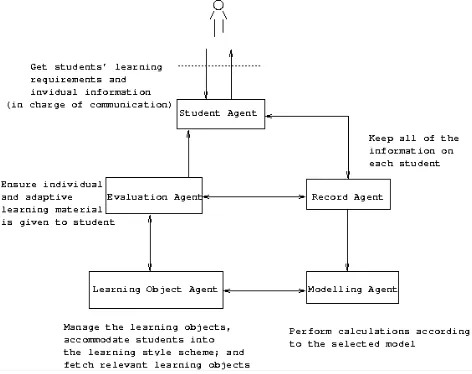
Our proposed multi-agent based pedagogic system is functionally constructed by five agents, as shown in Figure 3, and comprises the Student Agent, the Record Agent, the Modelling Agent, the Learning Object Agent, and the Evaluation Agent. Each agent is designed to satisfy a certain functional
requirement to actualize the service purpose of the education system, namely to provide dynamic and adaptive learning materials to individual users.
[image:5.595.69.281.248.377.2]The Student Agent is responsible for communicating with students; the Record Agent maintains information about each student; the Modelling Agent creates models of students’ skills and learning objectives; the Learning Object Agent manages the set of learning objects; and the Evaluation Agent ensures that learning objects are presented in individual and adaptive learning paths to each individual student. For a more extensive technical discussion, we refer to [5].
Figure 3. System Architecture
4. C
ONCLUSIONS ANDF
UTUREW
ORKWe have described the use of learning objects and learning style in an agent-based learning system to enhance adaptivity. At the conceptual level, personalization and adaptivity are achieved by the use of learning style schemes to tailor the presentation of learning objects to individual students. Conversely, at the practical level, this adaptivity is achieved by providing a set of agents that use a combination of pre-built and acquired knowledge to determine the learning styles and learning objects that are appropriate for individual students. In contrast to other agent-based learning systems, learning style schemes form the pedagogic foundation for adaptivity and the use of learning objects facilitate the personalization. Future work includes optimising the architecture, and the evaluation of the system effectiveness and efficiency.
5. R
EFERENCES[1] Brusilovsky P., Adaptive and Intelligent Technologies for Web-based Education,
[2] Jenkins T., On the Difficulty of Learning to Program, Proceedings of the 3rd Annual Conference of the LTSN Centre for Information and Computer Sciences, 53-58 (2002).
[3] Beetham H., Understanding e-learning, e-Tutoring for Effective e-Learning, LTSN, (2002). [4] Aroyo L. and Kommers P., Special issue
preface, Intelligent Agents for Educational Computer-aided Systems, Interactive Learning Research 10(3/4), 235-242 (1999).
[5] Sun, S., Joy, M., and Griffiths, N., An Agent-Based Approach to Dynamic Adaptive Learning,
Proceedings of Agent Based Systems for Human Learning – ABSHL Workshop, the Fourth International Joint Conference on Autonomous Agents and Multi Agent Systems – AAMAS, (2005).
[6] Academic ADL Co-Lab, University of Wisconsin System, and Wisconsin Technical College System, What are Learning Objects? (2002), http://adlcolab.uwsa.edu/lo/what.htm Accessed Dec 2003.
[7] Honey P., Honey and Mumford Learning Styles Questionnaire, PeterHoney Learning (2001), http://www.peterhoney.com/product/learningstyl es Accessed Apr 2004.
[8] Blackmore J., Learning Styles,
Telecommunications for Remote Work and
Learning (1996),
http://www.cyg.net/~jblackmo/diglib/styl-a.html Accessed May 2004.
[9] Kolb D. A., Experiential Learning: Experience as the Source of Learning and Development,
Englewood Cliffs, NJ, Prentice-Hall (1984). [10] Gardner H., Multiple Intelligences: The Theory
in Practice, Basic Books (1993).
[11] Felder R. M. and Spurlin J.E., Applications, Reliability, and Validity of the Index of Learning Styles, International Journal of Engineering Education, 21(1), 103-112 (2005).
[12] Jennings N. R. and Wooldridge M., Applications of Intelligent Agents, Agent Technology Foundations, Applications and Markets, Springer-Verlag (1998).
[13] Luck M., McBurney P., and Preist C., Agent Technology: Enabling Next Generation Computing A Roadmap for Agent Based Computing, AgentLink (2003).
[14] Georgeff M., Pell B., Pollack M., Tambe M., and Wooldridge M., The Belief-desire-intention Model of Agency, Proceedings of the 5th International Workshop on Intelligent Agents V: Agent Theories, Architectures, and Languages, 1–10 (1999).
[15] Carver C. A., Howard R. A., and Lane W. D., Enhancing Student Learning Through
Hypermedia Courseware and Incorporation of Student Learning Styles, IEEE Transactions on Education, 42(1),33-38 (1999).
[16] Paredes P. and Rodriguez P., Considering Learning Styles in Adaptive Web-based Education, Proceedings of the 6thWorld Multiconference on Systemics, Cybernetics and Informatics, 481-485 (2002).
[17] Specht M. and Oppermann R., ACE – Adaptive Courseware Environment, The New Review of Hypermedia and Multimedia, 4, 141-161 (1998). [18] Gilbert J. E. and Han C. Y., Arthur: A
Personalized Instructional System, Journal of Computing in Higher Education, 14(1), (2002). [19] Hong H. and Kinshuk, Adaptation to Student
Learning Styles in Web Based Educational Systems, ED-MEDIA 2004, 491-496 (2004). [20] Zywno M. S., A Contribution to Validation of
Score Meaning for Felder-Soloman’s Index of Learning Styles, Proceedings of the 2003 American Society for Engineering Education Annual Conference & Exposition, session 2351, (2003).
[21] Soloman B. A. and Felder R. M., Index of
Learning Styles Questionnaire, http://www.ncsu.edu/felder-public/ILSpage.html
Accessed Apr 2004.
[22] Boyle T., et al. Learning objects for Introductory Programming,
http://www.londonmet.ac.uk/ltri/javaobjects/ Accessed Feb 2004.
[23] Codewitz project. http://www.codewitz.net/ Accessed Mar 2004.
[24] Sun S., Joy M. and Griffiths N., The use of learning objects and learning styles in a multi-agent education system, ED-MEDIA 2005,
(2005).
[25] Razek M. A., Frasson C., and Kaltenbach M., Toward More Cooperative Intelligent Distance Learning Environments, Software Agents Cooperation Human Activity, (2002), http://www-perso.iro.umontreal.ca/~abdelram/ Accessed Feb 2003.
[26] Norman T. J. and Jennings N. R., Constructing a Virtual Training Laboratory using Intelligent Agents, International Journal of Continuous Engineering Education and Life-Long Learning,
12(1-4), 201-213 (2002).
[27] Shang Y., Shi H., and Chen S., An Intelligent Distributed Environment for Active Learning,
Proceedings of the tenth International Conference on World Wide Web, 308-315 (2001).
![Figure 2: Example result from [21]](https://thumb-us.123doks.com/thumbv2/123dok_us/9779916.479083/4.595.54.251.165.261/figure-example-result-from.webp)