http://wrap.warwick.ac.uk/
Original citation:
Turner, J. D., Bacigalupo, D. A., Jarvis, Stephen A., 1970- and Nudd, G. R. (2002) Using
a transaction definition language for the automated ARMing of web services. In:
Proceedings of the CMG UK Conference on Technology Management and Performance
Evaluation of Enterprise-Wide Information Systems
Permanent WRAP url:
http://wrap.warwick.ac.uk/61226
Copyright and reuse:
The Warwick Research Archive Portal (WRAP) makes this work by researchers of the
University of Warwick available open access under the following conditions. Copyright ©
and all moral rights to the version of the paper presented here belong to the individual
author(s) and/or other copyright owners. To the extent reasonable and practicable the
material made available in WRAP has been checked for eligibility before being made
available.
Copies of full items can be used for personal research or study, educational, or
not-for-profit purposes without prior permission or charge. Provided that the authors, title and
full bibliographic details are credited, a hyperlink and/or URL is given for the original
metadata page and the content is not changed in any way.
A note on versions:
Using a Transaction Definition Language for the
Automated ARMing of Web Services
J.D. Turner, D. Bacigalupo, S.A. Jarvis, G.R. Nudd
High Performance Systems Group, University of Warwick, Coventry, UK
jdt,daveb,saj,grn
@dcs.warwick.ac.uk
Abstract
Web service technology will provide a platform for next generation dynamic e-business applications. This paper describes a framework for identifying, monitoring and reporting performance data of critical transactions within a web service using the Java ARM standard, a Transaction Definition Language (TDL) and an Automated Instrumentation technique. Gourmet2Go, a demonstrator provided with the IBM web services toolkit, is used as a case study.
Keywords: Web Services, ARM, Performance Measurement, Service Routing, Java
1
Introduction
While high performance computing has been based on the culmination of massively parallel multi-node MIMD machines for a number of years, the vast increase in network bandwidth and desktop computer performance has meant that disparate heterogeneous resources executing highly scalable distributed applications have become the preferred infrastructure for high performance computing. This interest in geographically dis-persed resource-sharing networks spread across multiple ad-ministrative domains has stimulated the massive demand for both academic and industrial research into a number of stan-dards for the creation of a Grid[10, 17] infrastructure (for exam-ple Globus[11]), and for high performance resource allocation services with the ability to adapt to the continuous variations in user demands and resource availability.
More recently it has been proposed that Grids should pro-vide an infrastructure that would propro-vide the resources nec-essary for both e-science and e-business applications[12] to execute efficiently whilst meeting quality of service (QoS) de-mands and requirements. However, the different characteris-tics of e-science applications (such as large ‘run-once’ jobs) and e-business applications (such as high-frequency request-driven services) necessitate different methodologies for each; for example the use of resource allocation for large jobs, as opposed to a service routing approach for high frequency re-quests.
1.1
Performance-Driven Grid Scheduling
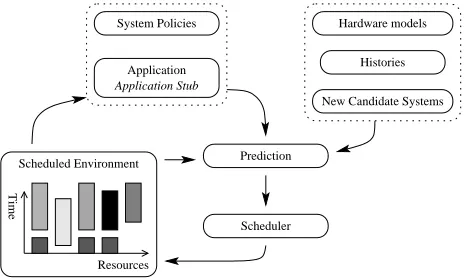
TITAN[22], a distributed resource scheduler, is being devel-oped to provide efficient resource allocation of distributed, sci-entific applications on Grid architectures. An overview of TI-TAN can be seen in Figure 1. TITI-TAN currently uses iterative heuristic algorithms to minimize a number of scheduling met-rics including makespan and idle time, while aiming to meet a number of QoS requirements; dead-line time for example. An agent-based resource discovery and advertisement frame-work A4[4, 5] is used by TITAN to gain access to and maintain a knowledge of the available resources within its administrative domain. This work is differentiated from other Grid scheduling research by the use of PACE[3, 18], a performance predic-tion environment that allows TITAN to predict the communi-cation and computational needs of scheduled applicommuni-cations on the available resources. PACE abstracts an application into a single performance model that provides accurate predictions based on input parameters (such as the number of processors) and a hardware model (provided from a benchmark of the re-source upon which the application will be executed). This al-lows the current schedule to be modified continuously accord-ing to these predictions of scheduled applications and there-fore allowing the scheduling metrics to be minimised while achieving the highest efficiency possible.
1.2
Performance-Driven Web Service Routing
Scheduler Prediction
Application Stub
Application System Policies
Histories Hardware models
New Candidate Systems
Time
[image:3.612.63.297.40.179.2]Resources Scheduled Environment
Figure 1: TITAN: a metric-based scheduling environment incorpo-rating the performance prediction of applications, resource alloca-tion, system policies, performance histories and QoS. Feedback of information during the application’s execution aids the prediction and scheduling of similar applications in the future.
e-business applications. Business to business (B2B) and business to consumer (B2C) applications are often charac-terised as long-running applications that service client re-quests. These connections tend to have a short execution time but have the potential to be very high-frequency. The web ser-vices framework, which is currently being standardised with a strong but not exclusive focus on e-business applications, will provide a platform for these dynamic, distributed applications.
In a similar way that Grid applications require resource allo-cation, it is necessary to make web service selection decisions. This normally involves routing the communication from a ser-vice requester through several intermediaries to the ultimate service provider. To achieve this, a service routing mechanism is necessary.
This paper describes a framework for the monitoring of performance-critical transactions within a web services en-vironment with a focus on providing performance data that can be used in making service routing decisions. As such, the average end-to-end response time for a web service is the primary QoS metric. The Application Response Measurement[15, 20] (ARM) standard is used for the measure-ment of defined performance-critical transactions, and a Trans-action Definition Language[24] (TDL) is used to instrument application bytecode so as to appropriately process these transactions. Results including a set of end-to-end response times of performance-critical transactions within Gourmet2Go, a demonstrator from the IBM Web Services Toolkit[14], are shown, with emphasis on how these results may be used by a service routing algorithm.
The remaining sections of this paper describe:
An introduction to the Web Services framework (see
Sec-tion 2).
An overview of ARM and an ARM compliant XML-based Transaction Definition Language, allowing the efficient ‘ARMing’ of Java applications (see Section 3).
The demonstration of using a TDL as part of a per-formance monitoring framework within an example Web Services application (see Section 4).
2
Web Services
The recent interest in web service technology parallels the in-crease in distributed infrastructures and their associated ap-plication domains. The Web, for example, is known to facil-itate human-to-application interaction, but currently provides limited support for fully automated and dynamic application-to-application interactions. Distributed enterprise computing plat-forms and their associated component technologies, includ-ing Enterprise Java Beans (EJB), COM+ and CORBA, facili-tate application-to-application integration, but are hard to ap-ply across organisational boundaries because of the lack of a standardised infrastructure.
One approach to facilitating application-to-application in-teractions across distributed infrastructures is the creation of a standard framework that could be used to create, de-scribe and publish network accessible services (including pro-grams, databases, networks, computational or storage re-sources etc. [12]). It has been the emergence of e-business however that has led to the increase in the industry-wide ef-fort to create a standard web services framework, the primary goals of which are described as [7]:
systematic application-to-application interactions on the Web;
the smooth integration of existing infrastructure;
the support for efficient application integration.
While the above goals are based on a web services frame-work that is based on existing existing web protocols (including HTTP, for example), web services are likely to function in other environments including private wide-area and local-area net-works. The open, heterogeneous and dynamic nature of the Web leads to a set of key requirements for a web-based dis-tributed computing model [8]:
A loose coupling between web services. Eg., allowing web services to switch between sub-services which pro-vide the same functionality.
Interfaces defined in terms of the messages that they pro-cess. Involving a shift in focus from the APIs supported by each platform to what goes ‘on the wire’.
Web services which are able to integrate with each other on an ad-hoc basis. Eg., e-business web services that are able to establish short-term goal-directed relation-ships.
Web services located ‘by-what’ and ‘by-how’. Eg.,
searching for web services that provide particular func-tionality (from a given community) with a predefined QoS.
These requirements could be realised by a framework in which a wide variety of functionalities are encapsulated as web services and run on any computing node that meets a minimal set of requirements. These web services will be able to ‘dy-namically bind’ to each other at runtime, which might involve a web service searching for other web services based on their functional and non-functional criteria. These services would interact through the exchange of ‘messages on the wire’ and would enable future applications to be constructed by dynami-cally orchestrating collections of contributing services.
2.1
Standardising the Web Services
Framework
One of the early attempts at web services standardisation be-gan with the release of IBM and Microsoft’s web service speci-fications for B2B e-business. The specispeci-fications, built on exist-ing industry standards, were based on XML and a simple web services model (see Figure 2 [16]) and contained two core ini-tiatives [7]:
1. A data exchange protocol called SOAP [2], for sending XML messages wrapped in a standard ‘header and body’-based XML envelope over an arbitrary transport protocol. SOAP includes a binding for HTTP and a convention for Remote Procedure Call (RPC). Potential extensions in-clude a standard routing mechanism and a unified trans-action model [19].
2. A unified representation for services called WSDL [6], providing an XML-based language for describing web services. An abstract description, for example the XML messages sent and received by the web services, is mapped onto one or more communication protocol ings. An end-point address is added to the protocol bind-ings to define a service end-point or ‘port’, and an ap-plication wishing to use the web service chooses which
Service Requestor
Bind
Service Registry ie UDDI
Service Provider Description
Service
Find Publish
Service
Service Description
[image:4.612.318.550.41.222.2]ie WSDL
Figure 2: An overview of the web services model on which the web services framework is based
of the available protocols to use. Despite a focus on e-business, WSDL can be seen as implicitly providing the basis of a distributed web services component interaction model [8]. It is likely that other specifications will build on WSDL to enable a more complete description of both web service components (for example non-functional as-pects of the service such as QoS) and the different types of interaction that they support (for example syn-chronous/asynchronous and point-to-point/broadcast).
More recently web service invocation frameworks such as WSIF [9] have been proposed. These should simplify the in-teraction with WSDL-described services, for example, an ap-plication might only be required to specify the WSDL file of a web service to interact with it at the XML exchange level. Re-maining interactions, such as selecting the protocol binding, could then be handled by the invocation framework.
SOAP and WSDL have now become de-facto industry stan-dards1. Since their release, a number of other specifications have been proposed:
Service discovery: Service registries such as UDDI [25] allow web service descriptions to be published. These registries can be searched at develop-time and at run-time; for example, web services can search and ‘dy-namically bind’ to other services. Services can also be published using inspection languages such as WS-Inspection [1], where service discovery is performed through the inspection of service sites.
1and have been submitted to the W3C as part of the recent web services
Composition: A major advantage of web services is their connectivity potential and the ability to form com-plex ‘compositions’ at run-time. Web service composi-tion languages include IBM’s WSFL [13] and Microsoft’s XLang [23].
2.2
Implementing Web Services
There are currently two main implementation platforms for web services, Microsoft’s .NET and J2EE. Both platforms use SOAP, WSDL and UDDI to promote basic interoperability, but additional non-standard functionality is also provided. Sup-porting web-server application products are currently being im-plemented and include IBM’s Websphere.
In addition to the WebSphere e-business platform, IBM has also published their J2EE-based Web Services Toolkit (WSTK) [14]. This provides a variety of APIs, a pre-installed run-time environment, an implementation of a private UDDI registry and a number of demonstrators. One of these demon-strators, Gourmet2Go, forms the basis of the case study found in Section 4.
2.3
Service Routing Intermediaries
The web services framework enables different versions of a conceptual service to be published. The communication be-tween service requester and a service provider can traverse several service selection levels:
1. Service provider selection: A standard interface for pro-viding a particular product or service which is imple-mented (or extended) by competing companies.
2. Service offering selection: The service provider offers a web service with various QoS characteristics and associ-ated prices.
3. Service replica selection: The web service is replicated on different servers and a server that can provide the agreed QoS level is selected.
It is likely that the communication will pass through a number of intermediaries that will contribute toward service selection decisions and hence perform a service routing role; part of the work of the W3C XML protocol working group is to consider the specification of such intermediaries. Web service routing (or message exchange) is the subject of significant attention and has been identified as one of the key functional components of the web services framework. One proposed routing standard is Microsoft’s SOAP-based WS-Routing.
An example of an intermediary might be a broker that helps a shopper select and then connect to a company to obtain a product or service based on criteria such as price, quality and
the performance of the company’s web service. Such brokers are likely to make their selection decisions based on the char-acteristics and capabilities of the potential services, using pa-rameters set by the requester and/or provider.
An important non-functional criteria is the performance of the web services being considered for selection. This requires mechanisms for measuring, storing and utilising web service performance data. An approach to web service performance monitoring using the ARM standard is discussed in the next section.
3
Application Response Measurement
With the increasingly complex computer infrastructures present within the industry today, it has become more diffi-cult to analyse the performance of modern e-business and e-science applications. Such applications are commonly dis-tributed across multiple administrative domains, systems, pro-cesses and threads, and can be broken down into individual units of work defined as ‘transactions’. Transactions, or sub-transactions within a transaction, may include data-base ac-cess, application logic and data input and/or presentation.
Analyzing the performance of such a distributed architecture can be problematic and application administrators are faced with a number of difficult questions:
Are transactions succeeding?
If a transaction fails, what is the cause of the failure?
What is the response time experienced by the end user?
Which sub-transactions are taking too long?
Where are the bottlenecks?
How many of which transactions are being used?
How can the application and environment be tuned to be more robust and to perform better?
3.1
Java 3.0 Standard
In October 2001, the ARM 3.0 specification was accepted by the Open Group[21]. This specification provides a Java bind-ing for the response measurement of Java applications, defin-ing a number of Java interfaces which are implemented by ev-ery ARM consumer interface. This standard interface allows ‘ARMed’ Java applications to utilize all consumer interfaces which conform to the appropriate version of the standard.
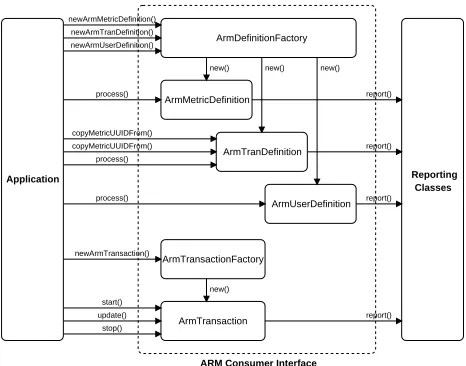
An example of an ‘ARMed’ Java application, and the nec-essary method calls to a consumer interface to define a sin-gle transaction can be seen in Figure 3. Each transaction is defined by creating a new instantiation of an ‘ArmTransaction’ object via the ‘ArmTransactionFactory’ implementation of the consumer interface, and then invoking ‘start’ and ‘stop’ calls on that instantiation at the beginning and end of the defined transaction respectively. The consumer interface measures the performance of this transaction and reports it to the data repository; shown in Figure 3 by the reporting classes.
ArmDefinitionFactory
new()
ArmMetricDefinition
ArmTranDefinition process()
copyMetricUUIDFrom() copyMetricUUIDFrom()
process()
new() new()
report() report()
process() report()
ArmUserDefinition
new() ArmTransactionFactory
ArmTransaction newArmMetricDefinition()
newArmTranDefinition() newArmUserDefinition()
start() update()
stop() newArmTransaction()
report()
Application Reporting
Classes
[image:6.612.62.295.273.456.2]ARM Consumer Interface
Figure 3:An example of an ‘ARMed’ application processing descrip-tive information and defining the location of a transaction via com-munication with an ARM consumer interface. All ARM transactions have (optional) definition information associated with them via ‘Ar-mMetricDefinition’, ‘ArmTranDefinition’, and ‘ArmUserDefinition’ ob-jects. Each of these objects are populated with information describ-ing the transaction; when the application invokes a process call, the consumer interface reports the data to the reporting classes. The application then creates a new instantiation of an ArmTransaction ob-ject, and defines the location of the transaction by invoking the start and stop transaction calls.
Optional descriptive information may also be associated with the transaction to aid analysis. This data comes in the form of definition objects such as ‘ArmMetricDefinition’, ‘Arm-TranDefinition’ and ‘ArmUserDefinition’ as seen in the diagram. Instantiations of these objects are provided by the consumer
interface’s implementation of the ‘ArmDefinitionFactory’, which are then populated with descriptive information by the appli-cation and processed whenever possible. This descriptive in-formation is associated with the transaction by their individual UUID numbers, allowing a more meaningful description each transaction within the repository.
3.2
An ARM Implementation
An ARM consumer and data repository implementation has been developed to allow distributed ‘ARMed’ applications to process and report transactions to a remote data repository service. The ARM consumer interface connects to this data repository service, and reports all processed transaction and descriptive measurement data. The service gathers this infor-mation and stores it in an efficient manner for future use. A number of standard clients have also been implemented that allow data to be extracted from the repository, including a GUI client so a developer can monitor currently executing and pre-viously executed transactions. This ARM data repository im-plementation infrastructure is shown in Figure 4.
Data Interface
Consumer Application
Service Repository
Data ARM
GUI Client
Client
Figure 4:An ARM implementation model containing: an ARM con-sumer interface client residing in the same JVM as the original appli-cation; an ARM data repository server for all reported and processed transactions and their respective descriptive information; a number of server clients for data retrieval, including a GUI client for a continuous update of all previously reported and currently executing transactions; a data client for specific transaction queries.
In the current implementation one central ARM repository service is defined. Scalability limitations are likely to be ad-dressed in the future by associating local data repository ser-vices with each ‘group’ of web serser-vices to be monitored; pos-sibly connected in a hierarchy.
3.3
Transaction Definition Language
[image:6.612.313.552.307.400.2]performance-critical transactions within classes of an applica-tion, and the fact that propriotry source code may not be avail-able to instrument.
To overcome these issues, a Transaction Definition Lan-guage (TDL)[24] has been developed. Developers define where transactions are located within their application using an XML syntax, and the object code of the application is auto-matically instrumented with the use of a bytecode instrumenta-tion tool to conform to both the ARM and Java Virtual Machine specifications. Within the TDL, descriptive information can be associated with each transaction using optional attributes, and groups of transactions can be easily defined within individual or groups of classes in an application’s jarfile or classpath. The current version of the TDL specification (version 1.1), provided as an XML DTD, can be seen in Figure 5.
<!-- Transaction Definition Language DTD (v1.1) -->
<!ELEMENT tdl (transaction+)>
<!ELEMENT transaction (location, line_number?, metric*)> <!ATTLIST transaction type (method_source | method_call |
line_number) #REQUIRED appl_name CDATA #IMPLIED tran_name CDATA #IMPLIED user_name CDATA #IMPLIED
fail_on_exception (yes | no) "yes">
<!ELEMENT location EMPTY>
<!ATTLIST location class CDATA #REQUIRED method CDATA #REQUIRED>
<!ELEMENT line_number EMPTY>
<!ATTLIST line_number begin CDATA #REQUIRED end CDATA #REQUIRED>
<!ELEMENT metric EMPTY>
<!ATTLIST metric type (Counter32 | Counter64 | CounterFloat32 | Guage32 | Guage64 | GuageFloat32 | NumericId32 | NumericId64 | String8 | String32) #REQUIRED value CDATA #REQUIRED>
Figure 5:Transaction Definition Language DTD (v1.1).
The advantage of this approach is that developers can use the TDL to ARM performance-critical areas of code by editing the associated XML file. The process of code instrumentation is then automated (saving the developer time) and bytecode-based (eliminating the need for proprietary source code). Ap-plications can then be monitored during the process of devel-opment, or alternatively after they have been deployed into a live environment.
4
Case Study
Service routing intermediaries, as discussed in Section 2, are likely to play an important role in future web service networks. Such intermediaries will need to consider QoS metrics when
making service selection decisions; the end-to-end response time that a service can provide being one example. For this to be possible, there must be a mechanism for monitoring the performance of the web services, and using this data to make a decision.
This section provides a case study demonstrating the use of ARM and the TDL to monitor such QoS metrics within a web services environment. Once performance-critical trans-actions are defined within the environment, the TDL is used to ‘ARM’ each transaction and therefore monitor each and ev-ery transaction during the environment’s life-cycle. This histor-ical performance information can then be used for a number of reasons, including the basis for an intermediary’s service selection algorithm.
Gourmet2Go, a demonstrator provided with the IBM Web Services Toolkit, is provided as an example of such a web ser-vices environment. Gourmet2Go’s design, an overview of the performance-critical transactions within Gourmet2Go, and the response times of these transactions during a test-run as mea-sured by ARM, are documented within the following text.
4.1
Gourmet2Go
Gourmet2Go is a Web services demonstrator from the IBM Web Services Toolkit. The demonstrator provides an exam-ple of how a Web service acts as a intermediary ‘broker’ that helps users select a ‘back-end’ Web service by obtain-ing bids from Web services published in a UDDI registry. In Gourmet2Go, the back-end Web services sell groceries and the broker presents itself as a value-added ‘meal planning’ ser-vice. However, the underlying architecture is generic and is used to demonstrate the brokering of any kind of service.
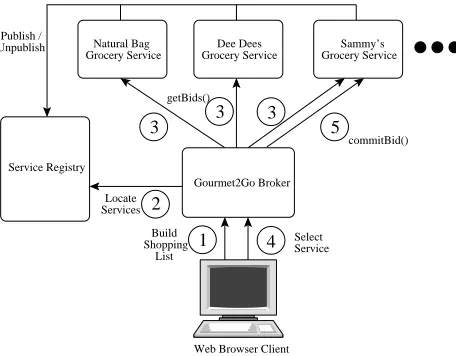
The architecture of the Gourmet2Go demonstrator is illus-trated in Figure 6. A typical interaction is as follows:
1. The user interacts with the Gourmet2Go Web application via a Web browser with the intention of building a shop-ping list of groceries. This represents the user specifying the service that the back-end web service must perform.
2. The broker searches the registry for businesses with pub-lished web services that sell groceries. This represents the broker selecting a number of potential services using information provided in the registry.
3. The shopping list is passed by the broker to each of the back-end web services, as located from the registry, via a ‘getBid’ request. This represents the broker contacting the ‘shortlist’ of candidates directly.
in-Dee in-Dees Grocery Service
Gourmet2Go Broker getBids()
Shopping
Web Browser Client
commitBid() Grocery Service
Natural Bag Sammy’s
Grocery Service Publish /
Unpublish
Service Registry
2
Locate Services
Select
3 3 5
4 1
Build
List Service
[image:8.612.64.292.39.217.2]3
Figure 6:The design of the Gourmet2Go demonstrator from the IBM Web Services Toolkit, showing a typical interaction in which a user browses the Gourmet2Go broker to obtain information regarding the available services, and then select their preference.
formation presented to them. This stage represents the broker assisting the user in decision making.
5. The broker sends a ‘commitBid’ request to the service that the users selects. This stage represents the broker continuing to act as an intermediary whilst the user inter-acts with the selected back-end service. This interaction has the potential to be significantly more complex than the confirmation message in the Gourmet2Go demonstrator. For example, specifying the details of what exactly is to be purchased and how it is to be paid for, through to delivery tracking and after-sales support.
It should be noted that the Gourmet2Go application also acts as a broker for delivery services and the broker itself is constructed from a number of dynamically registered services. For example, the meal planning ‘offering’ service provides the broker functionality that enables the user to build up a shop-ping list of groceries. However, we do not concern ourselves with these details except to note how Gourmet2Go is con-structed by dynamically ‘orchestrating’ a set of services that are published and unpublished whilst it is running.
The Web services in Gourmet2Go are implemented in Java using the WSTK and associated standards.
4.2
ARMing Gourmet2Go
Within the Gourmet2Go design, the most performance-significant transactions are the requests from the broker to the back-end services, and in-particular the ‘commitBid’ request. It is the historical performance of these transactions that would
<?xml version="1.0"?>
<!DOCTYPE tdl SYSTEM "tdl.dtd">
<tdl>
<transaction type="method_source"
appl_name="Dee Dees Grocery Ordering Service" tran_name="getBid_backend"
user_name="ARM">
<location class="com/ibm/ews/g2gServices/ grocery/DeeDeesGroceryService" method="getBid"/>
</transaction>
<transaction type="method_source"
appl_name="Dee Dees Grocery Ordering Service" tran_name="commitBid_backend"
user_name="ARM">
<location class="com/ibm/ews/g2gServices/ grocery/DeeDeesGroceryService" method="commitBid"/>
</transaction>
<transaction type="method_source"
appl_name="Natural Bag Grocery Service" tran_name="getBid_backend"
user_name="ARM">
<location class="com/ibm/ews/g2gServices/ grocery/NaturalBagGroceryService" method="getBid"/>
</transaction>
<transaction type="method_source"
appl_name="Natural Bag Grocery Service" tran_name="commitBid_backend"
user_name="ARM">
<location class="com/ibm/ews/g2gServices/ grocery/NaturalBagGroceryService" method="commitBid"/>
</transaction>
<transaction type="method_source"
appl_name="Sammys Grocery Ordering Service" tran_name="getBid_backend"
user_name="ARM">
<location class="com/ibm/ews/g2gServices/ grocery/SammysGroceryService" method="getBid"/>
</transaction>
<transaction type="method_source"
appl_name="Sammys Grocery Ordering Service" tran_name="commitBid_backend"
user_name="ARM">
<location class="com/ibm/ews/g2gServices/ grocery/SammysGroceryService" method="commitBid"/>
</transaction>
</tdl>
Figure 7: The Gourmet2Go TDL used within this example defining six transactions associated with six individual methods; ‘getBid’ and ‘commitBid’ on each of the three back-end grocery services.
be required by a service routing algorithm as the basis for its QoS decision making. To implement this, two methods within each grocery service are monitored using ARM so as to mea-sure this performance-critical information during each user it-eration.
back-Application Name Transaction Name User Name Status Number Executed Average Response Time Last Response Time Last Stop Date
Sammys Grocery Service getBid ARM GOOD 40 958 828 Sun Mar 24 13:43
Sammys Grocery Service commitBid ARM GOOD 3 988 1091 Sun Mar 24 13:39
Natural Bag Service getBid ARM GOOD 40 906 1246 Sun Mar 24 13:43
Natural Bag Service commitBid ARM GOOD 26 1000 773 Sun Mar 24 13:41
Dee Dees Servive getBid ARM GOOD 20 541 314 Sun Mar 24 13:43
[image:9.612.55.567.42.105.2]Dee Dees Service commitBid ARM GOOD 11 533 502 Sun Mar 24 13:43
Table 1:Gourmet2Go Back-End Grocery Service Transaction Measurements. (All response times are measured in ms)
end grocery services provided with the Gourmet2Go demon-strator, the TDL shown in Figure 7 was used. Six transac-tions are defined, two for each service, selecting the ‘getBid’ and ‘commitBid’ methods within each service’s class respec-tively. Optional descriptive information was associated with each transaction to provide clearer results within the ARM data repository: the application name is the name of the back-end service; the transaction name is the name of the method, ei-ther ‘getBid’ or ‘commitBid’ in this case; the user name remains constant at ARM.
4.3
Results
As well as ‘ARMing’ the back-end web services within Gourmet2Go, each transaction was also weighted to simulate a random element in response time that may occur during a service’s life-time due to resource load, communication bot-tlenecks, etc.. This also provides more interesting response times, as without these loads these times were measured as being 0ms for a large number of iterations on the resource2 used. The random elements chosen for this experiment were to set two of the services (‘Sammys’ and ‘Natural Bag’) to have an average response time of 1000ms, while ‘Dee Dees’ was set to 500ms. Dee Dee’s was also published half-way through the experiment.
Once the TDL was used to ‘ARM’ the six defined trans-actions within the back-end web services, the Gourmet2Go demonstrator was brought online as per normal and standard user interactions were made via a web client to the broker for forty iterations. During each iteration, successfully completed transactions within the three grocery services were reported and could be seen updating within the ARM data repository.
The results reported by the ARM transactions defined within the back-end web services can be seen in Table 1. During each iteration of Gourmet2Go controlled by the user, the ‘get-Bid’ method of each published grocery service is executed, while the ‘commitBid’ method of only the user’s selected ser-vice is executed. From the results, it can be seen that over the course of the experiment that the ‘Sammys‘ service was se-lected three times, ‘Natural Bag’ was sese-lected twenty-six times,
2All results were obtained using a Pentium III 450 Mhz with 256 Mb RAM,
running Redhat Linux 7.1, kernel 2.4.17, IBM JVM 1.3.7, and the WSTK 2.4.2 run-time environment which includes Webshere Micro-Edition 4.
and ‘Dee Dees’ was selected by the user eleven times, while only being published in the UDDI registry twenty out of the forty total iterations. It can also be seen that the ‘Dee Dees’ service performed with an average response time of roughly half the other two, due to the random load induced within the services for this experiment.
This case study, while providing a list of results obtained re-garding the performance of Gourmet2Go, is mainly provided as an exercise into how the TDL can be used to monitor the performance of any transaction within any Java application; a web services environment implemented using J2EE such as Gourmet2Go being one example. This information can then be used by a developer to locate performance-critical areas of code or, as explained previously within the paper, as the QoS measurements used within a service routing decision al-gorithm.
5
Conclusion
This paper has demonstrated how the ARM standard and a novel transaction definition and instrumentation technique de-veloped here at Warwick can be applied to assist web ser-vice intermediaries in making routing decisions by monitoring the web services under consideration. Our framework and ex-periences of applying our ARM tools and implementation to ’Gourmet2Go’, a real web service sample from the IBM Web Services Toolkit has been discussed in detail in the hope that it will provide insight into the process of applying existing per-formance tools and standards to Web Service based applica-tions.
It is envisaged that future work will include an implementa-tion of a service routing algorithm that bases its decisions on the QoS metrics measured and reported by the ARM frame-work described in this paper. The TDL is also being modified so as to be able to concisely define how entire web service ap-plications can be automatically instrumented and monitored.
6
Acknowledgments
Labora-tories, UK. for the contribution towards this research.
The work is sponsored in part by a grant from the NASA AMES Research Center, and administered by USARDSG (contract no. N68171-01-C-9012), as well as the ESPRC (contract no. GR/R47424/01).
The authors would also like to convey their sincere thanks to the Computer Measurement Group for their support with travel and accommodation expenses during the 27th CMG Annual Conference, Anaheim, USA.
References
[1] K. Ballinger, P. Brittenham, A. Malhotra, W. Nagy, S. Phar-ies, “Web Services Inspection Language (WS-Inspection) 1.0”, Available atwww.ibm.com/developerworks
[2] D. Box, D. Ehnebuske, G. Kakivaya, A. Layman, N. Mendelsohn, H. F. Nielsen, S. Thatte, D. Winer, “Simple Object Access Protocol (SOAP) 1.1”, May 2000. Available atwww.w3.org/TR/SOAP
[3] J. Cao, D.J. Kerbyson, E. Papaefstathiou and G.R. Nudd, “Modeling of ASCI High Performance Applications using PACE”, 19th IEEE International Performance, Computing and Communication Conference, Phoenix USA. 485-492 (2000).
[4] J. Cao, D.J. Kerbyson, G.R. Nudd, “Performance Eval-uation of an Agent-Based Resource Management In-frastructure for GRID Computing”, Proceedings of 1st IEEE/ACM Int. Symposium on Cluster Computing and the Grid, Brisbane Australia. 311-318 (2001).
[5] J. Cao, D.P. Spooner, J.D. Turner, S.A. Jarvis, D.J. Ker-byson, S. Saini and G.R. Nudd, “Agent-based Resource Management for Grid Computing”, Invited paper at the 2nd IEEE/ACM Int. Symposium on Cluster Computing and the Grid, Berlin. 21-24 May (2002).
[6] E. Christensen, F. Curbera, G. Meredith, and S. Weerawarana, “Web Services Description Language (WSDL) 1.1”, W3C Note, March 2001, Available at
www.w3.org/TR/wsdl
[7] F. Curbera, W. Nagy, S. Weerawarana, “Web Services: Why and How”, OOPSLA 2001 Workshop on Object-Oriented Web Services, Florida, USA, 2001
[8] F. Curbera, N. Mukhi, S. Weerawarana, “On the Emer-gence of a Web Services Component Model”, 6th In-ternational Workshop on Component-Oriented Program-ming (ECOOP), Budapest, Hungary, 2001
[9] M. Duftler, N. Mukhi, A. Slominski,S. Weerawarana, “Web Services Invokation Framework”, OOPSLA 2001 Work-shop on Object-Oriented Web Services, Florida, USA, 2001
[10] I. Foster, C. Kesselman, “The Grid : Blueprint for a New Computing Infrastructure”, Morgan Kaufmann. 279–290 (1998).
[11] I. Foster, C. Kesselman, S. Tuecke, “The Anatomy of the Grid: Enabling Scalable Virtual Organizations”, To be published in Intl. J. Supercomputer Applications, (2001).
[12] I. Foster, C. Kesselman, J. Nick, S. Tuecke, “The Physiology of the Grid: An Open Grid Services Architecture for Distributed Systems Integration”,
www.globus.org/research/papers/ogsa.pdf
[13] IBM Corporation, “Web Services Flow
Lan-guage (WSFL 1.0)”, May 2001, Available
at www.ibm.com/software/solutions/
webservices/pdf/WSFL.pdf
[14] IBM Web Services Toolkit, Available from
www.alphaworks.ibm.com/tech/webservices toolkit
[15] M.W. Johnson, J. Crowe, “Measuring the Performance of ARM 3.0 for Java”, Proceedings of CMG2000 Interna-tional Conference, Orlando USA. (2000).
[16] H. Kreger, “IBM Web Services Conceptual
Architecture (WSCA 1.0), May 2001,
Avail-able at www.ibm.com/software/solutions/
webservices/pdf/WSCA.pdf
[17] W. Leinberger, V. Kumar, “Information Power Grid : The New Frontier in Parallel Computing?”, IEEE Concurrency 7(4), (1999).
[18] G.R. Nudd, D.J. Kerbyson, E. Papaefstathiou, S.C. Perry, J.S. Harper, D.V. Wilcox, “PACE - A Toolset for the Performance Prediction of Parallel and Distributed Sys-tems”, International Journal of High Performance Com-puting Applications, Special Issues on Performance Mod-elling. 14(3), 228-251 (2000).
[19] OASIS, Business Transaction Protocol (0.9), OASIS pre-final draft 2001, Available fromwww.oasis-open.org
[20] The Open Group, “Application Response Measure-ment (Issue 3.0 - Java Binding)”, Open Group Technical Specification, (2001). Available from
regions.cmg.org/regions/cmgarmw/index.html
[22] D.P. Spooner, J. Cao, H.N. Lin Choi Keung, S.A. Jarvis, G.R. Nudd, “Titan: A Performance-Driven Scheduler”, Submitted to 11th IEEE International Symposium on High Performance Distributed Computing (HPDC-11), Edin-burgh, July 2002
[23] S. Thatte, “XLANG: Web Services for
Busi-ness Process Design”, May 2001,
Avail-able at www.gotdotnet.com/team/xml
wsspecs/xlang-c/default.htm
[24] J.D. Turner, D.P. Spooner, J. Cao, S.A. Jarvis, D.N. Dillen-berger, G.R. Nudd, “A Transaction Definition Language for Application Response Measurement”, International Journal of Computer Resource Measurement, 105, 55-65 (2001).
[25] UDDI Project, “UDDI Technical White Paper”, September 2000, Available atwww.uddi.org