1
Experiences of adheres and nonadheres with an
application based on the TransTheoretical model
with stage tailored and peer-designed text messages
Yselle van Praet, Supervisors Joris van Hoof & Stans Drossaert, University of Twente, Faculty Behavioural, Management and Social Sciences. 09-03-2018
Abstract
Background: Nowadays people do not engage in the recommend levels of physical activity. Despite that people
in general have favourable attitudes towards healthy behaviours, people often encounter difficulties when trying
to maintain a workout schedule. Persuasive technology can stimulate individuals to change their behaviour.This
qualitative study is aimed to examine experiences of adheres and nonadheres with the Motiapp. The application
(Motiapp) is developed to motivate people to keep exercising or to start exercising. The Motiapp is based on the
TransTheoretical Model (TTM) and sends daily text messages to exercise. These text messages are tailored to
stage of change of the user and are peer-designed.
Method: Individual in-depth interviews about their experiences with the Motiapp were conducted with 15
adheres and with 15 nonadheres of the Motiapp. Interviews were audio-recorded, transcribed and analysed both
deductively and inductively.
Results: The participants adhered to the Motiapp, because the application was easy to use and the participants
were curious about the effects of the Motiapp. The participants nonadhered to the Motiapp, because they got no
messages anymore, got a new mobile phone or they disliked certain aspects of the Motiapp. Overall, the
messages of the Motiapp were experienced positively. Participants indicated that most of the messages were
personal, persuasive and relevant. Moreover, the behavioural processes of the TransTheoretical model were
helpful to motivate them to exercise. More than half of the participants indicated that the Motiapp had a positive
effect, because it was a reminder to exercise. The other participants indicated that the Motiapp had no effect.
However, the participants indicated that the messages were a confirmation to their exercise behaviour. The
participants would change the time of receiving the messages and would enlarge the Motiapp with an activity
tracking system – to track their activities and to share their activities with friends and the messages should
include pictures and links to exercise activities.
Conclusion: There are no noticeable difference between the adheres and nonadheres. The most reason for
nonadherence are unintentionally. Moreover, it seems adherence can be increased by an easily working
application. In general the Motiapp was experienced positively. The messages were experienced as personal and
a reminder to exercise. Finally, participants would find a more comprehensive application motivating to exercise
more.
Keywords: Adheres, Nonadheres, Participants, Exercise, Messages, Motiapp
1.
Background
Regular physical exercise attributes a great benefit to people’s general health (Warburton, Nicol & Bredin,
2006). Exercise is beneficial for a person’s physical as well as psychological well-being (Penedo & Dahn, 2005).
2 reduced cardiovascular responses to stress (Bennett & Carroll, 1990) and report fewer symptoms of anxiety and
depression (Blair, LaMonte, & Nichaman, 2004). Exercise also improves people’s confidence and
self-esteem (Folkins & Sime, 1981). Recommend is that adults between the age of 18 and 54, exercise at least five
times a week for half an hour, such as strenuous walking. Adults also have to exercise at least three times a week
for half an hour more intensively, such as aerobics, football or tennis (van Uffelen, Paw, Hopman-Rock & van
Mechelen, 2008). However, a great number of people do not engage in the recommended levels of the physical
activity. This due to the low perceived benefits and high perceived barriers, such as physical exertion and the
time to exercise (Lovell, Ansari & Parker, 2010). It seems that people should be stimulated to exercise more
often.
To get people to exercise more a behavioural change is needed. Getting an individual to change their
everyday behaviours and their lifestyle is challenging. However, recent developments in persuasive technology
for health behaviour change has had promising results. Persuasive technology can be defined as interactive
information technology designed for changing users attitude or behaviour (Oinas-Kukkonen & Harjumaa, 2008).
Persuasive technology is used to persuade, motivate and activate individuals’ health behaviour change.
Persuasive technology plays a role in stimulating people to take responsibility for their own health and
well-being.
A persuasive technology that is widely used are applications (apps). It is not uncommon for individuals
to have tried using apps on their computers or mobile phones to track physical activity (Consolvo, Everitt, Smith
& Landay, 2006). Figures from Telecompaper shows that 81 percent of the Dutch people aged 18 to 80 years are
in the possession of a mobile phone (Marketingfacts, 2018). The use of an smartphone app for a health behaviour
change is effective, because an app is constantly accessible, easily adjustable to the needs of the user, able to
provide tailored feedback, has a large reach and can make use of interactive features (Griffiths, Lindenmeyer,
Powell, Lowe & Thorogood, 2006). Smartphone apps that promote physical activity are popular. Worldwide
875,683 active apps are available in iTunes and 696,527 active apps in Google Play. Middelweerd, Mollee, van
der Wal, Brug & te Velde (2014) categorized 17,756 of the total amount as fitness applications. Previous
research suggests that the use of behaviour change techniques in apps is effective (Abraham & Michie, 2008).
Commonly used behaviour change techniques in apps are goal-setting, prompt intention formation, providing
feedback on performance, self-monitoring and reviewing behavioural goals. A review of apps to promote
physical activity among adults showed that these apps are not based on theoretical models (Middelweerd et al.,
2014). Similarly, Cowan et al. (2013) found that the key constructs of a behaviour change theory are seldom
used in apps that target physical activity. However, the commonly used apps with behaviour change techniques
(goal setting, prompt intention formation, providing feedback on performance, self-monitoring and reviewing
behavioural goals) showed large effect sizes on behavioural change (Middelweerd et al., 2014).
An effective health behavioural change model that can be used is The TransTheoretical Model
(Prochaska &Velicer, 1997). The TransTheoretical Model (TTM) is a dynamic integrative behaviour change
model focused on the individual. Five stages of change associated with the TTM describe individuals willingness
to change their behaviour. The five stages of change can be practically applied and classify individuals in to
progressing stages for changing behaviour, i.e., precontemplation, contemplation, preparation, action and
maintenance. When moving through these stages people encounter processes of change, experiences and actions
3 energy is needed to move through the stages. According to Prochaska and Velicer (1997) the five stages are
defined as follow. Precontemplation is the stage in which people are not intending to take action in the
foreseeable future, usually measured in the next 6 months. Contemplation is the stage in which people are
intending to change in the next 6 months. Preparation is the stage in which people are intending to take action in
the immediate future, usually measured in the next month. Action is the stage in which people have made
specific overt modifications in their life styles within the past 6 months. Maintenance is the stage in which
people are working to prevent relapse, but do not apply change processes as frequently as people in the action
stage.
While the stages of change are useful in explaining when changes in cognition, emotion and behaviour
take place, the processes of change can help to explain how and why the progression through these stages occur.
Ten covert and overt processes will usually be experienced when successfully progressing through these stages
of change and attaining the desired behavioural change. The ten processes can be divided into two groups:
experiential processes and behavioural processes. Experiential processes are focused on changing people’s ideas
and behavioural processes are focused on changing people’s actions. The experiential processes include the
following. Consciousness raising - involves increased awareness about the causes, consequences and cures for a
particular problem behaviour. Dramatic relief - produces increased emotional experiences followed by reduced
affect if appropriate action can be taken. Self-re-evaluation - combines both cognitive and affective assessments
of ones self-image with and without a particular unhealthy habit. Environmental re-evaluation - combines both
affective and cognitive assessments of how the presence or absence of a personal habit affects ones social
environment. Social liberation - requires an increase in social opportunities or alternatives especially for people
who are relatively deprived or oppressed. The behavioural processes include the following. Self-liberation - is
both the belief that one can change and commitment and recommitment to act on that belief. Helping
relationships - combine caring, trust, openness and acceptance as well as support for the health behaviour
change. Counterconditioning - requires the learning of healthier behaviours that can substitute for problem
behaviours. Reinforcement management - provides consequences for taking steps in a particular direction.
Stimulus control - removes cues for unhealthy habits and adds prompts for healthier alternatives.
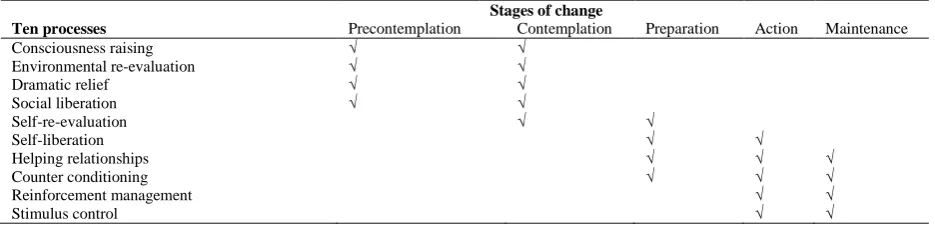
The effectiveness of the processes depends on their associated stages of change (Marcus et al., 1998).
Table 1 shows the stages of change combined with the ten process of change. The checkmark indicates the stage
[image:3.595.65.533.602.716.2]of change combined with the process of change.
Table 1Stages of change combined with the ten processes of the TransTheoretical Model
Developers of persuasive technology who want people to change their behaviour could use the TTM to tailor the
information they provide to the stage the user is in. According to Marcus et al. (1998) stage based interventions Stages of change
Ten processes Precontemplation Contemplation Preparation Action Maintenance
Consciousness raising √ √
Environmental re-evaluation √ √
Dramatic relief √ √
Social liberation √ √
Self-re-evaluation √ √
Self-liberation √ √
Helping relationships √ √ √
Counter conditioning √ √ √
Reinforcement management √ √
4 can be more effective than non-stage based interventions. Their study tested a tailored intervention - tailored to
the participants stage of change and associated processes, versus, a non-stage based intervention. The results
showed that both interventions increased physical activity levels, but the tailored version increased physical
activity levels the most. Spencer et al. (2006) remarks that individuals using the appropriate processes of change
as they move through the stages is essential for behavioural change. It seems that the TTM is an effective
behavioural change model especially when the stages are combined with the processes.
To translate a health behavioural change model, like the TTM, into an application, text messages can be
used. Text messages can stimulate behavioural change. There are four components to an effective persuasive text
message. To be specific, present a simple and tailored message that is easy to understand, send the message at an
appropriate time, at an appropriate place and do not use irritating strategies (Maheshwari, Chatterjee, & Drew,
2008). A systematic review of 18 studies that evaluated the use of a cell phones to provide health information
showed that providing care and support via cell phones and text messaging improved health related outcomes
and increased knowledge and self-efficacy (Perez-Ferre et al., 2010). Subsequently, a reminder system with text
messages alerts users when it is time to engage in a healthy behaviour, such as going for a walk . Time reminders
are examples of ‘cueing’ or ‘stimulus control’ processes, which involve changing an individual’s environment to
present a conditional stimulus to perform a desired health behaviour, for example keeping a gym bag by the door
as a physical reminder to work out (Prestwich, Perugini, & Hurling 2009). The technique of text messages as a
reminder to engage in a particular behaviour has successfully changed individuals health behaviour (Khonsari et
al., 2015). Text messages can be tailored to individuals. Using tailored text messages to influence someone’s
behaviour has proven effective in various contexts, for example with dieting (Mutsuddi & Connelly, 2012). In
addition, their research showed that tailored text messages in combination with a behaviour change theory or
model to influence someone’s behaviour can be effective for physical activity. Tailoring text messages to a
theory or model can enhance motivation to attend to and process health information (Rimer & Kreuter, 2006).
Text messages can be designed by experts, peers or other people. Usually experts design the text
messages. However, Coley et al. (2013) showed that peer-designed text messages can be more engaging and
more relevant to the users in comparison to expert-designed text messages.
Despite that people in general have favourable attitudes towards healthy behaviours, people often
encounter difficulties when trying to maintain a workout schedule (Ryan, Patrick, Deci & Williams, 2008).
Another research showed that only one of every two people would continue a physical activity program (Morgan
& Dishman, 2001; Marcus et al, 2000). It seems that many people dropout of a physical activity program before
attaining its benefits. This high dropout rate typically occurs within the first 6 months of a program, often before
any health benefits are realized (Ainsworth, 2000). The people who dropout a program are also defined as the
‘nonadheres’which means the extent to which an individual is not able to proceed a program or treatment. The
people who proceed a program or treatment are defined as the ‘adheres’ (Hugtenburg, Timmers, Elders, Vervloet
& van Dijk, 2013). Factors to dropout are lack of time, lack of insight, motivation, failed previous attempts, fear
of injury, costs and boredom (Salmon, Owen, Crawford, Bauman & Sallis, 2003; Teferra, Hanlon, Beyero,
Jacobsson, & Shibre, 2013). Nonadherence can be divided into unintentional nonadherence or intentional
nonadherence. Unintentional nonadherence involves participation as instructed but failing to do so for some
reason. For example, forgetfulness and carelessness (Wroe, 2002). Intentional nonadherence involves making a
5 reflects a rational decision making process by which the users outweighed the benefits against the effects (Wroe,
2002; Lehane, & McCarthy, 2007).
Adherence can be divided in short-term and long-term adherence. Long term adherence can be defined
as at least 1 year of regular participation. Most studies are limited to six months or less. However, factors of
short term adherence can be related to long-term adherence. Facilitators related to short-term physical adherence
include social support, education (Dayer, Heldenbrand, Anderson, Gubbins & Martin, 2003) and motivation
which includes enjoyment and self-efficacy (White, Randsell, Vener & Flohr, 2005; Huberty et al., 2008). Social
support is an important factor. However, more for the initiation for activity and not for the maintenance of
long-term physical activity (White et al., 2005).
There are many methods developed to increase adherence. Most methods attempt to change the user’s
behaviour by using reminders, counselling, reinforcement, education or a combination of these methods.
Vervloet, Linn & Weert (2012) showed that mobile devices using reminder systems through text messaging
increases adherence and can be useful in measuring adherence in the short term.
Another method to increase adherence is the acceptance of technology. An important model to ensure
that technology is accepted by users is the Technology Acceptance Model (TAM) (Venkatesh & Davis, 2000).
This model suggests that when users are presented with a new technology a number of factors influence their
decision about how and when they will use it. Two influential factors are the perceived ease of use and perceived
usefulness. The perceived ease of use is the degree to which a person believes that using a particular system
would be free from effort and the perceived usefulness is the degree to which a person’s beliefs that using a
particular system would enhance his or her job performance.
The application (Motiapp) is developed to motivate people to keep exercising or to start exercising. The
Motiapp is based on the TransTheoretical Model. The Motiapp sends daily text messages to exercise. These text
messages are tailored to the stage of change (TTM) of the user and are peer-designed. The main objective of this
study was to elaborate on the experiences of adheres and nonadheres with the Motiapp. The following research
question can be addressed: ‘What are the experiences with the Motiapp of the adheres and nonadheres?’
The following sub-questions can be examined:
(1) What are the self-reported reasons for adherence and nonadherence to the Motiapp?
(2) What are the perceived experience of the messages and which messages (aligned to the ten processes) are recalled?
(3) What are the perceived experience (perceived ease of use and perceived usefulness) of the Motiapp in
general?
6
2.
Method
2.1 Setting
The current study was part of a Randomized Control Trial (RCT). This RCT was a three month trial of the
Motiapp, with a begin survey (T0), biweekly surveys (T1) and a final survey (T2). All people were randomly
assigned to one of the two conditions. The first condition consists of people who received notifications based on
the stage of change they are in. The second condition consists of people who received notifications not based on
the stage of change they are in, but randomly. However, this will not be taken further into account during this
study.
To approach people for the RCT a convenience sample was taken. Emailing lists, personal lists, flyers,
Twitter, Facebook and a student system for course credits were used. In total 118 people started to use the
Motiapp. The people could participate anonymously or sign up with their name and email address. The Motiapp
is an application to motivate people with simple motivational text messages to either start doing physical activity
or to keep doing physical activity.The Motiapp starts with a survey. This survey ensures that people are assigned
to their stage of change. Based on the stage of change the participants are in, the participants received applicable
notifications (text messages), which are aligned to the ten processes. The participants received daily notifications
that could either be rated ‘Motivating’ or ‘Not motivating’. The participants were asked to rate these messages
considering their own situation. If the participant thought the message contributed a little to their motivation to
start doing physical activity or to keep doing physical activity. For three months the participants received a
notification every day at 18.00 o’clock. Besides the daily notifications, every two weeks a survey was filled in.
These surveys were only used for the RCT to keep track of changes in the exercise behaviour. The survey
consists of 20 questions, 6 about the self-efficacy, 6 about the decisional balance, 1 about the stage of change
and 4 about the glteg. Finally, at the end of three months a final survey was filled in. This survey offered the
possibility to give feedback on the use of the app.
2.2 Procedure and participants
The design of this study was a semi-structured interview with adheres and nonadheres of the Motiapp. At the
moment of data collection for the RCT, 47 people did adhere and 71 people did not adhere to the Motiapp.
People did adhere to the Motiapp when the final survey was filled in. From the RCT fifty-three participants
signed up with their name and email address. These fifty-three participants were asked to participate in this
study, twenty-seven adheres and twenty-six nonadheres of the Motiapp. The participants were contacted by
e-mail and invited to participate in a face to face interview about their experiences with the Motiapp. With
participants who were willing to participate, an appointment for a face-to-face interview was made. In total 30
participants responded of which 15 adheres and 15 nonadheres were interviewed. Table 2 shows the
[image:6.595.65.529.700.764.2]demographics of the participants.
Table 2
Demographics of the adheres and nonadheres of the Motiapp
Demographics Adheres
(n = 15)
Nonadheres (n = 15)
Total (N = 30)
Gender (Female) 10 8 18
Gender (Male) 5 7 12
7 The sample included both female (n = 18) and male (n = 12) participants of which ten females and five males did
adhere and eight females and seven males did not adhered to the Motiapp, with an average age of 24,4 years.
This study was approved by an Ethical Commission. The interviews were conducted in Dutch by a master
student of Communication Studies. All interviews were audio-recorded and transcribed. The interviews took
between 25 and 40 minutes, with an average duration of 30 minutes. Quotations appearing in this article have
been translated from Dutch into English.
2.3 Instrument
A semi-structured interview scheme was used. The interview scheme was pre-tested with two adheres of the
Motiapp. The aim of the pre-test was to optimize the interview scheme before conducting the interviews. The
pre-tests were not included in the research results.
The interview consisted of two parts. In the first part of the interview, the participants were emphasized
that they had the right to withdraw the interview and that there were no good or wrong answers. In addition, it
was stated that the participants had the right not to answer any questions, regardless of their reasons for it.
Furthermore, the anonymity of participants was assured. Followed by the request for their permission to record
the interview. After the participants agreed on these conditions, the interview started.
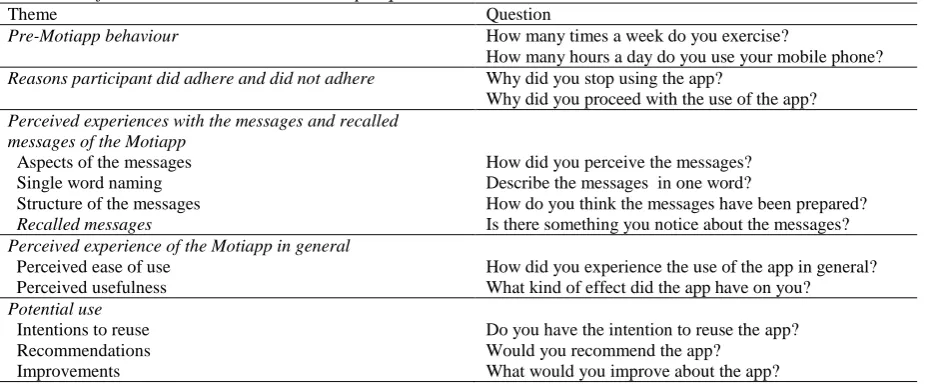
In the second part 5 themes were covered. Table 3 shows an overview of the themes and example
[image:7.595.67.537.410.603.2]questions.
Table 3
Overview of the interview themes and example questions
Theme Question
Pre-Motiapp behaviour How many times a week do you exercise?
How many hours a day do you use your mobile phone? Reasons participant did adhere and did not adhere Why did you stop using the app?
Why did you proceed with the use of the app? Perceived experiences with the messages and recalled
messages of the Motiapp Aspects of the messages Single word naming
How did you perceive the messages? Describe the messages in one word?
Structure of the messages How do you think the messages have been prepared?
Recalled messages Is there something you notice about the messages?
Perceived experience of the Motiapp in general Perceived ease of use
Perceived usefulness
How did you experience the use of the app in general? What kind of effect did the app have on you? Potential use
Intentions to reuse Recommendations Improvements
Do you have the intention to reuse the app? Would you recommend the app?
What would you improve about the app?
First the participants were asked about their exercise behaviour before the use of the Motiapp. Followed by the
reasons participants did adhere and did not adhere to the Motiapp. The perceived experiences with the messages
and the recalled messages of the Motiapp, which included the aspects of the messages, single-word naming
(Strain, Patterson & Seidneberg, 1995), structure of the messages and the recalled messages (aligned to the ten
processes of TTM)(Prochaska & Velicer, 1997). The perceived experiences of the Motiapp in general, which
included the perceived ease of use and usefulness of the Motiapp (Venkatesh &Davis, 2000). The potential use
of the Motiapp, which included the intention to reuse, the recommendations and the improvements for the
8 Subsequently, the participants were encouraged to motivate their answers and elaborate upon their experiences.
After the discussion of these five themes the participants were appreciated for their participation.
2.4 Analysis
A multistep content-analytic procedure was applied to analyse the qualitative data. After the interviews had been
transcribed, the interviews were coded in order to acquire basic insight into the content. The codebook that was
used for this coding session consisted codes that had been derived from the Technology Acceptance Model
(Venkatesh & Davis, 2000). Furthermore, this codebook consisted of new codes about adherence, recalled
messages, reuse, recommendations and improvements for the Motiapp. In other words, both a deductive and
inductive content analysis were used to develop the codebook (Elo & Kyngäs, 2008). After a first coding
session, the codebook was refined and new codes and subcategories were added to the codebook. Subsequently,
the new codebook was discussed with a second researcher. This discussion led to another coding session, where
the final codes and subcategories in the codebook were defined on the basis of consensus between the first and
the second researcher.
3.
Results
In the following paragraphs the participants experiences with the Motiapp are described. Starting with
pre-Motiapp behaviour (3.1), followed byreasons participants did adhere and did not adhere to the Motiapp (3.2),
their perceived experiences of the messages (3.3), their perceived experiences of the Motiapp in general (3.4)
and the potential use (3.5). In each paragraph a distinction is made between adheres (N = 15) and nonadheres (N
= 15) of the Motiapp.
3.1 Pre-Motiapp behaviour
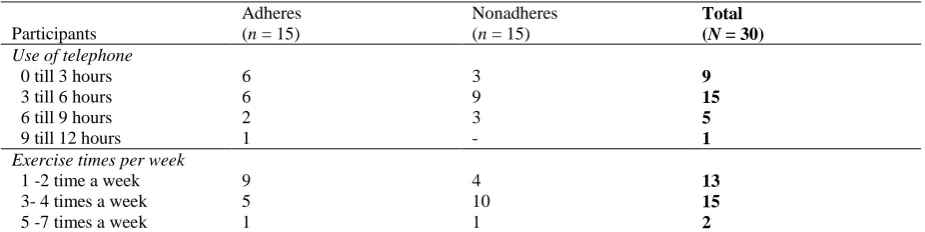
Table 4 shows the frequency of mobile phone use and the frequency of exercise a week by adheres and
[image:8.595.65.528.521.637.2]nonadheres of the Motiapp.
Table 4
Frequency of mobile phone use and exercise times a week by adheres and nonadheres of the Motiapp
The majority of the participants used their mobile phone more than three hours a day. Most of the adheres used
their mobile phones ranging from null till three hours a day or three till six hours a day. Most of the nonadheres
used their mobile phone ranging from three till six hours a day.
All of the participants exercise. Seventeen people exercise three or more times a week. The participants
go to the gym or practice team sports, like football. Nine adheres exercise two times a week. Ten nonadheres
exercise three times a week. It seems that in general the participants are all active.
Adheres Nonadheres Total
Participants (n = 15) (n = 15) (N = 30)
Use of telephone
0 till 3 hours 6 3 9
3 till 6 hours 6 9 15
6 till 9 hours 2 3 5
9 till 12 hours 1 - 1
Exercise times per week
1 -2 time a week 9 4 13
3- 4 times a week 5 10 15
9 3.2 Reasons participants did adhere and did not adhere to the Motiapp
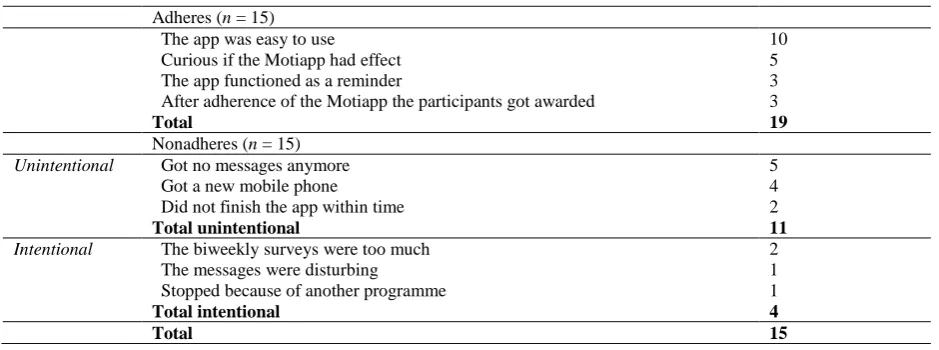
Table 5 shows the reasons why participants did adhere to the Motiapp. The adheres gave multiple reasons for
their adherence to the Motiapp. The main reason these participants (n = 10) adhered to the Motiapp was, because
the app was simple and easy to use. Moreover, the adheres were curious about the effect of the app. This is
illustrated by, ‘I found the research interesting. I was curious to see what it did and if it in the end would
motivate me to exercise more. That would be a nice bonus of course (P18)’ Another reason a few adheres
indicated was that the Motiapp functioned as a reminder to exercise. Finally, three participants adhered to the
[image:9.595.64.534.243.418.2]Motiapp, because afterwards those participants got course credits for their participation.
Table 5
Reasons participants did adhere and did not adhere to the Motiapp
Table 5 shows the reasons why participants did not adhere to the Motiapp. Eleven nonadheres unintentionally
did not adhere to the Motiapp. Reasons for unintentional nonadherence are, got no messages anymore, got a new
mobile phone and did not finish the app within time. Some nonadheres (n = 3) indicated that after a while they
did not receive any messages anymore. This is illustrated by,
‘Well it differed a lot, then I got no messages for a full week and sometimes every couple of days. I
hardly got messages three days in a row. I think that there is something wrong with the app (P2)’.
Other nonadheres (n = 2) indicated that the messages came only if the application was opened. This is illustrated
by,
’I did not get those messages unless I opened the app myself. I thought that was a little bit inconvenient.
When my telephone memory was full, I realised that I did not use the app, so I deleted it (P22)’.
Four nonadheres indicated nonadherence to the Motiapp, because those participants got a new mobile phone.
The nonadheres indicated that they forgot to reinstall the application on their new mobile phone, because it was
not really important. This is illustrated by, ‘I stopped purely because I got another mobile. I forgot about the
app, so actually I did not miss the app (P1)’. Two nonadheres indicated adherence to the Motiapp, but not within
the set timeframe.
Four nonadheres intentionally did not adhere to the Motiapp. Reasons for intentional nonadherence are,
the biweekly surveys are too much, the messages were disturbing and stopped because of another program. Two
nonadheres indicated that the biweekly surveys took too much time to fill in. The messages were a small effort,
but the questionnaire was to intensive. This is illustrated by,
‘I found the messages ok, it was just one click. However, you had to fill in a survey every two weeks.
Adheres (n = 15)
The app was easy to use 10
Curious if the Motiapp had effect 5
The app functioned as a reminder 3
After adherence of the Motiapp the participants got awarded 3
Total 19
Nonadheres (n = 15)
Unintentional Got no messages anymore 5
Got a new mobile phone 4
Did not finish the app within time 2
Total unintentional 11
Intentional The biweekly surveys were too much 2
The messages were disturbing 1
Stopped because of another programme 1
Total intentional 4
10 You could not swipe the survey away or fill it in later. That was quite annoying. I turned off the pop-up
notifications in my phone, so I would not receive the surveys anymore. In addition, the notifications
too did not pop-up (P20)’.
One nonadhere indicated the messages were irritating. This is illustrated by,
‘In the beginning I always answered the messages and completed the survey, but after a while I did not
like it anymore. I did not keep track of it. I started to ignore the messages, because sometimes I had
more than one message a day. I perceived the messages as annoying (P23)’.
Another nonadhere stopped, because of the participation of another programme to lose weight. This is illustrated
by,
‘It is pure laziness. I had downloaded the Motiapp and I reviewed the first few messages, furthermore I
did not do anything with it. However, if I had not participated in another programme I would have
taken the Motiapp more seriously (P26)’
Interim summary
Almost all participants exercise two or three times a week. It seems that in general all the participants exercise
regularly. The adheres did adhere to the Motiapp, because the app was easy to use and the adheres were curious
about the effects. Nonadheres unintentional did not adhere to the Motoiapp, because of technological failure or
forgetfulness. Nonadheres intentional did not adhere to the Motiapp, because of aspects they disliked about the
Motiapp.
3.3.Perceived experiences of the messages and the recalled messages of the Motiapp
The perceived experiences of the messages and the recalled messages of the Motiapp, by adheres (n = 15) and
nonadheres (n = 15) of the Motiapp can be divided into the perceived aspects of the messages, the single word
naming, the perceived structure of the messages, the spontaneously recalled messages and the named messages.
3.3.1 Perceived aspects of the messages
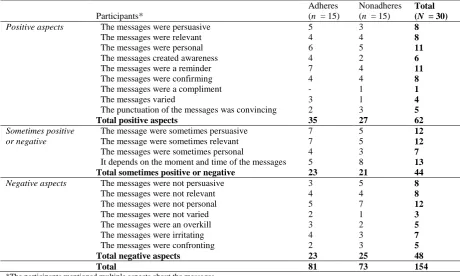
Table 8 shows the perceived aspects of the messages by adheres and nonadheres of the Motiapp. All participants
indicated several aspects about the messages. The perceived opinions of the messages are divided in positive-,
11 Table 8
Aspects ofthe perceived messages by adheres and nonadheres of the Motiapp
Adheres Nonadheres Total
Participants* (n = 15) (n = 15) (N = 30)
Positive aspects The messages were persuasive 5 3 8
The messages were relevant 4 4 8
The messages were personal 6 5 11
The messages created awareness 4 2 6
The messages were a reminder 7 4 11
The messages were confirming 4 4 8
The messages were a compliment - 1 1
The messages varied 3 1 4
The punctuation of the messages was convincing 2 3 5
Total positive aspects 35 27 62
Sometimes positive The message were sometimes persuasive 7 5 12
or negative The message were sometimes relevant 7 5 12
The messages were sometimes personal 4 3 7
It depends on the moment and time of the messages 5 8 13
Total sometimes positive or negative 23 21 44
Negative aspects The messages were not persuasive 3 5 8
The messages were not relevant 4 4 8
The messages were not personal 5 7 12
The messages were not varied 2 1 3
The messages were an overkill 3 2 5
The messages were irritating 4 3 7
The messages were confronting 2 3 5
Total negative aspects 23 25 48
Total 81 73 154
*The participants mentioned multiple aspects about the messages
The participants indicated the messages sixty-two times as positive. The participants indicated that the messages
were persuasive, relevant, personal, created awareness, a reminder, confirming, a compliment, varied and that
the punctuation was convincing. More than a third (n =11) of the total number of participants (N = 30) indicated
that the messages were personal. Those participants felt personally addressed by the messages, because it
corresponded with their exercise levels. Moreover, eleven participants indicated that the messages were a
reminder to exercise.
The adheres indicated more positive aspects about the messages than the nonadhres of the Motiapp
.
The participants indicated that the messages were sometimes positive or negative forty-four times. The
participants indicated that the messages were sometimes persuasive, -relevant, -personal, and it depends on the
moment and time of the messages. Twelve participants indicated that the messages were sometimes relevant and
twelve participants indicated that the messages were sometimes persuasive. Thirteen participants indicated how
they perceived the messages depends on the moment and time. This is illustrated by,
‘It depends on the mood I am in. If I was lazy, I found the messages convincing. If I was busy and had
no time, than I thought go away with your messages(P12)’.
Adheres indicated a little more sometimes positive and negative aspects about the messages. The adheres
indicated more often that the reception of the messages depends on the context of the messages (persuaive,
relevant or personal), while the nonadheres indicated more often that it depends on the moment and time.
Finally, the participants indicated the messages forty-eight times as negative. The participants indicated
that the messages were not persuasive, -relevant, -personal, -varied, an overkill, irritating and confronting. More
than a third (n = 12) of the total participants (N = 30) indicated that the messages were not personal. Moreover,
12 were not persuasive. The nonadheres indicated a little more negative aspects about the messages than the
adheres. However, it seems that in general the participants experienced the messages positively.
3.3.2 Single word naming
Table 9 shows the single word naming of the messages. The participants described the messages in one word.
Almost half (n =14) of the participants described the messages with positive words, such as reminder, motivating
and interesting. Four participants indicated the messages with the word neutral. However, eight participants
indicated the messages with a negative word, namely unnecessary. Four participants indicated the messages with
other words, such as difficult, helpful and variable. In general the adheres described the messages in one word
[image:12.595.61.536.274.369.2]more positively and the nonadheres described the messages in one word more negatively.
Table 9
Single word evaluation of the messages by adheres and nonadheres of the Motiapp
Adheres Nonadheres Total
Participants (n = 15) (n = 15) (N = 30)
Positive Reminder 5 1 6
Motivating 4 1 5
Interesting 1 2 3
Neutral 1 3 4
Negative Unnecessary 3 5 8
Other 1 3 4
Total 15 15 30
3.3.3 Perceived structure of the messages of the Motiapp
Table 10 shows the opinions about the perceived structure of the messages of the Motiapp by adheres and
[image:12.595.66.525.469.542.2]nonadheres of the Motiapp.
Table 10
Opinions about the perceived structure of the messages by adheres and nonadheres of the Motiapp
Adheres Nonadheres Total
Participants (n = 15) (n = 15) (N = 30)
The messages were based on the surveys 6 6 12
The messages were chosen random 4 4 8
The messages were adaptive 4 3 7
No idea how the messages were chosen 1 2 3
Total 15 18 30
The participants thought the messages were based on the surveys, chosen randomly or are based upon an
adaptive system. More than one third (n = 12) of the participants indicated that the messages were chosen based
on the surveys. Nine participants indicated that the messages were chosen random and eight participants
indicated that the messages were based on an adaptive system. A few participants (n = 3) had no idea how the
messages were chosen. There are no noticeable difference between the adheres and nonadheres of the Motiapp.
Interim summary
In general the messages were experienced as positive. Main positive aspects about the messages were that the
messages were personal and a reminder. Main negative aspects about the messages were that the messages were
not personal, relevant or persuasive. However, participants too indicated that the experiences with the messages
13
3.3.4 Spontaneously recalled messages
Table 11 shows the frequency of the spontaneous recalled messages aligned to the ten processes by adheres and
[image:13.595.66.531.154.476.2]nonadheres of the Motiapp. The ten processes are divided in helpful and unhelpful.
Table 11
Spontaneous recalled messages aligned to the ten processes by the adheres and nonadheres of the Motiapp
Total messages in each process
Adheres Nonadheres Total
Participants (n = 15) (n = 15) (N = 30)
Experiental processes
Helpful 30 Consciousness raising 9 4 13
26 Dramatic relief 1 - 1
30 Environmental re-evaluation - - -
10 Social liberation - - -
30 Self-re-evaluation 1 - 1
Total messages 126 Total helpful 11 4 15
Unhelpful 30 Consciousness raising 1 2 3
26 Dramatic relief 1 1 2
30 Environmental re-evaluation 10 5 15
10 Social liberation - - -
30 Self-re-evaluation - - -
Total messages 126 Total unhelpful 12 8 20
Behavioural processes
Helpful 30 Self-liberation 1 - 1
30 Helping relationships 6 - 6
30 Counterconditioning 3 1 4
30 Reinforcement management 3 5 8
21 Stimulus control 7 1 8
Total messages 141 Total helpful 20 7 27
Unhelpful 30 Self-liberation - - -
30 Helping relationships 1 - 1
30 Counterconditioning 1 - 1
30 Reinforcement management - - -
21 Stimulus control 3 - 3
Total messages 141 Total unhelpful 5 - 5
267 Total 47 19 66
The participants indicated the experiential processes fifteen times as a helpful process. Thirteen participants
indicated consciousness raising as a helpful process. The participants indicated messages, such as ‘you have to
make time to exercise’, ‘exercise makes you less stressful’ and ‘exercise makes you feel fit and healthier’. The
participants perceived these messages as motivating and personal. This is illustrated by, ‘It was motivating when
the app said; ‘if you go exercise now, than you will feel better about yourself’(P3)’. The processes dramatic
relief and self-re-evaluation are both indicated once by the participants.
The participants indicated the experiential process twenty times as an unhelpful process. Fifteen
participants indicated environmental re-evaluation as an unhelpful process. The participants indicated messages,
such as ‘your family wants to see you grow old’, ‘your family and friends want you to live long’ and ‘do it for
your family’. The participants perceived these messages as a threat. The participants indicated conscious raising
three times and dramatic relief twice as an unhelpful process.
The participants indicated the behavioural processes twenty-seven times as a helpful process. The
participants indicated self-liberation once, helping relationships six times and counterconditioning four times. In
addition, eight participants indicated reinforcement management as a helpful process. The participants indicated
messages, such as ‘you are doing great’, ‘great job’, ‘keep up the good work’ and ‘you can do it’. The
participants perceived these messages as a compliment and stimulating. This is illustrated by, ‘If the messages
14 found the messages motivating (P6)’. Moreover, eight participants indicated stimulus control as a helpful
process. The participants indicated messages, such as ‘go for a walk’, ‘take a half hour to exercise’, ‘it only takes
30 minutes’ and ‘take the stairs instead of the elevator’. The participants perceived these messages as
convincingly, because the steps to exercise are clear and understandable.
The participants indicated the behavioural processes five times as an unhelpful process. The participants
indicated helping relationships once, counterconditioning once and stimulus control three times as an unhelpful
process.
In general, the experiential processes are indicated more unhelpful than helpful and the behavioural
processes are indicated more helpful than unhelpful. The adheres recalled more messages than the nonadheres.
The adheres indicated the processes, helping relationships and stimulus control as a helpful process, while the
nonadheres indicated the process reinforcement management as a helpful process. Furthermore, there are no
noticeable difference between the adheres and nonadheres of the Motiapp.
3.3.5 Named messages
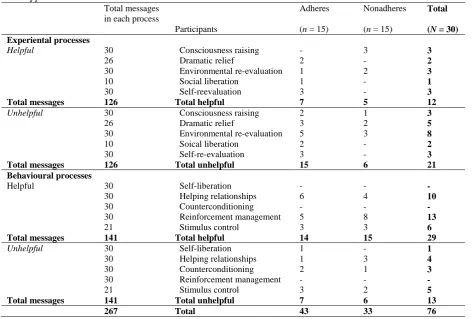
During the interview the assessed messages of each participant were shown. Table 12 shows the frequency of the
named messages aligned to the ten processes by adheres and nonadheres of the Motiapp. The processes are
[image:14.595.64.539.403.722.2]divided in helpful and unhelpful.
Table 12
The frequency of the named messages aligned to the ten processes by the adheres and nonadheres of the Motiapp
Total messages in each process
Adheres Nonadheres Total
Participants (n = 15) (n = 15) (N = 30)
Experiental processes
Helpful 30 Consciousness raising - 3 3
26 Dramatic relief 2 - 2
30 Environmental re-evaluation 1 2 3
10 Social liberation 1 - 1
30 Self-reevaluation 3 - 3
Total messages 126 Total helpful 7 5 12
Unhelpful 30 Consciousness raising 2 1 3
26 Dramatic relief 3 2 5
30 Environmental re-evaluation 5 3 8
10 Soical liberation 2 - 2
30 Self-re-evaluation 3 - 3
Total messages 126 Total unhelpful 15 6 21
Behavioural processes
Helpful 30 Self-liberation - - -
30 Helping relationships 6 4 10
30 Counterconditioning - - -
30 Reinforcement management 5 8 13
21 Stimulus control 3 3 6
Total messages 141 Total helpful 14 15 29
Unhelpful 30 Self-liberation 1 - 1
30 Helping relationships 1 3 4
30 Counterconditioning 2 1 3
30 Reinforcement management - - -
21 Stimulus control 3 2 5
Total messages 141 Total unhelpful 7 6 13
15 The participants indicated the experiential processes twelve times as a helpful process. The participants indicated
consciousness raising three times, dramatic relief twice, environmental re-evaluation three times, social
liberation once and self-re-evaluation three times as a helpful process.
The participants indicated the experiential processes twenty-one times as an unhelpful process. Eight
participants indicated environmental re-evaluation as an unhelpful process. The participants indicated messages,
such as ‘be healthy for your family’,’ you are doing this for your friends and family as much as for yourself and
your friends’ and ‘your family wants you to be around’. The participants perceived these messages as not
motivating and not personal, because the participants did not exercise for other people. The participants only
exercise for themselves. Five participants indicated dramatic relief as an unhelpful process. The participants
indicated messages, such as ‘you may find it more difficult to exercise as you get older’, ‘start working out
before it is too late’ and ‘you are not getting any younger’. The participants perceived these messages as pedantic
and not motivating. This is illustrated by,
‘I found ‘seven years younger or live less than active persons’ not motivating. It felt if I was in
elementary school again (P15)’.
The participants indicated the behavioural processes twenty-nine times as a helpful process. Ten
participants indicated helping relationships as a helpful process. The participants indicated messages such as,
‘sport with friends’, ‘I know how hard it is to find time to exercise’ and ‘get your friends to work out with you’.
The participants perceived these messages as relevant and personal, because friends do make it easier to
exercise. In addition, thirteen participants indicated reinforcement management as a helpful process. The
participants indicated messages, such as ‘you are doing great’, ‘keep up the good work’ and ‘be proud of your
accomplishments’. The participants perceived these messages as a compliment, motivating and a confirmation to
their behaviour. The participants indicated stimulus control six times as a helpful process.
The Participants indicated the behavioural processes thirteen times as an unhelpful process. The
participants indicated self-liberation once, helping relationships four times and counterconditioning three times.
In addition, the participants indicated five times stimulus control as an unhelpful process. The participants
indicated messages, such as ‘get up and get going, no excuses’ and ‘go do something’. The participants
perceived these messages as not personal and aggressive. This is illustrated by,
‘With the messages such as ‘get up and get going, no excuses’, I thought calm down, don’t be so
aggressive. The messages really forced itself on me (P3)’ .
In general the experiential processes are indicated more unhelpful than helpful and the behavioural
processes are indicated more helpful than unhelpful. The adheres indicated more messages than the nonadheres.
Furthermore, there are no noticeable difference between the adheres and nonadheres of the Motiapp.
Interim summary
In general, the behavioural processes are perceived as more helpful and the experiential processes are perceived
as more unhelpful. Moreover, the behavioural processes are indicated more often than the experiential processes.
Helpful processes are helping relationships, reinforcement management, stimulus control (behavioural
processes) and consciousness raising (experiential processes). Unhelpful processes are environmental
re-evaluation and dramatic relief (experiential processes). The adheres indicated more messages than the
16 3.4 Perceived experiences of the Motiapp in general
The perceived experiences of the Motiapp in general, by adheres (n = 15) and nonadheres (n = 15) of the
Motiapp can be divided into perceived ease of use and the perceived usefulness.
[image:16.595.65.533.246.505.2]3.4.1 Perceived ease of use
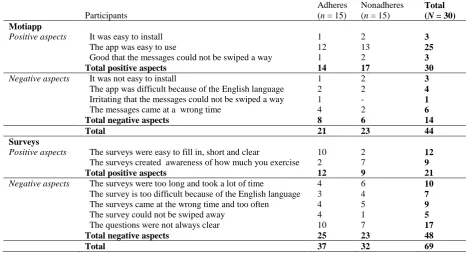
Table 6 shows the aspects of the perceived ease of use of the Motiapp in general and the surveys by adheres and
nonadheres of the Motiapp. Participants mentioned multiple aspects about the ease of use of the Motiapp in
[image:16.595.62.529.251.505.2]general and the surveys. The perceived aspects can be divided in positive and negative.
Table 6
Aspects of the perceived ease of use of the Motiapp in general and the surveys by adheres and nonadheres of the Motiapp
Adheres Nonadheres Total
Participants (n = 15) (n = 15) (N = 30)
Motiapp
Positive aspects It was easy to install 1 2 3
The app was easy to use 12 13 25
Good that the messages could not be swiped a way 1 2 3
Total positive aspects 14 17 30
Negative aspects It was not easy to install 1 2 3
The app was difficult because of the English language 2 2 4
Irritating that the messages could not be swiped a way 1 - 1
The messages came at a wrong time 4 2 6
Total negative aspects 8 6 14
Total 21 23 44
Surveys
Positive aspects The surveys were easy to fill in, short and clear 10 2 12
The surveys created awareness of how much you exercise 2 7 9
Total positive aspects 12 9 21
Negative aspects The surveys were too long and took a lot of time 4 6 10
The survey is too difficult because of the English language 3 4 7
The surveys came at the wrong time and too often 4 5 9
The survey could not be swiped away 4 1 5
The questions were not always clear 10 7 17
Total negative aspects 25 23 48
Total 37 32 69
Positive aspects mentioned by the participants were that the application in general was easy to install, easy to use
and it was good that you could swipe the messages away. The majority (n = 25) indicated that the application
was easy to use, because the messages just pop-up, you did not have to open the application to receive a message
and you only had to click on motivating or not motivating. This is illustrated by, ‘You did not have to open the
application every time, you could just easily click if it was motivating or not (P18)’.
Negative aspects mentioned by the participants were that the application in general was not easy to
install, difficult because of the English language, irritating because the messages could not be swiped away and
the messages came at the wrong time. Six participants indicated that the messages came at the wrong time. They
found the messages at six o’clock too rigid. This is illustrated by,
’Unfortunately you could not set the time for the messages. For me there are certain times where it
would be more relevant to get a messages, for example in the morning (P27)’.
Overall, the participants were more positive than negative about the application in general. Furthermore, there
are no noticeable difference between the adheres and nonadheres of the Motiapp.
Positive aspects mentioned about the surveys were that the survey was easy to fill in, short and clear and
17 illustrated by, ‘Every survey was the same. At a given moment you know what you have to fill in. You still read it,
but you did not have to think about it (P4)’. Nine participants indicated that the surveys created awareness. This
is illustrated by, ‘Normally I am not aware of how much I exercise, but with this survey you could indicate
whether you were exercising enough or not (P2)’.
Negative aspects mentioned about the surveys were that the surveys were too long, took a lot of time,
were difficult because of the English language, came at the wrong time, too often, could not be swiped away and
the questions were difficult. The majority (n = 17) indicated that the questions in the survey were not always
clear. The participants found it difficult to make a distinction between the terms heavy-, mild- and light exercise
and the response scales were vague. This is illustrated by,
‘It was hard to decide what kind of athlete you were, heavy, mild or light. For example I race the bike,
that is heavy, but I also cycle to school is that heavy too?(P22)’.
Ten participants indicated that the surveys were too long and took a lot of time. Moreover, nine participants
indicated that the surveys came at the wrong time and too often.
The adheres were positive about the aspects that the survey was short, clear and easy to fill in, while the
nonadheres were more positive about the awareness the surveys created. Furthermore, there are no noticeable
difference between the adheres and nonadheres. In general the surveys were experienced more negatively.
3.4.2 Perceived usefulness
The perceived usefulness can be divided into the self-reported reasons why the Motiapp had a positive effect, no
effect and a negative effect.
Positive effect
[image:17.595.72.519.505.769.2]Table 7 shows the self-reported positive reasons why the Motiapp had a positive effect by adheres and nonadheres of the Motiapp. Participants mentioned multiple reasons for the positive effect of the application.
Table 7
The reasons for the perceived usefulness, divided in a positive effect, no effect and negative effect by the adheres and nonadheres of the Motiapp
Adheres Nonadheres Total
Participants (n = 15) (n = 15) (N = 30)
Positive effect 9 7 16
Positive reasons The messages were a confirmation 2 2 4
The messages were a reminder to exercise 5 4 9
The messages created awareness 4 - 4
Started exercising more 2 2 4
It stimulated to continue my own exercise scheme 2 1 3
Total positive reasons 15 9 24
No effect 5 8 13
Positive reasons The messages were a confirmation 1 5 6
The messages were a reminder to exercise 2 - 2
The messages created awareness - 1 1
The effect of the messages depends on the moment of reception
- 2 2
Exercise already at regular times 2 4 6
Total positive reasons 5 12 17
Negative reasons The messages came at the wrong time 2 1 3
The messages had no meaningful content 2 1 3
Not started exercising more 2 3 5
Total negative reasons 6 5 11
Total 11 17 28
Negative effect 1 - 1
Negative reason The messages were irritating 1 - 1
18 More than half (n = 16) of the total number of participants indicated that the Motiapp had a positive effect.
Participants indicated that the Motiapp had a positive effect, because the messages were a confirmation, the
messages were a reminder, the messages created awareness, participants started exercising more, and were
stimulated to continue their exercise scheme. The majority (n = 9) indicated that the messages worked as a
reminder to exercise. This is illustrated by,
‘Often you do want to exercise, but you forget it. However, when you received a message like, ‘you are
doing well, but you can do more’, you are remembered to go exercise (P10)’.
Nine adheres and seven nonadheres indicated that the application had a positive effect. Both indicated a
positive effect, because the messages reminded the participants to exercise. The adheres indicated also that the
messages created awareness. Furthermore, there are no noticeable differences between the adheres and
nonadheres of the Motiapp.
No effect
Table 7 shows the self-reported reasons why the Motiapp had no effect by adheres and nonadheres of the
Motiapp. The participants mentioned multiple reasons why the Motiapp did not work for them. These reasons
can be divided into positive and negative. More than a third (n = 13) of the total number of participants indicated
that the Motiapp had no effect. Positive reasons the participants indicated were the messages were a
confirmation, the messages were a reminder, the messages created awareness, the effect of the messages depends
on the moment of reception and the participants already exercise at regular times. Almost half (n = 6) of the
participants indicated that the messages were a confirmation to their own exercise behaviour. This is illustrated
by,
‘I found the messages the most motivating when you already had plans to exercise or when you already
exercised. Then I thought, yes I am indeed doing good (P6)’.
Six participants indicated that they already exercise at regular times. For example in team sports, like football.
Negative reasons for the lack of effectiveness of the Motiapp were that the messages came at the wrong
time, the messages had no meaningful content and the participants did not start exercising more.
Five adheres and eight nonadheres indicated that the Motiapp had no effect. The nonadheres indicated
more positive reasons than the adheres. Furthermore, there are no noticeable differences between the adheres and
nonadheres of the Motiapp.
Negative effect
Table 7 shows the self-reported reasons why the Motiapp had a negative effect by adheres and nonadheres of the
Motiapp. One adhere, of the total number of participants (N = 30) indicated that the application had a negative
effect. This negative effect is caused by the participants injury. The participant was not able to exercise during
the use of the app. The messages were perceived as irritating. This is illustrated by,
‘It brought another effect with it than desired, it did not cause motivation but irritation.
Getting every time again and again a message and I could not do anything. It felt like
19 Interim summary
Sixteen participants of the total number of participants (N = 30) indicated that the Motiapp had a positive effect.
Adheres and nonadheres indicated the following reasons. The messages were a confirmation, the messages were
a reminder and participants started exercising more. Thirteen participants of the total number of participants (N =
30) indicated that the Motiapp had no effect. Despite no effect the nonadheres showed more positive reasons for
the perceived usefulness of the Motiapp. One participant indicated that the Motiapp had a negative effect, due to
the fact the participant was injured and could not exercise.
3.5 Potential use
The potential use of the Motiapp, by adheres (n = 15) and nonadheres (n = 15) of the Motiapp, can be divided
into the intention to reuse, recommendations and improvements for the Motiapp.
3.5.1 Intention to reuse and recommendations
Table 13 shows the intentions to reuse and the recommendations of the Motiapp by adheres and nonadheres of
[image:19.595.64.513.356.440.2]the Motiapp.
Table 13
Intentions to reuse and recommendations of the Motiapp by adheres and nonadheres of the Motiapp
Adheres Nonadheres Total
Participants (n = 15) (n = 15) (N = 30)
Intention to reuse
Yes 4 4 8
No 11 11 22
Recommend the motiapp Yes
No
10 5
9 6
19 11
Almost a third of the participants indicated to reuse the Motiapp. Those participants indicated to reuse the
Motiapp if the application got improved. Two third of the participants indicated not to reuse the Motiapp.
Reasons for not reusing the Motiapp are the following. Participants did not get motivated by applications. There
are no results, this is illustrated by, ‘I did not have the feeling that it was motivating or that it helped me to
exercise more (P3)’. The application did not work properly, this is illustrated by, ‘I did not get the messages. I
had to go to the application to get a message (P22)’.
Nevertheless, two third of the participants would recommended the Motiapp to others. The participants
would recommended the Motiapp to people who do not exercise, have no motivation to exercise, forget to
exercise or have weight problems. This illustrated by, ‘I think I would recommend the app specific to people who
forget or find it hard to exercise (P18)’. One third of the participants would not recommended the Motiapp.
Reasons for not recommending the Motiapp are the following. The application did not succeed for themselves
and the participants prefer a more comprehensive application. This is illustrated by,
‘To gain insight in your own activities is missing in this app. I think this is a very essential aspect of
an application, because it makes it more personal and possibly makes you more aware of your
movement pattern (P27)’.