Hedonic Capital
Liam Graham and Andrew J. Oswald
No 745
WARWICK ECONOMIC RESEARCH PAPERS
Hedonic Capital
Liam Graham University College London
and
Andrew J Oswald University of Warwick
April 2006
Abstract
This paper proposes a new way to think about happiness. It distinguishes between stocks and flows. Central to the analysis is a concept we call ‘hedonic capital’. The paper sets out a model of the dynamics of wellbeing in which bad life-shocks are smoothed by the drawing down of hedonic capital. The model fits the patterns found in the empirical literature: the existence of a stable level of wellbeing and a tendency to return gradually towards that level. It offers a theory of hedonic adaptation.
Keywords: Adaptation; wellbeing; evolution; happiness; habituation.
JEL codes: D1, I3.
Hedonic Capital
1. Introduction
Movements in wellbeing seem to exhibit a form of mean-reversion. Human beings
recover from bad life events and get used to good ones. This phenomenon is
sometimes referred to as habituation or hedonic adaptation.
Why is it that human beings can spring back indomitably from disability and other
adversity? How can winning a large sum of money in a lottery lead to little extra
wellbeing? Anecdotal reports of such facts are commonplace. In recent years, formal
evidence for the existence of hedonic adaptation has begun to grow. A recent
conceptual and empirical literature1 now includes Frederick and Loewenstein (1999),
Clark (1999), Argyle 2001, Di Tella et al (2001, 2003), Wu (2001), Menzel et al
(2002), Easterlin (2003), (2005a, b), Lucas (2005), Lucas et al (2003, 2004), Rayo and
Becker (2004), Clark et al (2004), Di Tella, Haisken and MacCulloch (2005), Dolan
and Kahneman (2005), Keely (2005), Oswald and Powdthavee (2005), Wilson and
Gilbert (2005), Kahneman and Sugden (2005), Lyubomirsky, King and Diener
(2005), Lyubomirsky, Sheldon and Schkade (2005), Ubel et al (2005), Weinzierl
(2005), and Gardner and Oswald (2006). An early exposition was provided by
Duesenberry (1949).
Adaptive behavior creates difficulties for economic theory. Economists are familiar
with the idea that the marginal utility from something declines as it is consumed more
heavily. They are unused, however, to the notion that the sheer passing of time might
alter people’s utility. In contrast to its centrality in psychology textbooks, almost no
attention is paid to adaptation in current economics textbooks. This attitude among
economists is partly because most are unaware of the accumulated evidence in
applied-psychology journals. But it is partly deeper. It is because economists find
unsatisfying the notion that, for unspecified reasons, human beings have a reference
level that depends on current experience. In the adaptation literature, the presumption
1 There is a related literature on other kinds of comparisons. Recent research includes Burchardt
has been that happiness is given by a utility function u = u(x – x*), where x might be a
variable like income or health, and x* is some comparison or past reference level that
automatically follows the actual level of x. The gap x-x* responds endogenously --
and in this way better income or health can slowly cease to give extra utility. Such a
model of adaptive behavior, many economic theorists would argue, is uninteresting.
First, it does not go beyond a restating of the observation to be understood. Second, it
gives no account of the richness of individual behavior in response to shocks.
This paper suggests a way to think about adaptation. It constructs a model of an
individual’s psychological structure. It then shows that the framework can replicate
the observed mean-reversion of wellbeing. The model achieves this by using
methodological principles that are familiar to economists and without invoking an
endogenous reference level. As in the innovative work of Robson (1996, 2001), we
view behavior as moulded by biology and nature. More broadly, our work falls
within an emerging area of research at the border between the disciplines of
psychology and economics (see, for example, Kahneman, Wakker and Sarin (1997)
and Kahneman 2003).
At the heart of the formal modelling is a simple idea: to understand wellbeing it is
valuable to distinguish between stocks and flows. Although it seems natural to view
happiness as a flow variable, there is agreement in the literature that some of the
important determinants of wellbeing have the nature of stocks. For example, Carr
(2004) writes
"people with large social support networks and stronger social bonds with
members of their networks have better physical and mental health, fewer
illnesses and less depression, recover more rapidly from physical illness
and psychological problems, and have a lower risk of death."
We propose a new concept, hedonic capital. Later sections denote this by the symbol
k. We view k as the stock of coping resources available to an individual. When
negative utility shocks hit individuals, they draw upon their k. We leave unspecified
its exact empirical foundations. Significant social relationships with friends and
include health (some stock aspects of which are discussed by Grossman (1999)),
self-esteem, status, and meaningful work. For some people, religious faith may also play a
part. These things are stocks in that they rely on past inputs and are carried across
time periods.
Hedonic capital is to be thought of as the psychological equivalent to the physical
capital used by firms. Just as machines produce output, hedonic capital produces a
flow of hedonic resources which might be termed hedonic energy. We posit that this
energy can be used either (i) to generate wellbeing today or (ii) to invest in hedonic
capital to produce wellbeing in the future. Hedonic capital ties together the present
and the future.
A machine that makes baked-bean cans depreciates as time passes. So, in our model,
does hedonic capital. To keep the level of hedonic capital constant, human beings
have to invest some of their mental resources in order to maintain their stock of
hedonic capital.
Using a formal description of such a psychological structure, which the paper presents
in a mathematical form, we show how evolution would rationally ‘design’ an
individual to respond adaptively to life events. Our focus is on the limiting outcome
of evolution, namely, the individual decision rules that are optimal from an
evolutionary standpoint. The paper shows that an individual so designed would:
• use hedonic capital to smooth2 the response of wellbeing to life events
• exhibit a steady-state level of wellbeing
• display adaptive behavior in response to shocks to permanent changes in
the stock of hedonic capital.
The formal analysis also suggests, first, that the lower is the level of hedonic capital
the more volatile is an individual’s wellbeing level and, second, that those with low
hedonic capital find it more difficult to recover from negative events.
The paper takes the modelling task to be to understand how human beings have come
to be hedonic adapters. It does not assume that a particular man or woman chooses to
adapt. For the person, adaptation is instinctive. Nature is the rational decision-maker
and has chosen it for human beings.
In the model developed below, happiness can be thought of as the return on hedonic
capital. This interpretation is usefully evocative. Nevertheless, such an interpretation
needs to be treated cautiously. A more accurate statement, which is explained with
the later algebra, is that some of the return on hedonic capital will be taken in the form
of current happiness while the remainder is invested to produce wellbeing in later
periods.
2. Adaptation in the Literature
Although it is not easy to explain why there is such a divide over adaptation between
economists and psychologists, Oswald and Powdthavee (2005) suggest two possible
reasons. First, the early empirical evidence was viewed by economists as debatable.
One of the literature’s most-quoted papers, for instance, is Brickman et al (1978). It is
sometimes claimed in the literature that these authors prove that lottery winners are no
happier than non-winners and paraplegics are as happy as able-bodied individuals.
On closer inspection, Brickman et al (1978) actually report data in which disabled
people do have lower life-satisfaction scores than the able-bodied, and this difference,
when compared to a control group, is statistically significant at conventional levels.
Moreover, lottery winners do have higher life-satisfaction scores than the controls,
although the null hypothesis of no difference cannot be rejected at the 5% level.
Second, one part of the psychology literature proposes the so-called ‘set point
hypothesis’, which is the idea that people adapt completely to life shocks. Rightly or
wrongly, economists view this position -- that utility effectively cannot be altered by
outside events -- as sufficiently implausible that they have been loathe to give
The paper by Frederick and Loewenstein (1999) is one of the most lucid introductions
to hedonic adaptation. Another term used in the literature is ‘affective adaptation’,
which, following Wilson and Gilbert’s (2005) definition, is where affective responses
weaken after one or more exposures to a stimulus. A valuable discussion, with
examples, is given in Lucas et al (2003). Earlier evidence is discussed in Argyle
(2001) and Diener et al (1999). Easterlin (2003, 2005a, b) argues that adaptation is
generally incomplete, namely, that people do not merely automatically bounce back to
a baseline level of happiness. Clark and Oswald (1994) find some evidence of partial
adaptation by the long-term unemployed. Adaptation is also discussed in the
overviews by Oswald (1997), Diener et al (1999), Frey and Stutzer (2002a, b), Van
Praag and Ferrer-I-Carbonell (2004) and Layard (2005).
A recent paper by Di Tella, Haisken and MacCulloch (2005) has provided more
evidence. Using individual panel data on 8000 people living in Germany from 1984
to 2000, the authors estimate the size of the effect on happiness of adaptation to
income and to status. They cannot reject the null hypothesis that people adapt totally
to income after four years. By comparison, significant status effects remain after this
time. In the short-run (the current year), a one standard deviation increase in status is
associated with a similar increase in happiness to an increase of 50% of a standard
deviation in income. In the long run (the past four years), a one standard deviation
increase in status has a similar effect to an increase of more than 300% of a standard
deviation in income.
In important theoretical contributions, Rayo and Becker (2004) and Wilson and
Gilbert (2005) consider why and how human beings adapt. The first of these, by
economists, likens hedonic adaptation to the ability of the eye to adjust -- for reasons
of self-preservation -- to changes in the amount of light. Rayo and Becker set out a
mathematical model of how Nature might, in the underlying spirit of Robson (2002),
have designed human beings’ emotional responses to behave a similar way. Rayo and
Becker see happiness as a kind of innately adaptive measuring rod. The second paper,
by psychologists, thinks of individuals as learning to change what they actually attend
to and how they react. Wilson and Gilbert suggest that hedonic adaptation is not
sensory or motor systems. The authors argue that affective habituation is provoked
by something else. It stems, instead, from the need and ability that humans have to
make sense of the stimuli around them. Wilson and Gilbert lay out an AREA model
-- attend; react; explain; adapt ---- to explain habituation.
Further evidence is offered by Riis et al (2005). These authors report remarkable
evidence consistent with the phenomenon of adaptation. Using an ecological
momentary-assessment measure of mood, the authors find that, despite their
apparently impaired lives, hemodialysis patients are no less happy than healthy
people. The authors suggest that patients in the sample have largely adapted to their
condition; they show that, in a forecasting task, healthy people fail to anticipate this
bounce-back in wellbeing. Affective forecasting is known to be imperfect (Gilbert et
al 1998, 2002; Ubel et al 2005). Other investigators, such as Clark (1999), Clark et al
(2004), Stutzer (2004) and Layard (2005), have begun to accumulate evidence and to
consider the economic implications of how people adapt. Kahneman and Sugden
(2005) discuss the policy implications of allowing for adaptation in experienced
utility. Di Tella, MacCulloch and Oswald (2001, 2003) study adaptation of national
happiness to movements in real income. By estimating dynamic equations, they find
evidence that the wellbeing consequences of shocks to gross domestic product
eventually wear off. They suggest a way to use difference equations to solve out for a
steady-state level of habituation. Conceptually and mathematically, the adaptation
literature might be seen as related to writings on habit formation, such as Carroll
(2001), Carroll et al (2000) and Carroll and Weil (1994), and, more broadly, to new
research on preferences such as Frey and Meier (2004).
Three building blocks lie behind the paper’s proposed framework. One is the
distinction between stocks and flows; a second is the concept of a production function
for happiness; a third is the notion of investment in hedonic capital. Although
unfamiliar to economists, antecedents of each can be found in the psychological
literature.
Headey and Wearing (1991) point to the difference between stocks and flows -- with
stocks arising, in their view, from “stable personality characteristics” and flows from
levels of a person’s wellbeing. Heading and Wearing also discuss the need for a
dynamic equilibrium model in which
“each person is regarded as having ’normal’ equilibrium levels of life
events and SWB, predictable on the basis of age and personality. Only
when events deviate from their equilibrium levels does SWB change.
Unusually favourable events enhance SWB; unusually adverse events
depress it.”
In this vein, a component of our model is a production function which explains how
hedonic capital produces wellbeing. Ormel et al (1999) describe the mechanism by
which wellbeing is generated. They use a social production function, taking the
inputs to be a range of personality characteristics and life events, and the output to be
wellbeing, and suggest, as we later do, that there are diminishing marginal return to
the inputs. Ormel et al also have a concept of emotional investment: they make a
distinction between activities that immediately satisfy a goal and those which increase
potential for future production.
3. The Model
This section provides a formal model of a person’s psychological structure and
describes how, in an uncertain world, evolution might optimally design the
individual’s response to emotional shocks. Assume that a human being begins with a
given level of psychological coping resources. This stock is hedonic capital3.
Hedonic resources can be used in two ways. They can be taken as happiness today or
invested in hedonic capital to produce greater wellbeing tomorrow. By assumption in
our framework, an increasing and concave function captures how hedonic capital is
used to produce happiness.
Let k represent hedonic capital. Define y, which might be called hedonic energy, as a
Define a variable v to capture random life-events. We assume that returns to hedonic
capital are diminishing, i.e. 0 < < 1. A parameter z represents different individual
types. For simplicity, the production function of hedonic energy is assumed to take a
constant-elasticity form:
t t t
y =zkα +v . (1)
The principal ideas go through in more general settings.
The flow of hedonic energy y in period t can be used by an individual in alternative
ways. One is directly to produce wellbeing, h, this period (i.e. to make the individual
happy). The other use is in the form of an investment activity, denoted now by i.
Such activities involve forgoing some wellbeing in order to increase the stock of
hedonic capital in the future.
The emotional budget equation is:
t t t
y = +h i (2)
which is an accounting relation. Finally, investment of hedonic energy leads to an
increase in the stock of k, while depreciation reduces that stock. Assume that hedonic
capital depreciates at rate . Then its law of motion is described by the equation:
(
)
1 1
t t t t
k+ = −δ k + +i ω (3)
where is a white-noise shock. These three equations provide a compressed
description of a human being’s psychological structure.
We are interested in the possible existence of a set of hard-wired behavioural rules
that might emerge from a Darwinian-like process. These are to be thought of as the
3 Another name for hedonic capital might be emotional capital. This term is occasionally used,
solution to a principal-agent problem in which the principal, ‘Nature’, corresponds to
the process of evolution. Nature shapes the characteristics of the individual.
Why should the wellbeing of an individual matter to evolution? We posit a positive
link between happiness and reproductive success. Mental health is just as important
to successful reproduction as physical health. There is a wide literature on the
connection between wellbeing and a range of variables related to the ability to leave
large numbers of offspring. Lyubomirsky et al (2005) assert a causal relation between
wellbeing and a range of positive individual characteristics. Segerstrom and Miller
(2004) show that stress is associated with a suppressed immune system. A review of
much of the medical and psychological evidence is given in Wilson and Oswald
(2005).
Assume that miserable agents breed less. This might be justified in a number of
ways, but a natural one is that unhappy agents put little weight on their own safety
and hence die more often. The risk of a low breeding rate is acute at extremely low
levels of happiness (the limiting case being complete disregard for safety, or suicide),
so that, for efficiency reasons, Nature will put particular weight on avoiding severe
unhappiness. There are also lower and upper limits to the number of offspring an
individual can have. To capture these ideas in a simple way, we assume that Nature
can be thought of as having concave preferences.
Given the complexity of an individual’s psychic make-up (the many different factors
which contribute to its hedonic capital), the individual has an informational advantage
over the evolutionary process. Rather than specify the detailed decision rules
governing each source of wellbeing, and each possible type of shock, the principal
chooses a set of decision rules for aggregate measured wellbeing. Then the principal
leaves the agent -- who is better informed -- to act given these background rules.
Evolution thus moulds the background characteristics of human beings; individual
agents make day-to-day decisions.
Nature’s objective is the maximization of a concave function of individual wellbeing
{ } 0 0
( )
max ln
t t
t i h i
E h
∞ =
∞ + =
∑
(4)where E is the expectations operator. This maximization4 is subject to the constraints
imposed by the psychological structure of the individual, described above by
equations (1) to (3). The assumption of logarithmic preferences for Nature is for
simplicity; it can easily be generalized.
4. Solving the Model
We can write Nature’s maximization problem in standard dynamic programming
language as a choice of the current level of hedonic capital, k, conditional on an
optimal choice of next period’s hedonic capital (denoted by a prime on k), where
( )
, max ln 1'{
(
)
'(
', ')
}
k
V k v = −δ k+zkα + −v k +βEV k v (5)
in which the term in square brackets is the current level of happiness as a function of
today’s k and tomorrow’s k.
The first-order condition, an Euler equation, is
1 1
' '
Er
h =β h (6)
where
(
)
11
r= − +δ αzkα− (7)
At the margin, there is a choice between taking an extra unit of hedonic energy as
happiness today or investing it to produce happiness tomorrow. The left-hand side of
the Euler equation is, given our assumption of logarithmic utility, the marginal benefit
of the extra unit of happiness in the present period. The right hand side of equation
(7) is the marginal benefit of the happiness tomorrow that would be gained from
units of hedonic energy tomorrow, comprising the hedonic energy produced from that
unit, αzkα−1 and the un-depreciated part of the unit, 1−δ. To convert this from units
of hedonic energy into utility terms, it is weighted by the marginal utility of happiness
tomorrow.
It is useful to have a benchmark. Hence consider a steady-state with no events, so
v=0. In such a steady-state, we can show5 that the level of hedonic capital is constant
and given by:
1 1
z
k α α
δ
−
=
(8)
where this steady-state level of hedonic capital depends, of course, on the underlying
parameters of the system. It is an increasing function of z, the efficiency with which
hedonic capital is used. It is a decreasing function of , the rate at which hedonic
capital depreciates.
Here the parameter z is a feature of individuals’ psychological make-up6. The
parameter plays the role of indexing idiosyncratic characteristics, and it abstracts from
the complex interaction of genetic and developmental factors which produces “happy”
individuals (with high z) or unhappy ones (with low z). We do not investigate what
determines z. Instead, the paper later examines how individuals’ response to
emotional shocks can differ with high or low values of z.
The parameter is the rate at which hedonic capital depreciates. This combines
features of an individual’s make-up (perhaps how good they are at sustaining
4 The choice of a unit discount factor might seem special. However, we are describing evolution’s
problem, not an individual’s. It is not possible to be sure if the evolutionary process discounts the future.
5 In a steady state with constant well-being, equation (6) implies β
r = 1. Using this in equation (7), and rearranging, gives (8).
6 Will the psychological structure described by equations (1) to (3) be optimal from the point of view
relationships) with features of society. In a society with strong community
attachment and low geographical mobility, hedonic capital might depreciate at a lower
rate. In a fragmented and highly mobile society, it might be more difficult to maintain
attachments. Then hedonic capital will decay more quickly.
Because hedonic capital depreciates, it will be optimal in this model for the individual
to use some of the hedonic energy to maintain the stock of hedonic capital. So the
steadystate is also characterised by a constant level of investment in hedonic capital
-- at a level just enough to keep the level stable and make up for depreciation. These
maintenance activities might be viewed as representing the energy put into, say,
keeping up friendships and relationships.
The steady-state level of hedonic capital, when combined with the production
function, (1), gives a steady-state level of wellbeing:
a
h=zk −δk (9)
Equation (9) conveys the paper’s first finding. The model produces a steady-state in
which happiness and hedonic capital are constant. In this sense, the model’s
assumptions lead to the “set-points” commonly described in the psychological
literature (e.g., in Diener et al 1999).
Our characterisation of the emotional steady-state can be used to throw light on a
widely cited empirical observation -- the so-called Easterlin paradox. This is the
finding that, while GDP in the West has increased dramatically over the last 50 years,
measured wellbeing has remained roughly constant. See, for example, Easterlin
(1974) and, on modern data, Blanchflower and Oswald (2004).
A number of points emerge. First, there is no direct relation between income and
wellbeing in our model. Some consequences of increasing GDP, such as
widely-available health-care, better education and insurance, might lead to the parameter z
increasing between different generations of individuals. This would tend to increase
the steady-state level of wellbeing with time. However, if the growth in GDP is
accompanied by an increasing rate of depreciation of hedonic capital -- such as higher
mobility and the breakdown of traditional communities and roles -- this could offset
the increase in a. Then the net movement of wellbeing would be determined by the
relative magnitude of the two effects.
The preceding section characterised an individual’s psychological steady-state in
terms of the underlying parameters of the model. We think of this psychological
steady-state as being perturbed by shocks. These shocks represent events which
affect the emotional state of an individual.
There are two channels, in this model, through which external events influence the
individual. The first is a one-off change in the level of a person’s hedonic capital (
in equation (3)) . Unemployment, divorce and disability are in this category. The
second channel is a temporary event which has no direct effect on the level of hedonic
capital but requires some psychic resources ( in equation (1)). Such events might be
a temporary illness of the individual or someone close to them. Real-world events
will, of course, often be a combination of these two types, but for clarity we analyse
them in isolation. The following sections describe how an individual who has been
optimally hard-wired by evolution would respond. In reality, life events can often be
anticipated, either because they depend partly on an individual’s behavior, or because
the individual can form expectations about the future, which means that wellbeing
changes before the event. In what follows, however, we assume for simplicity that
the events are exogenous and random.
In this framework, human beings differ along various dimensions. As explained, an
individual type is indexed by three parameters: , the rate at which hedonic capital
depreciates; , the degree of diminishing returns to hedonic capital; and z.7 Different
values of these parameters are to be thought of as describing different types of people.
The only effect of z is to change the steady-state levels of the variables. As long as
shocks are small relative to the steady-state, z does not affect the model’s dynamics.
We choose the two remaining parameters so that the impulse responses produced by
our model replicate the known data as closely as possible. Nevertheless, it is useful to
bear in mind that current empirical studies do not have enough data points to make
such choices completely reliable. Wellbeing in, say, the time-series plots of Gardner
and Oswald (2006) appears to have a half-life of approximately one year (i.e. it takes
a year for the level of wellbeing to decay to half of its value on impact). Taking the
base time period to be a month, our model replicates this with =0.5 and =8%. That
value for parameter means that 8% of an individual’s hedonic capital will decay
each month. In other words, without investment, roughly two-thirds of the stock of
hedonic capital will have been lost after a year. This may seem high, particularly in
comparison with physical capital. But it represents an extreme case: a complete lack
of investment in hedonic capital would imply an absence both of interaction with
other people and of meaningful activity. Solitary confinement in prison would be one
extreme example.
It is necessary to specify a process for the stochastic variable which describes the path
of life events. It is here assumed that shocks are random but persistent, and follow a
first-order autoregressive process
1
t t t
v =ρv− +ε (10)
where is a number between zero and one, and is a white-noise shock. The value of
does not affect our qualitative conclusions, so for simplicity we set it to 0.5.
5. Sketching the Time Paths of Happiness h and Hedonic Capital k after Negative and
Positive Shocks
What does this model predict about dynamics?
7 There are two other parameters relating to the evolutionary process. The first, nature’s discount
Negative shocks to life come in two forms here. Each induces adaptive behavior,
although of slightly different kinds. The time paths, derived from numerical solution,
are depicted in Figures 1 and 2.
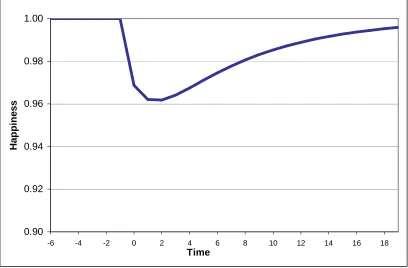
Figure 1 sets out what happens in our optimization model to the trajectory of
happiness -- first falling and then bouncing back upwards -- after a fall in the level of
hedonic capital. In this case what is being studied is the impact of an abrupt life-event
which destroys part of an individual’s k, a negative innovation to in equation (3).
Potential examples of such an event might be divorce, disability or unemployment.
The Figure mimics the adaptive pattern observed in empirical research.
The shock in Figure 1 is modelled as a one unit fall in the level of hedonic capital at
time t = 0. The baseline level of happiness, set to 1.00 for clarity, represents the
steady-state. In the Figure, there is only one external influence on the individual.
Everything else is determined by the individual’s hard-wired decision rules.
Happiness therefore adapts. It returns asymptotically to its starting point. Step by
step, the mechanics are as follows:
1. The reduction in hedonic capital means:
(a) the marginal return to investing in new hedonic capital increases
(b) the level of hedonic energy available to the individual decreases.
2. When deciding to allocate the lower level of hedonic energy between
wellbeing and investment, the proportion devoted to investment rises. This is
because of the higher marginal return.
3. So wellbeing falls by proportionally more than it would were investment
constant, but hedonic capital increases. Current-period wellbeing is foregone
for future wellbeing.
4. In the next period, hedonic capital is higher than on impact, but still below the
return, and hence investment, falling, but still being above the steady-state.
This continues in each period until all the variables are back at their
steady-state.
How might this process be conceptualized? Life has worsened. This individual has
lost part of his or her hedonic resources. As a result, the individual puts energy into
building up new resources to restore the lost hedonic capital. Taking disability as an
example, he or she forgoes some parts of the hedonic capital associated with physical
ability. In response, hedonic resources are diverted into re-constructing the lost
capital.
Not all of life’s blows are permanent. As illustrated in Figure 2, it is straightforward
to use the framework to study the effect of a life-event which temporarily requires
some of the individual’s hedonic energy, but has no long-run effects, a negative
innovation to in equation (10). An example might be a short-run illness of someone
close to the individual. After such a temporary shock, wellbeing will again deviate
from the steady-state, but the path of wellbeing in Figure 2 is much smoother than the
path of the shock.
Technically, Figure 2 models a one-off negative event that slowly decreases in size
over time. If hedonic capital was constant in the face of the shock, the story would
end here: the individual’s wellbeing would simply follow the path of the life-event.
When people have a stock of hedonic capital, however, the response of wellbeing,
shown by the curved line in Figure 2, is different. It reacts less initially, but more in
later periods. This is a reminder of the underlying property of hedonic capital: it is
optimally used to iron out part of the individual’s responses to life events. In this
fashion, we have the paper’s third principal result. When a bad shock strikes, the
individual allows the stock of hedonic capital to fall, so freeing up hedonic energy to
deal with the event. When the event has died away, the individual rebuilds hedonic
capital.
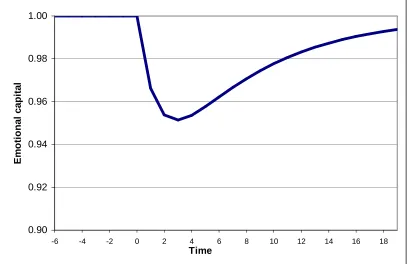
Because they lie behind the happiness time paths, the trajectories of hedonic capital,
k, are also of interest. Figures 3 and 4 set out those for the same negative shocks as in
k gradually returning to its steady state in Figure 3. Figure 4 shows that the
smoothing of happiness in Figure 2 is the result of stocks of k being first depleted as
agents draw down on their coping resources, then rebuilt.
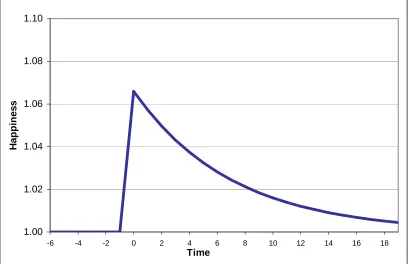
Figures 5 and 6 are the opposite. They turn to the case of life’s ups rather than downs.
Now the individual becomes happier, but the burst in happiness gradually falls away,
and wellbeing tends asymptotically back towards the steady state of 1.00. These
Figures thus correspond to the obverse of the bad shocks of Figures 1 and 2. Again in
Figure 5 we see adaptation to the permanent shock; and in Figure 6 smoothing of the
temporary shock. Although it should be emphasised again that the underlying nature
of these two shocks is different -- the former is a one-off permanent change and the
latter a steadily diminishing one -- the general structure of response in happiness in
Figures 5 and 6 has the same adaptive form (though the structure of Figure 6 stems
from the fact that the event is temporary). Initially, happiness is running flat along the
steady-state level, given by unity, 1.00. Then it lifts abruptly. After that, there is a
slow ‘habituation’.
Why does the change not make the individual permanently happier? Decreasing
returns to hedonic capital will mean that growth in k does not bring about a large
enough increase in y to sustain the depreciation implied by a permanently higher level
of capital. Therefore, although investment in hedonic capital goes up after the shock,
it does not increase by enough to cover the higher depreciation implied by the greater
level of hedonic capital. Put intuitively, if hedonic capital increases, more hedonic
resources are required to maintain the new level of hedonic capital, whereupon less is
available elsewhere. But such a shock has lasting effects on the composition of
hedonic capital. After the life occurrence has died away, the long-run level of
hedonic capital is the same, but its composition is different.
What happens to hedonic adaptation if there is some lower bound on hedonic capital?
This is potentially important. Such a lower bound might correspond to the concept of
depression. For an individual whose psychological make-up means their steady-state
level of hedonic capital is well above the lower bound (represented by a high value of
irrelevant. Only a long sequence of negative shocks would bring the individual’s
level of hedonic capital near to it. Nevertheless, consider someone who has a
steady-state level of hedonic capital that is not far from the lower bound (represented by a
low value of z or a high value of δ). If a further bad, but temporary, life event hits
this individual, he or she will use hedonic capital to smooth its effect. The person will
initially allow their stock of hedonic capital to fall. But this exposes the individual to
a risky situation. If in the next period there is another negative shock, the amount of
hedonic capital might drop to the lower bound, with grave consequences. So the
individual hoards hedonic capital, meaning that the event is not smoothed as much.
The same is true of a person subjected to a sequence of negative shocks: if these
shocks are large relative to the size of the stock of hedonic capital, the extent to which
they can be smoothed will decline with each shock.
This implies a further result: the extent to which k can be used to smooth life events is
an increasing function of its level. To put this in different language, individuals’
psychological resilience is dependent on the level of hedonic capital.
For this reason, our model has two implications for such resilience. First, the larger
the steady-state level of an individual’s wellbeing, the more resilient human beings
will be. People characterized by a high value of z and/or a low value of δ then
correspond to what Block and Kremen (1996) describe, without using a formal model,
as “ego-resilient”. Those with low value of z and/or a high value of δ will be
“ego-brittle”. Second, a series of positive shocks will, in a sense, make an individual
emotionally stronger. He or becomes better able to absorb the effect of a negative
shock. In a cumulative way, positive shocks can buffer a negative one. There is
indeed evidence of such buffering in the psychology literature: Fredrickson (2001)
writes that "individuals who experienced more positive emotions than others became
more resilient to adversity over time".
Need it be the case that happiness goes back, given a long enough span of time, to the
original steady-state? That is the extreme ‘set point’ view (discussed in detail, for
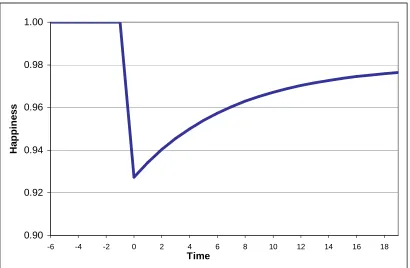
example, in Fujita and Diener (2005)). The answer, however, is no. Figure 7 shows
Sufficient conditions to obtain this result are that both hedonic capital k and the
efficiency parameter z drop at the same time. In this case, two life phenomena occur
at time t=0, and, although the person recovers much of the original level of happiness,
the steady-state level of wellbeing is permanently lower than 1.00 even as t extends
indefinitely beyond period 18 marked on Figure 7.
In principle, as Oswald and Powdthavee (2005) and others have pointed out,
decision-makers such as judges in legal compensation cases will sometimes need to take a view
on whether happiness is fully mean-reverting (that is, returning literally to the value
1.00). Paradoxically, although the issue is conceptually of fundamental importance to
this field, and has been the subject of intense debate in the empirical literature (such
as in Easterlin 2003), in many practical cases it may not matter whether there is, say,
90% or exactly 100% adaptation. Imagine, for example, that Time in Figures 1 and 7
is in years. Then, given data in which there is some measurement error, after a decade
it may be impossible statistically to detect reliably the difference between the settings
of Figure 1 and Figure 7.
Finally, there are four potential roles for income in our model. First, as we discussed
in section 3, increased income can have direct effects on the steady state level of
well-being by increasing the steady-state level of hedonic capital through, for example,
better health care or risk diversification. Second, an increase of income might raise an
individual’s sense of status, a component of their hedonic capital. Such effects will be
transient in our model, however, as will those of any one-off increase in hedonic
capital, even without the peer comparison effects that are empirically important in
evaluation of status. Third, income can help to buffer negative shocks by giving an
individual more opportunities to invest in new hedonic capital. Fourth, although we
have not included it in our model, a natural potential extension would be to think of a
subsistence level of income -- a level below which an individual’s ability to employ
their own stock of hedonic capital declines. The model provides a fairly general
framework in which to think about the relation between income and happiness, and
6. Generalizing the Framework
For clarity, we have assumed that the only determinants of wellbeing are the level of
hedonic capital and the life-events that strike the human being. To use the
terminology of Ormel et al (1999), our social production function contains only a
single factor of production. We have alluded to the idea that there are many types of
hedonic capital, and that adaptation to life events might involve substituting between
types in the way described by Ormel et al (1999). Also, time might be an important
factor in the production function. Wilson et al (2005) suggest that time is needed to
“make sense” of new events. All these factors could be incorporated into our model
by replacing Equation 1 with a production function that distinguishes between
different types of capital and allows for other influences on wellbeing.
What if the ease with which individuals can invest in hedonic capital depends upon
the level of hedonic capital? The intuition here would be that it is arguably easier to
make friends if one has lots of them. We could include this in our model by adding a
production function for investment, showing how both hedonic energy and hedonic
capital are needed to produce new hedonic capital.
The framework assumes that investment in hedonic capital and current period
wellbeing are strictly exclusive uses of hedonic energy. Other conceptions are
possible. Our model relies on there being some trade-off between current period
wellbeing and investment. But it would be straightforward to extend the model to
allow the assumption that investment directly generates some wellbeing.
With such extensions, the model would be able to make predictions about how the
dynamic response of wellbeing to life events varies with the type of individual.
Another feature of the analysis here is a division of life-events into two types – those
with a permanent effect on the level of hedonic capital and those with only a
temporary effect. Neither permits permanent effects on the steady-state: neglecting
the lower bound, hedonic capital and wellbeing will always adjust back to their
baseline. However, as in Lucas et al (2004), there is reason to believe that some of
although the size of the permanent consequences may be smaller than the temporary
consequences. As captured in Figure 7, this would correspond here to the life event
leading to a change in the parameter z on how efficiently hedonic capital is used.
The paper has modelled decision rules that Nature could hard-wire into individuals.
What if the opportunities to take the action prescribed by those rules are not
available? After some hedonic capital is destroyed, it will be optimal for the
individual to build up a new stock to replace that lost. If there are no opportunities to
do this (as an extreme case, return to the example of a prisoner in solitary
confinement), the level of k, and hence h, will fall to the lower bound.
An interesting asymmetry emerges. Adjustment back to the steady-state after a
positive shock to hedonic capital happens mainly because of depreciation, which is
independent of investment opportunities. Yet adjustment from a negative shock may
require investment in new types of hedonic capital. Hence it will be dependent on
opportunities for such investment being available. This potentially goes some way to
explaining the observation that, while income does not have large effects on the mean
level of wellbeing, it can buffer the response of wellbeing to a negative shock (Smith
et al (2005)). Income creates opportunities for investment in hedonic capital. That
allows an individual to recover from a negative shock, but income will have no
significant effect on the response to a positive shock.
7. Conclusions
This paper explores the dynamics of wellbeing. It sets out a formal theory of hedonic
adaptation.
Although the model is abstract, the paper’s motivation is practical. The aim is to
fashion an internally consistent framework that can make sense of the puzzling
resilience and adaptability of human wellbeing. Hedonic adaptation occurs when
shocks -- winning the lottery or becoming disabled, for example -- gradually wear off.
There is now much evidence for such a phenomenon. Yet adaptive behavior of this
sort creates fundamental conceptual problems for the subject of economics; its
We propose a new concept, a person’s level of hedonic capital, k. It is defined in the
paper as the stock of psychological coping resources available to the individual.
Happiness is then akin to a return8 on hedonic capital. We argue that the key
characteristic of hedonic capital is that it can be drawn down in a crisis (or,
correspondingly, built up in better times). In the same general spirit as Rayo and
Becker (2004) and Wilson and Gilbert (2005), the paper analyses the nature and roots
of habituation. In our framework, however, hedonic capital binds together the present
and the future.
The paper provides a mathematical model of wellbeing in which Nature optimally
designs human beings’ reactions in such a way that bad life-shocks are smoothed by
the depletion of hedonic capital. Good life-shocks lead, equivalently, to a happiness
response that is damped and mean-reverting. Our framework mimics the key facts of
the empirical wellbeing literature: (i) the existence of a stable mean level of wellbeing
and (ii) adaptation towards that level. Depending on the exact assumptions made, the
model leads to full or partial adaptation.
Just as the psychology and economics literatures now examine data on happiness, so,
we would conjecture, will it become possible to study empirically the level and rate of
change of hedonic capital. To do this, it will be necessary to use new measurements,
and to ask different kinds of questions than those in existing surveys. Those
measurements and questions will explore the nature of mental stocks.
8 As explained earlier, this intuitive statement should be tempered by the more precise technical one
Appendix
A Two Period Model
The paper has relied largely on numerical solution. As a pedagogical aid, it is helpful
to give simple analytical results for a two-period version of the model.
Nature designs human beings. In each period, Nature’s ‘utility’ is an increasing
function n(h), where h is the happiness of the agent. Assume that n(.) is concave and
differentiable. Let there be two periods. Assume there is a discount factor, beta.
Nature then maximizes a discounted sum of two utility levels. Assume, moreover,
that this mini-society has an initial endowment of hedonic energy. Denote it as y. It
can be converted into a flow of happiness today or invested to create a flow of extra
happiness in the second period. Denote the amount of emotional endowment held
over to the second period as k. Assume that happiness in the second period is given
by a concave ‘production’ function f(k). In this 2-period framework, the functional
forms and the discounting assumptions are more general than in the multi-period
model of the paper.
These assumptions lead to the following. Nature maximizes a concave weighted sum
of agents’ happiness levels across the present and the future:
) ( )
(h0 n h1 n
W = +β (A1)
where the hedonic energy budget constraint is
k h
y = 0 + (A2)
and happiness in the second period depends solely on the emotional endowment left
over from the first period so that
). (
1 f k
This framework, with just two periods, can produce the appearance of a form of
hedonic adaptation (a tendency to a form of mean-reversion). High happiness is
followed by low happiness. Low happiness is followed by high happiness. To
establish this, note that the structure can be converted into a single-variable
maximization problem in which k, the amount of the endowment put into investment,
which becomes the level of hedonic capital in the final period, is optimally decided by
Nature. The exogenous parameter here is y, which is the size of the starting
endowment.
The problem is then that of finding a turning point in the function
)) ( ( )
(y k n f k
n
W = − +β (A4)
so at an interior maximum
. 0 ) ( )) ( ( ) ( − + ′ ′ = ′ − = ∂ ∂ k f k f n k y n k W
β (A5)
This first-order condition defines Nature’s rational amount of investment in the future,
k, given a starting endowment, y. Let the resulting implicit function be rewritten as
k=k(y). As y increases, the optimal amount of k also increases. Its gradient follows
from the cross-partial of Nature’s maximand in equation (A4). That cross-partial’s
sign is given by
0 ) ( − ≥ ′′ − = ∂ ∂ k y n sign y k
sign (A6)
where, in general, the inequality will hold strictly, so the implied k(y) function is
strictly increasing in y.
From the first-order condition, (A5), we know that
. ) ( ) ( ) ( 1 0 h n h n k f ′ ′ = ′
A natural benchmark case is that of equal happiness in each period: h1 = h0. Hence
define a value of y*, and by monotonicity an implied k* value, that corresponds to
this case and also satisfies equation (A7). It is straightforward to check that y* is
unique. The value of k* so defined is, from equation (A7), the value of k that solves
. 0 1 *) ( − = ′ k f
β (A8)
There is an associated y*. At y* and k*, happiness in the present h0 is identical to
happiness in the future h1. Happiness is steady through time.
To see how a kind of hedonic adaptation then emerges, consider what happens if we
move away, either up or down, from the benchmark point.
Case I: The happiness path with an endowment greater than y*.
Now imagine a society that is richer in emotional endowment. Such a society has a
level of y > y*. It therefore has a second-period hedonic capital stock k > k*. But
then, by equation (A8) and the first order condition (A5), it follows that
. 1 ) ( ) ( 1 0 ≤ ′ ′ h n h n (A9)
Given strict concavity of the happiness production function, this inequality holds
strictly, so that h1 > h0. In this case, therefore, happiness starts high in the first period
and drops in the second.
Case II: The happiness path with an endowment less than y*.
Alternatively, consider the case where y<y*. Then k < k*. By strict concavity of
f(k), we have
1 ) ( >
′ k f
β (A10)
so that the optimal levels of happiness are such that h1 < h0. In this case, happiness
starts low in the first period and rises in the second.
A form of wellbeing reversal is found in Cases I and II. Good times, or in other
words a large endowment of y, act to trigger the appearance of adaptation -- a
retrenchment in happiness -- with h1 below h0. In the second period, happiness drops
below that in the first period. Bad times have the opposite character. They result in
h0 less than h1. In the second period, happiness is higher than in the first period.
This framework does not have the generality of the multi-period model of the paper
but it provides an intuitive statement and easy analytical derivation. Below the
surface, it is once again concavity and optimization-across-periods, along with the
assumption of hedonic capital, that together lead to rational habituation. Although the
existence of discounting affects the exact happiness profile through time, it can be
checked algebraically that the discount factor itself is not what accounts for the
Figure 1
The Time Path of Happiness after a Negative Shock to Hedonic Capital (a one-off shock to k)
0.90 0.92 0.94 0.96 0.98 1.00
-6 -4 -2 0 2 4 6 8 10 12 14 16 18
Time
H
a
p
p
in
e
s
s
Figure 2
The Time Path of Happiness after a Negative Shock to Hedonic Energy (a slowly dissipating shock to y)
0.90 0.92 0.94 0.96 0.98 1.00
-6 -4 -2 0 2 4 6 8 10 12 14 16 18
Time
H
a
p
p
in
e
s
[image:29.595.94.502.496.764.2]Figure 3
The Time Path of Hedonic Capital after a Negative Shock to Hedonic Capital (a one-off shock to k)
0.88 0.90 0.92 0.94 0.96 0.98 1.00
-6 -4 -2 0 2 4 6 8 10 12 14 16 18
Time E m o ti o n a l c a p it a l Figure 4
The Time Path of Hedonic Capital after a Negative Shock to Hedonic Energy (a slowly dissipating shock to y)
0.90 0.92 0.94 0.96 0.98 1.00
-6 -4 -2 0 2 4 6 8 10 12 14 16 18
[image:30.595.95.504.492.756.2]Figure 5
The Time Path of Happiness after a Positive Shock to Hedonic Capital (a one-off shock to k)
1.00 1.02 1.04 1.06 1.08 1.10
-6 -4 -2 0 2 4 6 8 10 12 14 16 18
Time
H
a
p
p
in
e
s
[image:31.595.94.502.475.744.2]s
Figure 6
The Time Path of Happiness after a Positive Shock to Hedonic Energy (a slowly dissipating shock to y)
1.00 1.02 1.04 1.06 1.08 1.10
-6 -4 -2 0 2 4 6 8 10 12 14 16 18
Time
H
a
p
p
in
e
s
Figure 7
The Time Path of Happiness after a Negative Shock to Hedonic Capital and a Decline in its Efficiency Parameter (a one-off shock to k and permanent fall in z)
0.90 0.92 0.94 0.96 0.98 1.00
-6 -4 -2 0 2 4 6 8 10 12 14 16 18
Time
H
a
p
p
in
e
s
References
Akerlof, G.A. (1997) Social distance and social decisions, Econometrica, 65, 1005-1028.
Alpizar, F., Carlsson, F. and & Johansson-Stenman, O. (2005) How much do we care about absolute versus relative income and consumption? Journal of Economic
Behavior and Organization, 56, 405-421.
Argyle, M. (2001) The Psychology of Happiness. 2nd ed. London: Routledge.
Babcock, L., Wang, X. & Loewenstein, G. (1996) Choosing the wrong pond: Social comparisons that reflect a self-serving bias. Quarterly Journal of Economics, 111, 1-19.
Blanchflower, D.G. & Oswald, A.J. (2004) Wellbeing over time in Britain and the USA. Journal of Public Economics, 88, 1359-1386.
Block, J. & Kremen, A.M. (1996) IQ and ego-resiliency: Conceptual and empirical connections and separateness. Journal of Personality and Social Psychology, 70, 349-361.
Brickman, P., Coates, D. & Janoff-Bulman, R. (1978) Lottery winners and accident victims – is happiness relative? Journal of Personality and Social Psychology, 36, 917-927.
Brown, G.D.A., Gardner, J., Oswald, A.J. & Qian, J. (2005) Rank, wellbeing and range-frequency theory. Working paper, Warwick University.
Burchardt, T. (2001) Are one man’s rags another man’s riches? Identifying adaptive expectations using panel data. Social Indicators Research, 74, 57-102.
Carr, A. (2004) Positive Psychology. London: Routledge.
Carroll, C.D. (2001) A theory of the consumption function, with and without liquidity constraints. Journal of Economic Perspectives, 15, 23-45.
Carroll, C.D., Overland, J. & Weil, D.N. (2000) Saving and growth with habit formation. American Economic Review, 90, 341-355.
Carroll, C.D. & Weil, D.N. (1994) Saving and growth: A reinterpretation.
Carnegie-Rochester Conference Series on Public Policy, 40, 133-192.
Clark, A.E. (1999) Are wages habit-forming? Evidence from micro data, Journal of
Economic Behavior and Organization, 39, 179-200.
Clark, A. E., Diener, E., Georgellis, Y. & Lucas, R. E. (2004) Lags and leads in life satisfaction: A test of the baseline hypothesis. Working paper, DELTA, Paris. Clark, A.E. & Oswald, A.J. (1994) Unhappiness and unemployment. Economic
Journal, 104, 648-659.
Diener, E., Suh, E.M., Lucas, R.E., & Smith, H.L. (1999) Subjective wellbeing: Three decades of progress. Psychological Bulletin, 125(2), 276-302.
Di Tella, R., Haisken, J. & Macculloch, R. (2005) Happiness adaptation to income and to status in an individual panel. Working paper, Harvard Business School. Di Tella, R., MacCulloch, R.J. & Oswald, A.J. (2001) Preferences over inflation and
unemployment: Evidence from surveys of happiness. American Economic
Review, 91, 335-341.
Di Tella, R., MacCulloch, R.J. & Oswald, A.J. (2003) The macroeconomics of happiness. Review of Economics and Statistics, 85, 809-827.
Duesenberry, J.S. (1949) Income, saving and the theory of consumer behavior. Cambridge, MA: Harvard University Press.
Easterlin, R. A. (1974) Does economic growth improve the human lot? Some empirical evidence. In Nations and Households in Economic Growth: Essays in
Honour of Moses Abramowitz, edited by P.A. Reder and M.W. David. New
York and London: Academic Press.
Easterlin, R.A. (2003) Explaining happiness. Proceedings of the National Academy of
Sciences, 100, 11176-11183.
Easterlin, R.A. (2005a) A puzzle for adaptive theory. Journal of Economic Behavior
and Organization, 56, 513-521.
Easterlin, R.A. (2005b) Is there an iron law of happiness? Working paper, University of Southern California.
Frank, R.H. (1985). Choosing the right pond: Human behavior and the quest for
status. London: Oxford University Press.
Frederick, S. & Loewenstein, G. (1999) Hedonic adaptation. In D. Kahneman, E. Diener, and N. Schwarz (Eds.) Hedonic Psychology: Scientific Approaches to
Enjoyment, Suffering, and Wellbeing. Russell Sage Foundation. New York.
Fredrickson, B. L. (2001) The role of positive emotions in positive psychology: The broaden-and-build theory of positive emotions. American Psychologist, 56, 218-226.
Frey, B.S. & Meier, S. (2004) Social comparisons and pro-social behavior: Testing conditional cooperation in a field experiment. American Economic Review, 94(5), 1717-1722.
Frey, B.S. & Stutzer, A. (2002a) What can economists learn from happiness research?
Journal of Economic Literature, 40(2), 402-435.
Frey, B. S. & Stutzer, A. (2002b) Happiness and Economics. Princeton, USA: Princeton University Press.
Fujita, F. & Diener, E. (2005) Life satisfaction set point: stability and change. Journal
of Personality and Social Psychology, 88(1), 158-164.
Gardner, J. & Oswald, A.J. (2006) Do divorcing couples become happier by splitting up? Journal of the Royal Statistical Society: Series A, forthcoming.
Gilbert, D.T., Driver-Linn, E. & Wilson, T.D. (2002) The trouble with Vronsky: Impact bias in the forecasting of future affective states. In L. Feldman-Barrett & P. Salvoney (Eds.) The Wisdom of Feeling, Guilford: New York.
Gilbert, D. T., Pinel, E. C., Wilson, T. D., Blumberg, S. J., & Wheatley, T. (1998) Immune neglect: A source of durability bias in affective forecasting. Journal of
Personality and Social Psychology, 75, 617-638.
Grossman, M. (1999) The Human Capital Model of the Demand for Health, NBER Working Paper 7078
Headey, B. & Wearing, A.J (1991) Subjective well-being: A stocks and flows framework. In F. Strack, M. Argyle, & N. Schwarz (Eds.) Subjective well-being:
An interdisciplinary perspective. Pergamon Press: Oxford.
Hopkins, E. & Kornienko, T. (2004). Running to keep in the same place: Consumer choice as a game of status. American Economic Review, 94, 1085-1107.
Kahneman, D. (2003) A psychological perspective on economics. American
Economic Review, Papers and Proceedings, 93, 162-168.
Kahneman, D., Wakker, P.P. & Sarin, R. (1997) Back to Bentham? Explorations of experienced utility. Quarterly Journal of Economics, 112, 375-405.
Keely, L.C. (2005) Why isn’t growth making us happier? Utility on the hedonic treadmill. Journal of Economic Behavior and Organization, 57, 333-335.
Layard, R. (1980). Human satisfactions and public policy. Economic Journal, 90, 737-750.
Layard, R. (2005) Happiness: Lessons from a New Science, London: Allen Lane. Lucas, R.E. (2005). Time does not heal all wounds – A longitudinal study of reaction
and adaptation to divorce. Psychological Science, 16, 945-950.
Lucas, R.E., Clark, A. E., Diener, E., & Georgellis, Y. (2003) Re-examining adaptation and the set-point model of happiness: Reactions to changes in marital status. Journal of Personality and Social Psychology, 84 (3), 527-539.
Lucas, R.E., Clark, A. E., Georgellis, Y. & Diener, E. (2004) Unemployment alters the set point for life satisfaction. Psychological Science, 15 (1), 8-13.
Luttmer, E.F.P. (2005) Neighbors as negatives: Relative earnings and wellbeing.
Quarterly Journal of Economics, 120, 963-1002.
Lyubomirsky, S., King, L. & Diener, E. (2005) The benefits of frequent positive affect: Does happiness lead to success? Psychological Bulletin, 131, 803-855. Lyubomirsky, S., Sheldon, K.M. & Schkade, D. (2005) Pursuing happiness: The
architecture of sustainable change, Review of General Psychology, 9, 111-131. Menzel, P., Dolan, P., Richardson, J. el al. (2002) The role of adaptation to disability
and disease in health state valuation: A preliminary normative analysis. Social
Science and Medicine, 55, 2149-2158.
Ormel, J., Lindenberg, S., Steverink, N. & Verbrugge, L.M. (1999) Subjective wellbeing and social production functions. Social Indicators Research, 46, 61-90.
Oswald, A.J. (1997) Happiness and economic performance. Economic Journal, 107, 1815-1831.
Oswald, A.J. & Powdthavee, N. (2005) Does happiness adapt? A longitudinal study of disability with implications for economists and judges. Working paper, University of Warwick.
Rayo, L. & Becker, G. (2004) Evolutionary efficiency and happiness. Working paper, University of Chicago.
Reay, D. (2004) Gendering Bourdieu's concepts of capitals? Emotional capital, women and social class, Sociological Review, 52, 57-74.
Riis J., Loewenstein G., Baron J., & Jepson C. (2005) Ignorance of hedonic adaptation to hemodialysis: A study using ecological momentary assessment.
Journal of Experimental Psychology: General, 134 , 3-9.
Robson, A.J. (1996) A biological basis for expected and non-expected utility, Journal
of Economic Theory, 68, 397-424.
Robson, A.J. (2001) The biological basis of economic behavior, Journal of Economic
Literature, 39, 11-33.
Robson, A.J. (2002) Evolution and human nature, Journal of Economic Perspectives, 16, 89-106.
Segerstrom, S. & Miller, G. (2004) Psychological stress and the human immune system: A meta-analytic study of 30 years of inquiry, Psychological Bulletin, 130, 601-630.
Senik, C. (2004) When information dominates comparison – Learning from Russian subjective panel data, Journal of Public Economics, 88, 2099-2123.