Collective Stance Classification of Posts in Online Debate Forums
Dhanya Sridhar Computer Science Dept.
UC Santa Cruz
Lise Getoor Computer Science Dept.
UC Santa Cruz [email protected]
Marilyn Walker Computer Science Dept.
UC Santa Cruz [email protected]
Abstract
Online debate sites are a large source of informal and opinion-sharing dialogue on current socio-political issues. Inferring users’ stance (PRO or CON) towards dis-cussion topics in domains such as politics or news is an important problem, and is of utility to researchers, government or-ganizations, and companies. Predicting users’ stance supports identification of so-cial and political groups, building of better recommender systems, and personaliza-tion of users’ informapersonaliza-tion preferences to their ideological beliefs. In this paper, we develop a novel collective classification approach to stance classification, which makes use of both structural and linguis-tic features, and which collectively labels the posts’ stance across a network of the users’ posts. We identify both linguistic features of the posts and features that cap-ture the underlying relationships between posts and users. We use probabilistic soft logic (PSL) (Bach et al., 2013) to model post stance by leveraging both these local linguistic features as well as the observed network structure of the posts to reason over the dataset. We evaluate our approach on 4FORUMS(Walker et al., 2012b), a col-lection of discussions from an online de-bate site on issues ranging from gun con-trol to gay marriage. We show that our col-lective classification model is able to eas-ily incorporate rich, relational information and outperforms a local model which uses only linguistic information.
1 Introduction
Modeling user stance (PRO, CON) in discussion topics in online social media debate is of inter-est to researchers, corporations and governmental
organizations alike. Predicting a user’s stance to-wards a given issue can support the identification of social or political groups (Gawron et al., 2012; Abu-Jbara et al., 2012; Anand et al., 2011; Qiu et al., 2013; Hasan and Ng, 2013), help develop bet-ter recommendation systems, or tailor users’ infor-mation preferences to their ideologies and beliefs. Stance classification problems consist of a collec-tion of debate-style discussions by authors on dif-ferent controversial, political topics.
While these may be spoken as in the Congres-sional Debates corpus (Thomas et al., 2006; Bur-foot, 2008), we focus on forum posts on social media debate sites. Users on debate sites share their opinions freely, using informal and social language, providing a rich and much more chal-lenging domain for stance prediction.
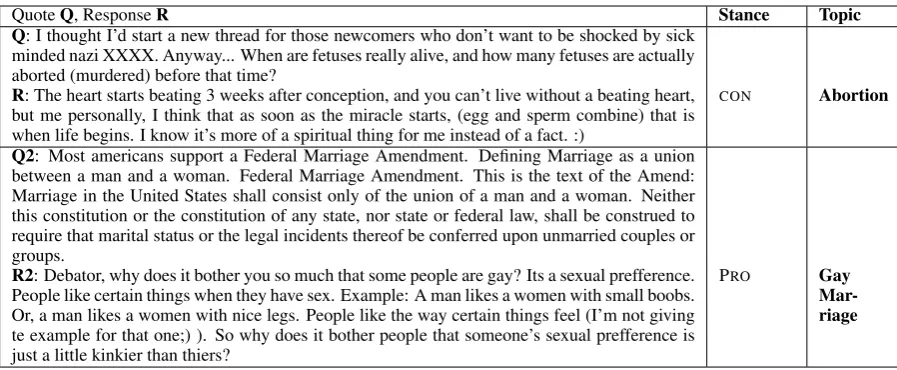
Social media debate sites contain online discus-sions with posts from various authors, where each post is either a response to another post or the root of the discussion (Anand et al., 2011; Walker et al., 2012a). Posts are linked to one another by ei-ther rebuttal or agreement links and are labelled for stance, either PRO or CON, depending on the framing of the issue under discussion. Each post reflects the stance and sentiment of its author. Au-thors may participate in multiple discussions in the same topic, and may discuss multiple topics. For example consider the sample posts from the online discussion forum 4forums.com shown in Fig. 1. Here, we see discussion topics, together with sample quotes and responses, where the response is a direct reply to the quote text. The annotations for stance were gathered using Amazon’s Mechical Turk service with an interface that allowed an-notators to see complete discussions. Quotes pro-vide additional context that were used by human annotators in a separate task for annotating agree-ment and disagreeagree-ment (Misra and Walker, 2013). Responses can be labeled as eitherPROorCON to-ward the topic. For the example shown in Fig. 1,
QuoteQ, ResponseR Stance Topic Q: I thought I’d start a new thread for those newcomers who don’t want to be shocked by sick
minded nazi XXXX. Anyway... When are fetuses really alive, and how many fetuses are actually aborted (murdered) before that time?
R: The heart starts beating 3 weeks after conception, and you can’t live without a beating heart, but me personally, I think that as soon as the miracle starts, (egg and sperm combine) that is when life begins. I know it’s more of a spiritual thing for me instead of a fact. :)
CON Abortion
Q2: Most americans support a Federal Marriage Amendment. Defining Marriage as a union between a man and a woman. Federal Marriage Amendment. This is the text of the Amend: Marriage in the United States shall consist only of the union of a man and a woman. Neither this constitution or the constitution of any state, nor state or federal law, shall be construed to require that marital status or the legal incidents thereof be conferred upon unmarried couples or groups.
R2: Debator, why does it bother you so much that some people are gay? Its a sexual prefference. People like certain things when they have sex. Example: A man likes a women with small boobs. Or, a man likes a women with nice legs. People like the way certain things feel (I’m not giving te example for that one;) ). So why does it bother people that someone’s sexual prefference is just a little kinkier than thiers?
PRO Gay
[image:2.595.74.523.60.245.2]Mar-riage
Figure 1: Sample Quote/Response Pair from4forums.comwith Mechanical Turk annotations for stance.
Both response posts are from the same author.
both response posts are from the same author. We describe the dataset further in Section 4.1.
We believe that models of post stance in on-line debate should capture both the content and the context of author posts. By jointly reasoning over both the content of the post and its relationships with other posts in the discussion, we perform col-lective classification, as we further define in Sec-tion 3 (Sen et al., 2008). Previous work has shown that collective classification models often perform better than content-only approaches. (Burfoot et al., 2011; Hasan and Ng, 2013; Thomas et al., 2006; Bansal et al., 2008; Walker et al., 2012c). Here, we develop a collective classification ap-proach for stance prediction which leverages the sentiment conveyed in a post through its language, and the reply links consisting of agreements or re-buttals between posts in a discussion. We imple-ment our approach usingProbabilistic Soft Logic
(PSL) (Bach et al., 2013), a recently introduced tool for collective inference in relational data. We evaluate our model on data from the 4FORUMS online debate site (Walker et al., 2012b).
Section 2 first presents an overview of our ap-proach and then in Section 3.1 we describe the PSL framework in more detail. Section 4 de-scribes the evaluation data and our results show-ing that the PSL model improves prediction of post stance in the4Forumsdataset. In Section 5 we describe related work, and compare with our pro-posed approach. Section 6 summarizes our ap-proach and results.
2 Overview of Approach
Given a set of topics{t1. . . tn}, where each topic
ticonsists of a set of discussions{di1. . . dij}, we model each discussiondk as a collection of posts {pk0, . . . , pkm}, where each postpkiis mapped to its authorai.
A discussiondi ∈ D is a tree of posts, starting with the initial postpi0. We distinguish between
posts that start a new thread (root) and others (non-root). Each non-root post pij is the response to some previous postpik, wherek < j, and we refer topikas the parent ofpij. For a subset of the posts, pij has been annotated with a real valued number in the interval[−5,5]that denotes whether the post disagrees or agrees with its parent. Values≤0 are considered disagreement and values≥1, as agree-ment. We discard the posts where the annotations are in the interval(0,1)since those indicate high annotator uncertainty about agreement.
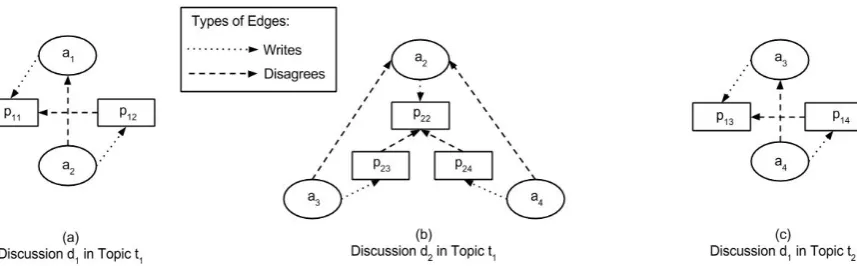
Fig. 2 illustrates an example of three discussion trees for two topics where authora2 participates
in multiple discussions of the same topic and a3
and a4 participate in multiple topics. An author
directly replies with a post to another author’s post and either disagrees or agrees.
Each postpij in discussiondiis also mapped to {xij1, . . . , xijN}linguistic features as described in
Section 3.2.1 as well asyij, the stance label (PRO, CON) towards the discussion topicti.
We say that aj participates in topic ti if there exist any postspj ∈diwith authoraj.
con-Figure 2: Example of 3 discussions in (a), (b) and (c). Dotted lines denote the ‘writes’ relation between authors and posts and dashed lines denote the ‘disagrees’ relation between posts and between authors. Authors can participate in multiple discussions of the same topic, shown by a2 in both (a) and (b).
Moreover, authors may post in multiple topics, as shown bya3 anda4 in both (b) and (c), and may
interact with the same authors multiple times, as shown again in (b) and (c).
sider the network graph G of disagreement and agreement between posts and between authors, where the vertices are posts{p0, . . . , pm}and
au-thors {a0, . . . , an}. A disagreement edge exists from postputopvifpudisagrees withpv.
A disagreement edge exists fromawtoayif any of the posts{pw, . . . , px} mapped toaw disagree with any posts{py, . . . pz}mapped toay. We sim-ilarly define agreement edges for both posts and authors.
3 Collective Classification of Stance Given the discussion structure defined in the pre-vious section, our task is to infer the stance of each post. We make use of both linguistic features and the relational structure in order to collectivelyor
jointlyinfer the stance labels. This corresponds to a collective classification setting (Sen et al., 2008), in which we are given a multi-relational network and some partially observed labels, and we wish to infer all of the unobserved labels, conditioned on observed attributes and links. Collective clas-sification refers to the combined clasclas-sification of a set of interdependent objects (posts, in our do-main) using information given by both the local features of the objects and the properties of the objects’ neighbors in a network. For the stance classification problem, we infer stance labels for posts using both the correlation between a post and its linguistic attributes {xij1, . . . , xijN}, and the
labels and attributes of its neighbors in observed network graphG. We use PSL, described below, to perform collective classification.
3.1 Probabilistic Soft Logic
Probabilistic soft logic (PSL) is a framework for probabilistic modeling and collective reasoning in relational domains (Kimmig et al., 2012; Bach et al., 2013). PSL provides a declarative syntax and uses first-order logic to define a templated undi-rected graphical model over continuous random variables. Like other statistical relational learn-ing methods, dependencies in the domain are cap-tured by constructing rules with weights that can be learned from data.
But unlike other statistical relational learning methods, PSL relaxes boolean truth values for atoms in the domain to soft truth values in the in-terval [0,1]. In this setting, finding themost proba-ble explanation(MPE), a joint assignment of truth values to all random variable ground atoms, can be done efficiently.
For example, a typical PSL rule looks like the following:
P(A, B)∧Q(B, C)→R(A, C)
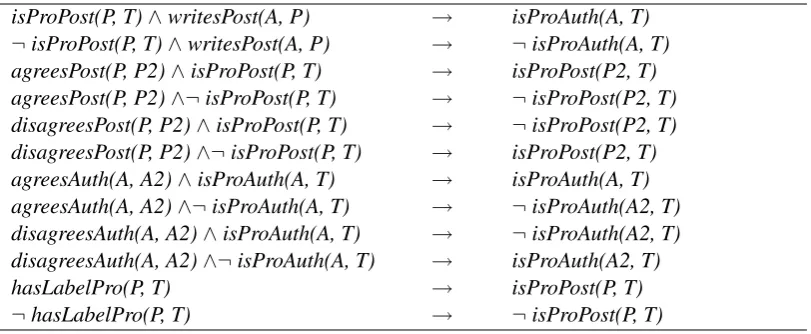
[image:3.595.94.523.74.207.2]isProPost(P, T)∧writesPost(A, P) → isProAuth(A, T)
¬isProPost(P, T)∧writesPost(A, P) → ¬isProAuth(A, T)
agreesPost(P, P2)∧isProPost(P, T) → isProPost(P2, T)
agreesPost(P, P2)∧¬isProPost(P, T) → ¬isProPost(P2, T)
disagreesPost(P, P2)∧isProPost(P, T) → ¬isProPost(P2, T) disagreesPost(P, P2)∧¬isProPost(P, T) → isProPost(P2, T)
agreesAuth(A, A2)∧isProAuth(A, T) → isProAuth(A, T)
agreesAuth(A, A2)∧¬isProAuth(A, T) → ¬isProAuth(A2, T)
disagreesAuth(A, A2)∧isProAuth(A, T) → ¬isProAuth(A2, T) disagreesAuth(A, A2)∧¬isProAuth(A, T) → isProAuth(A2, T)
hasLabelPro(P, T) → isProPost(P, T)
[image:4.595.97.503.61.228.2]¬hasLabelPro(P, T) → ¬isProPost(P, T)
Table 1: Rules for PSL model, where P=post, T=Topic, and A=Author.
and authors as variables and specify predicates to encode different interactions, such as writes, be-tween them. Domain knowledge is captured by writing rules with weights that govern the rela-tive importance of the dependencies between pred-icates. The groundings of all the rules result in an undirected graphical model that represents the joint probability distribution of assignments for all unobserved atoms, conditioned on the observed atoms.
Triangular norms, which are continuous relax-ations of logical AND and OR, are used to com-bine the atoms in the first-order clauses. As a result of the soft truth values and the triangu-lar norms, the underlying probabilistic model is a hinge-loss Markov Random Field (HL-MRF). Inference in HL-MRFs is a convex optimization, which leads to a significant improvement in effi-ciency over discrete probabilistic graphical mod-els. Thus, PSL offers a very natural interface to compactly represent stance classification as a col-lective classification problem, along with methods to reason about our domain.
3.2 Features
We extract both linguistic features that capture the content of a post and features that capture multiple relations from our dataset.
3.2.1 Linguistic Features
To capture the content of a post, on top of a bag-of-wordsrepresentation with unigrams and bigrams, we also consider basic lengths, discourse cues, repeated punctuation counts and counts of lex-ical categories based on the Linguistic Inquiry and Word Count tool (LIWC) (Pennebaker et al.,
2001). Basic length features capture the number of sentences, words, and characters, along with the average word and sentence lengths for each post. The discourse cues feature captures fre-quency counts for the first few words of the post, which often contain discourse cues. To capture the information in repeated punctuation like “!!”, “??” or “?!” we include the frequency count of the given punctuation patterns as a feature of each post (Anand et al., 2011). LIWC counts capture senti-ment by giving the degree to which the post uses certain categories of subjective language.
3.2.2 Relational Information
As our problem domain contains relations be-tween both authors and posts, for our PSL model, we consider the relations between authors, be-tween posts and bebe-tween authors and posts. As de-scribed above, in PSL, we model these relations as first-order predicates. In Section 3.3, we describe how we populate the predicates with observations from our data.
Author Information We observe that authors
participate in discussions by writing posts. For a subset of authors, we have annotations for their interactions with other authors as either disagree-ment or agreedisagree-ment, as given by network graph G. We encode this with the following predi-cates: writesPost(A, P), disagreesAuth(A1, A2),
agreesAuth(A1, A2).
that only uses linguistic features, as described in Section 3.3, as prior information. We capture these relations with the following predicates: hasLabel-Pro(P, T),hasTopic(P, T), disagreesPost(P1, P2),
agreesPost(P1, P2).
3.2.3 Target attributes
Our goal is to 1) predict the stance relation be-tween a post and its topic, namely,PROorCONand 2) predict the stance relation between an author and a topic. In our PSL model, our target predi-cates areisProPost(P, T) andisProAuth(A, T).
3.3 PSL Model
We construct our collective stance classification model in PSL using the predicates listed above. For disagreement/agreement annotations in the in-terval [-5, 5], we consider values [-5,0] as evidence for thedisagreesAuthrelation and values [1, 5] as evidence for theagreesAuth relation. We discard observations with annotations in the interval [0,1] because it indicates a very weak signal of agree-ment, which is already rare on debate sites. We populatedisagreesPostandagreesPostin the same way as described above.
For each relation, we populate the correspond-ing predicate with all the instances that we observe in data and we fix the truth value of each observa-tion as 1. For all such predicates where we observe instances in the data, we say that the predicate is closed. For the relationsisPostProandisAuthPro
that we predict through inference, a truth value of 1 denotes a PROstance and a truth value of 0 de-notes aCON stance. We say that those predicates are open, and the goal of inference is to jointly as-sign truth values to groundings of those predicates. We use our domain knowledge to describe rules that relate these predicates to one another. We fol-low our intuition that agreement between nodes implies that they have the same stance, and dis-agreement between nodes implies that they have opposite stances. We relate post and author nodes to each other by supposing that if a post is PRO towards its topic, then its author will also bePRO towards that topic.
We construct a classifier that takes as input the linguistic features of the posts and outputs predic-tions for stance label of each post. We then con-sider the labels predicted by the local classifier as a prior for the inference of the target attributes in our PSL model. Table 1 shows the rules in our PSL model.
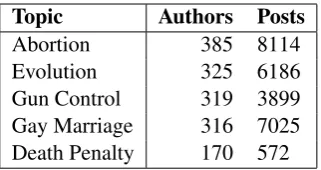
Topic Authors Posts
Abortion 385 8114
Evolution 325 6186
Gun Control 319 3899
Gay Marriage 316 7025
[image:5.595.337.498.61.146.2]Death Penalty 170 572
Table 2: Overview of topics in 4FORUMSdataset.
4 Experimental Evaluation
We first describe the dataset we use for evaluation and then describe our evaluation method and re-sults.
4.1 Dataset
We evaluate our proposed approach on discus-sions fromhttps://www.4forums.com, an online debate site on social and political issues. The dataset is publicly available as part of the Internet Argument Corpus, an annotated collec-tion of 109,533 forum posts (Walker et al., 2012b; Walker et al., 2012c). On 4FORUMS, a user ini-tiates a discussion by posting a new question or comment under a topic, or participate in an ongo-ing discussion by replyongo-ing to any of the posts in the thread. The discussions were given to English speaking Mechanical Turk annotators for a num-ber of annotation tasks to get labels for the stances of discussion participants towards the topic, and scores for each post in a discussion indicating whether it is in agreement or disagreement with the preceding post.
agree-ment/disagreement.
The discussions span many topics, and Table 2 gives a summary of the topics we consider in our experiments and the distribution of posts across these topics. Each post in a discussion comes as a quote-response pair, where the quote is the text that the post is in response to, and the response is the post text. We refer to (Walker et al., 2012b) for a full description of the corpus and the annotation process.
4.2 Evaluation
In order to evaluate our methods, we split the dataset into training and testing sets by randomly selecting half the authors from each topic and their posts for the training set and using the remaining authors and their posts for the test set. This way, we ensure that no two authors appear in both train-ing and test sets for the same topic, since stance is topic-dependent. We create 10 randomly sam-pled train/test splits for evaluation. Each split con-tains about 18,000 posts. For each train/test split, we train a linear SVM for each topic, with the L2-regularized-L1-loss SVM implemented in the LibLINEAR package (Fan et al., 2008). We use only the linguistic features from the posts, for each topic in the training set. We refer to the baseline model which only uses the the output of the SVM as the LOCAL model. We output the predictions fromLOCALmodel and get stance labels for posts in both the training and test sets. We use the pre-dictions as prior information for the true stance la-bel in our PSL model, with thehasLabelpredicate. We use the gold standard stance annotation (PRO, CON) for each post as ground truth for weight learning and inference. A truth value of 1 forisPostProandisAuthProdenotes aPROstance and a truth value of 0 denotes a CON stance. We learn the weights of our PSL model (initially set to 1) for each of our training sets and perform infer-ence on each of the test sets.
Table 3 shows averages for F1 score for the pos-itive class (PRO), area under the precision-recall curve (AUC-PR) for the negative class (CON) and area under the ROC curve (AUROC) over the 10 train/test splits. For the PSL model, the measures are computed for joint inference over all topics in the test sets. For the per-topic linear SVMs (LOCAL model), we compute the measures indi-vidually for the predictions of each topic in the test sets and take a weighted average over the
topics. Our PSL model outperforms the LOCAL model, with statistically significant improvements in the F1 score and AUC-PR for the negative class. Moreover, our model completes weight learning and inference on the order of seconds, boasting an advantage in computational efficiency, while also maintaining model interpretability.
Table 4 shows the weights learned by the PSL model for the rules in one of the train/test splits of the experiment. The first two rules relating post stance and author stance are weighted more heavily, in part because the writesPost predicate has a grounding for each author-post pair and con-tributes to lots of groundings of the rule. The rules that capture the alternating disagreement stance also have significant weight, while the rules denot-ing agreement both between posts and between au-thors are weighted least heavily since there are far fewer instances of agreement than disagreement. This matches our intuition of political debates.
We also explored variations of the PSL model by removing the first two rules relating post stance and author stance and found that the weight learn-ing algorithm drove the weights of the other rules close to 0, worsening the performance. We also removed rules 3-10 that capture agree-ment/disagreement from the model, and found that the model performs poorly when disregarding the links between nodes entirely. The PSL model learns to weight the first and second rule very highly, and does worse than when considering the prior alone. Thus, the combination of the rules gives the model its advantage, allowing the PSL model to make use of a richer structure that has multiple types of relations and more information.
5 Related Work
Classifier F1 Score AUC-PR negative class AUROC
LOCAL 0.66±0.015 0.44±0.04 0.54±0.02
[image:7.595.146.452.62.106.2]PSL 0.74±0.04 0.511±0.04 0.59±0.05
Table 3: Averages and standard deviations for F1 score for the positive class, area under PR curve for the negative class, and area under ROC curve for post stance over 10 train/test splits.
isProPost(P, T)∧writesPost(A, P) → isProAuth(A, T): 10.2
¬isProPost(P, T)∧writesPost(A, P) → ¬isProAuth(A, T): 8.5
agreesPost(P, P2)∧isProPost(P, T) → isProPost(P2, T): 0.003
agreesPost(P, P2)∧¬isProPost(P, T) → ¬isProPost(P2, T): 0.003
disagreesPost(P, P2)∧isProPost(P, T) → ¬isProPost(P2, T): 0.06
disagreesPost(P, P2)∧¬isProPost(P, T) → isProPost(P2, T): 0.11
agreesAuth(A, A2)∧isProAuth(A, T) → isProAuth(A, T): 0.001
agreesAuth(A, A2)∧¬isProAuth(A, T) → ¬isProAuth(A2, T): 0.0
disagreesAuth(A, A2)∧isProAuth(A, T) → ¬isProAuth(A2, T): 0.23
disagreesAuth(A, A2)∧¬isProAuth(A, T) → isProAuth(A2, T): 0.6
hasLabelPro(P, T) → isProPost(P, T): 2.2
¬hasLabelPro(P, T) → ¬isProPost(P, T): 4.8
Table 4: Weights learned by the model for the PSL rules in train/test split 2 of experiments
shorter and the language is more informal and so-cial. We predict that this difference makes it more difficult to achieve accuracies as high for 4FO -RUMSdiscussions as can be achieved for the con-gressional debates corpus.
Work by (Somasundaran and Wiebe, 2009) on idealogical debates very similar to our own show that identifying argumentation structure improves performance; their best performance is approxi-mately 64% accuracy over all topics. Research by (Thomas et al., 2006; Bansal et al., 2008; Yesse-nalina et al., 2010; Balahur et al., 2009) classifies the speaker’s stance in a corpus of congressional floor debates. This work combines graph-based and text-classification approaches to achieve 75% accuracy on Congressional debate siding over all topics. Other work applies MaxCut to the re-ply structure of company discussion forums (Mal-ouf and Mullen, 2008; Murakami and Raymond, 2010; Agrawal et al., 2003). Murakami & Ray-mond (2010) show that rules for identifying agree-ment, defined on the textual content of the post improve performance.
More recent work has explicitly focused on the benefits of collective classification in these set-tings (Burfoot et al., 2011; Hasan and Ng, 2013; Walker et al., 2012c), and has shown in each case that collective classification improves perfor-mance. The results reported here are the first to
apply the PSL collective classification framework to the forums conversations from the IAC corpus (Anand et al., 2011; Walker et al., 2012c).
6 Discussion and Future Work
Here, we introduce a novel approach to classify stance of posts from online debate forums with a collective classification framework. We formally construct a model, using PSL, to capture relational information in the network of authors and posts and our intuition that agreement or disagreement between users correlates to their stance towards a topic. Our initial results are promising, showing that by incorporating more complex interactions between authors and posts, we gain improvements over a content-only approach. Our approach is ideally suited to collective inference in social me-dia. It easily extendable to use additional rela-tional information, and richer behavioral and lin-guistic information.
Acknowledgments
[image:7.595.93.501.155.322.2]References
Amjad Abu-Jbara, Mona Diab, Pradeep Dasigi, and Dragomir Radev. 2012. Subgroup detection in ide-ological discussions. In Association for Computa-tional Linguistics (ACL), pages 399–409.
R. Agrawal, S. Rajagopalan, R. Srikant, and Y. Xu. 2003. Mining newsgroups using networks arising from social behavior. In International Conference on World Wide Web (WWW), pages 529–535. ACM.
Pranav Anand, Marilyn Walker, Rob Abbott, Jean E. Fox Tree, Robeson Bowmani, and Michael Minor. 2011. Cats Rule and Dogs Drool: Classifying Stance in Online Debate. InACL Workshop on Sen-timent and Subjectivity.
Stephen H. Bach, Bert Huang, Ben London, and Lise Getoor. 2013. Hinge-loss markov random fields: Convex inference for structured prediction. In Un-certainty in Artificial Intelligence (UAI).
A. Balahur, Z. Kozareva, and A. Montoyo. 2009. De-termining the polarity and source of opinions ex-pressed in political debates. Computational Linguis-tics and Intelligent Text Processing, pages 468–480.
M. Bansal, C. Cardie, and L. Lee. 2008. The power of negative thinking: Exploiting label disagreement in the min-cut classification framework. COLING, pages 13–16.
O. Biran and O. Rambow. 2011. Identifying justifi-cations in written dialogs. In IEEE International Conference on Semantic Computing (ICSC), pages 162–168.
Clinton Burfoot, Steven Bird, and Timothy Baldwin. 2011. Collective classification of congressional floor-debate transcripts. InAssociation for Compu-tational Linguistics (ACL), pages 1506–1515.
C. Burfoot. 2008. Using multiple sources of agree-ment information for sentiagree-ment classification of po-litical transcripts. InAustralasian Language Tech-nology Association Workshop, volume 6, pages 11– 18.
Rong-En Fan, Kai-Wei Chang, Cho-Jui Hsieh, Xiang-Rui Wang, and Chih-Jen Lin. 2008. LIBLINEAR: A library for large linear classification. Journal of Machine Learning Research, 9:1871–1874.
J.M. Gawron, D. Gupta, K. Stephens, M.H. Tsou, B. Spitzberg, and L. An. 2012. Using group mem-bership markers for group identification in web logs. In AAAI Conference on Weblogs and Social Media (ICWSM).
Kazi Saidul Hasan and Vincent Ng. 2013. Stance clas-sification of ideological debates: Data, models, fea-tures, and constraints. International Joint Confer-ence on Natural Language Processing.
Angelika Kimmig, Stephen H. Bach, Matthias Broecheler, Bert Huang, and Lise Getoor. 2012. A short introduction to probabilistic soft logic. In NIPS Workshop on Probabilistic Programming: Foundations and Applications.
R. Malouf and T. Mullen. 2008. Taking sides: User classification for informal online political discourse.
Internet Research, 18(2):177–190.
Amita Misra and Marilyn A Walker. 2013. Topic in-dependent identification of agreement and disagree-ment in social media dialogue. InConference of the Special Interest Group on Discourse and Dialogue, page 920.
A. Murakami and R. Raymond. 2010. Support or Op-pose? Classifying Positions in Online Debates from Reply Activities and Opinion Expressions. In Inter-national Conference on Computational Linguistics (ACL), pages 869–875.
J. W. Pennebaker, L. E. Francis, and R. J. Booth, 2001.
LIWC: Linguistic Inquiry and Word Count.
Minghui Qiu, Liu Yang, and Jing Jiang. 2013. Mod-eling interaction features for debate side clustering. InACM International Conference on Information & Knowledge Management (CIKM), pages 873–878. Prithviraj Sen, Galileo Mark Namata, Mustafa Bilgic,
Lise Getoor, Brian Gallagher, and Tina Eliassi-Rad. 2008. Collective classification in network data. AI Magazine, 29(3):93–106.
S. Somasundaran and J. Wiebe. 2009. Recogniz-ing stances in online debates. InACL and AFNLP, pages 226–234.
S. Somasundaran and J. Wiebe. 2010. Recognizing stances in ideological on-line debates. In NAACL HLT 2010 Workshop on Computational Approaches to Analysis and Generation of Emotion in Text, pages 116–124.
M. Thomas, B. Pang, and L. Lee. 2006. Get out the vote: Determining support or opposition from Con-gressional floor-debate transcripts. In Conference on Empirical Methods in Natural Language Pro-cessing (EMNLP), pages 327–335.
Marilyn Walker, Pranav Anand, Rob Abbott, Jean E. Fox Tree, Craig Martell, and Joseph King. 2012a. That’s your evidence?: Classifying stance in online political debate. Decision Support Sciences. Marilyn Walker, Pranav Anand, Robert Abbott, and
Jean E. Fox Tree. 2012b. A corpus for research on deliberation and debate. InLanguage Resources and Evaluation Conference, LREC2012.
Y.C. Wang and C.P. Ros´e. 2010. Making conversa-tional structure explicit: identification of initiation-response pairs within online discussions. InHuman Language Technologies: The 2010 Annual Confer-ence of the North American Chapter of the Associa-tion for ComputaAssocia-tional Linguistics, pages 673–676. A. Yessenalina, Y. Yue, and C. Cardie. 2010.