Information Navigation System Based on POMDP that Tracks User Focus
Koichiro Yoshino Tatsuya Kawahara
School of Informatics, Kyoto University Sakyo-ku, Kyoto, 606-8501, Japan
Abstract
We present a spoken dialogue system for navigating information (such as news ar-ticles), and which can engage in small talk. At the core is a partially observ-able Markov decision process (POMDP), which tracks user’s state and focus of at-tention. The input to the POMDP is pro-vided by a spoken language understanding (SLU) component implemented with lo-gistic regression (LR) and conditional ran-dom fields (CRFs). The POMDP selects one of six action classes; each action class is implemented with its own module.
1 Introduction
A large number of spoken dialogue systems have been investigated and many systems are deployed in the real world. Spoken dialogue applications that interact with a diversity of users are avail-able on smart-phones. However, current appli-cations are based on simple question answering and the system requires a clear query or a def-inite task goal. Therefore, next-generation dia-logue systems should engage in casual interactions with users who do not have a clear intention or a task goal. Such systems include a sightseeing nav-igation system that uses tour guide books or doc-uments in Wikipedia (Misu and Kawahara, 2010), and a news navigation system that introduces news articles updated day-by-day (Yoshino et al., 2011; Pan et al., 2012). In this paper, we develop an in-formation navigation system that provides infor-mation even if the user request is not necessarily clear and there is not a matching document in the knowledge base. The user and the system converse on the current topic and the system provides po-tentially useful information for the user.
Dialogue management of this kind of systems was usually made in a heuristic manner and based
on simple rules (Dahl et al., 1994; Bohus and Rud-nicky, 2003). There is not a clear principle nor established methodology to design and implement casual conversation systems. In the past years, ma-chine learning, particularly reinforcement learn-ing, have been investigated for dialogue manage-ment. MDPs and POMDPs are now widely used to model and train dialogue managers (Levin et al., 2000; Williams and Young, 2007; Young et al., 2010; Yoshino et al., 2013b). However, the conventional scheme assumes that the task and di-alogue goal can be clearly stated and readily en-coded in the RL reward function. This is not true in casual conversation or when browsing informa-tion.
Some previous work has tackled with this prob-lem. In a conversational chatting system (Shibata et al., 2014), users were asked to make evalua-tion at the end of each dialogue session, to define rewards for reinforcement learning. In a listen-ing dialogue system (Meguro et al., 2010), levels of satisfaction were annotated in logs of dialogue sessions to train a discriminative model. These approaches require costly input from users or de-velopers, who provide labels and evaluative judg-ments.
In this work, we present a framework in which reward is defined for the quality of system actions and also for encouraging long interactions, in con-trast to the conventional framework. Moreover, user focus is tracked to make appropriate actions, which are more rewarded.
2 Conversational Information Navigation System
In natural human-human conversation, partici-pants have topics they plan to talk about, and they progress through the dialogue in accordance with the topics (Schegloff and Sacks, 1973). We call this dialogue style “information navigation.” An example is shown in Figure 1. First, the speaker
Dialogue states
Speaker (system) Listener (user)
Offer a topic
Be interested in the topic Present the detail
Make a question Answer the
question
Be silent Offer a new topic
(topic 2) Not be interested in
Offer a new topic (topic 3)
・・・
Make a question Topic 3
Topic 2
・・・
[image:2.595.74.297.62.200.2]Topic 1
Figure 1: An example of information navigation.
Story Telling (ST)
System-initiative
Modules of related topics
Question Answering (QA)
User-initiative
Proactive
initiative
Proactive Presentation
(PP)
System-initiative
Draw new topic
Related topics
Topic Topic Topic Topic Topic Topic Topic
・
・
・
・
・
・
・・・
Selected topic
Modules of current topic Topic
Presentation (TP)
Topic N Topic 3 Topic 2
・・・
Topic 1
Other modules Greeting
(GR)
Keep silence (KS)
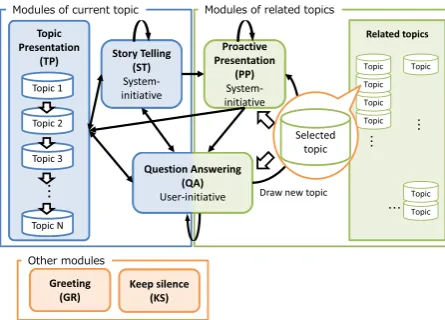
Figure 2: Overview of the information navigation system.
offers a new topic and probes the interest of the listener. If the listener shows interest, the speaker describes details of the topic. If the listener asks a specific question, the speaker answers the ques-tion. On the other hand, if the listener is not inter-ested in the topic, the speaker avoids the details of that topic, and changes the topic. Topics are often taken from current news.
In our past work, we have developed a news navigation system (Yoshino et al., 2011) based on this dialogue structure. The system provides top-ics collected from Web news texts, and the user gets information according to his interests and queries.
2.1 System overview
An overview of the proposed system is depicted inFigure 2. The system has six modules, each of which implements a class of actions. Each module takes as input a recognized user utterance, an an-alyzed predicate-argument (P-A) structure and the detected user focus.
The system begins dialogues by selecting the “topic presentation (TP)” module, which presents a new topic selected from a news article. The sys-tem chooses the next module based on the user’s response. In our task, the system assumes that each news article corresponds to a single topic, and the system presents a headline of news in the
TP module. If the user shows interest (positive response) in the topic without any specific ques-tions, the system selects the “story telling (ST)” module to give details of the news. In theST mod-ule, the system provides a summary of the news article by using lead sentences. The system can also provide related topics with the “proactive pre-sentation (PP)” module. This module is invoked by system initiative; this module is not invoked by any user request. If the user makes a specific ques-tion regarding the topic, the system switches to the “question answering (QA)” module to answer the question. This module answers questions on the presented topic and related topics.
The modules of PPandQAare based on a di-alogue framework which uses the similarity of P-A structures (Yoshino et al., 2011). This frame-work defines the similarity of P-A structures be-tween user queries and news articles, and retrieves or recommends the appropriate sentence from the news articles. This method searches for appropri-ate information from automatically parsed docu-ments by referring to domain knowledge that is automatically extracted from domain corpus.
Transitions between the modules are allowed as shown in Figure 2. The modules “greeting (GR)” and “keep silence (KS)” are also implemented.
GR module generates fixed greeting patterns by using regular expression matching. In terms of dialogue flow, these modules can be used at any time.
2.2 User focus in information navigation
[image:2.595.73.296.238.398.2]bril-SYS, tp, “Matsui, a part-time coach for the Giants, demonstrated 5 homeruns. The Giants president told him "Come back as a player!”
USR, st, 0, ” Give me the detail?”, ”Give:me/0the:detail/0”
SYS, st, ”Matsui joined the extra batting training in the Giants' camp, and demonstrated his batting to young players.”
USR, qa, 1, “Will Matsui become the Giants' manager in the future?”, ”Matsui/0will:become/0
the Giants' manager/1 in the future/0”
SYS, qa, ”The director of Giants told him "Come back as a player!”” USR, tp, 0, ”Next news, please.”, ”Next:news/0please/0”
[image:3.595.92.504.61.173.2]SYS, tp, ” To be a ace pitcher, has Fujinami improved from the rookie year? …
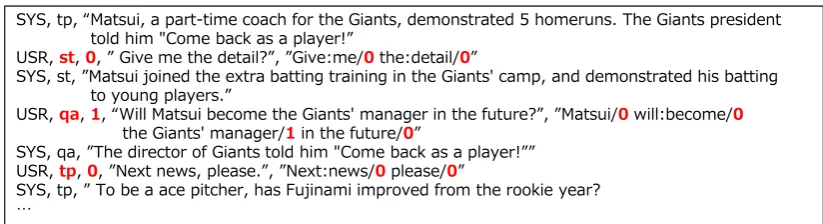
Figure 3: An example of annotation for collected dialogue. System utterances have a tuple of three elements separated by a comma: speaker, called module and utterance. User utterances have a tuple of four elements: speaker, the module the user request falls in, binary information of user focus, utterance and user focus annotation on each phrase or P-A element. (This example is translated from Japanese)
liantly?,” user focus is “Ichiro” because the sys-tem reply should include information on Ichiro. This information is annotated on content words or named entities in a user utterance. In the POMDP, decisions are made based on whether any user fo-cus was detected in the user’s utterance.
3 Spoken Language Understanding (SLU)
In this section, we present the spoken language un-derstanding components of our system. It detects the user’s focus and intention and provides these to the dialogue manager. These spoken language understanding modules are formulated with a sta-tistical model to give likelihoods which are used in POMDP.
3.1 Dialogue data
We collected 606 utterances (from 10 users) with a rule-based dialogue system (Yoshino et al., 2011). We annotated two kinds of tags: user intention (6 tags defined in Section 3.3), and focus information defined in Section 2.2. An example of annotation is shown inFigure 3. We highlighted annotation points in the bold font.
To prepare the training data, each utterance was labeled with one of the six modules, indicating the best module to respond. In addition, each phrase or P-A elements is labeled to indicated whether it is the user’s focus or not. The user focus is deter-mined by the attributes (=specifications of words in the domain) and preference order of phrases to identify the most appropriate information that the user wants to know. For example, in the second user utterance in Figure 3, the user’s focus is the phrase “the Giants’ manager”. These tags are an-notated by one person.
3.2 User focus detection based on CRF
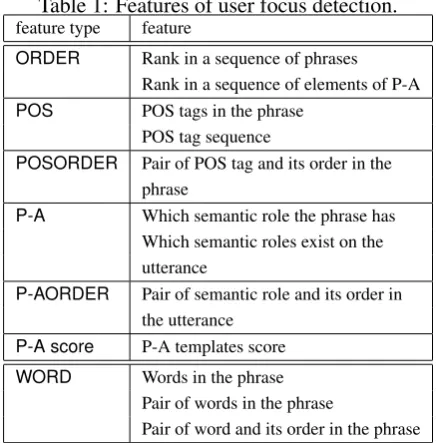
To detect the user focus, we use a conditional random field (CRF)1. The problem is defined as a sequential labeling of the focus labels to a se-quence of the phrases of the user utterance. Fea-tures used are shown in theTable 1.ORDER fea-tures are the order of the phrase in the sequence and in the P-A structure. We incorporate these features because the user focus often appears in the first phrase of the user utterance. POS fea-tures are part-of-speech (POS) tags and their pairs in the phrase.P-Afeatures are semantic role of the P-A structure. We also incorporate the domain-dependent predicate-argument (P-A) scores that are defined with an unsupervised method (Yoshino et al., 2011). The score is discretized to 0.01, 0.02, 0.05, 0.1, 0.2, 0.5.
Table 2 shows the accuracy of user focus de-tection, which was conducted via five-fold cross-validation. “Phrase” is phrase-base accuracy and “sentence” indicates whether the presence of any user focus phrase was correctly detected (or not), regardless of whether the correct phrase was iden-tified. This table indicates that WORD features are effective for detecting the user focus, but they are not essential for in the sentence-level accuracy. In this paper, we aim for portability across do-mains; therefore the dialogue manager only uses the sentence-level feature, so in our system we do not user theWORDfeatures.
3.3 User intention analysis based on LR
The module classifies the user intention from the user utterance. We define six intentions as below.
• TP: request to theTPmodule.
Table 1: Features of user focus detection. feature type feature
ORDER Rank in a sequence of phrases
Rank in a sequence of elements of P-A
POS POS tags in the phrase POS tag sequence
POSORDER Pair of POS tag and its order in the phrase
P-A Which semantic role the phrase has Which semantic roles exist on the utterance
P-AORDER Pair of semantic role and its order in the utterance
P-A score P-A templates score
WORD Words in the phrase Pair of words in the phrase
Pair of word and its order in the phrase
Table 2: Accuracy of user focus detection. Accuracy
phrase 86.7%
phrase + (WORD) 90.3%
sentence (focus exist or not) 99.8% sentence (focus exist or not) + (WORD) 99.8%
• ST: request to theSTmodule.
• QA: request to theQAmodule.
• GR: greeting to theGRmodule.
• NR: silence longer than a threshold.
• II: irrelevant input due to ASR errors or noise. We adopt logistic regression (LR)-based dia-logue act tagging approach (Tur et al., 2006). The probability of user intentionogiven an ASR result of the user utterancehis defined as,
P(o|h) = exp(ω·ϕ(h, o))
Σoexp(ω·ϕ(h, o)). (1) Here,ωis a vector of feature weights andϕ(h, o) is a feature vector. We use POS, P-A and P-A tem-plates score as a feature set. In addition, we add a typical expression feature (TYPICAL) to classify
TP, STorGR tags. For example, typical expres-sions in conversation are “Hello” or “Go on,” and those in information navigation are “News of the day” or “Tell me in detail.” Features for the clas-sifier are shown in theTable 3.
The accuracy of the classification in five-fold cross-validation is shown in Table 4. The
TYP-Table 3: Features of user intention analysis. feature type feature
POS Bag of POS tags Bag of POS bi-gram
P-A Bag of semantic role labels Bag of semantic role labels bi-gram Pair of semantic role label and its rank
P-A score P-A templates score
TYPICAL Occurrence of typical expressions
Table 4: Accuracy of user intention analysis. All features withoutTYPICAL
TP 100% 100%
ST 75.3% 64.2%
QA 94.1% 93.5%
GR 100% 100%
II 16.7% 16.7%
All 92.1% 90.2%
ICALfeature improves the classification accuracy while keeping the domain portability.
3.4 SLU for ASR output
ASR and intention analysis involves errors. Here,
sis a true user intention andois an observed in-tention. The observation model P(o|s) is given by the likelihood of ASR resultP(h|u)(Komatani and Kawahara, 2000) and the likelihood of the in-tention analysisP(o|h),
P(o|s) = ∑ h
P(o, h|s) (2)
≈ ∑
h
P(o|h)P(h|u). (3)
Here, u is an utterance of the user. We combine the N-best (N = 5) hypotheses of the ASR result
h.
4 Dialogue Management for Information Navigation
[image:4.595.313.520.83.194.2](=object of interest). This section describes the general dialogue management based on POMDP, and then gives an explanation of the proposed dia-logue management using the user focus.
4.1 Dialogue management based on POMDP
The POMDP-based statistical dialogue manage-ment is formulated as below. The random vari-ables involved at a dialogue turntare as follows:
• s∈Is: user state User intention.
• a∈K: system action
Module that the system selects.
• o∈Is: observation
Observed user state, including ASR and in-tention analysis errors.
• bsi =P(si|o1:t): belief
Stochastic variable of the user state.
• π: policy function
This function determines a system action a
given a belief of userb.π∗is the optimal pol-icy function that is acquired by the training.
• r: reward function
This function gives a reward to a pair of the user statesand the system actiona.
The aim of the statistical dialogue management is to output an optimal system actionaˆtgiven a se-quence of observationo1:tfrom1tottime-steps.
Next, we give the belief update that includes the observation and state transition function. The be-lief update of user statesiin time-steptis defined as,
bt+1 s′
j ∝P(o
t+1|s′ j)
| {z }
Obs.
∑
si
P(s′
j|si,aˆk)
| {z }
Trans.
bt
si. (4)
Obs.is an observation function which is defined in Equation (3) and Trans. is a state transition probability of the user state. Once the system es-timates the beliefbt
si, the policy function outputs the optimal actionaˆas follows:
ˆ
a=π∗(bt). (5)
4.2 Training of POMDP
We applied Q-learning (Monahan, 1982; Watkins and Dayan, 1992) to acquire the optimal policy
π∗. learning relies on the estimation of a Q-function, which maximizes the discounted sum of future rewards of the system actionatat a dialogue
turn t given the current belief bt. Q-learning is performed by iterative updates on the training dia-logue data:
Q(bt, at)⇐(1−ε)Q(bt, at) +ε[R(st, at) +γmax
at+1Q(b
t+1, at+1)], (6)
whereεis a learning rate,γis a discount factor of a future reward. We experimentally decidedε = 0.01andγ = 0.9. The optimal policy given by the Q-function is determined as,
π∗(bt) = argmax at Q(b
t, at). (7)
However, it is impossible to calculate the Q-function for all possible real values of belief b. Thus, we train a limited Q-function given by a Grid-based Value Iteration (Bonet, 2002). The be-lief is given by a function,
bsi = {
η if s=i
1−η
|Is| if s̸=i
. (8)
Here, η is a likelihood of s = i that is output of the intention analyzer, and we selected 11 dis-crete points from 0.0 to 1.0 by 0.1. We also added the case of uniform distribution. The observation function of the belief update is also given in a sim-ilar manner.
4.3 Dialogue management using user focus
Our POMDP-based dialogue management chooses actions based on its belief in: the user intention s and the user focus f (0 or 1 ∈ Jf). The observation o is controlled by hidden states
f and s that are decided by the state transition probabilities,
P(ft+1|ft, st, at), (9)
P(st+1|ft+1, ft, st, at). (10) We constructed a user simulator by using the an-notated data described in Section 3.1.
Equation (10) is also used for the state transition probability of the belief update. The equation of the belief update (4) is extended by introducing the previous user focus fl and current user focus fm′ information,
bts+1′ j =P(o
t+1|s′ j)
| {z }
Obs.
×∑
i
P(s′j|fm′ , fl, si,aˆk)
| {z }
Trans.
Table 5: Rewards in each turn.
state focus actiona
s f TP ST QA PP GR KS
TP 01 +10 -10 -10 -10 -10 -10
ST 01 -10 +10 -10 0 -10 -10
QA 01 -10 +10-10 +10+30 +10-10 -10 -10 GR 01 -10 -10 -10 -10 +10 -10 NR 01 +10-10 -10 -10 +10-10 -10 0
II 01 -10 -10 -10 -10 -10 +10
The resultant optimal policy is,
ˆ
a=π∗(bt, f
l). (12)
4.4 Definition of rewards
Table 5defines a reward list at the end of a each turn. The reward of +10 is given to appropriate actions, 0 to acceptable actions, and -10 to inap-propriate actions.
In Table 5, pairs of a state and its apparently corresponding action,TPandTP,STandST,QA
andQA, GRandGR, and II andKS, have posi-tive rewards. Rewards in bold fonts (+10) are de-fined for the following reasons. If the user asks a question (QA) without a focus (e.g. “What hap-pened on the game?”), the system can continue by story telling (ST). But when the question has a fo-cus, the system should answer the question (QA), which is highly rewarded (+30). If the system can-not find an answer, it can present relevant informa-tion (PP). When the user says nothing (NR), the system action should be decided by considering the user focus; present a new topic if the user is not interested in the current topic (f=0) or present an article related to the dialogue history (f=1).
Reward of +200 is given if 20 turns are passed, to reward a long continued dialogue. The user sim-ulator terminates the dialogue if the system selects an inappropriate action (action of r = −10) five times, and a large penalty -200 is given to the sys-tem.
5 Evaluations of Dialogue
We evaluated the proposed system with two exper-iments; dialogue state tracking with real users and average reward with a user simulator. For the eval-uation, we collected an additional 312 utterances
Average of rewards
Noise
-250 -200 -150 -100 -50 0 50 100 150 200 250 300 350
0.0 0.1 0.2 0.3 0.4 0.5 0.6 0.7 0.8 0.9
w. focus w.o. focus
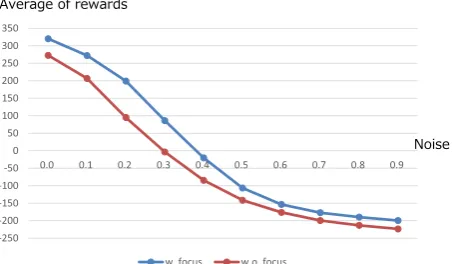
Figure 4: Effect of introduction of the user focus in simulation.
(8 users, 24 dialogues) with the proposed dialogue system.
5.1 Evaluation of dialogue manager with user simulator
First, we evaluated the dialogue manager with user simulation that is constructed from the train-ing corpus (Section 3.1). In this evaluation, the system calculated average reward of 100,000 di-alogue sessions between the system and the user simulator given a fixed noise rate.Figure 4shows the effect of the user focus. By introducing the user focus, the system receives higher rewards than the model without the user focus. Especially, the proposed model is more robust with a noise level of 10–30% that spoken dialogue systems of-ten encounter (Yoshino et al., 2013a).
5.2 Evaluation of dialogue state tracking with real users
Dialogue state tracking (DST) is a task of track-ing the correct user state with a noisy input (e.g. ASR and NLU errors) (Williams et al., 2013). It tries to maximize the probability of the belief of the correct states, but we evaluated the accu-racy of the 1-best result of the belief update. We also evaluated the average reward of each logue. The baseline system is a rule-based dia-logue manager which we previously implemented. The baseline system is operated by a score of the question-answering module using predicate-argument structures (Yoshino et al., 2011) and reg-ular expressions forTPandGRmodules.
Sys: Hello.
Usr: Hello. Tell me today's news.
Sys: Tanaka showed a crazy split. His colleague Sabathia was stunned.
Usr: What is the crazy split?
Sys: His split comes just like a four-seam, but it drops quickly in front of the home plate. Usr: Where was he training?
Sys: Tanaka practiced at the bullpen in the New York Yankees' camp on Feb. 20th.
Usr: (pause)
Sys: By the way, he also practiced a drop two-seam on Feb. 18.
Usr: Does his two-seam drop?
Sys: The catcher said "Tanaka's two-seam not only slides, but also drops."
Usr: OK, any other news?
Sys: Yankees' Ichiro is training strenuously! Usr: Tell me more.
Sys: Ichiro came to the field an hour earlier than usual and trained strenuously.
…
ݏ=TP, ܲ ݏ=0.8, ܾ(ݏ=TP)=0.800, ݂=0
ܽ=TP, ܾ(ݏ=TP݂=0)=0.8
ݏ=QA, ܲ ݏ=0.4, ܾ(ݏ=QA)=0.934, ݂=1
ܽ=QA, ܾ(ݏ=QA, ݂=1)=0.9
ݏ=QA, ܲ ݏ=0.8, ܾ(ݏ=QA)=0.973, ݂=1
ܽ=QA, ܾ(ݏ=QA, ݂=1)=1.0
ݏ=NR, ܲ ݏ=1.0, ܾ(ݏ=NR)=1.00, ݂=1
ܽ=PP, ܾ(ݏ=NR, ݂=1)=1.0
ݏ=QA, ܲ ݏ=0.6, ܾ(ݏ=QA)=0.867, ݂=1
ܽ=QA, ܾ(ݏ=QA, ݂=1)=0.9
ݏ=TP, ܲ ݏ=0.8, ܾ(ݏ=TP)=0.984, ݂=0
ܽ=TP, ܾ(ݏ=TP, ݂=0)=1.0
ݏ=ST, ܲ ݏ =0.9, ܾ(ݏ=ST)=0.871, ݂=0
ܽ=ST, ܾ(ݏ=ST, ݂=0)=0.9
Dialogue 1
Sys: Hello.
Usr: Hello. Tell me today's news?
Sys: Matsui, a part-time coach for the Giants, demonstrated 5 homeruns. The Giants president told him "Come back as a player!" Usr: What happened?
Sys: The godzilla cannon came back to the Giants‘ spring camp in Miyazaki.
Usr: What is the Godzilla cannon?
Sys: The Godzilla coach demonstrated his home-run batting to young players. Usr: Next please.
Sys: To be a ace pitcher, has Fujinami improved from the rookie year?
…
ݏ=TP, ܲ ݏ=0.8, ܾ(ݏ=TP)=0.800, ݂=0
ܽ=TP, ܾ(ݏ=TP݂=0)=0.8
ݏ=QA, ܲ ݏ=0.8, ܾ(ݏ=QA)=0.532, ݂=0
ܽ=ST, ܾ(ݏ=QA, ݂=0)=0.5
ݏ=QA, ܲ ݏ=0.8, ܾ(ݏ=QA)=0.806, ݂=1
ܽ=QA, ܾ(ݏ=QA, ݂=1)=0.8
ݏ=TP, ܲ ݏ=0.8, ܾ(ݏ=TP)=0.986, ݂=0
ܽ=TP, ܾ(ݏ=TP, ݂=0)=1.0
[image:7.595.121.475.62.470.2]Dialogue 2
Figure 5: A dialogue example. (This example is translated from Japanese)
Table 6: Accuracy of dialogue state tracking. rule focus POMDP Accuracy of tracking 0.561 0.869 (1-best) (=175/312) (=271/312)
Average reward -22.9 188.6
improved SLU accuracy and robustness against ASR errors, especially reducing confusions be-tween question answering (QA) and topic presen-tation (TP). Moreover, belief update can detect the
TP state even if the SLU incorrectly predictsQA
orST.
5.3 Discussion of trained policy
An example dialogue is shown in Figure 5. In the example, the system selects appropriate
ac-tions even if the observation likelihood is low. At the 4th turn of Dialogue 1 in this example, the sys-tem with the user focus responds with an action of proactive presentationa=PP, but the system with-out the user focus responds with an action of topic presentationa=TP. At the 2nd turn of Dialogue 2, the user asks a question without a focus. The con-fidence of s=QAis lowered by the belief update, and the system selects the story telling module
a=ST. These examples show that the training re-sult (=learned policy) reflects our design described in Section 4.4: It is better to make a proactive pre-sentation when the user is interested in the topic. 6 Conclusions
[image:7.595.80.283.540.598.2]infor-mation according to the user’s interest, by track-ing the user focus. We introduce the user focus detection model, and developed a POMDP frame-work which tracks user focus to select the appro-priate action class (module) of the dialogue sys-tem. In experimental evaluations, the proposed di-alogue management approach determines the state of the user more accurately than the existing sys-tem based on rules. An evaluation with a user sim-ulator shows that including user focus in the dia-logue manager’s belief state improves robustness to ASR/SLU errors.
In future work, we plan to evaluate the system with a large number of real users on a variety of domains, and optimize the reward function for the information navigation task.
Acknowledgments
We thank Dr. Jason Williams for his valuable and detailed advice to improve this paper on SIGDIAL mentoring program. This work was supported by Grant-in-Aid for JSPS Fellows 25-4537.
References
Dan Bohus and Alexander I. Rudnicky. 2003. Raven-claw: Dialog management using hierarchical task
decomposition and an expectation agenda. In
Pro-ceedings of the 8th European Conference on Speech Communication and Technology, pages 597–600. Blai Bonet. 2002. An e-optimal grid-based algorithm
for partially observable Markov decision processes. InProceedings of International Conference on Ma-chine Learning, pages 51–58.
Deborah A. Dahl, Madeleine Bates, Michael Brown, William Fisher, Kate Hunicke-Smith, David Pallett, Christine Pao, Alexander Rudnicky, and Elizabeth Shriberg. 1994. Expanding the scope of the ATIS
task: the ATIS-3 corpus. In Proceedings of the
workshop on Human Language Technology, pages 43–48.
Barbara J. Grosz and Candace L. Sidner. 1986. Atten-tion, intentions, and the structure of discourse. Com-putational Linguistics, 12(3):175–204.
Ryuichiro Higashinaka, Katsuhito Sudoh, and Mikio Nakano. 2006. Incorporating discourse features into confidence scoring of intention recognition
re-sults in spoken dialogue systems.Speech
Communi-cation, 48(3):417–436.
Tatsuya Kawahara. 2009. New perspectives on spoken language understanding: Does machine need to fully
understand speech? InProceedings of IEEE
work-shop on Automatic Speech Recognition and Under-standing, pages 46–50.
Kazunori Komatani and Tatsuya Kawahara. 2000. Flexible mixed-initiative dialogue management us-ing concept-level confidence measures of speech
recognizer output. InProceedings of the 18th
con-ference on Computational linguistics, pages 467– 473.
Esther Levin, Roberto Pieraccini, and Wieland Eckert. 2000. A stochastic model of human-machine inter-action for learning dialog strategies. IEEE Transac-tions on Speech and Audio Processing, 8(1):11–23. Toyomi Meguro, Ryuichiro Higashinaka, Yasuhiro
Mi-nami, and Kohji Dohsaka. 2010. Controlling listening-oriented dialogue using partially
observ-able markov decision processes. In Proceedings
of the 23rd International Conference on Computa-tional Linguistics, pages 761–769.
Teruhisa Misu and Tatsuya Kawahara. 2010. Bayes risk-based dialogue management for document
re-trieval system with speech interface. Speech
Com-munication, 52(1):61–71.
George E. Monahan. 1982. State of the art? a survey of partially observable Markov decision processes:
Theory, models, and algorithms. Management
Sci-ence, 28(1):1–16.
Naoaki Okazaki. 2007. CRFsuite: a fast implementa-tion of Condiimplementa-tional Random Fields (CRFs).
Yi-Cheng Pan, Hung yi Lee, and Lin shan Lee. 2012. Interactive spoken document retrieval with sug-gested key terms ranked by a markov decision
pro-cess. IEEE Transactions on Audio, Speech, and
Language Processing, 20(2):632–645.
Emanuel A. Schegloff and Harvey Sacks. 1973. Open-ing up closOpen-ings. Semiotica, 8(4):289–327.
Tomohide Shibata, Yusuke Egashira, and Sadao Kuro-hashi. 2014. Chat-like conversational system based on selection of reply generating module with
rein-forcement learning. In Proceedings of the 5th
In-ternational Workshop Series on Spoken Dialog Sys-tems.
Gokhan Tur, Umit Guz, and Dilek Hakkani-Tur. 2006.
Model adaptation for dialog act tagging. In
Pro-ceedings of IEEE workshop on Spoken Language Technology, pages 94–97. IEEE.
Christopher JCH Watkins and Peter Dayan. 1992. Q-learning. Machine learning, 8(3):279–292.
Jason D. Williams and Steve Young. 2007. Par-tially observable Markov decision processes for spo-ken dialog systems. Computer Speech & Language, 21(2):393–422.
Jason D. Williams, Antoine Raux, Deepak Ramachan-dran, and Alan Black. 2013. The dialog state
track-ing challenge. In Proceedings of the 14th Annual
Koichiro Yoshino, Shinsuke Mori, and Tatsuya Kawa-hara. 2011. Spoken dialogue system based on infor-mation extraction using similarity of predicate
argu-ment structures. InProceedings of the 12th Annual
Meeting of the Special Interest Group on Discourse and Dialogue, pages 59–66.
Koichiro Yoshino, Shinsuke Mori, and Tatsuya Kawa-hara. 2013a. Incorporating semantic information to selection of web texts for language model of spoken
dialogue system. InProceedings of IEEE
Interna-tional Conference on Acoustic, Speech and Signal Processing, pages 8252–8256.
Koichiro Yoshino, Shinji Watanabe, Jonathan Le Roux, and John R. Hershey. 2013b. Statistical dialogue management using intention dependency graph. In
Proceedings of the 6th International Joint Confer-ence on Natural Language Processing, pages 962– 966.
Steve Young, Milica Gaˇsi´c, Simon Keizer, Franc¸ois Mairesse, Jost Schatzmann, Blaise Thomson, and Kai Yu. 2010. The hidden information state model: A practical framework for POMDP-based spoken
dialogue management. Computer Speech &