Modelling Discourse in STAG:
Subordinate Conjunctions and Attributing Phrases
Timoth´ee Bernard Universit´e Paris Diderot
ALPAGE
Laurence Danlos Universit´e Paris Diderot
ALPAGE, IUF
Abstract
We propose a new model in STAG syntax and semantics for subordinate conjunc-tions (SubConjs) and attributing phrases – attitude/reporting verbs (AVs; believe, say) and attributing prepositional phrase
(APPs; according to). This model is
discourse-oriented, and is based on the ob-servation that SubConjs and AVs are not homogeneous categories. Indeed, previ-ous work has shown that SubConjs can be divided into two classes according to their syntactic and semantic properties. Simi-larly, AVs have two different uses in dis-course: evidential andintentional. While
evidential AVs and APPs have strong se-mantic similarities, they do not appear in the same contexts when SubConjs are at play. Our proposition aims at representing these distinctions and capturing these var-ious discourse-related interactions.
1 Introduction
A text as a whole must exhibit some coherence that makes it more than just a bag of sentences. This coherence hinges on the discourse relations
(DRs), that express the articulations between the different pieces of information of the text. There is still debate about the number and the nature of DRs, yet typical DRs include Contrast, Con-sequence or Explanation (Asher and Lascarides,
2003). In this paper we consider that DRs are two-place predicates that structure the text at the dis-course level (1a) but also at the sentence level (1b). In these two examples, the Consequencerelation
is explicit, i.e. lexically signalled, but a DR can
also beimplicit, i.e. semantically inferred. This
is for instance the case whenthereforeis removed
from (1b) to produce (1c).1
(1) a. Fred was ill. Therefore,he stayed home. b. Fred was ill,hethereforestayed home. c. Fred was ill,he stayed home.
Therefore is a discourse connective (DC), a
group of lexical elements whose function is to sig-nal that a DR holds between two spans of text.2
DCs can be of different syntactic categories; we are specifically concerned here with subordinate conjunctions (SubConjs). SubConjs are generally considered a homogeneous category although pre-vious work such as (Haegeman, 2004) has shown they can be divided into two classes with distinc-tive syntactic and semantic properties. Such prop-erties are the possibility or impossibility of cleft sentences illustrated in (2) or the difference of scope observed in (3).
(2) a. It is whenhe was twenty thatFred went to Brazil.
b. #It is even though he really wanted to come that Fred stayed home.
(3) a. He did not come because he was hungry: he came because he was thirsty.
b. #He did not come even though he still had work to do: he came even though he was tired.
In addition to SubConjs, we are interested in
attitude verbs andreporting verbs (AVs) – verbs
1Following the conventions of the PDTB (Prasad et al.,
2007), we refer to the two arguments of DRs as Arg1 and
Arg2and use italics and bold face respectively to indicate the
spans of text for each argument.
2There exist more complex markers constituting an open
like say or believe, which describe an action or
a state but also report the stance of an agent to-wards a given semantic proposition – and attribut-ing prepositional phrases (APPs; e.g. according to). These have particular interactions with DCs in
general and SubConjs in particular. Some of these phenomena could probably be correctly analysed with a purely semantic treatment of at-issueness
inspired from (Potts, 2005) and (Scheffler, 2013). However, we think a proper treatment of the syn-tactic aspects as well requires a different formal-ism. The goal of this work is to model these var-ious lexical elements in a Synchronous Tree Ad-joining Grammar (STAG, (Shieber and Schabes, 1990)). Current models so far (see (Nesson and Shieber, 2006), or (Danlos, 2009) which focuses specifically on discourse analysis) do not incorpo-rate most of the properties mentioned in this paper. The paper is organised as follows. Section 2 presents relevant work related to DCs, AVs and some of their interactions. Section 3 exposes and summarises the properties we are aiming for with our model. Then, Section 4 describes our STAG proposition. Section 5 discusses this model and introduce a possible evolution.
2 Relevant Work
2.1 Non-Alignment of Syntactic and
Discourse Arguments
According to a number of authors (see (Dinesh et al., 2005) for English and (Danlos, 2013) for French), in a sentence like (4a) the speaker intends to contrast her belief with the belief of Sabine; hence the inclusion ofSabine thinksin Arg2. On
the contrary, in (4b) the speaker does not intend to oppose her belief with the one of Sabine, but rather Fred’s stay in Peru with his (alleged) absence of stay in Lima; hence the exclusion ofSabine thinks
from the argument of the DR. In this last case, we observe that the (semantic/discourse) argument of the DR is included in but not equal to the propo-sitional content of the (syntactic) argument of the DC.3
Such non-alignments of the syntactic and dis-course arguments (“mismatches” in the following) often arise withattitude verbsandreporting verbs
(AV): when an AV together with the clause it in-troduces is an argument of a DC, the AV may (4a)
3Another argument for this distinction is that Sabine thinkscan be felicitously removed from (4b) while it cannot from (4a).
or may not (4b) be included in the discourse argu-ment of the corresponding DR. Following (Asher et al., 2006), we say the AV is intentionalin the
first case and evidential in the second. One can
notice that an evidential AV is equivalent to the expressionaccording to Sabine.
(4) a. Fred went to PerualthoughSabine thinks
he never left Europe.
b. Fred went to Perualthough Sabine thinks
he has never been to Lima.
It is interesting to note, as highlighted in (Hunter and Danlos, 2014), that contrarily to
althoughnot all DCs can be found with such
mis-matches. It is the case, for instance, ofbecause, as
illustrated in (5). (Hunter and Danlos, 2014), us-ing the DR hierarchy of the PDTB, observes that a DC lexicalising a COMPARISON or an EXPAN-SION relation can often be found with a mismatch, whereas it seems impossible for a DC lexicalising a TEMPORAL or a CONTINGENCY relation.
(5) a. Fred could not comebecausehe was not
in town.
b. #Fred could not come because Sabine thinks he was not in town.
2.2 Two Types of Adverbial Clauses
An adverbial clause is a subordinate clause that functions as an adverb. It is the case ofafter he ate
(temporal meaning) andalthough he was starving
(concessive meaning) in (6).
(6) a. Fred leftafterhe ate.
b. Fred leftalthoughhe was starving.
Traditionally, adverbial clauses are considered a rather homogeneous syntactical category. But a particular distinction between two types of adver-bial clauses is proposed by (Haegeman, 2004):
• on the one hand, the central adverbial
clauses (CAC), which add an information
(time, place, etc.) about the eventuality de-scribed in the matrix clause;
• on the other hand, the peripheral adverbial clauses(PAC), whose function is to structure
In (7),while he was a studentspecifies the date,
andif it is sunnyexpresses a necessary condition,
of the event in their respective matrix clause; they both are CACs. In (8),while Sabine has never left Europeexpresses a fact contrasting with, andif it is sunnyjustifies the interrogation in, their
respec-tive matrix clause; they both are PACs.
(7) a. Fred went to Brazilwhile he was a
stu-dent.
b. Ifit is sunny,I’ll go outside.
(8) a. Fred has been to Brazil whereasSabine
has never left Europe.
b. Ifit is sunny,why aren’t you playing out-side?
Several phenomena are studied in (Haegeman, 2004) – coordination, ellipsis, ambiguity, or phe-nomena related to scope, prosody, typography, etc. –, tending to show a greater integration of CACs into their matrix clause than PACs. Two of these phenomena are of particular interest for this work:
• “Main clause negation may scope over cen-tral adverbial clauses, but peripheral adver-bial clauses cannot fall within the scope of a negative operator in an associated clause”;
• “in addition to tense, other adverbial opera-tors may also have scope over central adver-bial clauses but they do not scope over pe-ripheral adverbial clauses”.
These two phenomena are illustrated in (9) – for negation – and (10) – for adverbs. These exam-ples each present a pair of sentences with parallel construction: the first contains a CAC and the sec-ond a PAC. In line with (Haegeman, 2004)’s ob-servation, the negation scopes over the whole sen-tence in (9a) while it only scopes over the matrix clause in (9b). Similarly, the adverb scopes over the whole sentence in (10a) while it only scopes over the matrix clause in (10b).
(9) a. Fred didn’t go to Brazil because he
wanted to learn Portuguese(but for
an-other reason).
b. Fred has not been to Brazil whereas
Sabine travels there often.
(10) a. Fred often wake up in the middle of the nightbecausehe is scared.
b. Fred often takes the bus while Sabine
prefers walking.
It should also be noted that a CAC cannot con-tain an epistemic modal if it is speaker-oriented
(as in (11a) but not in (11c) wheremayis mainly
“John-oriented”), while a PAC can (see 11b). Ex-pressed with the terms of (Hunter and Danlos, 2014): the syntactic and discourse arguments of a conjunction must be aligned in the case of a CAC, while there can be a mismatch with PACs.
(11) a. #Mary accepted the invitation without hesitation after John may have accepted it. [from (Haegeman, 2004)]
b. The ferry will be fairly cheap,
while/whereasthe planemay/will
proba-blybe too expensive. [from (Haegeman,
2004)]
c. John is worriedbecausehe may be ill.
In this paper, a SubConj introducing a CAC is called aCConjand a SubConj introducing a PAC
is called aPConj. It is important to keep in mind
that, as illustrated in (7b) and (8b), a same Sub-Conj, depending on its meaning, can alternatively introduce a CAC or a PAC.
3 Desired Properties of the Model
Before exposing our STAG model, we list in this section the properties that we want to include. First, we want our model to be able to account for the possibilities (with PConjs) and impossibilities (with CConjs) of syntax-discourse mismatch pre-sented in section 2.1. Then, as explained in sec-tion 2.2, the model should allow V-modifiers of a matrix clause – such as a negation or an adverb – to scope over a CAC but not over a PAC. Finally, two other interesting properties are presented in the following section, related to the scope of AVs and the meaning of attributing prepositional phrases (according to NP,in NP’s opinion).
3.1 Scope of AVs
The scope ambiguity for V-modifiers described in (Haegeman, 2004) seems to also apply to some S-modifiers such as AVs. A sentence of the form
Sabine thinks A because B can either mean that
the A-because-of-B relation (wide scope).4 This
generalises well to other CConjs, however things seem different for PConjs.
There has been a lot of discussion since Frege (Frege, 1948) about the semantics of a PConj such as although. Like a presupposition,
the concessive meaning of although can project
throughpresupposition holes(negation, epistemic
modals, etc.), but it also projects through pre-supposition plugs such as AVs. Indeed, al-though is often cited as a conventional implica-ture trigger since (Grice, 1975), which are
char-acterised in (Potts, 2005) with 4 properties: non-cancellability,not at-issueness,scopelessnessand speaker-orientedness. From these properties one
can explain many of the observation in (Haege-man, 2004).5
It is also interesting to remark that there is a strong interpretation bias associated with PConjs like although: for instance, out of context, (12a)
seems intuitively to imply that Fred was actually sick. Yet, saying that the Arg2 of aConcessionis
never at-issue (i.e. that it cannot be targeted by any operator, like the concessive part of the meaning) would be taking shortcuts. Indeed, (12a) can be fe-licitously followed by (12b) even though it negates Arg2. So in such a case,he was sickis under the
semantic scope ofSabine thinks. That is why we
believe such an utterance is ambiguous: the Arg2 may (wide scope) or may not (narrow scope) be under the semantic scope of the AV; the latter be-ing a default readbe-ing. Note that we do not relate this difference to a matter of centrality vs. periph-erality; in both cases the lexicalised relation is the same speaker-oriented Concession and is not
at-issue.
(12) a. Sabine thinks Fred came to work
althoughhe was sick.
b. But she is wrong, he had recovered sev-eral days ago.
4We are here implicitly dealing with the causalbecause,
which introduces a CAC, whereas there also exists a prag-maticbecauseas inIt has rained because the ground is wet. Such pragmatic DCs are particular in many ways and even though we believe they introduce PACs, we won’t consider them in detail here.
5One reviewer points out thatalthoughcan be embedded
under negation as inFred didn’t leave ALTHOUGH Lucy ar-rived, but because of it. We think that in such a case, the sub-ordinate clause behaves as a central one and thatalthoughcan be satisfactorily modelled with an ambiguity between PConj and CConj.
c. Althoughhe was sick, Sabine thinksFred came to work.
Although we lack space to support this claim, we believe that those properties about at-issueness, speaker-orientedness and scope ambi-guity are shared among PConjs. Even if PConjs are strongly biased towards the narrow scope read-ing, we still want our model to be able to handle both interpretations. Furthermore, the difference between them is not only a semantic one; only when the AV has narrow scope can the adverbial clause be anteposed (with no shift in meaning) as in (12c) – this applies to PConjs and CConjs equally.
3.2 Attributing Prepositional Phrases
In the context of this paper, we can consider that an evidential AV such asSabine thinksis
seman-tically equivalent to an attributing prepositional phrases (APP) such asaccording to Sabine(13a).
It might then come as a surprise that APPs can felicitously be found with CConjs (13b), which otherwise do not accept evidential AVs. In fact, the situation is not symmetrical; with a CConj, the APP does not scope only over Arg2 but also over the DR lexicalised by the CConj. (13b) is in-deed semantically equivalent to (13c). We want our model to predict the correct semantics for sen-tences including an APP. Note that APPs are ad-verbials, and thus can also appear in clause-medial position (13d).6
(13) a. Fred could not come even though,
ac-cording to Sabine,he was really looking
forward to it.
b. Fred could not come because, according
to Sabine,he was not in town.
c. Fred could not come and, according to Sabine, it is because he was not in town. d. Fred could not comeeven thoughhe was,
according to Sabine, really looking
for-ward to it.
4 Our Proposition in STAG
We now turn to STAG and propose new structures for AVs and SubConjs, in addition to a slight
vari-6We are aware that not all APPs are equivalent in terms of
ation of traditional phrase structures. These modi-fications reflect the properties described in the pre-vious sections.
4.1 AVs and APPs
AVs – as other bridge verbs – are usually mod-elled in TAG as anchors of auxiliary trees that ad-join on the S-node of the clause they introduce (Joshi, 1987). Auxiliary trees for these verbs are motivated by long distance extractions as inHe is the man Paul believes [...] Ringo said Yoko loves,
whereNP believes/saidis similar toaccording to
NP (see Fig. 1 for a model of APPs). However
this equivalence seems unwarranted for intentional AVs: such a verb describes the state or action (of believing, of saying, etc.) that is the argument of the DR, the introduced clause being a central el-ement of this eventuality but not the eventuality in itself. Intentional AVs, contrarily to evidential ones, do not appear as semantic modifier of the clause they introduce.
S S* PP
PP NP↓[1] TO
to V according
t
e↓[1] he, ti
t* ht,he, tii
saccording to
[image:5.595.326.506.50.276.2]saccording to=λp s.evid(s, p)
Figure 1: APP:βaccording to(the commas are omitted
for readability)
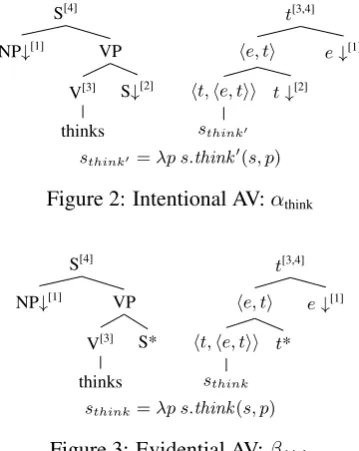
Therefore, to take into account the two eviden-tial and intentional uses of AVs, we propose an ini-tial TAG pair (Fig. 2) in addition to the auxiliary one traditionally used (Fig. 3). In our model their semantics is also slightly different: evidential AVs use predicates – marked here without apostrophe unlike intentional predicates – that are “erased” when in a peripheral DR. This is achieved by in-troducing rewriting rules of the form:
Contrast(p,think(a, q))→Contrast(p, q)
Conversely, unnatural mismatches can be avoided by discarding any analysis displaying an evidential AV predicate as argument of a central DR:
Explanation(p,think(a, q))→ ⊥
Thanks to these rules, our model will be able to get the correct semantics and to account for the possibilities and impossibilities of mismatch.
S[4]
VP S↓[2] V[3]
thinks NP↓[1]
t[3,4]
e↓[1] he, ti
t↓[2] ht,he, tii
sthink′
[image:5.595.331.500.165.259.2]sthink′ =λp s.think′(s, p)
Figure 2: Intentional AV:αthink
S[4]
VP S* V[3]
thinks NP↓[1]
t[3,4]
e↓[1] he, ti
t*
ht,he, tii
sthink sthink=λp s.think(s, p)
Figure 3: Evidential AV:βthink
4.2 Subordinate Conjunctions
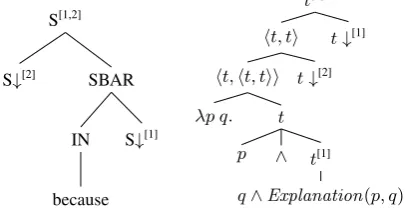
In the same vein, the difference in syntax and semantics between CACs and PACs can be ex-plained with different structures for CConjs and PConjs as in Fig. 4 and Fig. 5.7 The syntax of
all SubConjs is usually modelled homogeneously, be it with an auxiliary tree as in TAG (XTAG Re-search Group, 2001) or with an initial one as in D-LTAG (Webber, 2004), but this is not the case in our proposition. Because we model PConjs with a substitution node even for the left argument in-stead of the adjunction node of CConjs, we can assure that any modifier of the left argument (such as a negation) is only local and cannot scope over the whole Arg1∧Arg2∧R(Arg1,Arg2) proposi-tion, while this is possible with CConjs.
Also note that the link [3] for CConjs al-lows APPs such asaccording to Sabine in (13b)
to scope over both the Arg2 and the DR. With PConjs, the APP must adjoin on the right argu-ment, whicha prioriwould also be possible with
CConjs but is in fact excluded by the semantic rule for evidentials within a central DR (an APP is con-sidered as evidential). Not all S-modifiers should be allowed to adjoin on [3], in particular no AVs; a feature should then be used to restrict link [3] to natural adjunctions only.
7The presence of the SBAR-node for CConjs is necessary
[image:5.595.79.293.344.448.2]S
SBAR
S[3]
S↓[1] IN
because S*
t
ht, ti ht,ht, tii
λp q. t
p ∧ t[3]
q∧Explanation(p, q)
t*
[image:6.595.347.485.51.123.2]t↓[1]
Figure 4: CConj:βbecause
S[3]
S↓[1] IN
although S↓[2]
t[3]
t↓[1] ht, ti
t[2]
ht,ht, tii
salthough
salthough=λp q.(p∧q∧Concession(p, q))
Figure 5: PConj:αalthough
4.3 Sentence Structures
Following (Nesson and Shieber, 2006), we con-sider that sentence structures have two differ-ent adjunction sites in their semantic tree for V-modifiers (such as negation and adverbs) and S-modifiers (such as AVs). Because multiple adjunc-tions on the same node are allowed and are used to represent various scope ambiguities, doing so avoids (unnatural) interpretations of a V-modifier scoping over a S-modifier. However, CConjs are sentence modifiers like AVs but, as seen in the previous sections, they do present scope ambigu-ity when confronted with verbal modifiers such as negation. This is why, as illustrated in Fig. 6, we consider adding to sentence structures another ad-junction site on the S-node (link [3]) whose se-mantic counterpart is at the same node as verbal modifiers’ one. We can use features to restrict the other S-site (link [2]) to AVs and APPs, and con-versely to force them to adjoin there.
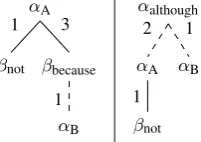
Fig. 7 shows the derivations trees obtained from the adjunction of a negation (or any verbal modi-fier) on the matrix clause of a SubConj. Our model correctly predicts that the negation can have local
orglobal scope in the case of a CConj, but only
local scope in the case of a PConj.
S[2,3]
VP ADJ absent V[1]
is NP Fred
t[2]
t[1,3]
absent(Fred)
Figure 6: A sentence structure; link [2] is re-stricted to AVs and APPs, other S-modifiers adjoin at [3].
αA
βbecause
αB 1
βnot
1 3 αalthough
αB αA
βnot 1
2 1
Figure 7: The derivation trees for¬A CONJ Bwith
a CConj (left) or a PConj (right). Because in αA
links [1] and [3] are at the same semantic node, the left tree is a scope neutral representation yielding one syntactic tree but two semantic ones depend-ing on the order of the adjunctions.
5 Discussion
5.1 Standard STAG
Tab. 1 shows the derivation trees for sentences of the form A CONJ Sabine thinks B as in (4). We
lack space to display all the derived trees cor-responding to this configuration, however Fig. 8 shows the trees obtained with a PConj and an ev-idential AV (top-right possibility in Tab. 1). The syntactic trees do not depend on the use (inten-tional or evidential) of the AV, whereas the seman-tic trees do, but only in the substitution of the ev-identialsthinkterm for the intentionalsthink′ one. This slight difference, in addition to the seman-tic rules stated earlier, accounts for the correct se-mantic of these various interpretations and the ex-clusion of analyses where an evidential AV is an argument of a CConj. Remains for PConjs, how-ever, an ambiguity that only the semantics of the various elements involved can solve.
Tab. 2 shows the derivation trees for sentences of the formSabine thinks A CONJ B, that is with
the AV in sentence-initial position as in (12a).
In this configuration, A CONJ B may be an
[image:6.595.367.468.189.260.2]in-Intentional AV Evidential AV
PConj:
αalthough
αSabine thinks
αB
2
αA
2 1
αalthough
αB
βSabine thinks
2
αA
2 1
CConj:
αA
βbecause
αSabine thinks
αB
[image:7.595.86.277.47.202.2]2 1 3
Table 1: Derivation trees for sentences of the form
A CONJ Sabine thinks B.
S
S VP
S B V thinks NP Sabine IN
although S
A
t
t
e
Sabine
he, ti
t
q
ht,he, tii
sthink
ht, ti
t
p
ht,ht, tii
salthough
Generated formula:
[image:7.595.345.482.111.332.2]p∧think(Sabine, q)∧Concession(p, q)
Figure 8: Result of the analyse of A although Sabine thinks Bwith an evidential AV.
tentional or evidential status of the AV is undeter-mined; we have chosen to use the traditionalβthinks
[image:7.595.122.258.253.464.2]pair. As before, this configuration presents ambi-guities that can only be resolved with the help of the semantics of the particular DR.
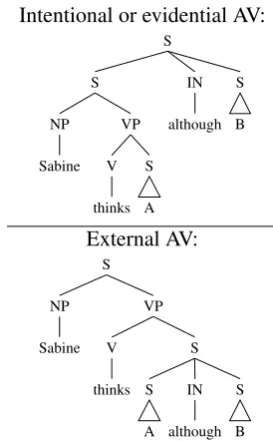
Fig. 9 shows the two syntactic trees obtained in this configuration with the PConjalthough,
de-pending on the role of the AV (on the top: inten-tional or evidential; at the bottom: external). Note that our model analyses the evidential case with a syntax-discourse mismatch on Arg1. Indeed, in the top treeSabine thinks Ais the syntactic
argu-ment ofalthough, whereas if the AV is evidential,
only the propositional content ofAconstitutes the
Arg1 of Concession. This analysis is supported
by the possibility of anteposition of the
subordi-nate clause in intentional and evidential cases il-lustrated in (12c): the anteposition ofalthough B
appears natural from the top tree and not from the bottom one.
Intentional or evidential AV:
S
S B IN although S
VP S A V thinks NP Sabine
External AV:
S VP
S S B IN although S
A V thinks NP Sabine
Figure 9: Syntactic derived trees for sentences of the form Sabine thinks A although B. Note that
with although (a PConj), the tree at the bottom
corresponds to a less likely reading that must be forced by the context.
Finally, Fig. 10 shows the analyses forA CONJ, according to Sabine, B. Note how the additional
link [3] in CConjs lead to a correct interpretation of (13b) where the APP scopes over both the DR and its Arg2 as stated in section 3.2.
αA
βbecause
αB βaccording to Sabine
3 1
3
αalthough
αB
βaccording to Sabine 2
αA
2 1
Figure 10: The derivation trees for A CONJ, ac-cording to Sabine, Bwith a CConj (left) or a PConj
(right).
5.2 Towards Multi-Component TAG
[image:7.595.327.504.507.580.2]Intentional AV Evidential AV External AV
PConj:
αalthough
αB αSabine thinks
αA
2
2 1
αalthough
αB αA
βSabine thinks
2
2 1
αalthough
αB αA βSabine thinks
3 2
1
CConj:
αSabine thinks
βbecause
αB
1
αA
2 3
αA
βbecause
αB
1
βSabine thinks
[image:8.595.158.442.47.204.2]2 3
Table 2: Derivation trees for sentences of the formSabine thinks A CONJ B.
in middle position with the same meaning as il-lustrated in (13d). This clearly poses a problem for our current approach, because an APP in mid-dle position must adjoin on the right argument and thus cannot scope over the DR itself. It seems we can overcome this problem with the help of Multi-Component Tree Adjoining Grammars (MCTAG) in a fashion similar to what is done for noun phrases in (Nesson and Shieber, 2007). We won’t give here a fully detailed MCTAG proposition, but rather sketch the main aspects of it.
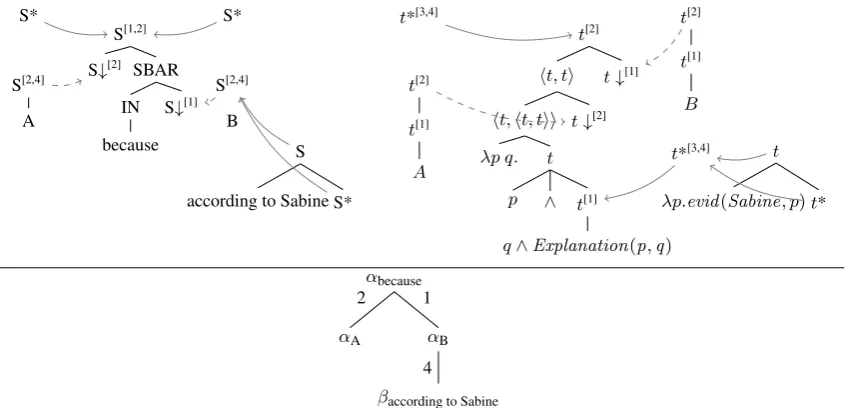
Our idea is that when an S-constituent is the syntactic argument (be it left or right) of a Sub-Conj, its modifiers can have a local scope (i.e. within this constituent), or, in the case of a CConj, also a wider scope (which depends on whether the S-constituent is on the left or right of the CConj). These scope phenomena could be dealt with homogeneously by considering a two-component structure for the S-constituents as shown in Fig. 11. One component provides the content of the sentence while the other one – a vestigial (S*, t*) one – would serve the purpose of “pluging in” the correct node of the SubConj’s semantic tree for subsequent adjunctions. Links [1,2] in Fig. 11 are for local scope and links [3,4] for (possibly) wider scope. Because of this multi-component structure, we probably don’t need an adjunction site for the left argument of CConjs anymore, as they can be modelled with two sub-stitution sites as shown in Fig. 12.
With such a model, sentences with a CAC con-taining a clause-initial APP like (13b) could be analysed as in Fig. 13. The derivation tree for sen-tences with clause-medial APP would be almost identical: the APP would adjoin on the link [3] of αBinstead of the link [4].
S[2,4]
VP ADJ absent V[1,3]
is NP Fred
t[2]
t[1]
[image:8.595.314.522.247.321.2]absent(Fred) S* t*[3,4]
Figure 11: A sketch of MCTAG structure for S-constituents.
S[1,2]
SBAR
S↓[1] IN
because S↓[2]
t[2]
ht, ti ht,ht, tii
λp q. t
p ∧ t[1]
q∧Explanation(p, q)
t↓[2]
t↓[1]
Figure 12: A sketch of MCTAG structure for CConjs.
6 Conclusion
We have first recalled the notion of syntax-discourse mismatch and related it to the two in-tentional and evidential uses of AVs. Then, we have presented the distinction made in (Haege-man, 2004) between central and peripheral ad-verbial clauses. Additional syntactic and seman-tic phenomena were mentioned, which have moti-vated our STAG model. This model is enriched with new structures for AVs and SubConjs that reflect the distinctions and properties previously highlighted.
Yet, it is still too constrained regarding the rel-atively free position of attributing prepositional
[image:8.595.315.518.377.483.2]Multi-S[1,2]
S↓[2] SBAR IN because
S↓[1] S[2,4]
B S*
S[2,4]
A S*
S
according to Sabine S*
t[2]
ht, ti ht,ht, tii
λp q. t
p ∧ t[1]
q∧Explanation(p,q)
t↓[2]
t↓[1]
t[2]
t[1]
B
t*[3,4] t[2]
t[1]
A t*[3,4]
t
λp.evid(Sabine, p)t*
αbecause
αB
βaccording to Sabine 4
αA
[image:9.595.89.514.48.252.2]2 1
Figure 13: MCTAG analysis of sentences with a CAC containing a clause-initial APP like (13a).
Component TAG formalism, which we believe is more suitable for modelling fine-grained phenom-ena in discourse. Only a sketch of an MCTAG model is given here; we plan on developing these ideas in the future. Furthermore, projection prop-erties not mentioned here will probably require us to refine our proposal, before extending our ap-proach to the other categories of discourse connec-tives. Among them, adverbials are the most prob-lematic; their ability to be integrated inside one of their argument has lead previous TAG-based accounts – namely D-LTAG (Webber, 2004) and D-STAG (Danlos, 2009) – to resort to a complex parsing process with an intermediate step. While more recent work has been successful in getting rid of this additional step in an elegant way (Dan-los et al., 2016), it requires a substantial change in formalism (the use ofAbstract Categorial Gram-mars (de Groote, 2001)). Further investigation
with MCTAG may confirm whether such a change is necessary.
References
N. Asher and A. Lascarides. 2003. Logics of
Conver-sation. Cambridge University Press.
N. Asher, J. Hunter, P. Denis, and B. Reese. 2006. Evidentiality and intensionality: Two uses of
repor-tative constructions in discourse. In Workshop on
Constraints in Discourse Structure, Maynooth, Ire-land.
L. Danlos, A. Maskharashvili, and S. Pogodalla. 2016. Interfacing Sentential and Discourse TAG-based Grammars. To appear in the proceedings of the 12th
International Workshop on Tree Adjoining Gram-mars and Related FormalismsTAG+12 (TAG+12), D¨usseldorf, Germany., June.
L. Danlos. 2009. D-STAG: a Formalism for Discourse Analysis based on SDRT and using Synchronous
TAG. In P. de Groote, editor,Proceedings of FG’09.
INRIA.
L. Danlos. 2013. Connecteurs de discours adverbiaux:
Probl`emes `a l’interface syntaxe-s´emantique.
Lin-guisticae Investigationes, 36(2):261–275, Decem-ber.
P. de Groote. 2001. Towards Abstract Categorial
Grammars. InProceedings of the 39th Annual
Meet-ing on Association for Computational LMeet-inguistics, ACL ’01, pages 252–259, Stroudsburg, PA, USA. ACL.
N. Dinesh, A. Lee, E. Miltsakaki, R. Prasad, A. Joshi, and B. Webber. 2005. Attribution and the (Non-)Alignment of Syntactic and Discourse Arguments
of Connectives. InProceedings of the Workshop on
Frontiers in Corpus Annotations II: Pie in the Sky, pages 29–36, Ann Arbor, Michigan, June. ACL.
G. Frege. 1948. Sense and Reference.The
Philosoph-ical Review, 57(3):209–230.
H. Grice. 1975. Logic and conversation. In P. Cole and
L. Jerry, editors, Syntax and semantics 3: Speech
acts, pages 41–58. Academic Press, San Diego, CA.
L. Haegeman. 2004. The syntax of adverbial clauses and its consequences for topicalisation. In M.
Co-ene, G. De Cuyper, and Y. D’Hulst, editors,Current
Studies in Comparative Romance Linguistics, num-ber 107 in APiL, pages 61–90. Antwerp University.
J. Hunter and L. Danlos. 2014. Because We Say
on Computational Approaches to Causality in Lan-guage, CAtoCL, pages 1–9, Gothenburg, Sweden, April. ACL.
A. Joshi. 1987. An introduction to Tree Adjoining
Grammars. Mathematics of Language, 1:87–115.
R. Nesson and S. Shieber. 2006. Simpler TAG
seman-tics through synchronization. InProceedings of FG
2006, pages 129–142, Malaga, Spain.
R. Nesson and S. Shieber. 2007. Extraction Phenom-ena in Synchronous TAG Syntax and Semantics. In Proceedings of the NAACL-HLT 2007/AMTA Work-shop on Syntax and Structure in Statistical Transla-tion, SSST ’07, pages 9–16, Stroudsburg, PA, USA. ACL.
C. Potts. 2005.The logic of conventional implicatures.
Oxford University Press Oxford.
R. Prasad, E. Miltsakaki, N. Dinesh, A. Lee, A. Joshi,
L. Robaldo, and B. Webber. 2007. The Penn
Discourse Treebank 2.0 Annotation Manual. IRCS
Technical Reports Series, December.
R. Prasad, A. Joshi, and B. Webber. 2010. Realization of Discourse Relations by Other Means: Alternative
Lexicalizations. In Proceedings of the 23rd
Inter-national Conference on Computational Linguistics, pages 1023–1031, Beijing, China, August.
T. Scheffler. 2013. Two-dimensional Semantics.
Clausal Adjuncts and Complements. De Gruyter Mouton, Berlin/Boston.
S. Shieber and Y. Schabes. 1990. Synchronous
Tree-adjoining Grammars. In Proceedings of the 13th
Conference on Computational Linguistics - Volume 3, COLING ’90, pages 253–258, Stroudsburg, PA, USA. ACL.
B. Webber. 2004. D-LTAG: extending lexicalized
TAG to discourse. Cognitive Science, 28(5):751–
779, September.