Munich Personal RePEc Archive
Dynamic Games under Bounded
Rationality
Zhao, Guo
Southwest University for Nationalities
8 March 2015
Dynamic Games under Bounded Rationality
G
UOZ
HAO Southwest University for Nationalities , Chengdu 610041,China
Abstract
:
I propose a dynamic game model that is consistent with the paradigm
of bounded rationality. Its main advantages over the traditional approach based on
perfect rationality are that: (1) under given state the strategy space is a
chain-complete partially ordered set; (2) the response function satisfies certain
order-theoretic property; (3) the evolution of economic system is described by the
Dynamical System defined by iterations of the response function; (4) the
existence of equilibrium is guaranteed by fixed point theorems for ordered
structures. If the preference happens to be represented by a utility function and the
response was derived from utility maximization, then the equilibrium defined by
fixed points of the response function will be the same as Nash equilibrium. This
preference-response framework liberates economics from the utility concept, and
constitutes a synthesis between normal-form and extensive-form games. And the
essential advantages of our preference-response approach was secured by
successfully resolving some long-standing paradoxes in classical theory, yielding
straightforward ways out of the impossibility theorem of Arrow and Sen, the
Keynesian beauty contest, the Bertrand Paradox, and the backward induction
paradox. These applications have certain characteristics in common: they all
involve important modifications in the concept of perfect rationality.
Keywords
:
Dynamic Games; Bounded Rationality; Dynamical System
JEL classification
:
C72, C78
1. INTRODUCTION
Among the common assumptions of classical existence theorems for competitive
equilibrium, one is central. That is, individuals are assumed to have perfect rationality, so
as to maximize their utilities (payoffs in game theoretic usage). With perfect rationality
and perfect competition, the competitive equilibrium is completely determined, and the
equilibrium depends only on their goals and their environments. With perfect rationality
and perfect competition, the classical economic theory turns out to be deductive theory
that requires almost no contact with empirical data once its assumptions are accepted as
axioms (see Simon 1959).
Unfortunately, this is empirically not the economic problem which society faces in
reality (see Hayek 1945). More seriously, under the assumption of perfect rationality one
can not develop a “truly” dynamic theory of games (see Aumann 1997). The difficulty is
that perfectly rational players have foresight, so they can contemplate all of time from the
beginning to play. Thus the situation can be seen as one-shot game, each play of which is
actually a long sequence of “stage games,” and then one has lost the dynamic character of
the situation.1 This conceptual difficulty can only be “solved” by eliminating the perfect
foresight under the constraint of bounded rationality.
Generally, models of bounded rationality are richer in structure than models of perfect
rationality, because they treat not only of equilibrium but of the process of reaching it as
well. Nevertheless, if we wanted to know about the dynamic behavior of an economy
before equilibrium was reached, then much more information would be required. For
example, we need information not only about the structures of the strategy space, but also
about the dynamics of the response function. In other words, we need to known how
people do behave, not just how they should behave (see Simon 1955, 1972). Lacking the
empirical knowledge of the decisional processes that will be required for a definitive
theory, one cannot describe the actual world in a systematic and rigorous way.
Essentially, bounded rationality means that players respond to each other’s behavior in
a relatively stable pattern, though not the best. Under the constraint of bounded
rationality, players may quest for satisfactory outcome rather than optimal outcome
(Simon 1959). Heuristic rule in the pursuit of satisfactory outcome is utilized rather than
its sharp contrast, the pursuit of “maximized utility.” Rather than consciously maximizing
1
in each decision situation, people adopt rules that work well “on average”, taken over all
decision situations to which that rule applies (see Aumann 2008).
In this paper, I propose a dynamic game model that is consistent with bounded
rationality. According to Aumann (2008), our preference-response based approach can be
categorized into the idea of rule rationality, which may provide a synthesis between
rationalistic neo-classical economic theory and behavioral economics. Rule rationality is
a form of bounded rationality yielded by the evolutionary paradigm.2 From molecular
biology, we have seen how a basic mechanism—the DNA double helix and the base
pairing rules—can account for a wide range of complex phenomena (see Simon 1979).
Historically, a significant catalyst to the development of the theory of rule rationality was
the experimental work of Axelrod and Hamilton (1981), based on the idea of a computer
to program for playing repeated prisoner’s dilemma. And the winner of Axelrod’s
tournament –TIT FOT TAT – was, because of its simplicity, nicely illustrative of the rule
rationality idea (see Aumann 1997).
With no lose of generality we assume that every player considers the range of
alternatives to be beyond his power to alter and hence knows the strategy sets of all
players .
i
S
n
i
1
,
2
,
,
3 In our dynamic game model, players have to make decisionsunder given state. If states change, then either the strategy set or the preference or the
response function will change accordingly.
Under given state, however, each player
may make his choice within a set of alternatives more limited than the whole
range of objectively available to it. Formally,
Given a state
the ference
i
≧ of
{
1
,
2
,
,
n
}
is just a partial order on his conditional ti
i
S
S
(
)
p
st y se re
rateg each player
i
.No utility concept need be hypothesized, and no topologic structure need beimposed.
2
According to Veblen (1898), any evolutionary science should be a theory of a process, of an unfolding sequence. Therefore, to study the dynamic evolution of economic system, it is necessary to investigate the process of how individuals respond to each other’s strategies under bounded rationality.
3
The Cartesian product of the ordered strategy sets of all the players
makes up the strategy space of the game, denoted by
) ≧ , S ( i i
n
i
1
,
2
,
,
(
)
(
S
1
)
S
2(
)
S
n(
)
S
.4 Mathematically, the strategy spaceS
(
)
can bemade into a partially ordered set by imposing the product order
≧
defined by(1) (x1,x2, ,xn)≧ (y1,y2, ,yn) xi≧i yi,i.
This product order describes the preference pattern for the society as a whole. 5
In order to be consistent with the relatively stable pattern of the behaviors of players
with bounded rationality, the response is assumed to be a function
R
:
S
(
)
S
(
)
,rather than a correspondence.6 Further, the stable pattern of players’ behavior is
described in terms of order-theoretic properties of the response function, such as
continuity, order preservation, and directedness. 7 Interestingly, it turns out that in the
repeated prisoner’s dilemma game, if the TIT FOT TAT strategy is adopted by both
players, then the corresponding response function is order-preserving (see section 5.4).
In essence, the response function represents a dynamical rule of strategy updating,
where player’s preferred strategy, whether optimal or satisficing, is determined by their
responses to other players' strategies (see Nash 1950, 1951; Simon 1955). From the
4
In classical theory, it is assumed that the preference can be represented by a real-valued utility function
on the strategy space
i ≧ ) ( i
U
S
(
)
, in the sense that if and only if . So in classicaltheory, the preference of each player are defined on the strategy space
y
i
≧
x U (x) U (y)
i i
)
(
S
, as opposed to the strategy setS
i(
)
of each players. In this case we shall work in the utility space rather than strategy space. For details and examples see section 2.4.5
It is silly to think that there might be social preferences that are analogous to individual preferences. In general, society as a whole may not have a social ordering relation for alternative social states. We can not expect what is true of individuals is also true of groups. For details see Arrow (1950).
6
It is worth emphasis that the assumption of response function is introduced not just to simplify the notation employed. In most real economic activities (such as auction and sports) the response does turn out to be a function, whether the player is of perfect rationality or not. When individuals are roughly indifferent between two actions they appear to choose more or less at random. Further, since most celebrated fixed point theorems for ordered structures had been generalized to set-valued functions, our model can be extended to the case of response correspondence without difficulty (see section 5.3).
7
viewpoint of dynamic system, the response function amounts to the evolution rule of the
dynamical system that describes what future states follow from the current state. Thus, to
investigate the dynamic process of decision making we have to study the dynamic system
defined by the iterations of response function.
To be specific, let the response be a function
R
:
S
(
)
S
(
)
on the strategy space.Then, to study the dynamic evolution of economic system, we must discuss the behavior
of the following dynamical system defined by the response function
(2)
k|
0,
1,
2,
3,
,
k,
R
R
R
R
R
k
R
.Further, given an initial strategy it is possible to determine all its future strategies, a
collection of points known as an orbit. Mathematically, given any initial strategy s in
strategy space
(
S(
),
≧
)
we must study the orbit generated by the iterated sequence(3)
(
)
|
,
(
),
2(
),
3(
),
,
(
),
s
R
s
R
s
R
s
R
s
k
s
R
k
k .Geometrically, if the strategy space is finite, then the partial preference
ordering can be represented by a Hasse diagram in which every vertex represents a
strategy profile (see Davey and Priestley 2002).
)
≧
),
S(
(
≧
)
8 The response function
)
(
(
:
S
S
R
is a deterministic rule that describes what future strategies followfrom the current strategy. At any given decision node belonging to the Hasse diagram,
one branch is chosen according to the rule described by the response function. Given an
initial strategy
s
S
(
)
, its orbit
R
k(
s
)
|
k
determines a path through the Hassediagram. In view of this, our preference-response framework constitutes a marriage of
normal-form game and extensive-form game: the Hasse diagram amounts to the game
tree, and the response function determines the dynamic process of decision making. 9
8
As an example, see section 2.4 for the Hasse diagram corresponding to the centipede game. 9
It turns out that the dynamic evolution of the economic system can be governed by the
behavior of this dynamical system defined by the response function under iteration.
Typically, the long term behavior of a dynamical system can be learned from its limit set,
namely
(4) {limRk(s)|s S(
)}, k which in turn determines all possible final states of the economic system.
As in classical game theory, an equilibrium of the economics system under state
is defined to be a fixed point of given response functionR
:
S
(
)
S
(
)
, i.e.,)
(
S
s
such that . It is worth emphasis that all fixed points will be containedin the limit set. Further, if the preference of each player happens to be able to be
represented by a utility function and the response function was derived from utility
maximization, then the equilibrium defined by fixed points of the response function will
be the same as Nash equilibrium (for details see section 3.1). It is this coincidence that
justifies the preference-response representation of games as a useful framework.
s
s
R
(
)
However, since players are just of bounded rationality, their preferences may not
be represented by utility functions in general. Further, the strategy space may
not have topologic structure, such as compactness and convexity. So to guarantee the
dynamic process of decision making to converge, we have to impose conditions on the
strategy space and response function in terms of order-theoretic properties, as opposed to
topologic properties.
i
≧
≧
),
)
S(
(
To this end, we assume that under given state the strategy space satisfies
the chain-complete condition (i.e. every chain has a least upper bound or a greatest lower
bound or both), and the response function
)
≧
),
S(
(
)
(
)
(
:
S
S
R
satisfies certainorder-theoretic properties, such as continuity, order preservation, and directedness. Under these
assumptions the existence of pure-strategy equilibrium can be guaranteed by fixed
pointed theorems for ordered structures, such as Zermelo-Bourbaki fixed point theorem
fixed point theorem (Abian and Brown 1961), as well as the Markowsky fixed point
theorem (Markowsky 1976). These order-theoretic fixed point theorems have been
widely cited in computer science, and have been applied to the study of supermodular
games (see Topkis 1978, 1979; Vives 1990; Milgrom and Roberts 1990).
It turns out that these order-theoretic assumptions are, in several respects, closer to
economic reality than classical theory of Nash (1950, 1951). Furthermore, there does
seem to have some advantages in concentrating attention at the preference relation and
response function on strategy space, rather than the utility. One of the advantages is that
it is dynamic in essence. Another advantage is that it permits the behavior of players with
bounded rationality. But the essential advantages of our model may be secured by
successfully resolving some longstanding paradoxes in classical theory, yielding
straightforward ways out of the impossibility theorem, the Keynesian beauty contest, the
Bertrand paradox, and the backward induction paradox. These applications have certain
characteristics in common: they all involve important modifications in the concept of
perfect rationality.
In many situations we may be interested in the precise question of whether one state is
more preferable than another. For many purpose there is needed a partial ordering
relation on pairs of elements of
, i.e., a relation which states that
1
2 if and onlyif
1is preferred to
2. In this case, a natural question is, whether the equilibriumstrategies under given states are order-preserving function of
(see section 5.2 fordetails). This problem is of considerable economic interest. Indeed, it is related to
monotone comparative statics (see Milgrom and Roberts 1994; Milgrom and Shannon
1994).
Furthermore, if the argument of the present paper is correct, then it provides partial
answers to two long-standing open problems in economics:
The first problem asks for a dynamical model that is compatible with the existing
equilibrium theory. This problem was listed into the mathematical problems for the next
century by Steve Smale (1998), and was regarded as the main problem of economic
theory. My preference-response based game model introduces dynamics into economic
defined by iterations of the response function. From the viewpoint of Dynamic System,
the response function amounts to the evolution rule of the dynamical system that
describes what future states follow from the current state. In dynamic games, the role of
response function is more fundamental than utility function.
The second problem, dated back at least to Herbert A. Simon (1955, 1959, 1978) and
Robert J. Aumann (1997), asks to establish a unified theory of bounded rationality, and to
develop a meaning for formal definition of rationality. This problem is regarded as the
most challenging conception problem in the area of bounded rationality. Within my
preference-response framework, the degree of rationality can be characterized by the
structure of fixed points of given response function (see section 3.4 for details).
The rest of the paper proceeds as follows. Section 2 builds a dynamic game model that
is consistent with the paradigm of bounded rationality. Solutions are investigated in
section 3. Applications are studied in section 4. Extensions are discussed in section 5.
Section 6 concludes this paper with some remarks.
2. THE BASIC MODEL
It has long been recognized that the concept of bounded rationality was of great
importance, but the lack of a formal approach impeded its progress. Indeed, there is no
unified definition for bounded rationality so far (Aumann 1997).10 However, models that
are described as bounded rationality tend to have some common characteristics. Thus, for
the sake of clarity, it is a good idea to begin with some definitions. What is meant by
“bounded rationality”, and, for that matter, by “dynamic games”?
1. Bounded Rationality
.—
“Bounded rationality” means that players respond to eachother’s behavior in a relatively stable pattern, subject to an adjustment process that is
rational in some dynamic sense.
10
Firstly, bounded rationality means incomplete information. Individuals with bounded
rationality may be uncertain about the “rules” of the game. 11 For example, Players with
bounded rationality may not have precise information about the specific mathematical
form of the utility functions of some other’s.12
Secondly, bounded rationality also means uncertain foresight. Nevertheless, since we
are trying to describe rationality and not some sort of irrationality, we can not assume that
players make choice completely at random and without foresight, as in Alchian (1950).
To be more realistic, we assume that all players know each other’s preference
orderings. But, under bounded rationality an individual may be willing and able to arrive
at preference decisions only for certain pairs of alternatives, while for others he may be
unwilling or unable to arrive at a decision. In short, any two alternatives may not be
comparable under bounded rationality. This means that we need to drop or modify some
of the fundamental rationality axioms that govern the preference relation in the classical
utility theory of von Neumann and Morgenstern (1944), especially the completeness
axiom.13
As a result, to make it logically compatible with the paradigm of bounded rationality,
under given state the preference of each player should to be a partial order on his
strategy set.This means that preference ordering of each player need not be expressed by
a real-valued utility function, thus liberates us from the utility concept.
11
Games with incomplete information have been systematically investigated by Harsanyi (1967/1968). However, our approach differs from that of Harsanyi in that our model need not be based on the assumption that, in dealing with incomplete information, every player will use the Bayesian approach. In contrast, under our model, it will be possible to analyze the dynamic evolution of any economic system in terms of preference ordering, rather than utility function.
12
Most existing game theory is based on the assumption that the players know each other’s utility functions. This essentially means that they know each other’s preference as well as each other’s attitudes towards risk. Bargaining Games in ignorance of the opponent’s utility function has been systematically studied by Harsanyi (1961, 1962). He discussed the more general case where the players do not know (and know they no dot know) each other’s utility functions.
13
2. Dynamic Games
.—
“Dynamic game” means extending the mathematical model ofNash equilibrium to include strategy adjustments.
As criticized by Simon (1978), economics has largely been preoccupied with the
results of rational choice rather than the process of choice. Yet as economics analysis
acquires a broader concern with the dynamics of choice under uncertainty, it will become
more and more essential to consider choice processes. The advances in our understanding
of the process of choice could provide immense help in deepening our understanding of
the dynamics of rationality. As economics moves out toward situations of increasing
complexity, it becomes increasingly concerned with the ability of agents to cope with the
complexity, and hence with the procedural aspects of rationality (see also Simon 1955,
1972).
In practice, to predict the short-run behavior of an adaptive organism in a complex and
rapidly changing environment, it is not enough to know its goals. In contrast, we must
know also a great deal about its internal structure and particularly its mechanism of
adaptation. As the complexity of the environment increases, we need to know more and
more about the mechanism and processes that economic man uses to relate himself to that
environment and achieve his goals. Thus to explain the behavior in the face of
complexity and instability of environment, the theory must incorporate at least some
description of the processes and mechanism through which the adaption takes place (see
Simon 1959).
From the viewpoint of Dynamic System, the response function amounts to the
evolution rule of the dynamical system that describes what future states follow from the
current state. In dynamic games, the role of response function is more fundamental than
the utility function. One element of realism is that, while the utility function may be
known in advance, the response function may not, especially under the circumstance of
bounded rationality.
In this section, we shall formulate the process of decision making in situations where
we wish to take explicit account of the “internal” as well as the “external” constraints that
preference and the repsonse will enable us to analysis the dynamic evolution of economic
system under bounded rationality.
In describing the proposed model, we shall begin with the most general assumptions
which are consistent with the classical economics. The mathematical techniques are
order-theoretical. A central concept is that of a chain-complete partially ordered set,
which is a generalization of the concept of a complete lattice, and includes nonempty
compact subset of finite-dimensional Euclidean space as special case (see Birkhoff 1967).
To keep things as simple as possible, in this section we build a basic model under the
assumption that
preferences are exogenous and stable (see Stigler and Becker
1977)
. In section 5, this basic model will be generalized to accommodate situations inwhich players have to make decision according to state-preference. Wherein, players are
assumed to make decision under given state. If states change, then either the strategy set
or the preference or the response function (or all) will change accordingly, and a new
equilibrium strategy will be found. 14
2.1. Preference
Since the first formulation of utility analysis by Jevons, Menger and Walras, there has
been much controversy for and against this concept.15 Indeed, the immeasurability of
utility has forced Edgeworth and Pareto to replace the old concept of utility by the
concept of an objective scale of preferences. It is shown that this change from cardinal
conception of utility to ordinal utility turned out to be a change of methodology (see
Hicks and Allen 1934).
As pointed out by Slutsky (1915), to place economic science upon a solid basis, we
must make it completely independent of psychological assumptions and philosophical
hypotheses. However, the discrediting of utility as a psychological concept robbed it of
14
It is worth enphasis that my assumption of a stable preference relation in the basic model is not just to reduce mathematical complexity, but to avoid a deep logical difficulty. That is, equilibrium strategies under different states may not be comparable with each other. In other words, equilibrium strategies are state-contingent in principle. It turns out that this problem is of considerable economic importance, but has never been emphasized in the literature. For details see section 5.2.
15
its only possible virtue as an explanation of human behavior in other than a circular sense,
revealing its emptiness as even a construction. Thus, to liberate economics from the
utility concept, economic models should be generalized to base upon operationally
meaningful foundations in terms of preference (see Samuelson 1938 a, 1938 b, 1948,
1950). 16
The replacement of utility by preference has this further advantage: it is possible to
proceed from a utility function to a scale of preference, but it is impossible to proceed in
the reverse direction. We can deduce from the utility function a scale of preference, but
this theoretical construction do not enable us to proceed from the scale of preference to a
particular utility function. Even if the utility function exists at all, it is by no means
unique and it can serve only as an index, and not as measure, of individual welfare (see
Hicks and Allen 1934).17 In many cases it is in principle impossible to get detailed
quantitative empirical information concerning the exact forms of the utility functions,
even in the neighborhood of the equilibrium point.
As in Arrow (1950), the behavior of an individual is completely expressed by a
well-behaved and stable preference pattern. This system of preferences guarantees the
consistency in the patterns of individual choice between different pairs of alternatives, so
that the choice from any collection of alternatives can be determined by knowledge of the
choices which would be made from pairs of alternatives. Under the constraint of bounded
rationality, however, any two alternatives may not be comparable. Thus, to make it
logically compatible with the paradigm of bounded rationality, the preference of each
player is just assumed to be a partial order on his strategy set.
Mathematically, under given state the preference of player
i
{
1
,
2
,
,
n
}
is a partialorder relation
≧
ion his strategy setS
i, the set of all possible alternatives. Playeri
16
In order to dispense with the notion of utility, Samuelson presented the revealed preference theory: starting from a few logical axioms of demand consistency, to derive the whole theory of valid utility analysis as corollaries. The fundamental axiom of revealed preference theory, namely the weak axiom of consumer’s behavior, assumes that the preferences of consumers can be revealed by consistent consumption behaviors. Revealed preference theory tries to provide new foundations for utility theory.
17
prefers strategy to strategy
x
iy
i will be symbolized byx
i≧
iy
i.18 More specifically,
the preference of player
i
is a binary relation on strategy set that satisfies thefollowing properties:
i
≧
S
i(i) Reflexivity:
x
i≧
ix
i for allx
i
S
i.(ii) Anti-symmetry:
x
i≧
iy
iandy
i≧
ix
i implyx
i
y
i for allx
i,
y
i
S
i.(iii)Transitivity:
x
i≧
iy
iandy
i≧
iz
i implyx
i≧
iz
i for allx y
i,
i,
z
i
S
i.The strategy set ordered by the preference relation becomes a partially ordered
set (poset for short), and will be denoted by . i
S
≧
ii
S
)
≧
i,
S
(
i19
A greatest element of the strategy set is a strategy
x
i
which playeri
would preferto all other strategies, i.e.,
x
i≧
iy
i for ally
i
S
i. The greatest element, if exists, will beunique by definition. Nevertheless, since the strategy set is just partially ordered,
we cannot expect the greatest element to exist in general.
)
≧
,
S
i i(
Within bounded rationality framework, more attention should be paid to the question
of the existence of the maximal element, a strategy that can not be dominated by other
strategies. Formally, a strategy
x
i
S
i is said to be a maximal element if there is noelement for which . It turns out that the question of the existence of the
maximal element is a fundamental problem in optimization theory. In classical economics,
this problem was often solved by imposing some topological structure on the involved
strategy sets. Fortunately, in ordered sets with no topological structures, the existence of
the maximal element can be guaranteed by invoking the famous Zorn’s Lemma (See Ok). i
i
S
y
y
i≧
ix
i18
In the terminology adopted by Arrow (1950), the preference relation should be understood as “preferred to or indifferent with”.
i
≧
19
Dually, we can use notation and interchangeably, if necessary. In general, given concept
about ordered sets, we can obtain the dual concept by replacing each occurrence of by and vice versa.
i i i
y
x
≧
y
i≦
ix
ii
Zorn’s Lemma:
Let
be a partially ordered set in which every chain (i.e.,
totally ordered subset) has an upper bound in
S. Then the set
Scontains at least
one maximal element.
)
≧
S,
(
Zorn's lemma is a powerful tool in modern mathematics, and is equivalent to the
Axiom of Choice over Zermelo–Fraenkel Set Theory (See Ok). Zorn’s Lemma allows
one to carry out constructions that may require infinite sequences of choices, each of
which depends on the preceding ones, so that one does not know initially just what
choices are to be made and in what order. 20
2.2. Strategy Space
The Cartesian product
S
1
S
2
S
n of the ordered strategy sets of all theplayers makes up the strategy space of the game, denoted by
)
≧
,
S
(
i i}
,
,
2
,
1
{
n
i
n
S
S
S
S
1
2
. Mathematically, the strategy space Scan be made into an orderedset by imposing the product order
≧
defined by(5)
(
x
1,
x
2,
,
x
n)
≧
(
y
1,
y
2,
,
y
n)
x
i≧
iy
i,
i
.This product order describes the preference pattern for society. Put otherwise, the whole
social preference relation
≧
is determined by the preference relations of all individuals. As before, all that is needed to define such an order is to know the relativeranking of each pair of alternatives of social states.
i
≧
Ordered by the product order the strategy space will become into a partially
ordered set in itself. If the strategy space Sis finite, then the partial order
≧
can be represented by a Hasse diagram: represents each element of S as a vertex in the plane anddraws a line segment or curve that goes upward from
)
≧
S,
(
x to
y
whenevery
covers x20
(that is, whenever
y
≧
x
and there is no sS such that ). These curves may cross each other but must not touch any vertices other than their endpoints. Such adiagram, with labeled vertices, uniquely determines its partial order (see Davey and
Priestley 2002).
x
s
y
≧
≧
)
≧
S,
(
In the literature, a maximal element of the strategy space is said to be a (Pareto)
optimum of the economic system, in that no player can make improvement without
making other players worse off. Pareto optimum is an attainable state to which no
attainable state is preferred to (see Debreu 1959, chapter 6).
Just as for a single individual, Zorn’s Lemma is still the basic existence theorem for
Pareto optimum.21 However, since Zorn’s Lemma is a non-constructive existence axiom
in mathematics and the statement of Zorn's Lemma is not intuitive, it is not suit for
providing a suitable foundation to the study of dynamic process of decision making.
Essentially, the achievement of optimum is the dynamic process of seeking to optimize
the response to the other players’ strategies subject to bounded rationality. Hence, unless
some a priori restrictions are placed upon the nature of the elements involved in the
strategy space, no useful results can be derived. Thus, it is necessary to introduce
assumptions about the nature of the structure of the strategy space thus obtained.
But since the strategy sets are just partially ordered by the preference relations, we can
not assume the strategy space to have topologic structures. In contrast, to study the
dynamic process of decision making we must make some order-theoretic assumptions.
Our major assumption will be that the society as a whole has a well-organized and stable
system of preference, so that the strategy space satisfies certain chain-complete
conditions.
)
≧
S,
(
21
CPO:
A partially ordered set
is said to be a
CPO
if it satisfies the
chain-complete condition, i.e., every chain has a least upper bound (i.e.,
supremum) in
S.
)
≧
S,
(
It is worth mentioning that the chain-completeness property can be characterized in
terms of directed sets (see Markowsky 1976). A nonempty subset
D
of a partiallyordered set is said to be directed if, for every pair of elements in there exists an
upper bound in S. Directed sets arise very naturally in the context of computer science as
well as economics.
)
≧
S,
(
D
CPO:
A partially ordered set
is said to be a
CPO
if it satisfies the
directed complete condition: every directed subset has a least upper bound (i.e.,
supremum) in
S.
)
≧
S,
(
22
Note that the chain-complete condition in the definition of CPO is stronger than the
condition of Zorn’s Lemma. However, chain-completeness itself is a significantly weaker
assumption. A remarkable merit of the chain-complete condition is that it does not
require convexity and compactness, in the topology sense. In fact, the condition that
is a CPO is extremely general and encompasses many (perhaps most, maybe even
all) settings of economic interest.
)
≧
S,
(
Firstly, any finite partially ordered set is a CPO.
Secondly, every complete lattice is a CPO. A partially ordered set is a complete
lattice if every subset has a least upper bound and greatest lower bound in S. A complete
lattice need not be complete in the metric space sense even when S is a metric space.
)
≧
S,
(
Thirdly, every nonempty compact subset of finite-dimensional Euclidean space is a
complete lattice, and hence is complete (see Birkhoff 1967). It follows that
chain-complete condition is weaker than the conditions required by the famous Brouwer
fixed-point theorem, which asserts that every continuous function from a convex compact
subset of a Euclidean space onto itself has a fixed point.
22
Finally, the chain-completeness property is preserved under taking Cartesian product.
That is, the strategy space
(
S
S
1
S
2
S
n,
≧)
is a CPO if and only if the strategysets
(
S
i,
≧
i)
of all players are CPOs.Intuitively, the concept of chain-completeness amounts to the process of Pareto
improvement. Nevertheless, during the dynamic bargaining process we have to make
concessions step by step and hence a dual concept is needed.
Dual CPO:
A partially ordered set
is said to be a dual CPO if it
satisfies the condition that every chain has a greatest lower bound (i.e., infimum)
in
S.
)
≧
S,
(
23
It is worth emphasis that CPO with a least element and dual CPO with a greatest
element play an indispensable role in order-theoretic fixed point theory.24 For details
section 3.3.
2.3. Response Function
The response function describes the way in which players respond to each other’s
strategies. In a sense, the role of response function in dynamic games is more
fundamental than the utility function. In fact, if the argument of the present paper is
correct, then it is the response function and not the utility function that are in some sense
primary.
In classical game theory, the best response was derived from the utility function by
assuming that players are of perfect rationality so as to maximize their utilities.
Nevertheless, in the absence of evidence that the classical concepts do describe the
decision-making process, it seems reasonable to examine the possibility that the actual
process is quite different from the ones the utility-maximizing rules describe. Our
23
In the literature, a dual CPO is sometimes called a filtered CPO (see Gierz et al. 2003), a notation not customarily employed in economics, though familiar in mathematics.
24
procedure will be to introduce some modifications that appear on the basis of casual
empirical evidence corresponding to observed behavior processes in humans. The point is
rather that these are procedures which appear often to be employed by human beings in
complex choice situations.
According to Aumann (2008), our approach can be categorized as the idea of “rule
rationality”, as opposed to “act rationality”.25 Within the paradigm of rule rationality,
people do not maximize utility in each of their acts, but rather follow rules of behavior
that usually—but not always—maximize utility. Specially, rather than choosing an act
that maximizes utility among all possible acts in a given situation, people adopt rules that
maximize some measure of total or average or expected utility, taken over all decision
situations to which that rules applies. Then, when making a decision, they choose an act
in accordance with the rule they have adopted.
With rule rationality, one optimizes a rule so as to do well “in general,” but not
necessarily always. Rule rationality concerns a whole class of decision scenarios. Often,
the rule will be described by means of a mechanism, which expresses the rule only
indirectly. It is worth emphasis that rule rationality is a positive concept: it describes how
people do behavior, rather than how they should behavior (see Aumann 2008). One
example of such a mechanism is the TIT FOR TAT strategy in repeated prisoner’s
dilemma (see Axelrod and Hamilton 1981).
In conclusion, bounded rationality means that the response function is such that players
respond to each other’s behavior in a relatively stable pattern, though not necessarily
always the best. Hence, under bounded rationality any “well-behaved” mapping
on the strategy space can serve as a response function. Where, by
“well-behaved” we mean that the order-theoretic properties of the response function are
consistent with rule rationality. These order-theoretic properties, such as continuity, order
preserving, and directedness, described the processes that players with bounded
rationality uses in reaching equilibrium.
S S
R:
(
S,
≧
)
25
This kind of definition of response function expresses fully the idea that all social
choices are determined by individual desires as a whole. It is society as a whole that
determines the final social choice.
As we shall see, if the response function is well-behaved, then its square
defined by is also well-behaved. Inductively, the k
th-power of the response function is also well-behaved for any
S S R:
S
S
R
2:
R
2(
x
)
R
(
R
(
x
))
S
S
R
k
:
k. In thisway the response function R:SS defines a dynamic system
2,
3,
,
k,
R
R
,
,
1 0R
R
R
|
k
k
R
on the strategy space(
S,
≧
)
.In a sense our framework constitutes a marriage of normal-form game and
extensive-form game: the Hasse diagram of the strategy space amounts to the game tree,
and the response function determines the dynamic process of decision making. At any
given decision node belonging to the Hasse diagram, one branch is chosen according to
the rule described by the response function, in a deterministic way. Given an initial
strategy , its orbit
)
≧
S,
(
S
s
R
k(
s
)
|
k
determines a path through the Hasse diagram.To proceed, let us consider more concretely some specific order-theoretic properties of
response functions of players who behave in accordance with bounded rationality.
1. Scott Continuity
.
Continuity of functions is one of the core concepts of topology.However, under bounded rationality, the strategy space may not have topologic structures.
Hence, under bounded rationality the response function may not be continuous in the
topological sense, as required by the Brouwer fixed point theorem.
On the other hand, since the strategy space is partially ordered by the preferences of
players with bounded rationality, it is necessary to characterize the continuity of the
response function in terms of order theory at first. In order theory, especially in CPO, this
can be done be considering a notion of continuity known as Scott continuity (see Gierz et
Scott continuous:
Let
be a partially ordered set and
be a
self-map
. Then
is said to be Scott continuous if it preserves suprema of
directed sets, that is,
)
≧
S,
(
)
D
S S R:
S S R:
)
(
sup
R
D
(sup
R
for every directed subsets
D
of
S.
Scott continuity is equivalent to the topological continuity induced by the Scott
topology (see Gierz et al. 2003).
2. Order Preservation
.
For many applications, Scott continuity is the appropriate one.But from the standpoint of computer science, only maps which are order-preserving are
likely to be of computational significance. The property of order preserving generalizes
the concept of Scott continuity in a natural way so as to guarantee the consistency in
players’ behavior with bounded rationality.
Order Preserving:
Let
be a partially ordered set and
be a
self-map
. Then
)
≧
S,
(
R:SSR
is said to be order preserving if it satisfies the property that
implies
for all
y
x
≧
R
(
x
)
≧
R
(
y
)
x
,
y
S
.
It is worth emphasis that since S is only partially ordered, there may be many pairs of
x and for which this property has no bite. However, if the response function is order
preserving, then implies that for all
y
y
x
≧
R
k(
x
)
≧
R
k(
y
)
kby induction.The intuition behind order-preserving response function is that a higher strategy
triggers a higher response. This fact enables order-preserving response to arise naturally
in economics. For example, in supermodular games, the best response functions are
order-preserving, so that the player’s strategies are “strategic complements.” Roughly
speaking, strategic complements means that the best responses of players are increasing
in actions of the other players (see Topkis 1978, 1979; Vives 1990; Milgrom and Roberts
1990).
3. Directedness. In the absence of precise quantitative information we can just infer
agents with bounded rationality may quest for improvements or make concessions step by
step. This observation leads to the following definitions.
Directed Response:
Let
be a partially ordered set and
be a
self-mapping. Then
)
≧
S,
(
R:SSR
is said to be increasing (decreasing) if it satisfies the
property that
R
(
s
)
≧
s
(
s
≧
R(s)
) for all
sS.
Given an increasing response functionR:SS, its orbit
R
k(
s
)
|
k
starting atthe initial strategy is an s ascending chain
(6)
≦
(
)
≦
2(
)
≦
3(
)
≦
≦
(
)
≦
.s
R
s
R
s
R
s
R
s
kIn case the strategy space is finite, then this ascending chain uniquely determines a path
through the Hasse diagram. At any given node belonging to the Hasse diagram, one
upward branch is chosen according to the rule described by the response function. This
dynamic system provides a language to describe a Pareto improving process among
players with bounded rationality.
Dually, given a decreasing response functionR:SS , its orbit
R
k(
s
)
|
k
starting at the initial strategy is a s descending chain
(7)
≧
(
)
≧
2(
)
≧
3(
)
≧
≧
(
)
≧
.s
R
s
R
s
R
s
R
s
kIn case the strategy space is finite, then this descending chain uniquely determines a
downward path through the Hasse diagram. This dynamic system can be used to describe
the process of concession-making in dynamic bargains.
Thus far we have not assumed that anything is known concerning the form of the
response function, merely knowing that the response function satisfies certain
order-theoretic properties. We do not know the actual forms of the response functions. As we
shall later show, these order-theoretic properties are sufficient to guarantee the
consistency in players’ behavior under bounded rationality. With this definition of
response function we are able to extend the classical game theory to contain bounded
To conclude, we have formulated the hypotheses upon which the theory of dynamic
games is constructed. Since we intend to treat the problem in the most general manner,
both the strategy space and the response function should not be subjected to further
restrictions. On a priori ground there is no reason why more information should be
obtained, especially in a dynamic environment.
2.4. Utility Space
Before we proceed to discuss the solutions of our model, we point out that there is a
subtle difference between our model and classical game model (see Nash 1950, 1951). In
classical theory, it is assumed that, corresponding to each player
i
{
1
,
2
,
,
n
}
, thepreference
≧
i can be represented by a real-valued utility function i(
)
)
(
)
(
x
U
iy
i
U
on the strategyspace , in the sense that if and only if
U
. So inclassical theory, the preference of player
i
n
S
S
S
S
1
2
x
≧
iy
,
,
2
,
1
{
n
}
are defined on the strategy spacen
S
S
S
S
1
2
, as opposed to the strategy setS
i of playeri
{
1
,
2
,
,
n
}
.In some cases, especially in the case of dynamic games, the strategy sets
themselves will be very complex. So the structure of the strategy space Swill become too
complex to be treated. In order to simplify notations we shall work in the utility space
rather than strategy space.
i
S
To this end, consider the image of utility function and denote
(8)
U
i(
S
)
{
U
i(
s
)
|
s
S
}
,which is a totally ordered set induced by the ordering
on the real numbers. In this waythe utility function naturally induces an order-epimorphism .
Consequently, we use vector notations to rewrite the utility function into
)
(
:
S
U
S
U
i
i(9)
U
(
s
)
(
U
1(
s
),
U
2(
s
),
,
U
n(
s
))
.Then this vector-valued utility function defines an order-epimorphism from
strategy space Sto the utility space
)
(
s
U
(
{
U
s
)
|
}
)
(
S
s
S
function happens to be an order-isomorphism, then we can regard as the strategy
space, since the structure of two isomorphic ordered sets are essentially the same.
)
(
S
U
n
,
,
The utility space is a subset of n-dimensional Euclidean space. So it has
inherited from n-dimensional Euclidean space the componentwise order
≧
, defined by the product of ordering
on the real numbers. That is,)
(
S
U
(10)
(
u
1,
u
2,
,
u
n)
≧
(
v
1,
v
2,
,
v
n)
u
i
v
i,
i
1
,
2
.Comparing two strategy profiles for the preference
≧
is therefore equivalent to comparing their images in n-dimensional Euclidean space by the function for thecomponentwise order. A strategy profile
)
(
U
S
s is an optimum if and only if its image is a maximal element in .
)
(
s
U
U
(
S
)
In theory, if the strategy space is finite, then the utility space is also a
finite partially ordered set in terms of componentwise order. In such a case itself
is a CPO.
)
≧
S,
(
U
(
S
)
(
U
S
)
To describe a game in terms of utility space, the response must be defined as a
well-behaved function . This approach leads us to value iterations, as
opposed to strategy iterations.
)
(
)
(
:
U
S
U
S
R
26
Example:
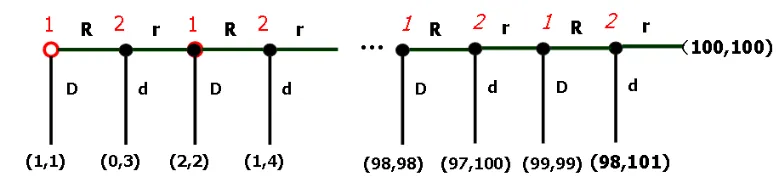
The Centipede Game
The centipede game was introduced by Rosenthal (1981) to question the logic of
[image:24.612.112.502.544.642.2]backward induction. Typically, the extensive form of centipede game can be illustrated in
figure 1.
26
FIGURE 1.THE CENTIPEDE GAME
Since the centipede game is “deep” in the sense that it had a limit of 100 rounds, the
strategy space is too complex. The utility space, instead, is rather simple since it consists
of pairs of real numbers
(11)
U
(
S
)
{(
1
,
1
),
(
0
,
3
),
(
2
,
2
),
(
1
,
4
),
,
(
99
,
99
),
(
98
,
101
),
(
100
,
100
)}
.Inherited the componentwise order
≧
from two-dimensional Euclidean space, the utility space becomes into a CPO that has no least or greatest element. It isworth emphasis that the utility space does have two maximal elements and
, though they are incomparable with each other. In fact, these two maximal
elements are exactly the utilities of two terminal nodes (100th round) in centipede game.
)
≧
),
(
(
U
S
)
100
,
100
(
)
101
,
98
(
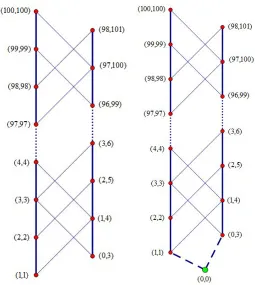
[image:25.612.180.435.362.647.2]The Hasse diagram of the utility space of centipede game can be depicted in
figure 2.
)
(
S
U
Given the game tree depicted in figure 1, backward-induction solution predicts that the
first player should pick Down on the firs move. As a result, the play ends at the first
move and each player gets just
1
. According to backward-induction algorithm, in eachround both players should pick Down, as if all vertices are actually reached (see Aumann
1995, 1998).
Indeed, if backward induction was used by both players throughout the game tree, then
the process of backward-induction reasoning gives rise to the best response function
that is order-preserving. Starting from the terminal node
)
(
)
(
:
U
S
U
S
R
)
100
,
100
(
, the orbit determines a downward path throughthe Hasse diagram (figure 2 left). The backward-induction outcome amounts to that the
orbit converges to minimal element as
}
100
,
,
2
,
1
|
)
(
{
R
k
k
)
1
,
1
(
)
(
kR
k.But, since the terminal node
(
100
,
100
)
is Pareto optimal, it seems strange thatrational players would choose to proceed back through the game tree and get worse off.
Now that the utilities for some amount of cooperations in the Centipede game are so
much larger than immediate defection, the "rational" solutions given by backward
induction seems to be paradoxical (see Aumann 1995, 1998).
Empirical evidences suggest that players with bounded rationality seldom accept the
backward induction as a guide to practical behavior, as indicated by the chain store
paradox (see Selten 1978). In contrast, the reasoning of rule rationality seems to be much
more compelling for games with sufficiently large limit of rounds. In what follows, a
solution to the backward induction paradox will be given based on our dynamic game
model under bounded rationality
To see this, note that both players will get nothing if they do not play the game. Then
we can add an element to the utility space . In this way we have “lifted”
the utility space into a CPO with a least element
)
0
,
0
(
U
(
S)
S)
(
U
U(S)
(
0
,
0
)
(see Davey andPriestley 2002).
Now if both players choose to play the game, then they will start from and
quest for improvement according to certain heuristic rules, which give rise to an
preserving function R:U(S)U(S) . That is, for any x,yU(S)
)
0
,
0
(
such that
, we have
R
. This order-preserving property stands for one kind ofrational expectation.
y
x
≧
(
x
)
≧
R
(
y
)
27 It is rational expectation that makes the escape from the backward
induction paradox possible. However, the actual dynamic process of decision making can
only be determined after the response function has been specified.
Now, starting from the least element
, the orbitdetermines an upward path through the Hasse diagram (figure
2 right). As a result of rule rationality, the Abian-Brown fixed point theorem (Abian and
Brown 1961, see also section 3.3) asserts that the response function
has a least fixed point, which can be approximated by the
sequence as . In general, equilibrium defined by this least fixed point is
the last vertex that will be actually reached. This will differ from the backward-induction
solution if the limit of round is sufficiently large, and hence enables us to escape from the
backward induction paradox.
,
2
,
1
|
k
) U
0
,
0
(
kR
}
100
,
k)
(
{
R
k
( :U S R
) (S
)
Finally, if the limit of rounds is too small then the game changes its character and it is
much more advantageous to use the best response given by backward induction (see
Selten 1978).28
3. THE SOLUTIONS
In this section, the notion of equilibrium solutions under bounded rationality will be
defined, and the properties of equilibrium solutions will be investigated. I shall show that
the problem of existence of equilibrium solutions depends formally in an important way
upon the structures of strategy space and the properties of response functions.
27
Note that in centipede game no player can punish defective behavior, since defection means game over. 28