Native Language Identification: A Key N-gram Category Approach
Kristopher Kyle, Scott Crossley
Jianmin Dai, Danielle S. McNamara
Georgia State University Arizona State University
34 Peachtree Ave, Ste 1200 PO Box 872111
Atlanta, GA 30303 Tempe, AZ 85287
[email protected], [email protected]
[email protected], [email protected]
Abstract
This study explores the efficacy of an ap-proach to native language identification that utilizes grammatical, rhetorical, semantic, syntactic, and cohesive function categories comprised of key n-grams. The study found that a model based on these categories of key n-grams was able to successfully predict the L1 of essays written in English by L2 learners from 11 different L1 backgrounds with an ac-curacy of 59%. Preliminary findings concern-ing instances of crosslconcern-inguistic influence are discussed, along with evidence of language similarities based on patterns of language misclassification.
1. Introduction
Native language identification (NLI) is generally an automated task that can be used in authorship profiling (Wong & Dras, 2009) and in assisting automatic writing evaluation systems provide fo-cused feedback (e.g., Rozovskaya & Roth, 2011). NLI is achieved by identifying patterns of lan-guage use that are common to a group of users of a particular second language (L2; e.g., English) that share a native language (L1). Useful to the discus-sion of these patterns is the concept of crosslin-guistic influence (CLI), which references ‘the consequences - both direct and indirect - that being a speaker of a particular native language (L1) has on the person’s use of a later learned language (Jarvis, 2012, p.1). Beyond its theoretical
applica-tions, CLI can also be used to inform L2 classroom pedagogy (Granger, 2009; Laufer & Girsai, 2008). NLI studies, then, are informed by and can inform CLI, and have diverse applications.
The current study seeks to add to the discus-sions of NLI and CLI by testing the efficacy of a new approach – the use of grammatical, rhetorical, semantic, syntactic, and cohesive function catego-ries of key n-grams.
2. Background
In this section we outline two approaches to CLI, provide a selected review of relevant literature, and address gaps in the current body of NLI research.
2.1 Approaches to CLI
Jarvis (2000, 2010, 2012) has outlined two ap-proaches to the investigation of CLI: a compari-son-based and a detection-based approach. The comparison-based approach is generally con-structed based on specific observed difference be-tween language systems (e.g., article usage in English as compared to article usage in Korean). Whether or not these L1 differences affect L2 pro-duction is then analyzed by examining example texts (e.g., inappropriate use of articles by native speakers of Korean writing in English as an L2). The detection-based argument, on the other hand, is built with the opposite trajectory. Instead of be-ginning with hypotheses based on differences in language systems, researchers begin by identifying patterns of language use (e.g., inappropriate article use) that occur regularly by members of an L1 that
use a particular L2 (intragroup homogeneity) but do not occur regularly by other L1 users of the same L2 (intergroup heterogeneity). These patterns of use are then verified through statistical and ma-chine learning techniques that use these patterns to predict the L1 group membership of L2 texts (i.e., NLI).
Recent advances in corpus development and natural language processing allow for larger num-bers of texts to be searched using a greater number of linguistic features. These features can then be used to create an NLI predictor model. A success-ful model not only success-fulfills the NLI task, but pro-vides further evidence that the observed patterns of language use can be attributable to CLI. While Type I errors are certainly a potential issue in this argument, Jarvis (2012) explains that false posi-tives can be mitigated by balancing or controlling for potentially confounding variables (e.g., profi-ciency levels and essay prompts) during the con-struction of the target corpus.
2.2 Selected literature review
A limited but growing number of studies have in-vestigated CLI using the detection-based approach, many of which are included in a volume edited by Jarvis and Crossley (2012). Researchers have ex-plored the topic of CLI in the areas of lexical style (Jarvis et al., 2012a), lexical n-grams (Jarvis & Paquot, 2012), character n-grams (Tsur & Rappo-prot, 2007), using variables related to cohesion, lexical sophistication, syntactic complexity and conceptual knowledge (Crossley & McNamara, 2012), error patterns (Bestgen, et al., 2012; Wong & Dras, 2009), and a combination of these ap-proaches (Jarvis et al., 2012b; Koppel et al., 2005; Mayfield Tomokiyo & Jones, 2001, Wong & Dras, 2009).
Such studies have demonstrated relatively strong success rates for classifying an L2 writing sample based on the L1 of the writer. For instance, Jarvis and Paquot (2012), using 1-4-grams as pre-dictor variables on a subset of argumentative es-says included in the International Corpus of Learner English (ICLE) (Granger et al., 2009) achieved a 53.6% classification accuracy for 12 groups of L1s. Crossley and McNamara (2012) used features related to cohesion, lexical sophisti-cation, syntactic complexity, and conceptual knowledge taken from the computational tool
Coh-Metrix (Graesser et al., 2004) to classify essays written in English by Czech, Finnish, German, and Spanish participants and achieved an L1 classifica-tion accuracy of 65-67.6%. Using error types, Bestgen et al. (2012), on 223 ICLE essays written by French, German, and Spanish L1 participants, achieved a classification accuracy of 65%. In a follow-up study, Jarvis et al. (2012b) explored the relative efficacy of these three CLI methods (n-grams, Coh-Metrix indices, and error types) using the corpus found in Bestgen et al. (2012). When all three approaches were used in the classification task, the accuracy increased to 79%.
2.3 Weakness of extant research in CLI
Although the studies discussed so far have pro-duced statistical models that can predict the L1 group of a text written in L2 English with accura-cies well above chance, the degree to which these studies have demonstrated instances of CLI may be questionable as they draw on the ICLE corpus, which is arguably imbalanced (Jarvis et al., 2012a, and Mayfield Tomokiyo, & Jones, 2001 being the exceptions). While ICLE was designed with an attempt to control for a number of variables, the proficiency levels vary across language groups (as suggested by Koppel et al., 2005, and empirically confirmed by Bestgen et al., 2012) and though the argumentative texts are limited to a particular set of prompts within the corpus, these prompts are not equally distributed across language groups, raising the question of the degree to which the ob-served differences in texts were due to CLI, profi-ciency level, or essay prompt.
essays into introduction, body, and conclusion paragraphs, and then further separated these into high and low proficiency categories based on over-all essay score. They then identified n-grams that occurred significantly more often (positive keyness values) in paragraphs of a certain type (e.g., intro-duction) from high scoring essays than the same type of paragraphs from low-scoring essays. Addi-tionally, they identified n-grams that occurred sig-nificantly less often (negative keyness values) in high-scoring paragraphs of a certain type than low-scoring paragraphs of the same type. Positively and negatively key n-grams for each paragraph type were then separated into categories based on their rhetorical, syntactic, grammatical, and cohesive features. These categories were then successfully used as variables in a multiple regression to create a model that accounted for between 24%-33% of the variance in essay scores. This study demon-strates the efficacy of using grammatical, rhetori-cal, syntactic, and cohesive function categories of key n-grams to identify instances of linguistic variation that successfully predict essay quality. These findings hold promise for the use of similar methods to contribute to the study of CLI by iden-tifying linguistic variation across different L1 groups writing in the same L2.
2.4 Goals of the current study
The current study, while drawing on previous re-search (notably Jarvis & Paquot, 2012 and Crossley et al., submitted for publication), contrib-utes to the detection-based CLI discussion by: a) examining a prompt and proficiency-controlled corpus and, b) using n-gram indices related to grammatical, rhetorical, semantic, syntactic, and cohesive functions to assess difference in L2 es-says based on the L1 of the writers. This study is guided by the following research questions:
1. Can a model consisting of functional categorical n-grams predict the native language of an L2 writer of English?
2. Does the resulting model inform theories of CLI?
3. Method
In this section, we describe the corpus used for our training and test set, the methods used for key gram identification, and the grouping of these n-grams into grammatical, rhetorical, semantic, syn-tactic, and cohesive categories.
3.1 Corpus
For this project we used an 11,000 essay subset of the 12,100 essay TOEFL11 corpus (Blanchard, Tetreault, Higgins, Cahill, & Chodorow, 2013). The TOEFL11 corpus is comprised of independent task essays written during administrations of the Test of English as a Foreign Language (TOEFL) between 2006-2007 (Blanchard et al., 2013). The corpus is balanced across 11 native language (L1) groups, includes responses to eight different inde-pendent-task prompts, and includes essays written by low, medium, and high proficiency writers. The languages represented include Arabic, Chinese, French, German, Hindi, Italian, Japanese, Korean, Spanish, Telugu, and Turkish. Following the pro-cedures of the NLI shared task (Tetreault, Blanch-ard, & Cahill, 2013), 1,100 of the original 11,000 essays were set aside as the test set, leaving a train-ing corpus of 9,900 essays.
3.2 Identifying key n-grams
In this study, we considered n-grams from 1-10 words in length. N-grams were considered to be
was completed for each language group until a key n-gram list existed for each.
Because one of the goals of our study was to generalize instances of CLI to essays written on prompts other than those included in the TOEFL11 Corpus, it was important to remove all prompt-based words from our key n-gram lists. Removing
all words occurring in the prompts from the n-grams list would remove a number of high fre-quency words that may not be prompt-based (e.g.,
the, to), so prompt-based words were operationally defined as content words and their lemmas in-cluded in the prompt that had a Kucera and Francis (1967) written frequency value of 715 or less. N-grams were removed from potential predictor sets if they contained any of these prompt-based words. The remaining key n-grams for each language group were then sorted by absolute keyness in each group and filtered for redundancy. For example, prior to this stage, the Chinese key n-gram list in-cluded both more and have more. Because more
had a higher absolute keyness value than have more, have more was removed from the Chinese key n-gram list.
Table 1 provides a summary of the length of key n-grams identified in each stage of the selec-tion process. Although n-grams from 1-10 words in length were initially considered, no n-grams longer than 5-grams were identified as being key. Addi-tionally, all 5-grams, such as the key Chinese n-gram ‘group led by a tour’, and the Telugu n-n-gram ‘agree with the statement that’ contained prompt-based words and were removed from further con-sideration. After the final n-gram refining step, the longest gram was a single 4-gram, the Turkish n-gram ‘on the other hand’.
3.3 Grouping of key n-grams into indices
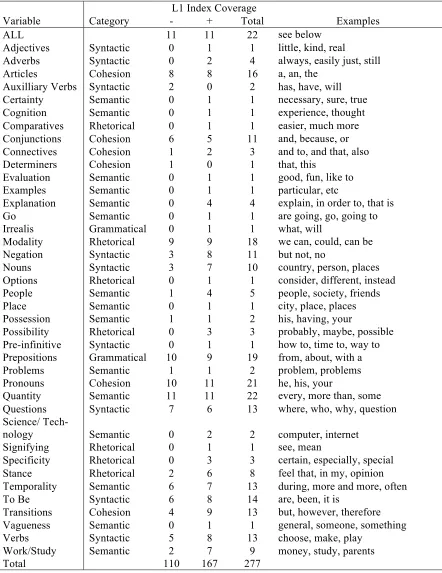
The last stage in our variable selection process was to group the key n-grams in each language group into categories. First, two indices for each laguage group were created. The first included all n-grams with positive keyness values that remained after the filtering process described above. The second included all of the n-grams with negative keyness values after filtering. Next, positive and negative n-grams were sorted into grammatical, rhetorical, semantic, syntactic, and cohesive func-tion categories by two trained linguists with expe-rience in the area of second language writing. The purpose of sorting n-grams in this manner was to identify patterns of relative over/underuse by each language group. See Table 2 for a list of all of the indices created during this process.
3.4 Evaluation of model
In CLI studies and other studies that attempt to predict the group membership of a text, discrimi-nant function analysis (DFA) is often used (Jarvis & Paquot, 2012; Crossley & McNamara, 2012). Although other methods can be used, such as sup-port vector machine decision trees (e.g., Koppel et al., 2005) or Naïve Bayes (e.g., Mayfield To-mokiyo & Jones, 2001), DFA has the advantage of being the most transparent of these with regard to interpreting results (Jarvis, 2012). DFA was there-fore chosen as the method of analysis for this study, using L1 as the dependent variable and n-gram indices as independent variables.
The first step in the analysis was to check the independent variables for multicollinearity using a Pearson correlation matrix. Any two variables above a threshold of p>.899 were flagged for fur-ther analysis. A MANOVA was then conducted using the languages from one proficiency group as independent variables and the predictor indices/n-grams as dependent variables. The effect sizes pro-duced by the MANOVA were used to select which variables flagged in the correlation matrix would be retained, and which would be eliminated. Within each highly correlated pair, the variable with the largest effect size was kept. Finally, a DFA was conducted on the training set. The pre-dictor model sets identified in the DFA were then N-gram
Length
Original No Prompt Words
After Final Sort
5 5 0 0
4 19 3 1
3 110 54 8
2 699 512 147
1 1100 877 770
[image:4.612.73.300.538.648.2]Total 1933 1446 926
L1 Index Coverage
Variable Category - + Total Examples
ALL 11 11 22 see below
Adjectives Syntactic 0 1 1 little, kind, real
Adverbs Syntactic 0 2 4 always, easily just, still
Articles Cohesion 8 8 16 a, an, the
Auxilliary Verbs Syntactic 2 0 2 has, have, will
Certainty Semantic 0 1 1 necessary, sure, true
Cognition Semantic 0 1 1 experience, thought
Comparatives Rhetorical 0 1 1 easier, much more
Conjunctions Cohesion 6 5 11 and, because, or
Connectives Cohesion 1 2 3 and to, and that, also
Determiners Cohesion 1 0 1 that, this
Evaluation Semantic 0 1 1 good, fun, like to
Examples Semantic 0 1 1 particular, etc
Explanation Semantic 0 4 4 explain, in order to, that is
Go Semantic 0 1 1 are going, go, going to
Irrealis Grammatical 0 1 1 what, will
Modality Rhetorical 9 9 18 we can, could, can be
Negation Syntactic 3 8 11 but not, no
Nouns Syntactic 3 7 10 country, person, places
Options Rhetorical 0 1 1 consider, different, instead
People Semantic 1 4 5 people, society, friends
Place Semantic 0 1 1 city, place, places
Possession Semantic 1 1 2 his, having, your
Possibility Rhetorical 0 3 3 probably, maybe, possible
Pre-infinitive Syntactic 0 1 1 how to, time to, way to
Prepositions Grammatical 10 9 19 from, about, with a
Problems Semantic 1 1 2 problem, problems
Pronouns Cohesion 10 11 21 he, his, your
Quantity Semantic 11 11 22 every, more than, some
Questions Syntactic 7 6 13 where, who, why, question
Science/
Tech-nology Semantic 0 2 2 computer, internet
Signifying Rhetorical 0 1 1 see, mean
Specificity Rhetorical 0 3 3 certain, especially, special
Stance Rhetorical 2 6 8 feel that, in my, opinion
Temporality Semantic 6 7 13 during, more and more, often
To Be Syntactic 6 8 14 are, been, it is
Transitions Cohesion 4 9 13 but, however, therefore
Vagueness Semantic 0 1 1 general, someone, something
Verbs Syntactic 5 8 13 choose, make, play
Work/Study Semantic 2 7 9 money, study, parents
[image:5.612.86.528.60.633.2]Total 110 167 277
used on the essays in the test set to determine whether the model sets could generalize to a new population.
4. Results
The training set DFA predicted L1 group member-ship of TOEFL independent essays with an accu-racy of 60% using 184 indices (df= 100, n= 9900,
χ2= 32997.259, p< .001), which is significantly
higher than the baseline chance of 9%. The re-ported Kappa = .560, indicates a moderate rela-tionship between actual and predicted L1.
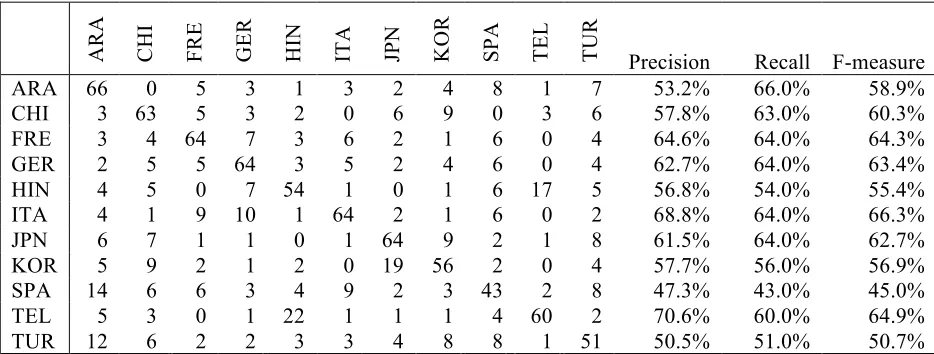
The predictive accuracy of the model was veri-fied on the test set, in which L1 group membership was predicted with an accuracy of 59% (df= 100, n= 1100, χ2= 3550.791, p< .001). The reported
Kappa = .549, indicates a moderate agreement be-tween the actual and predicted L1. Table 3 in-cludes the test set confusion matrix.
5. Discussion
The results of this study suggest the usefulness of key n-grams grouped into categories based on their grammatical, rhetorical, semantic, syntactic, and cohesive features for NLI. The results demonstrate that such indices can correctly classify 59% of es-says written in English as belonging to 1 of 11 L1 populations.
In addition, with regard to n-gram length, we found that although n-grams 1-10 words in length were initially considered, no n-grams longer than
5-grams were identified as key, and the longest n-gram that remained after removing prompt-based and redundancy was a single 4-gram. This suggests that 4-grams (or possibly even 3-grams) may be a useful threshold for future investigations.
5.1 Preliminary CLI findings
As Jarvis (2012) notes, CLI studies that use the detection-based argument to CLI are exploratory in nature, while studies that use the comparison-based argument are confirmatory in nature. The present study is, thus, exploratory in nature, and without substantial further investigation, we cannot defini-tively posit whether observed differences and simi-larities in English use can be attributed to the influence of the L1 itself or to cultural or educa-tional norms.
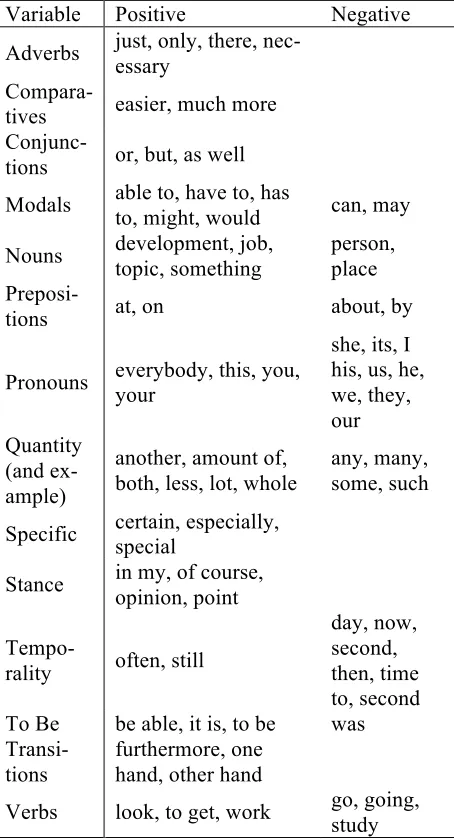
Nonetheless, a few preliminary observations are worthy of discussion. First, we identified a number of patterns of language use that may be attributable to CLI. Although a full discussion of these is beyond the scope of this paper, Table 4 includes examples of potential CLI features in ref-erence to the German writers represented in the corpus. The table demonstrates the particular n-grams that German writers are likely to use more or less often than writers of the other 10 languages. German writers, for example, are more likely to use the phrasal modals able to, have to, has to, and singular modals might and would more often than writers of the other language groups, but are less likely to use the modals can and may. These find-ings are preliminary, and further research that links
AR
A
CH
I
FR
E
GE
R
HI
N
IT
A
JP
N
KOR SPA TEL TU
R
Precision Recall F-measure
ARA 66 0 5 3 1 3 2 4 8 1 7 53.2% 66.0% 58.9%
CHI 3 63 5 3 2 0 6 9 0 3 6 57.8% 63.0% 60.3%
FRE 3 4 64 7 3 6 2 1 6 0 4 64.6% 64.0% 64.3%
GER 2 5 5 64 3 5 2 4 6 0 4 62.7% 64.0% 63.4%
HIN 4 5 0 7 54 1 0 1 6 17 5 56.8% 54.0% 55.4%
ITA 4 1 9 10 1 64 2 1 6 0 2 68.8% 64.0% 66.3%
JPN 6 7 1 1 0 1 64 9 2 1 8 61.5% 64.0% 62.7%
KOR 5 9 2 1 2 0 19 56 2 0 4 57.7% 56.0% 56.9%
SPA 14 6 6 3 4 9 2 3 43 2 8 47.3% 43.0% 45.0%
TEL 5 3 0 1 22 1 1 1 4 60 2 70.6% 60.0% 64.9%
TUR 12 6 2 2 3 3 4 8 8 1 51 50.5% 51.0% 50.7%
[image:6.612.72.539.60.237.2]these English n-grams with patterns of use in Ger-man is needed.
Additionally, our findings provide some evi-dence for close relationships between languages. For example, when checking for multicollinearity,
we found that the All Negative Japanese and All Negative Korean categories were very strongly correlated (r =.946, p< .001). Upon further exami-nation, 8 of the 19 n-grams (42%) in the All Nega-tive Japanese category occurred in the corresponding Korean category. The overlapping n-grams were the n-grams all, any, but, different,
or, person, this, and your, which may indicate
similarities between these language systems in that speakers from both language avoid the use of these words.
Patterns of essay categorization also provide preliminary insights into language similarities. Based on the test set confusion matrix (see Table 3), a few conflicting patterns emerged. Among the Indo-European languages represented, the Ro-mance (French, Italian, and Spanish) and Germanic (German) languages were regularly miscategorized as one another. Italian essays, for example, were predicted to be French, German, and Spanish 9%, 10%, and 6% of the time, respectively, but were predicted to be other languages only 0%-4% of the time. This seems to confirm generally accepted language taxonomies, though Spanish was pre-dicted to be Arabic (14%) and Turkish (8%) more often than Italian (6%) or French (6%) (as com-pared to 3% for German, and no more than 4% for other languages).
While similarities between language families seem to support extant language taxonomies (see Blanchard et al., 2013) and lend credence to claims of CLI, other observations may cast doubt on these. Hindi (an Iranian member of the Indo-European family) essays were predicted to be Telugu (Dravidian) essays 17% of the time, and Telugu essays were predicted to be Hindi essays 22% of the time. This may indicate instances of cultural proximity or educational similarities as opposed to linguistic transfer (and/or borrowing) because these languages are both spoken within India. Further investigations of these issues are clearly needed.
5.2 Limitations
While we have confidence in our findings, there are limitations to the analysis that need to be dis-cussed. The TOEFL11 corpus was designed to be comparable across languages. While it largely ac-complishes this goal, it is not well balanced across proficiency levels (which may reflect the relative proficiency levels of TOEFL test-takers). Although medium and high proficiency levels are well (though not equally) represented, the low profi-ciency group represents only 11% of the number of texts and an estimated 7.2% of total words (based on mean lengths of essays from each proficiency level given in Blanchard et al., 2013). The medium proficiency group represented 54.4% of the texts
Variable Positive Negative
Adverbs just, only, there, nec-essary
Compara-tives easier, much more
Conjunc-tions or, but, as well Modals able to, have to, has
to, might, would can, may Nouns development, job,
topic, something
person, place
Preposi-tions at, on about, by
Pronouns everybody, this, you, your
she, its, I his, us, he, we, they, our Quantity
(and ex-ample)
another, amount of, both, less, lot, whole
any, many, some, such
Specific certain, especially, special
Stance in my, of course, opinion, point
Tempo-rality often, still
day, now, second, then, time to, second To Be be able, it is, to be was
Transi-tions
furthermore, one hand, other hand
[image:7.612.70.297.142.562.2]Verbs look, to get, work go, going, study
and an estimated 52.8% of words in the corpus, and the high proficiency group comprised the re-maining 34.7% of the texts and an estimated 40% of the words. This indicates that caution should be used when generalizing any CLI findings from this study to low proficiency language users. Further-more, any CLI findings will be biased towards me-dium proficiency language users.
Another limitation that may have affected the accuracy of the model was the way in which poten-tial predictor variables were refined. For each lan-guage, the absolute keyness values were used when refining the lists of potential n-gram predictors (as discussed in Section 3.2). After the data had been processed, we discovered that this process re-moved some n-grams that should have remained. In a very few instances redundant n-grams (e.g.,
have; have more) had a positive keyness value for one n-gram (have) and a negative keyness value for the other (have more). Because all n-grams were later grouped into categories based on posi-tive and negaposi-tive keyness values, both have and
have more should have been retained (as they would not have occurred in any of the same cate-gories). In future studies, positive and negative n-grams will be kept separate during the elimination of redundant n-grams.
Another limitation that was discovered after the data analysis was that a data input error caused All Negative Chinese n-gram category to be com-bined with two n-grams included in the Positive Chinese School and Home category. A similar er-ror retained two positive German adverb categories (with one overlapping n-gram, just). The models described in this study retained these variables, as they were not highly correlated with each other or any other variable (based on the r > .899 thresh-old), so any CLI findings based solely on these variables should be considered with caution.
5.3 Future research
Although it is clear that categorical n-grams can be used as successful NLI predictor variables, it is unclear whether this approach is more or less ef-fective than the use of raw counts of frequent words or n-grams (e.g., Jarvis et al., 2012a; Jarvis & Paquot, 2012). Future research should explore the relative effectiveness of these methods using the TOEFL11 corpus to determine whether the
time involved to create key n-gram lists and then sort those lists into categories is warranted.
Finally, another remaining question is whether the key n-grams identified in this study are due to linguistic factors or, alternatively, other influences such as culture and educational materials.
Acknowledgements
We thank ETS for compiling and providing the TOEFL11 corpus, and we also thank the organizers of the NLI Shared Task 2013.
References
Bestgen, Y., Granger, S., & Thewissen, J. (2012). Error patterns and automatic l1 identification. In S. Jarvis and S. A. Crossley (Eds.), Approaching Language Transfer through Text Classification: Explorations in the Detection-Based Approach. (pp. 127-153). Bris-tol, UK: Multilingual Matters.
Blanchard, D., Tetreault, J., Higgins, D., Cahill, A., & Chodorow, M. (2013). TOEFL11: A Corpus of Non-Native English. Princeton, NJ: Educational Testing Service.
Crossley, S. A., & McNamara, D. S. (2012). Detecting the first language of second language writers using automated indices of cohesion, lexical sophistication, syntactic complexity, and conceptual knowledge. In S. Jarvis and S. A. Crossley (Eds.), Approaching Language Transfer through Text Classification: Ex-plorations in the Detection-Based Approach. (pp. 106-126). Bristol, UK: Multilingual Matters.
Crossley, S. A., Defore, C., Kyle, K., Dai, J., & McNa-mara, D. S. (under review). Paragraph specific n-gram approaches to automatically assessing essay quality. Sixth International Conference on Educa-tional Data Mining, Memphis, TN.
Graesser, A. C., McNamara, D. S., Louwerse, M. M., & Cai, Z. (2004). Coh-metrix: Analysis of text on cohe-sion and language. Behavior Research Methods, In-struments, & Computers, 36(2), 193-202.
Granger, S., Dagneaux, E.., Meunier, F., Paquot, M. (Eds.) (2009). International corpus of learner eng-lish. version 2. Belgium: Presses universitaires de Louvain.
Granger, S. (2009) The contribution of learner corpora to second language acquisition and foreign language teaching: A critical evaluation. In: Aijmer, K., Cor-pora and Language Teaching, Benjamins: Amster-dam and Philadelphia, 2009, p. 13-32.
Jarvis, S. (2000). Methodological rigor in the study of transfer: Identifying L1 influence in the interlan-guage lexicon. Laninterlan-guage Learning, 50, 245-309. Jarvis, S. (2010). Comparison-based and
M. Howard, M. Ó Laoire, & D. Singleton (Eds.), EUROSLA Yearbook 10 (pp. 169-192). Amsterdam: Benjamins.
Jarvis, S. (2012). The detection-based approach: An overview. In S. Jarvis & S.A. Crossley (Eds.), Ap-proaching language transfer through text classifica-tion: Explorations in the detection-based approach (pp. 1-33). Bristol, UK: Multilingual Matters. Jarvis, S., & Crossley, S. A. (2012). Approaching
lan-guage transfer through text classification: Explora-tions in the detection-based approach. Bristol, UK: Multilingual Matters.
Jarvis, S., Bestgen, Y., Crossley, S. A., Granger, S., Paquot, M., Thewissen, J., & McNamara, D. S. (2012). The comparative and combined contributions of n-grams, Coh-Metrix indices, and error types in the L1 classification of learner texts. In S. Jarvis & S.A. Crossley (Eds.), Approaching language transfer through text classification: Explorations in the detec-tion-based approach (pp. 154-177). Bristol, UK: Multilingual Matters.
Jarvis, S., & Paquot, M. (2012). Exploring the role of n-grams in L1 identification. In S. Jarvis & S.A. Crossley (Eds.), Approaching language transfer through text classification: Explorations in the detec-tion-based approach (pp. 71-105). Bristol, UK: Mul-tilingual Matters.
Jarvis, S., Castañeda-Jiménez, G., & Nielsen, R. (2012). Detecting L2 writers’ L1s on the basis of their lexical styles. In S. Jarvis & S.A. Crossley (Eds.), Approach-ing language transfer through text classification: Ex-plorations in the detection-based approach (pp. 34-70). Bristol, UK: Multilingual Matters.
Koppel, M., Schler, J. & Zigdon, K. (2005). Determin-ing an author’s native language by minDetermin-ing for text er-rors. In Proceedings of the Eleventh ACM SIGKDD International Conference on Knowledge Discovery in Data Mining (pp. 624-628). Chicago: Association for Computing Machinery.
Kucera, H. and Francis, W. N. (1967). Computational Analysis of Present-Day American English Provi-dence, RI: Brown University Press.
Laufer, B., & Girsai, N. (2008). Form-focused instruc-tion in second language vocabulary learning: A case for contrastive analysis and translation. Applied Lin-guistics, 29(4), 694-716.
Mayfield Tomokiyo, L. & Jones, R. (2001). You’re not from ‘round here, are you? Naïve Bayes detection of non-native utterance text. In Proceedings of the Sec-ond Meeting of the North American Chapter of the Association for Computational Linguistics (NAACL ’01), unpaginated electronic document. Cambridge, MA: The Association for Computational Linguistics. McEnery, T., & Hardie, A. (2012). Corpus linguistics:
method, theory and practice. Cambridge, New York: Cambridge University Press, 2012.
Rozovskaya, A. & Roth, D. (2011). Algorithm selection and model adaptation for ESL correction tasks. In Proceedings of the 49th Annual Meeting of the Asso-ciation for Computational Linguistics (ACL ’11). Scott, M., (2013). WordSmith Tools. Liverpool: Lexical
Analysis Software.
Tetreault, J., Blanchard, D., & Cahill, A. (2013). Sum-mary report on the first shared task on native lan-guage identification. In Proceedings of the Eighth Workshop on Building Educational Applications Us-ing NLP, unpaginated electronic document. Atlanta, GA: Association for Computational Linguistics. Tsur, O. & Rappoport, A. (2007). Using classifier
fea-tures for studying the effect of native language on the choice of written second language words. In Pro-ceedings of the Workshop on Cognitive Aspects of Computational Language Acquisition. (pp. 9-16). Cambridge, MA: The Association for Computational Linguistics.