
Implementing information and consultation: developments in medium szed organisations
61
0
0
Full text
(2) EMPLOYMENT RELATIONS RESEARCH SERIES NO.106. Implementing information and consultation: developments in mediumsized organisations BY MARK HALL, UNIVERSITY OF WARWICK, SUE HUTCHINSON, UNIVERSITY OF THE WEST OF ENGLAND, JOHN PURCELL, MICHAEL TERRY, UNIVERSITY OF WARWICK, AND JANE PARKER, AUCKLAND UNIVERSITY OF TECHNOLOGY.
(3) About EMAR Employment Market Analysis and Research (EMAR) is a multi-disciplinary team of economists, social researchers and statisticians based in the Employment Relations Directorate of the Department for Business, Innovation and Skills. Our role is to provide the evidence base for good policy making in employment relations, labour market and equality and discrimination at work. We do this through: Conducting periodic benchmark surveys Commissioning external research reports Conducting in-house research and analysis Assessing the regulatory impact of new employment laws Monitoring and evaluating the impact of government policies We publicly disseminate the results of this research through the BIS Employment Relations Research Series and other publications. For further details of EMAR's work, including PDF versions of all our publications, please see our web pages at:. www.berr.gov.uk/employment/research-evaluation About this publication The project manager for this report was Hulya Hooker in the EMAR branch. Published in December 2009 by the Department for Business, Innovation and Skills. URN 09/1544 ISBN 978-0-85605-752-6 © Crown Copyright 2009 This report can be ordered at: www.bis.gov.uk/publications Click the ‘Browse by subject’ button, then select ‘Employment Relations Research’. Alternatively, call the BIS Publications Orderline on 0845 015 0010 (+44 845 015 0010) and quote the URN, or email them at: [email protected]. Electronic copies are available to download at: http://www.berr.gov.uk/employment/research-evaluation/errs/index.html Enquiries should be addressed to [email protected] or to: Employment Market Analysis and Research Department for Business, Innovation and Skills Bay 4107 1 Victoria Street London SW1H 0ET UNITED KINGDOM The views expressed in this report are the authors’ and do not necessarily reflect those of the Department or the Government..
(4) Foreword The Department for Business, Innovation and Skills (BIS) leads work to create the conditions for business success through competitive and flexible markets that create value for businesses, consumers and employees. It drives regulatory reform, and works across Government and with the regions to raise levels of UK productivity. It is also responsible for ensuring an improved quality of life for employees and promoting choice and quality for consumers. As part of that work the Employment Market Analysis and Research (EMAR) branch of the Department manages an extensive research programme to inform policy making and promote better regulation on employment relations, labour market and equality and discrimination at work issues. The project on which this report is based is funded under this research programme, and co-sponsored by Acas and the Chartered Institute of Personnel and Development. The research was commissioned to investigate organisational responses to the Information and Consultation of Employees Regulations 2004. This report provides an update on key findings from the research in respect of information and consultation arrangements in medium-sized organisations. It draws on continued research in six case study organisations with 100-150 employees as well as initial case reports and employee surveys covering four case study organisations in the 50-100 employees size band. Case studies have been completed in twelve larger organisations with 150 or more employees and are the subject of a separate report published in the Employment Relations Research Series. We hope you find it of interest. Electronic copies of this and all other reports in our Employment Relations Research Series can be downloaded from the BIS website. Printed copies can be ordered online, by phone or by email. A complete list of our research series can be found at the back of this report. Please contact us at [email protected] if you wish to be added to our publication mailing list, or would like to receive regular email updates on EMAR’s research, new publications and forthcoming events.. Bill Wells. John Taylor. Ben Willmott. Deputy Director, EMAR. Chief Executive, Acas. ER Adviser, CIPD. i.
(5) Acknowledgements The authors are grateful to the Department for Business, Innovation and Skills, the Advisory, Conciliation and Arbitration Service and the Chartered Institute of Personnel and Development for funding the research project on which this report is based, and to the advisory group made up of representatives from the three funding bodies for their valuable input. We would also like to record our thanks to the management and employees at the case study organisations who participated in ‘wave 2’ and ‘wave 3’ of the research. Thanks are also due to Jill Smith, who researched and wrote up one of the case studies.. ii.
(6) Contents Foreword ....................................................................................................... i Acknowledgements....................................................................................... ii Contents .......................................................................................................iii Tables and figures ....................................................................................... iv Executive summary ...................................................................................... v The case study organisations ......................................................... vi Establishing I&C in the ‘wave 3’ cases ............................................. vi I&C developments in the ‘wave 2’ cases ......................................... vii Overall assessment .....................................................................viii. 1: Introduction ............................................................................................... 1 1.3 Structure of the report...................................................................3. 2: The case study organisations and their I&C arrangements ...................... 4 2.1 Characteristics of the ‘wave 2’ case study organisations ................4 2.2 Characteristics of the ‘wave 3’ case study organisations ................8. 3: Establishment, nature and functioning of ‘wave 3’ I&C bodies ............... 11 3.1 Factors shaping organisations’ I&C strategy ...................................... 11 3.2 Constitutional/operational arrangements ........................................... 13 3.3 I&C practice ............................................................................ 15 3.4 Employee perceptions of I&C ........................................................ 18. 4: The dynamics of I&C in ‘wave 2’ organisations....................................... 23 4.1 The development/sustainability of the I&C bodies ...................... 23 4.2 Strategic or housekeeping issues?............................................ 23 4.3 Support for and coordination of employee representatives........... 25 4.4 Interface between I&C and trade union representation................ 26. 5: Conclusion .............................................................................................. 28 References ................................................................................................. 31 Annex A: Methodological note ................................................................... 32 Research access ......................................................................... 33 Research interviews .................................................................... 33 Employee survey ........................................................................ 34 Data analysis and reporting .......................................................... 35. Annex B: Case study summaries................................................................. 2 ‘Wave 2’ cases..............................................................................2. iii.
(7) ‘Wave 3’ cases..............................................................................5. Tables and figures No. Title. Page. 1. Key characteristics of the ‘wave 2’ case study organisations and their I&C arrangements. 6. 2. Key characteristics of the ‘wave 3’ case study organisations and their I&C arrangements. 7. 3. Employee perceptions – year 1 survey comparisons in ‘wave 20 3’ organisations. iv.
(8) Executive summary This report presents findings from research in ten medium-sized organisations looking at employee consultation practice in the light of the Information and Consultation of Employees Regulations 2004. It draws on continued research in six case study organisations with 100-150 employees as well as initial case reports and employee surveys covering four organisations with 50-100 employees. There was little difference attributable to workforce size in the nature and experience of the information and consultation arrangements of the organisations in these two size bands. However, compared to the larger organisations that were the focus of an earlier phase of the research, information and consultation practice in the medium-sized organisations exhibited greater informality, involving less-detailed constitutional provisions, a lower incidence of contested elections for employee representatives, fewer ‘strategic’ issues being tabled for discussion by management and a greater reliance on employeeraised, largely housekeeping issues to make up the agenda. A minority of information and consultation bodies in the medium-sized organisations were the forum for ‘active consultation’; most were used largely for ‘communications’ and fielding employee concerns.. Aims and objectives The Information and Consultation of Employees (ICE) Regulations 2004 established a general statutory framework giving employees the right to be informed and consulted by their employers on a range of business, employment and restructuring issues. The legislation has applied since April 2005 to undertakings with at least 150 employees, since April 2007 to those with at least 100 employees and since April 2008 to undertakings with 50 or more employees. The Regulations provide considerable flexibility of response, and enable the adoption of organisation-specific information and consultation (I&C) arrangements. The research is investigating organisational responses to the Regulations, paying particular attention to: •. how the strategic choices of management, employees and trade unions (where present) determine the organisation’s approach to I&C;. •. the key features and practical operation of organisations’ I&C arrangements; and. •. the impacts of I&C practices on management decision-making, employee commitment, employment relations climate and organisational effectiveness.. v.
(9) This report is based on data derived from a second and third wave of case studies, undertaken in organisations with 100-150 employees and 50-100 employees respectively. The case study organisations The participating organisations are drawn from the private and voluntary sectors and include both manufacturers and service providers as well as organisations with unionised and non-union workforces. In all but one case, the organisations had introduced either I&C bodies representing – and elected by – all employees, or ‘hybrid’ I&C bodies involving both representatives elected by employees and representatives nominated by recognised trade unions. The other carried out I&C via the trade union it recognised. In a minority of cases, the organisations had obtained the formal agreement of employee representatives to the I&C arrangements introduced, but did not regard the agreement as having particular legal status as a ‘pre-existing agreement’ under the ICE Regulations. In one case, I&C via union representatives was underpinned by the union recognition agreement. Elsewhere, the I&C arrangements were introduced unilaterally by management.. Establishing I&C in the ‘wave 3’ cases In the four wave 3 cases, the establishment of I&C bodies (or in one case, an employee benefit trust with employee representation) was driven primarily by internal employment relations/company considerations and key individual managers rather than by external factors or the experience of major change. Notably, the impact of the ICE Regulations was slight, with the legislation cited as a factor in only one case. In each case, fairly detailed constitutions or other documents set out the role and remit of the I&C bodies. The influence of the ICE Regulations on their provisions or wording appears negligible. Senior operations managers were regular participants in meetings of the I&C body in three cases, with the human resources (HR) manager being the primary management participant at the fourth. Formal elections took place for employee representatives in two cases; at the others, representatives were volunteers. In practice, employee representatives at all four organisations were given paid time off to attend I&C meetings. This was reflected in the constitutions of the I&C bodies in two cases. Though not formally specified, representatives at each organisation were allowed access to office and communication facilities to enable them to carry out their role. Externallyprovided training for representatives took place in three of the four cases. None made formal provision for pre-meetings of representatives. These took place in one case, but elsewhere informal contact between representatives was limited. Methods of reporting back to the workforce varied. In one case, updates on discussions at the I&C body were included in the weekly briefing for all staff. In the others, representatives relied largely on personal contact. Representatives undertook individual case work in only one of the organisations. Confidentiality clauses were included in the constitution in three cases but, except in one case, discussion of confidential matters at the I&C body was rare. Practice varied in respect of the origins of agenda items for the I&C bodies. Issues for discussion were raised by both management and employee representatives in one case whereas the bulk of the agenda came from vi.
(10) management in another case and from employees in a third. Issues raised by employee representatives were typically housekeeping and HR issues, while more strategic or business-related matters were usually tabled by management. A proactive approach to consultation over major issues was exhibited by management in two cases, although in one the extent to which the most significant consultation exercise to date had influenced management decisions remained to be seen at the time of the initial research visit. In another the I&C body was more a vehicle for communications and staff concerns. In the fourth case, the scope of informal I&C processes developing alongside formal employee participation via the employee benefit trust was still to be clarified, but the expectation was that consultation would take place over major changes. To varying extents, pay-related issues were discussed by the I&C bodies in all cases. The employee survey, administered in three wave 3 cases to date, showed a lower incidence of formal direct means of informing and involving employees than was typical in the wave 1 and wave 2 cases. Echoing findings from surveys in the wave 2 organisations, the surveys suggested that employees in smaller organisations particularly valued meetings with managers, both formal and informal, and performance appraisals a means of both information and involvement. Indirect, representative mechanisms were seen as a helpful source of involvement by nearly 75% of respondents in one case and nearly 30% in another, but rated very lowly in the third. Perceptions of the effectiveness of employee representatives were generally rather lower than the WERS 2004 benchmarks. Views on the responsiveness of managers were more positive, with employees rating their managers better than or almost the same as the WERS national averages.. I&C developments in the ‘wave 2’ cases All six wave 2 cases exhibited broad stability in the role and operation of the I&C bodies over the 12 months or more since the initial research visit. There were few indications of sustainability problems, but in half the cases it was reported to be hard to find replacements for representatives who stood down. In a number of cases, reviews of the operation of the I&C body had resulted in agreed adjustments in practice aimed at improving the I&C body’s effectiveness. The experience of major change was a feature of three cases, although the nature and extent of I&C bodies’ involvement in handling its consequences varied. At one, cost cutting measures including a pay freeze were discussed with the (union-based) joint negotiation and consultation body but there was little evidence of resulting changes to management proposals. At a second, the staff council was informed about restructuring proposals but its role was largely confined to communicating the rationale for the changes to staff. In the third case, following job losses due to the economic downturn, concerns raised at the staff forum about the need to keep staff informed about the issues involved prompted site-level briefings of staff by senior management. The three remaining cases had not been affected by major organisational change over the previous year. In one, management regularly briefed the staff council on ‘strategic’ issues, though reportedly without prompting much engagement from staff representatives. In the two others, the organisation’s development plan was discussed following pressure from employee representatives for further. vii.
(11) information. Across all cases, the bulk of the I&C body’s agenda continued to be made up of mainly employee-raised items to do with housekeeping/facilities issues, operational issues, HR policy, staff development and staff benefits. Discussion of strategic issues was untypical or, at best, limited. The wave 2 cases presented a mixed picture in terms of management support for employee representatives and measures to raise the profile of the I&C bodies. Time off and facilities for representatives continued to be provided in all cases but ongoing training took place in only two cases. Coordination between representatives was informal at best and in no cases extended to pre-meetings. In most cases representatives were given slots in team or departmental meetings to report back to staff on issues discussed by the I&C body, and the work of the I&C body was publicised via in-house media. The relationship between I&C arrangements and trade union representation was a prominent issue in the three wave 2 cases with recognised unions, but in contrasting ways. In one case union and non-union representatives sat alongside each other on the ‘hybrid’ staff forum. It remained to be seen whether the prospective extension of recognition to the majority of staff (and an additional union) would affect the role of the staff forum. At another, the recognised union refused to take up its reserved seat on the formally hybrid I&C body although most representatives were union members. At the third, I&C was undertaken via the recognised union but the latter’s continuing minority membership amongst the workforce was seen as potentially problematic by management.. Overall assessment Most wave 2 and 3 I&C bodies were still young and ‘bedding down’. They appeared to be operating very much as intended when they were established, with few sustainability problems evident. There was little difference attributable to workforce size in the nature and experience of the I&C arrangements of the organisations in these two waves of case studies. However, compared to the larger organisations that were the focus of an earlier phase of the research, I&C practice in the medium-sized organisations exhibited greater informality, involving less-detailed constitutional provisions, a lower incidence of contested elections for employee representatives, fewer ‘strategic’ issues being tabled for discussion by management and a greater reliance on employee-raised, largely housekeeping issues to make up the agenda. The smaller size of the wave 2 and 3 organisations also facilitated more direct feedback by representatives to constituents. While the varying approaches to I&C adopted by the wave 2 and 3 companies fell within the Regulations’ terminology of ‘the exchange of views and establishment of a dialogue’, only a minority of I&C bodies in the medium-sized organisations were the forum for ‘active consultation’; most were used largely for ‘communications’ and fielding employee concerns. The contrasting experiences of the unionised case study organisations exemplified the wider ambivalence exhibited by trade unions towards involvement in ‘universal’, workforce-wide I&C arrangements.. viii.
(12) About this project The research method used is that of longitudinal case studies, tracking developments in each of the case study organisations over a two-year period. The case studies involve semi-structured interviews with senior management, trade unions (where present) and employee representatives, as well as an employee survey where possible. During 2006, case studies began in private and voluntary sector organisations with over 150 employees. In 2007, a second wave of case studies began in organisations with 100-150 employees. A third and final wave of case studies started during 2008 in organisations with 50-100 employees. The present report focuses on the experience of I&C arrangements in organisations included in waves 2 and 3 of the research. It draws on research updates prepared on six surviving wave 2 organisations and initial case reports and employee surveys covering the four wave 3 organisations.. About the authors Mark Hall, John Purcell and Michael Terry are members of the Industrial Relations Research Unit at Warwick Business School, Sue Hutchinson is at Bristol Business School at the University of the West of England and Jane Parker is at Auckland University of Technology.. ix.
(13) 1: Introduction This report is the fifth to be published as part of a research project, co-sponsored by BERR, Acas and CIPD, investigating organisational responses to the Information and Consultation of Employees (ICE) Regulations. It aims to provide an update on key findings from the research in respect of information and consultation arrangements in medium-sized organisations. The report draws on research updates prepared on six of the eight case study organisations with 100150 employees that were the subject of an earlier report (Hall et al, 2008), as well as initial case reports on four smaller case study organisations in the 50-100 employees size band.. 1.1 Background The ICE Regulations have applied since April 2005 to undertakings with at least 150 employees, since April 2007 to those with 100-150 and since April 2008 to those with 50-100, and constitute a significant change in the context within which employers develop their information and consultation (I&C) practices. Intended to implement the 2002 EU I&C Directive, the Regulations establish for the first time in the UK a general statutory framework giving employees the right to be informed and consulted by their employers on a range of key business, employment and restructuring issues. At the same time, the legislation allows employers considerable flexibility of response, both procedurally and substantively. The Regulations are a prime example of ‘reflexive’ employment law whereby ‘the preferred mode of intervention is for the law to underpin and encourage autonomous processes of adjustment’ by the parties to the employment relationship (Barnard and Deakin, 2000: 341). Under the Regulations, employers need not act unless 10% of their employees trigger statutory procedures intended to lead to negotiated agreements. Moreover, voluntary, ‘pre-existing agreements’ (PEAs) may effectively pre-empt the use of the Regulations’ procedures. Under either route there is considerable latitude to agree enterprise-specific I&C arrangements. Only in the event that the Regulations’ procedures are triggered but no agreement is reached are ‘standard’ or default I&C provisions enforceable. To date, there has been little systematic evidence on how employers, employees and trade unions are responding to the changed legal environment. Prior to the commencement of the ICE Regulations, it was suggested that their main impact was likely to be ‘legislatively-prompted voluntarism’ (Hall and Terry, 2004: 226), with the new legislation driving the diffusion of organisation-specific I&C arrangements. The findings of the 2004 Workplace Employment Relations Survey (WERS 2004) showed that the then imminent prospect of the ICE Regulations had not resulted in an upturn in the proportion of workplaces covered by joint consultative committees and that, on the contrary, the previous downward trend had continued (Kersley et al, 2006). Since then, a number of smaller, less comprehensive surveys have suggested that the Regulations have prompted increases in the incidence of formal I&C arrangements (CBI, 2006) and modifications to existing arrangements (IRS, 2006; LRD, 2006), particularly in the UK operations of multinational companies (Edwards et al, 2007).. 1.
(14) Other research also suggests considerable employer-led activity in terms of reviewing, modifying and introducing I&C arrangements (Hall, 2006), but there is currently no data available of the incidence of ‘pre-existing agreements’ or ‘negotiated agreements’ as defined by the Regulations. An early assessment, one year on from the commencement date of the Regulations, noted that relatively few companies were reported to have put formal PEAs in place, despite the protection they offer against the Regulations’ statutory procedures being invoked by employees, and that negotiated agreements appeared to be extremely rare (Hall, 2006). Trade unions have generally adopted a defensive approach to the Regulations, reflecting concern that the introduction of workforce-wide I&C arrangements could potentially undermine or marginalise union recognition where it exists. While little litigation has yet arisen under the Regulations, the leading case, Amicus and Macmillan Publishers Ltd, demonstrates the scope for employees and unions to use the law effectively against defaulting employers.. 1.2 Objectives and research design Against this background, and in the light of the legislation’s ‘reflexive’ design, the research aims to explore: •. the strategic choices of the key actors (management, employees and trade unions where present) in determining the organisation’s approach to designing and introducing systems of I&C, taking account of both the internal organisational context and the external legal environment;. •. the practical operation of I&C arrangements, including the respective roles and approaches of the key management/employee participants and the relationships between them, the issues most commonly dealt with and the nature of the processes used; and. •. the impacts of I&C practices in terms of quality of management decisionmaking, employee commitment, employment relations climate and organisational effectiveness.. The method adopted to carry out the research is that of longitudinal case studies, tracking developments in each of the case study organisations over a two-year period (or over a one-year period in the third and final wave of case studies). The case studies involve semi-structured interviews with senior management, trade unions (where present) and employee representatives, as well as an employee survey where possible. An initial research visit focuses on the business and employment relations context, the factors shaping management and employee/union approaches to I&C, the particular arrangements established and their experience to date. In the first two waves of case studies (see below), this is followed one year later by telephone interviews to monitor interim developments, and two years later by a final full return visit to assess the state of play and the longer-term organisational impacts of I&C practices. The employee survey takes place after the first research visit and is repeated after the final research visit. For the third wave of case studies – in the smallest category of organisations subject to the ICE Regulations – a shortened research programme applies. The initial research visit will be followed by a final update (phone interviews) one year later. Both of these stages are to be followed by an employee survey. 2.
(15) Reflecting the phased implementation of the ICE Regulations, the first wave of case studies began in 2006 in 13 private and voluntary sector organisations with 150 or more employees. A second wave of eight case studies in organisations with 100-149 employees started in 2007, and a third wave of four case studies in 2008 in organisations with 50-99 employees. Identification of the case study organisations has primarily been via Acas. Acas assisted by identifying potential cases from its advisory work databases and from information provided by senior advisors in the regions and seeking permission from the organisations concerned to release contact details to the research team. Access in other cases has resulted from leads provided by the CIPD, the Involvement and Participation Association (IPA) and the National Council for Voluntary Organisations (NCVO), or through IRRU’s existing contacts. The choice of case study organisations is, of course, not representative in a sample sense. All were studied because they had relatively recently introduced or reformed I&C bodies (or ‘employee forums’ – terms used interchangeably in this report), and because they were prepared to take part in the study, unlike many more which were approached but refused. This may mean that the companies studied are likely to be examples of good or better practice in this area and in people management in general. This would appear to be borne out by comparisons between employee survey responses in the case study organisations and the national picture as revealed by WERS 2004 (see Hall et al, 2007; 2008) Further details of the methodology employed in the research are given in Annex A.. 1.3 Structure of the report This report presents and analyses key findings from interim research updates prepared on six of the eight original ‘wave 2’ case study organisations with 100150 employees, as well as the initial interviews and employee surveys in four ‘wave 3’ case study organisations with 50-100 employees. Chapter 2 outlines the key characteristics of the case study organisations and their I&C arrangements. Chapter 3 examines the establishment, nature and functioning of the I&C bodies in the ‘wave 3’ organisations. Chapter 4 discusses key findings from the interim update interviews in the remaining ‘wave 2’ organisations, highlighting the dynamics of I&C over the 12 months since the initial research. The concluding chapter draws out key themes from the analysis of the case studies, focusing in particular on whether and how far organisations’ experience of I&C differs according to workforce size.. 3.
(16) 2: The case study organisations and their I&C arrangements This chapter briefly profiles the ‘wave 2’ and ‘wave 3’ case study organisations and the I&C arrangements they have adopted. Table 1 provides an overview summary of the key characteristics of the ‘wave 2’ case study organisations, the nature of the I&C arrangements they have introduced and the basis or status of the arrangements (e.g. whether they are regarded as ‘preexisting agreements’ or ‘negotiated agreements’ as defined by the ICE Regulations). Table 2 does the same thing for the ‘wave 3’ cases, while Annex B contains case study summaries for each wave 2 and wave 3 organisation.. 2.1 Characteristics of the ‘wave 2’ case study organisations Sector The wave 2 case study organisations are drawn from the private and voluntary sectors. Their spheres of activity vary considerably. The six remaining case study organisations comprise: a regional airport, a housing association, a regional charity, a professional association/trade union, a law firm and a hospice. Two organisations – a pharmaceuticals company and a bathroom manufacturer – dropped out after the initial phase of the research (the findings from which are reported in Hall et al, 2008). Nature of the organisations Three of the remaining case study organisations are limited companies. The professional association is a listed trade union, the hospice a registered charity, and the law firm a partnership that recently assumed limited liability partnership status. The northern housing association and the regional charity, though companies, are also both registered charities. Workforce size The target workforce size range for wave 2 case study organisations was 100-149 employees, i.e. organisations that became subject to the ICE Regulations in April 2007. In practice, the case study organisations’ workforces ranged from 90 to 170. The regional charity employed 90 people at the time of the initial research visit but employment was due to rise to 105 within two months because of a new contract. At the upper end of the size range, there had been a rapid expansion of the workforce at the housing association. Main types of employees Employee mix tended to be shaped by the organisations’ service orientation, emphasising knowledge-based/white collar workers of varying skill level and 4.
(17) function. For example, the professional association’s staff work mainly in administrative roles, whereas nurses and health care assistants predominate at the hospice. At the law firm, fee-earning staff are supported by a larger group of administrative staff. The largest occupational group at the regional airport is firefighting staff, followed by air traffic control. There is considerable part-time employment at some of the organisations, including the hospice and the regional charity. Extensive use of volunteers is also a feature of these two organisations. Union presence As can be seen from Table 1, half of the six organisations recognise trade unions for collective bargaining purposes, and half do not. This distribution of union/non-union cases is not typical of organisations in this size range. Recognition is underpinned by varying levels of union membership density. As might be expected, there is a high union density at the professional association/trade union (70%). Union recognition is more recent and membership lower at the housing association (40%) and airport (confined to air traffic control, engineering and fire service staff) following recent recognition claims. In one case – the regional charity – management had recently derecognised a union. At the hospice, most nurses are thought to belong to one of two trade unions but there has never been a request for recognition. Type of I&C arrangements Table 1 shows the principal type of I&C arrangement at each of the wave 2 case study organisations. These fall into three different categories: •. I&C bodies representing – and elected by – all employees;. •. ‘hybrid’ I&C bodies involving both representatives elected by employees and representatives nominated by recognised trade unions; and. •. I&C carried out via recognised unions within the organisation.. The three non-union organisations had each established an I&C body elected by all employees. Of the three case study organisations that recognised unions, two had established ‘hybrid’ I&C bodies involving union representatives and elected representatives of non-union employees. The format of these ‘hybrid’ arrangements differed: •. at the regional airport, union representatives from the parts of the organisation where unions are recognised sit on the staff forum alongside employee representatives elected to represent other departments/work groups;. •. at the professional association, the employee members of the staff forum consist of a representative elected from each department, around two-thirds of whom are thought to be union members, plus a seat reserved for a representative nominated by the recognised union (though the union leaves this seat vacant).. 5.
(18) Table 1: Key characteristics of the ‘wave 3’ case study organisations and their I&C arrangements Organisation/sector Workforce Union Date I&C size (in recognition arrangement 2007) set up. Type of I&C arrangement I&C body ‘Hybrid’ I&C body elected by (involving both union and nonall employees union representatives). Hospice. 150. No. Law firm Northern housing association Professional association/trade union. 130 170. No Yes. Reconstituted 9 2007 9 2007 2007. 150. Yes. 2007. Regional airport Regional charity. 124 90 (rising to 105). Yes No. 2005 2006. 9 9. 9 9 (but union seat currently left vacant) 9. 9. I&C via trade unions. Basis/status of I&C arrangements Voluntary Negotiated Introduced Union agreement/PEA agreement unilaterally by recognition management agreement under the Regulations. 9 9 (but no detailed. constitution). 9 9.
(19) Table 2: Key characteristics of the ‘wave 3’ case study organisations and their I&C arrangements Organisation/sector Workforce Union Date I&C size recognition arrangement (in 2008) set up. Theatre Safety company Snacks company Marine services. 60 + 150 casual staff 38 (45 in 2007) 100-114 73. Type of I&C arrangement Basis/status of I&C arrangements I&C body ‘Hybrid’ I&C body I&C via Voluntary Negotiated Introduced elected by all (involving both union trade agreement/PEA agreement unilaterally by employees and non-union unions management under the representatives) Regulations 9. Yes. 2006. No. 2000/2001 9. No No. 2007 December 2007. 9 9. 9 9*. 9 9. * Election of employee representatives on employee benefit trust. 7. Union recognition agreement.
(20) The other unionised case study organisation – the northern housing association – informs and consults via the trade union it recognises. The joint negotiation and consultation group set up to give effect to union recognition includes within its remit specific terms of reference, broadly reflecting the ICE Regulations, that identify the issues to be subject to consultation (as opposed to negotiation). Basis/status of I&C arrangements Three of the case study organisations had obtained the agreement of employee representatives to the I&C arrangements introduced. At the regional charity, management and employee representatives formally adopted an agreement establishing the staff council at its first meeting. At the law firm, the constitution of the employee forum was signed by the staff representatives as a ‘formal consultation agreement’ at the second meeting of the body. The professional association’s staff forum resulted from recommendations by a joint managementstaff working party. There is, however, no detailed constitution: it operates on the basis of a one-page document agreed by the staff forum outlining its aims, structure and working methods. In none of these three cases did management regard the agreement as having particular legal status as a ‘pre-existing agreement’ under the Regulations. More generally, none of the wave 2 organisations displayed much concern with meeting the Regulations’ procedural standards for introducing I&C arrangements. Table 1 does differentiate between those cases where the formal agreement of employee representatives to the I&C arrangements was obtained (or, in the case of the professional association, where the I&C arrangements were jointly developed) and those where the I&C arrangements were designed and introduced unilaterally by management – i.e. where the agreement of employee representatives was not sought. However, this can be a rather artificial distinction. At both the law firm and the regional charity, the constitution/agreement was essentially drafted by management though did incorporate some changes/refinements suggested by staff representatives. At the northern housing association, as noted, I&C via union representatives is anchored in the union recognition agreement. Finally, in no case was a ‘negotiated agreement’ sought or reached via the Regulations’ statutory procedures. This appears to be in line with experience under the Regulations more generally, with few ‘negotiated agreements’ being reported (Hall, 2006).. 2.2 Characteristics of the ‘wave 3’ case study organisations Sector The wave 3 case study organisations are again drawn from the private and voluntary sectors. As set out in Table 2, two are manufacturers – one producing in-vehicle safety equipment and the other in the food industry specialising in snacks. The other organisations are a theatre and a marine services provider. Nature of the organisations The case study organisations all take the form of limited companies, but marine services is employee-owned via an employee benefit trust and the theatre is operated by an independent charitable trust.. 8.
(21) Workforce size The target workforce size range for wave 3 case study organisations was 50-100 employees, i.e. organisations that became subject to the ICE Regulations in April 2008. In practice, the case study organisations’ workforces ranged from just under the Regulations’ minimum workforce size threshold (38 at the safety company, down from 45 the year before the first research visit) to just over (the snacks company had 100 employees in the summer of 2008 but by the time of the first research visit the workforce had increased to 114). There were 73 staff at marine services, including 11 vacancies and 24.5 specialist consultants/subcontractors. The theatre had 60 permanent staff, augmented by a pool of 150 casual staff Main types of employees The case study organisations embrace a range of different types of employees. At the snacks company, most employees are semi-skilled or unskilled factory operatives with the largest numbers concentrated in the packaging area. Most are paid the national minimum wage. At the safety company, the largest occupational group consists of manual shop floor and warehouse workers, many of whom are highly trained (e.g. are able to read engineering drawings and spot variances) with work with a high degree of functional flexibility. The workforce at marine services is highly skilled and comprises naval architects, marine engineers, skilled draughtsmen and administrative staff. At the theatre, most permanent staff work in administrative functions such as marketing, finance and sales. The bulk of the casual workforce are technical/backstage and ‘front of house’ staff. Union presence As can be seen from Table 2, only the theatre recognises a trade union for collective bargaining purposes. The membership base is reportedly low – some 20-30 members, many of them casual staff. The remaining three case study organisations are non-union. Type of I&C arrangements The three non-union organisations had each established an I&C body elected by all employees. (At marine services, which is employee owned, there is no I&C body as such but employees elect representatives to represent them on an employee benefit trust and these representatives are also a developing channel for I&C with senior management.) The theatre had set up a ‘hybrid’ I&C body involving union representatives as well as representatives of non-union employees. Basis/status of I&C arrangements In only one case – the snacks company – were the I&C arrangements the subject of formal agreement with employees. Here, a staff forum policy document had been signed by employee representatives, but it was unclear whether or how far employee representatives had influenced the content of the document. In the other three cases, the I&C arrangements were designed and introduced unilaterally by management. At the safety company, the constitution for the I&C body was written by management. At the theatre, a document setting out the I&C body’s remit was drafted by management and, although the minutes of the first meeting record that the HR manager went through the new body’s role and responsibilities and ‘all agreed with the approach’, was not intended as a PEA. 9.
(22) under the Regulations. Finally, at marine services, there appeared to be very little employee involvement in its decision to move to employee ownership, nor in the details of the employee benefit trust. Again, as with the wave 2 case studies, in no case was a ‘negotiated agreement’ sought or reached via the Regulations’ statutory procedures.. 10.
(23) 3: Establishment, nature and functioning of ‘wave 3’ I&C bodies This chapter summarises key findings from the initial research visits and employee surveys in the four wave 3 case study organisations. Brief details are provided of: •. the factors shaping the organisations’ I&C strategy;. •. the constitutional/operational arrangements introduced;. •. their approaches to I&C in practice; and. •. employee perceptions of I&C.. 3.1 Factors shaping organisations’ I&C strategy Our ‘wave 1’ case studies (Hall et al, 2007) found that the new legislative context was only one, and by no means the most significant, of a number of factors shaping organisational strategy on I&C. Others included ownership and corporate values, the experience of major change, the impact of newly-appointed managers, a wider emphasis on employee involvement and the existence or prospect of union recognition. The same set of factors emerged from analysis of the development of I&C in the ‘wave 2’ organisations (Hall et al, 2008), with some differences in emphasis, such as the unsurprising finding that wider employee communications and involvement mechanisms were less well developed among smaller organisations. Notable additional factors driving I&C developments in a number of the wave 2 organisations were the role of external standards (Investors in People (IiP) etc) and the need to formalise and professionalise human resource management arrangements in smaller companies experiencing growth and change. Our examination of the influences on the four ‘wave 3’ case study organisations’ I&C strategy suggests that the establishment of I&C bodies was driven primarily by internal employment relations/company considerations and key individual managers rather than by external factors or the experience of major change. Notably, the impact of the ICE Regulations was slight, with the legislation cited as a factor in only one case (the theatre). Ownership and corporate values The establishment of the I&C bodies was consistent with – rather than strongly driven by – the ownership and corporate values of the wave 3 case study organisations. Despite their strong Christian/Baptist ethos, which highlights the involvement and development of all employees, the safety company’s US owners were initially suspicious of the I&C body set up at their UK plant. At the theatre, the establishment of the I&C body was seen by management as supporting the theatre’s stated ethical standards and culture/values which include ‘[compliance] 11.
(24) with all laws that apply to the company’, ‘[working] together as one open and honest team’ and ‘[fostering] a collaborative management style’. The snacks company’s previous owners were strongly supportive of local management’s establishment of the I&C body, reflected in head office involvement in meetings but the current owners’ approach is more ‘hands off’. Marine services’ approach to I&C reflects its conversion to employee ownership status in 2007 and a change from paternalism to a more open ‘partnership’ style of management. Experience of major change At the theatre, the establishment of the I&C body formed part of a wider process of modernising its (previously ‘very traditional’) employment relations culture. At the snacks company, the initiative was a response to a growing business outgrowing previously informal communication methods, whereas at marine services the recently introduced arrangements for staff representation on the employee benefit trust and associated I&C procedures are part and parcel of the move to employee ownership. At the safety company, the establishment of the I&C body predated rather than resulted from employment growth. The role of new managers/management structures Newly-appointed managers were influential in driving the introduction of I&C arrangements at the theatre and the safety company. At the theatre, the establishment of the I&C body was initiated by a recently-recruited HR manager – the first ever HR specialist at the theatre. At the safety company, the I&C body was set up by the general manager appointed soon after company had established its UK operations, and at the snacks company, the initiative for the creation of I&C body came from the existing operations manager. In both these cases the manager concerned had had positive previous experiences of consultative bodies. At marine services, it was the move to employee ownership that resulted in new management structures and employee representation arrangements. Wider approaches to employee involvement The theatre introduced a range of new direct mechanisms alongside its new I&C body, including a staff newsletter, intranet and regular team and departmental meetings with the aim of remedy previous weaknesses in staff communications. Elsewhere, formal mechanisms for direct employee involvement are not extensive, but weekly workforce briefings take place at the safety company, including on matters discussed at I&C body. There are irregular team briefings at the snacks company but little formal direct information sharing or staff involvement beyond that. Marine services rely on email and the intranet as the main channels of direct communication, but senior managers have been round the offices from time to time taking staff questions informally. Interaction between I&C and union representation The theatre is the only wave 3 case study organisation with union recognition. Only a minority of staff are members, mainly casual staff, and the union’s role is limited to annual pay negotiations. It reportedly took no view on the establishment of the I&C body, though some members, including one of the union’s informal representatives at the theatre, sit on the I&C body. More generally, there was reportedly no particular pressure from staff for the establishment of an I&C body as such, although there had been staff complaints. 12.
(25) about a ‘lack of communication’. Staff pressure was apparently not a factor in the establishment of I&C arrangements at the other three cases either. Impact of legislation The new legal context was a consideration only at the theatre, where the ICE Regulations provided something of a catalyst for action. Here, the HR manager, while not expecting the theatre’s employees to trigger the ICE Regulations’ procedures, ‘wanted to be ahead of the game’. But the introduction of the I&C body was ‘really about [improving] workplace relations’ – to provide feedback on new initiatives and foster staff identification with the business. The legislation was not a factor at the safety company, where the I&C body predated both the EU Directive and the UK Regulation and, in any case, the company has never reached the size threshold to be within their coverage. The legislation was not mentioned as a factor at the snacks company, nor has it influenced developments at marine services. External standards In contrast to a number of wave 2 case study organisations, external standards were not a key driver of the development formalised I&C arrangements in the wave 3 cases. While the modernisation of employment relations at theatre included seeking IiP accreditation, IiP was not a direct factor in the introduction of its I&C body – the latter was set up before the IiP accreditation exercise was initiated. The introduction of the I&C body at the safety company also predated IiP accreditation. Elsewhere, neither the snacks company nor marine services have sought IiP accreditation.. 3.2 Constitutional/operational arrangements This section briefly summarises the approaches adopted by the four wave 3 organisations to the constitutional and operational aspects of their I&C arrangements, drawing on the fairly detailed constitutions/documents that exist in each case setting out the role and remit of the I&C bodies (and the employee benefit trust at marine services) and evidence of actual practice. Management participants There is regular senior/operations management participation in meetings of the I&C body at the safety company (the general manager plus the HR manager) and the snacks company (the operations manager plus the HR manager), whereas at the theatre the HR manager is the only regular participant, although other managers sometimes attend meetings for the discussion of specific items. At marine services, where there is no I&C body as such (as opposed to the employee benefit trust), board-level senior managers have agreed to meet with the two employee representatives on the trust after each board meeting to outline the key issues discussed and answer questions. Management representatives chair the meetings of the I&C bodies at the safety company and the theatre whereas at the snacks company the I&C body is chaired by an employee representative. Employee representatives The employee representatives at the snacks company were elected in a contested ballot, as were the employee representatives on the employee benefit trust at marine services. At the safety company, representatives are, according to the I&C body’s constitution, ‘nominated and/or elected’ but elections have rarely 13.
(26) been necessary and when three people recently came forward to fill two vacancies all were invited to become members of the I&C body rather than have an election. At the theatre, the constitution of the I&C body provides for ‘nonelected members’ (i.e. volunteers) as ‘a formal election process just wouldn’t work here’ (HR manager). Representation is on a departmental basis at the snacks company and the theatre, but at the latter the HR manager wanted to ensure that some members of the recognised union take part in the I&C body and this has transpired. Among them is one of two union representatives at the theatre. Similarly, management at the theatre was keen that the I&C body should include some casual staff and this too has happened. Other dimensions of workforce diversity (e.g. sex, race and age) were not reflected in organisations’ approaches to the recruitment of representatives but at the theatre the HR manager was satisfied that the I&C body was broadly representative of the workforce overall. Time off In practice, employee representatives at all four case study organisations are given paid time off work to attend meetings of the I&C body (or the employee benefit trust at marine services) and carry out associated duties. This is formally reflected in the constitutions of the I&C bodies at two organisations. At the theatre, it is specified that time spent in meetings of the I&C body ‘will be considered as working time, and will be compensated appropriately’. Meetings of the I&C body are scheduled for Thursday afternoons for an hour between matinée and evening performances, with representatives who are casual staff being paid for an extra hour for taking part in the meeting. At the snacks company, the constitution states that ‘employee representatives will be allowed sufficient time off their duties to attend forum meetings and speak to staff to canvass views or collate agenda items’. Unusually, the employee representatives at the snacks company receive an additional payment of £20 per month for carrying out the role of representative. Facilities Though not specified in the I&C body’s constitutions, employee representatives at each organisation are allowed access to the necessary office and communication facilities to carry out their role, though the representatives at the snacks company do not have access to email. Training At the safety company, training is regularly provided by Acas and includes both management and employee representatives. Acas also provided training for representatives after the establishment of the snacks company’s I&C body. At marine services, training has been provided by the IPA on how the management team and employee representatives should interact and how the communication and consultation process would operate. No training had been provided for staff representatives at the theatre but was reportedly under consideration. Staff representatives interviewed at the theatre did not voice any concerns about the absence of training. Networking by employee representatives Though not provided for by the constitution, there are short monthly meetings of employee representatives at the safety company. These are primarily to plan expenditure from the I&C body’s budget for social events but are also used to. 14.
(27) filter items to be raised at the I&C body. At the theatre, little or no independent networking by staff representatives was reported beyond some informal contact between representatives in the same department. At the snacks company, there are no pre-meetings, their organisation being inhibited by representatives being drawn from different shifts. Reporting back In addition to the publication of minutes of meetings of the I&C body, which takes place in all four cases, at the safety company the general manager uses the weekly briefing for all employees to report on discussions at the I&C body. At the theatre, staff representatives variously use noticeboards, email and personal contact to report back to constituents on discussions at the I&C body. At the snacks company this is largely done through personal contact and ‘word of mouth’. Role of representatives in individual casework At the snacks company, it is a specified part of the employee representatives’ role ‘to accompany fellow work colleagues during disciplinary, grievance and redundancy hearings’. In practice, this is done by the employee representative who chairs the I&C body and who was a shop steward in previous employment. Elsewhere, employee representatives do not have this role. The safety company was reportedly considering training representatives in handling grievance and disciplinary issues but this was not a pressing issue since the volume of such issues is low. Confidentiality At each of the three organisations with I&C bodies, the constitutions included confidentiality clauses requiring representatives not to divulge information provided in confidence. At the theatre and the snacks company, management has invoked such restrictions only rarely, but confidential discussions often take place in the safety company’s I&C body, on occasion attracting adverse comment from representatives’ constituents.. 3.3 I&C practice This section briefly reviews the varying approaches to I&C adopted by the ‘wave 3’ case study organisations, in terms both of the written provisions in the constitutions of the I&C bodies and actual practice. Particular attention is paid to the nature of the issues which are discussed by I&C bodies and the meaning and extent of consultation in practice. Analysis focuses on the three cases which have established I&C bodies, commenting on the operation of marine services’ distinctive arrangements for employee representation and input – the employee benefit trust and associated I&C procedures – as appropriate. Formal provisions on I&C Our earlier research found that the ICE Regulations had exerted a significant influence on the provisions and wording of agreements and constitutions underpinning I&C bodies in the larger, ‘wave 1’ case study organisations (Hall et al, 2007), but considerably less so in the case of the ‘wave 2’ medium-sized organisations (Hall et al, 2008). In the wave 3 cases, no such influence was discernible. Textual analysis of the constitutional documentation made available in relation to the I&C bodies at the safety company, theatre and snacks company revealed no evident echoes of the Regulations. This is hardly surprising in the. 15.
(28) case of the safety company, where the I&C body was established in 2000/2001 – well ahead of the adoption of the I&C legislation at either European or domestic level – but equally true in the cases of the theatre and the snacks company whose I&C bodies date from 2006 and 2007 respectively. Each of the three constitutions includes an indicative list of topics for discussion but these appear to be specific to each company and do not reflect the ICE Regulations’ provisions. The meaning and procedural aspects of ‘consultation’ are not spelt out in the constitutions at the safety company or the theatre. Conversely, the snacks company’s staff forum constitution nowhere uses the term ‘consultation’ but does specify that employee representatives’ ‘views and ideas will be given serious consideration by management before any final decisions are made on the given issue’. At marine services, formal arrangements relate to employee representation on the employee benefit trust, but the developing role of the two employee representatives as a channel for I&C with senior management is not underpinned by written provisions. Scope of agenda items At the safety company, issues for discussion are tabled by both management and employee representatives. Issues raised by employee representatives are typically housekeeping matters or queries about terms and conditions and HR policy. Business-related matters are usually tabled by the general manager, who has initiated discussions with the I&C body on a range of important issues. A regular agenda item is the ‘operational review’ looking at performance in areas such as sales, deliveries, quality and efficiency. The employee representatives are also responsible for the organisation of social events like the Christmas party and a summer outing. At the theatre, it is the HR manager who plans the bulk of the I&C body’s agenda. Issues from staff are usually raised under ‘any other business’. The I&C body has dealt with a mix of HR, restructuring, staff benefits and housekeeping issues. In contrast, the I&C body at the snacks company is conceived of largely as a forum for representatives to raise staff concerns rather than a vehicle for discussing management decisions or providing information on business developments and results. As a consequence, much of its agenda concerns housekeeping issues and in general there is little management information shared with employee representatives. As at the safety company, the I&C body has responsibility for organising social events for the workforce. Both of these I&C bodies have a budget to spend on social activities. At marine services, in addition to formal employee participation via the employee benefit trust in voting to approve the appointment of board members and the annual bonuses, the scope of the related I&C processes is still not fully clear. The employee representatives referred to a lack of clarity on the matters that could be discussed with senior management, although their expectation was that consultation would take place over major changes. Managers interviewed stressed that they intended to share information on fundamental issues, such as winning or losing business, and that discussion could take place on ‘anything and everything’.. 16.
(29) Process As noted previously, no formal consultation procedure is specified at the theatre. The approach taken by the HR manager has varied according to the issue involved. Agenda items relating to restructuring are essentially for information or explanation rather than consultation as such. For example, the HR manager put the restructuring of the box office – a ‘big business change’ – on the I&C body’s agenda once the changes to the box office function had been decided by senior management and the key new appointment made, in order to explain the business rationale for the restructuring and ‘allay gossip’. One of the staff representatives interviewed noted that the I&C body was not given ‘early information’ about restructuring. However, the HR manager has actively consulted the I&C body on certain issues, requesting detailed feedback on particular management- or staff-initiated proposals. For example, management proposals for moving from weekly to fourweekly payment for casual staff were discussed with the I&C body over two scheduled meetings and, in the light of employee concerns put forward by the representatives, the HR manager subsequently prepared a comments sheet for staff and asked representatives to collate staff opinions and bring them to the next meeting. Travel loans were also under consideration by management following a request from the I&C body: the HR manager asked staff representatives to seek staff feedback on the likely take-up of such a scheme. The I&C body at the safety company has been used by the general manager to discuss important issues, sometimes on a confidential basis (see above), as well as staff-raised matters. The most notable instance concerned managing an enforced shut-down due to the end-customer in China shutting down during the Olympic Games. The aim is reportedly to consider options, consult the workforce via the representatives and arrive at a consensus. At the snacks company, relatively few agenda items are raised by management; most are employeeraised housekeeping concerns. Where major decisions have been announced and discussed at the employee forum, representatives have been asked or expected to pass on this information to the shop floor. According to one representative interviewed: ‘We are not involved in decision-making; they get us involved in communication.’ Examples have included the implications for the snacks company of the closure of another company in the group, pay increases, and inducements to staff for working additional hours on Sundays in the run up to Christmas. At marine services, in addition to formal employee participation via the employee benefit trust, the two employee representatives meet with senior management after each board meeting to be informed of the key issues discussed, ask questions and agree what information can be provided to staff. Impact/outcomes At the theatre, employee-raised facilities and staff benefits issues have often met with a receptive response from management and in many cases have resulted in management agreeing to introduce practical changes of benefit to staff. Examples include the setting up of a dedicated recruitment phone line to avoid stage door crew having to field job enquiries out of office hours, and the extension and enhancement of the complimentary staff tickets scheme. Where suggestions are rejected, reasons are given to the I&C body. However, staff. 17.
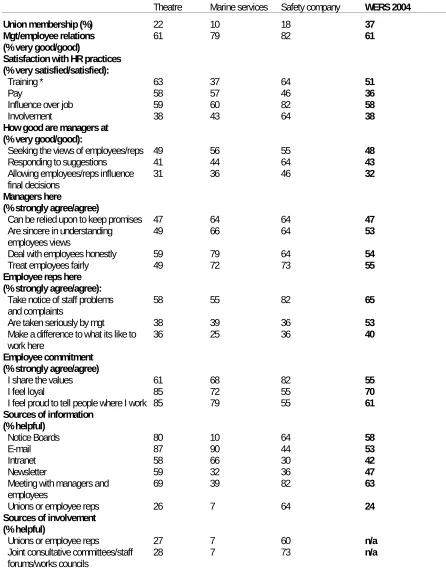
(30) representatives expressed some uncertainty as to how far management took account of staff views on major issues, and perceived the outcome of (then ongoing) consultation over the proposed move from weekly to monthly pay for casual staff as a key test of the value of the I&C body to staff. The latter consultation exercise had confirmed that staff were strongly against the proposal and, although management had yet to reach a final decision at the time of the research visit, it seemed likely that the proposal would be dropped. At the safety company, the contribution of representatives on the I&C body to dealing with the enforced shutdown issue was described by one manager as ‘key’. ‘While the main idea came from management, they came up with different rules on how to operate it.’ Other areas where there is evidence of the I&C body making a material difference include early finishing times on Fridays, an increase in the employer’s pension contribution from 4% to 4.5%, recycling and holiday planning. In addition, there is the I&C body’s previously-mentioned role managing a budget for the organisation of social activities. The impact of the employee forum at the snacks company has been more limited. Its early operation reportedly did make a difference in respect of staff-raised concerns, e.g. on booking holidays over Christmas and how many people per shift could be on holiday at the same time. The (employee) chair of the forum reported that ‘Initially there was a lot of change’, but that, since the takeover of the company, issues have often had to be referred to group headquarters causing delays in their resolution (and frustration on the part of the employee representatives). Otherwise, the forum has essentially played a ‘communications’ role. At marine services, the I&C arrangements are at an embryonic stage and, at the time of the first research visit, there had not been any substantial issues to test the process. Pay – included or excluded? At the theatre, the only unionised wave 3 case study organisation, although pay rates and allowances are determined in discussion with representatives of the recognised union, other pay and pay-related issues – including the controversial proposed move from weekly to monthly pay for casual staff – have been discussed with the I&C body. At the safety company, while pay scales and pay reviews are formally excluded from the I&C body’s remit, in practice pay is raised and discussed, but there are no negotiations since this is a matter for the American owners. At the snacks company, ‘changes to terms and conditions of employment’ are listed among ‘matters for discussion’, but ‘remuneration’ is specifically excluded. Nevertheless, pay issues (e.g. the non-payment of a traditional summer bonus) have been raised at the I&C body and it is informed about pay rises and asked to disseminate the details to the workforce. At marine services too, basic pay increases are decided unilaterally by the board, although staff are consulted, via approval by the employee benefit trust, on the scale of profit-related bonus awards.. 3.4 Employee perceptions of I&C The employee survey administered to the wave 1 and wave 2 case studies was also used in the wave 3 organisations. Employees’ experiences and perceptions of different forms of I & C arrangements (direct and indirect) were sought, plus their views on management and employee representatives’ effectiveness, certain HR practices and other employee outcomes. Some of the questions in the survey 18.
(31) are based on the Workplace Employment Relations Survey 2004 1 , and this enabled the research team to position the case study organisations against this benchmark. Further methodological details are provided in Annex A. To date, surveys have been conducted in three out of four wave 3 organisations (the exception being the snacks company), resulting in a total of 127 responses. Response rates varied between 37% and 47%. The results are summarised in table 3.. 1. The Workplace Employment Relations Survey (WERS 2004) is a nationally representative survey of British workplaces employing five or more employees. The survey was jointly sponsored by the Department for Business, Enterprise and Regulatory Reform, Acas, the Economic and Social Research Council and the Policy Studies Institute. More information on the survey can be found at: http://www.berr.gov.uk/employment/research-evaulation/wers-2004. 19.
(32) Table 3: Employee perceptions – year 1 survey comparisons in ‘wave 3’ organisations Union membership (%) Mgt/employee relations (% very good/good) Satisfaction with HR practices (% very satisfied/satisfied): Training * Pay Influence over job Involvement How good are managers at (% very good/good): Seeking the views of employees/reps Responding to suggestions Allowing employees/reps influence final decisions Managers here (% strongly agree/agree) Can be relied upon to keep promises Are sincere in understanding employees views Deal with employees honestly Treat employees fairly Employee reps here (% strongly agree/agree): Take notice of staff problems and complaints Are taken seriously by mgt Make a difference to what its like to work here Employee commitment (% strongly agree/agree) I share the values I feel loyal I feel proud to tell people where I work Sources of information (% helpful) Notice Boards E-mail Intranet Newsletter Meeting with managers and employees Unions or employee reps Sources of involvement (% helpful) Unions or employee reps Joint consultative committees/staff forums/works councils. Theatre. Marine services. Safety company. WERS 2004. 22 61. 10 79. 18 82. 37 61. 63 58 59 38. 37 57 60 43. 64 46 82 64. 51 36 58 38. 49 41 31. 56 44 36. 55 64 46. 48 43 32. 47 49. 64 66. 64 64. 47 53. 59 49. 79 72. 64 73. 54 55. 58. 55. 82. 65. 38 36. 39 25. 36 36. 53 40. 61 85 85. 68 72 79. 82 55 55. 55 70 61. 80 87 58 59 69. 10 90 66 32 39. 64 44 30 36 82. 58 53 42 47 63. 26. 7. 64. 24. 27 28. 7 7. 60 73. n/a n/a. * WERS survey question is about satisfaction with ‘training’. This survey asked about satisfaction with ‘training, coaching and guidance’.. 20.
Figure


Related documents
The main factor of the dialectal division of the Shor language into the Mrassu and Kondoma dialects is phonetic, based on the following types of correspondences (Chispiyakova,
Based on a full-resolution Meteosat dataset, an extensive climatological study of the mesoscale convective systems (MCSs) observed by satellite over the Sahel leads to the definition
Figure A.2: Residual histogram and Q-Q plots for the model with units independent variables and cartons as dependent variable. Figure A.3: Residual histogram and Q-Q plots for the
the pump, SPBN, APMS, SPBB and agents bunker other (Presidential Decree No. 18 of 2013 concerning the retail selling price and the consumer the User certain types of fuel)
Table I.-Questionnaire Statements and Comparison of Farmer and Cooperative Manager Responses Related to Prices, Membership, Service, Cooperative Management, Patronage Refunds,
The At-Equity accounted investments within the Business Area Carbon Fibers & Composites represented a total sales volume of €42.1 million in the reporting period (Q1/2011:
Under merger accounting, the shares issued by GlaxoSmithKline plc to acquire Glaxo Wellcome and SmithKline Beecham are accounted for at par and no share premium arises; the
