Journal of Cooperatives
Copyright National Council of Farmers Cooperatives. Duplication is permitted for academic or research purposes but not for commercial purposes. Permission is hereby granted for the redistribution of this material over electronic networks so long as this item is redistributed in full
Assessing the Effectiveness of
Farm Supply Cooperatives:
A Comparison of Farmer and
Manager Viewpoints
Larry
Burt and M.E. Wirth
This paper reports the results of a survey of attitudes of commercial farmers and supply cooperative managers about agricultural supply cooperatives. Cooperative managers and farm-ers frequently made significantly different responses to questionnaire statements. With a few exceptions, farm size and farmer age did not appear to influence perceptions about supply cooperatives. Whether a farmer was a cooperative member was important in some cases. Lower prices in lieu of easy credit and patronage refunds were found to be acceptable to farmers, but not at the expense of good service. Managers placed great importance on member loyalty to the supply cooperative without regard to price considerations.
Introduction
Many commercial farmers use cooperatives to market products, obtain supplies, or procure needed services. The downturn in the agricultural sector during much of the 1980s, combined with the financial difficulties of many farm credIt lenders, weakened the position of many cooperatives. In particular, farm supply cooperatives, the focus of thIS study, faced financial stress due to decreased demand for farm inputs along with an increased demand to finance accounts unable to obtain lines of credit from traditional lending sources. Supply cooperatives were also pressed by privately owned input suppliers that were competing effectively for large farm accounts.
Farm supply cooperatives in the Willamette Valley of western Oregon, the study area, faced additional problems typical of a diverse agricultural area. About 75 crops with gross sales exceeding $1 million are grown commercially in the Willamette Valley. Supply cooperatives in such an area may be pressured to provide a wide variety of services and products required to meet the needs of farmers of all the different crops grown in the area.
LarryBurt arul ME. Wirth are respectively associate professar, Department of AgrU;u1tural arul Resource Ecmwmics, Oregan State University, arul professar of agrU;u1tural finance, Departmerit of AgrU;u1tural Ecmwmics, Washington State University.
Wark at Oregan State UniversiJ:y wasdnneuruI.er AgrU;u1tural Experiment Statian Project 0351 arul Cooperative Research Agreement No. 58-3J31-5.{)028 between the Department of AgrU;u1tural arul Resource Economics arultheU.S. Department ofAgriculture, AgrU;u1tural Cooperative Service, Cooperative Marketing arul Purchasing Divisian. Wark at Washington State UniversiJ:ywasdnneuruI.er Agri£u1tural Research Center Project 0755.
Less obvious, but perhaps as important, supply cooperatives like other types of businesses face the difficulty of dealing with large as well as small farmer account
sizes.Asa part of that problem, large farming operations frequendy maintain
low-dollar-volume accounts with supply cooperatives. For some cooperatives farm size may be important in assessing policy decisions with respect to any related high versus low dollar-volume accounts and to better understand the causes for nonparticipation in cooperatives. Furthermore, age of the farm operator may affect participation.
The purpose of this research was to determine: (1) farmer versus manager percep-tions about farm supply cooperatives; (2) differences in perceppercep-tions between farmer groupings related to membership or nonmembership in a farm supply cooperative; and (3) variation in perceptions based on size of farm operation and age of the farmer. The major sources of data were mail surveys ofWillamette Valley farmers and supply
cooperative managers. This paper summarizes the results of those surveys.I
Review of Literature
To prepare for the study, an extensive literature review related to perceptions about supply cooperatives was completed. No studies were found that focused exclusively on issues related to serving farmers who produce many different crops, or farmer-versus-manager perceptions about supply cooperatives. However, there have been a number of studies that focused exclusively on farmer attitudes within fairly uniform agricul-tural settings.
Examples of studies primarily concerned with farmer supply purchases included Gensch and Wissman. Gensch found that Iowa fertilizer cooperatives could compete effectively with private dealers provided they possessed key attributes identified in a farmer survey: honest management, on-time deliveries, relative large size, willingness to negotiate price, and a business that also markets grain. Wissman concluded that supply cooperatives were valued by farmers in the Virginia, Delaware, and Kentucky areas he studied. However, customer loyalty and limited price discounting were found only with respect to fuel and not for feed, fertilizers, or pesticides.
Other studies that focused at least partially on supply cooperatives included a survey of young farmers in northern MISsouri (Osburn et al.). The respondents were generally satisfied with the supply-types of cooperatives they patronized. However, they expressed no commitment to purchases at their supply cooperatives versus privately owned businesses. Indifference to the cooperative business form and its principles was found to be widespread.
In a study that included farmers in Indiana, Illinois, and Iowa, litde difference was found on perceptions of cooperative and privately owned business performance
(Schrader et al.). Farmers felt slightly more loyal to cooperatives and gave them
somewhat higher management evaluations. But price was found to be an important factor in farmer decisions on where to buy or sell.
In another study of Indiana and Illinois farmers, cooperatives were perceived to have an advantage over privately owned firms in the areas of fairness and serving farmers' special needs (Boynton and Babb). Privately owned firms, however, were
perceived to have advantages in the areas of prices, financial performance, and
efficiency. Price was the most important factor for farmer choice ofa fertilizer supplier. Dependability of supply was ranked second.
Survey and
Analytical
Procedures
The study data were collected by mail questionnaires using standard mail and telephone follow-up procedures. Survey materials were sent to the 19 farm supply
CooperativeEffectiveness/Burt and Wirth 19 cooperative managers in the study area. There were 13 usable questionnaires returned, a 68-percent response rate. With the help of area Extension agents and farm supply cooperative managers, 1,300 commercial farmers in the study area were identified. The farmers were classified with respect to their annual farm cash receipts as: small ($20,000-$39,999), medium ($40,000-$99,999), and large (at least $100,000). By design, half the farmers were supply cooperative members and the other half were not members. Each farmer was sent the survey materials. A total of 674 usable questionnaires were returned, a 52-percent response rate.
Manager responsesto the questions were compared with those submitted by the
farmers. As a part of the analysis, farmers were placed in categories based on coopera-tive membership, operator's age, and farm size. Mean responses were calculated and compared for each combination of groupings. Analysis of variance techniques including Tukey's studentized range test (Morrison) were used to estimate the statisti-cal significance of differences in mean responses between groupings. In all cases differences at the 5 percent level or lower were defined as statistically significant.
The survey respondents were asked to answer each questionnaire statement by circling one of the following to indicate their feelings:
Opinion Strongly Agree Agree Neutral Disagree Strongly Disagree Number Score I 2 3 4 5
Summary
of Issues Addressed in the Survey
In drawing conclusions from analysis of the survey data, it was helpful to group the questionnaire statements into the following issue areas: (1) Prices, (2) Membership, (3) Service, (4) Cooperative Management, (5) Patronage Refunds, (6) Returns to Farmers, and (7) Competitive Environment. Although some of the questionnaire statements addressed more than one issue, the groupings were based on the primary focus of each statement.
In general the study results indicated that farm size was not a statistically significant factor associated with expressed farmer attitudes and perceptions about supply coop-eratives. Moreover, farm size was not a statistically significant factor with respect to farmer patronage levels at supply cooperatives. Except as noted below, farmer age was not generally associated in any significant ways with farmer attitudes toward supply cooperatives nor was it a factor in farmer purchasing habits.
Prices
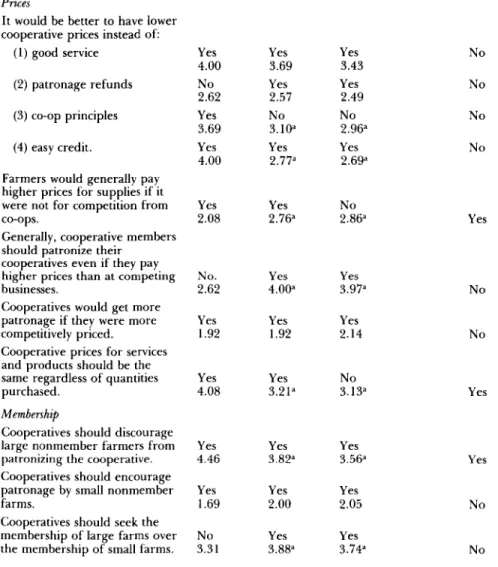
Farmers and managers had strong feelings about prices (table 1). The mean responses to price statements were, for the most part, significantly different from neutral. Generally, farmer's and manager's responses were significantly different, and in several cases they were also opposite. With respect to price issues, farmer members and nonmembers for the most part did not differ significantly in their responses.
The mean responses showed that farmers wanted lower prices, but not at the expense of good service. In general they were willing to sacrifice patronage refunds
Table I.-Questionnaire Statements and Comparison of Farmer and Cooperative Manager Responses Related to Prices, Membership, Service, Cooperative Management, Patronage Refunds, Returns to Farmers, and Competitive Environment.
Were Member Do the Means Differ ResponsesSignificantly Significantly from Neutral? Different from Yes or No (neutral = 3.00) Nonmembers? Questionnaire Statements Managers Members Nonmembers Yes or No
Mean Responses ---Prices
Itwould be better to have lower cooperative prices instead of:
(I) good service Yes Yes Yes No
4.00 3.69 3.43
(2) patronage refunds No Yes Yes No
2.62 2.57 2.49
(3) co-op principles Yes No No No
3.69 3.lOa 2.96a
(4) easy credit. Yes Yes Yes No
4.00 2.77a 2.69a
Farmers would generally pay higher prices for supplies if it
were not for competition from Yes Yes No
co-ops. 2.08 2.76a 2.86a Yes
Generally, cooperative members should patronize their
cooperatives even if they pay
higher prices than at competing No. Yes Yes
businesses. 2.62 4.00a 3.97a No
Cooperatives would get more
patronage if they were more Yes Yes Yes
competitively priced. 1.92 1.92 2.14 No
Cooperative prices for services and products should be the
same regardless of quantities Yes Yes No
purchased. 4.08 3.21" 3.13a Yes
Membership
Cooperatives should discourage
large nonmember farmers from Yes Yes Yes
patronizing the cooperative. 4.46 3.82a 3.56a Yes
Cooperatives should encourage
patronage by small nonmember Yes Yes Yes
farms. 1.69 2.00 2.05 No
Cooperatives should seek the
membership of large farms over No Yes Yes
Cooperative Effectiveness/Burtand Wirth 21
Were Member Do the Means Differ SignificantlyResponses Significantly from Neutral? Different from Yes or No (neutral = 3.00) Nonmembers? Questionnaire Statements Managers Members Nonmembers Yes or No
Mean Responses ---Cooperatives would get more
patronage if they lowered Yes Yes Yes
membership requirements. 3.54 3.29 2.76a Yes
Most cooperative members are
not very informed about the Yes Ves Ves
operation of their cooperative. 2.15 2.39 2.46 No
Service
Cooperatives offer better service No Ves Ves
than competing businesses. 2.69 3.22a 3.33a No
Cooperatives would get more
patronage if they hired Ves Ves No
friendlier personnel. 2.38 2.89a 2.91" No
Cooperatives are instrumental
in introducing new products Ves Ves Ves
and technologytolocal farmers. 1.46 2.54a 2.81" Ves
Cooperatives are no longer
serving small farmers' needs Ves No Ves
adequately. 3.77 3.00a 2.49a Ves
Cooperative Management
Cooperatives generally are not Ves Ves Yes
managed efficiently. 3.54 2.70a 2.65" No
Cooperative managers and board members care more
about cooperative survival than No Yes Ves
member needs. 3.08 2.62 2.54 No
Patronage Refunds
Members generally benefit by
patronage refunds of Yes Ves Yes
cooperatives. 2.38 2.70 2.68 No
Cooperatives would get more
patronage if they lowered Yes Yes Yes
patronage refund revolve time. 2.31 2.80 2.74 No
Returns to Farmers
Voung farmers should expect to receive as many benefits from
cooperatives in the future as Ves Ves Ves
others have in the past. 2.38 2.51 2.66 No
Cooperatives help their members attain a higher
standard of living through No No No
Questionnaire Statements
Do the Means Differ Significantly from Neutral? Yes or No (neutral = 3.00)
Managers Members Nonmembers Mean Responses ---Were Member Responses Significantly Different from Nonmembers? Yes or No Competitive Environment
There are few significant differences between
cooperatives and competing No Yes Yes
businesses. 3.23 2.57a 2.50a
Cooperatives would get more
patronage if they located closer No No No to other shopping needs. 2.54 2.99 2.78 Cooperatives would get more
patronage if they did more Yes Yes Yes
advertising. 2.31 2.71 2.71
alndicates responses significantly different from the managers' responses.
No
No
No
and easy credit to receive those lower prices. They were neutral with respect to sacrificing cooperative principles if it led to lower prices for their input purchases. In contrast, managers disagreed with the idea of lower prices at the expense of coopera-tive principles. Member farmers felt that cooperacoopera-tives were important in keeping prices at competing businesses low. The managers were even more convinced about that idea. Nonmembers were neutral on this issue.
Farmers strongly disagreed with managers who felt farmers should be loyal to the cooperative regardless of higher prices. Younger farmers in particular were less likely to be loyal if cooperative prices were higher. In general, farmer and manager responses stressed the need that supply cooperatives offer lower prices to stay competi-tive.
Member farmer's and manager's responses indicated that price discounts based on quantity purchased were acceptable. However, member farmers (primarily the oldest) agreed less than managers with the concept of quantity-triggered price discounts. Furthermore, nonmember farmers were neutral with respect to quantity-triggered price discounts.
Membership
Mean responses of all groups of farmers and managers implied that nonmembers, both large and small, should not be discouraged from patronizing cooperatives (table I). Managers felt even more strongly than farmers that large nonmember farms should not be discouraged from patronizing the cooperative. Likewise, member farmers felt more strongly than nonmembers that large nonmembers should not be discouraged from buying at supply cooperatives. Farmers in general would not want to see large farms favored for membership over small farms. Managers, however, were neutral on this issue.
Cooperative Effectiveness/Burtand Wirth 23 Nonmembers felt that patronage would increase if membership requirements were lower. In contrast, members and managers agreed that lower membership requirements would not increase patronage. In general, managers and all farmers agreed that members were not well informed about the operation of their supply cooperatives.
Service
As indicated earlier, both farmers and managers believed service should not be
sacrificed to obtain lower prices (table 1). However, both member and nonmember farmers did not think that cooperatives provided better service than competing businesses. In contrast, the managers were neutral with respect to that viewpoint.
Hiring friendlier personnel would influence patronage according to managers. Member farmers believed that to a much lesser extent. Furthermore, nonmember farmers were neutral in regard to friendlier personnel increasing patronage. All groups believed that cooperatives were effective in disseminating new technology, but managers were significantly more in agreement than farmers with this idea.
The managers did not agree that supply cooperatives are no longer serving the needs of small farmers. Member farmers were neutral on this service issue. However, nonmember farmers had a significantly opposite view to that of the managers by agreeing tlIat supply cooperatives are no longer serving the needs of small famlers.
Cooperative Management
Farmers held a critical view of supply cooperative management (table 1). Not surprisingly, managers took a significantly opposite view. They disagreed that supply cooperatives are generally not managed efficiently.
Both farmer groups felt that cooperative managers and board members were concerned more with survival of the supply cooperative than with member needs. They indicated that the leaders of supply cooperatives should put member needs ahead of any concerns about the economic viability of the cooperative. By implication, doing this would make the cooperative more economically viable. The managers, however, were neutral on this issue.
Patronage Refunds
Both farmers and managers believed patronage refunds to be beneficial, but they also thought cooperatives could get more business by reducing the revolve time (table
1). As noted in the prices section, all farmers were in agreement that it would be
acceptable to sacrifice patronage refunds to gain lower prices.
Returns to Fanners
Farmers and managers were in agreement about the continuing benefits of supply cooperative membership for young farmers (table 1). The younger farmers tended to be the most doubtful about the longer-term benefits of membership. Furthermore, all groups were neutral on whether patronizing supply cooperatives would bring them higher living standards.
Competitive Environment
Farmers indicated they believed that there were few substantial differences between cooperatives and privately owned firms (table 1). The corresponding manager
responses were neutral. All groups were neutral on whether supply cooperatives would get more business if they located closer to other shopping outlets. However, farmers and managers both agreed that supply cooperatives would get more patron-age if they did more advertising.
Cooperative Principles
When considering all the statements in the survey questionnaire that related to cooperative principles (table 1), it was generally apparent that farmers did not regard cooperative principles higWy and were at best neutral when asked if cooperative principles should be sacrificed for lower prices. Without regard to their level of understanding about them, many of the farmer respondents would have no trouble abandoning cooperative principles in order to buy their inputs at lower prices.
The farmers did not feel there were notable differences between cooperatives and privately owned firms. Furthermore, many of them felt members were poorly informed about the operations of their cooperatives. Farmers would not be loyal to cooperatives if they had to pay higher prices, and they seemed to reject egalitarian principles of equal prices and easy credit. Although managers, to the contrary, expressed a need for farmer loyalty to the supply cooperative, they were in agreement with the farmer respondents in regard to the acceptability of sacrificing some coopera-tive principles if it led to lower price levels for inputs being sold by the cooperacoopera-tive.
Implications of the Study
Price competitiveness appears to be very important to farmer respondents who purchase inputs at supply cooperatives. In that regard they would likely be willing to sacrifice easy credit or higher levels of patronage refunds to get more favorable prices for the products they are purchasing from these cooperatives. Inferior service, however, was clearly not an acceptable offset to lower prices.
Manager respondents in many respects identified with these ideas. However, they put a high premium on farmer loyalty to the supply cooperative even to the point of paying higher prices for some inputs. Based on the survey results, this attitude is clearly contrary to that of the farmers and may encourage low patronage. However, both farmers and supply cooperative managers saw a need to operate the cooperative in a businesslike manner.
There may be a number of possible approaches to implement these seemingly inconsistent operating goals and still maintain adequate equity capital balances in the cooperative. One idea might be to institute discounts for volume sales. Both farmers and managers found that concept to be acceptable and, if implemented, could be an immediate way for some patrons to realize lower prices. Tightening credit policies might also result in savings, which eventually could be passed on to customers in the form of lower prices. Similarly, lower prices could be offered if members would agree to accept lower patronage refunds.
Another perhaps more creative way to reduce prices might be to encourage farmers to buy a package of necessary inputs for a given crop. Conceptually, this might include all services and technical help that, if sold in larger volume, might provide economies of size that would benefit the cooperative. If these input packages were offered at lower prices, compared with separate purchases, even smaller farmers might realize g-ains. In addition to benefiting farmers by lowering prices, this package plan could lock in sales and possibly result in further savings for the cooperative.
CooperativeEffectiveness/Burt and Wirth 25 As a part of creating innovative pricing strategies for supply cooperatives in areas such as the study region, it is important that supply cooperatives maintain a high level of awareness about their customers' needs. As illustrated in this study, important perception differences between supply cooperative managers and members may be a problem. It might be very useful for a supply cooperative to develop a database containing customer information that could be used to develop strategies. That might enable them to tailor goods and services specifically to individual customer needs. Such a database would conceivably contain current farm enterprise information, addresses and locations of farm land, outbuildings, etc. for each patron.Itmight also contain information on the farmer's attitudes and perceptions obtained by any num-ber of formal as well as informal data-gathering procedures, as suggested by Dalecki and Perry.
Finally, it is clear that supply cooperatives in the study area, and perhaps elsewhere, need to renew their efforts to build member commitment and patron loyalty. Many farmer respondents saw little difference between cooperative and privately owned input suppliers. Cooperative management needs to find some way to impress mem-bers that a cooperative is not just another business, but offers some special characteris-tics that can be of benefit to members. The respondents, rather than see a supply cooperative go under if it is not price competitive, might respond positively to continu-ing educational efforts by management to help renew commitment to the cooperative form of input supplier.
With many farmers showing a lack of knowledge about cooperatives, it may be appropriate in any educational program to include the study of cooperation itself, e.g., the philosophy of cooperation and the ideological values underlying it. Such a process would encourage patrons to accept or reject the concept of cooperation. Furthermore, it might just increase the ideological commitment of farmers to supply cooperatives.
Note
1. For a complete discussion of the survey instruments, analytical approach, and details of the findings, see Hartley and Burt.
References
Boynton, Robert D., and Emerson M. Babb. Farmers' Perceptions of the Comparative Peifrmnance of Cooperative and Pmfrrietary Agribusinesses. Agr. Exp. Stat. Bull. 383, Purdue University, July 1982.
Dalecki, Michael D., and Ernest B. Perry.Howto Capture What Farmers Think. Washing-ton, D.C.: USDA ACS Service Rep. 23, Jan. 1989.
Gensch, DennisH.Iowa Cooperative Fertilizer Retail Outlets: Farmers' Attitudes and
Percep-tions, ed.
K.c.
Ling. Washington, D.C.: USDA ACS Res. Rep. 29, Aug. 1983.Hartley, Marcus L., and Larry Burt.Are Farm Supply Cooperatives Meeting Farmer Needs? A Survey ofFarmers and Managers.Agr. Exp. Stat. Bull. 672, Oregon State University,
Mar. 1989.
Morrison, D.G. Multivariate Statistical Methods. New York: McGraw-Hill Book Co., 1967.
Osburn, Donald D., C. Brice Ratchford,
K.c.
Schneeberger, and Scott Phillips.Young Farmer ,4ttitudes Toward Cooperatives. Agr. Exp. Stat. Special Rep. 341, University of Missouri-Columbia, Mar. 1985.Schrader, Lee F., E.M. Babb, R.D. Boynton, and M.G. Lang.CooperativeandPmprietary Agribusinesses:Campamon ofPeiformaru;e.Agr. Exp. Stat. Bull. 982, Purdue Univer-sity, April 1985.
Wissman, Roger A. Farmers' Supply-Purchasing Practices. Washington, D.C.: USDA ACS Res. Rep. 8,june 1981.