R E S E A R C H A R T I C L E
Open Access
Developing a group intervention to
manage fatigue in rheumatoid arthritis
through modifying physical activity
Victoria E. Salmon
1*, Sarah Hewlett
2,4, Nicola E. Walsh
2, John R. Kirwan
3,4, Maria Morris
4, Marie Urban
4and
Fiona Cramp
2Abstract
Background:Fatigue is a major symptom of rheumatoid arthritis (RA). There is some evidence that physical activity (PA) may be effective in reducing RA fatigue. However, few PA interventions have been designed to manage fatigue and there is limited evidence of end-user input into intervention development. The aim of this research was to co-design an intervention to support self-management of RA fatigue through modifying PA.
Methods:A series of studies used mixed methodological approaches to co-design a fatigue management intervention focused on modifying PA based on UK Medical Research Council guidance, and informed by the Behaviour Change Wheel theoretical framework. Development was based on existing evidence, preferences of RA patients and
rheumatology healthcare professionals, and practical issues regarding intervention format, content and implementation. Results:The resulting group-based intervention consists of seven sessions delivered by a physiotherapist over 12 weeks. Each session includes an education and discussion session followed by supervised PA chosen by the participant. The intervention is designed to support modification and maintenance of PA as a means of managing fatigue. This is
underpinned by evidence-based behaviour change techniques that might support changes in PA behaviour. Intervention delivery is interactive and aims to enhance capability, opportunity and motivation for PA.
Conclusion:This study outlines stages in the systematic development of a theory-based intervention designed through consultation with RA patients and healthcare professionals to reduce the impact of RA fatigue. The feasibility of future evaluation of the intervention should now be determined.
Keywords:Fatigue, Rheumatoid arthritis, Physical activity, Intervention development, Self-management, Patient and public involvement, Co-design
Background
Fatigue is an important symptom of rheumatoid arthritis (RA) [1]. Patients report fatigue as difficult to manage with
little professional support [2,3]. The multi-dimensional
na-ture of RA fatigue has been largely ignored, with little treat-ment targeted specifically at this symptom [4]. Despite inclusion of fatigue measurement in clinical trials [5], few studies have explicitly addressed RA fatigue management.
RA fatigue has been associated with reduced participation
in physical activity (PA) [6, 7]. However, meta-analyses
suggest that PA may have a small beneficial effect on RA
fa-tigue [8,9]. To date, few studies have investigated
interven-tions designed specifically to reduce fatigue, or examined fatigue as a primary outcome. The need to develop a specific PA fatigue management intervention that meets the needs of RA patients is evident.
Designing complex interventions to improve health outcomes requires systematic development to ensure they are likely to be worth implementing in clinical prac-tice [10]. Complex interventions have several dimen-sions, including the number and difficulty of behaviours required by recipients and those delivering the interven-tion and the permissible degree of flexibility or tailoring of the intervention [10]. Involving stakeholders in a
© The Author(s). 2019Open AccessThis article is distributed under the terms of the Creative Commons Attribution 4.0
International License (http://creativecommons.org/licenses/by/4.0/), which permits unrestricted use, distribution, and
reproduction in any medium, provided you give appropriate credit to the original author(s) and the source, provide a link to the Creative Commons license, and indicate if changes were made. The Creative Commons Public Domain Dedication waiver (http://creativecommons.org/publicdomain/zero/1.0/) applies to the data made available in this article, unless otherwise stated. * Correspondence:[email protected]
1Institute of Health Research, University of Exeter College of Medicine and
co-design process enables their experiences to be incor-porated into the intervention, increasing the likelihood of it being acceptable to users and providers [11]. Using a co-design approach provides an opportunity to explore challenges, concerns and ideas for future implementa-tion at an early stage, improving potential effectiveness and enhancing uptake, adoption and maintenance of the intervention.
UK Medical Research Council (MRC) guidance for developing complex interventions recommends three processes in early development:
1. identifying an existing evidence base 2. identifying/developing appropriate theory 3. modelling processes and outcomes [10]
Whilst MRC guidelines strongly advocate a theoretical basis, they do not provide detailed guidance on how to choose or apply theory. In recognition of this, the Behav-iour Change Wheel (BCW) has been proposed as a comprehensive, systematic approach to intervention devel-opment based on established behaviour change theory [12]. The central behaviour system in the BCW is the
theoretically-based Capability, Opportunity, Motivation –
Behaviour (COM-B) model, that suggests a change in behaviour will require a modification in at least one of the
following components: the‘capability’of a person to carry
out that behaviour; the ‘opportunity’for the behaviour to
occur; and ‘motivation’ to perform the behaviour at that
moment in time [12].
The BCW framework assists intervention developers in identifying potential concepts required for behaviour change, as well as aiding designers in analysing target behaviours and characterising interventions and their active components. It is supported by links to other theory-based resources, such as the Theoretical Domains Framework (TDF) [13] and a taxonomy of recognised behaviour change techniques (BCTs) [14]. It is recommended in UK National Institute for Health and Care Excellence (NICE) guidance for developing individual-level behaviour change interven-tions [15].
Few studies describe a collaborative co-design process
for the development of PA interventions in RA [16,17].
Despite recommendations for the use of theory in self-management interventions in rheumatology [18], few studies report how theory was used during
develop-ment of PA interventions for RA [19, 20]. The aim of
this research was to co-design an intervention with RA patients and healthcare professionals (HCPs) to support self-management of RA fatigue through modifying PA. Intervention development was guided by the MRC framework and based on existing evidence, RA patient and HCP preferences and priorities, underpinned by the BCW theoretical framework. The objectives were to 1)
develop programme content; 2) design programme ses-sions and develop resources required for delivery; and 3) develop educational support materials.
Methods
Full methods are available elsewhere [21]. Intervention
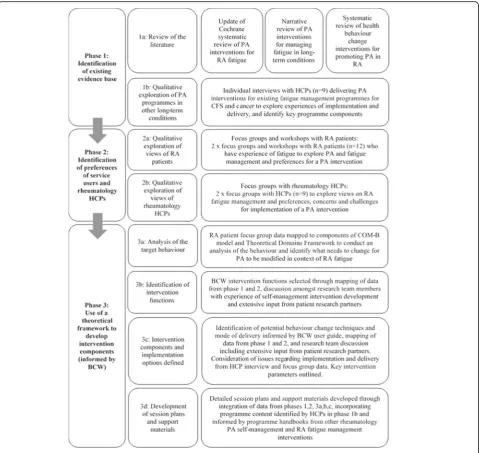
development (Fig. 1) was supported by a research team
and patient research partners (PRPs) with experience of developing theory-based self-management interventions for rheumatic diseases. The multi-disciplinary research team had professional backgrounds in physiotherapy (VS, FC, NW), rheumatology nursing (SH) and rheuma-tology medicine (JK). Both PRPs (MM, MU) had a diag-nosis of RA and had experienced fatigue, providing a perspective of the lived experience. PRP involvement in research improves research quality [22], with benefits in-cluding a fresh perspective, changes to study designs and novel outcomes [23].
Phase 1: identification of an existing evidence base
1a: review of the literature
Three literature reviews were conducted to 1) identify existing evidence and investigate the effectiveness of PA interventions for reducing RA fatigue; 2) identify existing evidence for the effectiveness of PA and exercise therapy interventions for fatigue in other conditions, and describe intervention characteristics and methods of delivery; and 3) evaluate the effectiveness of interventions incorporating health behaviour change theory or techniques for PA pro-motion, uptake and maintenance in RA.
Search methods
Reviews 1 and 3 used Cochrane systematic review meth-odology [24]. Review 1 was based on a Cochrane review investigating non-pharmacological interventions for man-aging RA fatigue [8]. Review 2 used systematic searching to identify papers for a narrative review. Electronic data-bases were searched up to March 2015: MEDLINE, Allied and Complementary Medicine (AMED), Cumulative Index to Nursing and Allied Health Literature (CINAHL) Plus, Cochrane Controlled Trials Register (CENTRAL), EMBASE, PsycINFO, SportDiscus, Science Citation Index.
1b: qualitative exploration of PA programmes in other long-term conditions
Semi-structured interviews were conducted with HCPs
(n= 9) delivering PA interventions for fatigue
Data analysis
Discussions were audio-recorded and transcribed verba-tim. Interviews were analysed (VS) using hybrid thematic
analysis [25,26], using a BCT taxonomy [27] as a
deduct-ive framework. A subset of transcripts was independently analysed (SH, MU).
Phase 2: identification of preferences of RA patients and rheumatology HCPs
Phase 2 was approved by the National Research Ethics Service Committee East Midlands - Nottingham 1 (Ref: 13/EM/0331).
2a: qualitative exploration of preferences of RA patients Two focus groups were conducted with purposively
se-lected RA patients (n= 12) who self-reported RA fatigue.
The acceptability of a PA intervention for managing RA fatigue was explored.
[image:3.595.59.539.87.540.2]TurningPoint handsets and imported into Microsoft Excel (2007). Participants discussed their views regarding the pre-sented content, such as which components would be most useful and acceptable as part of an RA fatigue management intervention. Comments were recorded in field notes.
2b: qualitative exploration of views of rheumatology HCPs Data from phase 2a were collated and summarised prior to
two further focus groups with rheumatology HCPs (n= 9).
Participants discussed challenges, opportunities and prac-tical considerations regarding implementation of a PA fatigue management intervention.
Data analysis
Focus groups were audio recorded, transcribed verbatim and analysed (VS) using inductive thematic analysis [25]. Transcripts were independently analysed (FC, NW, MM). All analyses were discussed and agreed with the research team. Workshop data were collected via TurningPoint
(TurningPoint version 4.2.3, www.turningtechnologies.
com) and analysed in Microsoft Excel (2007).
Phase 3: use of a theoretical framework to develop intervention components
The BCW guide to designing interventions was used to develop intervention components [28]. Data from phases 1 and 2 were mapped onto the theoretical framework in order to:
Understand the behaviour (3a)
Identify intervention options (3b)
Identify content and implementation options (3c)
Session plans and support materials were developed (phase 3d) based on outcomes from phases 3a-3c.
3a: analysis of target behaviour
Qualitative data from phases 1b, 2a and 2b were mapped onto domains of the COM-B model and TDF. This developed a comprehensive theoretical understanding of what might need to change for RA patients to modify PA as a means of managing their fatigue.
3b: identify intervention functions
Intervention functions that might bring about a change in behaviour were selected according to evidence of effective-ness for the given situation and population; relevance to the target behaviour, setting and population; feasibility of deliv-ery of the function; acceptability to patients and profes-sionals [28]. Where possible these criteria were supported by evidence from phases 1 and 2. Where these data were not available selection was made through discussion with the research team.
3c: identify content and implementation options
Selection of intervention content was guided by data from phase 1 and 2 and informed by programme man-uals provided in phase 1b, from existing evidence-based interventions in CFS [29] and for current research trials for a PA self-management intervention for chronic pain [30] and a cognitive behaviour therapy-based RA fatigue self-management intervention [31].
Identification and selection of potential BCTs to deliver intervention functions and decisions regarding mode of delivery were informed by the BCW guide [28], BCT tax-onomy [14], mapping of phase 1 and 2 data, and research team discussions. Core BCTs were selected from those
rec-ommended for inclusion in PA programmes [32, 33] and
additional BCTs identified from phase 1b. The criteria of effectiveness, relevance, feasibility and acceptability used to select functions were applied when choosing BCTs. Issues regarding implementation and delivery identified in phases 1b and 2 were considered.
3d: development of session plans and support materials Theory-informed content and delivery options were com-bined with patient and rheumatology HCP preferences and practical issues to produce a draft intervention. Individual session plans were developed along with educational sup-port materials. Further decisions about who should deliver the intervention, intervention format and setting, session frequency and duration were considered.
The research team reviewed individual session plans and accompanying support materials. In-depth discus-sions were held with PRPs to check the order of session topics and to ensure that content and materials were readable, comprehensive and useful. Comments pro-vided by all team members were used to amend and refine the intervention.
Results
Participant characteristics
Eighteen HCPs (all female) consented to take part in
phases 1b (n= 9) and 2b (n = 9). They had been qualified
between 11and 32 years (phase 1b) and 7–28 years (phase
2b) with rheumatology experience ranging from 5 to 15 years for phase 2b participants. Most HCPs were
physio-therapists (n= 12) with two occupational therapists also
participating in both phases. In addition, in phase 1b a clin-ical nurse specialist and exercise physiologist participated.
Twelve patients (6 female), aged 43–66 years (mean
56.8) with disease duration 0.25–25 years (mean 8.2),
consented to participate in phase 2a.
Phase 1: identification of an existing evidence base
1a: review of the literature
Cochrane review [8]. The original meta-analysis conclu-sion that there was a small beneficial short-term effect of PA for managing RA fatigue remained unaltered.
Review 2 concluded that aerobic PA using a graded approach might be particularly effective for managing fa-tigue. Optimal intervention parameters, such as dur-ation, frequency and intensity of PA were unclear, although some evidence suggested incremental increases from a lower intensity of PA might yield better outcomes in CFS [35]. There were limited data regarding adher-ence to treatment and research procedures and no quali-tative studies were identified exploring acceptability of PA for fatigue in other long-term conditions.
Review 3 highlighted a lack of evidence for the effective-ness of theory-based interventions to promote engagement in and long-term maintenance of PA in RA. Interventions that promoted PA in RA employed a range of BCTs, in-cluding instruction on how to perform the behaviour, infor-mation provision, goal setting, problem-solving, feedback and self-monitoring. Although some studies specified or al-luded to health behaviour change theories, it was unclear if or how theory was used during intervention development.
1b: qualitative exploration of PA programmes in other long-term conditions
Key themes from interviews with HCPs (n= 9) related to
format and delivery of PA interventions, and the need for organisational flexibility.
Format
HCPs (n = 9) identified various approaches to providing PA interventions for fatigue management in long-term condi-tions, including group and individual programmes of vari-able length. All programmes were delivered face-to-face with differences in the number, frequency and duration of sessions. Consistent findings included the use of a graded approach to PA and a need to address psychosocial and motivation issues relating to PA and fatigue. Several BCTs were identified, including instruction on performing PA, demonstration of PA, encouraging rehearsal of PA and de-livery by a credible source. However there was inconsist-ency in the application of techniques clinically. Some participants mentioned cognitive behavioural approaches, but these were not firmly embedded within existing programmes.
Delivery
HCPs advocated a patient-centred, interactive approach to delivery, with emphasis on patient-led problem solving. Most participants tried not to be prescriptive regarding PA, allowing patients to choose activities that were rele-vant and appealing. Motivational interviewing (MI) [36] was considered useful to improve engagement with PA.
Organisational flexibility
Organisational flexibility was required to ensure accessi-bility, meet training needs of staff, evaluate programmes and measure outcomes. Location and timing of sessions were considered important. For example, fatigued pa-tients might struggle to attend morning sessions or travel long distances.
Phase 2: identification of preferences of RA patients and rheumatology HCPs
All phase 2 participants supported the use of PA for managing RA fatigue. Key themes relating to challenges and solutions for implementation concerned group and peer support, patient-centred delivery, accessibility and knowledge and skills.
Group and peer support
All participants felt that PA interventions should be de-livered face-to-face in groups. Patients considered groups extremely valuable, providing an opportunity for interaction and discussion with fellow patients, as well as HCPs, who could offer expert advice and reassurance, enhancing confidence with managing fatigue and modi-fying PA. They felt that a group format was key for problem solving and learning through peer support. HCP participants agreed that group sessions had the ad-vantage of offering peer support and felt they could be justified from a management perspective. However, lack of staff and limited resources may prohibit group ses-sions in some services.
Patient-centred delivery
Patient participants felt that consideration of patient preferences and availability of choice was crucial to en-hance motivation. While some HCPs had concerns about managing patient choice in a group setting, others agreed that choice was important for patients. This echoed phase 1b findings that patient choice and decision-making are crucial for a successful outcome. Some phase 2b participants believed that delivery style was key to a successful intervention, reporting that MI techniques could be useful in this regard. Both patients and HCPs supported inclusion of a practical PA compo-nent to enhance confidence with PA in a supportive environment. All participants agreed that PA should be tailored to individual needs, with a choice of exercises to accommodate level of ability.
Accessibility
regarding limited access to services during working hours. Provision of out-of-hours services was challenging for HCPs, although some phase 2b participants reported positive experiences of flexible staffing, providing oppor-tunities for delivering evening or weekend sessions.
Patient preferences for location varied between commu-nity and hospital settings. Participants recruited from an inner-city hospital indicated that available transport op-tions may influence their decision to attend a programme.
Not all HCPs had access to premises that would allow a group of 6 to 10 patients to be seated comfortably for the discussion session, or access to an appropriate space for a practical PA session. These issues are likely to dif-fer according to local circumstances and would need to be addressed prior to implementation.
Duration and frequency of sessions and programme length were discussed. Patients indicated a preference for sessions of up to 2 h in duration, delivered over 12 to 14 weeks. Despite some concerns, HCP participants with experience of delivering 2-h sessions found these were well received by patients. Most HCPs had concerns about delivering a programme of more than 6 weeks. However, it was felt that this might be achievable by adjusting session frequency, believing that this could promote independence with self-management and PA, and improve long-term adherence.
Knowledge and skills
Patients identified a lack of knowledge and skills to self-manage their fatigue and PA. Those who had received HCP support with self-management skills, such as analys-ing and interpretanalys-ing activity patterns usanalys-ing activity diaries, had found this extremely useful. Patients wanted expert ad-vice regarding PA and fatigue management, suggesting that someone with good knowledge of RA, fatigue and PA should lead the intervention. This could be a HCP or a trained exercise professional. HCPs and patients agreed that techniques that enable patients to problem-solve challenges and identify opportunities for modifying PA should be in-corporated in an intervention.
HCPs believed that implementation of a PA intervention may require additional training in fatigue management, graded approaches to PA and/or basic psychosocial skills, depending on experience and knowledge. In addition, HCP participants indicated that delivery of fatigue management programmes by physiotherapists would require a change in referral practices, as current fatigue advice is usually pro-vided by occupational therapists.
Phase 3: use of a theoretical framework to develop intervention components
3a: analysis of the target behaviour
The target group for this intervention were adults with RA who experience fatigue. The behavioural target was
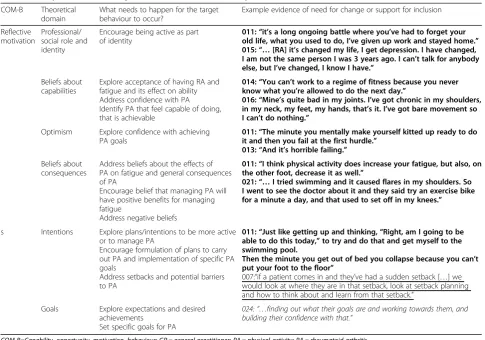
modification of PA in daily life. The behavioural analysis in-dicated that there was a potential need for change in all components of the COM-B model in order for RA patients
to modify PA within the context of fatigue (see Table1for
example, and supplementary file 1 for full tables).
3b: identification of intervention functions
Six intervention functions were selected. Education, per-suasion, incentivisation, training and enablement have been linked to effective BCTs for increasing PA [12]. Modelling was also included, as phase 1b participants noted the importance of vicarious learning, and demon-stration of the behaviour was considered a useful BCT.
3c: intervention components and implementation options defined
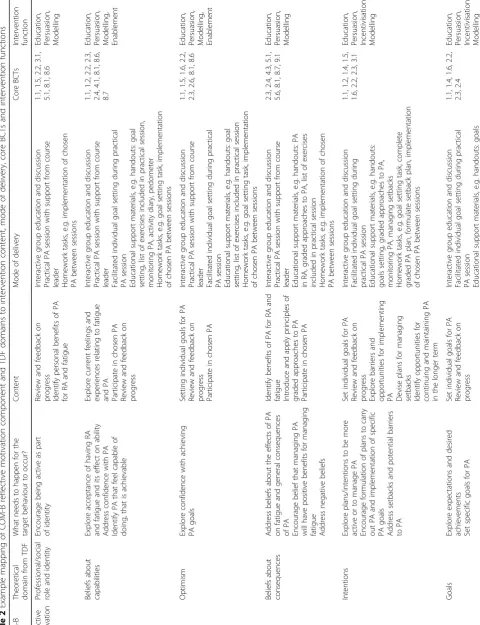
Selected content, mode of delivery, core BCTs and inter-vention functions were mapped onto COM-B and TDF
components (see Table 2 for example, and
supplemen-tary file for full version).
The resulting intervention consisted of seven face-to-face group discussion sessions and practical PA, delivered by a therapist over 12 weeks. The frequency and duration of ses-sions were designed to allow for gradual withdrawal of ther-apist support within a structured environment. This aimed to optimise self-efficacy and autonomy for PA behaviour change and encourage self-management.
The intervention was designed to be delivered by a ther-apist with knowledge of RA fatigue, PA and behaviour change. Optimal group size was specified as between six and 10 patients, but this could vary depending on local circumstances. The research team considered this large enough to minimise a diminished group-learning effect if attrition occurred, yet small enough to enable sufficient individual attention and support and ensure patient safety. HCPs and patients emphasised the importance of choice and patient-led decision making to facilitate motivation and engagement in behaviour change. Self-determination theory [37] was selected as an underpinning theory for interactive delivery, using MI techniques such as open-ended ques-tioning to encourage and facilitate patient-generated ideas. Self-determination theory distinguishes between two types of motivation: intrinsic (autonomous) and extrinsic
(con-trolled) [37]. Autonomous motivation relates to a person’s
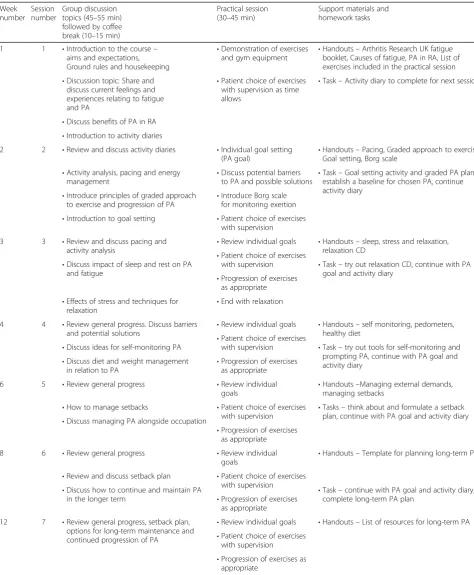
3d: development of session plans and support materials An outline of intervention sessions is presented in
Table3. A guide was developed for each session to
sup-port delivery. Suggested questions and prompts were detailed for the main objectives for each session. Edu-cational support materials were developed using ideas
from other evidence based programmes [29–31].
Sup-port materials were tested and modified by research team members. A list of equipment required to run the session was generated, including suggested exercises for the practical session. These were adapted, with per-mission, from a PA self-management intervention for chronic pain [30], and an upper limb self-management and exercise intervention for people with RA [38].
Discussion
This paper provides a detailed description of the devel-opment and co-design of a group-based RA fatigue self-management intervention based on modification of PA. Intervention development was based on MRC guidance for complex intervention development, and
informed by contemporary behaviour change method-ologies, including the BCW, TDF and BCT taxonomy. The resulting intervention aims to enable RA patients to develop their capability to self-manage fatigue through modifying PA, identify physical and social opportunities to support PA modification, and enhance motivation to mod-ify PA within the context of their fatigue. The benefits of PA for managing fatigue in RA and other long-term condi-tions were identified from existing literature (phase 1a), and evidence of its use in clinical practice was provided by HCPs (phase 1b) and supported by participants (phase 2).
[image:7.595.56.542.96.436.2]To our knowledge, this is the first study to provide evidence of RA patient and rheumatology HCP involve-ment, including extensive input from PRPs, in the co-design of a PA fatigue management intervention [34]. Consideration of implementation and participa-tion issues and preferences of potential intervenparticipa-tion users and those who might deliver it during develop-ment means that the intervention is likely to be accept-able to future users, and to translate into clinical settings [39].
Table 1Example behavioural analysis for reflective motivation component of COM-B
COM-B Theoretical domain
What needs to happen for the target behaviour to occur?
Example evidence of need for change or support for inclusion
Reflective motivation
Professional/ social role and identity
Encourage being active as part of identity
011:“it’s a long ongoing battle where you’ve had to forget your old life, what you used to do, I’ve given up work and stayed home.” 015:“…[RA] it’s changed my life, I get depression. I have changed, I am not the same person I was 3 years ago. I can’t talk for anybody else, but I’ve changed, I know I have.”
Beliefs about capabilities
Explore acceptance of having RA and fatigue and its effect on ability Address confidence with PA Identify PA that feel capable of doing, that is achievable
014:“You can’t work to a regime of fitness because you never know what you’re allowed to do the next day.”
016:“Mine’s quite bad in my joints. I’ve got chronic in my shoulders, in my neck, my feet, my hands, that’s it. I’ve got bare movement so I can’t do nothing.”
Optimism Explore confidence with achieving PA goals
011:“The minute you mentally make yourself kitted up ready to do it and then you fail at the first hurdle.”
013:“And it’s horrible failing.”
Beliefs about consequences
Address beliefs about the effects of PA on fatigue and general consequences of PA
Encourage belief that managing PA will have positive benefits for managing fatigue
Address negative beliefs
011:“I think physical activity does increase your fatigue, but also, on the other foot, decrease it as well.”
021:“…I tried swimming and it caused flares in my shoulders. So I went to see the doctor about it and they said try an exercise bike for a minute a day, and that used to set off in my knees.”
s Intentions Explore plans/intentions to be more active or to manage PA
Encourage formulation of plans to carry out PA and implementation of specific PA goals
Address setbacks and potential barriers to PA
011:“Just like getting up and thinking,“Right, am I going to be able to do this today,”to try and do that and get myself to the swimming pool.
Then the minute you get out of bed you collapse because you can’t put your foot to the floor”
007:“if a patient comes in and they’ve had a sudden setback […] we would look at where they are in that setback, look at setback planning and how to think about and learn from that setback.”
Goals Explore expectations and desired achievements
Set specific goals for PA
024:“…finding out what their goals are and working towards them, and building their confidence with that.”
COM-B=Capability, opportunity, motivation, behaviour; GP = general practitioner; PA = physical activity; RA = rheumatoid arthritis Underlined text = quotations from healthcare professionals in interviews (phase 1b)
Bold text = quotations from RA patients in focus groups (phase 2a)
Table
2
Example
mapping
of
COM-B
reflective
motivation
component
and
TDF
domains
to
intervention
content,
mode
of
delivery,
core
BCTs
and
intervention
func
tions
(Continued) COM
-B
Theo
retical
dom
ain
from
TDF
What
needs
to
happen
for
the
target
beh
aviour
to
occ
ur?
Con
tent
Mod
e
of
de
livery
Core
BCTs
Interve
ntion
fun
ction
se
tting,
graded
app
roac
hes
to
PA,
monit
oring
PA,
managing
se
tbacks
Ho
mework
task
s,
e.g.
goal
se
tting
task
BCT
=
behaviour
change
technique;
COM-B=Capability,
Opportunity,
Motivation,
Behaviour;
PA
=
physical
activity;
RA
=
rheumatoid
arthritis;
TDF
=
theoretical
domains
framework
BCT
codes
(from
BCT
taxonomy
version
1
[
14
]
):
1.1
=
goal
setting
(behaviour);
1.2
=
problem
solving;
1.4
=
action
planning;
1.5
=
review
behaviour
goal(s);
1.6
=
discrepancy
between
current
beha
viour
and
goal;
2.2
=
feedback
on
behaviour;
2.3
=
self-monitoring
of
behaviour;
2.4
=
self-monitoring
of
outcome(s)
of
behaviour;
3.1
=
social
support
(unspecified);
4.1
=
instru
ction
on
how
to
perform
the
behaviour;
4.3
=
re-attribution;
5.1
=
information
about
health
consequence
s;
5.6
=
information
about
emotional
consequences;
8.1
=
behavioural
practice/rehearsa
l;
8.6
=
generalisation
of
target
b
ehaviour;
8.7
=
graded
tasks;
9.1
=
credible
[image:9.595.71.171.86.732.2]Participant preferences influenced intervention design in several ways. For example, RA patients and HCPs in-dicated a desire for a face-to-face group programme, to
[image:10.595.57.532.97.673.2]provide an opportunity for shared experiences and vicarious learning. This finding suggests that other re-cent PA interventions for RA fatigue delivered on an
Table 3Outline of session content
Week number
Session number
Group discussion topics (45–55 min) followed by coffee break (10–15 min)
Practical session (30–45 min)
Support materials and homework tasks
1 1 •Introduction to the course– aims and expectations, Ground rules and housekeeping
•Demonstration of exercises and gym equipment
•Handouts–Arthritis Research UK fatigue booklet, Causes of fatigue, PA in RA, List of exercises included in the practical session
•Discussion topic: Share and discuss current feelings and experiences relating to fatigue and PA
•Patient choice of exercises with supervision as time allows
•Task–Activity diary to complete for next session
•Discuss benefits of PA in RA
•Introduction to activity diaries
2 2 •Review and discuss activity diaries •Individual goal setting
(PA goal) •
Handouts–Pacing, Graded approach to exercise, Goal setting, Borg scale
•Activity analysis, pacing and energy management
•Discuss potential barriers to PA and possible solutions
•Task–Goal setting activity and graded PA plan, establish a baseline for chosen PA, continue activity diary
•Introduce principles of graded approach to exercise and progression of PA •
Introduce Borg scale for monitoring exertion
•Introduction to goal setting •Patient choice of exercises with supervision
3 3 •Review and discuss pacing and
activity analysis •
Review individual goals •Handouts–sleep, stress and relaxation, relaxation CD
•Patient choice of exercises with supervision
•Discuss impact of sleep and rest on PA and fatigue
•Task–try out relaxation CD, continue with PA goal and activity diary
•Progression of exercises as appropriate
•Effects of stress and techniques for
relaxation •
End with relaxation
4 4 •Review general progress. Discuss barriers and potential solutions
•Review individual goals •Handouts–self monitoring, pedometers, healthy diet
•Patient choice of exercises with supervision
•Discuss ideas for self-monitoring PA •Task–try out tools for self-monitoring and prompting PA, continue with PA goal and activity diary
•Progression of exercises as appropriate
•Discuss diet and weight management in relation to PA
6 5 •Review general progress •Review individual goals
•Handouts–Managing external demands, managing setbacks
•How to manage setbacks •Patient choice of exercises with supervision •
Tasks–think about and formulate a setback plan, continue with PA goal and activity diary
•Discuss managing PA alongside occupation
•Progression of exercises as appropriate
8 6 •Review general progress •Review individual
goals •
Handouts–Template for planning long-term PA
•Review and discuss setback plan •Patient choice of exercises with supervision
•Discuss how to continue and maintain PA in the longer term
•Task–continue with PA goal and activity diary, complete long-term PA plan
•Progression of exercises as appropriate
12 7 •Review general progress, setback plan, options for long-term maintenance and continued progression of PA
•Review individual goals •Handouts–List of resources for long-term PA
•Patient choice of exercises with supervision
•Progression of exercises as appropriate
individual basis [40, 41] may not adequately meet the needs of some RA patients. Whilst it is acknowledged that individual interventions may suit patients who do not like groups, results from the current study suggest that people with RA value social support that may be important for facilitating behaviour change. Group struc-tures may facilitate formation of social networks which have been shown to influence health status and health-promoting behaviours, such as PA [42]. In addition, phase 2b HCPs reported that group delivery was consist-ent with currconsist-ent rheumatology practice, and potconsist-entially cost-effective, although this needs to be determined in future research.
Participant preferences determined the style of inter-vention delivery. The importance of choice and
patient-led decision-making to facilitate motivation and
engagement in behaviour change was emphasised by all participants, and use of MI techniques was recom-mended by HCPs. Placing patients at the centre of decision-making and enhancing autonomy regarding modification of PA to manage fatigue is a fundamental principle of this intervention. Interactive delivery pro-cesses were enhanced by selection of self-determination
theory as an underpinning motivational theory.
Person-centred approaches have been advocated for behaviour change interventions in musculoskeletal con-ditions [43] and have been successfully applied to pro-mote PA in RA [44].
Recent PA interventions for RA fatigue have focused
on individual home-based PA [40, 41, 45]. In the
current intervention, inclusion of an education session and practical PA were important components. Patients wanted the opportunity to develop knowledge and practice using skills to enhance their capability to per-form PA within a supportive environment. The group setting allows modelling of the behaviour by the group facilitator and other participants, and provides an opportunity for immediate feedback to facilitate behav-iour change.
Challenges identified for implementation and service provision included location, timing and duration of ses-sions. Participants emphasised these must be suitable for patients, whilst taking into account local staffing and resource constraints. Key challenges included accessibility for people who work or who have other roles and responsibilities that prohibit attendance dur-ing the week. Rheumatology HCPs believed that flexible staffing arrangements may be possible within current services, but some patients may still not be able to at-tend face-to-face sessions. Future intervention develop-ment should explore alternative modes of delivery for these patients. For example, research has suggested that RA patients would be prepared to take part in internet-based interventions [46], suggesting this format may
offer a viable alternative, whilst recognising that this removes the important supportive group environment.
Strengths and limitations
The strength of the intervention development process de-scribed here lies in its thorough, systematic approach to design, and the extensive consideration of the needs and preferences of those who may use or implement the inter-vention in real-world settings. In addition, use of the BCW combined with the TDF and BCT taxonomy pro-vided a comprehensive, structured method for developing a behaviour change intervention. Use of contemporary theories and models deepens our understanding of mech-anisms by which interventions might bring about behav-iour change, and facilitates comparison with similar interventions through use of standardised terminology.
Several limitations should be noted. Small numbers of patients and HCPs were involved in development. All participants in phase 2 voluntarily took part in focus groups, suggesting that they were predisposed to finding group settings acceptable. The views of those who do not like groups were not presented. Despite use of purposive sampling techniques, participants were a homogenous ethnic group, predominantly Cau-casian, and able to speak English fluently. Data regard-ing socio-economic status were not recorded. Future intervention development should seek to understand the preferences and needs of a wider range of socio-cultural perspectives to ensure relevance and ac-ceptability to a diverse population. Those responsible for commissioning services should also be involved, given their significant role in determining service implementation.
Implications and future research
Further feasibility testing is required prior to full scale evaluation in order to understand whether the current intervention and implementation suggestions are appro-priate, acceptable and possible to deliver in practice. Fu-ture development must consider how much flexibility in implementation and delivery is required and permissible to accommodate local context and resources without ex-cessively diluting potential intervention effectiveness. Other adaptations should identify different delivery models for those who cannot or do not wish to attend groups or face-to-face programmes, address cultural contextual issues, and consider suitability for other in-flammatory arthritis populations who experience fatigue.
Conclusion
preliminary stage of development was important to en-sure explicit links between the underpinning theory, mediating pathways and intervention outcomes thus facilitating future implementation and evaluation. Con-sultation and collaboration with potential recipients and professionals who might deliver the intervention enhances the likelihood of acceptability and implemen-tation in future clinical practice. The feasibility of further evaluation now needs to be determined by fur-ther investigation of acceptability, implementation and practicality of the intervention.
Abbreviations
BCT:Behavior change technique; CFS: Chronic fatigue syndrome; COM-B: Capability, Opportunity, Motivation–Behaviour; HCP: Healthcare professional; MI: Motivational interviewing; MRC: Medical Research Council; NICE: National Institute for Health and Care Excellence; PA: Physical activity; PRP: Patient research partner; RA: Rheumatoid arthritis; TDF: Theoretical Domains Framework
Acknowledgements
This research has been published in detail in VS’s PhD thesis [21]. We wish to thank the patients and healthcare professionals who gave up their time to take part in this research. Their experiences, ideas and commitment are the basis of this intervention and the research could not have been carried out without them.
Funding
The research was funded by a Clinical Doctoral Research Fellowship awarded to VS from University Hospitals Bristol NHS Foundation Trust through National Institute for Health Research (NIHR) funding. The funding body did not have any role in the design of the study, or in data collection, analysis and interpretation, or in writing the manuscript. The views expressed in this paper are those of the authors and not necessarily the NHS trust, NHS or the NIHR.
Availability of data and materials
The datasets used and/or analysed during the current study are available from the corresponding author on reasonable request.
Authors’contributions
FC, SH, NW, JK and VS made substantial contributions to conception and design of the research. VS carried out all primary data collection in phase 1b, and VS, FC, NW and MU facilitated focus groups in phase 2. All authors (VS, SH, NW, JK, MM, MU, FC) contributed to analysis and interpretation of the data, and the design of the intervention content and materials. MM and MU provided critical input from the perspective of patients with lived experience of RA and fatigue. VS drafted the initial manuscript and all other authors (SH, NW, JK, MM, MU, FC) revised it critically for important intellectual content. All authors have read and approved the final manuscript.
Authors’information
VS is a research fellow at the University of Exeter College of Medicine and Health and a member of the Chartered Society of Physiotherapy.
FC is Professor in Musculoskeletal Health at the University of the West of England, Bristol and Fellow of the Chartered Society of Physiotherapy.
SH is Arthritis Research UK Professor of Rheumatology Nursing at the University of the West of England and an honorary consultant nurse at University Hospitals Bristol NHS Foundation Trust.
NW is Professor of Knowledge Mobilisation and Musculoskeletal Health at the University of the West of England, Bristol and Avon Primary Care Research Collaborative.
JK is Emeritus Professor of Rheumatic Diseases at the University of Bristol, Visiting Professor at the University of the West of England, and a Fellow of the Royal College of Physicians.
MM and MU are patient research partners at the Academic Rheumatology Unit, University Hospitals Bristol NHS Foundation Trust, and have lived experience of rheumatoid arthritis.
Ethics approval and consent to participate
We confirm that all studies have been approved by the appropriate ethics committees and have been performed in accordance with the ethical standards laid down in the 1964 Declaration of Helsinki and its later amendments. We confirm that all persons gave informed written consent prior to their inclusion in the study. Details that might disclose the identity of the subjects under study have been omitted.
Ethics approval for studies in this manuscript was obtained from the following committees:
Phase 1b: approved by The University of the West of England Faculty of Health and Applied Sciences Research Ethics Committee (Ref: HLS/ 12/11/139)
Phase 2: approved by the National Research Ethics Service Committee East Midlands - Nottingham 1 (Ref: 13/EM/0331).
Consent for publication
Not applicable.
Competing interests
The authors declare that they have no competing interests.
Publisher’s Note
Springer Nature remains neutral with regard to jurisdictional claims in published maps and institutional affiliations.
Author details
1
Institute of Health Research, University of Exeter College of Medicine and Health, College House, St Luke’s Campus, Heavitree Road, Exeter EX1 2LU, UK.2Faculty of Health & Applied Sciences, University of the West of England, Blackberry Hill, Bristol BS16 1DD, UK.3Academic Rheumatology, University of Bristol, University of Bristol, Senate House, Tyndall Avenue, Bristol BS8 1TH, UK.4Bristol Royal Infirmary, University Hospitals Bristol NHS Foundation Trust, Upper Maudlin St, Bristol BS2 8HW, UK.
Received: 23 November 2017 Accepted: 9 April 2019
References
1. Nikolaus S, Bode C, Taal E, van de Laar MA. New insights into the experience of fatigue among patients with rheumatoid arthritis: a qualitative study. Ann Rheum Dis. 2010;69(5):895–7.
2. Hewlett S, Cockshott Z, Byron M, Kitchen K, Tipler S, Pope D, Hehir M. Patients’perceptions of fatigue in rheumatoid arthritis: overwhelming, uncontrollable, ignored. Arthritis Care Res. 2005;53(5):697–702. 3. Repping-Wuts H, Uitterhoeve R, van Riel P, van Achterberg T. Fatigue as
experienced by patients with rheumatoid arthritis (RA): a qualitative study. Int J Nurs Stud. 2008;45(7):995–1002.
4. Mayoux-Benhamou MA. Fatigue and rheumatoid arthritis. Annal de Readapt et de Med Physique. 2006;49(6):385–8.
5. Kirwan JR, Minnock P, Adebajo A, Bresnihan B, Choy E, de Wit M, Hazes M, Richards P, Saag K, Suarez-Almazor M, Wells G, Hewlett S. Patient perspective: fatigue as a recommended patient centered outcome measure in rheumatoid arthritis. J Rheumatol. 2007;34(5):1174–7.
6. Larkin L, Kennedy N. Correlates of physical activity in adults with rheumatoid arthritis: a systematic review. J Phys Act Health. 2014;11(6): 1248–61.
7. Katz P, Margaretten M, Trupin L, Schmajuk G, Yazdany J, Yelin E. Role of sleep disturbance, depression, obesity, and physical inactivity in fatigue in rheumatoid arthritis. Arthritis Care Res. 2016;68(1):81–90.
8. Cramp F, Hewlett S, Almeida C, Kirwan John R, Choy Ernest HS, Chalder T, Pollock J, Christensen R. Non-pharmacological interventions for fatigue in rheumatoid arthritis. Cochrane Database of Systematic Reviews. 2013;8: CD008322.https://doi.org/10.1002/14651858.CD008322.pub2.
9. Rongen-van Dartel SA, Repping-Wuts H, Flendrie M, Bleijenberg G, Metsios GS, van den Hout WB, van den Ende CH, Neuberger G, Reid A, van Riel PL, Fransen J. The effect of aerobic exercise training on fatigue in rheumatoid arthritis: a meta-analysis. Arthritis Care Res. 2015;67(8):1054–62.
11. Bate P, Robert G. Experience-based design: from redesigning the system around the patient to co-designing services with the patient. Quality and Safety in Health Care. 2006;15(5):307–10.
12. Michie S, van Stralen MM, West R. The behaviour change wheel: a new method for characterising and designing behaviour change interventions. Implement Sci. 2011;6(1):1.
13. Michie S, Johnston M, Abraham C, Lawton R, Parker D, Walker A. Making psychological theory useful for implementing evidence based practice: a consensus approach. Quality and safety in health care. 2005;14(1):26–33. 14. Michie S, Richardson M, Johnston M, Abraham C, Francis J, Hardeman W,
Eccles MP, Cane J, Wood CE. The behavior change technique taxonomy (v1) of 93 hierarchically clustered techniques: building an international consensus for the reporting of behavior change interventions. Ann Behav Med. 2013;46(1):81–95.
15. National Institute for Health and Care Excellence. Behaviour change: individual approaches. Public health guideline [PH49]. London: National Institute for Health and Care Excellence; 2014.
16. Revenäs Å, Opava CH, Åsenlöf P. Lead users’ideas on core features to support physical activity in rheumatoid arthritis: a first step in the development of an internet service using participatory design. BMC Med Inform Decis Mak. 2014;14(1):1.
17. Revenäs Å, Opava CH, Martin C, Demmelmaier I, Keller C, Åsenlöf P. Development of a web-based and mobile app to support physical activity in individuals with rheumatoid arthritis: results from the second step of a co-design process. JMIR research protocols. 2015;4(1):e22.
18. Iversen MD, Hammond A, Betteridge N. Self-management of rheumatic diseases: state of the art and future perspectives. Ann Rheum Dis. 2010; 69(6):955–63.
19. Cramp F, Berry J, Gardiner M, Smith F, Stephens D. Health behaviour change interventions for the promotion of physical activity in rheumatoid arthritis: a systematic review. Musculoskeletal care. 2013;11(4):238–47. 20. Larkin L, Gallagher S, Cramp F, Brand C, Fraser A, Kennedy N. Behaviour
change interventions to promote physical activity in rheumatoid arthritis: a systematic review. Rheumatol Int. 2015;35(10):1631–40.
21. Salmon V. Development of a physical activity intervention for managing fatigue in rheumatoid arthritis. Bristol: University of the West of England; 2016.
22. INVOLVE. Exploring the impact of public involvement on the quality of research: examples. Eastleigh: INVOLVE; 2013.
23. Hewlett S, Wit M, Richards P, Quest E, Hughes R, Heiberg T, Kirwan J. Patients and professionals as research partners: challenges, practicalities, and benefits. Arthritis Rheum. 2006;55(4):676–80.
24. Higgins JPT, Green S (2011) Cochrane handbook for systematic reviews of interventions version 5.1.0. The Cochrane collaboration. Available from: http://handbook-5-1.cochrane.org/.
25. Braun V, Clarke V. Using thematic analysis in psychology. Qual Res Psychol. 2006;3(2):77–101.
26. Fereday J, Muir-Cochrane E. Demonstrating rigor using thematic analysis: a hybrid approach of inductive and deductive coding and theme development. Int J Qual Meth. 2006;5(1):80–92.
27. Michie S, Ashford S, Sniehotta FF, Dombrowski SU, Bishop A, French DP. A refined taxonomy of behaviour change techniques to help people change their physical activity and healthy eating behaviours: the CALO-RE taxonomy. Psychol Health. 2011;26(11):1479–98.
28. Michie S, Atkins L, West R (2014) The Behaviour Change Wheel: A guide to designing interventions. United Kingdom: Silverback Publishing.
29. White PD, Goldsmith KA, Johnson AL, Potts L, Walwyn R, DeCesare JC, Baber HL, Burgess M, Clark LV, Cox DL, Bavinton J, Angus BJ, Murphy G, Murphy M, O'Dowd H, Wilks D, McCrone P, Chalder T, Sharpe M. Comparison of adaptive pacing therapy, cognitive behaviour therapy, graded exercise therapy, and specialist medical care for chronic fatigue syndrome (PACE): a randomised trial. Lancet. 2011;377(9768):823–36.
30. Walsh N, Cramp F, Palmer S, Pollock J, Hampson L, Gooberman-Hill R, Green C, Jones L, Phillips S, Johnson L, Hurley M. Exercise and self-management for people with chronic knee, hip or lower back pain: a cluster randomised controlled trial of clinical and cost-effectiveness. Study protocol. Physiotherapy. 2013;99(4):352–7.
31. Hewlett S, Ambler N, Almeida C, Blair P, Choy E, Dures E, Hammond A, Hollingworth W, Kirwan J, Plummer Z. Protocol for a randomised controlled trial for reducing arthritis fatigue by clinical teams (RAFT) using cognitive– behavioural approaches. Brit Med J. 2015;5(8):e009061.
32. Michie S, Abraham C, Whittington C, McAteer J, Gupta S. Effective techniques in healthy eating and physical activity interventions: a meta-regression. Health Psychol. 2009;28(6):690–701.
33. Bird EL, Baker G, Mutrie N, Ogilvie D, Sahlqvist S, Powell J. Behavior change techniques used to promote walking and cycling: a systematic review. Health Psychol. 2013;32(8):829–38.
34. Salmon V, Hewlett S, Walsh N, Kirwan J, Cramp F. Physical activity interventions for fatigue in rheumatoid arthritis: a systematic review. Phys Ther Rev. 2017;22(1–2):12–22.
35. Castell BD, Kazantzis N, Moss-Morris RE. Cognitive behavioral therapy and graded exercise for chronic fatigue syndrome: a meta-analysis. Clin Psychol-Sci Pr. 2011;18(4):311–24.
36. Rollnick S, Mason P, Butler C. Health behaviour change. A guide for practitioners. London: Churchill Livingstone; 1999.
37. Ryan RM, Deci EL. Self-determination theory and the facilitation of intrinsic motivation, social development, and well-being. The American Psychologist. 2000;55(1):68–78.
38. Manning VL, Hurley MV, Scott DL, Coker B, Choy E, Bearne LM. Education, self-management, and upper extremity exercise training in people with rheumatoid arthritis: a randomized controlled trial. Arthritis Care Res. 2014; 66(2):217–27.
39. Glasgow RE, Vinson C, Chambers D, Khoury MJ, Kaplan RM, Hunter C. National Institutes of Health approaches to dissemination and
implementation science: current and future directions. Am J Public Health. 2012;102(7):1274–81.
40. Katz P, Margaretten M, Gregorich S, Trupin L (2017) Physical activity to reduce fatigue in rheumatoid arthritis: a randomized, controlled trial. Arthritis Care Res Accepted Author Manuscript. doi:https://doi.org/10.1002/ acr.23230.
41. Feldthusen C, Dean E, Forsblad-d’Elia H, Mannerkorpi K. Effects of person-centered physical therapy on fatigue-related variables in persons with rheumatoid arthritis: a randomized controlled trial. Arch Phys Med Rehabil. 2016;97(1):26–36.
42. Berkman LF, Glass T, Brissette I, Seeman TE. From social integration to health: Durkheim in the new millennium. Soc Sci Med. 2000;51(6):843–57. 43. Knittle K, De Gucht V, Maes S. Lifestyle- and behaviour-change interventions
in musculoskeletal conditions. Best Pract Res Cl Rh. 2012;26(3):293–304. 44. Knittle K, De Gucht V, Hurkmans E, Peeters A, Ronday K, Maes S, Vlieland TV.
Targeting motivation and self-regulation to increase physical activity among patients with rheumatoid arthritis: a randomised controlled trial. Clin Rheumatol. 2015;34(2):231–8.
45. Durcan L, Wilson F, Cunnane G. The effect of exercise on sleep and fatigue in rheumatoid arthritis: a randomized controlled study. J Rheumatol. 2014; 41(10):1966–73.