DOI 10.1002/acr.22647
VC 2016, American College of Rheumatology
ORIGINAL ARTICLE
Explaining Physical Activity Maintenance
After a Theory-Based Intervention Among
Patients With Rheumatoid Arthritis: Process
Evaluation of a Randomized Controlled Trial
KEEGAN KNITTLE,
1V
ERONIQUE DE GUCHT,
2EMALIE HURKMANS,
3THEA VLIET VLIELAND,
4ANDSTAN MAES
2Objective. Regular physical activity (PA) benefits patients with rheumatoid arthritis (RA), particularly when maintained over time. Research in this area has largely focused on factors associated with initiating PA, while factors contributing to PA maintenance, particularly after lifestyle interventions, have received less attention. This study examined whether higher levels of autonomous motivation, self-efficacy for PA, and greater use of self-regulation skills mediated PA initia-tion and maintenance 6 months after a theory-based motivainitia-tional interviewing and self-regulainitia-tion coaching interveninitia-tion.
Methods. Seventy-eight individuals with RA were randomized to receive either a patient-education session (control group), or the patient-education session plus 1 motivational interview and 2 self-regulation coaching sessions (treat-ment group). Mediation analyses examined the effects of this intervention on PA initiation and maintenance through the intermediate variables autonomous motivation, self-efficacy for PA, and use of self-regulation skills. Analyses were controlled for age, sex, and previous levels of PA.
Results. The treatment group reported significantly higher autonomous motivation and greater use of self-regulation skills than controls at posttreatment. Increases in PA from baseline to posttreatment were not mediated by any inter-mediate variables. However, maintenance of PA from posttreatment to followup (6 months later) was inter-mediated by greater autonomous motivation and use of self-regulation skills.
Conclusion. Greater autonomous motivation and use of self-regulation skills predict maintenance of PA following a motivational interviewing and self-regulation coaching intervention. In promoting PA among patients with RA, sup-porting patient autonomy and teaching self-regulation skills, which focus attention on achieving PA goals, may improve long-term maintenance of PA.
INTRODUCTION
Physical activity (PA) provides many benefits for patients with rheumatoid arthritis (RA). Apart from strengthening muscles, increasing flexibility, and improving pain and
physical function (1,2), PA may also reduce cardiovascular disease (CVD) risk (3), a leading cause of death among patients with RA (4). Despite these benefits, a large propor-tion of individuals with RA do not engage in the recom-mended 150 minutes of moderate- to vigorous-intensity PA each week (5).
While many self-management and patient-education interventions lead to the initiation of PA (i.e., an increase of PA in the short term) (2,6), these effects are not consis-tently maintained in the long term (7). This is problematic, as regular PA confers maximum benefit to patients with RA when maintained over time, particularly in relation to CVD risk reduction (8). It is therefore vital that interven-tions that lead to lasting increases in PA be developed, and this requires a better understanding of which specific-intervention components (e.g., information provision and goal setting) and PA-related cognitions (e.g., self-efficacy and autonomous motivation) most contribute to PA maintenance.
ClinicalTrials.gov identifier: NTR2240.
Dr. Hurkmans’ work was supported by the Friends of SoleMio Foundation.
1Keegan Knittle, PhD: University of Helsinki, Helsinki,
Finland, and Leiden University, Leiden, The Netherlands; 2Veronique De Gucht, PhD, Stan Maes, PhD: Leiden Universi-ty, Leiden, The Netherlands;3Emalie Hurkmans, PhD: Leiden University Medical Center, Leiden, The Netherlands, and FH Campus Wien University of Applied Sciences, Vienna, Austria;4Thea Vliet Vlieland, MD, PhD: Leiden University Medical Center, Leiden, The Netherlands.
Address correspondence to Keegan Knittle, PhD, Depart-ment of Social Research, PO Box 54, 00014 University of Helsinki, Helsinki, Finland. E-mail: [email protected].
Submitted for publication March 12, 2015; accepted in revised form June 23, 2015.
Many of the existing interventions to increase PA among patients with RA utilize behavioral change techniques derived from self-regulation theory (6). Self-regulation the-ory posits that (health) behavior is goal-directed, and that setting goals, planning the actions necessary to achieve them, monitoring progress, and solving problems that arise during the pursuit of goals all underlie behavioral change (9). In the general population, there is strong evidence that interventions utilizing these core self-regulation techniques lead to larger short-term increases in PA (initiation) than interventions not using such tech-niques (10). Additional self-regulation techtech-niques, such as focusing attention on goal pursuit and staying positive despite setbacks, have been hypothesized to contribute to the maintenance of behavioral change (9,11). Despite this, research demonstrating that interventions actually increase patients’ use of self-regulation skills is scarce, and research demonstrating that this increased use of self-regulation skills indeed explains changes in PA behavior is almost nonexistent (12).
Apart from targeting self-regulation skills, interventions to increase PA among patients with RA also frequently tar-get changes in PA-related cognitions. One such cognition is self-efficacy for PA, which predicts PA in the general popu-lation (13) and among individuals with RA (14,15). Increas-ing self-efficacy, or one’s belief in his or her capabilities to engage in a particular behavior or obtain a desired outcome (16), has therefore been a primary goal of many interven-tions to increase PA. Although numerous studies have demonstrated increases in self-efficacy for PA following an intervention, there is only limited evidence that increases in self-efficacy lead to the initiation or maintenance of PA (12,17), none of it among patients with RA.
Recently, autonomous motivation for PA has been identi-fied as a cognition predicting PA maintenance among patients with RA (18). Autonomous motivation for PA describes the motives that underlie individuals’ engagement in PA: namely, the extent to which an individual engages (or would engage) in PA because it is deemed intrinsically enjoyable and benefi-cial, as opposed to doing so to achieve external rewards or to avoid feelings of guilt (19). Although autonomous motivation predicts engagement in PA (13), few PA interventions have measured autonomous motivation as an outcome, and there is therefore little experimental evidence linking changes in autonomous motivation to PA initiation or maintenance (12).
Based on existing evidence from longitudinal and inter-vention studies, our group identified self-regulation skills,
self-efficacy, and autonomous motivation for PA as impor-tant predictors of PA initiation and maintenance among patients with RA (6,14,18), and also found that no previous interventions had targeted all of these variables to increase PA: a deficit that could explain the lack of PA maintenance following existing interventions. To fill this gap in the liter-ature and to foster PA maintenance among patients with RA, our group developed a new intervention that speci-fically targeted increases in regulation skills, self-efficacy, and autonomous motivation. As improvements in these skills and cognitions were hypothesized to lead to greater initiation and maintenance of leisure-time PA among patients with RA, the intervention included tech-niques specifically designed to change each of these inter-mediate constructs: motivational interviewing to increase autonomous motivation (20), self-regulation coaching to increase the use of self-regulation skills (9), and goal setting and feedback to increase self-efficacy for PA (21). In a previ-ous randomized controlled trial (RCT), we compared this combined motivational interviewing and self-regulation coaching intervention to a patient-education control group, and over the course of 32 weeks, the intervention group reported significantly greater improvements in autonomous motivation, self-efficacy for PA, and PA behavior itself (22). The present study is a process analysis of the original RCT, which aims to formally test the theoretical assump-tions made when developing the combined motivational interviewing and self-regulation coaching intervention. The study first aims to determine whether the intervention led to differences in the use of self-regulation skills between groups, as self-regulation skills have previously been linked to improvements in PA outcomes (23,24). It then aims to use mediation analyses to test the theory upon which the inter-vention was based; or in other words, to determine which of the intermediate intervention targets (use of self-regulation skills, autonomous motivation, and self-efficacy for PA) best explain the initiation and maintenance of leisure-time PA among individuals who took part in the trial. We hypothe-size that leisure-time PA at posttreatment (initiation) will be significantly predicted by each of these intermediate targets. Additionally, due to the importance of self-regulation, self-efficacy, and autonomous motivation in PA mainte-nance (9,18), we hypothesize that these intermediate tar-gets will more strongly predict leisure-time PA at followup (maintenance) than at posttreatment.
PATIENTS AND METHODS
This study was a prespecified process evaluation within a parallel-group RCT. The RCT was approved by the Leiden University Medical Center Ethics Review Board and was conducted in accordance with the Declaration of Helsinki between August 2010 and December 2011. The trial proto-col is registered with the Netherlands Trial Register (http:// www.trialregister.nl; identifier NTR2240) and its main results have been published elsewhere (22).
Patients. Patients who had received a clinical diagnosis of RA were recruited from the databases of the Leiden University Medical Center (LUMC); Haga Hospital, The
Significance & Innovations
Patients receiving a motivational interviewing and self-regulation coaching intervention reported greater use of self-regulation skills than those receiving patient education alone.
Hague; and Reinier De Graaf Gasthuis, Delft. Patients were included if they were diagnosed with RA according to the American College of Rheumatology criteria (25), older than 18 years of age, and active at a level below the Dutch guideline for healthy PA (26), which recommends 30 minutes or more of moderate- to vigorous-intensity PA on 5 or more days per week. Patients who had received physi-cal therapy for their RA within the last 6 months, who had difficulty ambulating, or who could not attend the treat-ment sessions due to scheduling or transportation issues were excluded.
Interventions. After providing informed consent, 78 patients with RA were randomly allocated to receive a group patient-education session (control group, n540), or the patient-education session plus a motivational in-terview and 2 self-regulation coaching sessions over a 5-week period (treatment group, n538). In developing the intervention, the duration, quantity, and frequency of in-tervention sessions were chosen because they map well onto existing outpatient care for RA commonly provided in the LUMC. A full description of procedures used in the RCT is published elsewhere, and includes detailed inter-vention descriptions as well as additional patient charac-teristics and outcomes (22).
Measures. Data were collected via questionnaires mailed to participants at baseline, posttreatment (6 weeks after baseline), and followup (32 weeks after baseline). regulation skills were assessed using the Self-Regulation Skills Battery (27). At baseline, participants self-selected a PA goal that they wished to pursue.
At posttreatment, participants were reminded of the goal they chose at baseline, and assessed the extent to which they used each of 8 self-regulation skills in pursu-ing that goal. The 8 self-regulation skills are action plan-ning (4 items), problem solving and coping planplan-ning (4 items), self-monitoring (3 items), obtaining feedback (3 items), focusing attention on goal pursuit (3 items), remaining positive when faced with setbacks (2 items), using self-reward (3 items), and avoiding self-criticism (3 reverse-scored items). Each item is scored on a 5-point Likert scale, with responses ranging from “strongly dis-agree” (scored as 1) to “strongly dis-agree” (scored as 5). The score for each of the self-regulation skills is the mean of the answered items (possible range 1–5), and the total self-regulation score is the sum of the 8 self-self-regulation skill scores (possible range 8–40; higher scores indicate greater use of self-regulation skills). With the exception of the feedback scale, Cronbach’s alphas for all self-regulation skills scales, including the total self-regulation score, were in the acceptable range or better (a .0.70;afeedback50.65).
Self-efficacy for PA was assessed with the 18-item scale developed by Bandura (28). This scale assesses the extent to which individuals feel that they would be physically active in a number of situations (e.g., if tired, if busy, if the weather were bad). Participants responded to each item on a 0–10 scale with anchors of “certainly would not” (scored as 0) and “certainly would” (scored as 10). The 18 items’ scores were summed to create a total self-efficacy
for PA score, potentially ranging from 0 (very low self-effi-cacy) to 180 (very high self-effiself-effi-cacy).
Three items from the Treatment Self-Regulation Ques-tionnaire (29) were used to assess autonomous motivation for PA. Each item presents participants with a reason why one is, or might be, physically active on a regular basis. Participants respond on a 7-point Likert scale with responses ranging from “strongly disagree” (scored as 1) to “strongly agree” (scored as 7). The autonomous motivation score is calculated by taking the mean of the 3 items (pos-sible range 1–7; higher scores indicate greater autonomous motivation for PA).
The Short Questionnaire to Assess Health-Enhancing Physical Activity was used to assess leisure-time PA (30). This questionnaire assesses PA during an average week in the past month, and asks participants on how many days per week and for how many minutes per day they engaged in PA across a number of life domains, including at work, in commuting, in doing housework, and in walking, cycling, and sporting activities. For each activity, a minutes-per-week score was calculated by multiplying minutes per day by days per week. Leisure-time PA was calculated by summing the minutes-per-week scores for walking, cycling, and sporting activities.
Statistical analysis. At final followup, 11 patients (14%) had not completed all measurements. The pattern of missing data within the data set was analyzed, and the missing cases and variables were deemed to be missing at random (31). Missing data points were therefore replaced using multiple imputation in 5 separate data sets. Each of these data sets was compared to the original data, and the multiple imputa-tion data set with parameters most similar to the original data set was used for all subsequent analyses.
and self-efficacy were compared across conditions using
t-tests. We adjusted for multiple comparisons at posttreat-ment using Holm’s sequential Bonferroni adjustposttreat-ment (32).
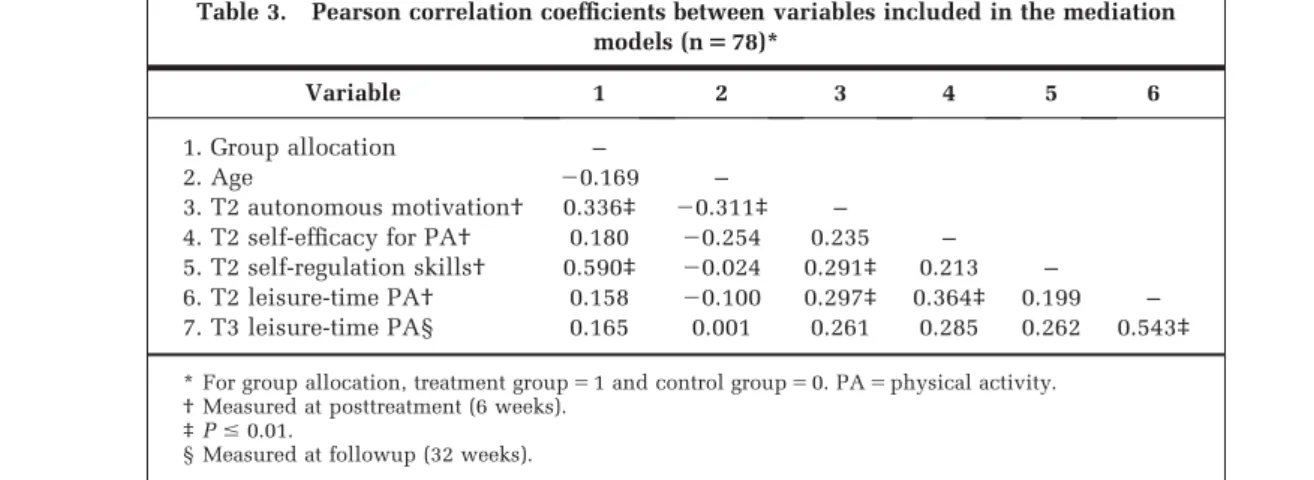
To examine possible multicollinearity, correlations were calculated between the independent variable group alloca-tion (treatment51, control50); the proposed mediating variables autonomous motivation, self-efficacy, and total
self-regulation score; and the dependent variable leisure-time PA at 6 and 32 weeks after baseline. Correlations above 0.80 would indicate potential multicollinearity (33).
Each mediation model presented in Figure 1 was tested using a separate run of the indirect.sps macro for SPSS (34). The indirect.sps macro produces bootstrap estimates of the effects of the independent variable on the mediator Table 1. Between-group comparisons on self-regulation skill use at 6 weeks (T2) and
32 weeks (T3)
Self-regulation skill
Intervention group, mean6SD (n538)
Control group,
mean6SD (n540) P
Making action plans
T2 3.6160.72 3.1260.76 0.006*
T3 3.6160.81 2.7460.78 ,0.001*
Problem solving/coping planning
T2 3.4860.57 3.0760.53 0.003*
T3 3.4160.49 2.8460.62 0.009*
Self-monitoring of progress
T2 3.3960.56 2.8960.63 ,0.001*
T3 3.2960.68 2.8960.67 0.011*
Obtaining feedback
T2 3.1460.59 2.7360.59 0.005*
T3 3.2360.68 2.7960.61 0.001*
Focusing attention on progress
T2 3.5260.44 2.9560.63 ,0.001*
T3 3.3160.67 2.7460.87 0.003*
Staying positive despite setbacks
T2 3.4560.49 2.8760.76 0.008*
T3 3.6760.86 3.0460.71 0.003*
Use of self-reward
T2 3.2260.74 2.4660.57 ,0.001*
T3 3.0360.77 2.4660.66 0.017
Avoiding self-criticism
T2 2.9560.89 2.8561.73 0.184
T3 2.8460.87 2.8360.71 0.312
*P,Holm’s sequentially adjusted significance threshold.
Table 2. Between-group comparisons of patients’ PA-related cognitions, use of self-regulation skills, and leisure-time PA at baseline (T1), 6 weeks (T2), and 32 weeks (T3)*
Variable
Intervention group, mean6SD (n538)
Control group,
mean6SD (n540) P
Autonomous motivation for PA
T1 5.9260.85 5.4161.19 0.006†
T2 5.9860.82 5.1861.37 0.002†
Self-efficacy for PA
T1 78.19644.27 84.51636.27 0.492
T2 93.84637.13 79.80640.44 0.115
Total use of self-regulation skills
T2 26.7762.34 22.9262.21 ,0.001†
T3 26.7162.84 22.6763.05 ,0.001†
Leisure-time PA
T1 215.86175.1 208.56210.7 0.871
T2 293.86198.7 223.56243.5 0.175
T3 315.56287.2 221.06285.1 0.157
* PA5physical activity.
variables (a paths) and of the mediator variables on the dependent variable (bpaths). The products of these effects (a 3b paths) estimate the indirect effects (mediation) of the independent variable on the dependent variable, through each of the mediators. Mediation is said to occur atP,0.05 if the 95% confidence interval for the indirect effect (a3bpath) does not include zero. Mediation model 1 predicted the initiation of leisure-time PA at posttreat-ment, and was controlled for age, sex, and baseline level of leisure-time PA. Mediation model 2 predicted the main-tenance of leisure-time PA at 6-month followup, and was controlled for age, sex, and posttreatment level of leisure-time PA.
RESULTS
At baseline, the intervention group was comprised of sig-nificantly more women than the control group (79% female versus 55% female, respectively;P,0.05), but did not significantly differ on age (60.7 years versus 64.7 years), body mass index, employment, education, or
medi-cation use. More detailed demographic information from the 78 study participants is reported elsewhere (22).
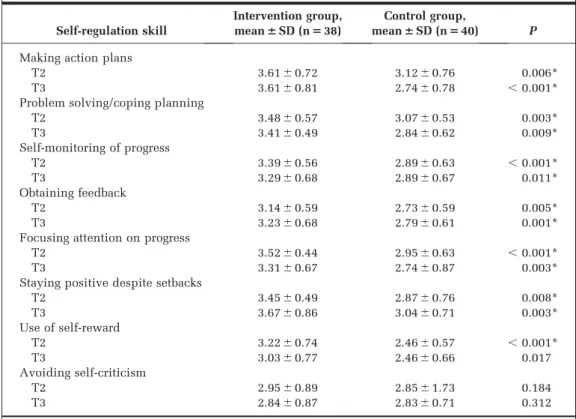
Between-group differences in self-regulation skills, PA-related cognitions, and PA. At posttreatment, the interven-tion group reported using the individual self-regulainterven-tion skills action planning, problem solving and coping plan-ning, self-monitoring, obtaining feedback, focusing atten-tion on goal pursuit, remaining positive when faced with setbacks, and self-reward more often than the control group, indicating a significant effect of the intervention on the use of these skills. The groups did not differ signi-ficantly in their avoidance of self-criticism (Table 1). Over-all, the intervention group also reported significantly higher total use of self-regulation skills than the control group (Table 2).
At followup, 32 weeks after baseline, the intervention group continued to use each individual self-regulation skill more than the control group, with the exception of self-reward, which was no longer significant. The differ-ence between groups in total self-regulation skill use remained significant at followup as well (Table 2).
Table 3. Pearson correlation coefficients between variables included in the mediation models (n578)*
Variable 1 2 3 4 5 6
1. Group allocation –
2. Age 20.169 –
3. T2 autonomous motivation† 0.336‡ 20.311‡ –
4. T2 self-efficacy for PA† 0.180 20.254 0.235 –
5. T2 self-regulation skills† 0.590‡ 20.024 0.291‡ 0.213 –
6. T2 leisure-time PA† 0.158 20.100 0.297‡ 0.364‡ 0.199 – 7. T3 leisure-time PA§ 0.165 0.001 0.261 0.285 0.262 0.543‡
* For group allocation, treatment group51 and control group50. PA5physical activity. † Measured at posttreatment (6 weeks).
‡P#0.01.
§ Measured at followup (32 weeks).
Table 4. Summary of mediation analyses predicting levels of PA goal achievement and leisure-time PA*
Model
apaths,
groupfiMV† Posttreatment MV
bpaths,
MVfiDV DV
a3bpaths indirect effect
95% CI, a3b
1‡
a150.62§ T2 autonomous motivation b1513.03 T2 leisure-time PA a13b158.09 26.25, 33.25
a259.67 T2 self-efficacy for PA b250.56 a23b255.45 22.98, 33.10
a353.92¶ T2 self-regulation skills b350.05 a33b350.18 246.56, 54.21 2#
a150.56§ T2 autonomous motivation b1525.45 T3 leisure-time PA a13b1514.26 0.75, 59.48**
a256.54 T2 self-efficacy for PA b250.65 a23b254.24 23.67, 35.40
a353.84¶ T2 self-regulation skills b3513.99 a33b3553.54 0.73, 126.51**
* Confidence intervals (CIs) presented are bias-corrected and accelerated, and based on 5,000 bootstrap resamples. PA5physical activity; MV5mediator variable; DV5dependent variable.
† Treatment group51, control group50.
‡ Controlled for age, sex, and leisure-time PA at baseline (R250.493,P,0.0001). §P,0.05.
¶P,0.01.
At posttreatment the intervention group reported signifi-cantly more autonomous motivation for PA than the control group, but the groups did not significantly differ on their rat-ings of self-efficacy for PA. The groups did not significantly differ in leisure-time PA at any time point (Table 2).
Mediation analyses. None of the correlations between variables exceeded the 0.80 threshold (Table 3) (33), and multicollinearity was therefore assumed not to influence the results of the mediation analyses. Mediation models and results are presented in Figure 1 and Table 4.
In model 1, none of the proposed mediators had signifi-cant effects on the initiation of leisure-time PA at post-treatment (bpaths), and there were no significant indirect effects of the intervention on leisure-time PA through any of the proposed mediators (a3bpaths).
In model 2, which predicted 32-week maintenance of leisure-time PA, none of the mediator variables had a sig-nificant effect on leisure-time PA (bpaths); however, signif-icant indirect effects (a 3b paths) of the intervention on leisure-time PA were found through autonomous motiva-tion and use of self-regulamotiva-tion skills, but not self-efficacy.
DISCUSSION
This process evaluation explored several possible working mechanisms of an intervention to promote the initiation and maintenance of leisure-time PA among a group of patients with RA. The intervention combined motivation-al interviewing and self-regulation coaching to specificmotivation-ally target participants’ use of self-regulation skills and the PA-related cognitions autonomous motivation and self-efficacy, assuming that increases in these variables would predict greater levels of PA.
As hypothesized, participants who had received the motivational interviewing and self-regulation coaching intervention reported significantly greater use of self-regulation skills at posttreatment than participants allocat-ed to the patient-allocat-education control group. These differ-ences in self-regulation skill use persisted at followup, 32 weeks after baseline. On the whole, this indicates that most self-regulation skills, once learned, can be integrated into individuals’ daily routines and maintained for at least 6 months. This finding is in line with those from a similar study among patients with type 2 diabetes mellitus, which demonstrated that approximately 40% of patients contin-ued to use behavioral change techniques 1 year after an initial intervention (23). As very little research has exam-ined the continued use of self-regulation skills and other behavioral change techniques after interventions, future research should investigate whether these factors explain behavioral maintenance over longer periods of time than investigated here (35). It may also be worthwhile to exam-ine the effects of followup prompts (e.g., text messages, phone calls, or e-mails) on the maintenance of self-regulatory processes, particularly on self-monitoring, goal setting, and action planning, as these skills are crucial to the process of self-regulation and in focusing attention on behavior (10,36–38).
The 2 mediation models tested here provide somewhat contrasting views of the working mechanisms of the com-bined motivational interviewing and self-regulation coaching intervention. In the first model, predicting the initiation of PA at posttreatment, none of the indirect effects reached significance. In the second model, predict-ing maintenance of PA at 32 weeks, significant indirect effects appeared through both self-regulation skill use and autonomous motivation. These findings indicate the importance of ownership and self-regulatory processes in maintaining and building upon initial changes in PA behavior. As has been found elsewhere, autonomous moti-vation appears to be important in sustaining behavioral change in the long term among patients with RA (18). Clinicians looking to promote long-term gains in PA should therefore work with patients to come up with activities that are not only safe and beneficial but that are also intrinsically enjoyable for the patient (39). Autonomy can be further supported by increasing patients’ sense of ownership over their trajectories or by providing a list of options from which patients can choose (19,20). In addi-tion, providing patients with tools they can use to enact self-regulatory behaviors such as setting goals, making action and coping plans, and monitoring progress may also help to maintain PA behavior.
While we found significant indirect effects of the inter-vention through both autonomous motivation and use of self-regulation skills, we did not find any such indirect effects through self-efficacy for PA as was hypothesized. Although self-efficacy increased significantly from base-line to posttreatment within the intervention group (22), there was no significant difference in self-efficacy between groups at posttreatment, which meant that the a paths toward self-efficacy within our mediation models were nonsignificant. As there were indeed significant differ-ences between groups for the other intermediate variables in the model (i.e., autonomous motivation and self-regulation skills), the amount of variance in PA left to be explained by the indirect effect through self-efficacy was diminished. Had more patients been included in the study (i.e., n560 in each group, based on post hoc calculations), the increased statistical power would have yielded a significant between-group difference in self-efficacy at posttreatment, and perhaps also significant mediations through this variable. Additional studies testing media-tion in this manner should conduct power calculamedia-tions for both outcomes and potential mediators of effects.
Second, despite a robust randomization procedure, the intervention groups differed significantly in their levels of autonomous motivation at baseline. As a result, the a
paths of our mediation models, between treatment condi-tion and autonomous motivacondi-tion, might have overesti-mated the effect of the intervention on this variable at posttreatment. Since our models examined all 3 potential mediating pathways simultaneously, the baseline differ-ences in autonomous motivation may have taken away from the explanatory power of self-regulation skills and self-efficacy. The significant indirect effect of the interven-tion through autonomous motivainterven-tion upon leisure-time PA at followup must therefore be interpreted with cau-tion, and merits further investigation.
Finally, as only 78 individuals took part in this study, we were only able to include the total self-regulation skills score in our mediation analyses. Larger studies in this domain might consider examining each of the 8 self-regulation skills as independent mediators of sustained changes in behavior. Such studies might reveal whether some self-regulation skills are more effective than others and, through the use of moderated mediation models, whether particular self-regulation skills have greater benefits for certain subgroups of participants or at various stages in the process of behavi-oral change (41). More research on factors that predict sus-tained engagement with self-regulatory processes is also warranted.
By testing mediation within this RCT to promote PA, this study has helped to fill a recognized gap in the health behavioral change literature (42). In order to properly test and refine theory, intervention studies need to measure (and examine the indirect effects of interventions through) the cognitions and skills that are thought to precede and maintain shifts in behavior (43).
This study did precisely that, and demonstrated that after 32 weeks, the sustained increases in leisure-time PA brought about by a motivational interviewing and self-regulation coaching intervention were attributable to patients’ levels of autonomous motivation and their use of self-regulation skills at posttreatment. These factors should therefore be given attention in subsequent PA interventions among patients with RA. Practitioners aiming to support maintenance of PA among patients with RA, which is vital to achieving pro-longed PA benefits (44), should therefore try to foster auton-omous motivation and self-regulation skills by working with patients to set personally meaningful PA goals, and by teach-ing patients how to use core self-regulation skills, such as goal setting, self-monitoring, and action planning.
AUTHOR CONTRIBUTIONS
All authors were involved in drafting the article or revising it critically for important intellectual content, and all authors ap-proved the final version to be submitted for publication. Dr. Knittle had full access to all of the data in the study and takes responsibi-lity for the integrity of the data and the accuracy of the data analysis.
Study conception and design.Knittle, De Gucht, Hurkmans, Vliet Vlieland, Maes.
Acquisition of data.Knittle, Hurkmans, Vliet Vlieland. Analysis and interpretation of data.Knittle, De Gucht, Maes.
REFERENCES
1. Hurkmans E, van der Giesen FJ, Vliet Vlieland T, Schoones J, van den Ende E. Dynamic exercise programs (aerobic capacity and/or muscle strength training) in patients with rheumatoid arthritis. Cochrane Database Syst Rev 2009;4:CD006853. 2. Conn VS, Hafdahl AR, Minor MA, Nielsen PJ. Physical
activi-ty interventions among adults with arthritis: meta-analysis of outcomes. Semin Arthritis Rheum 2008;37:307–16.
3. Metsios GS, Stavropoulos-Kalinoglou A, Sandoo A, van Zanten JJ, Toms TE, John H, et al. Vascular function and inflammation in rheumatoid arthritis: the role of physical activity. Open Car-diovasc Med J 2010;4:89–96.
4. Meune C, Touze E, Trinquart L, Allanore Y. Trends in cardio-vascular mortality in patients with rheumatoid arthritis over 50 years: a systematic review and meta-analysis of cohort studies. Rheumatology (Oxford) 2009;48:1309–1313.
5. Sokka T, Hakkinen A, Kautiainen H, Maillefert JF, Toloza S, Hansen TM, et al, on behalf of the QUEST-RA group. Physi-cal inactivity in patients with rheumatoid arthritis: data from twenty-one countries in a cross-sectional, international study. Arthritis Rheum 2008;59:42–50.
6. Knittle K, Maes S, De Gucht V. Psychological interventions for rheumatoid arthritis: examining the role of self-regulation with a systematic review and meta-analysis of randomized con-trolled trials. Arthritis Care Res (Hoboken) 2010;62:1460–72. 7. Fjeldsoe B, Neuhaus M, Winkler E, Eakin E. Systematic
review of maintenance of behavior change following physi-cal activity and dietary interventions. Health Psychol 2011; 30:99–109.
8. Haskell WL, Lee I. Physical activity and public health: updated recommendation for adults from the American Col-lege of Sports Medicine and the American Heart Associa-tion. Circulation 2007;116:1081–93.
9. Maes S, Karoly P. Self-regulation assessment and intervention in physical health and illness: a review. Appl Psychol 2005; 54:267–99.
10. Michie S, Abraham C, Whittington C, McAteer J, Gupta S. Effective techniques in healthy eating and physical activity interventions: a meta-regression. Health Psychol 2009;28: 690–701.
11. Parschau L, Fleig L, Koring M, Lange D, Knoll N, Schwarzer R, et al. Positive experience, self-efficacy, and action control predict physical activity changes: a moderated mediation analysis. Br J Health Psychol 2013;18:395–406.
12. Rhodes RE, Pfaeffli LA. Review mediators of physical activi-ty behaviour change among adult non-clinical populations: a review update. Int J Behav Nutr Phys Act 2010;7:37–48. 13. Trost SG, Owen N, Bauman AE, Sallis JF, Brown W.
Corre-lates of adults’ participation in physical activity: review and update. Med Sci Sports Exerc 2002;34:1996–2001.
14. Knittle KP, De Gucht V, Hurkmans EJ, Vliet Vlieland TP, Peeters AJ, Ronday HK, et al. Effect of self-efficacy and physi-cal activity goal achievement on arthritis pain and quality of life in patients with rheumatoid arthritis. Arthritis Care Res (Hoboken) 2011;63:1613–9.
15. Taal E, Rasker JJ, Seydel ER, Wiegman O. Health status, adherence with health recommendations, self-efficacy and social support in patients with rheumatoid arthritis. Patient Educ Couns 1993;20:63–76.
16. Bandura A. Self-efficacy: the exercise of control. New York: Freeman; 1997.
17. Williams SL, French DP. What are the most effective inter-vention techniques for changing physical activity self-efficacy and physical activity behaviour—and are they the same? Health Educ Res 2011;26:308–22.
activity in patients with rheumatoid arthritis. Arthritis Care Res (Hoboken) 2010;62:371–7.
19. Ryan RM, Williams GC, Patrick H, Deci EL. Self-determina-tion theory and physical activity: the dynamics of motiva-tion in development and wellness. Hellenic J Psychol 2009; 6:107–24.
20. Markland D, Ryan RM, Tobin VJ, Rollnick S. Motivational interviewing and self-determination theory. J Soc Clin Psy-chol 2005;24:811–31.
21. Ashford S, Edmunds J, French DP. What is the best way to change self-efficacy to promote lifestyle and recreational physical activity? A systematic review with meta-analysis. Br J Health Psychol 2010;15:265–88.
22. Knittle K, De Gucht V, Hurkmans E, Peeters A, Ronday K, Maes S, et al. Targeting motivation and self-regulation to increase physical activity among patients with rheumatoid arthritis: a randomised controlled trial. Clin Rheumatol 2015:34;231–8.
23. Hankonen N, Sutton S, Prevost AT, Simmons RK, Griffin SJ, Kinmonth AL, et al. Which behavior change techniques are associated with changes in physical activity, diet and body mass index in people with recently diagnosed diabetes? Ann Behav Med 2015:49;7–17.
24. Janssen V, De Gucht V, van Exel H, Maes S. A self-regulation lifestyle program for post-cardiac rehabilitation patients has long-term effects on exercise adherence. J Behav Med 2014: 37;308–21.
25. Arnett FC, Edworthy SM, Bloch DA, McShane DJ, Fries JF, Cooper NS, et al. The American Rheumatism Association 1987 revised criteria for the classification of rheumatoid arthritis. Arthritis Rheum 1988;31:315–24.
26. Kemper HG, Ooijendijk WT, Stiggelbout M. Consensus about the Dutch recommendation for physical activity to promote health. Tijdschrift voor Gezondheidswetenschap-pen 2000;78:180–3. [In Dutch].
27. Maes S, Karoly P, De Gucht V, Ruehlman L, Heiser W. The Self-Regulation Skills Battery (SRSB) 2006. Leiden (Nether-lands)/Phoenix (AZ): Leiden University and Arizona State University; 2006.
28. Bandura A. Guide for constructing self-efficacy scales. In: Pajares F, Urdan TC, editors. Self-efficacy beliefs of adoles-cents. Charlotte (NC): Information Age; 2006. pp. 307–37. 29. Levesque CS, Williams GC, Elliot D, Pickering MA, Bodenhamer
B, Finley PJ. Validating the theoretical structure of the Treatment
Self-Regulation Questionnaire (TSRQ) across three different health behaviors. Health Educ Res 2007;22:691–702.
30. Wendel-Vos GC, Schuit AJ, Saris WH, Kromhout D. Repro-ducibility and relative validity of the Short Questionnaire to Assess Health-Enhancing Physical Activity. J Clin Epide-miol 2003;56:1163–9.
31. IBM Corporation. IBM SPSS missing values 21. 2012. URL: http://www.sussex.ac.uk/its/pdfs/SPSS_Missing_Values_21. pdf.
32. Holm S. A simple sequentially rejective multiple test proce-dure. Scand J Stat 1979;6:65–70.
33. Field A. Discovering statistics using SPSS. 2nd ed. London: Sage; 2005.
34. Hayes AF. Indirect syntax. URL: http://www.afhayes.com/ spss-sas-and-mplus-macros-and-code.html.
35. Greaves CJ. Uptake of behavior change techniques: a key focus for process analysis and for intervention delivery. A comment on Hankonen et al [letter]. Ann Behav Med 2015; 49:1–2.
36. Baumeister RF, Heatherton TF. Self-regulation failure: an overview. Psychol Inquiry 1996;7:1–15.
37. Gollwitzer PM. Implementation intentions: strong effects of simple plans. Am Psychol 1999;54:493–503.
38. Latham GP, Locke EA. Goal setting: a motivational tech-nique that works. Organ Dyn 1979;8:68–80.
39. Rejeski WJ, Mihalko SL. Physical activity and quality of life in older adults. J Gerontol Series A Biol Sci Med Sci 2001; 56 Suppl 2:23–35.
40. Adams SA, Matthews CE, Ebbeling CB, Moore CG, Cunningham JE, Fulton J, et al. The effect of social desirability and social approval on self-reports of physical activity. Am J Epidemiol 2005;161:389–98.
41. Van Stralen MM, de Vries H, Mudde AN, Bolman C, Lechner L. Determinants of initiation and maintenance of physical activity among older adults: a literature review. Health Psychol Rev 2009;3:147–207.
42. Weinstein ND. Misleading tests of health behavior theories. Ann Behav Med 2007;33:1–10.