Unlocking the black box of HRM system strength
“Explaining the link between HRM system strength and
organizational members’ affective commitment within a Dutch
home care organization”
M. Bomans
Master Business Administration University of Twente
2
Unlocking the black box of HRM system strength
“Explaining the link between HRM system strength and
organizational members’ affective commitment within a Dutch home
care organization”
Student
Name: Marjolein Bomans
Student number: s1234382
Study: Master Business Administration Track: Human Resource Management E-mail: [email protected]
Committee:
First supervisor: Dr. Anna Bos-Nehles University of Twente
Second supervisor: Dr. Tanya Bondarouk University of Twente
External supervisor: Hans van Leeuwen TSN Thuiszorg
3
Preface
This master thesis is the final project to finish my master Business Administration with the specialization Human Resource Management. The research is aimed at exploring the link between HRM system strength and affective commitment and provides insight in the effectiveness of the HRM system within Dutch home care organization TSN Thuiszorg.
I would like to thank some people who supported me during my graduation project. First of all I would like to thank my first supervisor Dr. Anna Bos-Nehles for her useful support and feedback, and always being there when I needed advice. Furthermore, I would like to thank my second supervisor Tanya Bondarouk for her input, feedback and interesting views on the topic. Special thanks to Hans van Leeuwen, Director HR of TSN Thuiszorg, who provided me the opportunity to conduct research in a very interesting organization. I would like to thank Arlin Sarve, HR professional at TSN Thuiszorg, as well for her practical support during the research at TSN Thuiszorg and for always willing to help me. My perspective on the field of HR in practice is enriched. Furthermore, I learned a lot about doing academic research and I gained more knowledge about HRM system strength and HR effectiveness.
I could not have finished this project without the support of the important people in my life. I would like to thank my mother, brother and sister in law, family, friends and colleagues for their support. Special thanks to my boyfriend, for always being there when I needed you. You listened to all my stories, problems and feelings, you tried to help me as much as possible and did nice things with me when I needed distraction. You always motivated me to go on with this research project.
4
Summary
Rationale
In order to explain the link between HRM and performance, HRM literature states that both the content and process approach of HRM need to be taken into account. The concept of HRM system strength integrates the content of HRM, a specific set of HR practices, and the way HR messages are communicated throughout the organization by the HR department and line managers. An organization needs a HRM system that is perceived as strong, which means that organizational members perceive clear, consistent and unambiguous HRM messages about which behavior is expected and rewarded., in order to achieve the organizational goals.
Research objective and research question
Although there is some empirical evidence that HRM system strength contributes to organizational performance, it is not clear how the HRM system strength characteristics are interrelated and how this affects the performance of an organization. The aim of this research was to explain the link between HRM system strength and organizational members’ affective commitment by adopting several models. Furthermore, this research was aimed to examine differences in perceptions about HRM system strength among different organizational members; employees, line managers and HR professionals. The following research question was formulated: “Which combination of the characteristics of HRM system strength; distinctiveness, consistency and consensus, has the strongest influence on organizational members’ affective commitment to the organization?”
A distinctive, consistent and consensual HRM system
5 Methodology
In order to investigate the link between HRM system strength and organizational members’ affective commitment, a case study is performed. The research is conducted within TSN Thuiszorg, the largest Dutch home care organization. They provide domestic, medical and personal care to needy people. In order to get insight in the context of the HRM system within the organization, a document analysis and data from two bachelor students provided useful information. A questionnaire was sent to all the employees, line managers and HR professionals of TSN Thuiszorg in order to test the relationship between HRM system strength and organizational members’ affective commitment. Next to that, a focus group session was organized to get more insight in explanations that could be given for the perceptions of employees, line managers and HR professionals about the strength of the HRM system.
Results and conclusion
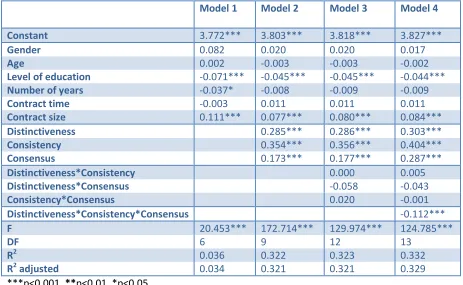
6 A multiple regression analysis is performed to test the several formulated hypotheses. First the hypothesis that all the three characteristics have a direct and independent impact on organizational members’ affective commitment was supported. Support was found for an additive model as well, which implies that distinctiveness, consistency and consensus are compensatory and together have an effect on affective commitment. Furthermore, two-way interactions were explored. Only a significant interaction effect was found for distinctiveness and consensus. It seems that in order for consistency to have a strong influence on organizational members’ affective commitment, both distinctiveness and consensus need to be present. The three-way interaction model implies that the characteristics of HRM system strength are complementary. If one of the characteristics is absent, organizational members will not feel committed at all. Regarding the main question, it can be concluded that models that included interrelationships among HRM system strength characteristics showed greater explained variance than the direct models. The three-way interaction model can be considered as the best predictor of affective commitment. To conclude, organizational members need to perceive a distinctive, consistent and consensual HRM system at the same time in order to have a strong influence on their affective commitment to the organization.
Recommendations
7
Table of contents
Preface ... 3
Summary ... 4
Table of contents ... 7
1. Introduction... 9
1.1 Integrating the content and process approach of HRM ... 9
1.2 Problem statement ... 10
1.3 Research objective and research question ... 11
1.4 Relevance of the study ... 12
1.5 Thesis outline... 12
2. Theoretical framework ... 13
2.1 HRM system strength ... 13
2.1.1 Distinctiveness ... 14
2.1.2 Consistency ... 16
2.1.3 Consensus ... 18
2.2 Discovering the link between HRM system strength and performance ... 20
2.2.1 HRM system strength and organizational members’ affective commitment ... 20
2.2.2 Universalistic approach ... 21
2.2.3 Configurational approach ... 22
2.3 Research model ... 26
3. Methodology ... 27
3.1 Company TSN Thuiszorg ... 27
3.2 Research design ... 28
3.3 Data collection methods ... 28
3.4 Sample and participants ... 29
3.5 Procedure ... 30
3.5.1 Document analysis ... 30
3.5.2 Secondary data from interviews bachelor students ... 30
3.5.3 Questionnaire ... 30
3.5.4 Focus group ... 31
3.6 Research instrument ... 32
3.7 Validity and reliability ... 33
8
4. Results ... 38
4.1 The HRM system within TSN Thuiszorg ... 38
4.2 Means, standard deviations and correlations ... 40
4.3 Direct effects ... 43
4.4 Additive effect ... 45
4.5 Multiplicative effect ... 46
4.6 Moderating effects ... 51
4.7 Strength of the HRM system within TSN Thuiszorg ... 55
4.7.1 Distinctiveness ... 55
4.7.2 Consistency ... 58
4.7.3 Consensus ... 60
5. Discussion ... 63
5.1 Perceptions about HRM system strength ... 63
5.1.1 Distinctiveness ... 64
5.1.2 Consistency ... 66
5.1.3 Consensus ... 67
5.2 HRM system strength and affective commitment ... 68
5.3 Main contributions ... 70
5.4 Limitations ... 70
5.5 Suggestions for future research ... 71
5.6 Recommendations... 72
List of references ... 78
Appendix 1: Invitation letters ... 85
Appendix 2: Questionnaires ... 88
Appendix 3: List of studied documents ... 103
9
1.
Introduction
In this section, an introduction of the research is given. Paragraph 1.1 provides an introduction to the topic. In paragraph 1.2 the problem statement is outlined. The research objective and research question are presented in paragraph 1.3. The relevance of the study is described in paragraph 1.4 In paragraph 1.5, the thesis outline is given.
1.1 Integrating the content and process approach of HRM
There is a lot of attention for the relationship between HRM and organizational performance, because there is evidence that HRM positively influences the performance of an organization (Huselid, 1995; MacDuffie, 1995; Huselid et al., 1997; Richard & Johnson, 2001). However, it is not clear through which mechanism HRM affects performance (Wright & Gardner, 2000). The presence of HR practices dominated the research about HRM and performance, nowadays the interest of researchers shift towards the perceptions of employees about HR practices (e.g. Purcell & Hutchinson, 2007; Wright & Nishii, 2007; Nishii et al., 2008; Kehoe & Wright, 2013). It is argued that the effect of HR practices is resided in the perceptions of employees about those HR practices (Nishii & Wright, 2007), because it are these perceptions that affect employee attitudes and behavior and ultimately, organizational performance (Wright & Nishii, 2007; Takeuchi & Takeuchi, 2013). The focus on perceptions leads to increasing attention for the importance of integrating both the content and process approach of HRM (Bowen & Ostroff, 2004; Sanders et al., 2008; Delmotte et al., 2011; Li et al., 2011; Sanders et al., 2012; Bos-Nehles & Bondarouk, 2012). The content of HRM refers to a specific set of HR practices that is necessary for achieving the goals of an organization (Bowen & Ostroff, 2004). However, the problem is that the content approach does not explain why the same HR practices do not always lead to the same outcomes in terms of performance (Bowen & Ostroff, 2004; Sanders et al., 2012; Bos-Nehles & Bondarouk, 2012). It seems that employees respond differently to the same set of HR practices. The differences in responses could be explained by the process approach of HRM, which refers to the “set of activities aimed at developing, communicating, and implementing HR practices” (Delmotte et al., 2011, p. 1). The HRM system sends signals which are perceived and interpreted differently among employees (Bowen & Ostroff, 2004; Wright & Nishii, 2007; Chow, 2012; Sanders et al., 2012). Therefore, the process approach deals with the effective design and administration of the HRM system (Bowen & Ostroff, 2004).
10 2011). Distinctiveness means that the cause-effect relationship is highly observable. Consistency refers to the consistency of the cause-effect relationship over modalities and time. Consensus means that individuals agree about the cause-effect relationship (Bowen & Ostroff, 2004). It is argued that the HRM system is strong when employees perceive (1) clear and unambiguous HRM messages, which are (2) consistently communicated throughout the organization, and (3) which are perceived and interpreted uniformly among employees (Bowen & Ostroff, 2004; Delmotte et al., 2011). A strong HRM system results in a strong organizational climate in which “employees share a common interpretation of what is important and what behaviors are expected and rewarded” (Bowen & Ostroff, 2004, p. 204). Bowen and Ostroff (2004) argue that a strong HRM system ensures a more effective implementation of HR. Guest and Bos-Nehles (2012) distinguish three types of HR effectiveness. The first component is HR practices effectiveness, which means that the HR practices contribute to the goals of the organization (e.g. Huselid et al., 1997; Mitsuhashi et al., 2000; Wright et al. 2001; Pereira & Gomes, 2012). The second component is HR department effectiveness, which means that the HR department meets the objectives and expectations of its stakeholders (Tsui, 1990; De Winne et al., 2012). The third component is HR implementation effectiveness. HR practices need to be implemented as intended (Khilji & Wang, 2006; Chow, 2012). HR practices effectiveness can be considered as the content approach of HRM, while HR department effectiveness and HR implementation effectiveness are part of the process approach of HRM.
1.2
Problem statement
11 While there is some empirical evidence, the interrelationships between the characteristics of HRM system strength are underexposed in existing research. Only Gomes et al. (2010) and Frenkel et al. (2012) empirically investigated this. As suggested by Bowen and Ostroff (2004), distinctiveness, consistency and consensus are related to each other, but more research is needed to investigate this link. Therefore the main topic of this research is to empirically investigate the interrelationships among distinctiveness, consistency and consensus. Bowen and Ostroff (2004) introduced the concept of HRM system strength, but did not develop a measurement instrument. Recently, Gomes et al. (2010) and Delmotte et al. (2011) made an attempt to develop such a measurement instrument. Both use the characteristics distinctiveness, consistency and consensus and include the features as distinguished by Bowen and Ostroff (2004), however the two researches differ in the way in which they have operationalized HRM system strength. The items of Delmotte et al. (2011) are used by other researchers as well (Bondarouk et al., 2010; Sanders et al., 2012; De Winne et al., 2012). While it is a good attempt to measure HRM system strength, it seems that the items related to distinctiveness, consistency and consensus are mixed up. The separation is made artificially. It can be concluded that the concept of HRM system strength can be considered as a black box; it is not clear which items belongs to distinctiveness, consistency and consensus, how these characteristics are interrelated and how it affects organizational performance. More research is needed to explore the interrelationships in order to investigate what the appropriate model is to explain HRM system strength and its relationship with organizational performance.
1.3 Research objective and research question
12 organizational members’ affective commitment. Therefore, the following research question is formulated:
“Which combination of the characteristics of HRM system strength; distinctiveness, consistency and consensus, has the strongest influence on organizational members’ affective commitment to the organization?”
1.4 Relevance of the study
This study is of both theoretical and practical relevance. It contributes to the literature about HRM system strength through empirically investigating which model best explains the relationship between HRM system strength and organizational performance. While there is some empirical evidence about HRM system strength (Guest & Conway, 2011; Chen et al., 2011; Sanders et al., 2012; De Winne et al., 2012), this research will provide insight in the interrelationships between all the three characteristics of HRM system strength.
Furthermore, this research is of practical relevance for the company where the research is conducted in, Dutch home care organization TSN Thuiszorg. The outcomes of the research provide practical recommendations for TSN Thuiszorg to improve the strength of the HRM system within the organization. The implications are that it becomes clear in which areas HR need to be improved. The HR department wants to professionalize. The findings can reveal important outcomes that need to be taken into account in the development of the HR department towards a HR service delivery model.
1.5 Thesis outline
13
2.
Theoretical framework
The purpose of this chapter is to get more insight in the theoretical background of HRM system strength. In paragraph 2.1 the concept of HRM system strength is outlined. In paragraph 2.2, the relationship between HRM system strength and organizational members’ affective commitment is described. Based on the literature study, hypotheses are formulated. In paragraph 2.3, a research model is developed that guides the research.
2.1 HRM system strength
Bowen and Ostroff (2004) argue that the link between HRM and performance could be explained by the strength of the HRM system which integrates both the content and process approach of HRM. The content of HRM refers to a specific set of HR practices that serve as a mechanism to communicate and signal to employees to engage in certain behaviors (Bowen & Ostroff, 2004). These HR practices should be effective (e.g. Huselid et al., 1997; Mitsuhasi et al., 2000; Wright et al., 2001), which means that they are horizontally and vertically aligned thereby contributing to the performance of the organization (Pereira & Gomes, 2012). Furthermore, the process approach should be taken into account. The HR department is responsible for the design and administration of HR practices (Bos-Nehles & Bondarouk, 2012; Guest & Bos-Nehles, 2012), and thus plays an important role in communicating the HRM message. A strong HRM system ensures an effective implementation of actual HR practices by line managers, which means that HR practices are implemented as intended (Khilji & Wang, 2006; Wright & Nishii, 2007; Nishi et al., 2008; Chow, 2012). It is argued that if the HRM system send signals about which organizational goals are important and what behavior is expected and rewarded, the more likely it is that those goals will be achieved (Bowen & Ostroff, 2004). A strong HRM system can be characterized by high levels of distinctiveness, consistency and consensus (Bowen & Ostroff, 2004; Delmotte et al., 2011), “these characteristics refer to the process by which a consistent message about HRM content can be sent to employees” (Bowen & Ostroff, 2004, p. 207). A strong HRM system supports a strong organizational climate where the messages that are sent by the HRM system to stakeholders are clear, unambiguous and consistent (Bowen & Ostroff, 2004; De Winne et al., 2012), which encourages employees to expose desired attitudes and behavior (Bowen & Ostroff, 2004; Wright & Nishii, 2007).
14 that these interpretations play an important role in determining reactions to the behavior” (Kelley & Michela, 1980, p. 458). Bowen and Ostroff (2004) use these principles and argue that employees make attributions based on the HRM message that is communicated to them by a distinctive, consistent and consensual HRM system (Bowen & Ostroff, 2004).
2.1.1 Distinctiveness
In order for HR to be effective, employees need to make attributions about the HRM system. They need to perceive the HRM system as distinctive, which means that the event-effect relationship is highly observable (Bowen & Ostroff, 2004). Distinctiveness is facilitated by the degree to which the HRM system delivers visible, understandable, legitimate and relevant messages to employees (Bowen & Ostroff, 2004; Delmotte et al., 2011).
15 2011). Line managers and employees need to make sense of the HRM system in order to be able to interact with it (Bondarouk & Bos-Nehles, 2012).
While visible and understandable HR practices are considered as important, in order to contribute to the performance of the organization these HR practices should be designed in such a way that the alignment of individual goals with the goals of the organization is fostered (Bowen & Ostroff, 2004). This feature is called relevance (Bowen & Ostroff, 2004; Delmotte et al., 2011). In other literature this is referred to as the vertical alignment of HR practices (Delery, 1998; Heneman & Milanowski, 2011; Pereira & Gomes, 2012), it is argued that this alignment will positively influence the performance of an organization (Huselid et al., 1997; Richard & Johnson, 2001; Chang, 2005; Mendelson et al., 2011; Guest & Conway, 2011; Chow, 2012; Su & Wright, 2012). Effective HR practices promote strategically expected employee behaviors, this in turn will contribute to desired organizational outcomes (Ruel et al., 2007).
16 contributes to the competitive position and core competences of the firm (Wright et al., 1998; Mitsuhashi et al., 2000; Wright et al., 2001; Han et al, 2006; Guthrie et al., 2011; Kim & Ryu, 2011). A strong HRM system contributes to the effectiveness of the HR department; if the HRM system sends clear, consistent and unambiguous messages it is more likely that different stakeholders perceive high effectiveness of the HR department (De Winne et al., 2012).
2.1.2 Consistency
Consistency refers to the reliable and internally coherent implementation of HR practices, and establishing consistent relationships over time, people and context (Bowen & Ostroff, 2004; Sanders et al., 2012). For instance, an organization that trains employees to stimulate their innovative behavior needs to judge and reward this behavior in the performance appraisal cycle. Consistency of HRM messages helps employees to have an understanding of what behaviors are expected and rewarded (Bowen & Ostroff, 2004); it creates awareness (Pereira & Gomes, 2012). Features are instrumentality, validity and consistent HRM messages (Bowen & Ostroff, 2004; Delmotte et al., 2011).
In order to perceive a consistent HRM messages, outcomes should be linked to behavior. Bowen and Ostroff (2004) refer to this as the instrumentality of the HRM system. This feature is based on the expectancy theory of Vroom (1964); which states that employees decide to act in certain behavior based on their expectations of the outcome. The HR department and line managers should create an unambiguous cause effect-relationship when implementing HR practices. The HR practices can be considered as effective when they elicit desired behaviors which are linked to employee consequences (Bowen & Ostroff, 2004). High instrumentality means that the relationship between behavior of employees and results are closely related in time and that HR practices are applied consistently over time (Pereira & Gomes, 2012).
17 Brewster, 2003; Purcell & Hutchinson, 2007; Bos-Nehles, 2010). However, differences between intended and actual HR practices lead to different perceptions of HR practices at the level of employees (Bowen & Ostroff, 2004; Purcell & Hutchinson, 2007; Wright & Nishii, 2007), which in turn will lead to different attitudes and behaviors of those employees (Wright & Nishii, 2007; Takeuchi & Takeuchi, 2013). This hinders the effectiveness of HR implementation. Differences in perceptions can be attributed to the way HR practices are implemented by line managers (Wright & Nishii, 2007). Reasons are that one line manager could implement HR practices differently than others (Wright & Nishii, 2007; Elorza et al., 2011; Bos-Nehles & Bondarouk, 2012), or that line managers do not give priority to ensure high-quality implementation of HR practices (Guest & Bos-Nehles, 2012). Furthermore, it could be that line managers fail to implement HR practices (Chen et al., 2011; Guest, 2011; Guest & Bos-Nehles, 2012), factors that influence the effective implementation of HR practices by line managers are the desire, capacity, competences, support and clear policies and procedures they perceive when implementing HR practices (Bos-Nehles, 2010).
18
2.1.3 Consensus
Consensus refers to the agreement among employees about what behaviors and responses lead to what outcomes, and consists of the features agreement among principal HRM decision makers and fairness (Bowen & Ostroff, 2004; Delmotte et al., 2011). In this research, only the dimension agreement is taken into account which refers to the agreement among HRM decision makers about the HRM message that needs to be communicated (Bowen & Ostroff, 2004). Several actors are involved in the effective implementation of HR, like top management, HR managers and line managers (Guest & Bos-Nehles, 2012). Top management within an organization is responsible for setting the goals of an organization (Bowen & Ostroff, 2004; Stanton et al., 2010), and is involved in the decision to introduce HR practices together with HR managers (Guest & Bos-Nehles, 2012). HR managers are responsible for the design and administration of effective HR practices (Guest & Bos-Nehles, 2012), while the implementation of HR practices belongs to the responsibility of line managers in an organization (e.g. Hall & Torrington, 1998; Larsen & Brewster, 2003; Bos-Nehles, 2010; Bos-Nehles & Bondarouk, 2012; Guest & Bos-Nehles, 2012). Agreement among those HRM decision makers within an organization - top management, HR managers and line managers - helps to create consensus among employees about the HRM message, which in turn will lead to shared interpretations about which behavior is expected and rewarded (Bowen & Ostroff, 2004; Delmotte et al., 2011; Pereira & Gomes, 2012; Sanders et al., 2012).
19 It is argued that an effective HR department is able to meet the needs of its stakeholders (Tsui, 1990; De Winne et al., 2012). However, the role HR need to perform in order to be perceived as effective is not clear. Stakeholders have different perceptions about the role of HR that adds most value to the firm (Guest & Bos-Nehles, 2012). Wright et al. (2001) found that both line managers and HR managers value the HR services role the most, while HR is least effective in performing change consulting. De Winne et al. (2012) found that trade union representatives stated the importance of the more operational roles; administrative expert and employee champion, while line managers valued the HR function in the roles of administrative expert and strategic partner. Overall, line managers perceived the HR department as more effective compared to trade union representatives (De Winne et al., 2012). Buyens and De Vos (2001) found that top managers perceived the domain of transformation and change most frequent as delivering most value for the HR function, while line managers perceived management of firm infrastructure as the most value added domain. Furthermore, HR managers considered the management of employees as the domain in which the HR function delivers value (Buyens & De Vos, 2001). This is in contrast with the findings of Wright et al. (1998); while HR respondents focused on the administrative expert role, line managers wanted a more strategic focus of the HR department. Some other researchers focused on the value of HR competencies. Paauwe and Boselie (2005) found that HR raters score higher on strategic contribution, personal credibility and HR delivery than non HRM raters do. The results of Ulrich and Brockbank (2005) show higher ratings of HR managers compared to non HR managers as well.
20 increases the performance of an organization; it improves the alignment of HR practices with the needs of line managers, while it provides line managers the opportunity to get more insight in both the technical and strategic contribution of HR to the organization (Yip et al., 2001).
2.2 Discovering the link between HRM system strength and performance
Bowen and Ostroff (2004) argue that the concept of HRM system strength could help to explain how HR practices lead to organizational outcomes by integrating both the content and process of HRM. The underlying thought is that perceptions about HRM system strength will lead to desired behavior and outcomes. Bowen and Ostroff (2004) did not empirically examine this link. While there is some empirical evidence about the relationship between HRM system strength and performance (Bondarouk et al., 2010; Gomes et al., 2010; Guest & Conway, 2011; De Winne et al., 2012; Frenkel et al., 2012; Sanders et al., 2012), it is still not clear how the characteristics distinctiveness, consistency and consensus are interrelated and how they affect performance. In this research, the focus is on affective commitment as indicator for performance. First, the link between HRM system strength and organizational members’ affective commitment is explained. Next to that, several perspectives are adopted in order to explore the relationship between HRM system strength and affective commitment of different organizational members – employees, HR professionals and line managers.21 HRM system strength is related to employees’ affective commitment (Chen et al., 2007; Sanders et al., 2008; Sanders et al., 2012). A definition of affective commitment that is often used in HRM literature is the definition given by Meyer et al. (1993): “the extent to which followers identify with, are involved in and are emotionally attached to an organization”. In this research it is argued that if organizational members perceive that their exchange relationship with the organization is characterized by a supportive work environment, in this research a distinctive, consistent and consensual HRM system, they are more likely to feel obliged to the goals of the organization and in this way develop an affective bond with the organization (Gilbert et al., 2011; Kehoe & Wright, 2013).
2.2.2 Universalistic approach
First, a universalistic approach is taken. This means that there is a universal relationship between the independent and dependent variable (Delery & Doty, 1996). Applying the universalistic approach to the context of HRM system strength means that the greater the extent of perceived distinctiveness, consensus or consistency, the greater the organizational performance in terms of affective commitment. This is in line with existing research about HRM system strength (Sanders et al., 2008; Sanders et al., 2012). Distinctiveness is related to the content of the HR practices. It can be argued that if employees perceive and understand the content of the HR practices; if they feel that the organization is supportive to them and they know what is expected of them, in return they will expose the desired attitudes and behavior (Bowen & Ostroff, 2004). Furthermore, it can be argued that if employees perceive a consistent HRM message about organizational goals and congruent individual behavior and rewards, it is more likely that they will expose the desired attitudes and behaviors (Bowen & Ostroff, 2004). Furthermore, it is argued that if there is consensus among the HRM decision makers; if their behavior is integrated, this will foster consensus among employees, which helps to create shared meanings about which behavior is expected and rewarded. In turn, employees are more likely to expose this behavior (Bowen & Ostroff, 2004). So if organizational members perceive that the organization invests in them by receiving a clear, consistent and unambiguous HRM message (Bowen & Ostroff, 2004), they will reward the organization with higher attachment to the organization (Kinnie et al, 2005; Gilbert et al, 2011; Kehoe & Wright, 2013). The following hypothesis is formulated:
22
2.2.3 Configurational approach
Another way to explain the relationship between HRM system strength and affective commitment is to adopt the configurational approach. The underlying principle of this approach is that there are multiple unique configurations of factors that could result in maximum performance (Delery & Doty, 1996). This means that the characteristics of HRM system strength; distinctiveness, consistency and consensus, are interrelated and that there are several combinations of the characteristics that could lead to organizational members’ affective commitment. Research about interrelationships between characteristics of HRM system strength is scarce. A theory where the principles of the configurational approach are applied to is the AMO theory (Appelbaum et al., 2000). Therefore, principles of the AMO theory are adopted to help to explain the relationship between HRM system strength and organizational members’ affective commitment.
Interaction effects
Within the AMO theory, different models are used to explain the relationship with performance. A first model is the additive model (Delery, 1998), it is assumed that there is a substitutional relationship among factors. This means that the factors ability, motivation and opportunity have a direct and independent impact on performance, boosting one of the factors will increase the performance of the organization (Nehles et al., 2010). This line of reasoning could be applied to HRM system strength as well. It can be argued that performance; affective commitment, is a function of the additive effect of distinctiveness, consistency and consensus (P = D+C+C). This means that the characteristics can compensate one another. A high level of one of the characteristics will compensate a low level of another characteristic (Nehles et al., 2010). If one of the characteristics is improved, this will positively influence the affective commitment of organizational members. The following hypothesis is formulated:
Hypothesis 2: The additive effect of distinctiveness, consistency and consensus is positively related to organizational members’ affective commitment
23 interaction is that distinctiveness, consistency and consensus should be present at least to some degree, in order for organizational members’ affective commitment to occur. If employees do not perceive a distinctive, consistent and consensual HRM system at the same time, they will not feel committed to the organization. The following hypothesis is formulated:
Hypothesis 3: The multiplicative effect of distinctiveness, consistency and consensus is positively related to organizational members’ affective commitment.
Moderating effects
While it could be argued that the three characteristics together have an effect on organizational members’ affective commitment, it could also be argued that two-way interaction effects occur. When assuming a moderating effect, this means that some characteristics of HRM system strength do not directly influence organizational members’ affective commitment, without the presence of another characteristic. Some arguments can be found in the article of Bowen and Ostroff (2004). However, research about the interrelationships between distinctiveness, consistency and consensus is scarce. Gomes et al. (2010) treated consensus and consistency as antecedents of distinctiveness. They argued that distinctiveness is most important, and that consensus and consistency affects distinctiveness, but they did not explain why this relationship is expected. Frenkel et al. (2012) related distinctiveness and consistency to one dimension of consensus: justice. They found that a distinctive, attractive and consistently implemented HR system influences employees’ perceptions of organizational justice. In order to get a better understanding of the interrelationships between the HRM system strength characteristics, hypotheses are formulated to explore two-way interaction effects without a clear theoretical explanation for the suggested relationships.
24 Therefore, the following hypothesis is formulated:
Hypothesis 4a: A consensual HRM system moderates the relationship between a distinct HRM system and organizational members’ affective commitment.
As argued by Bowen and Ostroff (2004), distinctiveness ensures that the HRM system defines the social context for employee behavior, a consistent HRM message enhances the likelihood that desired behaviors will be exposed by employees. A consistent communication and implementation of HR practices across the organization enhances the visibility, understandability and relevance of the HRM system and fosters the creation of shared meanings about the HRM system (Bowen & Ostroff, 2004), which in turn will positively influence organizational members’ affective commitment. HR practices that are implemented as intended (Chow, 2012), strengthens the relationship between a distinctive HRM system and organizational members’ affective commitment. Therefore, the following hypothesis is formulated:
Hypothesis 4b: A consistent HRM system moderates the relationship between a distinct HRM system and organizational members’ affective commitment.
A consistent HRM message that is communicated throughout the organization signals to employees which behavior is expected and rewarded (Bowen & Ostroff, 2004). However, the relationship between consistency and organizational members’ affective commitment could be impeded by disagreement among HR decision makers (Bowen & Ostroff, 2004). When there is no agreement among HR principals, it can occur that the unofficial HRM message is different from the official explicit HRM message, which will lead to different interpretations of the HRM message among employees (Bartram et al., 2007). But if there is agreement among top management and HR managers about the HR goals of the organization, or agreement among HR managers and line managers about the implementation of HR, this will enhance the communication of unambiguous and consistent HRM messages throughout the organization. The effect of consistency on organizational members’ affective commitment will become stronger. Therefore, the following hypothesis is formulated:
25 Less explicit arguments for a moderating effect of distinctiveness on the relationship between consistency and affective commitment can be found in the article of Bowen and Ostroff (2004). Consistency between implemented and intended HR practices (Chow, 2012), positively influences organizational members’ affective commitment. This relationship becomes stronger if employees actually observe the HR practices of the organization, if they understand what is expected from them and if they perceive the practices as important to their own goals. Therefore, the following hypothesis is formulated:
Hypothesis 4d: A distinctive HRM system moderates the relationship between a consistent HRM system and organizational members’ affective commitment.
Furthermore, it could be argued that without consensus among HRM decision makers about the HRM message, it will not be possible to communicate distinct and consistent HRM messages. If there is consensus among HRM principal decision makers, this will foster consensus among employees. If organizational members perceive consensus among HRM decision makers, this will help them to create shared meanings about what is expected (Bowen & Ostroff, 2004), which in turn will positively influence their affective commitment. Furthermore, if organizational members are supported by consistent HRM messages that communicate which behavior is expected and rewarded, the effect of consensus on organizational members’ affective commitment will be enhanced. Therefore, the following hypothesis is formulated:
Hypothesis 4e: A consistent HRM system moderates the relationship between a consensual HRM system and organizational members’ affective commitment.
Another explanation could be that distinctiveness moderates the relationship between consensus and organizational members’ affective commitment. If consensus among HRM decision makers about the formulation and implementation of HR is translated into visible, understandable and relevant HR practices, the effect of consensus on organizational members’ affective commitment will be stronger. Therefore, the following hypothesis is formulated:
26
2.3 Research model
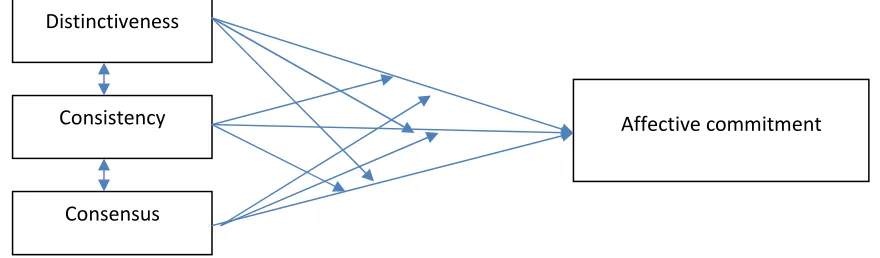
[image:26.595.68.508.198.327.2]Based on the review of the literature, it can be concluded that HRM system strength is expected to be related to organizational members’ affective commitment to the organization. A research model is developed, in line with the formulated hypotheses.
Figure 1: The hypothesized relationship between HRM system strength and affective commitment
Consensus
Affective commitment Consistency
27
3.
Methodology
In this chapter, the methodology will be outlined. Paragraph 3.1 contains a description of the organization in which the research is conducted. In paragraph 3.2 it is argued which research design is chosen and why. Paragraph 3.3 describes both qualitative and quantitative data collection methods that are used. Paragraph 3.4 contains the sample and participants of the research. The procedures that are followed are outlined in paragraph 3.5. Paragraph 3.6 contains the operationalization of the variables of this study. A reflection on the reliability and validity of the measurement instrument is given in paragraph 3.7. The data analysis procedure is described in paragraph 3.8.
3.1 Company TSN Thuiszorg
The research is conducted within TSN Thuiszorg. The company is established in 2002 by healthcare people who believed that home care could be organized better and more efficiently, with the result of more time and quality for the care of people who need help (Organization, structure and meeting forms, 2011). In 2007, TSN Thuiszorg became part of the ADG Dienstengroep. While TSN Thuiszorg is operating in the health care sector, it is a profit organization. With more than 20.000 employees spread over 56 locations, it is the largest home care organization in the Netherlands. Due to mergers and takeovers, the organization grew tremendously in a short time. TSN Thuiszorg provides domestic care, personal care and guidance to people who need help, and serves about 100.000 clients. Regulations from government play an important role. The domestic care is financed by the WMO (Wet Maatschappelijke Ondersteuning), people who need personal or medical care receive care that is financed by the AWBZ (Algemene Wet Bijzondere Ziektekosten). The mission of TSN Thuiszorg is:
“TSN Thuiszorg is an independent home care provider (AWBZ and WMO) with a nationwide covering of establishments. From local, neighborhood focused establishments, TSN is daily exerting to be the best home care provider with the most competitive price-quality ratio by continuously testing her processes and where necessary improving, and besides maintaining a “lean and mean” organization. Furthermore, TSN provides her clients superior service, which is aimed at optimal functioning in their own environment. In acting personal commitment is the driving force (Organization, structure and meeting forms, 2011).
28 help for people who are not able to organize their own household like elderly, sick and disabled people. Furthermore, personal and medical care is delivered to needy people by the AWBZ business unit. Supportive staff functions like HR, finance and facility management are organized at the headquarter. Line management consists of 14 rayonmanagers and in total 115 zorgcoordinatoren. Rayonmanagers are responsible for three to ten districts. Zorgcoordinatoren are operating at establishments and are the direct manager of the health care employees. The organization operates in a very dynamic environment which rapidly changes. Political developments largely influence the core business of TSN Thuiszorg. High cuts around the household care in 2015 and devolution of AWBZ tasks to municipalities have a great impact on the operation. Margins are low, therefore TSN Thuiszorg needs to search for new market opportunities, be innovative and deliver high quality care in a very efficient way while putting the client central.
3.2 Research design
In order to investigate the relationship between HRM system strength and organizational members’ affective commitment, a case study was conducted. A case study involves the in-depth study of a particular phenomenon (Babbie, 2010). This research design provides a rich understanding of the context of the research and the process being enacted (Saunders et al., 2007). The research was conducted within TSN Thuiszorg. This company is chosen because of several reasons. First, with more than 20.000 employees working at TSN Thuiszorg, this organization provides the opportunity to conduct research among a large population of HR professionals, line managers and employees. This makes a comparison between those stakeholders within the organization possible. Second, the business units that provide domestic care and medical care are two very different business units. The research gives insight in the differences in perceptions between those business units. Third, TSN Thuiszorg is a dispersed organization with locations all over the Netherlands. There is a large distance between the HR department and the health care people. From current research it is not clear what this means for the effectiveness of HR.
3.3 Data collection methods
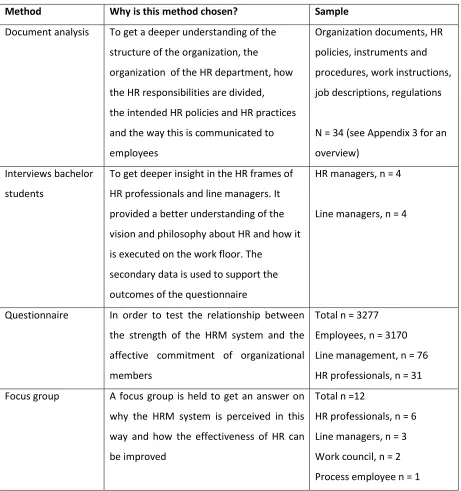
29 Table 1: Overview of data collection techniques
Method Why is this method chosen? Sample
Document analysis To get a deeper understanding of the structure of the organization, the
organization of the HR department, how the HR responsibilities are divided, the intended HR policies and HR practices and the way this is communicated to employees
Organization documents, HR policies, instruments and procedures, work instructions, job descriptions, regulations
N = 34 (see Appendix 3 for an overview)
Interviews bachelor students
To get deeper insight in the HR frames of HR professionals and line managers. It provided a better understanding of the vision and philosophy about HR and how it is executed on the work floor. The
secondary data is used to support the outcomes of the questionnaire
HR managers, n = 4
Line managers, n = 4
Questionnaire In order to test the relationship between the strength of the HRM system and the affective commitment of organizational members
Total n = 3277 Employees, n = 3170 Line management, n = 76 HR professionals, n = 31 Focus group A focus group is held to get an answer on
why the HRM system is perceived in this way and how the effectiveness of HR can be improved
Total n =12
HR professionals, n = 6 Line managers, n = 3 Work council, n = 2 Process employee n = 1
3.4 Sample and participants
30
3.5 Procedure
Different procedures are used to conduct the data collection techniques as reported in Table 1. The way this is done will be elaborated for each of the methods.
3.5.1 Document analysis
A document analysis was performed in order to gain insight in the organization structure and how HR is organized within TSN Thuiszorg. Several organizational documents like the organization plan and organization structure were studied to get insight in the mission and vision of TSN as well as how the organization is structured. On the website additional information was found about the services that TSN Thuiszorg offers to its clients and how TSN Thuiszorg arranges this care. Furthermore, a lot of HR related documents were analyzed. HR policies, instruments, working instructions and process descriptions provided insight in the intended HR policies and practices, the HR services the HR department delivers and the way this is executed. Job descriptions from HR and line management were studied to gain insight in the division of HR responsibilities within the organization. The HR strategy provided insight in the transition of the HR department towards a HR service delivery model. When selecting relevant documents, a main criterion was if it provided relevant information about the organization or HR.
3.5.2 Secondary data from interviews bachelor students
Two bachelor students conducted semi-structured interviews with HR managers and line managers in order to get insight in the congruence of HR frames within TSN Thuiszorg. Purposive sampling is used to select cases, which is a kind of non-probability sampling technique that selects respondents which best enabled the bachelor students to answer their research question (Saunders et al., 2007). First, based on the advice of a HR professional and with the goal of the research of the bachelor students in mind, four HR professionals were selected of varying rayon’s. Two HR professionals that serve the WMO business unit as well two HR professionals that support the AWBZ business unit where invited to participate by me. Then snowball sampling is used to select the rayonmanagers, which means that you ask respondents to identify further cases (Saunders et al., 2007). The HR professionals were asked which of the rayonmanagers they support should be asked to participate in the interviews and then the rayonmanagers were approached by phone. In total eight semi-structured interviews were conducted.
3.5.3 Questionnaire
31 the HR Director and a HR professional, in order to customize the questionnaire to the organization. The HR Director made an announcement about the research in the newsletter of the organization, people were kindly asked to participate in the research. Based on a list of all the employees of the organization, the respondents were approached by e-mail. They received an invitation letter that contains information about the research goal, the research itself, the way they could fill out the questionnaire and the fact that anonymity and confidentiality was assured. The e-mail included a link to the online survey. The response period was three weeks. After 1.5 week, a reminder was sent to the respondents in which they were kindly asked to fill out the questionnaire if they did not responded yet. Completing the questionnaire took about 8 minutes. Forced entry was used, so there were no missing values.
3.5.4 Focus group
32 presentation, and were posed to the participants which were invited to react on it. I asked follow-up questions in order to get a better understanding of the answers given by the participants.
3.6 Research instrument
In order to test the variables that are included in the research model, they needed to be operationalized and translated into items for the questionnaire. The participants were asked to fill out a questionnaire with questions related to HRM system strength. Furthermore, they were asked about their affective commitment to the organization. In order to measure the variables existing scales were used that have been reported to be valid and reliable. The used scales are originally formulated in English, but were already translated into Dutch by other researchers. Table 2 gives an overview of the operationalization of the variables.
HRM system strength
In order to measure HRM system strength, the measure developed by Delmotte et al. (2011) is used. HRM system strength means communicating clear, consistent and unambiguous messages to employees about which behavior is expected and rewarded (Bowen & Ostroff, 2004). HRM system strength consists of the elements distinctiveness, consistency and consensus (Bowen & Ostroff, 2004; Delmotte et al., 2011). Bondarouk et al. (2010) translated the items of Delmotte et al. (2011) into Dutch. 27 items about HRM system strength are included in this research. Distinctiveness is about the extent to which HRM is observable, and included 13 items such as ‘Employees are regularly informed about the initiatives taken by the HR department’. Consistency deals with the alignment of the HRM system and HR messages. This scale consists of 10 items and included for example ‘There is a wide gap between intended and actual effects of HR initiatives’. Consensus refers to the agreement among HRM decision makers about HRM, four items are included. For example: ‘HR management and line management are clearly on the same wavelength. The items were all measured on a five point Likert scale. The used scales of Bondarouk et al. (2010) and Delmotte et al. (2011) have been reported to be reliable. The Cronbach alpha’s of the scales of Delmotte range from 0.70 to 0.86, Bondarouk et al. (2010) reported Cronbach alpha’s ranging from 0.631 (consensus), 0.78 (consistency) and 0.887 (distinctiveness). All but one of the Cronbach Alpha’s is above the threshold of 0.70 (Field, 2009).
Affective commitment
33 a strong desire to remain in the organization (Meyer et al., 1993). The scale consisted of six items and included an item like ‘I’m proud to work in this organization’. The items were all measured on a five point Likert scale. The scale of Torka (2003) has proven to be reliable. The Cronbach Alpha of the affective commitment scale to the organization as reported by Torka (2003) is 0.90.
Control variables
In order to rule out the influence of other factors that affects employees perceptions about HRM system strength or their affective commitment, some control variables were included. Control variables related to organizational members’ gender, age, level of education, number of years within the organization, and type and size of labor contract were taken into account. The variable gender is dummy coded (0 = male, 1 = female), as well as the type of contract (0 = flexible, 1 = fixed term) and the size of contract (0 = part-time, 1 = fulltime).
3.7 Validity and reliability
34
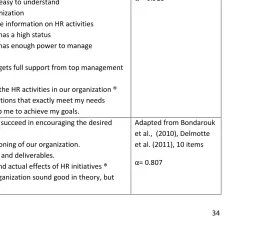
Table 2: Operationalization of the variables
Variable Definition Items Source and Cronbach
Alpha’s
HRM system strength = communicating unambiguous messages to employees about which behavior is expected and rewarded (Bowen & Ostroff, 2004;
Delmotte et al., 2011).
Distinctiveness Features that allow a situation to stand out in the
environment and to capture attention
and interest
- I am regularly informed about the initiatives taken by the HR department - In this organization it is clear what the tasks of the HR department are - The actual functioning of the HR department is a mystery to me ® - The HR department works too much behind the scenes ®
- The HR activities in my organization are easy to understand
- I understand the HR strategy of my organization
- The HR department gives understandable information on HR activities - The HR department in this organization has a high status
- The HR department in this organization has enough power to manage employees
- The HR department in this organization gets full support from top management for HR activities
- I often wonder about the usefulness of the HR activities in our organization ® - The HR department undertakes those actions that exactly meet my needs - The HR activities in our organization help me to achieve my goals.
Adapted from Bondarouk et al., (2010), Delmotte et al. (2011), 13 items
α = 0.918
Consistency Establishment of an effect over time and modalities
regardless of the form of
interactions
- The HR activities for employee appraisal succeed in encouraging the desired behavior.
- The HR activities add value to the functioning of our organization. - There is a clear fit between HR promises and deliverables.
- There is a wide gap between intended and actual effects of HR initiatives ® - The HR activities implemented in this organization sound good in theory, but do not function in practice ®
Adapted from Bondarouk et al., (2010), Delmotte et al. (2011), 10 items
35 - HR policies in this organization are changed every minute ®
- In this organization there is a clear match between all HR messages - There is a clear fit between all HR activities
- The various HR initiatives send inconsistent signals ®
Consensus There is an
agreement
among individuals’ views of the event effect
relationship
- HR and line management are clearly on the same wavelength
- Top management and HR professionals clearly share the same HR vision
- HR management is established by mutual agreement between HR professionals and line management
- Management commonly supports HR policy in our organization
Adapted from Bondarouk et al., (2010), Delmotte et al. (2011), 4 items
α= 0.870
Affective commitment = a strong desire to remain in the organization (Meyer et al, 1993; Torka, 2003).
Affective commitment Emotionally attachment
towards the organization
- I’m proud to work for this organization - I belong to the ‘organization’ family
- This organization is nice to work for - This organization means much to me - I feel home in this organization
- I want to accept almost every job to work for this organization
Adapted from Meyer et al. (1993), Torka (2003), 6
items
36 In the confirmatory factor analysis first-order models, as well as second-order models were explored. While both models showed a good model fit, the second order model did not provide reliable scales. Therefore it was decided to develop a first-order measurement model with the characteristics distinctiveness, consistency and consensus included. All the measures were at a satisfactory level, with CFI, GFI and NFI all above 0.90 and a RMSEA below 0.08 (Browne & Cudeck, 1993). The measures are: CFI = 0.924, GFI = 0.900, NFI = 0.919, RMSEA=0.063). The Cronbach Alpha’s were all way above the threshold of 0.70 (Distinctiveness = 0.918, consistency = 0.807 and consensus = 0.870). Although exploratory factor analysis showed good factor loading for affective commitment, in order to be consistent a confirmatory factor analysis for this scale is conducted as well. This model shows good fit (CFI = 0.994, GFI, = 0.988, NFI = 0.993, RMSEA = 0.060), and the reported Cronbach Alpha is high (0.939). Based on the analyses, the measurement instruments for HRM system strength and affective commitment can be considered as valid and reliable.
A low response rate increases the risk of sampling bias (Saunders et al., 2007). Therefore the data was checked for sampling bias (Field, 2009). A histogram showed a normal distribution of the data. Scatterplots were checked but did not show extreme outliers and showed heteroscedasticity. The measure of Durbin Watson was 1.905, a value close to 2 shows that there is no problem with the correlation of residuals (Field, 2009). Furthermore, residual statistics were checked with a default criterion of 2 SD away from the mean. The results show that there are 159 cases with SD’s above 2. This means a percentage of 4.9% of the cases in the sample, which is below the threshold of 5% (Field, 2009). The measure of Cook distance’ of all cases was below 1, so there were no cases that exert undue influence on the parameters in the model (Field, 2009). It can be concluded that sample bias is not a problem.
3.8 Data analysis
37 and affective commitment. Simple slope analysis was conducted to investigate the significant interaction effects further.
38
4. Results
In this chapter, the results of the research are presented. In paragraph 4.1, the HRM system within TSN Thuiszorg is described. In paragraph 4.2, means, standard deviations and correlations are reported. Paragraph 4.3 until 4.6 present the results of the tested hypotheses. In paragraph 4.7, the findings of the document analysis and focus group are outlined.
4.1 The HRM system within TSN Thuiszorg
In order to get a better understanding of how HR is organized within TSN Thuiszorg and the intended HR policies and practices, several documents are studied. Documents about the organization, HR policies, HR instruments, job descriptions and HR procedures provided more detailed information about the HRM system of TSN Thuiszorg.
39
“TSN Thuiszorg puts the client and the health care professional central. Our way of working and
systems are designed in such a way to maximize the time spend on the delivery of care. Employees of
TSN provide all sorts of care at home, from household assistance until personal care & nursing. TSN
Thuiszorg has a strong position in the neighborhood. Fixed teams know the environment, speak the
language and know their way, they organize the care the client needs in order to function in their own
familiar environment as long as possible: Always home.”
“The function HR contributes to the result of TSN by the execution of high quality and efficient HR
processes and the control of HR costs. In this way TSN can dispose of the right number of qualified
and motivated employees at any time. Line management is responsible for HR and is optimal
supported and advised by the HR function.” (HR strategy, 2013).
A lot of HR responsibilities are devolved to line management in the organization. Rayon managers are middle level managers of TSN Thuiszorg who are responsible for the operational management of their rayon in the area of WMO or AWBZ. They translate the business strategy to the operation and they need to ensure high service quality and client satisfaction. Furthermore they maintain contacts with municipalities and other third parties and search for new business opportunities. They are directly responsible for the management of 10 to 25 ‘zorgcoordinatoren’, the low level line managers within the organization. Indirectly they are responsible for 2500 employees in the field. The rayonmanager is responsible for HR tasks as well. They need to translate HR policies and practices to the lower level in the organization (Job description rayonmanager, 2010). The operational HR tasks are devolved to zorgcoordinatoren. The main task of zorgcoordinatoren is the planning and coordination of care for their location. Zorgcoordinatoren in the WMO business unit give leadership to 150 to 200 household employees while zorgcoordinatoren in the AWBZ business unit are responsible for the management of 30 to 50 healthcare employees. Zorgcoordinatoren are responsible for the operational HR tasks; recruitment & selection, training and development, employee appraisal, compensation and management of sick leave (Job description zorgcoordinator, 2010).
40 management about the translation of HR policies and HR practices to the field and support the implementation of HR initiatives. They need to align HR with the business goals of the organization by taking up a pro-active role (Job description HR professional, 2008).
4.2 Means, standard deviations and correlations
In Table 3 means, standard deviations and correlations of all the variables are reported. The overall mean scores and SD’s are calculated, as well as the correlations between the different variables. Spearman’s Rho is used as a measure for correlation. The results show that all the three characteristics of HRM system strength are correlated with affective commitment: distinctiveness (rs = 0.516, p<0.001), consistency (rs = 0.531, p<0.001), and consensus (rs = 0.453, p<0.001). It seems that distinctiveness and consistency are better predictors of HRM system strength than consensus, although the strength of the correlations does not differ much. Furthermore, it can be concluded that the characteristics of HRM system strength are interrelated. Distinctiveness and consistency positively correlate (rs = 0.797, p<0.001). There is a positive correlation between distinctiveness and consensus (rs = 0.640, p<0.001), and between consistency and consensus as well (rs = 0.641, p<0.001). The fairly high correlation coefficients may suggest multicollinearity problems. In order to test if multicollinearity between distinctiveness, consistency and consensus could be a problem, the Variance Inflation Factor is analyzed. VIF range from 1.867 to 3.175, which is quite low. All the VIF’s are below the threshold of 10, so multicollinearity does not play a role (Field, 2009). From the control variables, only level of education shows a meaningful correlation with each of the characteristics of HRM system strength and employees’ affective commitment, although the correlation coefficients are quite low.
41 Table 3: Means, standard deviations and correlations
Mean SD Affective commitment
Distinctiveness Consistency Consensus Gender Age Level of education
Number of years
Contract time
Contract size Affective
commitment
3.77 0.97 1.000
Distinctiveness 3.01 0.72 0.516*** 1.000
Consistency 3.07 0.71 0.531*** 0.797*** 1.000
Consensus 3.09 0.67 0.453*** 0.640*** 0.641*** 1.000
Gender = 1 0.97 0.18 0.040** 0.067*** 0.032* 0.039* 1.000
Age 7.11 2.11 0.007 0.037* -0.006 0.014 0.055*** 1.000 Level of
education
5.11 2.35 -0.197*** -0.160*** -0.104*** -0.116*** -0.122*** -0.212*** 1.000
Number of years
2.24 1.22 -0.022 -0.027 -0.050** -0.051** 0.055*** 0.304*** -0.134*** 1.000
Contracttime = 1
0.72 0.45 -0.010 -0.031* -0.039* -0.017 0.023*** 0.191*** -0.090*** 0.456*** 1.000
Contractszie = 1 0.13 0.34 0.073*** 0.026 0.045** 0.001 -0.125*** 0.001 0.054*** -0.007 0.054*** 1.000 ***p<0.001, **p<0.01, *p<0.05
Table 4: Means, standard deviations different stakeholders and results one way Anova
Overall (n=3277) Employees (n=3170) Line managers (n=76) HR professionals (n=31) F-value (df = 2) Mean SD Mean SD Mean SD Mean SD
Distinctiveness 3.01 0.72 3.02 0.72 2.63 0.47 2.73 0.52 13.077***
Consistency 3.07 0.71 3.07 0.71 2.80 0.54 3.08 0.59 5.337***
Consensus 3.09 0.67 3.10 0.67 2.60 0.58 2.64 0.65 28.209***
Affective commitment
3.77 0.97 3.78 0.97 3.30 0.79 3.48 0.86 10.789***
[image:41.595.62.763.338.443.2]