http://www.scirp.org/journal/ijcm
ISSN Online: 2158-2882 ISSN Print: 2158-284X
DOI: 10.4236/ijcm.2018.93012 Mar. 7, 2018 117 International Journal of Clinical Medicine
The Effect of Pre-Exercise Cooling on
Performance Characteristics: A Systematic
Review and Meta-Analysis
Erich Hohenauer
1,2,3, Rahel Stoop
1, Peter Clarys
3, Ron Clijsen
1,2,3, Tom Deliens
3, Jan Taeymans
3,41Research Rehabilitation 2rLab, Department of Business Economics, Health and Social Care, University of Applied Sciences and
Arts of Southern Switzerland, Landquart, Switzerland
2THIM University of Applied Sciences, Landquart, Switzerland
3Department of Movement and Sport Sciences, Vrije Universiteit Brussel, Brussels, Belgium 4Health Department, Bern University of Applied Sciences, Berne, Switzerland
Abstract
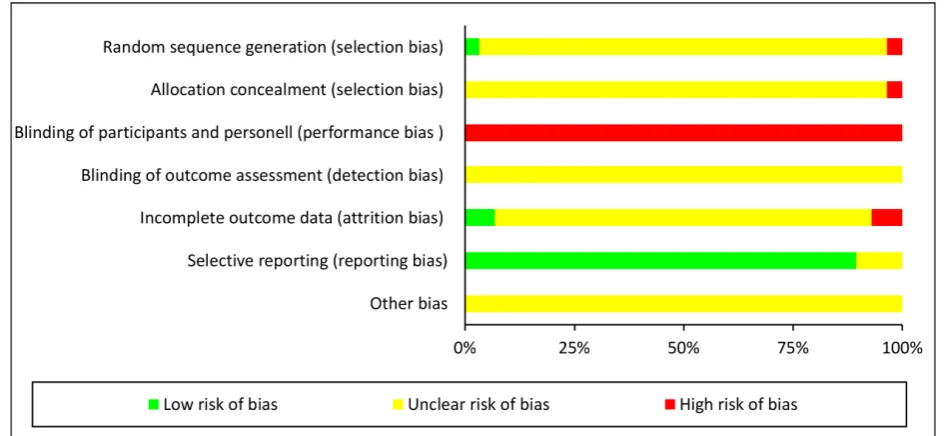
Exercising in high environmental temperatures may cause precocious hyper-thermia induced fatigue resulting in a decreased athletes’ performance output. This systematic review with meta-analysis investigated the possible effects of pre-exercise cooling on performance output. This study was performed ac-cording to the PRISMA guidelines and the PICO-model was used to establish the research question. The Cochrane Risk of Bias Tool was applied to assess the validity of the included studies. Study eligibility was given when the stud-ies compared the effects between any kind of pre-cooling and non-cooling strategies prior to exercise on performance output. Twenty-nine studies met the inclusion criteria for quantitative analysis. Risk of bias was high or unclear but the performance bias was low. The estimated standardized mean differ-ence revealed that external pre-cooling (21 studies) enhanced performance (Hedges’ g = 0.49 [95% CI: 0.33 to 0.64]), with the main effect observed in endurance cycling or running. Internal (7 studies) and mixed-method (5 studies) pre-cooling failed to significantly affect performance parameters. However, the main output parameter, evaluated in these studies, was peak power output. Subgroup analysis for different outcome measures was not pos-sible because meaningful grouping was not plaupos-sible. Limitations of this meta-analysis were the high or unclear risk of bias and the comparability of the included studies. Future studies should also determine the effects of dif-ferent pre-cooling applications on female and untrained participants. Based on the results of this meta-analysis, it can be concluded that there is some evidence in favour of external pre-cooling to avoid precocious hyperthermia
How to cite this paper: Hohenauer, E., Stoop, R., Clarys, P., Clijsen, R., Deliens, T. and Taeymans, J. (2018) The Effect of Pre-Exercise Cooling on Performance Cha-racteristics: A Systematic Review and Me-ta-Analysis. International Journal of Clinical Medicine, 9, 117-141.
https://doi.org/10.4236/ijcm.2018.93012
Received: February 12, 2018 Accepted: March 4, 2018 Published: March 7, 2018
Copyright © 2018 by authors and Scientific Research Publishing Inc. This work is licensed under the Creative Commons Attribution International License (CC BY 4.0).
http://creativecommons.org/licenses/by/4.0/
DOI: 10.4236/ijcm.2018.93012 118 International Journal of Clinical Medicine
induced fatigue in endurance athletes exercising in hot environments.
Keywords
Performance Cooling, Precooling, Core Temperature, Exercise, Meta-Analysis
1. Introduction
High environmental temperatures may negatively influence the athletes’ per-formance output due to precocious hyperthermia induced fatigue [1] [2]. Vari-ous studies have demonstrated that a hot environment is an important factor which may significantly reduce athletes’ power output, especially in endurance sport types such as running sports [3] and cycling [4] [5]. At environmental conditions above 30˚C, core temperature over 40˚C and coinciding increased brain temperature, performance will be impaired [6] [7] [8] [9]. Under these circumstances, the athlete’s thermoregulatory system will try to decrease core temperature to maintain physical performance. The most effective way of heat dissipation from the body is the evaporation of sweat, also in case of systemic diseases [10]. Therefore, the thermoregulation depends strongly on sweat pro-duction and sweat evaporation from the skin [11] [12]. Nybo et al. (2014) com-prehensively reviewed the existing literature of the last century on the physio-logical mechanisms that lead to hyperthermia induced fatigue. The authors con-cluded that various interdepending factors, such as psychological factors, respi-ration, peripheral and central fatigue factors, neurobiological changes and car-diovascular changes may lead to precocious fatigue during prolonged exercise in the heat [1]. To combat the debilitating effects of hyperthermia induced fatigue, athletes were encouraged to acclimatize to hot environmental conditions [13]. Another strategy to prevent hyperthermia induced fatigue is pre-cooling the body before exercising in the heat. The latter has been demonstrated to increase the heat storage capacity before a critical, performance limiting temperature is reached [14] [15]. As the temperature gradient between the body core and the skin narrows during exercise, blood flow of the skin must be increased to main-tain the heat transfer [16] [17]. Additionally, heart rate must be increased for an adequate cardiac output [18]. Consequently, an artificially increased margin be-tween the core temperature and the environmental temperature might be an important factor that leads to an advantage from pre-cooling on performance
[19]. Another performance limiting factor seems to be the impaired cardiovas-cular function to maintain adequate oxygen delivery to the working muscles [18] [20]. Beside reduced metabolism, the increase of intramuscular temperature might lead to impaired mitochondrial functioning, disturbances of K+, Ca2+ and
DOI: 10.4236/ijcm.2018.93012 119 International Journal of Clinical Medicine
warm-up period. Various forms of pre-cooling are already practiced and scien-tifically investigated. External pre-cooling strategies aim to reduce core tem-perature by decreasing skin and muscle temtem-perature, including the use of ice-vests [24], cold-packs [25], cold-water immersion (CWI) [26] and combina-tions of cooling different body parts [27]. Internal pre-cooling aims to reduce core temperature and can be performed by ingesting cold water [28] or crushed
ice [29] while mixed-method pre-cooling usually contains the combination of
ingesting cold water or ice plus an additional partial body cooling application
[30]. In a systematic review, Ross et al. (2013) evaluated the effectiveness of pre-cooling during field-based sports performance [31]. The findings of this study are in line with another meta-analytical review from Wegmann et al. (2012) who indicated that the effects of pre-cooling on performance output are larger in hot (>26˚C) environmental conditions than under moderate (18˚C - 26˚C) temperatures [32]. Although the bulk of literature is growing in this field, a consensus about which cooling method is the most effective [28] and which performance parameter is the most affected under hot temperature conditions is still lacking [2]. Therefore, the aim of this study was to systematically search and critically evaluate the current literature on the effects of external cooling, inter-nal cooling and mixed-method cooling prior to exercise in comparison to non-cooling strategies on different performance parameters of humans exercis-ing under “hot” as well as under “hot and humid” environmental conditions.
2. Methods
2.1. Research Question
The research question was defined by the PICO-model in accordance with the Preferred Reporting Items for Systematic Reviews and Meta-Analyses (PRISMA) statement [33]: Population: healthy, non-injured athletes and active participants; Intervention: external cooling or internal cooling or mixed-method cooling (combination of external and internal cooling) prior to a specified exercise pro-tocol; Comparator: passive non-cooling strategies; Outcomes: time to finish, time to exhaustion, speed, covered distances and peak power output (PPO).
2.2. Literature Search Strategies and Data Sources
DOI: 10.4236/ijcm.2018.93012 120 International Journal of Clinical Medicine
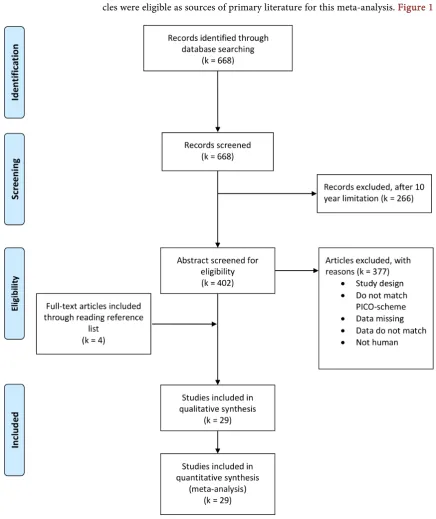
[image:4.595.104.541.191.711.2]published within the last 10 years (2006-2016), 8) the studies had to be random-ized controlled trials (RCT) or randomrandom-ized cross-over trials (RCO). The key-words which best fitted the research question were: “Pre-cooling”, “Precooling”, “Cold”, “Performance” and “Exercise”. These keywords were inserted as follows: (“Pre-cooling” OR “Precooling” OR “Cold”) AND “Performance” AND “Exer-cise”. The keywords “Pre-cooling”, “Precooling” and “Cold” were used individu-ally, in any order and always combined with (“Performance” AND “Exercise”). After screening and processing all the articles found (k = 668), a total of 29 arti-cles were eligible as sources of primary literature for this meta-analysis. Figure 1
DOI: 10.4236/ijcm.2018.93012 121 International Journal of Clinical Medicine
shows the flow-chart of the selection process.
2.3. Data Extraction and Quality Assessment
Data extraction from the studies was performed by two researchers (EH, RC). These authors extracted independently from each other the data into spread-sheets. This method was used to extract relevant data on study eligibility and content of the study (including the cooling procedure, environmental condi-tions, exercise protocols and outcome measures). In case of disagreement, a third researcher (RS) checked the variable in the original study and agreement was sought by consensus. The primary outcomes considered in this meta-analysis were time to finish or exhaustion, maximum speed, covered distance or PPO of a specified exercise task. Data were extracted at the end of the performance of a specified exercise. The methodological quality of the studies was assessed with the Cochrane Risk of Bias Tool [35]. Two researchers independently evaluated the 29 studies (RS, RC). A third researcher (EH) rated in case of disagreement and agreement was sought by consensus.
2.4. Data Analysis
Several meta-analyses and forest plot drawings were conducted using the Com-prehensive Meta-Analysis software (CMA II, Biostat Inc., Englewood, NJ 07631, US). A priori it was decided to use a random-effects model because the studies under investigation were not exact replicates of each other. The DerSimonian and Laird inversed-variance method was used to calculate the weighting factors. Because individual studies reported study results in different metrics, the calcu-lated individual study effect sizes were standardized and expressed as Hedges’ g to correct for overestimation of the true effect size in small study samples. The corresponding 95% confidence intervals (95% CI) around the individual studies effect sizes as well as around the overall weighted effect were calculated. The lat-ter indicates the range in which the mean effect size may fall, based on the un-iverse from which this set of studies was sampled. Cohen’s benchmarking for the interpretation of the effect size was followed: g lower than 0.2 (neglible effect size), g between 0.21 and 0.49 (small effect size), g between 0.50 and 0.79 (mod-erate effect size), and g equal to or higher than 0.8 (very high effect size) [36].
To test the Null hypothesis of heterogeneity (i.e. that all studies have a com-mon effect size), a Cochran’s Q-test was conducted and the Q-value was re-ported together with its corresponding degrees of freedom (df(Q)) and exact
p-value. The significance level of this Q-test was set at 0.1 because this test is known to lack statistical power. Higgins’ I2 was calculated to express the amount
of the total observed variance that can be explained by the true between studies variance rather than random sampling error and was reported as a relative number (i.e. in %). Higgins’ suggested benchmarking values for the interpreta-tion of I2 was followed: I2 around 25% (low heterogeneity), I2 around 50%
DOI: 10.4236/ijcm.2018.93012 122 International Journal of Clinical Medicine
give the reader a more absolute estimate of the distribution of possible true effect sizes on population level T2 (i.e. the variance of the distribution of true effects)
and its square root (i.e. the standard deviation of the distribution of true effect sizes) were calculated. The latter allowed for the calculation of the 95% predic-tion intervals (95% PI), indicating the range in which the effect-size will fall in most populations. The latter was marked as a horizontal line through the di-amond representing the overall weighted mean estimate on the forest-plots.
Subgroup meta-analysis was conducted to explain a part of the observed he-terogeneity only if this was plausible (i.e. in case of a sufficient number of stu-dies). Groups were established based on the type of exercise protocols (cycling, running and functional strength) and outcomes (cycle time to exhaustion, cycle time to finish, power output, running distance, running time, running time to exhaustion, sprint time and lifted weight) used in the individual studies. Because of the low numbers of studies within the subgroups it was decided to assume a common variance. Thus, to obtain a more accurate value of T2 in the subgroup
analysis, T2 was pooled and used as the common between studies variance across
all the subgroups.
The likelihood for publication bias was assessed only in the overall me-ta-analysis using the classic fail-safe N and the Duval and Tweedie’s trim and fill methods [38].
3. Results
3.1. Risk of Bias Analysis
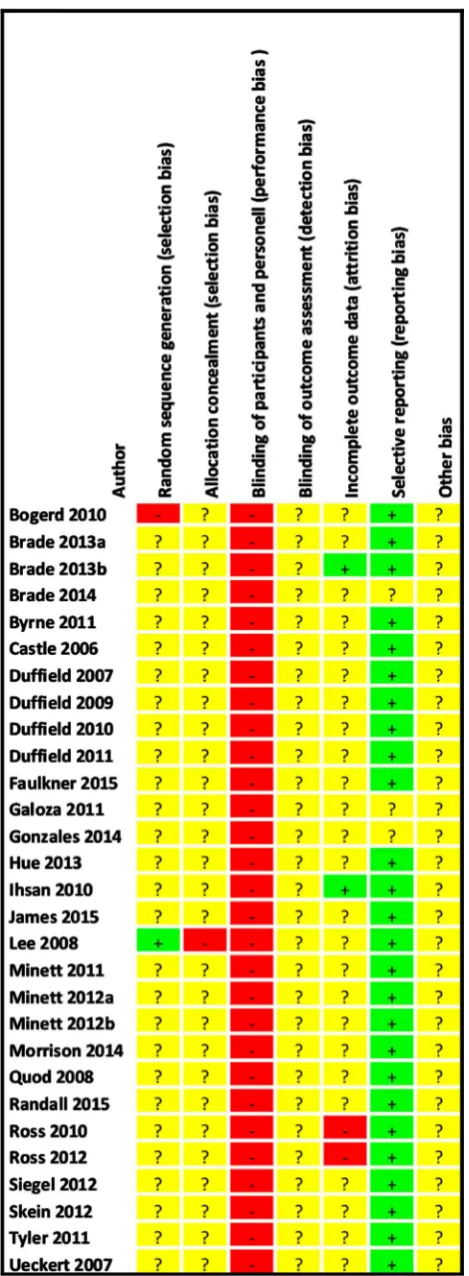
Figure 2 depicts the Risk of Bias results of each included study and Figure 3
demonstrates the overview of all included studies for this analysis. Blinding of the participants was not possible in these studies. However, it was not always clear if other members of the research teams were blinded. Similarly, for nearly all other items (with the exception of reporting bias) the raters were uncertain. Thus, methodological issues in the studies under investigation may not be ex-cluded. A low risk of reporting bias was observed in 90% of the analysed studies. For the remaining three studies (10%), reporting bias remained unclear [39] [40] [41]. Additionally, it can be observed that the risk for selection bias (93% for se-quence generation and 97% for allocation concealment) detection bias (100% for blinding of outcome assessment) and other bias (100%) remained unclear.
3.2. Study Characteristics
DOI: 10.4236/ijcm.2018.93012 123 International Journal of Clinical Medicine
DOI: 10.4236/ijcm.2018.93012 124 International Journal of Clinical Medicine
Figure 3. Risk of bias summary for all included studies.
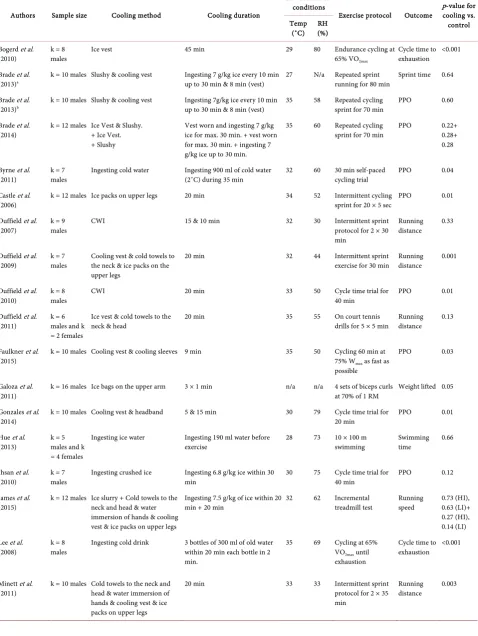
endurance cycling (k = 11) or running (k = 5), repeated cycling (k = 3) or run-ning (k = 6) sprints and sport specific tasks (k = 4). Table 1 depicts a summary of the included studies.
External cooling techniques comprised of cooling vests (k = 4), local ice ap-plications (k = 4), cold-water immersion (CWI; k = 3), combinations of external cooling (k = 11) and whole-body cryotherapy (WBC; k = 1). In total, 23 external cooling data sets were extracted from 21 studies.
Internal cooling techniques comprised of ingesting cold water (k = 3) and crushed ice/ice slurry/slushies (k = 4). In total, seven internal cooling data sets were extracted from seven studies. Mixed-method cooling comprised of the combination of ingesting ice slushies and waring cooling vests (k = 3) or ice towel applications (k = 2). In total, five mixed-method cooling data sets were ex-tracted from five studies comprising of ingesting ice/drinking slushies and wearing cooling vests [39] [44] [45] or using ice towels [30] [46].
3.3. External-Cooling vs. Non-Cooling Strategies
In these analysis, the effects of external cooling was studied on following out-come variables: PPO (k = 5) [25] [39] [40] [41] [47], time to exhaustion (k = 8)
[5] [15] [24] [48] [49] [50] [51] [52], covered distance (k = 5) [26] [27] [42] [53]
[54] and speed (k = 3) [55] [56] [57]. Six studies investigated the effects of pre-cooling on endurance cycling [5] [24] [41] [47] [48] [49], five studies on endurance running [15] [50] [51] [52] [55], two on repeated cycle sprints [25] [39], five studies on repeated running sprints [26] [27] [53] [54] [57] and three studies on sport specific performance [40] [42] [56]. Authors used ice vests [24]
[39] [50] [52], local cooling applications [25] [40] [50] [51], CWI [15] [26] [48]
and combinations of external cooling methods [5] [27] [41] [42] [47] [49] [53]
DOI: 10.4236/ijcm.2018.93012 125 International Journal of Clinical Medicine
Table 1. Summary of the included studies for the meta-analyses.
Authors Sample size Cooling method Cooling duration
Environmental conditions
Exercise protocol Outcome p
-value for cooling vs. control Temp (˚C) RH (%)
Bogerd et al.
(2010) k = 8 males Ice vest 45 min 29 80 Endurance cycling at 65% VO2max
Cycle time to exhaustion <0.001
Brade et al.
(2013)a k = 10 males Slushy & cooling vest Ingesting 7 g/kg ice every 10 min up to 30 min & 8 min (vest) 27 N/a Repeated sprint running for 80 min Sprint time 0.64
Brade et al.
(2013)b k = 10 males Slushy & cooling vest Ingesting 7g/kg ice every 10 min up to 30 min & 8 min (vest) 35 58 Repeated cycling sprint for 70 min PPO 0.60
Brade et al. (2014)
k = 12 males Ice Vest & Slushy. + Ice Vest. + Slushy
Vest worn and ingesting 7 g/kg ice for max. 30 min. + vest worn for max. 30 min. + ingesting 7 g/kg ice up to 30 min.
35 60 Repeated cycling
sprint for 70 min
PPO 0.22+
0.28+ 0.28
Byrne et al. (2011)
k = 7 males
Ingesting cold water Ingesting 900 ml of cold water
(2˚C) during 35 min
32 60 30 min self-paced
cycling trial
PPO 0.04
Castle et al. (2006)
k = 12 males Ice packs on upper legs 20 min 34 52 Intermittent cycling
sprint for 20 × 5 sec
PPO 0.01
Duffield et al.
(2007) k = 9 males CWI 15 & 10 min 32 30 Intermittent sprint protocol for 2 × 30
min
Running
distance 0.33
Duffield et al. (2009)
k = 7 males
Cooling vest & cold towels to the neck & ice packs on the upper legs
20 min 32 44 Intermittent sprint
exercise for 30 min
Running distance
0.001
Duffield et al.
(2010) k = 8 males CWI 20 min 33 50 Cycle time trial for 40 min PPO 0.01
Duffield et al. (2011)
k = 6 males and k = 2 females
Ice vest & cold towels to the neck & head
20 min 35 55 On court tennis
drills for 5 × 5 min
Running distance
0.13
Faulkner et al.
(2015) k = 10 males Cooling vest & cooling sleeves 9 min 35 50 Cycling 60 min at 75% Wmax as fast as
possible
PPO 0.03
Galoza et al. (2011)
k = 16 males Ice bags on the upper arm 3 × 1 min n/a n/a 4 sets of biceps curls
at 70% of 1 RM
Weight lifted 0.05
Gonzales et al.
(2014) k = 10 males Cooling vest & headband 5 & 15 min 30 79 Cycle time trial for 20 min PPO 0.01
Hue et al.
(2013) k = 5 males and k
= 4 females
Ingesting ice water Ingesting 190 ml water before
exercise 28 73 10 × 100 m swimming Swimming time 0.66
Ihsan et al. (2010)
k = 7 males
Ingesting crushed ice Ingesting 6.8 g/kg ice within 30
min
30 75 Cycle time trial for
40 min
PPO 0.12
James et al.
(2015) k = 12 males Ice slurry + Cold towels to the neck and head & water immersion of hands & cooling vest & ice packs on upper legs
Ingesting 7.5 g/kg of ice within 20
min + 20 min 32 62 Incremental treadmill test Running speed 0.73 (HI), 0.63 (LI)+
0.27 (HI), 0.14 (LI)
Lee et al.
(2008) k = 8 males Ingesting cold drink 3 bottles of 300 ml of old water within 20 min each bottle in 2 min.
35 69 Cycling at 65%
VO2max until
exhaustion
Cycle time to exhaustion <0.001
Minett et al.
(2011) k = 10 males Cold towels to the neck and head & water immersion of hands & cooling vest & ice packs on upper legs
20 min 33 33 Intermittent sprint
protocol for 2 × 35 min
Running
DOI: 10.4236/ijcm.2018.93012 126 International Journal of Clinical Medicine
Continued
Minett et al.
(2012)a k = 8 males Cold towels to the neck and head & water immersion of
hands & cooling vest & ice packs on upper legs
20 min 33 34 Intermittent sprint
protocol for 2 × 35 min
Running
distance 0.001
Minett et al. (2012)b
k = 10 males Cold towels to the neck and head & water immersion of hands & cooling vest & ice packs on upper legs
20 min 32 64 6-over spell bowling
performance
Running speed
0.83
Morrison et al. (2014)
k = 10 males CWI 60 min 30 50 Cycling at 95% of
ventilatory threshold until exhaustion
Cycle time to exhaustion
0.001
Quod et al.
(2008) k = 6 males CWI & cooling vest 30 min (CWI) & 40 min (cooling vest) 34 41 Cycle time trial for 40 min Cycle time to finish 0.008
Randall et al. (2015)
k = 8 males
Cooling vest + ice packs on upper legs
30 min + 30 min 32 48 Treadmill running at
70% VO2max until
exhaustion
Running time 0.22 + 0.002
Ross et al. (2011) k = 11 males Cold towels & ingesting ice Ingesting 14 g/kg of ice while
wearing cold towels 30 min 34 55 Cycle time trial of 46.4 km PPO 0.04
Ross et al. (2012) k = 12 males Cold towels & ingesting ice Ingesting 14 g/kg of ice while
wearing cold towels 30 min 33 50 Cycle time trial of 46.4 km PPO 0.70
Siegel et al.
(2012) k = 8 males Ice slurry + CWI Ingesting 7.5 g/kg of ice within 30 min + CWI for 30 min 34 52 Running till exhaustion Running time to exhaustion 0.005+ <0.001
Skein et al. (2012)
k = 10 males CWI & ice towels over shoulder
15 & 5 min 31 33 Intermittent sprint
protocol for 50 min
Sprint time 0.08
Tyler et al.
(2011) k = 8 males Cooling collar N/a 32 53 Treadmill running at 70% of VO2max until
exhaustion
Running time to exhaustion 0.01
Uckert et al. (2007)
k = 20 males Cooling vest 20 min 31 50 Incremental
treadmill test
Running time to exhaustion
<0.001
& = indicates combinations within a cooling intervention; + = indicates additional cooling intervention within one study; PPO = peak power output; CWI = cold water immersion; N/a = not available, RM = repetition maximum; VO2max = maximal oxygen uptake; Wmax = maximal power output; HI = high inten-sity, LI = low intensity.
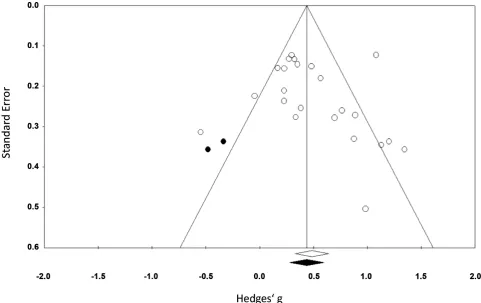
To test the hypothesis that external pre-cooling had an enhancing effect on performance parameters, an overall meta-analysis was conducted. This calcula-tion showed that external pre-cooling techniques had a moderate but statistical significant effect on performance output compared to non-cooling strategies (Hedges’ g = 0.49 [95% CI: 0.33 to 0.64]), which can be observed in Figure 4. The observed heterogeneity was high and statistically significant (Q = 77.0; df(Q) = 22; p < 0.001; I2 = 71.4%) suggesting that about 71.4% of the variance on
observed effects reflects variance in true effects. The remaining 28.6% can be at-tributed to random or sampling error and would probably disappear in case of very large sample sizes. The 95% prediction interval, indicating in which range the effect size in most populations will fall, ranged from −0.17 to 1.14 Hedges’ g. To assess the risk for publication bias in this overall meta-analysis, a classic fail-safe N test was conducted and showed that 729 studies would be needed to bring p-value to >0.05. In addition, the Duval and Tweedie’s trim and fill method revealed that only two small studies were missing to obtain funnel plot symmetry
DOI: 10.4236/ijcm.2018.93012 127 International Journal of Clinical Medicine
Figure 4. Forest plot of the meta-analysis illustrating the overall weighted effect of external cooling versus no cooling on
per-formance parameters (The diamond on the bottom of the forest-plot represents the overall weighted estimate while the horizontal line through the diamond represents the 95% prediction interval).
Figure 5. Funnel plot of the included studies using external-cooling strategies (The white diamond indicates the actual effect size
[image:11.595.57.539.387.690.2]DOI: 10.4236/ijcm.2018.93012 128 International Journal of Clinical Medicine
overall weighted effect-size would yield an adjusted value of Hedges’ g = 0.43 [95% CI: 0.28 to 0.58]).
In an effort to explain a part of the observed high heterogeneity in this overall meta-analysis, different subgroup meta-analyses were conducted by stratifying studies based on their type of exercise protocols (cycling, running and functional strength) and outcomes (cycle time to exhaustion, cycle time to finish, power output, running distance, running time, running time to exhaustion, sprint time, running speed and lifted weight). Pre-cooling was effective for enhancing per-formance characteristics in humans for both cycling (Hedges’ g = 0.53, [95% CI: 0.26 to 0.80]; Q = 14.7, df(Q) = 7, p = 0.037; I2 = 52.5%) and running (Hedges’ g
= 0.45, [95% CI: 0.25 to 0.65]; Q = 59.9, df(Q) = 13; p <0.001; I2 = 78.3%)
exer-cises.
Pre-cooling had very strong, positive and statistical significant effects on cycle time to exhaustion (Hedges’ g = 1.02; [95% CI = 0.53 to 1.51]), cycling time to finish (Hedges’ g = 0.88; [95% CI: 0.23 to 1.52]) and running time to exhaustion (Hedges’ g = 0.82; [95% CI: 0.53 to 1.11]), while low respectively moderate, posi-tive and statistical significant effects of pre-cooling were observed on PPO (Hedges’ g = 0.33; [95% CI: 0.11 to 0.55]), running distance (Hedges’ g = 0.54; [95% CI: 0.28 to 0.80]) and running time (Hedges’ g = 0.48; [95% CI: 0.08 to 0.88]). In these subgroups heterogeneity disappeared except for the “running time to exhaustion” subgroup where heterogeneity remained high (Q = 17.0, df(Q) = 2, p < 0.001; I2 = 88.2). External pre-cooling had no main effect on
sprint time (Hedges’ g = −0.55; [95% CI: −1.16 to 0.07]), running speed (Hedges’ g = 0.15; [95% CI: −0.04 to 0.35]) and lifted weight (Hedges’ g = 0.98; [95% CI: −0.003 to 1.97]).
3.4. Internal-Cooling vs. Non-Cooling Strategies
Seven studies revealed the effect of internal pre-cooling on performance pa-rameters [15] [28] [29] [39] [43] [55] [58] with one study investigating the effect on performance using a 70 min repeated cycling sprint protocol [39], one study using an endurance swimming task [43], two studies using endurance running
[15] [55] and three studies using endurance cycling tasks [28] [29] [58]. Four
studies examined the effects of ingesting ice [15] [29] [39] [55] on performance while three studies used cold water [28] [43] [58] as a cooling intervention. The overall weighted mean estimate showed that internal cooling has a moderate and positive, albeit no statistical significant effect compared to the control condition on performance parameters (Hedges’ g = 0.55; [95% CI: −0.01 to 1.11]) (Figure 6). The 95% prediction interval indicating the range of possible true effect sizes in most populations ranged from −1.38 to 2.48 Hedges’ g. The observed hetero-geneity was high and statistically significant (Q = 56.38, df (Q) = 7; p <0.001; I2
DOI: 10.4236/ijcm.2018.93012 129 International Journal of Clinical Medicine
3.5. Mixed-Method Internal and External Cooling vs. Non-Cooling
Strategies
Five studies examined the effects of mixed-method internal and external cooling versus non-cooling strategies on PPO and performance times [30] [39] [44] [45] [46]. Four studies investigated the effect of pre-cooling prior to a cycle sprint
[39] [45] or endurance cycle trial [30] [46] while one study investigated the
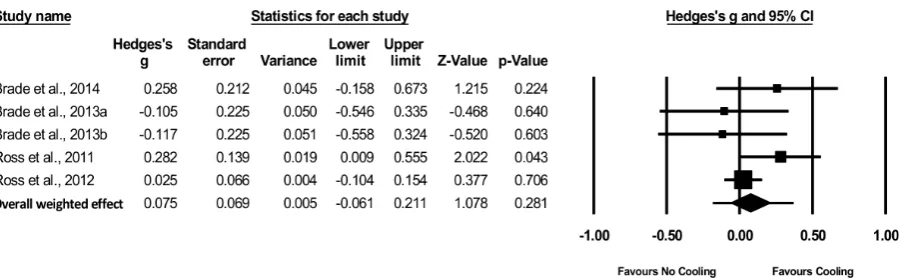
ef-fect of pre-cooling on repeated sprint running times [44]. The overall weighted mean effect size between mixed method pre-cooling and the control group was very low and statistically not significant (Hedges’ g = 0.07; [95%CI: −0.06 to 0.22]). Heterogeneity was low (I2 = 17.41%) and not significant (Q = 4.84; df(Q)
= 4; p = 0.30). The 95% prediction interval ranged from −0.24 to 0.39 (see
Fig-ure 7). These results indicate that mixed-method pre-cooling is not superior
compared to the non-cooling control group for enhancing performance. Sub-group analyses or meta-regression was not plausible to conduct due to the low number of studies included in this analysis.
4. Discussion
[image:13.595.91.539.348.494.2]The aim of this systematic review and meta-analysis was to evaluate the effects of
Figure 6. Forest plot of the meta-analysis illustrating the overall weighted effect of internal cooling versus no cooling on
performance parameters (The diamond on the bottom of the forest-plot represents the overall weighted estimate while the horizontal line through the diamond represents the 95% prediction interval).
Figure 7. Forest plot of the meta-analysis illustrating the overall weighted effect of mixed-method cooling versus no
[image:13.595.89.540.542.681.2]DOI: 10.4236/ijcm.2018.93012 130 International Journal of Clinical Medicine
pre-cooling (external cooling, internal cooling and mixed-method cooling) vs. non-cooling strategies on different performance parameters in hot and humid environmental conditions. The analysis demonstrated that, prior to exercise tasks, external cooling methods had a significant better effect on performance parameters compared to non-cooling strategies. However, internal cooling and mixed method cooling strategies were not superior compared to non-cooling strategies to enhance performance.
4.1. External-Cooling vs. Non-Cooling Strategies
The overall weighted mean difference revealed a significant (p < 0.001) effect of pre-exercise external cooling applications on the performance output compared to non-cooling strategies. The observed effect size for this analysis was small (Hedges’ g: 0.49). The strongest effect of pre-cooling was observed for cycling performance (Hedges’ g: 0.53; p < 0.001), primarily cycle time to exhaustion (p < 0.001) and cycling time to finish (p = 0.008) under hot (ranging from 29 to 34˚C) and humid (ranging from 41 to 80%) conditions. Only one study in the subgroup analysis showed a non-significant result for external pre-cooling on cycle performance [39]. The main difference to the other studies was, that Brade
et al. (2014) did use a repeated sprint protocol with a 10 min break between the
sets. Each set comprised of 120 maximal sprints at varying intensities, which made (self-) pacing very difficult in this protocol. These findings suggest that vasoconstriction occurred, preventing heat exchange from the body-core to the surroundings (cooling vest), resulting in non-affected core temperature changes. Similar observations were already described in previously published studies [24] [59].
Pre-cooling demonstrated to be overall significant effective for running tasks (p < 0.001). Open-end exercise tests, like the determination of total running dis-tance and running time to exhaustion seem to be primarily positive affected from pre-cooling (p <0.001 and p = 0.003), especially under hot (ranging from 31˚C to 35˚C) and humid (ranging from 30% to 53%) conditions. However, the subgroup analysis demonstrated that it was ineffective to enhance running speed and sprint times and weight lifting. It has already been reported that decreased muscle temperature from excessive cooling can negatively influence voluntary force production and sprint performance [57]. Decreased tissue temperature has been shown to reduce nerve conduction velocity, muscle force production and muscular power [60] [61] [62]. These observations are in line with the findings of Galoza et al. (2011), demonstrating that external pre-cooling failed to signifi-cantly affect weight lifting activity in the biceps brachii muscle compared to a non-cooling strategy [40]. However, it has to be taken into account that only one study was included in the subgroup analysis of the present meta-analysis for as-sessing sprint time and weight lifting, respectively.
combina-DOI: 10.4236/ijcm.2018.93012 131 International Journal of Clinical Medicine
tions of external cooling methods (k = 5; Hedges’ g range: 0.32 to 1.12), CWI (k = 3; Hedges’ g range: 0.69 to 1.34), cooling vests (k = 2; Hedges’ g range: 0.27 to 1.20) and local cooling applications (k = 3; Hedges’ g range: 0.29 to 0.56) dem-onstrating to have the largest effect.
4.2. Internal-Cooling vs. Non-Cooling Strategies
The overall weighted effect indicated that internal pre-cooling is not effective vs. non-cooling strategies (p = 0.05) to enhance performance under hot and humid environmental conditions. As it can be observed in Figure 6, only two studies showed statistically significant effects, favouring internal cooling [15] [58]. In-terestingly, these two authors investigated the effects on open-end protocols (time to exhaustion) during endurance running [15] and cycling [58]. The re-maining included studies evaluated the effects on PPO [28] [29] [39] or speed factors [55] with no superior effect of pre-cooling with ice. These findings are in line with a comparable finding [32]. Other studies have already demonstrated that the effect of internal cooling is only limited. One main mechanism, which is not present after or during internal cooling methods, is the reduction of the shell temperature. This drop in temperature causes a redistribution of blood to the core, leading to a reduced heart rate [63] and a larger stroke volume [6]. How-ever, the present study indicates that internal cooling can decrease core tem-perature. Reduced core temperature is well known to increase heat storage ca-pacity [64]. However, a lower body core temperature may also reduce the par-ticipants’ performance output due to central regulation mechanisms [65] be-cause tissue temperature reductions will negatively influence the maximal loco-motor speed through reduced afferent and efferent signal transmission
[66]. Muscle contractions produce heat inside the muscle, before any change in core temperature can be noticed. This muscle temperature rise increases the rate of force development of a muscle twitch with positive effects on power and speed [67] [68]. The results of this present meta-analysis are in line with compa-rable studies showing the efficacy of internal pre-cooling on endurance per-formance [32]. It has been speculated that the cooled water, while passing the oesophagus, might reduce the blood temperature in the carotid artery and this would decrease the athlete’s brain temperature, leading to enhanced perform-ance output in the heat [69] [70]. However, most research, concentrating on the effectiveness of internal cooling on performance tries to explain the mecha-nisms via changes in core temperature. More mechanistic (e.g. investigation of brain and muscle temperature or cutaneous vascular conductance) insights are needed to further elucidate the potential mechanisms behind this very practi-cal pre-cooling method.
4.3. Mixed-Method Internal and External Cooling vs. Non-Cooling
Strategies
DOI: 10.4236/ijcm.2018.93012 132 International Journal of Clinical Medicine
overall weighted effect of mixed-method pre-cooling on performance output. However, it has to be mentioned, that the included studies used acclimatization periods prior to the pre-cooling method (for the experimental and control group). Acclimatization to hot environmental conditions has been demonstrated to be a key component for reducing the negative effects of heat strain [19]. Brade
et al. (2013) concluded that pre-cooling alone is unnecessary if athletes are heat
acclimated [44]. Therefore, an increase of the heat storage capacity seems to be more effective with acclimatisation to the heat than pre-cooling the body core and shell. Acclimatisation to the heat has various physiological advantages to enhance performance. One main factor is that the increase in core and skin temperature is attenuated through increased sweat rates [71]. Evaporative heat loss is the most effective way to release heat from the body [10]. Furthermore, the increased heart rate is also attenuated because of the increasing stroke vol-ume during acclimatisation [71]. This might be one explanation why a positive effect of pre-cooling can rather be seen in aerobic exercises than in anaerobic exercise or power outputs. Muscle power depends strongly on the actual muscle temperature. Published data have already demonstrated that an increase in mus-cle temperature (through immersion in hot water) leads to higher vertical jump performances [72]. A similar positive observation has been demonstrated after warm water immersion prior to intensive cycling exercises on PPO [72]. As mixed-method cooling aims to lower tissue temperature it might be possible that cold has a negative effect on dynamic force production, as described earlier [73].
4.4. Limitations and Future Research
Figure 2 and Figure 3 depict that the included studies had a high or unknown
DOI: 10.4236/ijcm.2018.93012 133 International Journal of Clinical Medicine
Furthermore, the included studies used primarily at least well-trained, male par-ticipants for their investigation of pre-cooling. It is still unclear, if the effects of pre-cooling, obtained from the current observations, can be extrapolated to male, untrained or even female participants. Future research is strongly advised to control for the systematic error (especially by eliminating selection bias, de-tection bias and other bias). Although the effects of pre-cooling on performance are more relevant in field settings than in laboratory settings, researchers should also take into account that these results can be hardly replicated or even com-pared to each other.
5. Conclusion
Based on the results of this meta-analysis, external pre-exercise cooling appears to be an effective intervention to enhance performance in hot (between 29˚C and 34˚C) and humid (41% to 80%) conditions. Endurance running and cycling tasks were primarily affected from external pre-cooling. Combinations of exter-nal cooling applications, CWI and wearing cooling vests demonstrated to have the largest effects. Internal and mixed-method cooling demonstrated to have no main effect on performance enhancement, although internal cooling might have a significant positive effect on both cycling and running endurance tasks. How-ever, it has to be considered that the main outcome parameter for internal and mixed-method pre-cooling was PPO. The low number of studies made an evaluation of the possible effects of internal and mixed-method pre-cooling on endurance performance impossible. The high and unclear risk of bias of the in-cluded studies has to be taken into account when using the current results, al-though the risk for publication bias was very low.
Acknowledgements
The authors thank the “Thim van der Laan foundation” for the financial sup-port.
Conflict of Interest Statement
The authors declare no conflict of interest.
Author Contributions
Conceived and designed the experiments: EH PC RC JT. Data extraction and quality assessment: EH RS TD JT. Risk of bias assessment: EH RS RC. Analysis of the data: EH JT. Wrote the paper: EH PC JT RC. Read and approved final ver-sion of manuscript: EH RS PC RC TD JT.
References
DOI: 10.4236/ijcm.2018.93012 134 International Journal of Clinical Medicine
[2] Jones, P.R., Barton, C., Morrissey, D., Maffulli, N. and Hemmings, S. (2012) Pre-Cooling for Endurance Exercise Performance in the Heat: A Systematic Review. BMC Medicine, 10, 166.https://doi.org/10.1186/1741-7015-10-166
[3] Tyler, C. and Sunderland, C. (2008) The Effect of Ambient Temperature on the Re-liability of a Preloaded Treadmill Time-Trial. International Journal of Sports Medi-cine, 29, 812-816. https://doi.org/10.1055/s-2007-989321
[4] Van Cutsem, J., De Pauw, K., Buyse, L., Marcora, S., Meeusen, R. and Roelands, B. (2017) Effects of Mental Fatigue on Endurance Performance in the Heat. Medicine and Science in Sports and Exercise,49, 1677-1687.
https://doi.org/10.1249/MSS.0000000000001263
[5] Faulkner, S.H., Hupperets, M., Hodder, S.G. and Havenith, G. (2015) Conductive and Evaporative Precooling Lowers Mean Skin Temperature and Improves Time Trial Performance in the Heat. Scandinavian Journal of Medicine & Science in Sports, 25, 183-189. https://doi.org/10.1111/sms.12373
[6] Gonzalez-Alonso, J., Teller, C., Andersen, S.L., Jensen, F.B., Hyldig, T. and Nielsen, B. (1999) Influence of Body Temperature on the Development of Fatigue during Prolonged Exercise in the Heat. Journal of Applied Physiology, 86, 1032-1039. https://doi.org/10.1152/jappl.1999.86.3.1032
[7] Caputa, M., Feistkorn, G. and Jessen, C. (1986) Effects of Brain and Trunk Tem-peratures on Exercise Performance in Goats. Pflügers Archiv, 406, 184-189. https://doi.org/10.1007/BF00586681
[8] Kunstetter, A.C., Wanner, S.P., Madeira, L.G., Wilke, C.F., Rodrigues, L.O. and Lima, N.R. (2014) Association between the Increase in Brain Temperature and Physical Performance at Different Exercise Intensities and Protocols in a Temperate Environment. Brazilian Journal of Medical and Biological Research, 47, 679-688. [9] Nybo, L. (2012) Brain Temperature and Exercise Performance. Experimental
Physi-ology, 97, 333-339. https://doi.org/10.1113/expphysiol.2011.062273
[10] Petrofsky, J.S., Lee, S., Patterson, C., Cole, M. and Stewart, B. (2005) Sweat Produc-tion during Global Heating and during Isometric Exercise in People with Diabetes. Medical Science Monitor, 11, CR515-CR521.
[11] Brotherhood, J.R. (2008) Heat Stress and Strain in Exercise and Sport. Journal of Science and Medicine in Sport/Sports Medicine Australia, 11, 6-19.
https://doi.org/10.1016/j.jsams.2007.08.017
[12] Wingo, J.E., Low, D.A., Keller, D.M., Brothers, R.M., Shibasaki, M. and Crandall, C.G. (2010) Skin Blood Flow and Local Temperature Independently Modify Sweat Rate during Passive Heat Stress in Humans. Journal of Applied Physiology, 109, 1301-1306. https://doi.org/10.1152/japplphysiol.00646.2010
[13] James, C.A., Richardson, A.J., Watt, P.W., Willmott, A.G., Gibson, O.R. and Max-well, N.S. (2017) Short-Term Heat Acclimation Improves the Determinants of En-durance Performance and 5-km Running Performance in the Heat. Applied Physi-ology, Nutrition, and Metabolism, 42, 285-294.
https://doi.org/10.1139/apnm-2016-0349
[14] Arngrimsson, S.A., Petitt, D.S., Stueck, M.G., Jorgensen, D.K. and Cureton, K.J. (2004) Cooling Vest Worn during Active Warm-Up Improves 5-km Run Perform-ance in the Heat. Journal of Applied Physiology, 96, 1867-1874.
https://doi.org/10.1152/japplphysiol.00979.2003
DOI: 10.4236/ijcm.2018.93012 135 International Journal of Clinical Medicine
https://doi.org/10.1080/02640414.2011.625968
[16] Wendt, D., van Loon, L.J. and Lichtenbelt, W.D. (2007) Thermoregulation during Exercise in the Heat: Strategies for Maintaining Health and Performance. Sports Medicine, 37, 669-682. https://doi.org/10.2165/00007256-200737080-00002
[17] Kenney, W.L. and Johnson, J.M. (1992) Control of Skin Blood Flow during Exer-cise. Medicine and Science in Sports and Exercise, 24, 303-312.
https://doi.org/10.1249/00005768-199203000-00005
[18] Nybo, L. (2008) Hyperthermia and Fatigue. Journal of Applied Physiology, 104, 871-878. https://doi.org/10.1152/japplphysiol.00910.2007
[19] Marino, F.E. (2002) Methods, Advantages, and Limitations of Body Cooling for Ex-ercise Performance. British Journal of Sports Medicine, 36, 89-94.
[20] Gonzalez-Alonso, J. and Calbet, J.A. (2003) Reductions in Systemic and Skeletal Muscle Blood Flow and Oxygen Delivery Limit Maximal Aerobic Capacity in Hu-mans. Circulation, 107, 824-830.
https://doi.org/10.1161/01.CIR.0000049746.29175.3F
[21] Brooks, G.A., Hittelman, K.J., Faulkner, J.A. and Beyer, R.E. (1971) Temperature, Skeletal Muscle Mitochondrial Functions, and Oxygen Debt. The American Journal of Physiology, 220, 1053-1059. https://doi.org/10.1152/ajplegacy.1971.220.4.1053 [22] Fitts, R.H. (1994) Cellular Mechanisms of Muscle Fatigue. Physiological Reviews,
74, 49-94. https://doi.org/10.1152/physrev.1994.74.1.49
[23] Lamb, G.D. and Stephenson, D.G. (2006) Point: Lactic Acid Accumulation Is an Advantage during Muscle Activity. Journal of Applied Physiology, 100, 1410-1412. https://doi.org/10.1152/japplphysiol.00023.2006
[24] Bogerd, N., Perret, C., Bogerd, C.P., Rossi, R.M. and Daanen, H.A. (2010) The Ef-fect of Pre-Cooling Intensity on Cooling Efficiency and Exercise Performance. Journal of Sports Sciences, 28, 771-779. https://doi.org/10.1080/02640411003716942 [25] Castle, P.C., Macdonald, A.L., Philp, A., Webborn, A., Watt, P.W. and Maxwell,
N.S. (2006) Precooling Leg Muscle Improves Intermittent Sprint Exercise Perform-ance in Hot, Humid Conditions. Journal of Applied Physiology, 100, 1377-1384. https://doi.org/10.1152/japplphysiol.00822.2005
[26] Duffield, R. and Marino, F.E. (2007) Effects of Pre-Cooling Procedures on Inter-mittent-Sprint Exercise Performance in Warm Conditions. European Journal of Applied Physiology, 100, 727-735. https://doi.org/10.1007/s00421-007-0468-x [27] Duffield, R., Steinbacher, G. and Fairchild, T.J. (2009) The Use of Mixed-Method,
Part-Body Pre-Cooling Procedures for Team-Sport Athletes Training in the Heat. Journal of Strength and Conditioning Research/National Strength & Conditioning Association, 23, 2524-2532. https://doi.org/10.1519/JSC.0b013e3181bf7a4f
[28] Byrne, C., Owen, C., Cosnefroy, A. and Lee, J.K. (2011) Self-Paced Exercise Per-formance in the Heat after Pre-Exercise Cold-Fluid Ingestion. Journal of Athletic Training, 46, 592-599. https://doi.org/10.4085/1062-6050-46.6.592
[29] Ihsan, M., Landers, G., Brearley, M. and Peeling, P. (2010) Beneficial Effects of Ice Ingestion as a Precooling Strategy on 40-km Cycling Time-Trial Performance. In-ternational Journal of Sports Physiology and Performance, 5, 140-151.
https://doi.org/10.1123/ijspp.5.2.140
[30] Ross, M.L., Garvican, L.A., Jeacocke, N.A., Laursen, P.B., Abbiss, C.R., Martin, D.T., et al. (2011) Novel Precooling Strategy Enhances Time Trial Cycling in the Heat. Medicine and Science in Sports and Exercise, 43, 123-133.
DOI: 10.4236/ijcm.2018.93012 136 International Journal of Clinical Medicine
[31] Ross, M., Abbiss, C., Laursen, P., Martin, D. and Burke, L. (2013) Precooling Methods and Their Effects on Athletic Performance: A Systematic Review and Prac-tical Applications. Sports Medicine, 43, 207-225.
https://doi.org/10.1007/s40279-012-0014-9
[32] Wegmann, M., Faude, O., Poppendieck, W., Hecksteden, A., Frohlich, M. and Meyer, T. (2012) Pre-Cooling and Sports Performance: A Meta-Analytical Review. Sports Medicine, 42, 545-564.https://doi.org/10.2165/11630550-000000000-00000 [33] Moher, D., Liberati, A., Tetzlaff, J., Altman, D.G. and Group, P. (2009) Preferred
Reporting Items for Systematic Reviews and Meta-Analyses: The PRISMA State-ment. Journal of Clinical Epidemiology, 62, 1006-1012.
https://doi.org/10.1016/j.jclinepi.2009.06.005
[34] Liberati, A., Altman, D.G., Tetzlaff, J., Mulrow, C., Gotzsche, P.C., Ioannidis, J.P., et al. (2009) The PRISMA Statement for Reporting Systematic Reviews and Meta-Analyses of Studies That Evaluate Healthcare Interventions: Explanation and Elaboration. BMJ, 339, b2700. https://doi.org/10.1136/bmj.b2700
[35] Higgins, J.P.T. and Green, S. (2011) Cochrane Handbook for Systematic Reviews of Interventions. Version 5.1.0. The Cochrane Collaboration.
http://handbook-5-1.cochrane.org
[36] Cohen, J. (1992) A Power Primer. Psychological Bulletin, 112, 155-159. https://doi.org/10.1037/0033-2909.112.1.155
[37] Higgins, J.P. and Thompson, S.G. (2002) Quantifying Heterogeneity in a Meta-Analysis. Statistics in Medicine, 21, 1539-1558.
https://doi.org/10.1002/sim.1186
[38] Borenstein, M., Hedges, L.V., Higgins, J.P.T. and Rothstein, H.R. (2009) Introduc-tion to Meta-Analysis (Statistics and Practice). John Wiley & Sons, Hoboken, NJ.
https://doi.org/10.1002/9780470743386
[39] Brade, C., Dawson, B. and Wallman, K. (2014) Effects of Different Precooling Techniques on Repeat Sprint Ability in Team Sport Athletes. European Journal of Sport Science, 14, S84-S91. https://doi.org/10.1080/17461391.2011.651491
[40] Galoza, P., Sampaio-Jorge, F., Machado, M., Fonseca, R. and Silva, P.A. (2011) Re-sistance Exercise Inter-Set Cooling Strategy: Effect on Performance and Muscle Damage. International Journal of Sports Physiology and Performance, 6, 580-584. https://doi.org/10.1123/ijspp.6.4.580
[41] Gonzales, B.R., Hagin, V., Guillot, R., Placet, V., Monnier-Benoit, P. and Groslam-bert, A. (2014) Self-Paced Cycling Performance and Recovery under a Hot and Highly Humid Environment after Cooling. The Journal of Sports Medicine and Physical Fitness, 54, 43-52.
[42] Duffield, R., Bird, S.P. and Ballard, R.J. (2011) Field-Based Pre-Cooling for On-Court Tennis Conditioning Training in the Heat. Journal of Sports Science & Medicine, 10, 376-384.
[43] Hue, O., Monjo, R., Lazzaro, M., Baillot, M., Hellard, P., Marlin, L., et al. (2013) The Effect of Time of Day on Cold Water Ingestion by High-Level Swimmers in a Tropical Climate. International Journal of Sports Physiology and Performance, 8, 442-451. https://doi.org/10.1123/ijspp.8.4.442
[44] Brade, C.J., Dawson, B.T. and Wallman, K.E. (2013) Effect of Pre-Cooling on Re-peat-Sprint Performance in Seasonally Acclimatised Males during an Outdoor Simulated Team-Sport Protocol in Warm Conditions. Journal of Sports Science & Medicine, 12, 565-570.
DOI: 10.4236/ijcm.2018.93012 137 International Journal of Clinical Medicine
on Repeat-Sprint Performance in Heat. Journal of Sports Sciences, 31, 779-786. https://doi.org/10.1080/02640414.2012.750006
[46] Ross, M.L., Jeacocke, N.A., Laursen, P.B., Martin, D.T., Abbiss, C.R. and Burke, L.M. (2012) Effects of Lowering Body Temperature via Hyperhydration, with and without Glycerol Ingestion and Practical Precooling on Cycling Time Trial Per-formance in Hot and Humid Conditions. Journal of the International Society of Sports Nutrition, 9, 55. https://doi.org/10.1186/1550-2783-9-55
[47] Duffield, R., Green, R., Castle, P. and Maxwell, N. (2010) Precooling Can Prevent the Reduction of Self-Paced Exercise Intensity in the Heat. Medicine and Science in Sports and Exercise, 42, 577-584. https://doi.org/10.1249/MSS.0b013e3181b675da [48] Morrison, S.A., Cheung, S. and Cotter, J.D. (2014) Importance of Airflow for
Physi-ologic and Ergogenic Effects of Precooling. Journal of Athletic Training, 49, 632-639. https://doi.org/10.4085/1062-6050-49.3.27
[49] Quod, M.J., Martin, D.T., Laursen, P.B., Gardner, A.S., Halson, S.L., Marino, F.E., et al. (2008) Practical Precooling: Effect on Cycling Time Trial Performance in Warm Conditions. Journal of Sports Sciences, 26, 1477-1487.
https://doi.org/10.1080/02640410802298268
[50] Randall, C.A., Ross, E.Z. and Maxwell, N.S. (2015) Effect of Practical Precooling on Neuromuscular Function and 5-km Time-Trial Performance in Hot, Humid Condi-tions among Well-Trained Male Runners. Journal of Strength and Conditioning Research/National Strength & Conditioning Association, 29, 1925-1936.
https://doi.org/10.1519/JSC.0000000000000840
[51] Tyler, C.J. and Sunderland, C. (2011) Cooling the Neck Region during Exercise in the Heat. Journal of Athletic Training, 46, 61-68.
https://doi.org/10.4085/1062-6050-46.1.61
[52] Uckert, S. and Joch, W. (2007) Effects of Warm-Up and Precooling on Endurance Performance in the Heat. British Journal of Sports Medicine, 41, 380-384.
https://doi.org/10.1136/bjsm.2006.032292
[53] Minett, G.M., Duffield, R., Marino, F.E. and Portus, M. (2011) Volume-Dependent Response of Precooling for Intermittent-Sprint Exercise in the Heat. Medicine and Science in Sports and Exercise, 43, 1760-1769.
https://doi.org/10.1249/MSS.0b013e318211be3e
[54] Minett, G.M., Duffield, R., Marino, F.E. and Portus, M. (2012) Duration-Dependant Response of Mixed-Method Pre-Cooling for Intermittent-Sprint Exercise in the Heat. EuropeanJournal of Applied Physiology, 112, 3655-3666.
https://doi.org/10.1007/s00421-012-2348-2
[55] James, C.A., Richardson, A.J., Watt, P.W., Gibson, O.R. and Maxwell, N.S. (2015) Physiological Responses to Incremental Exercise in the Heat Following Internal and External Precooling. Scandinavian Journal of Medicine & Science in Sports, 25, 190-199. https://doi.org/10.1111/sms.12376
[56] Minett, G.M., Duffield, R., Kellett, A. and Portus, M. (2012) Mixed-Method Pre-Cooling Reduces Physiological Demand without Improving Performance of Medium-Fast Bowling in the Heat. Journal of Sports Sciences, 30, 907-915. https://doi.org/10.1080/02640414.2012.679677
[57] Skein, M., Duffield, R., Cannon, J. and Marino, F.E. (2012) Self-Paced Intermit-tent-Sprint Performance and Pacing Strategies Following Respective Pre-Cooling and Heating. EuropeanJournal of Applied Physiology, 112, 253-266.
https://doi.org/10.1007/s00421-011-1972-6
DOI: 10.4236/ijcm.2018.93012 138 International Journal of Clinical Medicine
Exercise Endurance Capacity in the Heat. Medicine and Science in Sports and Exer-cise, 40, 1637-1644. https://doi.org/10.1249/MSS.0b013e318178465d
[59] Belani, K., Sessler, D.I., Sessler, A.M., Schroeder, M., McGuire, J., Merrifield, B., et al. (1993) Leg Heat Content Continues to Decrease during the Core Temperature Plateau in Humans Anesthetized with Isoflurane. Anesthesiology, 78, 856-863. https://doi.org/10.1097/00000542-199305000-00008
[60] Rubley, M.D., Denegar, C.R., Buckley, W.E. and Newell, K.M. (2003) Cryotherapy, Sensation, and Isometric-Force Variability. Journal of Athletic Training, 38, 113-119.
[61] Lee, J.M., Warren, M.P. and Mason, S.M. (1978) Effects of Ice on Nerve Conduction Velocity. Physiotherapy, 64, 2-6.
[62] Herrera, E., Sandoval, M.C., Camargo, D.M. and Salvini, T.F. (2010) Motor and Sensory Nerve Conduction Are Affected Differently by Ice Pack, Ice Massage, and Cold Water Immersion. Physical Therapy, 90, 581-591.
https://doi.org/10.2522/ptj.20090131
[63] Mitchell, J.B., McFarlin, B.K. and Dugas, J.P. (2003) The Effect of Pre-Exercise Cooling on High Intensity Running Performance in the Heat. International Journal of Sports Medicine, 24, 118-124. https://doi.org/10.1055/s-2003-38203
[64] Booth, J., Marino, F. and Ward, J.J. (1997) Improved Running Performance in Hot Humid Conditions Following Whole Body Precooling. Medicine and Science in Sports and Exercise, 29, 943-949.
https://doi.org/10.1097/00005768-199707000-00014
[65] Noakes, T.D. (2007) The Central Governor Model of Exercise Regulation Applied to the Marathon. Sports Medicine, 37, 374-377.
https://doi.org/10.2165/00007256-200737040-00026
[66] Herrera, E., Sandoval, M.C., Camargo, D.M. and Salvini, T.F. (2011) Effect of Walking and Resting after Three Cryotherapy Modalities on the Recovery of Sen-sory and Motor Nerve Conduction Velocity in Healthy Subjects. Revista Brasileira de Fisioterapia, 15, 233-240. https://doi.org/10.1590/S1413-35552011000300010 [67] Ranatunga, K.W. (1982) Temperature-Dependence of Shortening Velocity and Rate
of Isometric Tension Development in Rat Skeletal Muscle. The Journal of Physiol-ogy, 329, 465-483.
[68] Close, R. and Hoh, J.F. (1968) Influence of Temperature on Isometric Contractions of Rat Skeletal Muscles. Nature, 217, 1179-1180. https://doi.org/10.1038/2171179a0 [69] Siegel, R. and Laursen, P.B. (2012) Keeping Your Cool: Possible Mechanisms for
Enhanced Exercise Performance in the Heat with Internal Cooling Methods. Sports Medicine, 42, 89-98. https://doi.org/10.2165/11596870-000000000-00000
[70] Mariak, Z., White, M.D., Lewko, J., Lyson, T. and Piekarski, P. (1999) Direct Cool-ing of the Human Brain by Heat Loss from the Upper Respiratory Tract. Journal of Applied Physiology, 87, 1609-1613. https://doi.org/10.1152/jappl.1999.87.5.1609 [71] Lind, A.R. and Bass, D.E. (1963) Optimal Exposure Time for Development of
Ac-climatization to Heat. Federation Proceedings, 22, 704-708.
[72] Bergh, U. and Ekblom, B. (1979) Influence of Muscle Temperature on Maximal Muscle Strength and Power Output in Human Skeletal Muscles. Acta Physiologica Scandinavica, 107, 33-37. https://doi.org/10.1111/j.1748-1716.1979.tb06439.x [73] Crowley, G.C., Garg, A., Lohn, M.S., Van, Someren, N. and Wade, A.J. (1991)
DOI: 10.4236/ijcm.2018.93012 139 International Journal of Clinical Medicine
[74] Hohenauer, E., Taeymans, J., Baeyens, J.P., Clarys, P. and Clijsen, R. (2015) The Ef-fect of Post-Exercise Cryotherapy on Recovery Characteristics: A Systematic Review and Meta-Analysis. PLoSONE, 10, e0139028.
DOI: 10.4236/ijcm.2018.93012 140 International Journal of Clinical Medicine