A GENERAL ALGORITHM FOR RATIONAL INTERPOLATION
by
S. L. Loi
No. 33 June, 1984
1 INTRODUCTION
Recently Brezinski [1] presented a very effective general
extrapolation algorithm for linear and rational extrapolation. This algorithm was extended by Brezinski to a general interpolation
algorithm' which is called the Muhlbach-Neville-Aitken (MNA) Algorithm in [2] . In this rep9rt, the rational interpolating function is generalized in a similar way. This method answers the question raised in [2] by Brezinski. The aim of this paper is to present an algorithm for recursively constructing the interpolating rational function.
m
.1:
a.
h. (x)i J=O J J ( 1.1)
R (x)
n m,n
.:E
b. h. (x) J=O J J With i R (x.) =f., . jm,n J J · i, i+l .•. i+m+n, i=O,l,2 ... ,
from either Ri
1 (x) orR 1i (x) by an extension of .the MNA
m,n- m- ,n
algorithm. The set of ·given functions [ {h. (x) } . mo, {h . ( x) f ( x) } . n 1]
J J= J J=
is assumed to form a complete ·or quasi complete Chebyshev system [ 7] on the set of interpolating points.
Instead of setting Ri (x)
. n,O 1 n
=
1, 2 .~ ..i R
0 ,n (x)
for the rational function (as in [2]), we apply this algorithm to the rational fraction Ri (x) directly.
o,n
i
Then the R (x) can be m,n
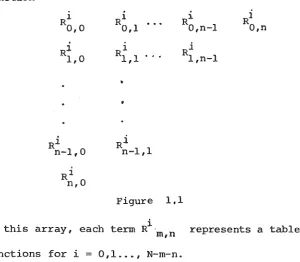
column horizontally. If (N+l) interpolating points are given, we could construct the following triangular array of the interpolating function
Rl Rl. Ri
0,1 O,n-1 O,n
1 Ri
[image:3.595.100.401.181.443.2]Rl,l l,n-1
Figure 1,1 i
In this array, each term R m,n represents a table of functions f o r i = 0,1 ..• , N-m-n.
This algorithm is more general than the algorithms suggested by Larkin [6]. With the normalization b = 1 Ri (x) is
0 ' m,n
expressed implicitly in the form
n . i
h
0 (x) R m,n (x)
i ~ .
'R (x).
1b.h.(x)+ m,n J= J J
m
.~
0
a .h. (x)]= J J
By using this algorithm, the coefficients of the inte:t;polating function can be determined easily. The interpolating value at a given point x=a can be found
( 1.2)
implicitly. However for computational convenience,.we could
transform the representation to a new basis
.h.
(x) = h. (x) - h. (a),J J J
Vj
>
0, so that h.(a)=
0, Vj>
0. In thts case interpolation JIn Section 2 the MNA algorithm [ 2]is reviewed. The extension
of this algorithm to generalized rational functions is given in
Section 3. In Section 4 we discuss how to overcome the problem
when the algorithm breaks down due to a zero divisor. Some
examples and numerical results are given in SectionS.
2 THE MNA ALGORITHM
We begin by reviewing the MNA algorithm [2] .
suppose we construct the polynomials
he e ( f ) i
=
n •.• n + k are the interpolating points.w r xi' i ~ ,
n
Then Pk(x) can be expressed as
0 -f -f k
n n+
n
g 0 (xn+k)
Pk (x) go (x) g 0 (xn)
gk (x) gk(xn) gk (xn+k)
D
Note: In this paper D is the minor obtained by eliminating the
first row and the first column of the determinant.
Now let gnk (x)be the ratio of determinants obtained replacing
I~
n
the first row in the numerator of Pk by
(-g. (x) -g. (x ) . . . -g. (x k))
J. J . n J.n+
n
i~k n
Note that gk . (x)
=
o, and gk . (x.)=
o, j n.~ .~ J ' 0 • • '
Then the MNA algorithm is the following
0 -f
n
n g
0 (x) go (xn) go (x)
P 0 (x) f
n
..
go (xn) go (xn)
-g. (x)
~ ·-g. ~ (x ) n
n go (x) go(xn) g. (x ) g 0 (x) - g i (x) ,. i.
go,i (x)
=
go (xn) ~ n go (xn)
For k
=
1,2 .•. and n=
0,1n+l n n · n+l
gk-l,k(x) Pk-l(x) - gk-l,k(x) Pk-l(x)
n+l n
gk-l,k(x) - gk-l,k(x)
n Pk-1 (x)
n+l gk-l,k(x)
6. n
Pk-l(x) g n (x)
--- k-l,k
6. n gk-1 (x)
n+l gk-1, i (x)
n+k.
=
1,2( 2. 2a)
n gk-l,i (x)
6. n
gk-1, i (x) n
gk-l,k (x) i k+l,k+2 ...
6. n gk-l,k(x)
and 6. is the forward difference on the.index n.
( 2. 2b)
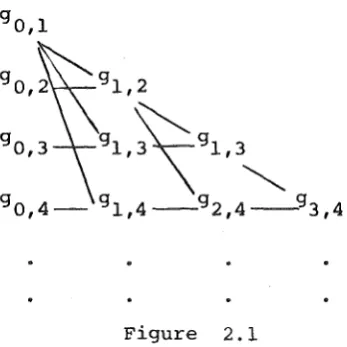
The way of computing gnk . (x) in [2] is equivalent to Aitken's
.~
...
pattern. With the initialization of gn
0 ,1. . (x) for a fixed value of
Figure 2.1
To show .the relationship to its generalization, this algorithm is essentially restated in a new notation.
For convenience, instead of using gnk . (x), we initialize
,J.
Note:
n
Vgl-k,k(x)
n Vgk,O(x)
n HgO,k (x)
is used. is used
We define Hg ~ k(x)
=
0 -J,to generate to generate
-gk (x) go (x)
n Pk (x)
n Pk(x)
k = 1,2 vertically. horizontally.
and Vg ~ k (x) = 0 when j ~ k . -J,
Fori= 2,3,4 ... , j = 0,1,2 • • o I and k = j+i.
(2 .3a)
n
Hg . k(x)
- ) ,
n n+l . · n+l n
Hg_(j+l) ,k(x) Vg_j,k-1 (x) - Hg_(j+l) ,k(x) Vg_j,k-1 (x)
n+l n
Vg . k 1 (x) - Vg . k l(x)
- ) '
-
- ) '-n
6
Hg_(j+l),k(x) nHg_
~+1)
,k (x) - Vg_j ,k-1 (x)n
6
Vg_j,k-l (x) [image:6.595.162.336.136.310.2]n Vg . k(x)
- ] ,
n . n+1 n+l n
Vg_j,k-1 (x) Hg_(j+l) ,k(x) - Vg_j,k-1 (x) Hg_(j+1) ,k(x)
n+l n ·
Hg_(j+l) ,k(x) - Hg_(j+l),k(x)
n b. Vg -J, -
~
k 1 (x) nVg_j ,k-1 (x) - - - Hg_(j+l) ,k (x)
where Hg ~ k(x) :
- ] ,
Vg n. k(x)'
- ] ,
-gk (x)
go(x)
9j+1 (x)
9k-1 (x)
-gk(x)
go(x)
gj+1 (x)
9k-1 (x)
-gk (x)
go(x)
9k-1 (x)
-gk (xn)
9o(xn)
9 j+l (xn)
9k-1 (xn)
9q(xn) (x )
9j.i-r n
.
gk-1 (xn)
-gk(xn)
9o(xn)
gj+l (xn)
9k-1 (xn)
9o(xn)
9 j+2(xn)
· 9k (xn)
-gk(xn)
9o(xn)
9k-l (xn)
-gk(xn+k-j-1)
9o<xn+k-j-1)
gj+l (xn+k-j -1)
9k-1 (xn+k-j-1)
9 o(xn+k-j-1)
gj+1 (xn+k-j-1)
.
9k-1 (xn+k-j-1)
-gk (xn+k- j-1 l
9o(xn+k-j-1)
9 j+l (xn+k-j-1)
9 (x . ) k-1 n+k-J-1
9o(xn+k-j-1)
9 j+2(xn+k-j-1)
.
.
gk(x k · 1) n+
-J--g (x ) 0 n+k-j-1
9o(xn+k-j-1)
.
9k-l (xn+k-j-1)
0
( 2. 3c)
( 2. 3d)
( .2. 3 e)
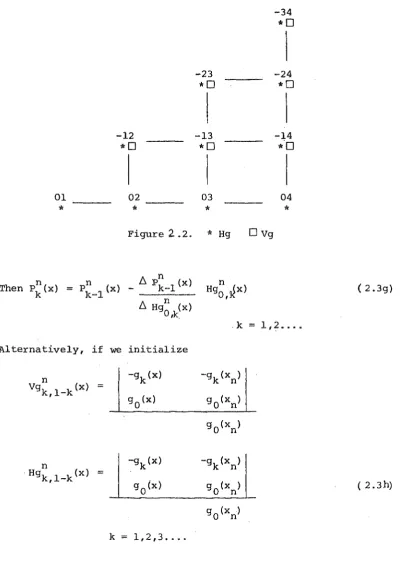
This is equivalent to Neville pattern and the way of computing can be shown by Figure 2. 2.
-34
*0
I
-23 -24
*0
*0
I
-12 -13 -14
*0
*0
.,. .. 0
I
I
01 02 03 04
[image:8.595.98.502.171.737.2]*
*
*
*
Figure 2 .2.
*
Hg0
VgThen Pk {x) n
=
Pk-1 (x) n-
/j,P~-1
(x) Hgn0
,.~x) ( 2. 3g)6
Hg~
(x),]<;.,
. k
=
1, 2 •••• Alternatively, i f we initializen -gk (x) -gk(xn)
Vgk, 1-k (x)
go (x) g 0 (xn) go(xn)
n -gk (x) -gk (xn)
· Hgk, 1-k (x)
go (x) go (xn) ( 2. 3h)
then by using (.2,3c,d) to compute Hgk . (x) and Vgk . (x)
, - ] , - ]
we have
n
~
Pk-1 (x) Vgn (x) k,O~
vg;,o
<x>
n
and Vgk,O(x) has the same form as (2.3f).
( 2. 3 i)
For linear interpolation, it is better to use the Aitken pattern rather than the Neville since it uses less storage and computation. But for the rational interpdation, Neville pattern is more effective and economical. The ratios of the differ~nces in ( 2. 2) and
(2.3b,c) are constant terms as shown in the following lemma.
LEMMA 1:
The ratio of the differences in
(2.3b)and
(2.3c)are
constants ( independent
of
x).Proof:
with the definition of Hg_(;+l) ,k(x) and Hg_;,k-l (x) in (2.3d,e) by using the Sylvester's identity and exchanging some
n
b. Hg_(j+1) ,k (x) =
n
b. Vg_j,k-1 (x)
9o (xn) 9 0 (x) 9 o1xn+l >
.
9o(xn+k-j-l) 9 j+2 (xn) gj+2(x) 9 · +2 (xn+l) • J . 9 j+2 (xn+k-j-1). .
.
.
.
. .
.
9k-1 (xn)
' . 9 k-1 (X) 9 k-1 (xn+1) • 9 k-1 (xn+k-j-1) 0 1 0 • • • 0
,9
0(x) 9 o1xn+l)
. .
.
.
.
9 o (xn+k-j)gj+2 (x) gj+2 (xn+1)
....
9 j+2 (xn+k-j). . . .
.
. .
.
. .
9 k-1 (x) 9 k-1 (xn+l) 9 k-1 (xn+k-j)
1 0
.
.
0...
0 1
'g 0 (x) 9 0 (xn+l)
9 j+2(x) 9k+2(xn+1)
0 • • • • 0
9 o<xn+k-j)
9 k+2 (xn+k-j)
...
9k-1 (x) 9 k-1 (xn+1)
1 0
-gk(x) -gk (xn+l) • • • -gk (xn+k-j)
9o<x> 9o(xn+l) . •
.
• 9o1xn+k-j) gj+2(x) 9 j+2 (xn+1) • • 9 j+2(xn+k-j)+
.
.
.
. .
.
.
. .
.
.
9 k-1 (x) 9 k-1 (xn+1)
.
9 k-1 (xn+k-j)g
0(x n > 90(x) 9 0 (ic ,. ) , n+l 9
(X • )
0 n+k-j-1
gj+2(xn) gj+2(x) 9j+2(xn+l)~gj+2(xn+k-j-1)
-gk-1 (x)-gk-1 (xn+1) • .-gk-1 (xn+k-j)
( ) ( ) • • g (x-1+k-j)
· 9 o x 9o xn+1 • 0
9 j+1 (x) gj+1 (xn+l) • ' 9 j+1 (xntk -j) +
1
f
-gk-~
(xn) -gk-1 (x) -gk-1 (xn+l) ' 9 k-l (xn+k-j-l)'l 9o(xn) g~(x) 9 o(xn+l) • • 9 o(xn+k-j-1) i...
~j~l ~x~) .g:+~ (~) .g~+~ ~~n~l~ ·~j~1~x~+~-j-1)
J/
9 k-2 (xn) 9 k-2 (x) 9 k-2 (xn+l) "9 k-2 (xn+k-j-1)
-gk(x) -gk(x ) ' · • n -gk~% n+ -J k .)
9 o(x) 9 o(xn) • ' • 9 o<xn+k-j)
gj+2 (x) 9 j+2 (xn) • 9 j+2 (xn+k-j)
1 0 • • • 0
9 j+1 (x) 9 j+l (xn) · ' 9 j+l (xn+k-j)
9o(x) 9o(Y. ) • • .go(x n n+ -] k .)
9j+2(x) 9j+2(xn) •• gj+2(xn+k-j)
9k l(x)-gk 1(x) ·-gk l(x k .) - - n - n+ -J
l 0 • • • 0
where j + 2 <k
LEMMA 2:
k-1 (xn)
9 o(xn)
9j+l (xn)
• • - gk(x k .) n+ -J
• 9 o (xn+k-j)
• • - 9 k l - (x n+. k .) -J
9 o(xn+k-j)
9 j+l (xn+k-j)
The ratios of the differences in
(2.3g)and
(2.3i)are
constants
Proof:
Similar to Lemma 1.=
constant
n [ .. n n ]
It is interesting to observe that gk-l,k(x) Vgk,O(x) 9 Hg0 ,k(x) . n
in the algorithm acts to increase the degree of Pk(x). The key
n [ n n
of this algorithm is to build up g .(x) Vg (x) Hg (x)] These k,l k,i , k,i
play an important role in the generalization ~o the rational interpolating function Ri (x) with Ri (x,) f.
m,n m,n J J
3 THE RATIONAL INTERPOLATION ALGORITHM
i
The interpolating rational function R m,n ( x) (. 1.1) may be expressed implicitly in the form (1.2). Then h i
0 (x) R m,n (x) can be expressed in the same form as ( 2.1) where f. is replaced
J by h
0 (xj).fj, j
=
i, i+l, ••. , i+m+n and gk (x) = ~ (x), k = 0,1, •.. ,m;gm+~(x)
=
h~(x)Ri
m,n(x),~
=
i,2, ... ,n.If we ass\.lllle gk(x) == xk7k = 0,1 ••. m, gm+Q,(x) = x.Q_f(x),_t:::;: 1,·2 . . . n,
i
then R (x) can be expressed as below
m,n (3.1).
(Clearly a minor notational change will suffice to handle the more general case when h
0(x) is not identically 1).
i
R (x)
m,n
0
1 X
m ·x
-f. l. 1
X,
1.
m
X.
1.
n
X. f. l. l.
.
.
.
.
.
'. . .
...
-f.
l.+m+n 1 xi+m+n
m X.
1.+m+n
X~ f. 1+m+n 1.+m+n
D
i
We can build up g (x) where m
=
1,2 ... for computing m-l,m( 3.1)
i i i
R
0(x), and g -" (x) where n = 1,2 ... for computing R0 (x) by
m, n-~,n ,n
using ( 2.2) which is based on Aitken's pattern, or build up
i i i i )
Vg
0 (x) for R 0 (x) and Hg0 (x)for R (X by using ( 2. 3) which is
m, m, ,n O,n
based on Neville pattern. Then by using the relation of Vgmi,O(x) (gi
1 (x)) and Hg0i (x) (gi (x)) we build up
Vgi (x) and Hgi (x) which is based on Neville's pattern for
m,n m,n
constructing Ri (x) either from the previous column or row. The m,n
following algorithm is based on the Neville pattern. 1. Initialization.
For m,n = 1,2, ... Nand fori
i
Vg
1 (x)
m, -m
i
Hgm, 1-m (x)
where go (xi,) = 1 m g (x.) X. m i
m l. l.
i Vg
1 -n,n (x)
i Hg
1 -n,n (x)
where gn (x.) x.f. n
l. l. l.
go(xi) 1 n =
0,1, ..• , N-1
~-gm
(x).I
go(x)-gm (x) go (x)
1,2 0,1
~-gn(x)
I
go (x)1-g (x)
I
g:
(x)1,2
...
-g (x.)
I
m l.I
go (xi~
-g (x.)
I
m l.go(xi) go(xi)
-g (x.)
I
n 1
I
go(xi) go(xi)
-g (x.) n l.
I
go (xi)l
go (xi)( 3 . .2a)
2 . For k
=
2 , 3, •.. , NForm= N, N-1, ..• ,k-N
set
n = k - mFori= 0,1, .•• ,N-k
i
Hg (x) m,n
i
Hgi
1 (x) - b:. Hgm-1 ,n (x) · Vgi 1 (x)
m- ,n
m,n-i
b:. Vg
1 (x)
m,n-( 3. 2c)
i Vg (x)
m,n
i = Vgi
1 (x) - b:. Vgm,n-1 (x) H i ( )
m,n- gm.,.l ,n x
i
b:. Hgm-1,n(x)
( 3. 2d)
3. For i =
o,
1, •.. ,N,define Ri0,0(x) = fi For n 1,2, ... ,N
For i Ri ( x)
O,n
· o,
1, . . . , N-n i.
tm
o,
n-1 { x) i = R1
0,n-1 (x} - i Hg O,n tx)
~Hg O,n ( x) Form= 1,2, ..• ,N
Fori= 0,1, .•• ,N-m
i ) i ('
R m, 0 ( x = R m-1, 0 x) -i
~R m-"-1 , 0 ( x) l. ·
i Vg m, 0 ( x)
~Vg
0 ( x) m, For m,n ~ 1,2, ... N
Fori= 0,1, •.. ,N-m-n
Ri (x) m,n
i b:. R i
1 (x) i Rm,n-1 (x) m,n- Hg (x)
i m,n
b:. Hg (x) m,n
( 3. 2e)
Ri (x) m,n
i b:. i (x) i
(x) R
R
-
m-l,n Vg (x)m-l,n
i m,n
'b. Vg (x)
m,n
( 3. 2f)
THEOREM 1
Equations ( 3. 2e) and ( 3. 2f) hold for m,n 0' l ' 2 . . . .
provided n
>
1 for ( ~ · 2e) and m>
l for (J.2f).Proof: To prove i
(3.2e), using the Sylvester's identity for the determinants, R (x) can be decomposed as the. following:
m,n
1
0 -f. l. 1 1
X xi
m m X x.
l. xf x.f.
l. l.
-f i+m+n
1
X~ J.+m+n
xi+m+nfi+m+n
n-1 n-1
xi fi • • xi+m+nfi+m+n
1
Ill
X.
l.
1
m xi+m+n
x? f J.+m+n i+m+n
.
,D
-f i+m+n-1
.
1xi+m+n-1
.
.
m xi+m+n-1
xi+m+n-1
1
X l\i
..;
..
1
x.f. l. l.
fi+m+n-1
1
n-1 . n-1
i
Hg (x) =
m,n
n -x f
X
m
X
xf 1
n -x. f.
1. 1. 1
n
.-x. l.+m+n-lf. 1+m+n-1 1
• xi+m+n-1
m m
xi ' • • xi+m+n-1 x.f.
1. 1. X. l.+m+n-lf. 1.+m+n-1
n-1 n-1 n-1
X f X, f. •• :X f
1 X,
1.
m :x;i x.f.
1. 1.
n-1
X. f.
1 1
• . 1 . 1
~ 1. 1.+m+n-
l.+m+n-.
.
.
.
. l• x.
l.+m+n-1
m
xi+m+n-1
x. J.+m+n-lf. 1+m+n-1
n-1
• • • X, lf, 1
1.+m+n-
1+m+n-( 3. 2g)
which is the second factor of the second term by shifting the last row to the first row and change the sign. The first factor of the
i
6. Rm,n-l(:x) s.econd term is in fact equal to
i
6. Hg (x)
In the same way as in lemma 1, it ·can be shown that
i /;;,. R
1 (x)
m,n-i /;;,. Hg (x)
m,n
-f. 1. 1
X.
1.
m X.
l. x.f.
l. l. .
.
n-1
x.
f.l. l.
n
-x.f. 1. l. 1
X.
l.
m
X. 1
x.£. l.
J.
n
x.f. 1. l.
"
..
-f. 1.+m+n 1 X.
1.+m+n
m
X.
J.+m+n
X. f,
l. +m+n 1. +m+n
n-1
x. f. 1.+m+n l.+m+n
n-1
-x. f.
J.+m+n l.+m+n 1
x.
J.+m+n
m
X.
1+m+n
X. f,
1+m+n J.+m+n
n-1
X. f.
J.+m+n J.+m+n which is a constant fanned by the interpolating set
{(x.,f.), j
=
i, ••• i+m+n}J J
To prove (3.2f), shift the mth row of the numerator in ( 3. 1 ) to the last row and the proof follows using the same method as above, where in this case .the second factor is defined
i
Where we define
i
Vg (x)
=
m,nn -x .f
l
X
m
X
xf
n-1
X f
n
-x. l. l. f. • ·• 1
.
.
.
. .
.
m x.
l.
x.f.
.
.
-J, l.
. .
.
n-1
X. f.
.
.
l. l.
n f
- xi+m+n-1 i+m+n-1
1
x. l.+m+n-1
.
m ,
X. l.+m+n-1
.
x. 1f. 1~ +m+n- l.
+m+n-. +m+n-. +m+n-.
.
n-1
~ x. 1f. 1
l.+m+n-
1.-~t'm+n-(3.2h)
Note: 1.
1 II p A o
X. l.
m-1
x.
l. x.f.
l. l.
n
x.f. l. l.
.
.
1• xi+m+n-1
m-1 xi+m+n-1
X i+m+n-1 1.+m f,
+
:r:t-1n
x. 1.+m+n -1 1. +m+n-f. 1
i i
The expressions for Hg (x) and Vg (x) have common
m,n m,n
numerators and the denominators have one row different. 2. The expressions for Hgi
1 (x) and Vgi 1(x) have
m- ,n .
m,n-the same denominators but m,n-the numerators have one row different.
THEOREM 2.
Equations (.3 .2c) and ( 3 .2.d) hold for all integers m,n
such that m + n
>
1 .COROLLARY 1.
The ratios of the differences in ( 3. 2c), \3. 2d), ( 3. 2e)
and ( 3. 2f) are constants (independent of x).
Proof:
i i}R ·
1(x)
m,n-Consider----~---
/:::, Hgi (x)
, - the ratio of the differences in
m,n
( 3.2e). From the proof of Theorem 1 i t is clear that the ratio
is a constant term ( independent of x ) . The proof for the other
ratios follows similar1y.
GOROLLARY 2 • i
Hg (x) =
m,n
Proof:
i
k., Vg (x)
1 m,n where k. 1
tiHl
(x)m-l,n i
Avg (x)
m,n-1
T})is follows immediately by combining ( 3. 2c) and { 3. 2d)
since the ratios of the differences are inverses and, by
Corollary !,constant.
COROLLARY 3 •
In the case h. (x)
=
J xj , the maximum degree3 ky of the terms
k
k i i i.x and x R (x) in Vg (x) and Hg (x) are
m,n m,n m,n m and n
respectivel-y.
Proof:
From the initialization ( 3.2a,b) i t is clear that the degree
of
f
in Vgi (x) = Hgi1 (x) is m and the degree, k, of
m,l-m m, -m ·
k i . i
x R in vg
1 -n,n (x) = Hg. -n,n 1 (x) is n. By induction using k
(3.2c,d) and Corollary 1, the maximum degree of x in
i i k
Vg (x) and Hg (x) is at most m.Similarly for x R
i i+l
COROLLARY 4.
If
Hg (x)=
Hg (x),then
k. = k. l(where
k1,
,has
m,n m,n l. 1.+
b
een
d ef~ned .in Corollary 2) and
Vg i (x)=
Vg i+l (x).m,n m,n
Proof:
Since Hgi (x) = Hgi+l(x)m,n m,n
i i+l i+l i
Hg
1 (x)Vg 1(x) - Hg 1 (x)Vg 1(x)
m- ,n m,n- m- ,n
m,n-i+l i
Vg .l (x) - Vg
1 (x)
m,n-
m,n-=
Hgi+l (x)Vgi+2 (x) - H i+2 (x)V i+l (x) m-l,n . m,n-1 gm-l,n gm,n-1
. +2 i+l
Vg1 (x) - Vg
1(x)
m,n-1
m,n-i+l i+l
By cross multiplying and inserting- Vg
1(x)Hg 1 (x)
m,n- m- ,n
in both sides, i t follows
. '+l '+1 .
~
Hg11
(x)~
Vg1
1(x)
=
~
Hg1
1
(x)~
Vg1
1(x).
m- ,n m,n- m- ,n
m,n-i Hence k
=·
k and by Corollary 2 i t follows Vg (x)i i+l m,n
i+l Vg (x).
·m,n
Note. All these results follow in similar way for the general case k
when x.
l.
k
is replaced by h (xJ..) and x.f. replaced by h (x.)f .. -k l. l. "1< l. l.
4, THE SINGULAR CASE
These algorithms may break down if the adjacent terms are equal.
. i+l i
For examp.J_e ~ Hgm1,n-l (x) is zero i f Hg
1 (x) = Hg 1 (x).
m,n-
m,n-i+l i
Then since Vg .
1(x) = Vg 1(x) from Corollary 4, i t follows
m,n-
m,n-i
Hg (x) = 00
m,n
i
and Vgm+l,n-l (x)
i
In the case noted above, the indeterminancy of Hgm,n (x)
j
implies that
h
Hg (x) and hence m,nj
Hg (x) for j
=
i-l,i m+l,ncannot be computed. This difficulty may be overcome by jumping two steps. Instead of ( 3. 2c) it can be shown
i i-1 , i-1
Hg
1 (x) Hgm,n (x)
- 6
g.Vgm+l,n-'l (x)mt· ,n
i i+l
- /J.g. Vg i+l
Hg (x) Hg (x) (x)
m+l,n m,n m+l,n-1
where if m
=
N,N-l, ... k-n and m+n=
kwhere i-1
Hg +l m ,n (x) Hg
i-l
(x) m,n1\ i-1
w Hg (x)
- m,n
6 i-1
Vg m+ 1 ,n-l(x)
( 6 Hgi
1 (x)
i-1
Vgm+l,n-1 (x)
m- ,n
I _
___:m:.:.:.-_; , n= Vg!,n-l (x)\
6
Vg!,n-l(x)6. Hgi-11 (x))
A i-1
, w Hg (x)
6
Vgm,n-1 (x) i-1( 4. la)
( 4.lb)
b. · m,n
g : J.-' 1
6. Vg .1 l(x)
m+
,n-
Hgi m,n-l(x)(6
Vgi+l m ,n-2(x) 6vg m+i-l
1 ,n-2(x)\
,
f>g
If Vgi · 1 (x)
m,n-6 Hgi
l
(x) m- ,n6. Vg i·
1 2 (x) m+
,n-. 6 Hgi (x)
m,n-1 8 Hgi-1 1 (x) m,n- )
Hgi
1(x) for all i. Then
m,n-6 Vg i-1 - 6 Hgi-] (x) 1 (x)
m,n- m-l,n
6 Hg i-1 . 6 Vgi-l (x) 1 (x)
-m,n- m+l.,n-2
6 Vgm,n-1 (x) i 6. Hg i
1 (x) m,n-When 6. Hgi
1(x) = 6. Vgi 1(x)
m,n- m,n- 0, the above form can be reduced to
A i-1 w Hg (x)
m,n 6. i-1
· Vgm+1 ,n-1 (x)
i 6 Hg
1 (x)
m- ,n i
By the same method it can be shown
!J. Hgi 1 (x) m- ,n
( 4. 2a)
[), v
9i ( )m+l,n-2 x
This applies to the case when the singularity occurs at the first step. i.e. k Q 2, otherwise more work is required to derive !J.g
=
i
!J. Hg (x)
m,n
!J. Vg i 1 1 ( x)
m+ ,n-i
!J. Hg (x)
m,n
=
[), Vg i 1 1 ( ) X
m+
,n-!J. Hgm-l,n(x) i+l
•
·as follows:
i+l Vg
1(x)
m,n-H it1. (x) 9m,n-l
!J. Vgi (x)
m,n-1 - !J. i
( x) !J. i+l
Hgm-l,n Vg m,n-1 (x)
!J. Vg i+1 1 2(x) !J. Hgm,n-1 (x) i - !J. Vgm+1,n-2(x) i !J. Hg i+1 l ( ) X
m+ ,n-
m,n-!J. Hgi (x)
m,n-1
i
!J. Vgm,n-1 (x)
!J. H 9i+l (x) m,n-1
A i+l
u Vgm,n-1 (x)
where !J.
Hg~,n-1
(x) !J. H i+1 9m,n-l (x)X
i+1 Vg
1 (x)
m,n-!J. Vgi 1 (x) !J.
m,n-( !J.
Hgm~1,n-1
(x) !J. Hgm-1,n-l (x) i+1vi:+l
(x) !J. Vg i2
(x)m,n-2 m,n- !J. V i+1 9m,n""'2 (x)
- i+l i
Hgm-1,n-l (x)(:
Vg~,n-2(x)
!J. V 9m,n-2 i+l (x) )V i+2 (x) 9m,n-2
Hgm-1,n-l (x) . i+2 (
Hgm-1 ,n-1 (x) !J. Hgm-1,n-1 (x) i+l
!J. Hgi+1 (x) !J. Hgi+2 (x)) m-1,n-1 - m-1,n-l
!J. Vgi+1 (x) !J. Vgi+2 2(x)
m,n-2
m,n-i+1 i+2
!J. Vg m,n-2 (x) !J. Vg m,n-2 (x) )
i+l i+2
i+l i+2 6. i . Vg
2 (x) Vg 2 (x) Hgm-1,n-1 (x)
m,n-
m,n-. i+l i+2 6. i
Hgm-1,n-1 (x) Hgm-1,n-1 (x) Vg m,n-2(x)
m-1,n-1
(6.
Hgi+1 (x))2l
6. V i+1 (x) gm,n-26. i+2 ( ) Hgm-1,n-1 x
i+2
6. Vgm-1,n-2(x)
I£6. Vgm,n-1 (x) i i
6. Hg (x) m,n i
6. Vgm+1,n-1 (x)
i+1 Vg
2 (x) m,n-i+l
Hgm-1,n-1 (x)
6. Hgm,n-1 (x) i 0, then
6. Vgm,n-2 (x) i+l 6. Hg i 1 (x) m- ,n 6. Hgm-1,n-1 (x) i+l 6. Vgm+1,n-2(x) i
i+2 Vg
2 (x)
m,n-i
6. Hgm-1,n-1 (x) i+2
Hgm-1,n-1 (x) 6.v/ m,n-2(x)
(
:
Hg~~~,n-1
(x))2
i+l Vg
2 (x)
m,n-i+2
6. Hgm-1,n-1 (x) 6. Vg i+2 ( )
2 X
m,n-6. 6.
After the terms rearrangment, these can b~ expressed as
6.g = -6.1 .6.2 .6.3 where Vgi+1 (x)
6.1
=
m,n-2 6. Vg!+1 n-2(x)'
,
i+l Vg
1 (x) m,n-i+l Hgm,n-1 (x)
( 4. 2b)
i
6. i 6. i+l
!:::,. Hg. 1 (x) Hgm-1,n-1 (x) Hgm-1,n-1 (x)
6.2 =. m- ,n
i+1 i i+l
Hgm-1,n-1 (x) !:::,. Vg
2 (x) 6 Vgm,n-2(x)
m,n-6.
v
i+1 (x) V i+2 (x) !:::,. i+29m,n-1 gm,n-2 Hgm-1,n-1 (x)
6.3
=
'+2·•
i+l 6. i+2 (x)and by the same method,
where
A
i-1
u Vgm,n-1 (x)
i
Hgm-l,n-1 (x)
if k = 3,4, ••• N
i-Vg
2 (x) m,n-i-1 6 Hgm,n-l(x)
( 4.2c)
i-1
6
Hgm-l,n-1 (x) i-16vg
2(x)
m,n-The computation of Vgj (x)
m+l,n 1 j
=
i - l , i may be Similarly accomplished by replacing ( 3.2d)by formulas analogous to (4.1) withI I
the terms 6g and
6g
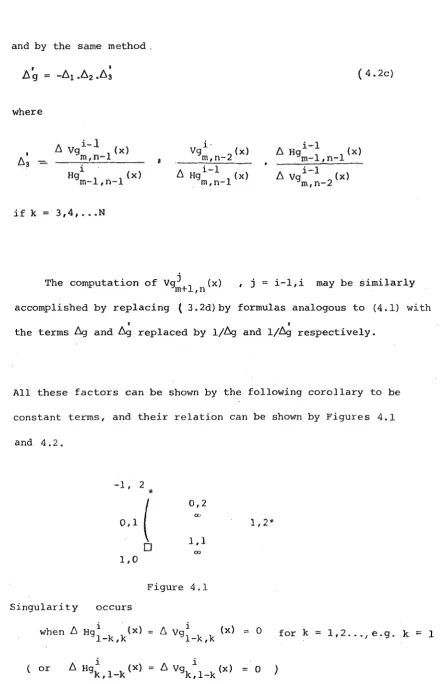
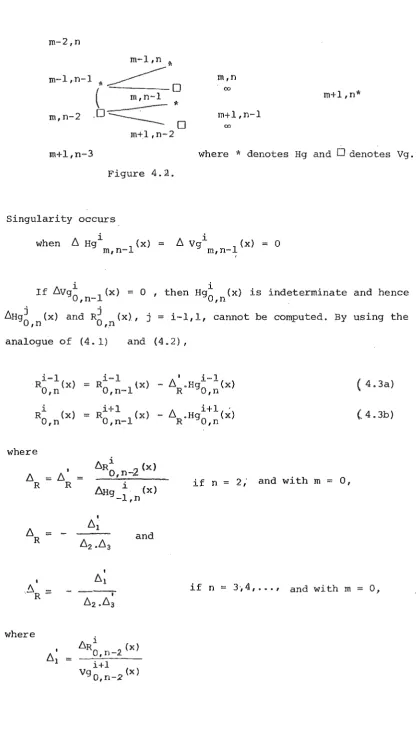
replaced by l/6g and l/6g respectively.All these factors can be shown by the following corollary to be constant terms, and their relation can be shown by Figures 4.1 and 4.2.
-1, 2
*
(
0,2 ro0,1 1,2*
1,1
0 (X)
1,0
Figure 4.1 Singularity occurs
when 6 i . (x} !3. i (x} 0
Hgl-k,k = Vgl-k,k == for k 1,2 ... , e.g. k-= 1
6 i
[image:24.595.68.509.69.754.2]m-2,n
m-l,n
*
m-l,n-1
*~
(
- - - - 0 m,n-1 *
0~
m, n-2 ·
-0
m+l,n-2
m,n
00
m+l,n* m+l,n-1
00
m+l,n-3 where
*
denotes Hg and 0 denotes Vg. Figure 4.2.Singularity occurs when 6 Hgi
1(x)
m,n- 6 Vgi m,n-, 1(x)
=
0If 6vg;,n-l (x)
=
0 , then Hg;,n(x) is indeterminate and hence 6Hg0j ,n (x) and R0j ,,n (x), j
=
i-1,1, cannot be computed. By using the analogue of (4. 1) and (4. 2) ,i-1 R
0 ,n (x)
i R
0 ,n (x) where
6
=
R6 = R
I
./:). . R -
-where 6
I 61
'
Ri-1 I i-1
RO,n-1 (x) - 6 R.HgO,n(x)
i+l i+l .
= RO,n-1 (x) - 6 R.Hgo,n(x)
6R;,n_2 (x)
=
6Hg i (x) -l,n
if n 2,· and with m 0,
I
61
62 .63 and
I 61
if n 3~4, ... , and with m
/:; i
RO,n-l(x) i+l VgO,n-2 (x)
( 4. 3a)
( 4. 3b)
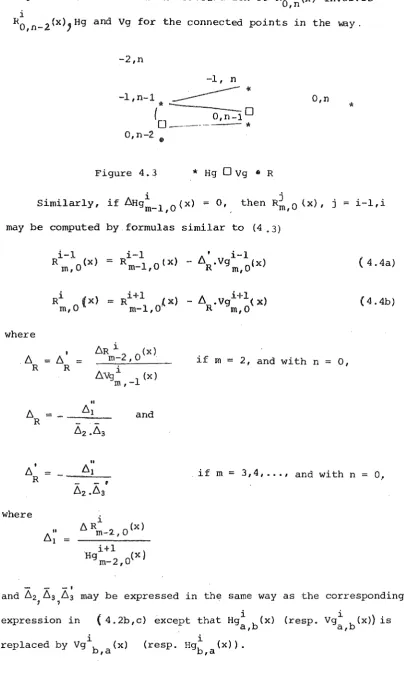
[image:25.595.63.484.78.816.2]Figure 4. 3 shows how the calculation of R 0
i (x) involves ,n
i
RO,n-l(x),Hg and Vg for the connected points in the way.
-2,n
-1, n
- - - .j(
-1, n-1
____.--(* - - - o
O,n-1D - e - - · - - *
O,n
*
0, n-2.
[image:26.595.69.483.120.795.2]0
Figure 4.3
*
Hg 0 Vg • R jthen Rm,O (x), j
=
i-l,i may be computed by formulas similar to (4 .3)i-1
i-1 I i-1( 4. 4a) R
0(x)
=
Rm-l,O(x) flR.Vg (x)m, m,O
Ri (x) = Ri+l ~ x)
-
fl .Vgi+l(x) (4.4b)rn,O rn-1,0 R rn,O
where
•
flR;_2,0 (x) .fl fl =R R i
fl.Vgm '-1 (x)
if m = 2, and with n
=
o,
II
fl
--
.6.1 and R/j,2 ·/j,3
I II
/j,
=
.6.1R - u
~2 ·/j,3
if m 3,4, ... , and with n
o,
where
-
-
-'
and /j,2 .6.3 /j,3 may be expressed in the same way as the corresponding
1 '
i
expression in ( 4. 2b, c) except that Hg b (x) a,
i i
replaced by Vg b ,a (x) (resp. Hgb ,a (x)).
Figure 4.4 shows how the calculation of R i
0{x) involves m,
i
Rm- 2 , 0 (x), Hg and Vg for the connected points in the way .
•
m-2 I . 0 'lr'~----o
m-1,~ .,. m-1, -1 0 - - - - ·
---
0
m, -1 m,-2Figure4.4
In fact the above expressions ( 4. 3) and
·m,o
( 4. 4) can be
i
generalized to computeR (x) for m,n = 1,2,3 ... where some of m,n
i i
R (x) do not exist. But in this case R (x) may be generated
m,n m,n
either 'horizontally' or 'vertically' (3.2e,f). If the calculation is blocked one way then i t is possible to continue in the other way. Thus the situation is simpler than (4.3) and (4. 4)
This approach was motivated by the method used by Wynn [11] to deal with the singular cases.
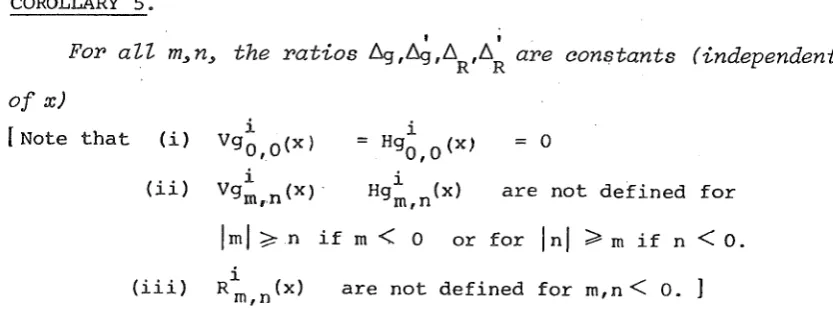
COROLLARY 5.
I I
For all
m~n~the ratios
~'~'~R'~Rare
con~tants(independent
of x)
[Note that {i) vgo,o<xl i Hgo,o<x> i
=
0i i
Vgm,n {x). Hg (x) m,n
(ii) are not defined for
[image:27.595.78.471.192.444.2] [image:27.595.61.478.570.725.2]Proof:
(4.2b)
Only the first ratio ( i.e.
i
b. Hgm-l,n(x)
i+l
Hgm-l,n-1 (x)
)
in offor m and n ~ 0 is proved . The others· follow in a similar way.
From ( 3.2g,h),
i
b. Hg
1 (x) m- ,n i+l Hgm-l,n-l(x) -xn! 1 X m-1 X xf n-1 )( f
-xn f i+1 1-+1.
l. xi+1 m-1 xi+1 xi+lfi+l
. .
.
n-1xi+1fi+1
. .
0i+1 m-1,n
-x~ f.
l.+m+n-1 J+m+n-1
• q 1
xi~~+n-1
m-1 xi+m+n-1
n-1
xi+m+n-1fi+m+n-1
n-1 n-1
-x f -xi+l fi+1
1 1
X
xi+1
m-1 m-1
X
xi+1
.
.
xf xi+lfi+l
.
n-2
X f xi+lfi+l n-2
..
• 0it1 m-1,n-1 1 xi. .
.
i m-1·
where 0
m-l,n X, l. •
I
xi fi ,-.
.
n-1
x. f. I'
l. ~
.
'
.
.
1 1
X
m-1 m-1
x xi
n-1 n-1
x fx. f .• l. l.
n-1 .n-1
-x~ f. l.+m+n-2 l+m+n-2
1 m-1 xi+tn+n-2 xi+m+n-2fi+m+n-2 n-1 ·xi+m+n-2fi+mtn-2
-x i+m+n-·2t i+tn+n ·2
1
x i+m+n-2
.
m-1 xi+m+n··2
xi+m-l-n-2f i +m+n-2
.
n-2
xi+m~n-2f i+mtn-2
1 xi+m+n-2
.
.
m-1 xi+m+n-2 xi+m+n-2f itm+n-2.
In-1
By applying Sylvester's identity to the determinants and exchanging
some rows or columns, then
- x~f. ~ l.
1 X. l ni-l X. J. x.f.
l. J.
n
-x f -xi+1 fi+l . n
1 1
X xi+1
m-1 m-1
x xi+l
xf xi+1 fi+1
n · - xi+m+n-1
·
..
1xi+m+n-1 m-1 xi+m+n-1 xi+m+n-1fitm+n-1 1 X m-1 X xf 1 x. l.
X. f,
J. l.
1 m-1 xi+m+n-2 · m-1 xi+m+n-2 x itm+n-2f'i+m+n-2 i+1 n-1 xi+m+n-1fitm+n-1
.. · · · · 0rn-l,n-l
0 1 0
.
.
0Di
m-1,n 1
X·
m-1
X
X f
n-1
X f
n-1
• x. J.tm+n-2f. ~+m+n-L ~I
1 1
m-1
x. xitn.tn-2
J.
m-1 m-1
x. xi+m+n-2
J.
x: f.
~ l. · xi+m+n-2f i+tn+n-2
.
n-1
xi fi. xi+m+n-2fi+m+n-2 n-1
After eliminating terms this is easily seen to be a constant term.
Using (2.3d,e) and the same method i t is straightforward to
extend the result to the cases m<o or n<o.
S.NUMERICAL RESULTS
It is obvious that when x
=
0, this algorithm reduces to thegeneral rational extrapolation. since the interpolating functions
which are generated by this algorithm have the implicit form
interpolating function value at a given point, especially when done by the computer. But if thls point x
=
a is transformed tox'= 0 and the interpolation algotithm· is used, the arithmetic is substantially simplified.
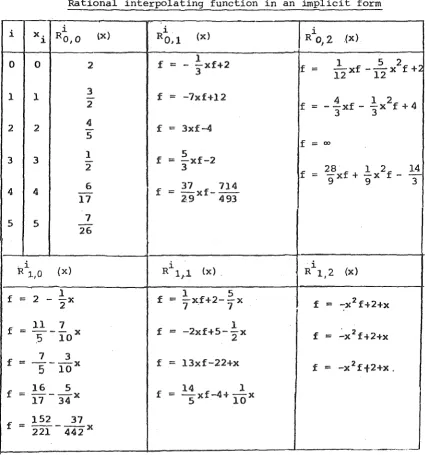
Example 1.
The same example is used as in [4].
Table 5.1
Rational interpolating function in an implicit form
i X. Ro, i
o
{X) i iRo,1 (x) Ro2 .(x)
l. I
0 0 2 f
=
-
3
1 xf+2 f = - x f - - x f+.( 1 5 2 12 121 1 3 f
=
-7xf+l2 4 1 22 f = - - x f - -x f + 4
3 3
2 2
-
4 f <= 3xf-4 5f ::: 00
1
f 5
3 3
-
=
-xf-22 3 28 1 2 14
f = -xf + -x f -
-6 37 714 9 9 3
4 4 f
=
2·9 xf- 493 17
5 5
-
726
. i
(x) Ri (x) . i (x)
R 1,0 1,1 R 1,2
f
=
2 - 2x 1 f=
1 -xf+2--x 5 f -x2f+2+x
7 ' 7
=
f
=
- - - X 11 7 f=
-2xf+5--x 1 f ' 215
10 2=
-x f+2+xf
=
- - - x 7 3 f :::: 13xf-22+xf -:x2ft2+x.
5
10 =f = l7-34x 16 5 f
=
Sxf-4+ 14 lOX 1____ _j
[image:30.597.84.510.316.771.2](continued.) i
R 2,0 ('x )
i
R 2,1 ( x)
i
R 2,2 (x)
2 1 2 1 . 3 x2
-x2f+2+x f
=
2 - - x - - x f=
-xf-+2 - - x + - f =.5 10 2 2 4.
13 13 1 2 f 7 5 x2 f == -x2
f+2+x f = - - - x +~
=
xf+4 x +-5 10 6 6 12
33 7 X 2
158
58
X 13 2 f =--x£+17--x+-f ==
85
85 + 170 X 4 4 8292 163 7 2
f
=
- - -
221 442 X + 221 X.where f is the rational approximation
These results are exactly the same as those obtained explicitly in [ 4] .
i i
The terms Hg (x) and Vg (x) for the construction or the
m,n m,n
table 5.2
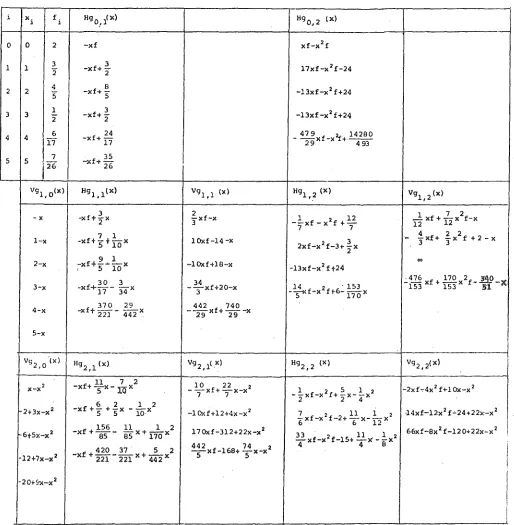
i X. l f. HgO! l(X) Hg0,2 (X)
l
0 0 2 -xf xf-x2f
1 1 2 3 -xf+ ~ l7xf-x2f-24
2
2 2 4 5 -xf+ ~ -13xf-x2 f+24
5
3 3 2 1 -xf+.:!. -13xf -x2 f+24
2
4 4 6 -xf+ 24 479 f 2t 142aO
17 17 - 29x -x +493
5 5 7 35
126 ~f+ 26
Vg1,0(X) Hsl,1(x) Vg1,l (x) Hgl ,2 (x) Vg1,2 (x)
-x -xf+~x 3.xt -x
-~xf-x2f +12 1 7 2
2 3 I2 xf + 12 x f-x
7 7
1-x -xf+ Z. t .?:._x lOxf-14 -x
2xf-x2f-3t-~x
·-
!xf+ 3.x2
f +2 -x
5 10 3 3
2
2-x -xf+2~.?:.._x -10xf+la-x "'
I 5 10 -l3xf-x
2
ft24
-xf+~- ~x -.:!!xf+20-x
.:.476 t+ 110 2£.£19-x
3-x -~=i1<f-x2ft6~ ~x 153 X 153 X .51
17 34 3 5 170
4-x -xft 370- 29 -~xf+ 740 -x
221 442 X 29 29
5-x
Vg2,0'(x) Hg2,1 (x) Vg2,1< .x) Hg2,2 (X) Vg
212(xl
2 11 7 2
-10 xf+ ~x-x2
x.,-x -xf+ 5 x-10x
-~ l<f -X 2 f + ~X-!_X 2 -2xf-c4x
2
ft-10x-x2
7 7
-xf+.§_ +lx -l....x 2
2 2 4
2+3x-x2
5 5 10· -1 Ox f+l2+4x -x2
lxf-x 2 f-2+ ~x-.!___ x2 J4xf-12x
2f~24+22x-x2
-xf + 156 _ 11 1 2 6 6 12
I
6t5x-x2 as x+ 170 x 17 Oxf-312+22x-x
2
~xf-x2f-15+ ~X'-!.x2 66xf-8x
2f-120~22x-x2
I
as
442
xf-16a+ 74 x-x2 4 4 8
I
420 37 5 2
-12+7x-x2 -xf +m-221 X+ 442 X 5 5
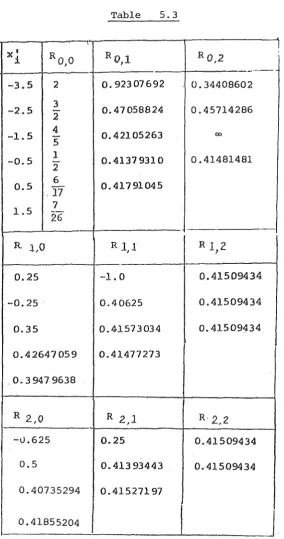
[image:32.596.51.565.161.686.2]Numerical rational interpolation at x == 3.5, computed by transforming x = 3.5 to x'
=
0.Table 5.3
x'
Roo
Ro 1 R 0 2!
i I I I
~-·--3.5 2
o.
923 07 692 0.34408602 -2.5 3 0.47058824 0. 457142862
-1.5
-
4 0.42105263 005
-0.5
-
1 0.41379310 0.41481481 20.5 6 0.41791045 . 17
1.5 7
26
R l,O RJl I R 1 2
'
0.25 -1.0 0.41509434
-o.
25 · 0.4-0625 0.415094 340. 35 0.41573034 0. 41509434
0. 42647 059 0.41477273 . 0. 3 947 9638
R 2 0 I R 2 1 , R· 2,2
-0.625 0.25 0. 41509434
0.5 0.413 93443 0.41509434
0.40735294 0.41527197
0.41855204
[image:33.595.114.399.158.698.2]Example 2. 2
Since Hg O, l (x)
Hg~'
1 (x), singularity occurs at Vgl,l (x) and 2Hg~
12
(x).
The approximationR~,l
(x) does not exist, but by using the rules of section 3 the algorithm .can continue to calculate higher order rational approxima~ions.Table 5.4
i X. f. HgO,l (x) Hg0,2(x)
~ l.
0 0.5 2 -xf+l 23 2 9
10xf-x f-5
1 2 3 -xf+6
xf-x2f+6
2 4 o.s -xf+2
"'
3 1 2 -xf+2 4xf-x2f+6
4 3 2 -xf+6
Vgl,O(x) Hgl,l (x) Vgl,l (x) Hgl,2(x) Vgl, 2 (X)
0. 5-x -xi- 3+ Tx 2 10 lOX 3 f +0.2-X 87 2 51 3 9 87 24 2 51
48 xf-x ·f-24 + 24x 78 xf- 39x f-t 39 -x
2-x -xf+l0-2x - ~xf+S-x
2 2xf-x2f-4+2x xf -0. 5x < f-2 tx
'
4-x -xf+2 00
3xf-x2 f-6+2x 3 1 ~
2xt-2x. f-3+x
1-:x -xf+2x ~xf-x
2
3-x
[image:34.595.61.483.242.583.2]i i
R (x) can be computed either from R
1 (x)
m,n m- ,n
i orR
1(x)
m,n-Table .5.5
i X, Ro,o(x) R0,1 (x) RO, 2 (x)
l
0 0.5 2 1 9
f 99 17 " 63.
f
=
- x f +-
= 104 xf- 52 xLf+
52
5 5
l 2 3 5 6
f 7 . 1 2 3
f
=
-xf ---" == - x f - - xf+-8 8 8 4 4
2 4 0.5
'1 2 1
00
f == xf--x
f+-1 2 4 2
3
f
=
24 3 2
Rl,O(x) Rl,l (x) Rl,2(x)
5 2
f 23 61 51 5 1 r 25 2
f
=
-+ -X=
- x f + - - - x f=
- x f + - x L f + - - - x3 ·3 64 32 96 24 12 12 3
11 5 3 7 l 5 1 2 5 l
f
=
- -
2 4x f = -xf+ 4-2x f=
- x f - - x f + - - - x8 8 8 4
4
5 1 1 1
f =
-
-
2x f = 4xf+2-
2x2 f = 2
Example 3.
i ' In this example f (x
2). == 0 and hence RO, 1 (x) , i == l, 2 and
R~
2(x), i=
0,1,2 do not have an explicit form. In addition'
Hg~
1
(x)
=Hg~
(x) andVg~,l(x)= Vg
1
~
1
(x) which lead to singularities0 0 0
·at Vg
211(x) and Hg112(x). Hence l).,l (x) does not exist. Note that the algorithm continues to calcul·ate higher order interpolations
[image:35.595.88.515.166.546.2]Table 5.6
i xi fi Hg0,1(x) Hg0,2 (x)
0 1 4 -xf+4 -x2!+4
1 2 1 -xf+2 2xf -x 2 f
2 3 0 -xf 4xf-x2f
3 4 1 -xf+4 _17 xf+x2f- 20
3 3
4 5 2 -xf+lO
Vg1 ,0 (x) Hgl,1(x) Vg1,1 (x) Hg (x) Vg (x)
1,2 1,2
·1-x -xf+6-2x -2 1 xf+3-x ClO -~xf+-3-x
2
1 1 0 x f -x 2 f -8 + ~ x - ~xft ~x2f+3-x
2-x -xf+6-2x - 2xft3-x 3 3 . 4 8
3-x -xf-12+4x !xf+3-x
9xf-x2f+60-2x ~xf-
.J:.
x2tt3-x4 20 20
4-x -xf-20+6x ~xtt6 103 -x
5-x
vg2 , 0 cx> Hg2,1 (x) Vg2,1 (x) Hg2,2 (x) Vg2 ,2 (x)
4xf-x2f-24+14x-2x2 ' 1 2 2
-2t3x-x2 -xf+6-2x "' 2xf- 2x f-l2+7x.ox
-6+5x-x2 -xf+24-17x+3x 2 !.xf-8+ 17 -x 2
!xf -x 2f+60- 91.x+ 17 x2 1 2 2 12 0 91 2
3 3 2 2 2 -17xH17x f-17t 17x-x
l2t7x-x2 -xf -3x+x 3
·xft3x·-x2
[image:36.595.72.539.179.544.2]i x. R (X)
l. o,o
0 1 4
1 2 1
2 3 0
3 4 1
4 5 2
R
1, 0 tx)
'
f
=
7-3xf
=
3-xf = -3+x
f
=
-3+xR. 2 o(x)
,
f
=
9-6x+x2f
=
9-6x+x2f
=
-3+xTable 5.7
RO 1 (X)
'
3 f
=
-2+ -xf2
f
= -
1 xf 2 f s:; - x f 14
f ;::: - +- xf 1 1 3. 6
R 1,1 (x}
00
f
=
-3+xR2,l(x) f
=
9-6x;-x21 5 1 2
f = -xf-3+ -x- -x
2 2 2
R o 2'(x)
'
3 1 2
f = -::-xf- -x f 2 2 3 1 2
f = -'Xf- -x f
4 8
f
=
- x f - 20 )( f 9 1 2 20R 1 2 {X)
'
1 2
f
=
2xf- -x f-3+x 2f 9 1 2 9 '3
=
17
xf-~ f+
17-
17
xR2,2 (x)
f
=
-::?<f- -x 4 1 2 f+ -39 -4x+ -x 5 27 7 7 7
[image:37.595.86.488.205.693.2]Example 4.
If x. is considered for i
=
0,1,2,3 in.Example 1, the1
interpolating functions ·may be expressed explicitly. Then
0 4-x
R
2,1 (x)
= --
2- for the sequence offunctions which can be expressed as continued fractions. Note that
x2 = 2 is considered as an 'unattainable point' of R0
1 (x} (see [ 10] )·. 2,
If the method suggested in [3] which reorders·the
points so that the 'unattainable points' appear at the end of the
list is used, then
4-x
2 and
0
Rl,l (x) 14-Sx 7-x
In this case x
3
=
3 is considered an unattainable point and thealgorithm terminates.
With the algorithm described in this chapter, all possible
forms of the .interpolating function may be computed and decided
which is most suitable. Even when more points are added, the
interpolation procedure may still be continued without reordering
the points and higher order functions may be obtained. For example
if f (4)
= .
6 · 0 2+x17 1s added, then R2 , 2 (x)= l+x~ ( see Example 1)
2.
Alternatively suppose f(4) = 1 is added, then RO (x) 96 - 62 x+llx
2, 2 48-22x+4x z
Both of these functions interpolate f(x) at all the points x.
1
i = 0,1,2,3,4 despite the existence of unattainable points for
Example 5. (Example 3 in l3]).
If f is infinite at one of the interpalation points, It can be replaced by a parameter a, in the computation.
Suppose f(O) = l, f(l) ~ ·o, f(2) = ro Then
Table 5.8
i X. l f. l Hgo 1 (x)
~
0 0 1 -xf
1 1 0 -xf
2 2
a
'""xf+2aI
Vgl,O (x) Hgl,l (x)-X -xf
·1-x -xf-2a (1-x) 2..;·X
The rational interpolants are
i Rl,
0
0 f
1 f
0 Hence R
1, 1 (x) =
= (X) 1-x
-a (1-x)
1-x 1 1 1--x- -x
2 2a
R1,1(x)
f = - - xf+1-x 1+a 2a
0 l
setting
-a 0, .It is noted that_ R · ( ) 1,1 X
interpolates the data.
I
·-·
1- X 1 -
-k
2
[image:39.595.114.331.221.492.2]6 CONCLUSION
An algorithm for the recursive calculation of the interpolating
rational function has been given. The algorithm has been constructed
in a general form to allow for the expression of the rational function
in any suitable basis subject to the Chebyshe~ condition being
satisfied. The algorithm is given a form which lends itself to
generalization.
The way of constructing the coefficients of the interpolating
function by this algorithm is quite easy,
e.g.~
(x) is:obtainedm,n
i i
either from Rm-l,n (x) by adding- a multiple of Vgm,n (x) or from
i .
R
1(x) by add{ng a multiple of Hg
1
(x). These multiples .in
m,n- ' m,n
fact are the constant ratios of the differences of the adjacent
terms of Vgmi n(x) or Hgi (xJ even in the singular cases.
, m,n
It has been shown that an isolated singularit~ may be avoided by
'jumping over' those situations where a rational interpolating
fun~tion does not exist without the necessity of restarting the calculation for a different ordering of the interpolating points.
The evaluation of the rational interpolating approximation at
a particular point x
=
a is more efficiently accomplished by atransformation.
The general extrapolation algorithm has been derived
independently in [ 4] ,[ 5] ,[8] ,[9] . The MNA algorithm is quite
similar to the algorithm in [8]. The algorithm for rational
extrapolation in [ 8] computes the numerator and denominator
separately. The algorithm in this paper computes the rational
REFERENCES
1. C. BREZINSKI, A general extrapolation Algorithm,
Numer. Math.
35, (1980), 175~187.2.
c.
BREZINSKI, The Muhlbach-Neville-Aitken Algorithm and some some extensions, B.I.T. 20, (1980), 444-451.3. P. R. GRAVES-MORRIS and T. R. HOPKINS, Reliable Rational Interpolation,
Numer. Math.
36, (1981), 111-128.4. T. HAVIE, Generalized Neville type extrapolation schemes.
B.I.T. 19, (1979) I 204-213.
5. T. HAVIE, Remarks on a unified theory for classical and generalized interpolation and extrapolation,
B.I.T. 21, (1981) 465-474.
6. F. M. LARKIN, Some techniques for rational interpolation,
Computer J. 10,
(1967), 178-187.7. G. MUHLBACH, The general Neville-Aitken Algorithm and some Applications,
Numer. Math.
31, (1978) 97-110.8. C. SCHNEIDER, Vereinfachte Rekursionen zur Richardson-Extrapolation in Spezialfallen,
9. J. WIMP, Sequence transformations and their applications,
Academic Press,
N.Y. 1981.10. LUC WUYTACK, On some aspects of the rational interpolation Problem,