http://wrap.warwick.ac.uk/
Original citation:McColl, R. W. and Martin, Graham R. (1989) Texture analysis and synthesis. University of Warwick. Department of Computer Science. (Department of Computer Science Research Report). (Unpublished) CS-RR-136
Permanent WRAP url:
http://wrap.warwick.ac.uk/60832
Copyright and reuse:
The Warwick Research Archive Portal (WRAP) makes this work by researchers of the University of Warwick available open access under the following conditions. Copyright © and all moral rights to the version of the paper presented here belong to the individual author(s) and/or other copyright owners. To the extent reasonable and practicable the material made available in WRAP has been checked for eligibility before being made available.
Copies of full items can be used for personal research or study, educational, or not-for-profit purposes without prior permission or charge. Provided that the authors, title and full bibliographic details are credited, a hyperlink and/or URL is given for the original metadata page and the content is not changed in any way.
A note on versions:
-Research
report
136
TEXTURE
ANALYSIS
AND
SYNTHESIS
RWMcColl&GRMartin
(RR136)
The purpose
of
this report is to present abrief
reviewof
the literature on texture analysis,modeiling and synthesis, including two very recent investigations of particular interest to the
authors,
together
with
a
discussionof
various
attemptsby
the
authorsto
analyse and synthesizetexores
which are found in typical videoconferencing images. Some concluding remarks are made about the relative successof
these attempts. togetherwith
aview
towardfuture work.
Department of Computer Science
University of
Warwick
Covenury
CY47N-United
Kingdom
R.W. McColl andG.R. Martin, Depanment of Computer Science,
University of Warwick.
1. Introduction
Texture is an important feature in many images. There has been much research in the many areas
relating
to
the undentanding and manipulationof
textures. Although there are many acceptedterms used to describe textural features, the semantic nature of these terms makes for an inexact
description. Two quotes from the literature may serve to present a prcper sening for this report.
"Image texture is a region property or feature of an image that characterizes the structural
relationship within the region,"
Faugeras and Pratt [1].
"Texnlre
is
usefulin
several image processing applications. Changesin
texture can beemployed to spatially segment an image. Texture measures can be used to classify crcps.
Finally, texrure can be synthesized
to
'fill
in'
regionsof
an image for purposesof
imagecoding,"
Pratt, Faugeras and Gagalowicz [2].
Alttrough these quotes put the importance of texture in images into perspective, they do not bring us any closer to a proper description of texture. What 'measures' can we use? In order to decide
that two neighbouring 'regions' have different textures, what must we know about them? What
data do we need
to
synthesize a texture so thatit
appearsto
duplicate the original? This last question implies a fundamental problem : what people seein
an image is often related to what they expect to see. There are aspects of textures then which demand that psychology enter intothe equation. The scale at which
a
textureis
presentedwill
change the way we describe it. Textures at one scale may be built of different rcxtures at another. There are hierarchies involved. Wewill
consider only the mathematics of the textures,but bear in mind the individual's responseto rcx$re.
There arc two main approaches to texture (some authors have used three however[3], with the last two :ls sub-sets of the second approach mentioned here) :
may
k
used to fit the texture.O) Stnrctural- the texnrre is assumed to be formed from the repeated placement over the image
of
a basic 1gxrure building-block known as a 'primitive'. The primitive and the rules for replicatingit over the image may in tum be derived from a statistical process of some sorl
Most
of
the early modelsof
texturefell
into thefint
category. Recently there has been much interestin
the second category, with models that are local-area or region-based. In the next twosections each of these approaches
will
be discussed with reference to the literature.2.
Statistical TextureIn a famous paper, Julesz [4] reported that human subjects were unable to discriminate between
synthetic textures
with
identicalfirst-
and second-order statisticsbut
differing higher-order statistics. This conjecture appliesin
general to textures, but counter examples have disprovedit
for
some texturcs. Subsequently, Julesz r€ported that local featuresin
such textures, which he called textons[S], were the key to texture discrimination and that differencesin
the fint-order statistics of such textons was sufficient for discrimination t6l. Until very recently there was littlemention
of
textonsin
real images. Voorhees and Poggio[7]
have reported an algorithm toidentify such features and use them to segment rcal images.
The Julesz conjecture supports the use
of
autocorrelation functions and spectral densities in texture description, because the autocorrelation function is the expectation of the second-orderdensity function of the texture and the amplitude spectrum is simply the Fourier transform of the
autocorrelation. The use of ampiitude spectra alone was further supported by Julesz' conjecrure that the local positional information conceming each texton is not processed by the visual system, and the phase spectrum is the analogue of position.
Haralick
t8l
has reported extensivelyon
the
useof
GrayLevel
Co-occurrrence Matrices (GLCMs) for texture discrimination and description. The GLCM is used as a histogram ofgray-level differences between pixels over the region. The GLCM over the set of vectors distance D apaft, GLCMD11>
will
containat
position(ij)
all
those vectorswith
greyJevelsi
andj.
Typically, the eight nearest neighbours to a pixel are used @ < 2) and grey-levels are quantized
into a
small numberof
buckets. Regionsof
strong texture tendto
produce GLCMs orientedtoward
the
diagonal (the outermostof
the eight nearest neighbours). Haralick has reportedfavourable results with such a scheme. GLCMs created over windows in an image have been used
for a texture segmentation algorithm t9l. Limited spatial resolution from the windowing hampen
the general application of such a scheme.
Faugeras and PraU [1] have rcported a scheme in which the texture is considered to be the result
of
filtering the
outputof
a
random streamof
independent, identically distributed randomestimated, and hence the filter function. Deguchi and Morishita [10] also considered the use
of
"time-series" models by using linear estimation to minimize the error beween a predicted and
actual texture.
3.
Structural TextureHawkins'
view
of
texture[11]
wasof
the
rcgularor
semi-regular placementof
a
texture'primitive' over a whole region. This view has perhaps more use in the synthesis of textures than
that presented
in
the
previoussection
Many researchers have investigatedthe
roleof
theprimitive
in
texture description, discrimination and synthesis. Zucker [12] presented the ideaof
an ideal texnlre, composed
of
a regularly-spaced primitive over the whole regionof
interest.Geometric transformations to each placed primitive enable the synthesis of a 'surface texture' to match the real
thing.
Rosenfeld and his co-worken [13,14] have investigated the ways in which primitives may be extracted, such as thresholding the gray-levels, and to discriminate betweenthem using second-order statistics. Ahuja [15] conceived of texture as a mosaic, each element in the mosaic itself a mosaic and so on down to the level
of
individual pixels. The hierarchicai naturcof
texture has also been investigatedby
Burtet
al
[16], who deviseda
segmentation scheme based on a pyramid structure. The image to be segmented is represented in the tree atmultiple resolutions.
An
iterative procedureis
performed on the tree,with
region identity, orclass, being passed from father to children down the tree, and a smoothing function modified by this information proceding up the tree, until a convergence criterion is reached. Recently, Spann
and Wilson[l7,18] have presented hierarchical schemes, using quad-trees, with the advantage
of
requiring
only
top-down processing.They
also incorporated spatial informationwith
thestatistical information, modifying spatiai filters
by
local statistics, and demonstrated superior results.4.
Two Recent ApproachesThe work to be presented
in
this paper is inspired to some extent by two recent investigations.Volet [19]
considers rexturesto
be madeof
a quasi-periodically repeated primitive over theregion.
His
work involved tesselating the regionof
interest into a numberof
smaller squares.Within
each squarean
autoconelation was performed. Median flltering then peak retentionenabled the identification
of
a repeatedprimitive. In
order to take into account the dilation or rotationof
the (similar) primitives over the entire region, he used ensembles to create an idealprimitive and used affine transforms [20] to guide the placement of this ideal primitive over the
region. The synttresized images he presented were very similar to the originais. Unfomtnately, his
aigorithm required squarc regions and a large area from which the primitives could be gleaned.
In
practice, many regionsof
an image may be polygons, as a resultof
(texture) segmentation.Franke [21] used the amplitude spectnrm derived from a windowed, polygonal, texurred region
and attempted to deconvolve the effect of the window from the spectrum in order to estimate the
'true'
spectnm over the extrapolated region. Then
highest peaksin
the spectnrm werc thenretained and used
to
reconstruct the rcxrurewithin
the region,with
ana6itrary
quality. His techniqueis
an iterative process.A
forward DFTis
followedby
the selectionof
the largest spectral pair not yet found, the invene DFT then an update of the new texturc, and so on until some threshold has been reached. Such a process can lead to favourable results but can also bevery time-consuming.
5.
Texture in Alvey MMI085This report forms part of the Warwick University contribution to the collaborative Alvey Project
MMI085, "Image Analysis and Coding," which has as
is
long-term goal the deployment of anefficient algorithm to provide video communications at 64 kbiVs. The emphasis is on so-called second-generation techniques [22], such as image segmentation and region- coding. The aim
of
the texture studyis
the provision, at the transmitter,of
succinct descriptionsof
region texturcfeatures which may used, at the receiver, to synthesize acceptable approximations to the original regions.
It
should be noted that there are no algorithms available in the literature which perform sucha
taskwell
usingthe
structural approachto
texture. Given the promiseof
enormouscompression that there is
with
such a scheme, the pursuitof
such seems reasonable. We havebriefly investigated the use
of
autocorrelations and periodogftIms (amplitude spectra) in texturedescription and synthesis.
6.
Autocorrelation MeasuresVolet's approach to identifying primitives with autocorrelations provided good results so use was
made
of
the essenceof
his algorithm. Unfornrnately we were working with regions that werenon-rectangular.
Many
regionsin
a
segmented image arenot
even convex poiygons. The assumption we had to make was that the texture within any region was largely homogeneous so asmall part
of
it
could be used as representativeof
the whole.A
square area may therefore beselected and used for the autocorrelation function. There are two autocorrelation estimates that
may be used over the square area, known as biased and unbiased estimates. The biased estimator is defined as
c6(k,l) =
K-lk t-tL-t I l-l
t
I
r(i,"1)x(k+i,l+j)i{ i4
and the unbiased estimator is defined as
KL
K-tkl-lL-il t-l
I
t
x(i,i)x(k+i,l+i)
i<) j4 Crrs\K'l)=@,
(1)
where
K
andL
are the dimensions of the test arca.If
the arca is squarc, with side N, there are--"
(N+1)2therefore
y2'vr!Lt
mdtiplications
and additions performedto
get the
result,i.e. O
(ru4) operations. The unbiased estimator makes an allowance for the differing number of coefficients inthe summation as k and I vary. It is related to
fie
biased estimaor byc,6(k,l) =
(K-tk
lxt-l/
l)
'q(k,t)
.There is support for both estimators in the literature. We investigated the use of both in our work.
In
Volet's
thesis [19], he performed an autocorrelation overa
relatively large area and thenperformed median filtering to enhance the peaks in the resulting wavefomt. This technique may
be appiied
if
the texture primitiveis
much smaller than the area over the autocorrelation. Insegmented images, unformnately, the primitive may have dimensions 20 7o of the iength of a side
of the region It may also be the case that the texture is not visible but none-the-less exists within the region.
In
viewof
these factors we decided tofint
enhance the test area by increasing thecontrast, then performing an autocorrelation. The pre-processing step replaces the post-processing
filter. Contrast stretching involves three steps.
1. Identify the MAXimum, MINimum and AVErage grey-level pixels.
2. Select the smaller
o,
255-maxund
tin
,
as an enhancement factor, F.max-4ve
ave-mln3. Add F'Qtixel-ave ) to each pixel.
The assumptions
max+min
ave=:,ave=128,
L
should ensure a significant enhancement of contrast.
After median filtering, Volet used the positions of the peaks in the autocorrelation response (there
were typically more than thirty around the origin) to select basis vectors that describe the local periodicity of the texture primitive. The nrles
of
regular tesselations of polygons (deformationswhich leave a shape invariant) described by Fejes-Toth [23] were used to identify the shape of the
primitive and the rules for local placement.
Unfornrnately, due to the small number of peaks obtained with the autoconelation we used
-
aresult
of
the relative sizesof
the texture primitives we encountered-
this technique provedimpracticable.
Indications
of
successwith l-D
autocorrelations [24] led to the implementationof
a modifiedscheme. The algorithm for the extraction and placement of the primitive were modified to (see
KL (3)
fig. 1)
1. Perform
l-D
autoconelations along every row and down every column.2. Create histograms of these
o
identify a rectangle containing the primitive.3. Use auocorrelations between distant rows and columns to identify the placement vectors.
The third srep implies that regular tesselations are not considered with this technique, as the
only possible regular tesselation for a rectangular shape results in orthogonal vectors. Figure
2
showsthe
possible vector pairs.(In
effect then,the
rectangleis
deformedto
aparallelogram.) Specifications
of
obtuse vectors are relatedto
autocorrelations betweenrows or columns that lead to candidates which have values greater than half the length
of
the primitive. Note
also
that using
l-D
autocorrelations considerably reduces thecomputational load as N increases. The number of multiplications and additions is reduced
^ M+l
@
2lVz.!:l-,
or O(N3).L
Both the biased and unbiased estimator were used
initially
to test the algorithm. The unbiasedestimalor performed significantly better, allowing
the
direct
comparisonof
peaksin
theautocorrelation. The progressive reduction
in
the valueof
the biased estimator restricts such acomparison. Note however that at long autocorrelation lags the biased estimator tends to produce spurious data.
In order to calculate the placement vectors, rows and columns within the test area, which were as distant as possible but shared very similar autoconelation coefficients, were cross-correlated and
the peaks of these data were used to select the vectors.
The parameters extracted from this autocorrelation technique are
1. The coefficients (ength, width) of the rectangle containing the primitive.
2.The coefficients (gradients, offsets) of the vectors specifying the placement rules.
Once these parameters are calculated, the position'of every pixei in the region is related to a
position
in
the primitive andis
assigned to that value (see frg. 3). The resultsof
applying thistechnique to real images produce the following observations (for large image regions)
1. The resulting synthetic texrure is similar in appearance to the original, BUT
3. There
is
no variationin
local mean across ttre region, which enhances the 'artificial'appeanmce of the synthetic texture.
4.
Rounding errorsin
the
primitive
placement produce jagged boundaries betweenneighbouring placements of the primitive.
The unpleasant appeannce of the highly regular synthetic texture indicates the fact that texures may in general be locally periodic, but are rarely globally periodic, in other words distortions to
the local primitive occur over the region. Some method of incorporating these distortions needs to be incorporated into the algorithm
to
produce a more pleasing structure.A
successful schemeshould also reduce the jagged effect mentioned
in
the fourthpoint.
Large differencesin
localmean can occur within the region. Some method of incorporating this into the algorithm is also
desirable.
A
soiution to the larer probiem is fairly straighforward. We chose to use a bilinear interpolation algorithm as a prediction of the pixel values within the region. The averaging of these predictionslocally over the region can be used
to
modify the value supplied from the texture primitive. Consider fig.4.The
aim of the bilinear interpolation scheme for each region is the selectionof
values
for
the (unknown) pixels Xs,Xy
X,
andX,
that minimize some elror function over theregion, i.e.
I
f
(x;;"xi;)
+t
i-lelR
It
seemed reasonable to minimize the visible error between each pixel and its prediction. The functionf
(xi)
is therefore defined as1@fi=
rrrlo,
]
Tuming this function into a form suitable for least-squares minimization (with reference to fig.4)
and taking derivatives with respect to the comer pixels yields the following equations
s
d.(ii)
- ,
i;2sy
x(i,i)
tTrnIn matrix form, the left hand side of (7)
will
be a 1x4 column vector of the summations, the righthand side
will
be the product of a 4x4 matrix of distance products with a 1x4 vector, the solution for X1. Inversion of the 4x4 matrix followed by multiptication by the left hand sidewill
providethe
solution.The
resultof
applying these equationsto
image regions was a more pleasingvariation in the luminance of the texture acrcss the region, at the expense of four extra bytes
of
The solution to the former problem is a more formidable challenge.
It
is the central problem in rcxture synthesis using placemenfrules. Volet's
solution, once he had identified the local periodicities in each zub-image, was to create, from the ensemble, an ideal sub-image with local periodicities, and to use affine transforms to derive the rules for placement over the texturc image as a whole. Affine transforms are linear transforms, such as rotations and scalings, describing point-to-point relationships between given structures. The result is a smooth reconstruction of thetexture in agreement with the original.
Unfornrnately,
our
technique providesno
ensembleof
vectors,only
a
singleprimitive
andplacement rule. The method we investigated for local adaptation invoived the identification of the
equivalences
of
the upperleft
comerof
the primitive over the region. From thesepoins,
themeasurement of the local statistics was used to guide the selection of pixels from the primitive'
Note that with a polygonal region, the correspondence may be incomplete. Two deformations
of
the sub-region are considered.
1. Rotation.
If
the contentsof
the primitive correspondto
a rotated versionof
thesub-region concemed,
the
rotationmay be
identifiedby
performing conelations betweencorresponding rows and columns.
A
linear shiftof
the peaksin
the correlations would indicate a rotation, and this may be used to guide the modified placement rule.2. Scaling. The correlations between the primitive and a sub-sampled venion of the
sub-region,
or
vice-versa, may be usedto
identifya
scaling factor. Thedifficulty with
thisapproach is that the scaling,
if
it exists, may not be isotropic.The results
of
aCempting crude versionsof
both these deformation analyses were poor.It
isrecognized that a combination
of
scaling and rotation is needed in many instances. The jaggedeffect mentioned earlier
is
not
removedwith
this
technique becausethe
relations betweenneighbouring sub-regions
is
not
considered.A
further discussionwill
be
includedin
theconclusion.
7.
Spectral AnalysisWhen a region contains a large amount of variation (energy) which is concentrated largely into a
small number of spectral points, the retention of thesepoints only may be sufficient to produce a
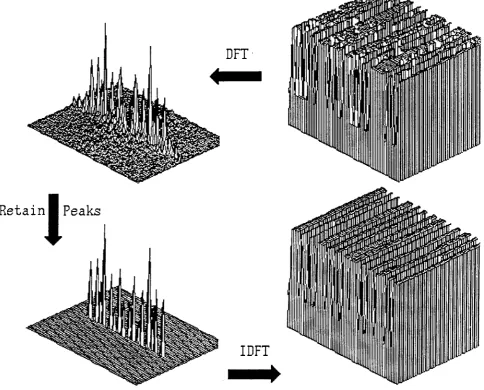
fair approximation to the original. For example, a region of intense stripes may be reconstructed
with less than ten spectral values. Consider fig. 5. The original rcxture is part of the curtain in the
"Trevor" image used for video-codec analysis [25]. After an FFT is performed and the magnitude
of the coefficients are found, the result is as shown. With the retention of eight spectral peaks (in
each half of the Fourier domain) the inverse FFT produces a reliable version of the original. In this case, about
l0
Voof
the original energyin
the Fourier domainis
retained.In
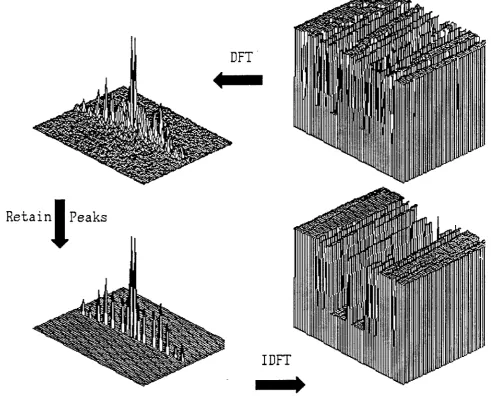
the caseof
stripes which lie
off
the main o(es, as in fig. 6, the results arcstill
acceptable. The retention of adescriptor and provide a visually close approximation after reconstruction.
The point we have ignored in the last paragraph is, of course, that the segmented regions are not recuulgular. This problem has been considered by Franke
in
his investigations [20,26-28]. He presents a technique called Selective Deconvolution as a method of'filling in'
(extrapolating) theunknown pixels in a non-rectangular textured region.
A
few of the spectral lines in the spectmmdrawn from this filled region may be retained to reconstruct the original region at the receiver.
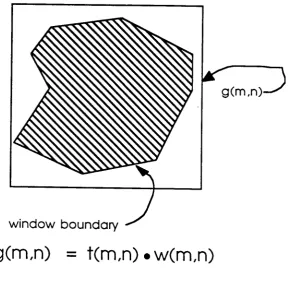
With reference to a typical textured region, shown in fig. 7, the data S (t
i)
can be considered theproduct of the (unknown) texturc over the entire rectangle, t(i
j)
with a binary window functionw (i
,j),
i.e.s (i
j)
= t (i ,i)'w (ij)
.
(9)In the Fourier domain the spectrum G(u,v) is therefore the convolution of the spectrum T(u,v) with the spectrum of the windo w , W (u,v ), i.e.
G (u,v) = T (u,v)
*
W (u,v) . (10)Franke's deconvolution scheme involves an iteration.
A
DFT on t(1,7), set initially to g(i,7), isfollowed by the selection
of
the largest spectral pair not yet considered:
the positionof
theselines
are usedto
updatea
binary
filter
functionwhich
in
urm
is
usedto
selectthe
bestaccumulated specffum which minimizes the error between the known samples,
s(ii)
and theinverse transformed spectrum.
Following
the
proper selection,the IDFT
completes thedeconvolution and the next iteration
is
performed after extrapolated pixels are assigned. Theiteration stops after the region is 'filled-in' to the desired degree. The number of iterations may be
large (30
or
more)for
acceptable results but the techniqueis
provedto
convergeto
a stablesolution.
Franke's scheme has obvious drawbacks as a coding technique, as mentioned above, but the fact that a small number
of
spectral peaks may be used to accumtely synthesize texture leads us toconsider the foliowing algorithm. Note that this proposal has not been implemented at the time of writing.
8.
A Possible RegionFilling
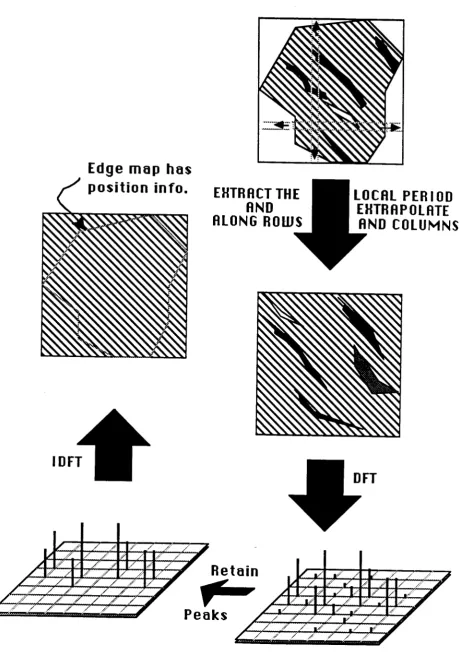
TechniqueThe scheme is described pictorially in fig. 8. There are four steps in the process.
1. Perform
l-D
autocorrelations along rows and columns using known samples. The most-
likely
period, perhaps using windowed autocorrelations, can be used to extrapolate the datafrom
eitherend
to
'Rll
in'
the
conespondingrow or
columnof
the
rectangle. Theextrapolated data can also be made to maintain the second-order statistics
of
the known2. Oncn,the rectangle is filled perform a DFT over the recangle.
3. Select the n largest spectral lines from the periodogram.
4. perform an IDFT (at e.g. the receiver) to approximate the texture signal. The positional information is given from the edge map.
In ttris way the iteration of Franke's scheme is removed; the desired spectral lines are found from
one pass through the DFT-IDFT loop. The potential difficulty with this scheme is obviously that
of
correlations along short rowsor
columns.A
reliableway
aroundthis
problemis
not immediately obvious.9.
Conclusions and FutureWork
We have investigated the description and synthesis of textures, based on a structural model
of
texture.It
is apparent that real textures are often locally-periodic but are rarely globally-periodic. This view is supported by the Julesz conjectures mentioned in the references. The problems with selecting a feature from the centreof
an arbitrary region and replicatingit
regularly over theregion mean
that
it
is
unlikely
to
createa
pleasing approximationto
the
original.
Theincorporation of parameters which lead
o
smooth deformations to the primitive across the regionare rherefore highly desirable. The amount of information required with this may
limit
a coding application.The
ability
of
a
small numberof
spectral linesto
reconstruct mostof
the gloss featuresof
atextured ar€a, as indicated
in
examples from the text, make the pursuitof
a fast and reliable methodof
extracting such data from a non-rectangular area a worthy one.It
is hoped that thedevelopment of the algorithm proposed in the previous section
will
lead to a successfirl method.10. Acknowledgements
This research was carried out under the collaborative Alvey Project MMI085, "Image Analysis
and Coding." The authors express their gratitude to the Alvey Directorate for making these funds avaiiable.
11. References
tll
O. D. Faugeras and W. K. Pratt, "Decorrelation Methods of Texture Feature Extraction," IEEE Trans. Patt. Anal., Mach.lntell., Vol. PAMI-2, No. 4, July 1980' pp 323-332.t3l
L.
S.
Davis, "Image Texurre Analysis Techniques- A
Survey,"in Digital
ImageProcessing (eds.J. C. Sirnon an-d R. M. Haralick), 1981, pp 189-201.
t4l
B. Julesz, "Visual Pattem Discrimination," /RE Trans. Inform" Theory, Vol. IT-8, Feb.1962,pp84-92.
tsl
B.
Julesz, "Spatial nonlinearitiesin
the
instantaneous perceptionof
textures with identical power," Phil. Trans. Royal. Soc. B Vol. 290, 1980, pp 83-94.16] B. Julesz, "Textons, the elements of texture perception, and their interactions," Nature,
Vol. 290, 12 March 1981, pp 9l-97.
[7] H. Voorhees and T. Poggio, "Computing texrure boundaries from images," Nature,Yol.
333,26 May 1988, pp364-367.
t8l R. M. Haralick, "Statistical and Strucnrral Approaches to Texnrre," Proc. IEEE, Vol. 67,
No.5, May 1979, pp 786-8M.
t9l
J. W. Modestino, R. W. Fries and A.L.
Vickers, "Texture discrimination based on anAssumed Stochastic Texture Model," IEEE Trans. Patt. AnaL, Mach. Intell., Vol. PAMI-3,
No.5, Sept. 1981, pp 557-580.
t10l K.
Deguchi andI.
Morishita, "Texture Characterization and Texture-Based ImagePartitioning
Using
Two-DimensionalLinear
Estimation Techniques,"IEEE
Trans.Comput.,Yol. C-27, No. 8, Aug. 1978, pp739-745.
tl
ll
J. K. Hawkins, "Textulal properties for pattem recognition," in Picture Processing and Psychopictorics (eds. Bernic Saclcs Lipkin and Azriel RosenfeW), Academic Press, NewYork 1969, pp347-370.
t12l S. W. Zucker, "Toward a Model of Texture," Comp. Graph., Im. Proc., Yol. 5, 1976,
pp r9O-202.
t13l S. W.
Zucker,A.
Rosenfeld andL.
S.
Davis, "Picture segmentationby
texturediscriminati on," IEEE Traru. Comput., Vol. C-24, 1975, pp 1228-1233.
tl4l
S. Wang,F.
R. Dias Velasco,A,
Wu andA.
Rosenfeld, "Relative Effectivenessof
Selected Texture Primitive Statistics for Texture Discrimination," IEEE Trans. Syst., Man, Cybern., Vol. SMC-I1, No. 5, May 1981, pp 360-370.
l15l N.
Ahuja andA.
Rosenfeld, "Mosaic Models forTextures," IEEETrans Patt. Anal.,tl6l
p.
J. Burt,T-H.
Hong andA.
Rosenfeld, "Segmentation and Estimationof
ImageRegion Properties Through Cooperative Hierarchical Computation,"
IEEE
Trans. Syst.,Man, Cybern, Vol. SMC-I1, No. l2,Dec.1981, pp 802-809.
tl7]
M.
Spann, 'Texture Description and Segmentation in Image Processing,"PM.
Thesis,Universiry of Aston in Birmingharn, Sepr 1985.
tl8l
M.
Spann andR.
Wilson,"A
Quad-Tree Approachto
Image Segmentation which Combines Statistical and Spatial Information," Patt. Recog.,Vol.
18, Nos 3/4, 1985, pp 257-269.tlgl
P. Volet, "Analyse et Synthese D'Images de Textures Structurees," PhD. Thesis, Ecole.Polytechnique Federale de Lausanne, 1987.
t20l D. Cyganski and J. A. Orr, "Applications of Tensor Theory to Object Recognition and
Orientation Determination," IEEE Trans. Pau. AnaI., Mach. InteII.,
Vol.
PAMI-7, No. 6,Nov. 1985, pp 662-673.
t21l U. Franke, "Selective Deconvolution:
A
New Approach to Extrapolation and SpectralAnaiysis of Discrete Signals," Proc. ICASSP, Dallas,
April
1987, pp 1300-1303.t22l
M.
Kunt,
A.
Ikonomopoulos andM.
Kocher, "Second-Generation Irnage-CodingTechniques," Proc. IEEE, Vol. 73, No. 4,
April
1985, pp 549-574.t23)L.
Fejes Toth, Regular Figures, Pergamon Press, 1964.t24lV.
Stanger, GEC Hirst Research Centre, private communication.t25l R. W. McColl
and G. R. Martin, "Quantisationof
Digitised Coiour knages," Dept. Comp. Sci. Res. Rep. RRll2,Warwick
Univenity, Nov. 1987.t26l
U. Franke and R. Meister, "Representationof
the Texture Signaisin
Region-BasedImage Coding Schemes:
A
Comparative Study," Pict. Coding Sytnp. 1988, Turin, Italy,1988, pp
2.1-l
- 2.1-2.t27lU.
Franke, R. Meister and T. Aach, "Constrained Iterative Restoration Techniques: APowerful Tool
in
Region Oriented Texture Coding," Proc. EUSIPCO, Crenoble, France,Sept. 1988, pp 1145-1148.
r
t-\>
ir
i.
--r-i'
\
i
\
i
i
**o"*ll
,r.v\.&{-
*
(r,r)
=
I
k=0
d1'
"k
.Kt
+--+
K
Figure
i'b
{
\
r'r'\ ;1i1ii,:,?
\,1,:q
I
lt:
1 tr . t t\\\ ,/Zs-ttf-, \ \ \
tl/f/fftrallaal
F \ \ \ \ \ \t\ ftafttrtltlta \ \ \ \ \ \ \ \ \ \ \ \ \i\ a/aaat?/arral \ \ \ \ \ \
\ \ \
aaaafatarafal\
\ \
\.\
\
\ \
\
\
\
\ \ \ \ \ \ \i\ trftft?aattal \ \ \ \ \ \ \ \ \ \ \ \ \t\ /af \ \ \ \ \ \
f f f t /aalal \ \ \ \ \ \ \l\ afaafa!tlalra \ \ \ \ \ \ \ \ \ \ \ \ \l\ fffffa?f/tall \ \ \ \ \ \ \ \ \ \ \ \ \f \ \ \ \ \ \ \tffarftftttta
trtrtrt rtr\t i,) t r t rtrtr t r'
nfiffirti;yrr
\\\\\\\\\\\\\\
/afaftlaaaft/ aaf/faaafafal\\\\\\\\\\\\\\
alfrf/fattt/r\\\\\\\\\\\\\\
atr/aaat/ttra\\\\\\\\\\\\\\
taaffattrft//\\\\\\\\\\\\\\
tfftrrtflt/ra\\\\\\\\\\\\\\
J'J-L l\\\\\\\\\\tvtftaftaall\ \ \ \ \ \ \ \ \ \ Yaftfal/ta
l\ \ \ \ \ \ \ \ \ \ It f a f a a / l a
$\\\\\\\\\
tf / a a a t I f a
l\\\\\\\\\ vatrttaaa
t\ \ \ \ \ \ \ \ \ lfflatfta
l\\\\\\\\\
tt a a f f a a a l|\\\\\\\\
lffttff/a
l\ \ \ \ \ \ \ \ Yrafaaar
\trtrtrtrtrtr) $\\\\!zta f f
a- l\\!-