http://dx.doi.org/10.4236/jcc.2015.311028
Modeling and Stability Analysis of a
Communication Network System
Zvi Retchkiman Königsberg
Centro de Investigacion en Computacion, Instituto Politecnico Nacional, Mexico City, Mexico
Received October 2015
Abstract
In this work, the modeling and stability problem for a communication network system is ad-dressed. The communication network system consists of a transmitter which sends messages to a receiver. The proposed model considers two possibilities. The first one, that messages are suc-cessfully received, while in the second one, during the sending process the transmitter breaks down and as a result the message does not reach the receiver. Timed Petrinets is the mathematical and graphical modeling technique utilized. Lyapunov stability theory provides the required tools needed to aboard the stability problem. Employing Lyapunov methods, a sufficient condition for stabilization is obtained. It is shown that it is possible to restrict the communication network sys-tem state space in such a way that boundedness is guaranteed. However, this restriction results to be vague. This inconvenience is overcome by considering a specific recurrence equation, in the max-plus algebra, which is assigned to the timed Petri net graphical model.
Keywords
Communication Network System, Transmitter Breakdown, Discrete Event Dynamical Systems, Max-Plus Algebra, Lyapunov Method, Timed Petri Nets
1. Introduction
network system spends at a given state etc. For a detailed discussion of Petri net theory see [1] and the refer-ences quoted therein. One of the most important performance issues to be considered in a communication net-work system is its stability. Lyapunov stability theory provides the required tools needed to aboard the stability problem for communication network systems modeled with timed Petri nets whose mathematical model is given in terms of difference equation. By proving practical stability one is allowed to preassigned the bound on the communication network systems dynamics performance. Moreover, employing Lyapunov methods, a sufficient condition for the stabilization problem is also obtained. It is shown that it is possible to restrict the communica-tion network systems state space in such a way that boundedness is guaranteed. However, this restriccommunica-tion results to be vague. This inconvenience is overcome by considering a specific recurrence equation, in the max-plus al-gebra, which is assigned to the timed Petri net graphical model. The paper is organized as follows. In Section 2, Lyapunov theory for discrete event systems modeled with Petri nets is given. Section 3 presents max-plus alge-bra. In Section 4, the solution to the stability problem for discrete event systems modeled with timed Petri nets is considered. Finally, in Section 5 the modeling and stability analysis for communication network systems is ad-dressed. Some conclusion remarks are also provided.
2. Lyapunov Stability and Stabilization of Discrete Event Systems
Modeled with Petri Nets [2] [3]
NOTATION: N=
{
0,1, 2,...}
, R+ =[0, )∞ , Nn0{
n n0, 0 1,...,n0 k,... ,}
n0 0+ = + + ≥
. Given x y, ∈Rn, x≤y is equivalent to xi≤ yi,∀i . A function ( , )f n x , : 0
n n
n
f N+ ×R →R is called nondecreasing in x if given
, n
x y∈R such that x≥y and n Nn0
+
∈ then, f n x( , )≥ f n y( , ). Consider systems of first ordinary difference equations given by
0 0
( 1) [ , ( )], ( )o , n
x n+ = f n x n x n =x n∈N+ (1)
where n Nn0
+
∈ , x n( )∈Rn and 0
: n n
n
f N+ ×R →R is continuous in x n( ).
Definition 1. The n vector valued function Φ( ,n n x0, 0) is said to be a solution of (1) if Φ(n n x0, 0, 0)=x0
and Φ +(n 1,n x0, 0)= f n( , ( ,Φ n n x0, 0)) for all n Nn0
+
∈ .
Definition 2. The system (1) is said to be practically stable, if given ( , )λ A with 0< <λ A, then
0
0 ( , 0, 0) , n , 0 0
x < ⇒λ x n n x < ∀ ∈A n N+ n ≥ .
Definition 3. A continuous function α: [0, )∞ →[0, )∞ is said to belong to class if α(0)=0 and it is strictly increasing.
Consider a vector Lyapunov function ( , ( ))v n x n , : 0 n p n
v N+ ×R →R+ and define the variation of v relative to (1) by
( 1, ( 1)) ( , ( )) v v n x n v n x n
∆ = + + − (2)
Then, the following result concerns the practical stability of (1).
Theorem 4. Let v N: n0 Rn Rp
+
+
× → be a continuous function in x, define the function 0( , ( )) 1 ( , ( ))
p i i
v n x n =
∑
=v n x nsuch that satisfies the estimates
( )
(
)
0
( ) , ( ); , , ( , ( )) ( , ( , ( )))
b x ≤v n x n ≤a x a b∈ ∆ v n x n ≤w n v n x n (3)
for n Nn0
+
∈ , x n( )∈Rn, where w N: n0 Rp Rp
+ +
× → is a continuous function in the second argument. Assume
that: g n e( , )e+w n e( , ) is nondecreasing in e, 0< <λ A are given and finally that a( )λ <b A( ) is satis-fied. Then, the practical stability properties of
0 0
( 1) ( , ( )), ( ) 0.
e n+ =g n e n e n =e ≥ (4)
imply the practical stability properties of system (1).
Corollary 5. In Theorem (4): if w n e( , )≡0 we get uniform practical stability of (1) which implies structural stability.
Definition 6. A Petri net is a 5-tuple, PN ={ , , ,P T F W M, 0} where: P={ ,p p1 2,...,pm} is a finite set of places, T= { , ,..., }t t1 2 tn is a finite set of transitions, F⊂(P T× )∪ ×(T P) is a set of arcs, W F: N1
+
weight function, M0: P→N is the initial marking, P∩ = ∅T and P∪ ≠ ∅T .
Definition 7. The clock structure associated with a place pi∈P is a set V= {Vi:pi∈P} of clock se-quences Vi={vi,1,vi,2,...}, vi k, R ,k 1, 2,...
+
∈ =
The positive number vi k, , associated to pi∈P, called holding time, represents the time that a token must
spend in this place until its outputs enabled transitions ti,1,ti,2,..., fire. We partition P into subsets P0 and Ph,
where P0 is the set of places with zero holding time, and Ph is the set of places that have some holding time.
Definition 8. A timed Petri net is a 6-tuple TPN={ , , ,P T F W M, 0, }V where { , , ,P T F W M, 0} are as be-fore, and V={Vi:pi∈P} is a clock structure. A timed Petri net is a timed event Petri net when every pi∈P has one input and one output transition, in which case the associated clock structure set of a place pi∈P re-duces to one element Vi ={ }.vi
Notice that if W p t( , )=α (or W t p( , )=β) then, this is often represented graphically by α, (β) arcs from p to t (t to p) each with no numeric label.
Let Mk(pi) denote the marking (i.e., the number of tokens) at place pi∈P at time k and let
1
[ ( ),..., ( )]T
k k k m
M = M p M p denote the marking (state) of PN at time k. A transition tj∈T is said to be enabled at time k if Mk(pi)≥W p t( i, )j for all pi∈P such that
(
p
i,t
j)
∈
F
. It is assumed that at each time k there exists at least one transition to fire. If a transition is enabled then, it can fire. If an enabled transitionj
t ∈T fires at time k then, the next marking for pi∈P is given by
1( ) ( ) ( , ) ( , ).
k i k i j i i j
M + p =M p +W t p −W p t (5) Let A=[aij] denote an n m× matrix of integers (the incidence matrix) where aij aij aij
+ −
= − with
( , )
ij i j
a+ =W t p and aij− =W p t( j, )i . Let uk∈{0,1}n denote a firing vector where if tj∈T is fired then, its corresponding firing vector is uk =[0,..., 0,1, 0,..., 0]T with the one in the th
j position in the vector and zeros everywhere else. The nonlinear difference matrix equation describing the dynamical behavior represented by a PN is:
1
T
k k k
M + =M +A u (6)
where if at step k, aij Mk(pj)
− <
for all pi∈P then, ti∈T is enabled and if this ti∈T fires then, its
cor-responding firing vector uk is utilized in the difference equation to generate the next step. Notice that if M′
can be reached from some other marking M and, if we fire some sequence of d transitions with corresponding firing vectors u u0, ,...,1 ud−1 we obtain that
1
0
, .
d T
k k M M A u u u
−
=
′ = + =
∑
(7)Let (Nnm0, )d be a metric space where d N: nm0×Nnm0 →R+ is defined by
1 2 1 2
1
( , ) | ( ) ( ) |; 0
m
i i i i
i
d M M ζ M p M p ζ
=
=
∑
− > and consider the matrix difference equation which describes thedynamical behavior of the discrete event system modeled by a PN, see (7).
Proposition 9. Let PN be a Petri net. PN is uniform practical stable if there exists a Φ strictly positive m vector such that
0
T v u A
∆ = Φ ≤ (8) Moreover, PN is uniform practical asymptotic stable if the following equation holds
( ), T
v u A c e c K
∆ = Φ ≤ − ∈ (9)
Lemma 10. Let suppose that Proposition (9) holds then,
0 0
T
v u A A
∆ = Φ ≤ ⇔ Φ ≤ (10)
Remark 11. Notice that since the state space of a TPN is contained in the state space of the same now not
timed PN, stability of PN implies stability of the TPN.
Lyapunov Stabilization
with transition count vector u such that system (7) remains bounded.
Proposition 13. Let PN be a Petri net. PN is stabilizable if there exists a firing transition sequence with tran-sition count vector u such that the following equation holds
0
T v A u
∆ = ≤ (11)
Remark 14. By fixing a particular u, which satisfies (11), the state space is restricted to those markings that are finite.
3. Max-Plus Algebra [4] [5]
3.1. Basic Definitions
NOTATION: = −∞, e=0, max = ∪ { }, n=1, 2,...,n. Let a b, ∈max and define the operations ⊕ and ⊗ by: a⊕ =b max( , )a b and a⊗ = +b a b.
Definition 15. The set max with the two operations ⊕ and ⊗ is called a max-plus algebra and is de-noted by ℜmax =(max, , , , ).⊕ ⊗ e
Definition 16. A semiring is a nonempty set R endowed with two operations ⊕R, ⊗R, and two elements
R
and e such thatR : ⊕R is associative and commutative with zero element R, ⊗R is associative, distri-butes over ⊕R, and has unit element eR, ∈R is absorbing for ⊗R i.e., a⊗R = R⊗ =a a, ∀ ∈a R. In addition if ⊗R is commutative then R is called a commutative semiring,and if ⊕R is such that a⊕Ra=a,
a R
∀ ∈ then it is called idempotent.
Theorem 17. The max-plus algebra ℜmax =(max, , , , )⊕ ⊗ e has the algebraic structure of a commutative and idempotent semiring.
3.2. Matrices and Graphs
Let maxn n× be the set of n n× matrices with coefficients in max
with the following operations: The sum of matrices A B, ∈maxn n× , denoted A⊕B is defined by: ( ) max( , )
ij ij ij ij ij
A⊕B =a ⊕b = a b for i and j∈n. The product of matrices A∈n lmax× ,B∈l nmax× , denoted A⊗B is defined by:
1
( ) ( )
l
ik ij jk j
A B a b
=
⊗ =
⊗
⊗ for i andk∈n. Let ∈n nmax× denote the matrix with all its elements equal to and denote by
max
n n
E∈× the matrix which has its diagonal elements equal to e and all the other elements equal to . Then, the following result can be stated.
Theorem 18. The 5-tuple ℜmaxn n× =(n nmax× ,⊕ ⊗, , , ) E has the algebraic structure of a noncommutative idem-potent semiring.
Definition 19. Let A∈maxn n× and k∈ then the k-th power of A denoted by k
A⊗ is defined by:
k
A⊗ = ⊗ ⊗⋅⋅⋅⊗A A A,(k times), where A⊗0 is set equal to E.
Definition 20. A matrix A∈n nmax× is said to be regular if A contains at least one element distinct from in each row.
Definition 21. Let be a finite and non-empty set and consider ⊆ × . The pair G=( , ) is called a directed graph, where is the set of elements called nodes and is the set of ordered pairs of nodes called arcs. A directed graph G=( , ) is called a weighted graph if a weight w i j( , )∈ is asso-ciated with any arc ( , )i j ∈.
Let A∈maxn n× be any matrix, a graph ( )A , called the communication graph of A, can be associated as fol-lows. Define N A( ) =n and a pair ( , )i j ∈ ×n n will be a member of ( )A ⇔aji ≠, where ( )A denotes the set of arcs of ( )A .
Definition 22. A path from node i to node j is a sequence of arcs p={( ,ik jk)∈( )}A k m∈ such that 1, k k 1
i=i j =i+ , for k<m and jm= j. The path p consists of the nodes i=i i1, ,...,2 im,jm= j with length m denoted by |p|1=m. In the case when i= j the path is said to be a circuit. A circuit is said to be elementary if nodes i and k i are different for kl ≠l. A circuit consisting of one arc is called a self-loop.
Let us denote by P i j m( , ; ) the set of all paths from node i to node j of length m≥1 and for any arc ( , )i j ∈( )A let its weight be given by aij then the weight of a path p∈P i j m( , ; ) denoted by |p|w is
com-munication graph ( )A and powers of matrix A are closely related as it is shown in the next theorem.
Theorem 23. Let A∈n nmax× , then ∀ ≥k 1: [ k] max{| | : ( , ; )}
ji w
A⊗ = p p∈P i j k , where [A⊗k]ji = in the case when P i j k is empty i.e.( , ; ) , no path of length k from node i to node j exists in ( )A .
Definition 24. Let A∈n nmax× then define the matrix
max
n n
A+∈× as:
1 k k A A ∞ + ⊗ =
=
⊕
. Where the element [A+]ji gives the maximal weight of any path from j to i. If in addition one wants to add the possibility of staying at a node then one must include matrix E in the definition of matrix A+ giving rise to its Kleene star representationdefined by:
0 . k k A A ∞ ∗ ⊗ = =
⊕
Lemma 25. Let max
n n
A∈× be such that any circuit in ( )A has average circuit weight less than or equal to
. Then it holds that:
1 0 . n k k A A − ∗ ⊗ = =
⊕
Definition 26. Let G=( , ) be a graph and i j, ∈ , node j is reachable from node i, denoted as i j , if there exists a path from i to j. A graph G is said to be strongly connected if ∀i j, ∈ ,j i. A matrix
max
n n
A∈× is called irreducible if its communication graph is strongly connected, when this is not the case ma-trix A is called reducible.
Remark 27. In this paper irreducible matrices are just considered. It is possible to treat the reducible case by transforming it into its normal form and computing its generalized eigenmode see [4].
3.2.1. Spectral Theory and Linear Equations Definition 28. Let A∈maxn n× be a matrix. If
max R
µ ∈ is a scalar and v∈Rmaxn is a vector that contains at least one finite element such that: A⊗ = ⊗v µ v then, µ is called an eigenvalue and v an eigenvector.
Let ( )A denote the set of all elementary circuits in ( )A and write:
( ) 1 max w p A p p λ ∈ =
for the maximal
average circuit weight. Notice that since ( )A is a finite set, the maximum is attained (which is always the case when matrix A is irreducible). In case ( )A = ∅ define λ=.
Definition 29. A circuit p∈G A( ) is said to be critical if its average weight is maximal. The critical graph of A, denoted by Gc( )A =(c( ),A c( ))A , is the graph consisting of those nodes and arcs that belong to crit-ical circuits in G A( ).
Theorem 30. If A∈n nmax× is irreducible, then there exists one and only one finite eigenvalue (with possible several eigenvectors). This eigenvalue is equal to the maximal average weight of circuits in G A ( )
( ) 1
( ) max w
p A p A p λ ∈ = .
Theorem 31. Let max
n n
A∈× and max
n
b∈ . If the communication graph G A has maximal average circuit ( ) weight less than or equal to e, then x=A*⊗b solves the equation x=(A⊗ ⊕x) b. Moreover, if the circuit weights in G a are negative then( ) , the solution is unique.
3.3. Max-Plus Recurrence Equations for Timed Event Petri Nets
Definition 32. Let maxn n m
A ∈× for 0≤ ≤m M and x m( )∈nmax for − ≤ ≤ −M m 1; M ≥0. Then, the recurrence equation:
0
( ) ( ); 0
M m m
x k A x k m k
=
=
⊕
⊗ − ≥ is called an Mth order recurrence equation.Theorem 33. The Mth order recurrence equation, given by equation
0
( ) ( ); 0
M m m
x k A x k m k
=
=
⊕
⊗ − ≥ , can betransformed into a first order recurrence equation x k( + = ⊗1) A x k( ); k≥0 provided that A has circuit 0 weights less than or equal to zero.
With any timed event Petri net, matrices 0, 1,..., n n M
where ajl is the largest of the holding times with respect to all places between transitions
t
l and tj with m tokens, for m=0,1,...,M, with M equal to the maximum number of tokens with respect to all places. Let( )
i
x k denote the kth time that transition ti fires, then the vector ( ) ( ( ),1 2( ),... ( ))
T m
x k = x k x k x k , called the state of the system, satisfies the Mth order recurrence equation:
0
( ) ( ); 0
M
m m
x k A x k m k
=
=
⊕
⊗ − ≥ Now, assumingthat all the hypothesis of theorem (33) are satisfied, and setting x kˆ( )=(xT( ),k xT(k−1),...,xT(k−M+1))T, equation
0
( ) ( ); 0
M
m m
x k A x k m k
=
=
⊕
⊗ − ≥ can be expressed as: x kˆ( + = ⊗1) Aˆ x kˆ( );k≥0, which is known as the standard autonomous equation.4. The Solution to the Stability Problem for Discrete Event Dynamical
Systems Modeled with Timed Petri Nets
Definition 34. A TPN is said to be stable if all the transitions fire with the same proportion i.e., if there exists q∈ such that
( )
, 1,..., lim i
k
x k
q i n k
→∞ = ∀ = (12)
This means that in order to obtain a stable TPN all the transitions have to be fired q times. It will be desirable to be more precise and know exactly how many times. The answer to this question is given next.
Lemma 35. Consider the recurrence relation x k( + = ⊗1) A x k k( ), ≥0, (0) 0
n
x =x ∈ arbitrary. A an ir-reducible matrix and λ∈ its eigenvalue then,
( )
, 1,..., lim i
k
x k
i n k λ
→∞ = ∀ = (13)
Proof. Let v be an eigenvector of A such that x0 =v then, ( ) ( )
( ) k ( ) limk i
x k x k v
x k v x k k v
k k k
λ⊗ λ λ λ
→∞
= ⊗ ⇒ = + ⇒ = + ⇒ = .
Now starting with an unstable TPN, collecting the results given by: proposition (13), what has just been dis-cussed about recurrence equations for TPN at the end of subsection (3.3) and the previous lemma (35) plus theorem (30), the solution to the problem is obtained.
5. Modeling and Stability Analysis of a Communication Network System
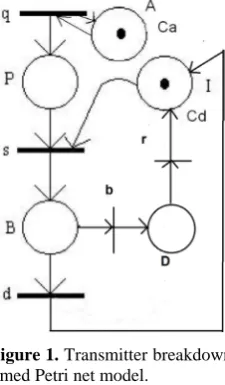
In this section, the modeling and stability analysis for a communication network system is addressed. The com-munication network system consists of a transmitter which sends messages through a comcom-munication channel to a receiver. The proposed model considers two possibilities. The first one, that messages are successfully re-ceived, while in the second one, during the sending process the transmitter breaks down and as a result the mes-sage does not reach the receiver. Consider a communication network system whose TPN model is depicted in
Figure 1.
Where the events (transitions) that drive the system are: q: receivers connect to the communication network, s: messages are sent, b: the transmitter breaks, r: the transmission is restored, d: the message has been successfully received. The places (that represent the states of the queue) are: A: receivers concentrating, P: the receiver is waiting for a message to be sent, B: the message is being received, D: transmitter breaks down, I: the transmitter is idle. The holding times associated to the places A and I are Ca and Cd respectively (with Ca>Cd). The incidence matrix that represents the PN model is
0 1 0 0 0
0 1 1 1 0
0 0 1 1 0
0 0 1 0 1
0 0 0 1 1
A
− −
= −
−
−
Figure 1. Transmitter breakdown timed Petri net model.
Therefore since there does not exists a Φ strictly positive m vector such that AΦ ≤0 the sufficient condi-tion for stability is not satisfied, (moreover, the PN (TPN) is unbounded since by the repeated firing of q, the marking in P grows indefinitely). However, by taking u=[ , , / 2, / 2, / 2];k k k k k k>0 (but unknown) we get that A uT ≤0. Therefore, the PN is stabilizable which implies that the TPN is stable. Now, let us proceed to determine the exact value of k. From the TPN model we obtain that:
0 0
0
0 A
ε ε ε ε ε ε ε ε ε
ε ε ε ε
ε ε ε ε ε
ε ε ε ε
=
and 1 Ca
Cd Cd A
ε ε ε ε
ε ε ε
ε ε ε ε ε
ε ε ε ε ε
ε ε ε ε ε
=
which implies 0* 0
0 0
,
0 0 0
0
0 0
A
ε ε ε ε ε ε ε ε ε
ε ε ε ε
ε ε ε
=
leading to:
*
0 1
ˆ
Ca
Ca Cd Cd A A A Ca Cd Cd
ε ε ε ε
ε ε
ε ε
ε ε ε ε ε
ε ε ε ε ε
= ⊗ =
Therefore,
( ) 1
( ) max w max{ , }
p A
p
A Ca Cd Ca p
λ
∈
= = =
. This means that in order for the TPN to be stable and
work properly the speed at which the receivers concentrate has to be equal to Ca (the firing speed of transition q) which is attained by taking k=Ca.
6. Conclusion
This paper studies the modeling and stability problem for communication network systems using timed Petri nets, Lyapunov methods and max-plus algebra. The results obtained are consistent to what was expected.
References
[1] Murata, T. (1989) Petri nets: Properties, Analysis, and Applications. Proc. IEEE, 77. http://dx.doi.org/10.1109/5.24143
[2] Retchkiman, Z. (2005) Stability Theory for a Class of Dynamical Systems Modeled with Petri Nets. International Journal of Hybrid Systems, 4.
American Control Conference’99, San Diego, June 1999.