~ 39 ~ WWJMRD 2017; 3(7): 39-43
www.wwjmrd.com Impact Factor MJIF: 4.25 e-ISSN: 2454-6615
Van Huong Dong Faculty of Mechanical Engineering, Ho Chi Minh, University of Transport, Ho Chi Minh city, Vietnam
Van Vang Le Faculty of Mechanical Engineering, Ho Chi Minh, University of Transport, Ho Chi Minh city, Vietnam
Correspondence: Van Huong Dong Faculty of Mechanical Engineering, Ho Chi Minh, University of Transport, Ho Chi Minh city, Vietnam
Fuel saving and reduction in the pollution emissions:
Solutions and methods
Van Huong Dong, Van Vang Le
Abstract
In recent years, environmental pollution has become more serious in big cities where transportation means are the main factors causing the emission of toxic substances such as CO, Pb, NOx...
Therefore, car manufacturers are constantly working for the benefit of consumers and the sustainable development of transport by step by step innovating technology, introducing vehicles with efficient fuel, reducing emissions, environmental friendliness. Accordingly, Vietnamese Ford introduces EcoBoost technology, Fuso introduces Canter E-cell Zero CO2 technology, Toyota introduces Hybrid
technology or Phev technology of Mitshubishi. Specifically, the 1.0L EcoBoost engine has a power output equivalent to a 1.6L engine while saving over 20% more fuel than conventional engines. Not only save fuel, the EcoBoost engine also reduces about 25% of the amount of components and is lightest compared to other engines. In particular, this engine reduces CO2 emissions causing a
greenhouse gas compared to traditional engine models by up to 15%.
Keywords: fuel saving, emission reduction, EcoBoost technology, environmental pollution.
Introduction
The impact of industrial activity on the environment comes mainly from the consumption of energy, the process of chemical production and the use of resources in industrial production. In the past, it has been argued that the greater the prosperity and growth of economies, the more negative the impact on the environment is. However, in the past two decades, some developed countries have proved the opposite. They use less raw materials and energy to produce the same output value, while reducing carbon emissions per unit of energy consumption. Based on this experience, changing the technology and thinking of business owners will help developing countries reduce emissions, as well as boost economic growth and sustainable development.
The energy supplied to the traditional industry is based primarily on the burning of high-carbon fossil fuels to generate electricity. However, the transition to other natural gas technologies more effectively, combined with the development of renewable energy sources, promises significant reductions in emissions of the industry in the future.
In the field of manufacturing, through industrial ecology - a field of study of similarities between industrial and natural systems, many of the lessons from nature have been successfully applied in the industry. Anything that is not needed in a certain process will be recycled and converted for use in another process. Likewise, the wastes generated by this process can become new materials for another process and the entire system is powered by solar energy.
Life Cycle Assessment (LCA) is increasingly being used to understand how recycling and recycling of energy, as well as materials, can affect the reduction of GHG emissions. LCA considers total energy use and emissions to air, water and soil as potential environmental impact assessment criteria. Building on the LCA to make a decision that can bring environmental benefits and cost savings while encouraging less economic and less polluting alternatives.
Other sectors must also play a role in reducing emissions in the future. The European Council has agreed to further reduce emissions from non-ETS subjects, in particular, by around 30% from 2005 through the "EU Effort Sharing Decision" (ESD) set up. Annual binding targets for Member States up to 2020 and apply to all types of industry emissions, such as, transportation, construction, agriculture and waste.
Solutions
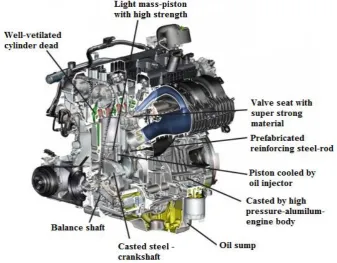
The EcoBoost engine is based on top-of-the-line advanced technologies for internal combustion engines: with approximately 25% reduction in the number of components and components, the EcoBoost engine is one The smallest and lightest engines compared to other engines of same capacity at the present time. This is a feature that helps Ford reduce costs and production time, while also reducing fuel consumption due to the significant reduction in engine mass. The machine was made entirely of alloy and molded at extremely low pressure. This not only improves engine accuracy but also accelerates heating, reducing fuel consumption compared to conventional aluminum engines. The internal friction inside the engine is suppressed to the maximum by the special components inside the cylinder, such as a piston shell coated with a special material with extremely low friction that produces less noise like minimizing shaking in the engine. Cement is loose in the groove so it can rotate automatically to minimize the friction inside the cylinder. The new EcoBoost engine is equipped with a special direct injection technology with injectors placed directly in the middle of the cylinder head, which increases the mixing of air and gasoline, and helps with combustion. Fuel is more efficient. The EcoBoost is equipped with a compact turbocharged system capable of operating at very high revs up to 248,000 rpm. Combined with variable valve timing control technology, the EcoBoost engine achieves maximum power and torque at low rpm, thus minimizing latency and maximizing the uptake process for speed of the car.
All new EcoBoost engines are equipped with Ti-VCT timing valve systems with two independent states. This system uses DOHC dual camshafts with a drive shaft for intake valves and the remaining shafts that drive the exhaust valves. During operation, the central controller (ECU) controls the valve system based on the impact on the high pressure oil stream to rotate the camshaft a smaller angle than the original position, thereby changing the valve, time of opening/closing of intake/exhaust valves. These two camshafts are individually controlled to optimize the closing /opening time of the exhaust valves as well as the intake valves. This will help the engine reduce its fuel consumption and emissions. Still does not affect the performance of the engine. The fluid-cooled exhaust system with integral commutator is molded seamlessly with the top of the cylinder, helping the exhaust temperature always lower even when the engine is running at high speed. This new design not only helps the engine to run at wider speeds with optimum fuel/fuel ratio but also reduces weight, reduces fuel consumption and allows the engine to operate more smoothly. The EcoBoost engine is equipped with a dual heat sink with two temperature sensors that help the engine start faster, reduce internal
friction as well as reduce fuel consumption and lower CO2
emissions. Muscle activity at low ambient temperature. In addition, EcoBoost has special features such as camshafts that are driven by cam chucks embedded in lubricants. This design produces less noise, less friction and contributes to greater fuel economy.
Fig. 1: Advantages of EcoBoost engine about structure
expects the EcoBoost engine to cut about 15 percent of its greenhouse gas emissions from conventional
larger-displacement engines with equivalent operating
horsepower.
With the 3.6L V6 engine on the Cadillac CTS, when using the EFI (Electronic Fuel Injection) system, the maximum power output is only 263 horsepower, maximum torque is 253 lb/ft. In addition, the fuel consumption is reduced by about 0.5 liters for a distance of 100 km. EFI fuel injection system outside the combustion chamber - indirect injection, the mixture will form outside before it is loaded into the interior of the combustion chamber. The EFI system is divided into three main categories:
Single Point Injection (SPI): This system uses only one central nozzle to replace the carburetor. The fuel injection nozzle is placed in front of the throttle and forms a mixture gas on the intake manifold. The system is quite simple, the cost is cheap, usually only in small cars.
BiPoint Injection (BPI) injection system is upgraded from a single point injection system. This system uses an additional nozzle placed behind the throttle to boost fuel for the mixture. Often the BPI system is of little use because of not much improvement over the SPI.
MultiPoint Injection (MPI): Each cylinder is equipped with a separate nozzle located just in front of the pump. The nozzle system is signaled from the crankshaft angle to determine the exact injection time.
In fact, the EFI electronic fuel injection system has been around since the 1950s, but it was not until the 1980s that the system actually expanded in Europe. Current models still use the EFI fuel system, although the basic principle does not change, but thanks to electronic control technology development has made this system more complete and more effective.
The structure of the EFI or GDI fuel system is quite complex, but the basic principle still uses signals from the motor (via the sensors) and then processed at the ECU central processing unit to adjust the taps, spray (time, pressure). Here are some important sensors:
Intake air sensor: measure the amount of air intake cylinder.
Oxygen Sensor: Measure the amount of oxygen in the exhaust gas to determine whether the fuel mixes excess or if there is no gasoline needed to correct the ECU when needed.
Valve position sensor: helps the ECU adjust the amount of gas injected to fit the gas pedal.
Coolant temperature sensor: measure the working
temperature of the engine.
Voltage sensor for ECU offset gas when opening the
electrical equipment in the car.
Pressure Gauge Pressure Gauge: to help ECU measure
engine power.
Engine speed sensor: used to calculate motor speed.
In this type of fuel injection system, the central controller collects the engine's operating parameters (through the sensor system) and then processes the information, comparing it with the standard program. Determine the amount of gas needed to supply the engine and direct the operation of the four nozzles (spraying time and spraying time).
EFI is divided into 3 small systems: electronic control system, fuel system and intake air system.
Electronic control system is to ensure the ideal combustion mixture (15: 1). The main component of the electronic control system is the ECU, which receives information from sensors (water temperature, air temperature, throttle position, start signal and oxygen sensor) along with the ignition signal and the information from the air intake. After processing the received signals, the ECU will issue a nozzle control signal (time and spray information). As a result, the amount of fuel injected is always proportional to the intake.
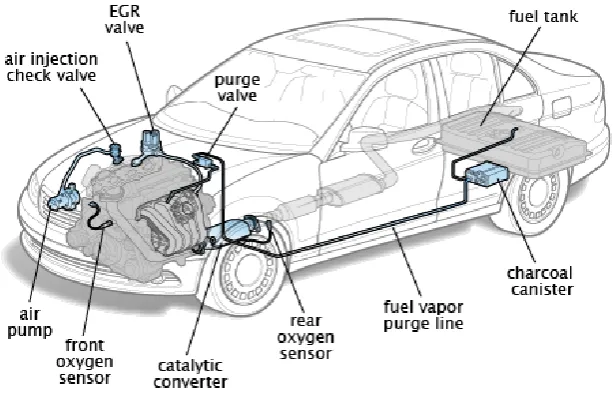
Fuel system: It consists of an electric pump that draws gas from the tank and pushes it into the system through a filter. Thus, when the engine is running, there is always a constant dry pressure in the fuel
delivery pipe to the nozzles (about 2.5 - 3 kG/cm2),
which is also the injection pressure. Received control signal from the ECU, open valve and fuel injected into the intake manifold. In order to keep the pressure steady on the fuel line supplied to the nozzles, a pressure regulator is arranged. In addition, the fuel line is connected to a cold start nozzle arranged in the intake chamber. This nozzle control signal is taken from the cold start switch. This switch is located in the water jacket of the cylinder and closes, depending on the water temperature
Fig. 2: Fuel system schematic of 4 seats -CADILLAC car
Methods
a. Tire must always stretch
Keeping the tires in good condition is one of the best ways to save on fuel, and at the same time, it's a way to ensure the safety of your car. Pumps for tires reach the maximum threshold recommended by the manufacturer. Drivers should check at least once a month.
If the phenomenon is weak, then pump immediately should not hesitate. Prior to the wheelchair on the road, a digital pressure gauge should be used to check the tension. Tight enough tires will both help keep the car running smoothly and running optimally.
b. Drive at moderate speed
Drivers should pay attention to avoid high speed on the rugged, bumpy roads. On highways, the fuel consumption of vehicles traveling at speeds of less than 100 km/h and over 100 km/h is very different, which can vary by 10% or more depending on the type of vehicle.
Rather than continuously standing and accelerating abruptly, especially in traffic lights, the driver should estimate the distance with red lights and the traffic flow of the front passenger to keep the car's speed evenly. However, not at low velocity can save gas. According to car experts, speed below 50 km /h consumes 10% more fuel.
c. Limit use of air-conditioning
If the weather is pleasant, the user should turn off the air conditioner. This will help to save energy for the car. Air conditioners can consume 10% of fuel. However, at speeds above 80km / h using air conditioning is better for opening a window.
d. Turn off the engine when not in use
When the car stops or is shut down, turn off the engine to reduce fuel costs. Avoid overheating the engine for long
computer calculates and adjusts the throttle to maintain that speed, helping to save fuel for the car. More efficient is the Adaptive Cruise system, which uses radar to keep distance from the car behind and in front.
f. Clean air filters regularly
The condition of the air filter in the congested vehicle will be costly. According to expert calculations, if the clogged filter consumes 10% of the fuel. The air filter is easy to disassemble. Clean and dry in the sun, if you do not see light through it, it means that you need to replace the filter. If the filter is blocked several times, replace the filter to ensure that the air purification is smooth and fuel efficient.
g. Press the gas slowly
Many people still have the habit of pedaling the accelerator pedal to accelerate the vehicle suddenly, before parking the vehicle at high speed and then braking abruptly. This can bring strong feelings to the driver, but it is also the culprit "hook" from your pocket a small amount of money when accrued.
Therefore, try to press the gas slowly when starting and before stopping the vehicle, maintain a safe distance between vehicles and judge traffic conditions to increase gas and press brake regularly.
h. Build a schedule first
Before starting to go, the driver should calculate before the schedule will go, time to go to avoid loops, wrong roads or lost cause more trouble or waste of fuel.
i. Do not carry too many things
k. Regularly check and replace oil at regular intervals:
Replacement of genuine lubricant, international standard, proper grade, correct SAE viscosity, proper API grade suitable for vehicle. To increase engine life, save fuel.
References
1. JG Hawley, CD Bannister, CJ Brace, A Cox, D
Ketcher and R Stark. Vehicle modal emissions measurement – techniques and issues, 2004, Proceedings IMechE, Part D, Journal of Automobile
Engineering, 218, 859-873. DOI:
10.1243/0954407041581057
2. CJ Brace, RD Burke and J Moffa. Increasing accuracy
and repeatability of fuel consumption measurement in chassis dynamometer testing, 2009, Proceedings IMechE, Part D, Journal of Automobile Engineering, 223, 1163-1177. DOI: 10.1243/09544070JAUTO1084
3. E Chappell, CJ Brace and C Ritchie. The control of
chassis dynamometer fuel consumption testing noise factors and the use of response modelling for validation of test repeatability, 2013, Proceedings IMechE, Part D, Journal of Automobile Engineering, 227, 853-865. DOI: 10.1177/0954407012469557
4. RD Burke, AJG Lewis, S Akehurst, CJ Brace, I Pegg
and R Stark. Systems optimisation of an active thermal management system during engine warm-up, 2012, Proceedings IMechE, Part D, Journal of
Automobile Engineering, 226,1365-1379. DOI:
10.1177/0954407012441883.
5. CJ Brace, JG Hawley, S Akehurst, M Piddock and I
Pegg. Cooling system improvements – assessing the effects on emissions and fuel economy, 2008, Proceedings IMechE, Part D, Journal of Automobile
Engineering, 222, 579-591. DOI:
10.1243/09544070JAUTO685.
6. JG Hawley, CD Bannister, CJ Brace, S Akehurst, I
Pegg, and MR Avery. The effect of engine and transmission oil viscometrics on vehicle fuel consumption, 2010, Proceedings IMechE, Part D, Journal of Automobile Engineering, 224, 1213-1228.
7.
https://www.asme.org/kb/news--- articles/articles/automotive/better-fuel-efficiency-through-a-better-oil-pump
8.
http://ieoty2012.fordmedia.eu/factsheets/Ford-1litre_EcoboostEngine_EU.pdf
9. http://www.fordotosan.com.tr/.../Analyst_Meeting
_Presentation_25_Oct_2011.pdf
10. http://www.imakenews.com/lng/e_article002367909.c
fm
11.
http://www.ford.co.uk/.../CompanyNews/2012/UK-Engineering-Support
12. http://media.ford.com/article_display.cfm?article_id=
37398
13. https://www.full-race.com/articles/what-is-ecoboost/
14. http://media.ford.com/article_display.cfm?article_id=
36244
15.