http://dx.doi.org/10.4236/jbise.2014.77041
Temporal Optimality of a Via-Posture on
Trajectory during Sit-to-Stand and
Back-to-Sit Movements
Hiroshi R. Yamasaki
1, Urara Nakamura
1, Hiroshi Nagasaki
21Department of Physical Therapy, Showa University, Yokohama, Japan
2Department of Health and Welfare, Tohoku Bunka Gakuen University, Sendai, Japan
Email: [email protected]
Received 12April 2014; revised 16May 2014; accepted 24May 2014
Copyright © 2014 by authors and Scientific Research Publishing Inc.
This work is licensed under the Creative Commons Attribution International License (CC BY). http://creativecommons.org/licenses/by/4.0/
Abstract
The purpose of this study was to examine the hypothesis that the minimum angle-jerk with via- point model could account for the temporal consistency of kinematics in sit-to-stand (STS) and back-to-sit (BTS) movements. The positions of bony landmarks on the subjects during the tasks were recorded using a Vicon motion analysis system to yield the angular displacement and posi-tion of the center of mass (COM) of a three-link rigid body model in the sagittal plane. Minimum angle-jerk and minimum jerk trajectories with a via-point were computed for joint angle and COM, respectively. Five to six candidate points were selected as the via-point from the measured trajec-tory based on the separate kinematic events. The results show the optimal angular trajectories using the via-points (via-angles) before the seat-off for STS, and at around the seat-contact for BTS resembles the measured angular trajectories well, indicating that the posture at the via-point was temporally optimal to produce the minimum angle-jerk trajectory for both movements. It is hy-pothesized that the multi-joint angular patterns during STS and BTS movements were organized to pass through the via-point, namely the via-posture along the minimum angle-jerk trajectory.
Keywords
Temporal Optimality, Via-Posture, Trajectory, Sit-to-Stand, Back-to-Sit
1. Introduction
in-volved in these motions, it is necessary to master the redundant degrees of freedom to perform a coordinated movement pattern [1]. Optimization hypotheses are important approaches to accounting for motor coordination. The maximum smoothness models, for instance, have succeeded in explaining the pattern of endpoint kinemat-ics [2] and joint movements [3]-[6] in reaching movements.
Recent studies have shown that the optimization approach can be adopted for the movements of other parts of the human body, such as finger movements [7], gait [8] [9], STS movement [10]-[12], and kip movements of a gymnast [13]. For example, Yamasaki et al. [11] demonstrated that the minimum torque-change criterion could predict the joint trajectory as well as the center of mass (COM) trajectory in STS movement after the seat-off (the instance the buttocks leaves the seat), indicating that the joint movements are optimized to yield a coordi-nated movement pattern in STS. However, whether the prediction of the optimization can explain the pattern of the joint movement before the seat-off in STS and during BTS has not been well examined.
Another unknown about the motor coordination in STS and BTS is the determinant of temporal consistency of the kinematics. For example, Pai and Rogers [14] demonstrated that the timing of peak horizontal velocity of the COM was consistent across movement speeds, and the horizontal momentum of the COM that is generated by the trunk flexion remained constant across different speeds. Dubost et al. [15] also showed that maximum trunk flexion occurs around the middle period during STS, and that its maximum angles in young and elderly subjects were similar. This stereotypically, temporally constrained invariant characteristic of the joint movement during STS suggests that the movement is planned and executed in terms of the optimal sequence of the move-ment events. The temporal optimality of the kinematic events in STS and BTS has not been fully explained.
The purpose of this study was to examine the hypothesis that the optimal trajectory formation model, espe-cially the minimum jerk and minimum angle-jerk with via-point models, could account for the temporal consis-tency of kinematics in STS and BTS movements. The minimum angle-jerk model has been regarded as a good approximation of the minimum torque-change criterion [4] [16]. An advantage of the minimum angle-jerk model is the independence of the biomechanical parameters of the musculoskeletal system.
2. Method
2.1. Subjects
Five male subjects (mean age 24.2 ± 6.3 years) without musculoskeletal or neurologic impairments took part in the experiment after giving informed consent. The study protocol was approved by the institutional ethics com-mittee.
2.2. Tasks
The subjects performed the STS task from a standardized sitting posture on a chair in two speed (fast and natural) conditions. They were told to cross their arms in front of their chest throughout the duration of the task. In the natural speed condition, the subjects were asked to stand at a comfortable speed after receiving a signal from the experimenter. In the fast speed condition, the subjects stood as fast as possible. The subjects gazed at a point presented in front of them during the tasks. They were also instructed to stand still at the end of the movement task until receiving another signal from the experimenter. This second signal indicated the start of the BTS movement task at the same speed condition. The height of the seat was set to two different positions, i.e., Low and High positions that yield knee angles at 80 degrees and 50 degrees flexion, respectively. Angle of the ankle joint was 10 degrees dorsiflexion for both positions. All subjects started STS tasks in the Low-natural speed conditions, followed by the fast speed condition. Tasks in the High position were always examined after all the tasks in the Low position were completed. The subjects performed 10 trials in each condition, thus a total of 40 STS trials and 40 BTS trials (2 speed conditions by 2 seat-height positions) were recorded. There was a 3minutes rest period between each test. The subjects were allowed remain seated during the rest.
2.3. Motion Capture
Figure 1. Schematic diagram for data analysis.
composed of HAT segment (Head, Arms and Trunk), thigh, and shank in the sagittal plane was assumed to cal-culate the anatomical joint angle of the hip, knee, and ankle joints and position of the COM of the subject. The angular velocity and acceleration as well as the linear velocity of the COM were also calculated by numerical differentiation. The length and weight of the links for each subject were estimated using the height and weight of each subject [17]. Movement time was determined as the duration when the velocity of the COM exceeded 5% of its peak velocity. For the convenience of data processing, the data length of kinematics was normalized by the movement time (one hundred points). Raw kinematic data were low-pass filtered using a second-order Butter-worth filter with a cut-off frequency of 5 Hz [18].
The ground reaction force (GRF) under the seat was monitored using a Kistler 9287B force plate (Kistler, Switzerland) at a sampling frequency of 1 kHz to determine the moment of seat-off during STS, i.e., when the GRF reduces to zero, and the moment of seat-contact during BTS, i.e., when the GRF increased above two standard deviations of the unloaded period.
2.4. Cost Functions and Computation of the Optimal Trajectory
Two criteria were adopted to compute the trajectories. First, the cost function for the minimum jerk trajectory of the COM was determined as
(
2 2)
01
d 2
T
J
C =
∫
x +y t (1)where x and y represent the jerk (third derivative) of the COM position in the Cartesian coordinate system,
and T denotes the movement time. The optimal time sequence of COM positions, X t
( )
=(
x t( ) ( )
,y t)
mini-mizes the cost function under the boundary conditions X0 =
(
x( ) ( )
0 ,y 0)
and Xf =(
x T( ) ( )
,y T)
withvia-points, Xvia =
(
x P( ) ( )
,y P)
. As described later, timing of a via-point P was selected based on the kine- matic events. Second, the cost function for minimum angle-jerk trajectory of the joints was determined as,3 2
1 0 1
d 2
T
AJ j j
C =
∑ ∫
= θ t (2)where
θ
denotes the angle jerk (third derivative of the joint angle), and subscript j indicates the joint number.The optimal angular trajectories, Θ
( )
t =(
θ
1( ) ( ) ( )
t ,θ
2 t ,θ
3 t)
minimizes the cost function under the boun-dary conditionsΘ =0
(
θ
1( ) ( ) ( )
0 ,θ
2 0 ,θ
3 0)
and Θ =f(
θ
1( ) ( ) ( )
T ,θ
2 T ,θ
3 T)
with via-points( ) ( ) ( )
(
1 , 2 , 3)
via
θ
Pθ
Pθ
Ppoint equality constraints, as described by Flash and Hogan [2].
2.5. Selection of the Via-Point (Via-Posture)
To examine the temporal optimality of the movement kinematics, some position datasets during movement, i.e., via-points, were selected in the computation. Because the via-point is not evident a priori, the candidate posi-tions were selected as the via-points based on the important components of the STS and BTS suggested by pre-vious studies; i.e., hip flexion, and extension and COM movement velocity [19]-[21]. In this study, six candidate positions were identified:
• Position at peak velocity of the hip flexion ( peak hflex P−θ ); • Position at maximum angle of the hip ( max
hflex P−θ ); • Position at peak velocity of the hip extension ( peak
hext P−θ ); • Position at seat-off for STS or seat-contact for BTS (P-seat); • Position at peak horizontal velocity of the COM ( peak
hor P−X ); • Position at peak vertical velocity of the COM ( peak
ver P−X ).
The optimal time to pass through a via-point or via-posture was determined in the optimization process [2].
2.6. Quantification of the Correspondence
To quantify the correspondence between the optimal COM trajectory and measured COM trajectory, the norm of the difference in each data point was calculated as the residual,
(
meas) (
2 meas)
2x 1
Red mn= xnopt xn yoptn yn
= − + −
∑
(3)where superscript opt denotes the data of the computed optimal trajectory, and superscript meas denotes the data from the measured trajectory averaged over 10 trials. Subscript n means the data number within a total number of m (m = 100). The correspondence between angular kinematics can also be quantified by a similar equation,
(
)
23 meas
θ 1 1 , ,
Red m opt
j n j n
j= n= θ θ
=
∑
∑
− (4)where j represents joint number. All numerical computations were performed using custom programs of MATLAB (The MathWorks, Inc., USA).
2.7. Statistical Analysis
Statistical analysis was carried out using SPSS version 17. Differences in the residuals and effects of speed and seat height were tested using analysis of variance (ANOVA) tests. Statistical significance was set at p < 0.05.
3. Results
3.1. Movement Times
Mean and standard deviation of movement times during STS in the Low condition were 0.98 ± 0.12 (s) and 1.58 ± 0.19 (s) for the fast and natural speed conditions, respectively. For BTS, the movement times for the fast and natural speed conditions were 1.26 ± 0.10 (s) and 1.88 ± 0.40 (s), respectively. Two-way ANOVA (speed, seat height) was performed separately for both task direction (STS or BTS). The main effects of speed were significant for task direction (p < 0.01). The main effects of height and interactions were not significant. These results confirm that the subjects performed the tasks at different speeds according to the instructions.
3.2. Boundary Joint Angle
main effect of seat height was found on the knee and hip joints for both task directions (p < 0.01 for initial and final) but not on the ankle joint for both STS and BTS. The effect of speed was not significant for all joints for both task directions, indicating the boundary joint angles were independent of the speed conditions.
3.3. Timings of the Candidate Via-Points
As shown in Table 1, the timings of the candidate positions, i.e., the occurrence of measured kinematic features relative to movement time, are distinguishable for all conditions except for between peak
hor
p−X (at peak hori-
zontal velocity of COM) and peak ver
p−X (at peak vertical velocity of COM) in the BTS task. According to two-way ANOVA (speed and candidate positions), there were significant main effects candidate positions (p < 0.01 for both STS and BTS) on the timing. The main effect of speeds and interaction effect were not significant for the STS and BTS. Bonferroni post-hoc analysis confirmed a significant difference among all six candidate positions for STS and BTS (p < 0.01) but not for the difference between peak
hor
p−X and peak ver
p−X in the BTS.
Hence, six candidate positions for the STS task and five positions for the BTS task ( peak hflex
p−θ , max hflex p−θ ,
peak hext
p−θ , P-seat, and peak ver
p−X ) were temporally discriminated as via-points. The peak hor
p−X was unused for
the BTS task.
3.4. Temporal Consistency
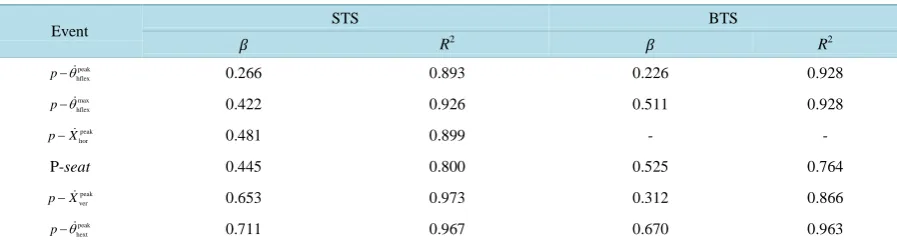
Linear regression analysis revealed that there were highly consistent temporal relationships between the timings of the candidate positions and movement time. Table 2 summarizes the slope and the determinant coefficient of the linear regression lines, showing that the timings of candidate positions are highly dependent on the move-
ment times (R2 =0.76 0.97− ).
3.5. Optimal Trajectory
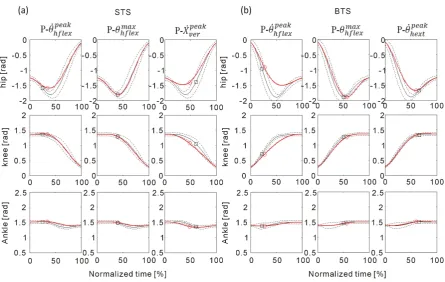
Given the candidate positions for via-points, six different optimal trajectories for STS and five optimal angular trajectories for BTS could be computed by the minimum angle-jerk model for each speed and seat-height condi-tion. Figure 2shows an example of angular profiles and computed optimal trajectories for the Low-fast speed condition for one subject. Selected original points as via-points are indicated by square markers and computed optimal via-points (and its timing) are plotted using circle markers. An optimal via-point computed for the hip joint at peak
ver
p−X in STS is clearly different from the original via-point in terms of timing. On the other hand,
computed optimal via-points at max hflex
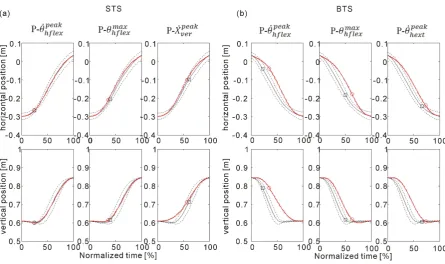
p−θ as well as the optimal trajectories for these via-points in both STS and BTS are relatively close to the measured ones. In addition to the angular trajectories, optimal trajectories of the COM are also computed for the via-points. Figure 3shows the time profiles of the COM displacement and the optimal trajectories computed by the minimum jerk model. The trajectory computed for peak
hflex p−θ (a via-point at peak velocity of the hip flexion) in STS is found to be close to the measured trajectory for both the horizontal and vertical directions. As for the BTS trajectories shown in Figure 3(b), on the contrary, the com-puted trajectories for all via-points are not compatible with the measured kinematics.
Figure 4shows the residuals of difference, or the degree of correspondence between the computed optimal trajectory and measured trajectory in terms of the angular (Redθ) and COM (RedX) trajectories for all condi-tions and subjects. On average, Redθ was small when the optimal trajectories were computed using the via-point at the maximum hip flexion for both STS and BTS. This trend was also true for the residuals evaluated on the COM kinematics (RedX) except for the BTS. Two-way ANOVA (height and via-points) was performed separately for each direction (STS, BTS) and type of residuals (Redθ, RedX). As for the Redθ in STS, the main effects of the height (p < 0.01), via-point (p < 0.01), and interactions (height * via-points, p < 0.01) were significant. Bonferroni post-hoc analysis found that Redθ at max
hflex
p−θ was significantly smaller than Redθs at peak
hflex
p−θ , P-seat, peak ver
p−X , and peak hext
p−θ . Main effects of height (p < 0.01), via-points (p < 0.01), and inte-
raction (height * via-points, p < 0.01) were also significant for RedX in STS. Differences among RedXs of
peak hflex
p−θ , and peak hor
Table 1. Relative timing of kinematic events (% of movement time).
Seat height Speed
kinematic events (order of appearance)
peak hflex
p−θ max
hflex
p−θ peak
hor
p−X P-seat peak
ver
p−X peak
hext
p−θ
STS
High fast 22.0 (2.5) 38.6 (3.4) 55.0 (6.4) 62.8 (5.8) 62.8 (3.3) 71.4 (4.4)
natural 29.0 (1.9) 45.4 (3.2) 49.8 (1.6) 52.6 (3.0) 68.0 (1.6) 73.2 (2.9)
Low fast 24.0 (0.7) 38.8 (1.3) 48.4 (1.8) 54.6 (3.7) 64.4 (3.2) 69.6 (2.6)
natural 25.8 (3.0) 40.8 (2.8) 44.4 (1.1) 48.8 (6.7) 63.6 (3.1) 69.2 (4.1)
peak hflex
p−θ peak
hor
p−X peak
ver
p−X P-seat max
hflex
p−θ peak
hext
p−θ
BTS
High
fast 21.4 (3.1) 27.4 (4.3) 31.8 (2.6) 38.8 (6.2) 49.8 (5.8) 65.4 (7.0)
natural 20.6 (4.5) 29.6(17.1) 30.8 (4.2) 41.0 (4.0) 50.0 (3.1) 68.6 (1.1)
Low
fast 23.2 (1.3) 33.4(10.8) 31.8 (2.6) 47.6 (3.1) 51.6 (2.5) 66.2 (3.3)
natural 22.4 (1.8) 34.8(19.0) 32.2 (2.2) 50.2 (3.8) 53.4 (3.1) 67.6 (4.2)
Table 2. Slope (β) and determinant coefficient (R2) of the regression lines of the relative timing of the kinematic event against the movement time.
Event STS BTS
𝛽𝛽 R2
𝛽𝛽 R2
peak hflex
p−θ 0.266 0.893 0.226 0.928
max hflex
p−θ 0.422 0.926 0.511 0.928
peak hor
p−X 0.481 0.899 - -
P-seat 0.445 0.800 0.525 0.764
peak ver
p−X 0.653 0.973 0.312 0.866
peak hext
p−θ 0.711 0.967 0.670 0.963
of peak
ver
p−X and peak hext
p−θ . As for the Redθ in BTS, the main effects of the height (p < 0.01), via- point (p < 0.01), and interactions (height * via-points, p < 0.01) were significant. Differences among the Redθs of P-seat, max
hflex
p−θ , and peak hext
p−θ were not significant, but the residuals were significantly smaller than
the residuals at peak hflex
p−θ and peak ver
p−X . The main effects of height was significant (p < 0.01) for RedX in BTS, but post-hoc analysis failed to show significant differences among residuals at the via-points. These results indicate that the optimal angular trajectory computed using the via-points at around the maximum hip flexion fit the measured angular kinematics well.
4. Discussion
The results of the present study showed that the residual of the angular trajectory (Redθ) was smallest when the trajectory was computed using the via-point around the hip flexion posture in the early period of the STS movement, and in the latter period of the BTS movement. The similarity of angular trajectories computed with the via-points will be discussed in terms of the functional significance of the via-point and temporal optimality of the points.
[image:6.595.89.538.311.433.2]Figure 2. Angular profiles during STS and BTS.Typical angular profiles of hip, knee, and ankle joints in the Low-fast speed condition from one subject during STS (A) and BTS (B). Abscissa: Normalized movement time. Ordinate: Angle in radians. Bold line: Computed optimal trajectory. Thin line: Measured trajectory averaged over 10 trials. Dotted line: Standard
deviation of measured trajectory. Square: Via-point selected. Circle: Computed optimal timing of via-point. p−θhextpeak:
Position at peak velocity of the hip flexion, p−θhflexmax: Position at maximum angle of the hip, p−Xverpeak: Position at peak vertical velocity of the COM, p−θhextpeak: Position at peak velocity of the hip extension.
planned to pass through the dynamic hip flexion posture at around the seat-off for STS.
It should be noted that the optimal time to pass through the via-posture, i.e., optimal via-time, is determined in the optimization procedure. Matsui et al. [25] proposed an optimal control model that reproduces movements of humans when rising from a chair. Their model switches its dynamics equation at the time when the body moves away from the chair, which is close to the instance of maximum hip flexion. The present study supports the idea that the coordinated STS movement would be generated with a set of temporal information of the via-posture before the seat-off.
The via-posture hypothesis also accounts for the temporal consistency of the BTS kinematics. The residuals on the COM trajectory (RedX) were relatively larger than the residuals on the angular trajectory (Redθ) for BTS. Therefore, the optimality of the COM trajectory could not be explained by the minimum jerk trajectories com-puted with the via-point at any candidate positions during the movement. As opposed to the COM control notion of the rising movement [26]-[28], the present study suggests that the angular movement of the joints is con-trolled during the BTS movement as well as the STS movement. In fact, it is shown that both movements have a common critical posture, i.e., the via-posture around the maximum flexion angle of the hip joint, corresponding to the via-point of the optimal trajectory.
Figure 3. Profiles of COM trajectory during STS and BTS.Typical COM trajectory in the Low-fast speed condition from the same subject presented inFigure 2. A: STS. B: BTS. Abscissa: Normalized movement time. Ordinate: Position in meters. Bold line: Computed optimal trajectory. Thin line: Measured trajectory averaged over 10 trials. Dotted line: Standard
deviation of measured trajectory. Square: Via-point selected. Circle: Computed optimal timing of via-point. p−θhextpeak:
Position at peak velocity of the hip flexion, p−θhflexmax: Position at maximum angle of the hip,
peak ver
p−X : Position at peak
vertical velocity of the COM, p−θhextpeak: Position at peak velocity of the hip extension.
Figure 4. Residual of difference between the optimal and measured trajectories. Mean and standard deviation of the residuals of the angular (Redθ) and COM (RedX) trajectories averaged over five subjects. A: STS, B: BTS. Abscissa: Label
of the via-points aligned in order of appearance. Ordinate: Radians for upper panel, meters for lower panel. p−θhextpeak:
Position at peak velocity of the hip flexion, p−θhflexmax: Position at maximum angle of the hip,
peak hor
p−X : Position at peak
horizontal velocity of the COM, P-seat: Position at seat-off for STS or seat-contact for BTS, p−Xverpeak: Position at peak
[image:8.595.153.479.440.626.2]5. Conclusion
The present study showed that coordinated angular trajectories of the joints during STS and BTS movements were well reproduced by the minimum angle-jerk criterion with via-point, namely the via-posture around the hip flexion in the early period of the STS movement, and in the latter period of the BTS movement. The result indi-cates that the pattern of STS and BTS movements is organized in terms of smoothness of the joint rotations with a via-posture. The present study revealed the significance of temporal invariance found in the pattern of STS and BTS by the posture-based optimization model.
Acknowledgements
The work was supported by a grant from Showa University. The author is grateful to Dr. Satoshi Nishizawa for helpful comments and discussions on the original manuscript.
References
[1] Bernstein, N.A. (1967) The Co-Ordination and Regulation of Movements. Pergamon Press, New York.
[2] Flash, T. and Hogan, N. (1985) The Coordination of Arm Movements: An Experimentally Confirmed Mathematical Model. Journal of Neuroscience, 5, 1688-1703.
[3] Uno, Y., Kawato, M. and Suzuki, R. (1989) Formation and Control of Optimal Trajectory in Human Multijoint Arm Movement. Biological Cybernetics, 61, 89-101. http://dx.doi.org/10.1007/BF00204593
[4] Nakano, E., Imamizu, H., Osu, R., Uno, Y., Gimi, H., Yoshioka, T. and Kawato, M. (1999) Quantitative Examinations of Internal Representations for Arm Trajectory Planning: Minimum Commanded Torque Change Model. The Journal of Neurophysiology, 81, 2140-2155.
[5] Okadome, T. and Honda, M. (1999) Kinematic Construction of the Trajectory of Sequential Arm Movements. Bio-logical Cybernetics, 80, 157-169. http://dx.doi.org/10.1007/s004220050514
[6] Wada, Y., Kaneko, Y., Nakano, E., Osu, R. and Kawato, M. (2001) Quantitative Examinations for Multi Joint Arm Trajectory Planning—Using a Robust Calculation Algorithm of the Minimum Commanded Torque Change Trajectory.
Neural Networks, 14, 381-393. http://dx.doi.org/10.1016/S0893-6080(01)00026-0
[7] Friedman, J. and Flash, T. (2009) Trajectory of the Index Finger during Grasping. Experimental Brain Research, 196, 497-509. http://dx.doi.org/10.1007/s00221-009-1878-2
[8] Pham, Q.C., Hicheur, H., Arechavaleta, G., Laumond, J.P. and Berthoz, A. (2007) The Formation of Trajectories dur-ing Goal-Oriented Locomotion in Humans. II. A Maximum Smoothness Model. European Journal of Neuroscience, 26, 2391-2403. http://dx.doi.org/10.1111/j.1460-9568.2007.05835.x
[9] Xiang, Y., Arora, J.S. and Abdel-Malek, K. (2011) Optimization-Based Prediction of Asymmetric Human Gait. Jour-nal of Biomechanics, 44, 683-693. http://dx.doi.org/10.1016/j.jbiomech.2010.10.045
[10] Kuželički, J., Žefran, M., Burger, H. and Bajd, T. (2005) Synthesis of Standing-Up Trajectories Using Dynamic Opti-mization. Gait & Posture, 21, 1-11. http://dx.doi.org/10.1016/j.gaitpost.2003.11.004
[11] Yamasaki, H.R., Kambara, H. and Koike, Y. (2011) Dynamic Optimization of the Sit-to-Stand Movement. Journal of Applied Biomechanics, 27, 306-313.
[12] Sadeghi, M., Andani, M.E., Bahrami, F. and Parnianpour, M. (2013) Trajectory of Human Movement during Sit to Stand: A New Modeling Approach Based on Movement Decomposition and Multi-Phase Cost Function. Experimental Brain Research, 229, 221-234. http://dx.doi.org/10.1007/s00221-013-3606-1
[13] Yamasaki, T., Gotoh, K. and Xin, X. (2010) Optimality of a Kip Performance on the High Bar: An Example of Skilled Goal-Directed Whole-Body Movement. Human Movement Science, 29, 464-482.
http://dx.doi.org/10.1016/j.humov.2009.11.007
[14] Pai, Y.C. and Rogers, M.W. (1990) Control of Body Mass Transfer as a Function of Speed of Ascent in Sit-to-Stand.
Medicine and Science in Sports and Exercise, 22, 378-384. http://dx.doi.org/10.1249/00005768-199006000-00015
[15] Dubost, V., Beauchet, O., Manckoundia, P., Herrmann, F. and Mourey, F. (2005) Decreased Trunk Angular Displace-ment during Sitting down: An Early Feature of Aging. Physical Therapy, 85, 404-412.
[16] Wada, Y. and Kawato, M. (2004) A Via-Point Time Optimization Algorithm for Complex Sequential Trajectory For-mation. Neural Networks, 17, 353-364. http://dx.doi.org/10.1016/j.neunet.2003.11.009
[17] Winter, D.A. (2009) Biomechanics and Motor Control of Human Movement. Wiley, Hoboken.
http://dx.doi.org/10.1002/9780470549148
Measurements. Medical and Biological Engineering and Computing, 22, 597-602.
http://dx.doi.org/10.1007/BF02443876
[19] Kralj, A., Jaeger, R.J. and Munih, M. (1990) Analysis of Standing up and Sitting down in Humans: Definitions and Normative Data Presentation. Journal of Biomechanics, 23, 1123-1138.
http://dx.doi.org/10.1016/0021-9290(90)90005-N
[20] Riley, P.O., Schenkman, M.L., Mann, R.W. and Hodge, W.A. (1991) Mechanics of a Constrained Chair-Rise. Journal of Biomechanics, 24, 77-85. http://dx.doi.org/10.1016/0021-9290(91)90328-K
[21] Kerr, K.M., White, J.A., Barr, D.A. and Mollan, R.A.B. (1994) Standardization and Definitions of the Sit-Stand-Sit Movement Cycle. Gait & Posture, 2, 182-190. http://dx.doi.org/10.1016/0966-6362(94)90006-X
[22] Alexander, N.B., Schultz, A.B. and Warwick, D.N. (1991) Rising from a Chair: Effects of Age and Functional Ability on Performance Biomechanics. Journal of Gerontology, 46, M91-M98. http://dx.doi.org/10.1093/geronj/46.3.M91
[23] Schultz, A.B., Alexander, N.B. and Ashton-Miller, J.A. (1992) Biomechanical Analyses of Rising from a Chair. Jour-nal of Biomechanics, 25, 1383-1391. http://dx.doi.org/10.1016/0021-9290(92)90052-3
[24] Etnyre, B. and Thomas, D.Q. (2007) Event Standardization of Sit-to-Stand Movements. Physical Therapy, 87, 1651- 1666. http://dx.doi.org/10.2522/ptj.20060378
[25] Matsui, T. (2010) Optimal Control Model for Reproducing Human Rising Movements from Chair and Its Effectiveness Verification. 2010 IEEE International Conference on Robotics and Biomimetics (ROBIO), Tianjin, 944-949.
http://dx.doi.org/10.1109/ROBIO.2010.5723453
[26] Scholz, J.P. and Schöner, G. (1999) The Uncontrolled Manifold Concept: Identifying Control Variables for a Func-tional Task. Experimental Brain Research, 126, 289-306. http://dx.doi.org/10.1007/s002210050738
[27] Reisman, D.S., Scholz, J.P. and Schöner, G. (2002) Coordination Underlying the Control of Whole Body Momentum during Sit-to-Stand. Gait & Posture, 15, 45-55. http://dx.doi.org/10.1016/S0966-6362(01)00158-8