© 2015, IRJET ISO 9001:2008 Certified Journal
Page 1142
NON LINEAR MODELING FOR PREDICTING SOAKED CBR OF SOIL
1
Priyank Patel,
2Dr Suneet Kaur
M. Tech. Student, Department of Civil Engineering, M.A.N.I.T Bhopal, (M.P) India.
Associate Professor, Department of Civil Engineering, M.A.N.I.T Bhopal, (M.P) India.
Abstract
:
CBR value is a crucial parameter for the design of flexible pavements. In laboratory CBR test is performed in accordance with IS 2720 part 16 on soilsamples acquired from site.
.
California Bearing Ratio(CBR) is an indicator of sub grade soil strength. In the design of flexible pavements soaked value of this parameter is often used; the evaluation of which through
laboratory test is time consuming and laborious.Any delay
in the construction leads to escalation of project cost.. In any road project quality control is very important during and after construction to check the quality of the prepared sub grade. This can be done by comparing the in-situ value of CBR of constructed sub grade and design value of CBR. But practically it is impossible to put enormous time into this aspect ,hence from time and cost point of view it is very much essential to correlate CBR value of soils with its engineering parameters. Some correlations have been presented in this field in recent period but utility of these methods needs considerable verifications. In this research an attempt has been made to check the efficacy of the suggested correlations and develop a more generalized correlation for all types of soil.Many researcher in the past have developed several empirical relations and equations other such equations when used give large deviation in estimated and actual value of the CBR perhaps either such relations are developed using small data base or not
matching with the soils types and or test conditions .Hence in this research an attempt have been made to perform non linear multivariate regression analysis on the basis of which an empirical relationship have been developed to give better results. Hence it would be worthwhile if the soaked CBR can be determined indirectly from correlation with simple properties of soil like plasticity characteristics and compaction characteristics. Non linear regression analysis was performed on the large number of soil samples collected from different road projects of Madhya Pradesh (India). The basic soil properties, namely liquid limit, plastic limit, fine content, optimum moisture content and maximum dry density correlate with the soaked value of the CBR. The developed correlation equation is validated from a test data obtained by performing laboratory test in the geotechnical laboratory of MANIT Bhopal and is found reasonably accurate.
1.
INTRODUCTION
© 2015, IRJET ISO 9001:2008 Certified Journal
Page 1143
CBR value is a crucial parameter for the design of flexiblepavements. In laboratory CBR test is performed in accordance with IS 2720 part 16 on soil samples acquired from site. . The conventional soaked CBR testing method is expensive and time consuming. This would result in the delay of the project since in most of the situations ,materials for earthwork construction come from variable sources. Any delay in the construction leads to escalation of project cost.. In any road project quality control is very important during and after construction to check the quality of the prepared sub grade. This can be done by comparing the in-situ value of CBR of constructed sub grade and design value of CBR. But practically it is impossible to put enormous time into this aspect ,hence from time and cost point of view it is very much essential to correlate CBR value of soils with its engineering parameters. Some correlations have been presented in this field in recent period but utility of these methods needs considerable verifications. In this research an attempt has been made to check the efficacy of the suggested correlations and develop a more generalized correlation for all types of soil.Many researcher in the past have developed several empirical relations and equations other such equations when used give large deviation in estimated and actual value of the CBR perhaps either such relations are developed using small data base or not matching with the soils types and or test conditions .Hence in this research an attempt have been made to perform non linear multivariate regression analysis on the basis of which an empirical relationship have been developed to give better results. In the present study the soaked CBR is correlated with simple properties of fine grained soil like liquid limit, plastic limit, optimum moisture content, maximum dry density ( by modified Proctor test) and %
fine content in the soil (i.e. passing 75 micron sieve size particles) by non linear regression analysis. In order to develop the correlation, the test data is collected from various government department of Madhya Pradesh. The sample covers silts and clays of all types, i.e. low, medium and high compressible soils.
2.
NON LINEAR REGRESSION ANALYSIS
Regression analysis is a statistical technique that is very useful for developing relationships between two or more variables. This method uses the line or curve which provides the best fit through a set of data points. This basic approach is applicable in situations ranging from single linear regression to more complex nonlinear multiple regressions. It is not always possible to get a linear relationship between dependent and the independent variables therefore in linear analysis first step to be followed is to plot a graph between these variable . Based on the data collected from the various department ,model have been developed by resorting to non linear analysis . In this study overall ninety sample data were used for developing the model The final expression after performing regression analysis is as follows:
Y=2572.64*
X1=Fines(%)
X2=Liquid Limit(%)
X3= Plastic Limit (%)
X4=Optimum moisture content(%)
© 2015, IRJET ISO 9001:2008 Certified Journal
Page 1144
The statistical performance indicators namely regressioncoefficient R2 and standard error Se, for above equation is
found to be 0.94 and 0.038.Hence, the developed correlation can be regarded as fairly good for the prediction of soaked CBR of fine grained soils .
3.
VALIDITY OF THE EQUATION DEVELOPED
The validation of the developed equation has been done from the data obtained by performing laboratory test in the geotechnical laboratory of MANIT Bhopal.The test obtained value of CBR (CBRs report) is compared with the predicted value (CBRs predicted) using developed equation in the present work .4.
RESULT AND ANALYSIS
In the present investigation a non linear multivariate model have been developed from the database collected. Developed model is validated by 18 test sample .The database for validation is obtained from tests performed in the geotechnical laboratory of MANIT Bhopal. Model is developed by analysis of data obtained using multivariate
non linear regression analysis technique.The comparison
is done by plotting the graph between the actual CBR and the predicted CBR .
4.2 MODEL VALIDATION DATA SET
The model is validated using the database obtained by conducting test in the geotechnical laboratory MANIT;
BHOPAL .The R2 Value of the validated data set is
0.944.This R2 value shows that it is a good fit model. Fig 4.9
shows the absolute percentage error between Actual CBR
and predicted CBR .It varied from 1 %to 28 %.
Chart 1. Absolute Percentage Error-sample
(1-18)-Validation Data Set
Chart 1 shows the graph between CBR observed and CBR predicted for model validation data base.
Chart 2. CBR Observed and CBR Predicted Value – sample
number(1-18)-Validation Data Set
© 2015, IRJET ISO 9001:2008 Certified Journal
Page 1145
Chart 3.CBR Observed and CBR Predicted Value – sample
number(1-18)-Validation Data Set
5.0 CONCLUSIONS
The research was conducted to find a correlation between CBR value and soil index properties within the scope of the study. Accordingly, the required data base were obtained from different government department of Madhya Pradesh. Using the obtained ninety test results a multivariate non linear regressions model was developed and a relationship was established that predicted CBR value in terms of % fines, LL, PL, MDD and OMC.
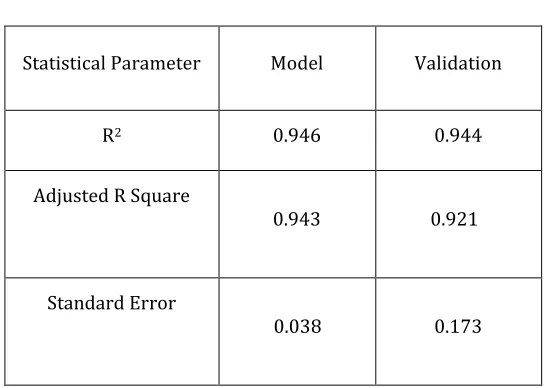
[image:4.612.300.572.152.346.2]The suitability of the developed correlation is evaluated by performing validation of the developed model. The results are summarized in Table 5.1.
Table 5.1 Statistical Parameter Comparison
Statistical Parameter Model Validation
R2 0.946 0.944
Adjusted R Square
0.943 0.921
Standard Error
0.038 0.173
The result indicates that there is a good correlation between the observed soaked CBR value and predicted soaked CBR value. Hence for preliminary design purpose the developed correlation can be used to predict CBR value with good accuracy
REFERENCES
1.
Agarwal, K.B. and Ghanekar, K.D. (1970).
“Prediction of CBR from Plasticity
Characteristics of Soil”. Proceeding of 2nd
South-east Asian Conference on Soil.
2.
AASHTO T180 -10 “Moisture-Density
Relations of Soils Using a 4.54 kg Rammer
and a 457 mm Drop”.
© 2015, IRJET ISO 9001:2008 Certified Journal
Page 1146
4.
Black, W.P.M. (1962). “A Method of
Estimating the CBR of Cohesive Soils from
Plasticity Data”. Geotechnique Vol.12, 271 -
272.
5.
Carter, M. and Bentley, S. P. (1991).
“Correlations of Soil Properties.” Pentech
Press, London.
6.
Danistan, J. and Vipulanandan, C. (2009).
“Relationship between CBR values
(un-soaked) and undrained shear strength of
artificial CH soils”.
7.
De Graft - Johnson, J.W.S. and Bhatia, H.S.
(1969). “The Engineering Characteristics of
the Lateritic Gravels of Ghana”. Proceedings
of 7
thInternational Conference on Soil
Mechanics and Foundation Engineering,
Mexico. August 28-29. Bangkok: Asian
Institute of Technology. Vol.2, 13 – 43
8.
Farrshad, A. (2003). “Potential Applications
of dynamic and Static Cone Penetrometer in
MDOT Pavement Design and application”.
Final
Report,
Department
of
Civil
Engineering Jackson State University,
Corporate Department of Transportation
and US Department of Transportation
Federal
Highway
Administration,
Mississippi
9.
Gregory, G.H. and Cross, S.A. (2007).
“Correlation of CBR with Shear Strength
Parameters”.
Proceedings
of
9th
International Conference on Low Volume
Roads, Austin, Texas, June 24-27, 1-14.
10. Highway Agency (1994). “Design Manual
for Roads and Bridges”. In: Volume 7:
Section 2 Part 2 HD 25/94. London:
Stationery Ltd.
11. IS : 2720 (Part VII-1980 Fifth Reprint
AUGUST
1997
(Reaffirmed
2011))
“Determination of Water Content-Dry
Density Relation Using Light
Compaction”. BIS New Delhi.
12. IS: 2720 (Part-IV)-1985. “Indian Standard
for Grain Size Analysis”. BIS New Delhi.
13. IS: 2720 (Part-V)-1987. “Indian Standard
for Determination of Liquid Limit and
Plastic Limit”. BIS New Delhi.
14. IS: 2720 (Part-VIII)-1983. “Indian Standard
for Determination of Water Content-dry
density relation using heavy Compaction”.
BIS New Delhi.
15. IS: 2720 (Part-XVI)-1974:”Indian Standard
for Laboratory Determination of CBR”. BIS
New Delhi.
16. Kin, M.W. (2006). “California Bearing Ratio
Correlation with Soil Index Properties”.
Master of Engineering Thesis, University of
Technology, Malaysia.
© 2015, IRJET ISO 9001:2008 Certified Journal