© 2016, IRJET ISO 9001:2008 Certified Journal Page 574
MODELLING AND STRUCTURAL ANALYSIS OF VEHICLE CHASSIS FRAME
MADE OF POLYMERIC COMPOSITE MATERIAL
Shaik Neelophar Begum
1, S.P.Bhanu Murthy
21Department of Mechanical Engineering, VEMU Institute of Technology, Chittoor, Andhra Pradesh, India 2Department of Mechanical Engineering, VEMU Institute of Technology, Chittoor, Andhra Pradesh, India
Email: [email protected]
---***---Abstract -
The chassis frame forms the backbone of avehicle; its principle function is to safely carry the maximum load for all designed operating conditions. This paper describes design and analysis of vehicle chassis. Weight reduction is now the main issue in automobile industries. In the present work, the dimensions of an existing vehicle chassis frame of a MAHINDRA BOLERO vehicle is taken for modeling and analysis of a vehicle chassis frame with three different composite materials namely, Carbon/Epoxy, E-glass/Epoxy and S-glass /Epoxy subjected to the same pressure as that of a steel chassis frame. The design constraints were stresses and deflections. The three different composite vehicle chassis frames have been modeled by considering three different cross-sections. Namely C, I and Box type cross sections. For validation the design is done by applying the vertical loads acting on the horizontal different cross sections. Software’s used in this work are PRO – E for modeling, ANSYS for analysis.
Key Words: Chassis, Mahindra Bolero, Carbon/Epoxy, E Glass/Epoxy, S Glass Epoxy, PRO-E, ANSYS
1.INTRODUCTION
Chassis is a French term and was initially used to denote the frame parts or Basic Structure of the vehicle. A vehicle without body is called Chassis. The components of the vehicle like Power plant, Transmission System consisting of clutch gearbox, propeller shaft and rear axle, Wheels, Suspension, and Controlling Systems like Braking, Steering etc., and electrical system parts are also mounted on the Chassis frame. So it is also called as Carrying Unit. Chassis of Automotive helps to keep an automobile rigid, stiff and unbending. Automobile chassis ensures less noise, vibrations and harshness throughout the automobile. Along with the strength, an important consideration in the chassis design is to increase the stiffness (bending and torsion) characteristics. In the conventional design procedure the design is based on the strength and
emphasis is then given to increase the stiffness of the chassis, with very little consideration to the weight of the chassis. One such design procedure involves the adding of structural cross member to the existing chassis to increase its torsion stiffness. As a result weight of the chassis increases. This increase in weight reduces the fuel efficiency and increases the cost due to extra material. The design of the Chassis with adequate stiffness and strength is necessary.
All most all components weight is acting on the chassis frame, thus chassis subjected to static, dynamic and cyclic loading condition on the road. Static stress analysis is important to point out critical (highest stress) regions in the frame. These critical regions may cause fatigue failures. In this study, ladder type chassis frame is analysed. The Chassis consists of side members attached with a series of cross members to complete the ladder like structure, thus its name. The FEM is a common tool for stress analysis. FEM with required boundary conditions was used to determine critical regions in the chassis frame. Static structural analysis is performed to identify critical regions and based on the results obtained design modification has been done.
There are three types of frames:
a)Conventional control chassis
© 2016, IRJET ISO 9001:2008 Certified Journal Page 575 frame is made of channel section or tubular section of
box section.
b) Semi-forward control chassis
In which engine is mounted that half of it is in the driver`s cabin whereas the other half is in front, outside the driver`s cabin. In this case the rubber mountings used in conventional frame between frame and suspension are replaced by more stiff mountings. Because of this some of the vehicle load is shared by the frame also. This type of frame is heavier in construction.
c) Full-forward control chassis
In which engine is mounted completely insides the driver`s cabin. Obviously maximum utilization of space is achieved in this type of arrangement.
1.1 Types Of Automobile Chassis Frame
a) Conventional Frame
It is non-load carrying frame. The loads of the vehicle are transferred to the suspensions by the frame. This suspension in the main skeleton of the vehicle is supported on the axles through springs. The body is made of flexible material like wood and isolated frame by inserting rubber mountings in between. The frame is made of channel section or tubular section of box section.
b) Ladder Chassis
Ladder chassis is one of the oldest forms of automotive chassis these are still used in most of the SUVs today. It is clear from its name that ladder chassis resembles a shape of a ladder having two longitudinal rails inter linked by lateral and cross braces.
1.2 Types of ladder frame
1. C cross section type of ladder chassis frame 2. I cross-section type of ladder chassis frame. 3. Rectangular Box cross section type of ladder chassis frame.
4. Rectangular Box (Intermediate) cross section type. 2. LITERATURE REVIEW
MohdAzizi Muhammad Nor et al. (2012)this paper aims to model simulate and perform the stress analysis of an actual low loader structure consisting of I-beams design application designed in-house by Sumai Engineering Sdn. Bhd, (SESB). The material of structure is Low Alloy Steel a 710 C (Class 3) with 552 MPa of yield strength and 620 MPa of tensile strength. Finite element modeling (FEM), simulations and analysis are performed using modeling software i.e. Pro E .Firstly, a 3-D model of low loader based on design from SESB is created by using Pro E. Stress and displacement contour are later constructed and the maximum deflection and stress are determined by performing stress analysis. Computed results are then compared to analytical calculation, where it is found that the location of maximum deflection agrees well with theoretical approximation but varies on the magnitude aspect. Safety factor for the low loader structure has also been calculated. In the end, the current study is important for further improvement of the current low loader chassis design.
Swami K.I. et al. (Jan. 2014)The Automotive chassis is considered as the backbone of the vehicle. An important consideration in chassis design is to have adequate bending stiffness for better handling characteristics. So, strength and stiffness are two important criteria for the design of the chassis. This paper related with work performed towards the static structural analysis of the truck chassis. Structural systems like the chassis can be easily analyzed using the finite element techniques. So a proper finite element model of the chassis is to be developed. The chassis is modeled in ANSYS. Analysis is done using the same software.
© 2016, IRJET ISO 9001:2008 Certified Journal Page 576 3.COMPOSITE MATERIALS
A composite material is usually made up of at least two materials out of which one is the binding material, also called matrix and the other is the reinforcement material. Composites are materials that comprise strong load carrying material (known as reinforcement) imbedded in weaker material (known as matrix) with physically separable phases. Reinforcement provides strength and rigidity, helping to support structural load. The matrix or binder maintains the position and orientation of the reinforcement. Significantly, constituents of the composites retain their individual, physical and chemical properties yet together they produce a combination of qualities which individual constituents would be incapable of producing alone. The reinforcement may be platelets, particles or fibers and are usually added to improve mechanical properties such as stiffness, strength and toughness of the matrix material.
A) Material properties
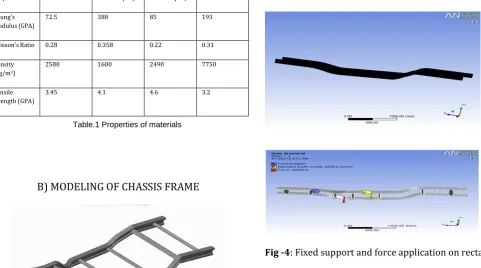
Properties E-Glass Carbon Epoxy S-Glass Epoxy Stainless steel
Young's modulus (GPA)
72.5 388 85 193
Poisson's Ratio 0.28 0.358 0.22 0.31
Density (kg/m3)
2580 1600 2490 7750
Tensile strength (GPA)
3.45 4.1 4.6 3.2
Table.1 Properties of materials
B)MODELING OF CHASSIS FRAME
Fig-1: I-Section Chassis frame
Fig-2: Box chassis frame
Fig-3: C-section Chassis frame
4.STRUCTURAL ANALYSIS OF RECTANGULAR
CHASSISFRAME:
[image:3.595.43.525.436.704.2]
Fig -4: Fixed support and force application on rectangular
© 2016, IRJET ISO 9001:2008 Certified Journal Page 577 Fig -5: Total deformation for Rectangular section chassis
frame
Carbon
Fig -6: Equivalent stress for Rectangular section chassis
frame- Carbon epoxy
[image:4.595.37.268.279.376.2]
Fig -7: Total deformation for Rectangular section chassis
frame-E-Glass fiber
Fig -8: Equivalent stress for Rectangular section chassis frame-E-Glass
[image:4.595.309.567.426.557.2]fiber
Fig -9: Total deformation for Rectangular section chassis frame-S-Glass fiber
[image:4.595.35.259.446.535.2]
Fig -10: Equivalent stress for Rectangular section chassis frame-S-Glass fiber
Fig -11: Total deformation for Rectangular section chassis frame-Stainless steel-Glass fiber
Fig -12: equivalent stress for rectangular-section chassis
[image:4.595.308.535.596.726.2] [image:4.595.35.275.612.724.2]© 2016, IRJET ISO 9001:2008 Certified Journal Page 578
[image:5.595.36.254.154.280.2]
5. structural analysis of c-section chassis frame
[image:5.595.325.541.291.413.2]Fig -13: mesh gearation of c-section chaisiss frame
Fig -14: Fixed support and force application on C- section
chassis frame
Fig -15: total deformation of c-section chassis
[image:5.595.43.281.330.471.2]frame-carbon epoxy
Fig -16: equivalent stress for c-section chassis frame
carbon epoxy
Fig -17: Total deformation for C- section chassis
frame-E-Glass fiber
Fig -18: Equivalent stress for C section chassis
[image:5.595.323.546.477.613.2] [image:5.595.49.275.538.660.2]© 2016, IRJET ISO 9001:2008 Certified Journal Page 579
Fig -19: total deformation of c-section chassis frame
[image:6.595.42.280.304.428.2]s-glass fiber
Fig -20: Equivalent stress for C section chassis
frame-S-Glass fiber
Fig -21: total deformation of c-section chassis frame
stainless steel glass fiber
[image:6.595.325.541.336.453.2]
Fig -22: equivalent stress of c-section chassis frame
stainless steel glass fiber
6.structural analysis of I-section chassis frame
[image:6.595.36.288.492.619.2]
Fig -23: mesh genaration on I-section chasiss
frame
[image:6.595.318.548.511.627.2]
Fig -24: Fixed support and force application on I- section
© 2016, IRJET ISO 9001:2008 Certified Journal Page 580
[image:7.595.270.552.55.229.2]
Fig -25: Total deformation for I- section chassis
frame-Carbon epoxy
[image:7.595.56.267.299.425.2]
Fig -26: equivalent stress for I-section chassis frame
carbon epoxy
Fig -27: Total deformation for I- section chassis
[image:7.595.310.556.304.423.2]frame-E-Glass fiber
Fig -28: equivalent Stress for I- section chassis
frame-E-Glass fiber
Fig -29: Total deformation for I- section chassis frame
S-Glass fiber
Fig -30: equivalent stress for I-section chassis frame
[image:7.595.45.281.499.607.2] [image:7.595.326.544.503.623.2]© 2016, IRJET ISO 9001:2008 Certified Journal Page 581 Fig -31: Total deformation for I- section chassis frame
Fig -32: Equivalent Stress for I- section chassis frame
7.ANANLYASIS OF RESULT
Material Stainless steel
Shape Total
deformation(mm)
Equivalent stress(Mpa)
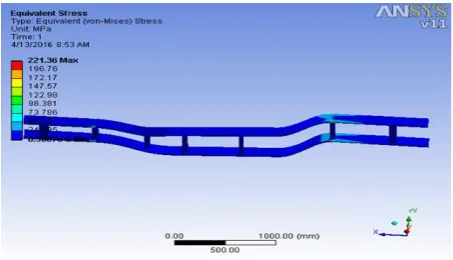
Box 1.6783 221.36
C-Section 2.8311 251.29
[image:8.595.48.274.259.369.2]I-section 0.68203 94.987
Table -2: analysis result for stainless steel
Material Carbon epoxy
Shape Total
deformation(mm)
Equivalent stress(Mpa)
Box 0.81695 208.67
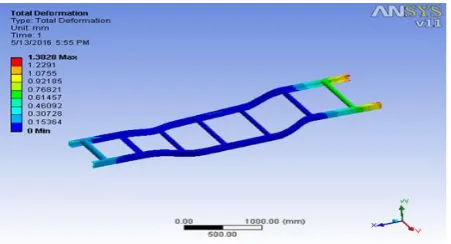
C-section 1.3828 235.27
[image:8.595.30.202.447.550.2]I-section 0.32022 89.093
Table -3: analysis result for carbon epoxy
Material E-Glass
Shape Total
deformation(mm)
Equivalent stress(Mpa)
Box 4.3834 222.74
C-section 7.4151 252.27
I-section 1.7315 90.49
Table -4: analysis result for E-glass
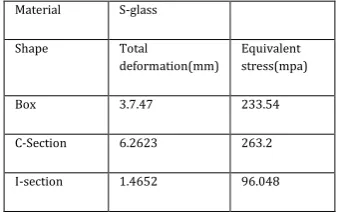
Material S-glass
Shape Total
deformation(mm)
Equivalent stress(mpa)
Box 3.7.47 233.54
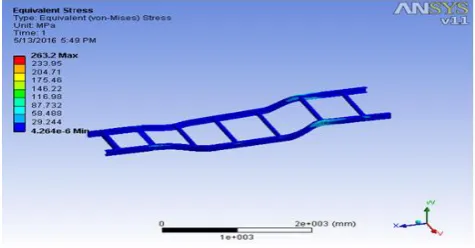
C-Section 6.2623 263.2
I-section 1.4652 96.048
Table -5: analysis result for S-glass
8.CONCLUSION
[1] From the structural Analysis it is concluded that Equivalent stresses and total deformations are more in C type Cross section and less in I type cross section where as Box type cross section offers moderate total deformation and equivalent stresses.
[2] Considering polymeric composites Carbon/Epoxy, E-glass/Epoxy and S-glass /Epoxy for chassis material, based on the results it was inferred that carbon/epoxy polymeric composite vehicle chassis with I-SECTION has superior strength and stiffness and lesser in weight compared to steel and other polymeric composite materials mentioned.
[image:8.595.30.202.586.691.2]© 2016, IRJET ISO 9001:2008 Certified Journal Page 582 9.REFERENCES
1. Dave Anderson and Grey Schede, “Development of a Multi- Body Dynamic Modal of Tractor – Semi trailer for Ride Quality Prediction”, International Truck and Engine Corp. 2001.
2. I.M. Ibrahim, D.A.Crolla and D.C. Barton, “Effect of Frame Flexibility on the Ride Vibration of Trucks”, Department of Mechanical Engineering, University of Leeds LS2 9JT, U.K. August 1994.
3. Pomulo Rossi Pinto Filho, “Automotive Frame Optimization”, Universidade Federal de Uberlandia. November 2003.
4. Zaman @ Bujang, Izzudin and Abd. Rahman, Roslan (2006), “Application of Dynamic Correlation Technique and Model Updating on Truck Chassis”, 1st Regional Conference on Vehicle Engineering & Technology, July 2006.
[5]Lonny L. Thomson, Jon K. Lampert and E. Harry Law, “Design of a Twist Fixture to measure the Torsional Stiffness of a Winston Cup Chassis”, Department of Mechanical Engineering, Clemson Univ.1998.